1997 CHEVROLET BLAZER lock
[x] Cancel search: lockPage 170 of 402
Downloaded from www.Manualslib.com manuals search engine Remember: Anti-lock doesn’t change the time you need
to get your foot up to the brake pedal or always decrease
stopping distance.
If you get too close to the vehicle in
front of you‘ you won’t have time to apply your brakes
if that vehicle suddenly slows or stops. Always leave
enough room up ahead to stop, even though you have
anti-lock brakes.
Using Anti-Lock
Don’t pump the brakes. Just hold the brake pedal down
and let anti-lock work for you. You may feel the brakes
vibrate, or you may notice some noise, but this is
normal. On vehicles
with four-wheel drive, your
anti-lock brakes work at all times
-- whether you are in
two-wheel drive or four-wheel drive.
Braking in Emergencies
With anti-lock, you can steer and brake at the same
time.
In many emergencies, steering can help you more
than even the very best braking.
Steering
Power Steering
If you lose power steering assist because the engine
stops
or the system is not functioning, you can steer but
it will take much more effort.
Steering Tips
Driving on Curves
It’s important to take curves at a reasonable speed.
A lot of the “driver lost control” accidents mentioned on
the news happen on curves. Here’s why:
Experienced driver or beginner, each
of us is subject to
the same laws
of physics when driving on curves. The
traction of the tires against the road surface makes
it
possible for the vehicle to change its path when you turn
the
front wheels. If there’s no traction, inertia will keep
the vehicle going
in the same direction. If you’ve ever
tried to steer
a vehicle on wet ice, you‘ll understand this.
The traction you can get in a curve depends on the
condition
of your tires and the road surface, the angle at
which the curve
is banked, and your speed. While you’re
in a curve, speed is the one factor you can control.
4-9
Page 172 of 402
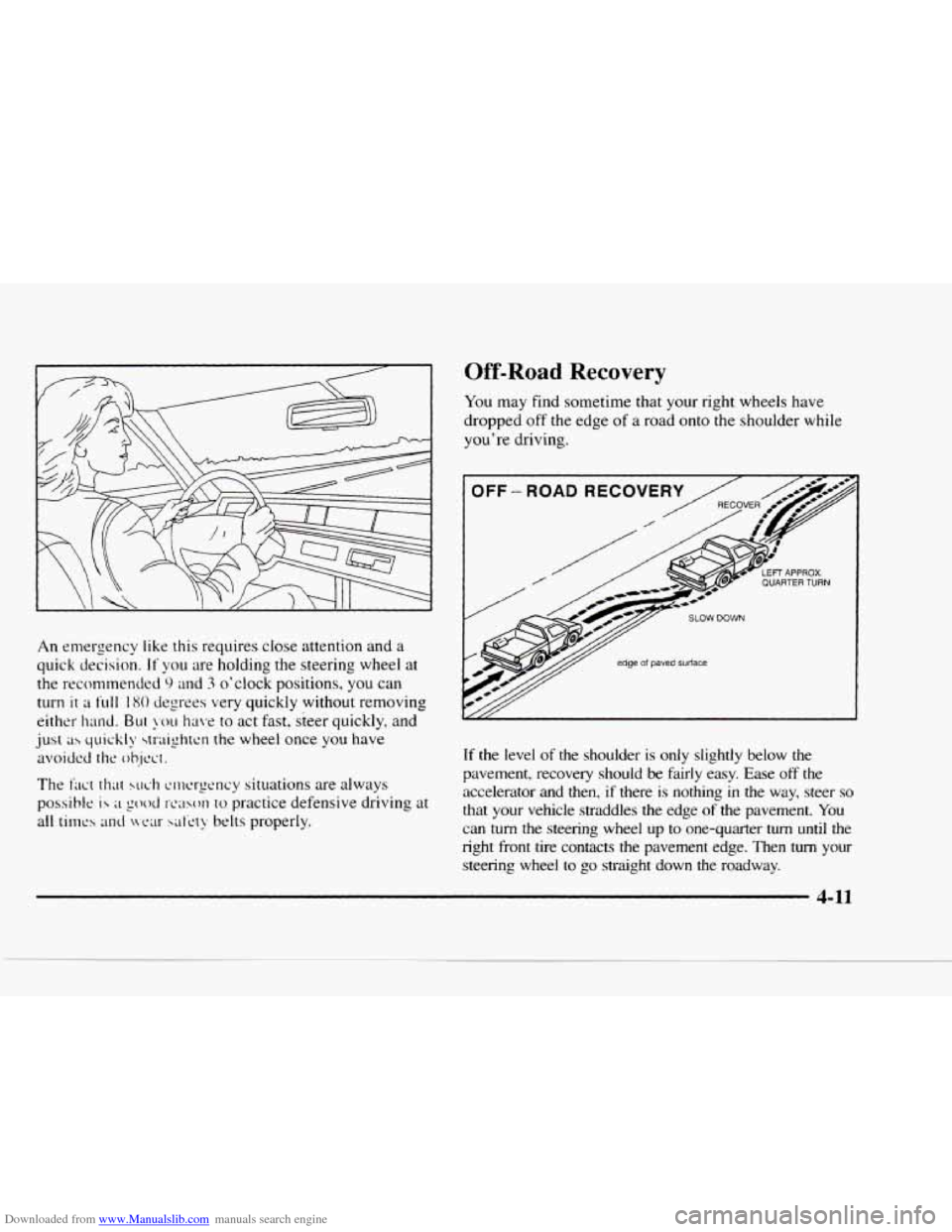
Downloaded from www.Manualslib.com manuals search engine An emergency like this requires close attention and a
quick decision. If you are holding the steering wheel at
the recommended
9 and 3 o'clock positions, you can
turn
it a tull 180 degrees very quickly without removing
either
hand. Bur you hrt\*e to act fast, steer quickly, and
just ah quickly straighten the wheel once you have
avoided
the ob-jcct.
The fact that wch clncrgcncy situations are always
possible ih ;I good reason to practice defensive driving at
all
times and NYN satety belts properly.
Off-Road Recovery
You may find sometime that your right wheels have
dropped off
the edge of a road onto the shoulder while
you're driving.
I OFF - ROA
v/// edge of paved surface
If the level of the shoulder is only slightly below the
pavement, recovery should be
fairly easy. Ease off the
accelerator and then, if there is nothing in the way, steer so
that your vehicle straddles the edge of the pavement. You
can turn the steering wheel up to one-quarter turn until the
right front tire contacts the pavement
edge. Then turn your
steering wheel to go straight down the roadway.
4-11
Page 175 of 402
Downloaded from www.Manualslib.com manuals search engine If your vehicle starts to slide. ease your foot off the
accelerator pedal and quickly steer the way
you want the
vehicle to
go. If you start steering quickly enough. your
vehicle may straighten
out. Always be ready for a
second skid
if it occurs.
Of course, traction is reduced when water, snow. ice.
gravel or other material is on the road. For safety. you’ll
want to
slow down and adjust your driving to these
conditions.
It is important to slow down on slippery
surfaces because stopping distance will be longer and
vehicle control more limited.
While driving on a surface with reduced traction.
try
your best to avoid sudden steering, acceleration or
braking (including engine braking by shifting to a lower
You may not realize the surface
is slippery until your
vehicle is skidding. Learn to recognize warning
clues
-- such as enough water. ice or packed snow on
the road to make a “mirrored surface“
-- and slow down
when you have any doubt.
t oear). Any sudden changes could cause the tires to slide.
Remember: Any anti-lock brake system
(ABS) helps
avoid only the braking skid.
Driving Guidelines
This multipurpose passenger vehicle is defined as a utility
vehicle
in Consumer Information Regulations issued by
the National Highway Traffic Safety Administration
(NHTSA) of the United States Department of
Transportation. Utility vehicles have higher ground
clearance and a nmower track to make them capable
of
perfolming in a wide variety of off-road applications.
Specific design characteristics give them a higher center of
gravity than ordinary cars.
An advantage of the higher
to anticipate problems. They are
not designed for
cornering at the same speeds as conventional
two-wheel-drive vehicles any more than low-slung
sports
cars are designed to perform satisfactorily under off-road
conditions.
If at all possible, avoid sharp turns or abrupt
maneuvers.
As with other vehicles of this type, failure to
operate this vehicle correctly may result
in loss of control
or vehicle rollover.
2 oround clearance is a better view of the road allowing you
4-14
Page 176 of 402
Downloaded from www.Manualslib.com manuals search engine Off-Road Driving with Your
Four-Wheel-Drive Vehicle
This off-road guide is for vehicles that have
four-wheel drive.
Also, see “Anti-Lock Brakes”
in the Index.
If your vehicle doesn‘t have four-wheel drive, you
shouldn‘t drive off-road unless you‘re on a level,
solid surface.
Off-road driving can be great
fun. But it does have some
definite hazards. The greatest
of these is the terrain itself.
“Off-roading” means
you’ve left the great North
American road
system behind. Traffic lanes aren‘t
marked. Curves aren’t banked. There are
no road signs.
Surfaces can be slippery. rough, uphill
or downhill. In
short. you’ve gone right back to nature.
Off-road driving involves some new skills. And that’s
why it’s very important that you read this guide. You’ll
find many driving tips and suggestions. These will help
make your off-road driving safer and more enjoyable.
Before You Go Off-Roading
There are sutfre things to do before you go out. For
example, be sure
to have all necessary maintenance and
service work done. Check
to make sure all underbody
shields
(if so equipped) are properly attached. Be sure
you read all the information about your
four-wheel-drive vehicle
in this manual. Is there enough
fuel?
Is the spare tire fully inflated? Are the fluid levels
up where they should be? What are
the local laws that
apply to off-roading where you’ll be driving? If
you
don’t know, you should check with law enforcement
people
in the area. Will you be on someone’s private
land?
If so, be sure to get the necessary permission.
Loading Your Vehicle for Off-Road Driving
There are some important things to remember about
how
to load your vehicle.
The heaviest things should be on the load floor and
forward of your rear axle. Put heavier items as far
forward
as you can.
Be sure the load is secured properly, so driving on
the off-road terrain doesn’t toss things around.
4- 15
Page 178 of 402
Downloaded from www.Manualslib.com manuals search engine Traveling to Remote Areas
It makes sense to plan your trip, especially when going
to a remote area. Know the terrain and plan your route.
You are much less likely to get bad surprises. Get
accurate maps of trails and terrain. Try to learn
of any
blocked or closed roads.
It’s also
a good idea to travel with at least one other
vehicle. If something happens to one of them, the other
can help quickly.
Does your vehicle have
a winch? If so. be sure to read
the winch instructions.
In a remote area, a winch can be
handy if you get stuck. But you’ll want to know how to
use
it properly.
Getting Familiar with Off-Road Driving
It’s a good idea to practice in an area that’s safe and
close to home before you
go into the wilderness.
Off-road
driving does require some new and different
driving
skills. Here’s what we mean.
Tune your senses to different kinds of signals. Your
eyes. for example, need to constantly sweep the terrain
for unexpected obstacles. Your ears need to listen for
unusual tire
or engine sounds. With your arms, hands,
feet and body, you’ll need to respond to vibrations and
vehicle bounce. Controlling
your vehicle is the key to successful
off-road driving. One of
the best ways to control your
vehicle is to control your speed. Here are some things to
keep
in mind. At higher speeds:
0
e
0
a
you approach things faster and you have less time to
scan the terrain for obstacles.
you have less time to react.
you have more vehicle bounce when you drive
over obstacles.
you’ll need more distance for braking, especially
since you’re on
an unpaved surface.
I A CAUTION:
When you’re driving off-road, bouncing and
quick changes in direction can easily throw you
out
of position. This could cause you to lose
control and crash. So, whether you’re driving on
or off the road, you and your passengers should
wear safety belts.
Page 180 of 402
Downloaded from www.Manualslib.com manuals search engine Driving on Off-Road Hills
Off-road driving often takes you up, down or across a
hill. Driving safely
on hills requires good judgment and
an understanding
of what your vehicle can and can’t do.
There are some hills that simply can’t be driven,
no
matter how well built the vehicle. incline
may get steeper as
you near the top, but you may
not see this because
the crest of the hill is hidden by
bushes, grass or shrubs.
Here are some other things
to consider as you approach
a
hill.
0
I A CAUTION: 0
Many hills are simply too steep for any vehicle. If
you drive up them, you will stall. If you drive
down them, you can’t control your speed.
If you
drive across them, you will roll over.
You could be
~ seriously injured or killed. If you have any doubt
~ about the steepness, don’t drive the hill.
Approaching a Hill
When you approach a hill, you need to decide if it’s one
of those hills that’s just too steep to climb, descend or
cross. Steepness can be hard to judge. On a very small
hill, for example, there
may be a smooth. constant
incline with
only a small change in elevation where you
can easily see all the way to the top. On a large hill, the
0
0
0
0
Is there a constant incline, or does the hill get sharply
steeper in places?
Is there good traction on the hillside, or will the
surface cause tire slipping?
Is there a straight path up or down the hill so you
won’t have to make turning maneuvers?
Are there obstructions on the
hill that can block your
path (boulders. trees, logs or ruts)?
What’s beyond the hill?
Is there a cliff, an
embankment. a drop-off,
a fence? Get out and walk
the
hill if you don’t know. It’s the smart way to
find out.
Is the hill simply too rough? Steep hills often have
ruts, gullies, troughs and exposed rocks because they
are more susceptible
to the effects of erosion.
4-19
Page 182 of 402
Downloaded from www.Manualslib.com manuals search engine @ What should I do if my vehicle stalls, or is about
A: If this happens, there are some things you should
to stall, and I can’t make it up the hill?
do. and there are some things you must not do.
First, here’s what
you should do:
0 Push the brake pedal to stop the vehicle and keep it
from rolling backwards. Also, apply the parking brake.
0 If your engine is still running, shift the transmission
to REVERSE
(R), release the parking brake, and
slowly back down the hill
in REVERSE (R).
0 If your engine has stopped running, you’ll need to
restart it. With the brake pedal depressed and the
parking brake still applied, shift
the transmission to
PARK (P) (or, shift to NEUTRAL (N) if your
vehicle has a manual transmission) and restart
the
engine. Then, shift to REVERSE (R), release the
parking brake, and slowly back down the
hill as
straight as possible in REVERSE (R).
As you are backing down the hill, put your left hand
on the steering wheel at the 12 o’clock position. This
way, you’ll be able
to tell if your wheels are straight
and maneuver
as you back down. It’s best that you
back down the hill with your wheels straight rather
than
in the left or right direction. Turning the wheel
too far to the left or right will increase the possibility
of
a rollover.
Here are some things
you must not do if you stall, or are
about
to stall, when going up a hill.
0 Never attempt to prevent a stall by shifting into
NEUTRAL
(N) (or depressing the clutch, if you
have
a manual transmission) to “rev-up” the engine
and regain forward momentum. This
won’t work.
Your vehicle will roll backwards very quickly and
you could go out of control.
Instead, apply the regular brake
to stop the
vehicle. Then apply
the parking brake. Shift to
REVERSE
(R), release the parking brake, and
slowly back straight down.
0 Never attempt to turn around if you are about to stall
when going up
a hill. If the hill is steep enough to
stall your vehicle, it’s steep enough to cause you to
roll over if you turn around. If you can’t make it up
the hill, you must back straight down the hill.
4-21
Page 199 of 402
Downloaded from www.Manualslib.com manuals search engine A
‘‘1 :- ................ .................. . .. .. ....,.___.__..___._._.._... .. . . . . . . . . . . . . . . . . . . . , . , . . . , . . . . . , . , , , ,.I
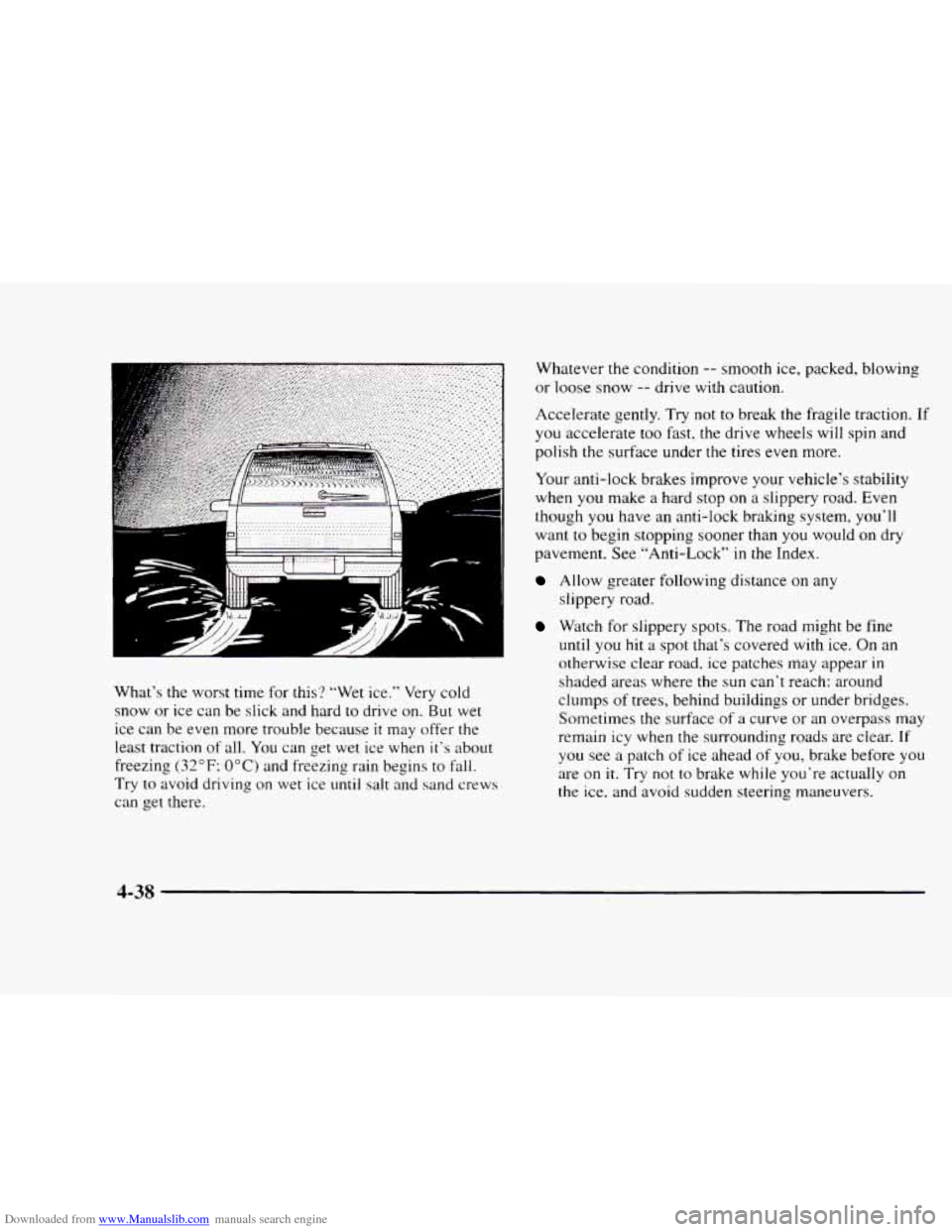
What’s the worst time for this’? “Wet ice.“ Very cold
snow or ice can be slick and hard
to drive on. But wet
ice can be even more trouble because
it may offer the
least traction
of all. You can get wet ice when it’s about
freezing
(32°F; OOC) and freezing rain begins to fall.
Try to avoid driving on wet ice until salt and sand crews
can get there. Whatever
the condition
-- smooth ice, packed, blowing
or loose snow
-- drive with caution.
Accelerate gently. Try
not to break the fragile traction. If
you accelerate too fast. the drive wheels will spin and
polish the surface under the tires even more.
Your anti-lock brakes improve your vehicle’s stability
when you make a hard stop
on a slippery road. Even
though
you have an anti-lock braking system, you’ll
want
to begin stopping sooner than you would on dry
pavement. See “Anti-Lock” in
the Index.
Allow greater following distance on any
slippery road.
Watch for slippery spots. The road might be fine
until you hit a spot that’s covered with ice. On an
otherwise clear road, ice patches may appear in
shaded areas where the sun can’t reach: around
clumps
of trees, behind buildings or under bridges.
Sometimes the surface of a curve or an overpass may
remain icy
when the surrounding roads are clear. If
you see a patch of ice ahead of you, brake before you
are on it. Try not to brake while you’re actually on
the ice, and avoid sudden steering maneuvers.
4-38