1997 CHEVROLET BLAZER transmission oil
[x] Cancel search: transmission oilPage 137 of 402
Downloaded from www.Manualslib.com manuals search engine Shift Light
-w
/fls 1
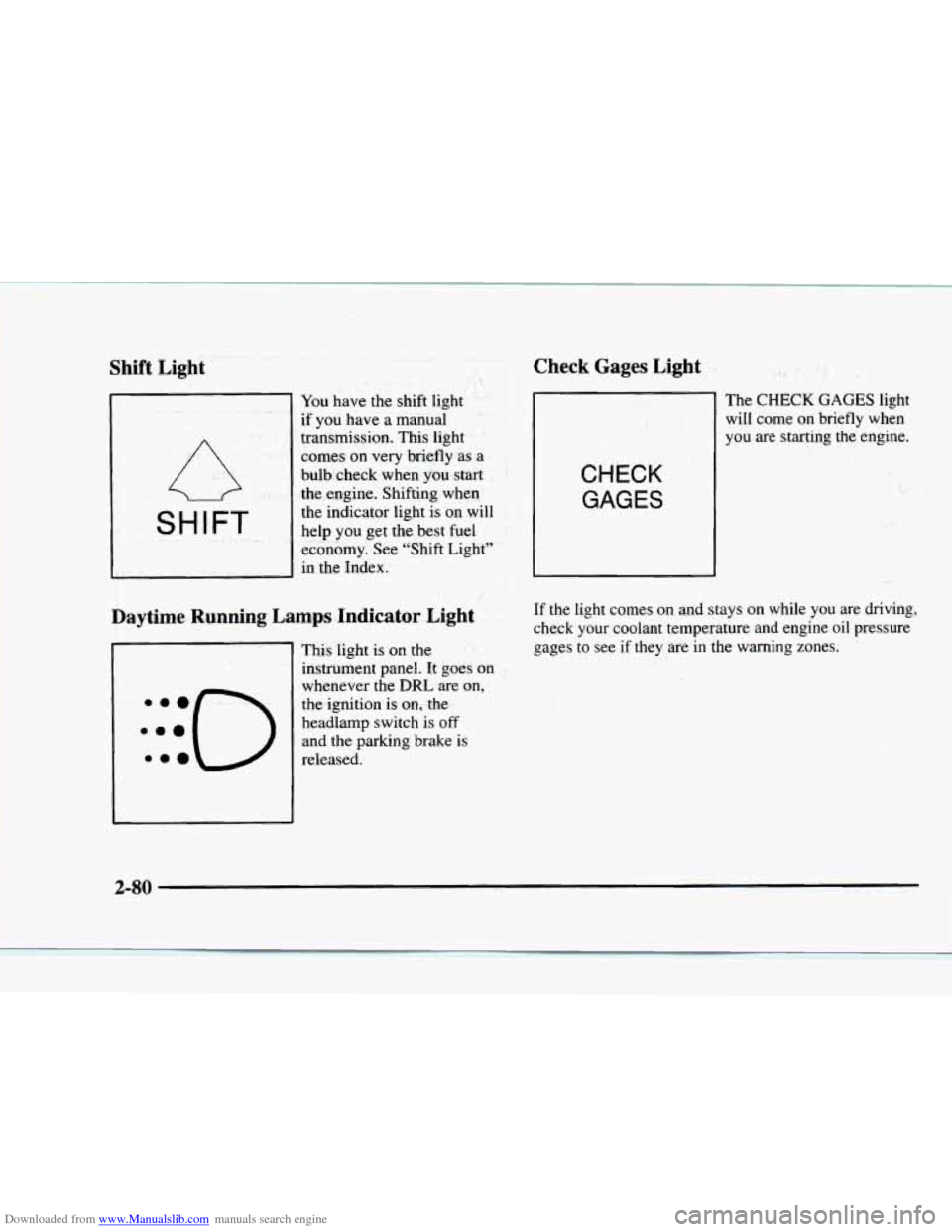
You have the shift light
if you have a manual
transmission. This light
comes
on very briefly as a
bulb check when
you start
the engine. Shifting when
the indicator light is on will
help you get
the best fuel
economy. See "Shift Light"
in the Index.
1 'd 8.
Daytime Running Lamps Indicator Light
This light is on the
instrument panel. It goes on
whenever the
DRL are on,
the ignition is on,.the
headlamp switch is
off
and the parking brake is
released.
Check Gages Light
CHECK GAGES
The CHECK GAGES light
will come on briefly when
you are starting the engine.
:
.. * ,. ,. , i ..3
I I.. -_. .
If the light comes on and stays on while you are driving,
check your coolant temperature and engine oil pressure
gages to see if they are in the warning zones.
1;
.I. ..
' , .;i ,- ..
"j
.. . .
2-80
Page 185 of 402
Downloaded from www.Manualslib.com manuals search engine Q: Am I likely to stall when going downhill?
A: It’s much more likely to happen going uphill. But if
it happens going downhill, here’s what to do.
0 Stop your vehicle by applying the regular brakes.
Shift to PARK (P) (or to NEUTRAL (N) with the
Apply the parking brake.
nlanual
transmission) and, while still brakin,,
0 restart
the engine.
and drive straight down.
Shift back to a low gear. release the parking brake,
If the engine won’t start, get out and get help.
Driving Across an Incline
Sooner or later, an off-road trail will probably go across
the incline of a hill. If this happens, you have to decide
whether
to try to drive across the incline. Here are some
things
to consider:
0 A hill that can be driven straight up or down may be
too steep to drive across. When you
go straight up or
down
a hill. the length of the wheel base (the
distance from the front wheels
to the rear wheels)
reduces the likelihood
the vehicle will tumble end
over end.
But when you drive across an incline, the
much more narrow track width (the distance between
the left and
right wheels) may not prevent the vehicle
0
0
from tilting and rolling over. Also, driving across an
incline puts more weight
on the downhill wheels.
This could cause
a downhill slide or a rollover.
Surface conditions can be
a problem when you drive
across
a hill. Loose gravel. muddy spots, or even wet
If the vehicle slips sideways. it can hit something
that
will trip it (a rock. a rut, etc.) and roIl over.
Hidden obstacles can make the steepness
of the
incline even worse. If you drive across a rock with
the uphill wheels, or if the downhill wheels drop into
a rut or depression, your vehicle can tilt even more.
2 orass can cause your tires to slip sideways. downhill.
For reasons like these, you need
to decide carefully whether
to try to drive across 31 incline. Just because the trail goes
;lcross the incline doesn’t mean you have to drive it. The
last vehcle
to try it might have rolled over.
A CAUTION:
Driving across an incline that’s too steep will
make your vehicle roll over. You could be
seriously injured or killed.
If you have any doubt
about the steepness
of the incline, don’t drive
across it. Find another route instead.
A
4-24
Page 213 of 402
Downloaded from www.Manualslib.com manuals search engine When towing a trailer, the arrows on your instrument
panel
will flash for turns even if the bulbs on the trailer
are burned out. Thus, you may
think drivers behind you
are seeing your signal when they are not. It's important
to check occasionally to be sure the trailer bulbs are
still working.
Driving On Grades
Reduce speed and shift to a lower gear byfilw you start
down
a long or steep downgrade. If you don't shift
down. you might have to use your brakes
so much that
they would get hot and no longer work well.
On
a long uphill grade. shift down and reduce your
speed
to around 45 mph (70 km/h) to reduce the
possibility of engine and transmission overheating.
if
you have an automatic transmission. you should use
DRIVE (D) when towing a trailer. Operating your
vehicle in DRIVE (D) when towing a trailer will
minimize heat buildup and extend the life
of your
transmission. Or.
if you have a manual transmission. it's
better not to use
FIFTH (5 j gear. just drive in
FOURTH (4) gear (or. as you need to. a lower gear). When
towing
at high altitude on steep uphill grades.
consider the following: Engine coolant will boil at a
lower temperature than at normal altitudes.
If you turn
your engine off immediately after towing at high altitude
on steep uphill grades, your vehicle may show signs
similar to engine overheating.
To avoid this. let the
engine
run while parked (preferably on level ground)
with the automatic transmission in PARK (P) (or the
rnanual transmission out of gear and the parking brake
applied) for a few minutes before turning the engine off.
If you do get the overheat warning, see "Engine
Overheating"
in the Index.
Parking on Hills
You really should not park your vehicle. with a trailer
attached.
on ;I hill. If something goes wrong, your ris
could start to move. People can be injured, and both
your vehicle and the trailer
can be damaged.
4-52
Page 215 of 402
Downloaded from www.Manualslib.com manuals search engine When You Are Ready to Leave After
Parking
on a Hill
1. Apply your regular brakes and hold the pedal down
whiie you:
Start your engine:
Shift into a gear: and
Release the parking brake.
3,. Let up on the brake pedal.
3. Drive slowly until the trailer is clear of the chocks.
4. Stop and have someone pick up and store the chocks.
Maintenance When Trailer Towing
Your vehicle will need service more often when you’re
pulling
a trailer. See the Maintenance Schedule for more
on this. Things that are especially important in trailer
operation are automatic transmission fluid (don’t
overfill), engine
oil, axle lubricant, belt. cooling system
and brake adjustment. Each
of these is covered in this
manual. and
the Index will help you find them quickly.
If you’re trailering, it‘s a good idea to review these
sections before you start your
trip.
Check periodically to see that all hitch nuts and bolts
are tight.
4-54
Page 256 of 402
Downloaded from www.Manualslib.com manuals search engine Section 6 Service and Appearance Care
Here you will find information about the care of your vehicle. This section begins with service and fuel information,
and then
it shows how to check important fluid and lubricant levels. There is also technical information about your
vehicle, and a part devoted
to its appearance care.
6-3
6-4
6-5
6-6
6-9 6-
13
6- 14
6-18
6- 19
6-
20
6-2 1
6-23
6-26
6-26
6-26 6-27
Fuel
Fuels in Foreign Countries
Filling Your Tank
Checking Things Under the Hood
Engine Oil
Air Cleaner
Automatic Transmission Fluid
Manual Transmission Fluid
Hydraulic Clutch
Rear Axle
Four-wheel Drive and All-Wheel Drive
Engine Coolant Radiator Pressure Cap
Thermostat Power Steering Fluid
Windshield Washer Fluid 6-28
6-32
6-3 3 6-3 8
6-40 6-49
6-49
6-52
6-54
6-5
7
6-5 8
6-58
6-58
6-62
6-63
6-64
Brakes
Battery
Bulb Replacement
Windshield Wiper Blade Replacement
Tires
Appearance Care
Cleaning the Inside
of Your Vehicle
Care
of Safety Belts
Cleaning the Outside of Your Vehicle
Appearance Care Materials Chart
Vehicle Identification Number
(VIN)
Service Parts Identification Label
Electrical System
Replacement Bulbs
Capacities and Specifications
Air Conditioning Refrigerants
Page 263 of 402
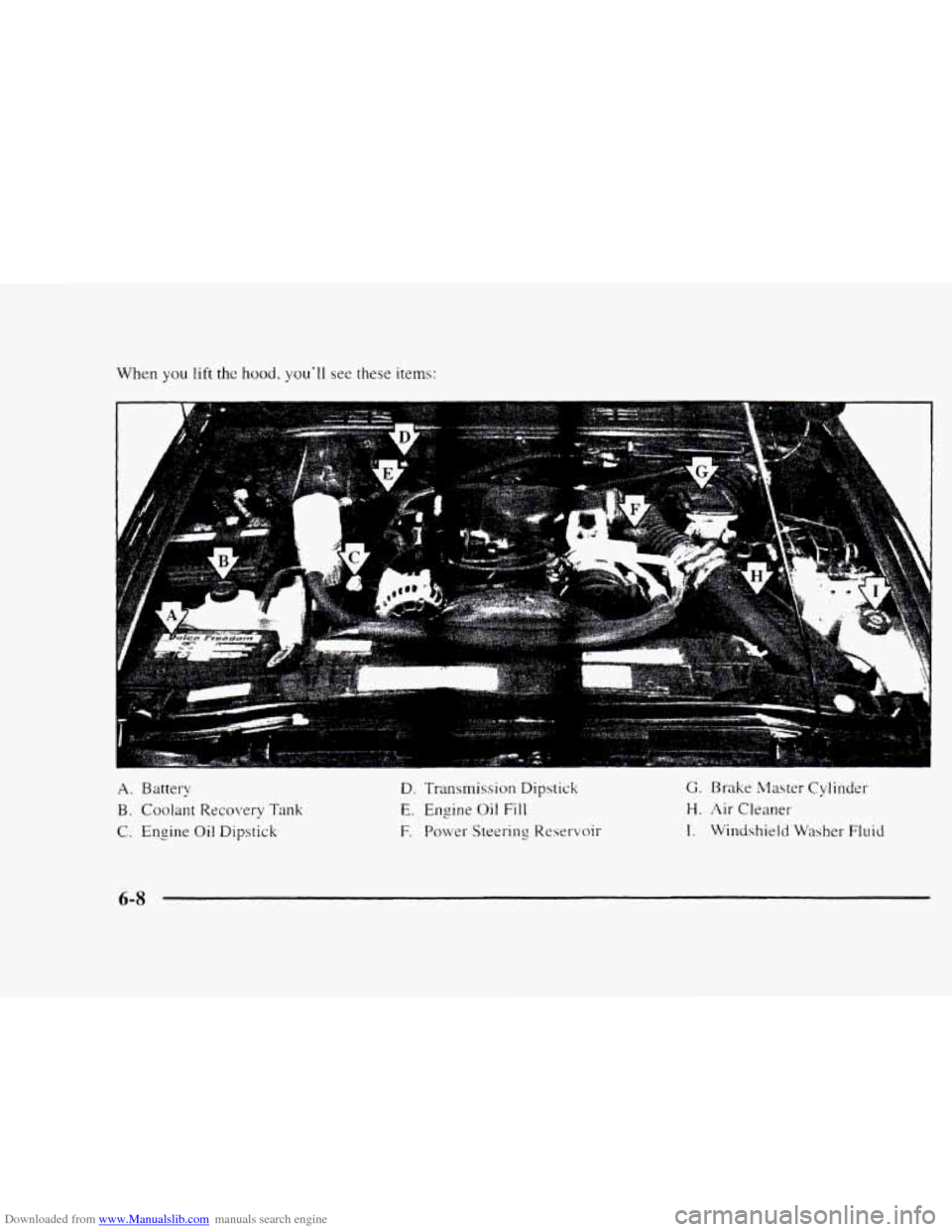
Downloaded from www.Manualslib.com manuals search engine When you lift the hood. you'll see these items:
B -- ."*f . ..
A. Battery
B. Coolant Recovery Tank
C. Engine Oil Dipstick
*
C
D. Transmission Dipstick
E. Engine Oil Fill
F. Power Steering Reservoir
G. Brake Master Cylinder
H. Air Cleaner
I. Windshield Washer Fluid
6-8
Page 269 of 402
Downloaded from www.Manualslib.com manuals search engine A CAUTION:
Operating the engine with the air cleaner off can
cause you or others to be burned. The air cleaner
not only cleans the
air, it stops flame if the engine
backfires.
If it isn’t there, and the engine
backfires, you could be burned. Don’t drive with
it
off, and be careful working on the engine with
the air cleaner
off.
NOTICE:
If the air cleaner is off, a backfire can cause a
damaging engine fire. And, dirt can easily get
into your engine, which will damage
it. Always
have the air cleaner in place when you’re driving.
Automatic Transmission Fluid
When to Check and Change
A good time to check your automatic transmission fluid
level is when the engine oil is changed.
Change both the fluid and filter every
50,000 miles
(53 000 km) if the vehicle is mainly driven under one or
more
of these conditions:
In heavy city traffic where the outside temperature
regularly reaches
90°F (32°C) or higher.
In hilly or mountainous terrain.
When doing frequent trailer towing.
Uses such as found in taxi. police or delivery service.
If you do not use your vehicle under any of these
conditions, the fluid and filter
do not require changing.
See “Scheduled Maintenance Services”
in the Index.
6-14
Page 273 of 402
Downloaded from www.Manualslib.com manuals search engine Manual Transmission Fluid
When to Check
A good time to have it checked is when the engine oil is
changed. However, the fluid in your manual
transmission doesn't require changing.
How to Check
Because this operation can be a little difficult. you
rnay choose to have this done at your GM dealership
Service Department.
If you do it yourself. be sure to follow all the
instructions here, or
you could get a false reading.
I NOTICE:
i Too much or too little fluid can damage your
1 transmission. Too much can mean that some of
the fluid could come out and fall on hot engine
parts or exhaust system parts, starting a fire. Be
sure
to get an accurate reading if you check your
transmission fluid.
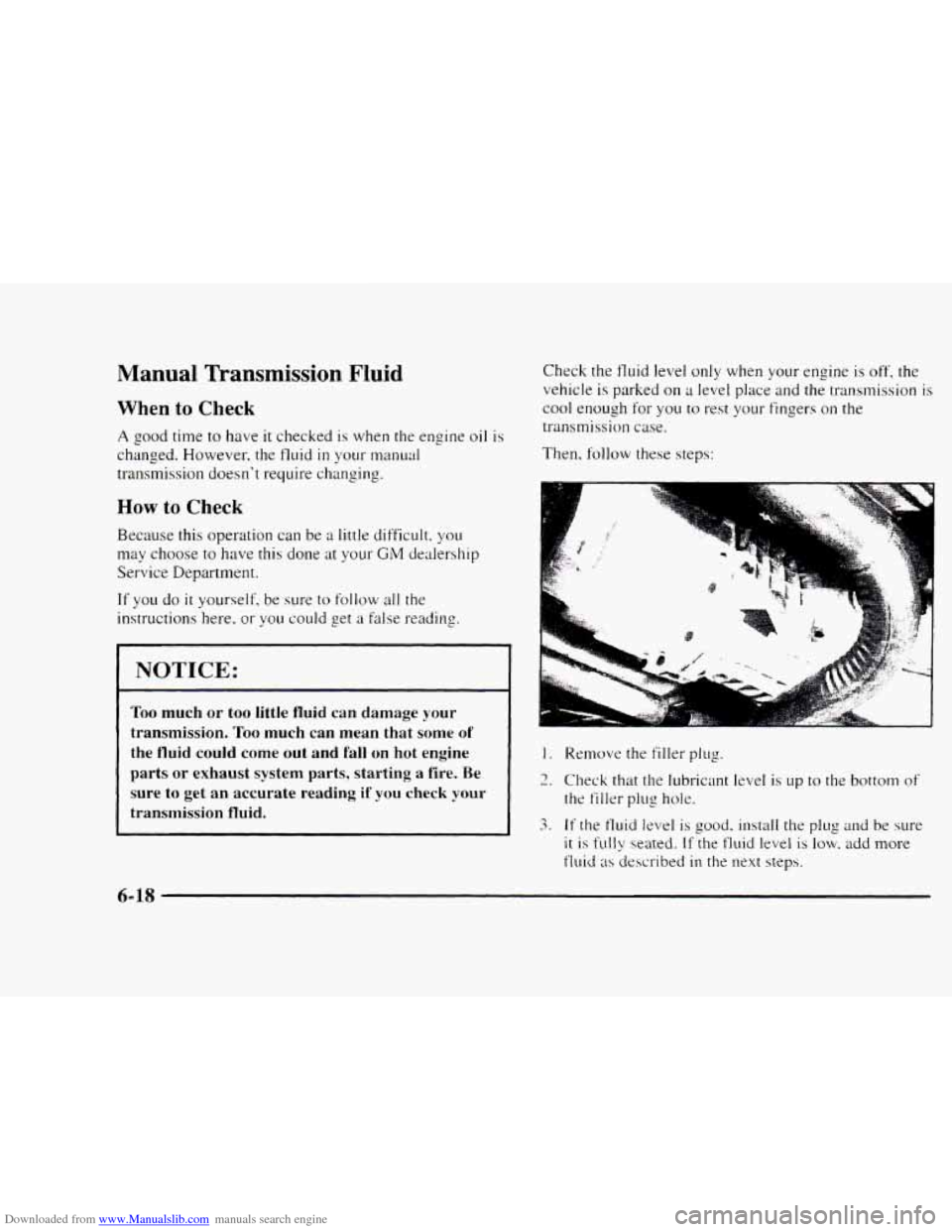
Check the fluid level only when your engine is off, the
vehicle
is parked on a level place and the transmission is
cool enough for
you to rest your fingers on the
transmission case.
Then. follow these steps:
1. Remove the filler plug.
2. Check that the lubricant level is LIP to the bottom of
the filler plug hole.
3. If the fluid level is good. install the pl~~g md be sure
it is f~llly seated. If the fluid level is low. add more
fluid as described in the next steps.
6-18