1997 CHEVROLET BLAZER service indicator
[x] Cancel search: service indicatorPage 84 of 402
Downloaded from www.Manualslib.com manuals search engine 4LO: This setting also engages your front axle to give
you extra traction. You may never need
4LO. It sends
the maximum power
to all four wheels. You might
choose
4LO if you were driving off-road in sand, mud
or deep snow and climbing or descending steep hills.
Indicator lights
in the switches show you which setting
you are
in. The indicator lights will come on briefly when
you
turn on the ignition and one will stay on. If the lights
do not come on, you should take your vehicle in for
service. An indicator light
will flash while shifting. It will
remain illuminated when the shift is completed.
Shifting from 2HI to 4HI
Press and release the 4HI switch. This can be done at
any speed, and the front axle will lock automatically.
Shifting from 4HI to 2HI
Press and release the 2HI switch. This can be done at
any speed.
and the front axle will unlock automatically.
Shifting from 2HI or JHI to 4LO
To shift tiom ZHI or -!HI to 4L0, the vehicle must be
stopped or mo\fing less than 3 mph (4.8 kmk) with the
transmission
in NEUTRAL (N) in vehicles equipped with
an automatic transmission or the clutch pedal engaged in
vehicles equipped with a manual transmission.
The
preferred method for shifting into 4LO is to have your
vehicle moving
1 to 2 mph (1.6 to 3.2 km/h). Press
and release the
4LO switch. You must wait for the
4LO indicator light to stop flashing and remain
illuminated before shifting your transmission into
gear or releasing the clutch pedal.
If
the 4LO switch is pressed when your vehicle is in
gear and/or moving, the
4LO indicator light will flash
for
30 seconds and not complete the shift unless your
vehicle is moving slower than 3 mph (4.8
kmk) and
the transmission is in
NEUTRAL (N) or the clutch
pedal engaged.
On automatic transmission equipped vehicles,
if your
transfer case does not shift into 4L0, your transmission
indicator switch may require adjustment. With your
transmission in
NEUTRAL (N), press and release the
4LO switch. While the
4LO indicator light is flashing,
shift
your transmission into PARK (P). Wait until the
4LO indicator light remains illuminated before shifting
your transmission into gear. This will get you into 4L0,
but you should take your vehicle in for service to restore
normal operation.
2-27
Page 85 of 402
Downloaded from www.Manualslib.com manuals search engine Shifting from 4LO to 4HI or 2HI
To shift from 4LO to 4HI or 2H1, your vehicle must be
stopped or moving less than 3 mph (4.8 kmh) with the
transmission in NEUTRAL (N) or the clutch pedal
engaged. The preferred method for shifting out
of
4LO is to have your vehicle moving 1 to 2 mph (1.6 to
3.2 km/h). Press and release the 4HI switch. You must
wait for the
4HI indicator light to stop flashing and
remain illuminated before shifting your transmission
into gear or releasing
the clutch pedal.
If the 4HI switch is pressed when your vehicle is in gear
and/or moving, the
4HI indicator light will flash for
30 seconds but not complete the shift unless the
vehicle is moving slower than
3 mph (4.8 km/h) and
the transmission
is in NEUTRAL (N) or the clutch
pedal engaged.
On automatic transmission equipped vehicles, if your
transfer case does not shift into
4H1, your transmission
indicator switch may require adjustment. With your
transmission in NEUTRAL
(N), press and release the
4HI switch. While the 4HI indicator light is flashing,
shift your transmission into PARK
(P). Wait until the
4HI indicator light remains illuminated before shifting
your transmission into gear. This will get
you into 4HI.
but you should
take your vehicle in for service to restore
normal operation.
2-2s
Page 130 of 402

Downloaded from www.Manualslib.com manuals search engine Air Bag Readiness Light
There is an air bag readiness light on the instrument
panel, which shows
AIR BAG. The system checks the
air bag’s electrical system for malfunctions. The light
tells you
if there is an electrical problem. The system
check includes
the air bag sensors, the air bag module,
the wiring and
the diagnostic module. For more
information
on the air bag system, see ‘*Air Bag” in
the Index.
AIR
BAG
This light will come on
when you start your engine,
and
it will flash for a few
seconds.
Then the light
should
go out. This means
the system
is ready.
If the air bag readiness light stays on after you start the
engine or comes on when you are driving, your air bag
system may
not work properly. Have your vehicle
serviced right away. The
air bag
readiness light should flash for a few
seconds when
you turn the ignition key to RUN. If the
light doesn’t corne
on then, have it fixed so it will be
ready
to warn you if there is a problem.
Charging System Indicator Light
II..
~ The charging system light
~ will come on briefly when
you turn on the ignition,
but the engine is not
running,
as a check to
show you it is working.
It should go out once the engine is running. If it stays
on, or comes on while you are driving, you may have
a problem with the charging system. It could indicate
that
you have problems with a generator drive belt, or
another electrical problem. Have
it checked right away.
Driving while
this light is on could drain your battery.
If you must drive a short distance with the light on, be
certain to turn off all your accessories, such as the radio
and air conditioner.
2-73
Page 134 of 402
Downloaded from www.Manualslib.com manuals search engine Malfunction Indicator Lamp (Service Engine Soon
Light)
1
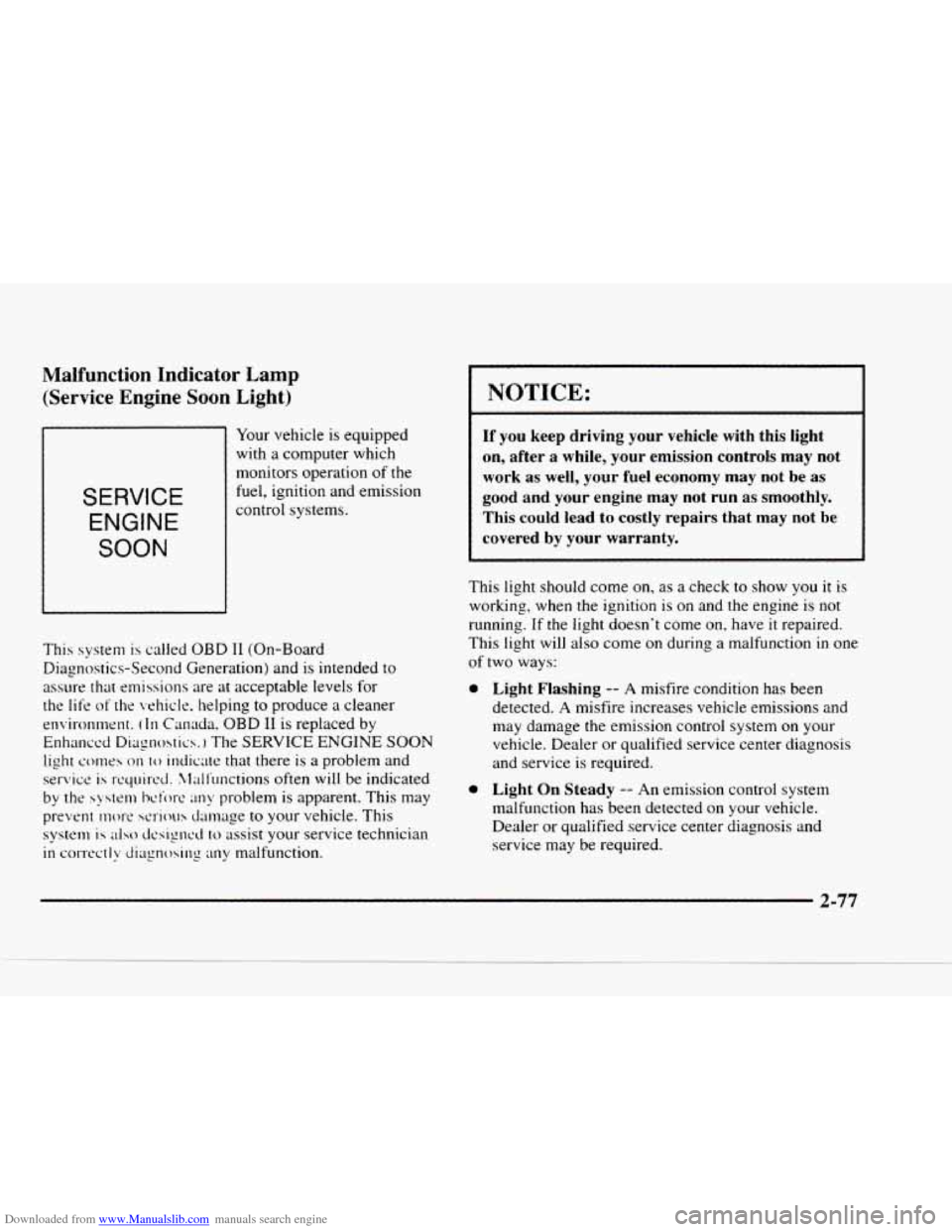
Your vehicle is equipped
with a computer which
monitors operation
of the
fuel, ignition and emission
SERVICE
ENGINE
SOON
control systems.
This system
is called OBD I1 (On-Board
Diagnostics-Second Generation) and
is intended to
assure that emissions are at acceptable levels for
the life of
the vehicle. helping to produce a cleaner
environment.
(In Canada. OBD 11 is replaced by
Enhanced
Diqnohtics. The SERVICE ENGINE SOON
light co111es
on to indicate that there is a problem and
service
is rquired. X,l;df'unctions often will be indicated
by the
system bciore any problem is apparent. This may
prevent
mort' serious damage to your vehicle. This
system is also t1csignt.d to assist your service technician
in correctly diagnosing any malfunction.
NOTICE:
If you keep driving your vehicle with this light
on, after a while, your emission controls may not
work as well, your fuel economy may not be as
good and your engine may not run
as smoothly.
This could
lead to costly repairs that may not be
covered by your warranty.
This light should come on, as a check to show you it is
working, when
the ignition is on and the engine is not
running. If the light doesn't come on, have it repaired.
This light will also come
on during a malfunction in one
of two ways:
0 Light Flashing -- A misfire condition has been
detected.
A misfire increases vehicle emissions and
may damage
the emission control system on your
vehicle. Dealer or qualified service center diagnosis
and service
is required.
0 Light On Steady -- An emission control system
malfunction has been detected on
your vehicle.
Dealer or qualified service center diagnosis and
service may be required.
2-77
Page 258 of 402
Downloaded from www.Manualslib.com manuals search engine Adding Equipment to the Outside of
Your Vehicle
Things you might add to the outside of your vehicle can
affect the airflow around
it. This may cause wind noise
and affect windshield washer performance. Check with
your
GM dealer before adding equipment to the outside
of your vehicle.
Fuel
Use regular unleaded gasoline rated at 87 octane or
higher.
At a minimum, it should meet specifications
ASTM
D48 14 in the United States and CGSB 3.5-M93
in Canada. Improved gasoline specifications have been
developed by the American Automobile Manufacturers
Association
( AAMA) for better vehicle performance
and engine protection. Gasolines meeting the AAMA
specification
could provide improved driveability and
emission
control system protection compared to
other ga~)l i nes.
Be SCII-~ the pos~cl octane is at least 87. If the octane is
less than 87. you ma, gct a heavy knocking noise when
YOLI driirc. If’ it‘ hac1 crlough. it can damage your engine. If
you’re using fuel rated at
87 octane or higher and you
still hear heavy knocking, your engine needs service.
But don’t worry if you hear a little pinging noise when
you’re accelerating or driving up a hill. That’s normal,
and
you don’t have to buy a higher octane fuel to get rid
of pinging. It’s the heavy, constant knock that means
you have a problem.
If your vehicle
is certified to meet California Emission
Standards (indicated on the underhood tune-up label),
it
is designed to operate on fuels that meet California
specifications. If such fuels are
not available in states
adopting California emissions standards, your vehicle
will operate satisfactorily
on fuels meeting federal
specifications, but emission control system performance
may be affected. The malfunction indicator lamp
on
your instrument panel may turn on and/or your vehicle
may fail a smog-check test.
If this occurs, return to your
authorized GM dealer for diagnosis to determine the
cause of failure.
In the event it is determined that the
cause of the condition is the type of fuels used, repairs
may
not be covered by your warranty.
6-3
Page 259 of 402
Downloaded from www.Manualslib.com manuals search engine Some gasolines that are not reformulated for low
emissions contain an octane-enhancing additive called
methylcyclopentadienyl manganese tricarbonyl
(MMT);
ask your service station operator whether or not his fuel
contains MMT. General Motors does not recommend the
use of such gasolines.
If fuels containing MMT are used,
spark plug life may be reduced and your emission
control system performance may be affected. The
malfunction indicator lamp
on your instrument panel
may turn on.
If this occurs, return to your authorized
GM dealer for service.
To provide cleaner air, all gasolines in the United States
are now required to contain additives that will help
prevent deposits from forming in your engine and fuel
system, allowing your emission control system to
function properly. Therefore, you should not have to add
anything to
the fuel. In addition, gasolines containing
oxygenates, such as ethers and ethanol. and
reformulated gasolines may be available
in your area to
help clean the air. General Motors recommends that you
use these gasolines if they comply with the
specifications described earlier.
I NOTICE:
Your vehicle was not designed for fuel that
contains methanol. Don’t
use it. It can corrode
metal parts
in your fuel system and also damage
plastic and rubber parts. That damage wouldn’t
be covered under your warranty.
Fuels in Foreign Countries
If you plan on driving in another country outside the United
States or Canada. the proper fuel may be hard
to find. Never
use leaded gasoline or any other fuei
not recommended in the
previous text on fuel. Costly repairs caused
by use of
improper fuel wouldn’t be covered by your warranty.
To check
on fuel availability, ask an auto club. or
contact a major oil company that does business
in the
country where
you’ll be driving.
You can also write us at the following address for
advice. Just tell us where you’re going and give your
Vehicle Identification
Number (VTN).
General Motors International Product Center
1908 Colonel Sam Drive
Oshawa. Ontario
L 1 H 8P7
6-4
Page 299 of 402
Downloaded from www.Manualslib.com manuals search engine When It's Time for New Tires
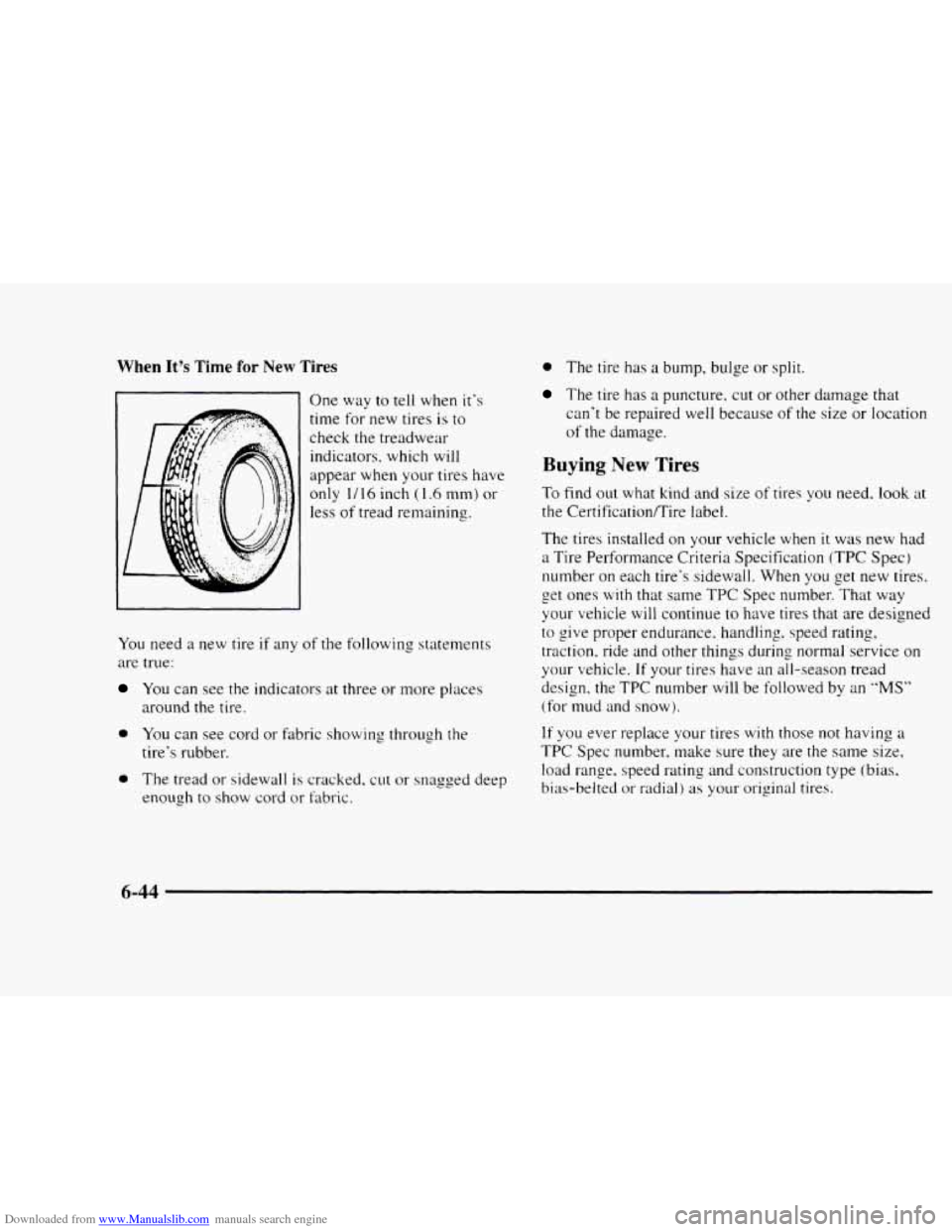
One way to tell when it's
time
for new tires is to
check
the treadwear
indicators, which will
appear when your tires have
only
1 /16 inch ( 1.6 mm) or
less
of tread remaining.
You need
a new tire if any of the following statements
are true:
You can see the indicators at three or more places
around
the tire.
0 You can see cord or fabric showing through the
tire's rubber.
0 The tread or sidewall is cracked, cut or snagged deep
enough to
show cord or fabric.
0 The tire has a bump, bulge or split.
The tire has a puncture, cut or other damage that
can't be repaired well because
of the size or location
of the damage.
Buying New Tires
To find out what kind and size of tires you need. look at
the CertificatiodTire label.
The tires installed on your vehicle when
it was new had
a Tire Performance Criteria Specification (TPC Spec)
number on each tire's sidewall. When
you get new tires.
your vehicle
will continue to have tires that are designed
to give proper endurance. handling, speed rating,
traction. ride and other things during
normal service on
your vehicle. If your tires have an all-season tread
design, the
TPC number will be followed by an "MS"
(for mud and snow).
If you ever replace your tires with those not having a
TPC Spec number, make sure they are the same size,
load range, speed rating and construction type (bias,
bias-belted or radial)
as your original tires.
t oet ones with that same TPC Spec number. That way
6-44
Page 392 of 402
Downloaded from www.Manualslib.com manuals search engine Clock. Setting ................................... 3-6
Clutch. Hydraulic
............................... 6- 19
Comfort Controls
................................ 3- 1
Compact Disc Care ............................. 3-21
Control of
a Vehicle .............................. 4-6
Convenience Net
............................... 2-57
Convex Outside Mirror
.......................... 2-50
Coolant .................................. 5-14. 6-23
Coolant Heater. Engine
.......................... 2- 17
Courtesy Transportation ........................... 8-8
Cruise Control
................................. 2-42
Customer Assistance Information
................... 8- I
Customer Satisfaction Procedure .................... 8-2
Compact Spare Tire
............................. 5-35
Damage.
Finish ............................... 6-56
Damage. Sheet Metal
............................ 6-55
Daytime Running Lamps
......................... 2-46
Daytime Running Lamps Indicator Light
............ 2-80
Dead Battery
................................... 5-3
Defects. Reporting Safety
................... 8- IO. 8- 1 I
Defensive Driving ............................... 4-2
Defogging
..................................... 3-5
Dimensions. Vehicle
............................ 6-64
Dome Lamps
.................................. 2-48
Door Locks
....................................... 2-4
Storage
..................................... 2-56
Drive. Automatic Transmission
.................... 2-20
Defrosting
..................................... 3-5 Drive Axle
Service
..............................
City ........................................ 4-32
Defensive
.................................... 4-2
Drunken
..................................... 4-3
Foreign Countries
.............................. 6-4
Freeway .................................... 4-33
Guidelines
.................................. 4-14
Hill and Mountain Roads
....................... 4-35
InaBlizzard
................................. 4-39
Night
...................................... 4-28
Off-Road
................................... 4-15
OnCurves
................................... 4-9
Rainy Conditions
............................. 4-29
Snowy and Icy Conditions
...................... 4-37
Through Deep Standing Water
................... 4-31
WetRoads
.................................. 4-29
Winter
...................................... 4-37
With
a Trailer ................................ 4-50
Driving On Grades While Towing
a Trailer ........... 4-52
Drunken Driving
................................ 4-3
Easy Entry Seat
................................ 1-7
Electrical Equipment, Adding
................ 3-20. 6-58
Electrical System
............................... 6-58
Endgate
....................................... 2-9
Emergency Release
........................... 2-11
Manual Release .............................. 2-10
Remote Release
.............................. 2-11
9-3