1997 CHEVROLET BLAZER climate control
[x] Cancel search: climate controlPage 140 of 402

Downloaded from www.Manualslib.com manuals search engine Section 3 Comfort Controls and Audio Systems
In this section, you'll find out how to operate the comfort control and audio systems offered with your vehicle. Be
sure to read about the particular systems supplied
with your vehicle.
3-2
3-2
3-3 3-3
3-4
3-5
3-5
3 -6
3-6
3-6
3-6
Comfort Controls
Climate Control System
Air Conditioning
Heating Ventilation System
Defogging and Defrosting
Rear Window Defogger (Option)
Audio Systems
Setting the Clock
Setting the Clock for AM-FM Stereo
with Compact Disc Player and Automatic
Tone Control
AM-FM Stereo 3-8
3- 10
3- 13
3-17
3- 19
3- 19
3-20
3-2 1
3-2 1
AM-FM Stereo with Cassette Tape Player
(If Equipped)
AM-FM Stereo
with Cassette Tape Player
and Equalizer
(If Equipped)
AM-FM Stereo
with Compact Disc Player
and Automatic Tone Control (If Equipped)
Theft-Deterrent Feature
Understanding Radio Reception
Tips About Your Audio System
Care of
Your Cassette Tape Player
Care
of Your Compact Discs
Fixed Mast Antenna
Page 141 of 402

Downloaded from www.Manualslib.com manuals search engine Temperature Knob Comfort Controls
With this system. you can control the heating. cooling
and ventilation in your vehicle.
Climate Control System
1
$8
hl
OF
Fan Control
The switch with the fan symbol changes the fan speed.
To increase the fiu1 speed. move the switch upward
toward
HI. To decrease the fan speed, move the switch
downward toward
LO.
The upper knob regulates the temperature of the air
coming through the system. Turn the knob clockwise
for
wrnw air, Turn the knob co~~nterclockwise for
cooler air.
Mode Knob
The lower knob allows you to choose the direction of
air delivery.
OFF: This setting turns the system off. Some outside air
will still enter the vehicle whenever the vehicle is
moving fot-w;lrd.
XlAX A/C: This setting provides maximuM cooling
with the least amount of work. MAX A/C recirculates
much
of the air inside your vehicle so it cools quickly.
NC: This settins cools the air entering your vehicle and
directs it 1111-ough the instrument panel outlets.
.)/J BI-LEVEL A/C: Air is delivered through the
heater 11oor outlets as well as the instrument panel outlets.
/J VENT: This setting directs airflow through the
instrument panel outlets. The air conditioning
conlpressor
is not working when VENT is selected.
+e
+e
3-2
Page 300 of 402
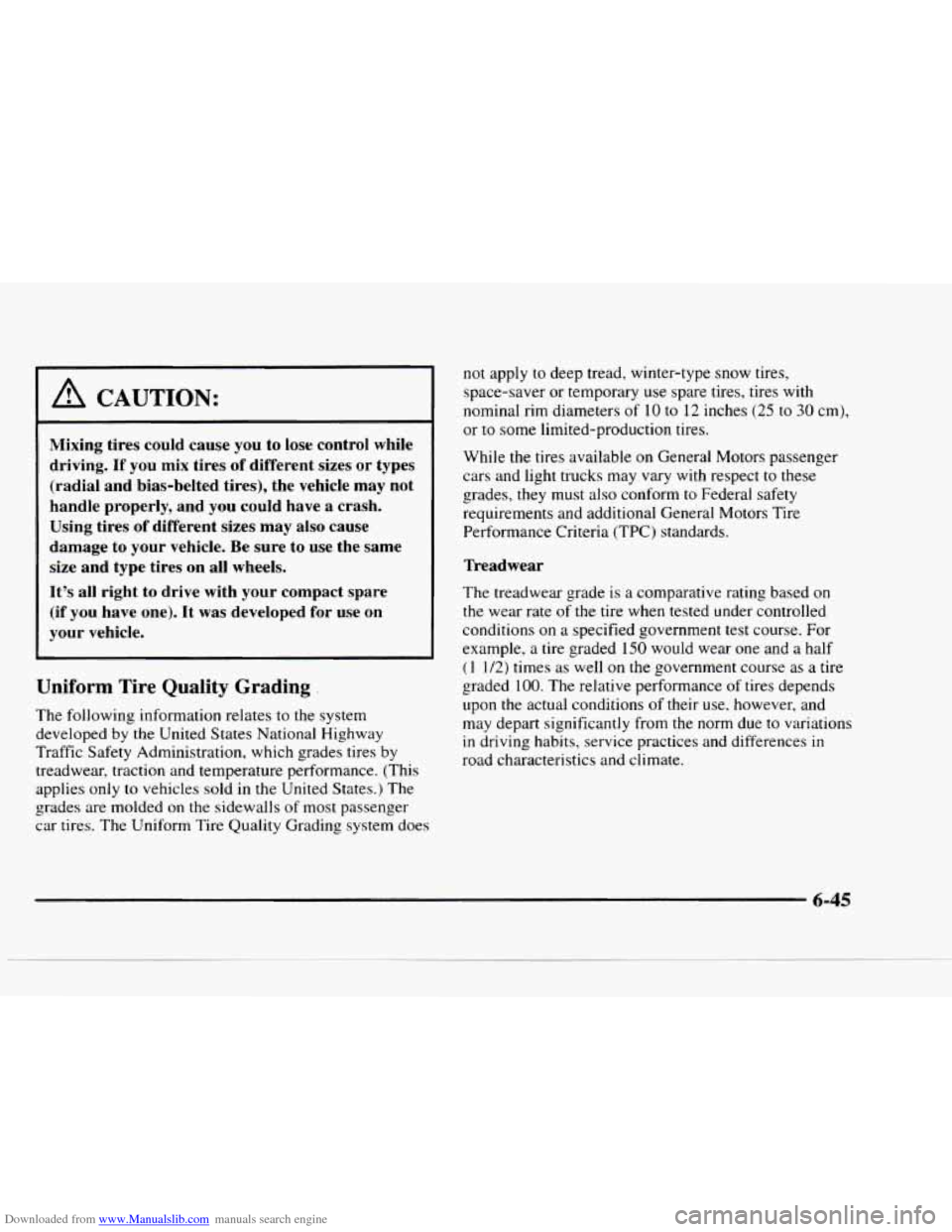
Downloaded from www.Manualslib.com manuals search engine I A CAUTION:
Mixing tires could cause you to lose control while
driving.
If you mix tires of different sizes or types
(radial and bias-belted tires), the vehicle may not
handle properly, and you could have a crash.
Using tires of different sizes may
also cause
damage to your vehicle. Be sure to use the same
size and type tires on all wheels.
It’s all right to drive with your compact spare
(if you have one). It was developed for use on
your vehicle.
Uniform Tire Quality Grading
The following information relates to the system
developed by
the United States National Highway
Traffic Safety Administration, which grades tires by
treadwear, traction and temperature performance. (This
applies only
to vehicles sold in the United States.) The
grades are molded on the sidewalls
of most passenger
car tires.
The Uniform Tire Quality Grading system does
not apply to deep tread, winter-type snow tires,
space-saver or temporary use spare tires, tires with
nominal rim diameters
of 10 to 12 inches (25 to 30 cm),
or
to some lirnited-production tires.
While the tires available
on General Motors passenger
cars and light trucks may vary with respect
to these
grades, they must also conform
to Federal safety
requirements and additional General Motors Tire
Performance Criteria (TPC) standards.
Treadwear
The treadwear grade is a comparative rating based on
the wear rate of the tire when tested under controlled
conditions on a specified government test course. For
example, a tire graded
150 would wear one and a half
(1 1/2) times as well on the government course as a tire
graded
100. The relative performance of tires depends
upon
the actual conditions of their use, however, and
may depart significantly from the norm due to variations
in driving habits, service practices and differences
in
road characteristics and climate.
6-45
Page 391 of 402
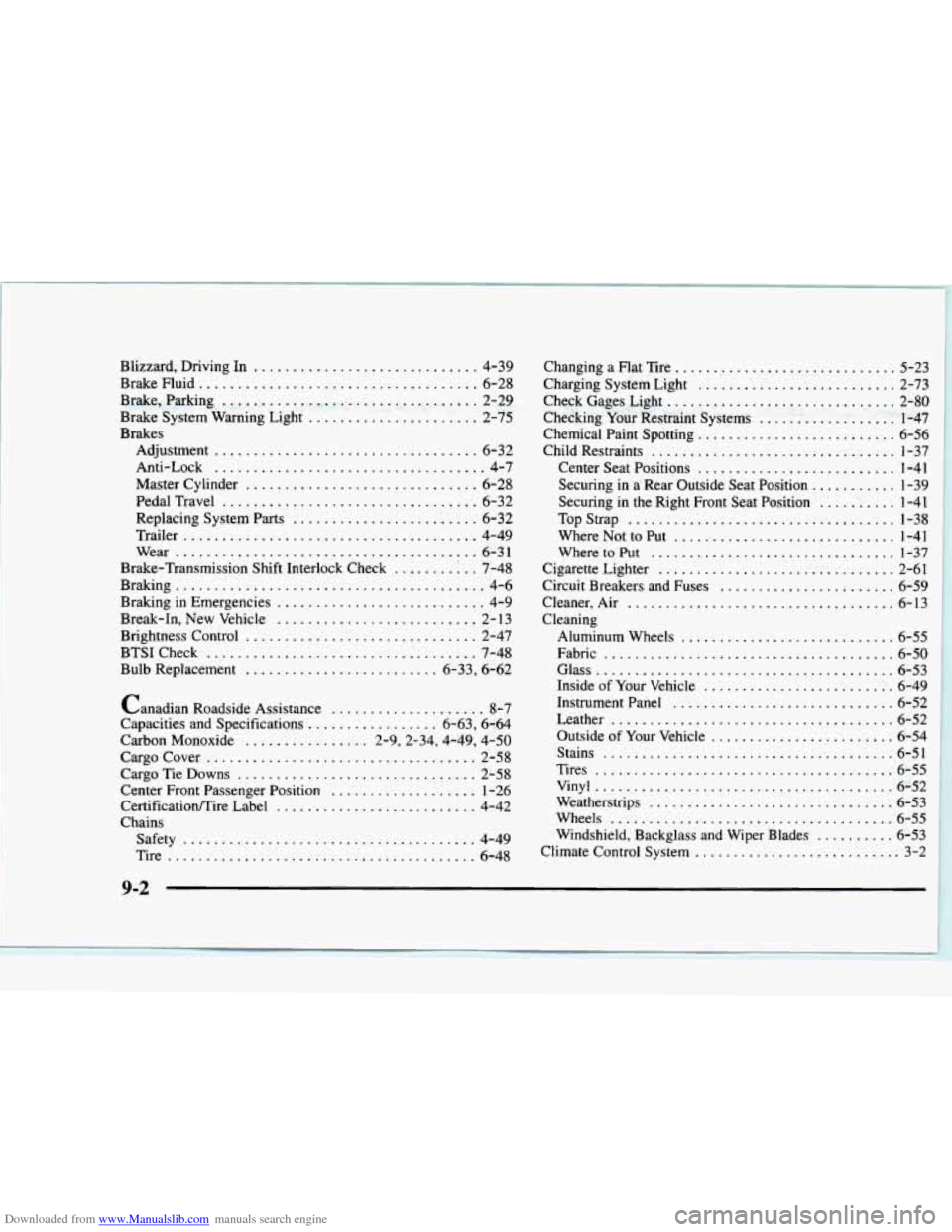
Downloaded from www.Manualslib.com manuals search engine Blizzard. Driving In ............................. 4-39
Brake Fluid
.................................... 6-28
Brake. Parking
................................. 2-29
Brake System Warning Light
...................... 2-75
Brakes Adjustment
.................................. 6-32
Anti-Lock
................................... 4- 7
PedalTravel
................................. 6-32
Trailer
...................................... 4-4 9
Wear ....................................... 6-31
Brake-Transmission Shift Interlock Check
........ .. 7-48
Braking
........................................ 4- 6
Master Cylinder
.............................. 6-28
Replacing System Parts
........................ 6-32
Braking in Emergencies
........................... 4-9
Break-In, New Vehicle
.......................... 2-13
Brightness Control
.............................. 2-47
Bulb Replacement
......................... 6-33, 6-62
BTSICheck
................................... 7-48
Canadian Roadside Assistance
.................... 8-7
Capacities and Specifications ................. 6-63, 6-64
Carbon Monoxide
................ 2-9.2-34.4-49, 4-50
Cargocover ................................... 2-58
Cargo Tie Downs ............................... 2-58
Center Front Passenger Position ................... 1-26
CertificatiodTire Label
.......................... 4-42
Chains Safety
...................................... 4-49
Tire
........................................ 6-48 Changing a Flat Tire
............................. 5-23
Charging System Light
.......................... 2-73
Check Gages Light
.............................. 2-80
Checking Your Restraint Systems
..... : ............ 1-47
Chemical Paint Spotting
.......................... 6-56
Child Restraints
................................ 1-37
Center Seat Positions
.......................... 1-41
Securing
in a Rear Outside Seat Position ........... 1-39
TopStrap
................................... 1-38
Where Not to Put
............................. 1-41
WheretoPut
................................ 1-37
Circuit Breakers and Fuses
....................... 6-59
Cleaner. Air
................................... 6-13
Cleaning Aluminum Wheels
............................ 6-55
Fabric
...................................... 6-50
Glass
....................................... 6-53
Inside of Your Vehicle
......................... 6-49
Instrumentpanel
............................. 6-52
Leather
..................................... 6-52
Outside
of Your Vehicle ........................ 6-54
Stains
...................................... 6-51
Tires
....................................... 6-55
Vinyl ....................................... 6-52
Wheels
...................................... 6-45
Windshield, Backglass and Wiper Blades
.......... 6-53
Securing in the Right Front Seat Position .......... 1-41
Cigarette Lighter
............................... 2-61
Weatherstrips
................................ 6-53
Climate Control System
........................... 3-2
9-2