1997 BUICK CENTURY lock
[x] Cancel search: lockPage 88 of 406
the current unlock mode, providing you with feedback.
When the door unlock switch is released, the vehicle will
remain in the most recent unlock mode.
Both the lock and unlock Security Feedback functions
will be in operating Mode
4 when the vehicle is shipped
from the factory.
Disconnecting the vehicle’s battery for up to a year will
not change the programmed mode of the lock and
unlock Security Feedback functions.
Illumination on Remote Activation
This feature provides interior illumination when a
remote keyless entry door unlock command is received
and executed by your vehicle. Your vehicle’s ignition
must be off for the Illumination on Remote Activation
feature
to work. The interior lamps will illuminate until
your vehicle’s ignition is turned to the
RUN position or
until an illumination period
of 40 seconds has elapsed. If
a door
is opened during the illumination period, the
timed illumination will be canceled, and
the interior
lamps will remain on since a door is open.
Instant Alarm
This feature allows you to activate an alarm by pressing a
switch on the remote keyless entry transmitter.
Your vehicle’s ignition must be
off for the Instant Alarm to
work. When
you press the special horn button on the remote
keyless entry transmitter, your vehicle’s headlamps will flash, the horn will
honk repeatedly, and your interior lamps
will illuminate, attracting attention if you need it. The alarm
will continue until:
1. You press the alarm button on the RKE transmitter a
second time.
2. The vehicle’s ignition is turned to the RUN position.
3. An alarm period of about two minutes has elapsed.
Matching Transmitter(s) To Your Vehicle
Each remote keyless entry transmitter is coded to
prevent another transmitter from unlocking your vehicle.
If a transmitter is lost or stolen, a replacement can be
purchased through your dealer. Remember
to bring any
remaining transmitters with you when you go
to your
dealer. When the dealer matches the replacement
transmitter to your vehicle, any remaining transmitters
must also be matched. Once your dealer has coded the
new transmitter, the lost transmitter will not unlock your
vehicle. Each vehicle can have only four transmitters
matched
to it.
2-12
ProCarManuals.com
Page 90 of 406
Resynchronizing Your Remote Keyless
Entry Transmitter
After you have changed the battery in your transmitter,
you will need
to resynchronize the transmitter. To do
this, press the
LOCK and UNLOCK buttons on the
transmitter together and hold for approximately seven
seconds
or until three brief horn chirps are heard. You
will also need to use
this procedure if your vehicle has
lost battery power for an extended period
of time.
Trunk
It can be dangerous to drive with the trunk open
because carbon monoxide
(CO) gas can come into
your vehicle. You can’t see or smell
CO. It can
cause unconsciousness and even death.
If you must drive with the trunk open or if
electrical wiring or other cable connections must
pass through the seal between the body and
the trunk:
Make sure all windows are shut.
Turn the fan on your heating or cooling
system to
its highest speed with the setting
on VENT. That will force outside air into
your vehicle. See “Comfort Controls” in
the Index.
instrument panel, open them all the way.
If you have air outlets on or under the
See C4Engine Exhaust” in the Index.
2-14
ProCarManuals.com
Page 91 of 406
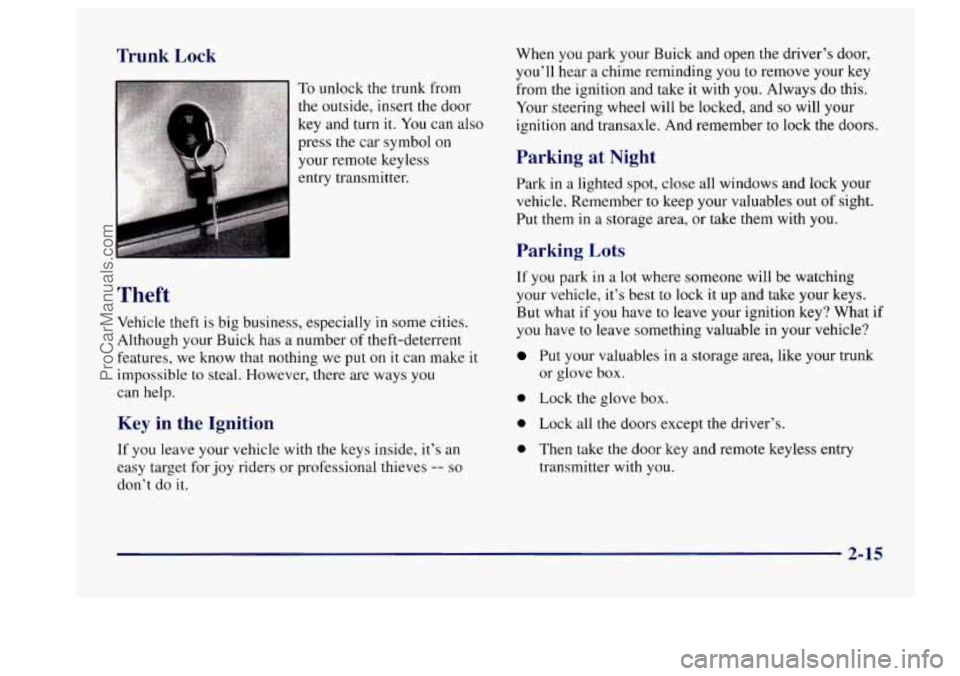
Trunk Lock
To unlock the trunk from
the outside, insert the door
key and turn
it. You can also
press the car symbol on
your remote keyless
entry transmitter.
Theft
Vehicle theft is big business, especially in some cities.
Although your Buick has a number
of theft-deterrent
features, we know that nothing we put on it can make it
impossible to steal. However, there are ways
you
can help.
Key in the Ignition
If you leave your vehicle with the keys inside, it’s an
easy target for joy riders or professional thieves
-- so
don’t do it. When
you park your Buick and open the driver’s door,
you’ll hear
a chime reminding you to remove your key
from the ignition and take it with you. Always do this.
Your steering wheel will be locked, and so will your
ignition and transaxle. And remember to lock the doors.
Parking at Night
Park in a lighted spot, close all windows and lock your
vehicle. Remember to keep your valuables out of sight.
Put them
in a storage area, or take them with you.
Parking Lots
If you park in a lot where someone will be watching
your vehicle, it’s best
to lock it up and take your keys.
But what if
you have to leave your ignition key? What if
you have to leave something valuable in your vehicle?
Put your valuables in a storage area, like your trunk
or glove
box.
0 Lock the glove box.
0 Lock all the doors except the driver’s.
0 Then take the door key and remote keyless entry
transmitter with
you.
2-15
ProCarManuals.com
Page 92 of 406
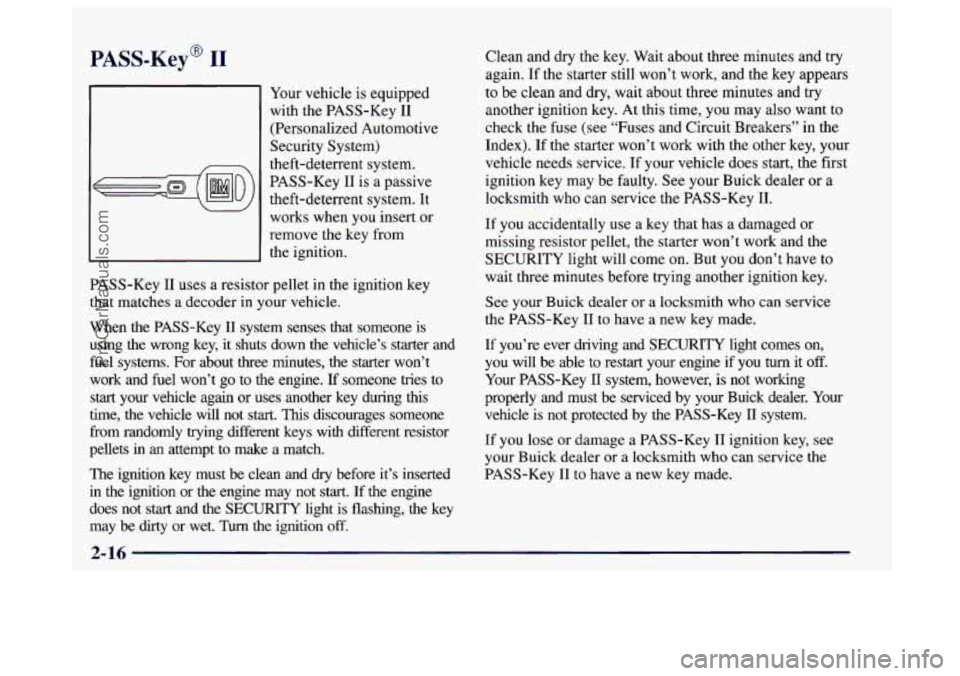
PASS-Key@ I1
Your vehicle is equipped
with the PASS-Key I1
(Personalized Automotive
Security System)
theft-deterrent system.
PASS-Key I1
is a passive
theft-deterrent system. It
works when you insert or
remove the key from
the ignition.
PASS-Key I1 uses a resistor pellet in the ignition key
that matches
a decoder in your vehicle.
When the PASS-Key I1 system senses that someone is
using the wrong key, it shuts down
the vehicle’s starter and
fuel systems. For about three minutes, the starter won’t
work and fuel won’t go to the engine.
If someone tries to
start your vehicle again or uses another
key during this
time, the vehicle will not start. This discourages someone
from randomly trying different keys with different resistor
pellets in
an attempt to make a match.
The ignition key must be clean and dry before it’s inserted
in the ignition or the engine may not start. If the engine
does not start and the SECURITY light is flashing, the key
may be dirty or wet.
Turn the ignition off. Clean and dry the
key. Wait about three minutes and
try
again. If the starter still won’t work, and the key appears
to be clean and dry, wait about three minutes and try
another ignition key. At this time, you may also want to
check the fuse (see “Fuses and Circuit Breakers’’ in the
Index). If the starter won’t work with the other key, your
vehicle needs service.
If your vehicle does start, the first
ignition key may be faulty. See your Buick dealer or a
locksmith who can service the PASS-Key
11.
If you accidentally use a key that has a damaged or
missing resistor pellet, the starter won’t work and the
SECURITY light will come on. But you don’t have to
wait three minutes before trying another ignition key.
See your Buick dealer or a locksmith who can service
the PASS-Key
I1 to have a new key made.
If you’re ever driving and SECURITY light comes on,
you will be able to restart your engine if you
turn it off.
Your PASS-Key I1 system, however, is not working
properly and must be serviced by your Buick dealer. Your
vehicle
is not protected by the PASS-Key II system.
If you lose or damage a PASS-Key
I1 ignition key, see
your Buick dealer or a locksmith who can service the
PASS-Key I1 to have a new key made.
ProCarManuals.com
Page 93 of 406
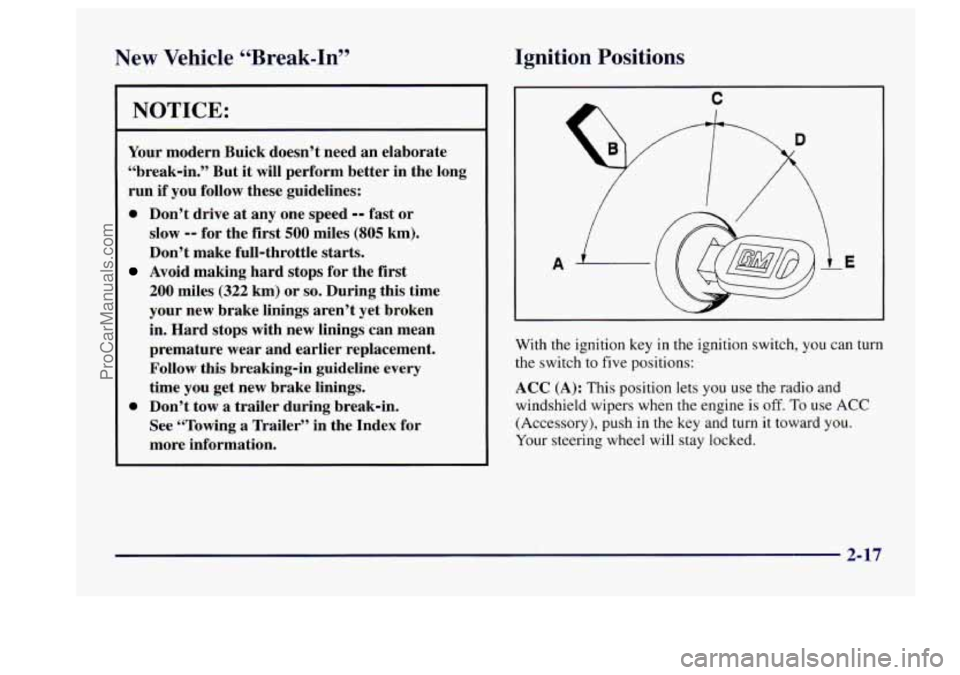
New Vehicle “Break-In”
NOTICE:
Your modern Buick doesn’t need an elaborate
“break-in.” But it will perform better in the long
run if you follow these guidelines:
0 Don’t drive at any one speed -- fast or
slow
-- for the first 500 miles (805 km).
Don’t make full-throttle starts.
200 miles (322 km) or so. During this time
your new brake linings aren’t yet broken
in. Hard stops with new linings can mean
premature wear and earlier replacement. Follow this breaking-in guideline every
time you get new brake linings.
See “Towing
a Trailer’’ in the Index for
more information.
Avoid making hard stops for the first
0 Don’t tow a trailer during break-in.
Ignition Positions
A L
With the ignition key in the ignition switch, you can turn
the switch
to five positions:
ACC
(A): This position lets you use the radio and
windshield wipers when the engine is off. To use
ACC
(Accessory), push in the key and turn it toward you.
Your steering wheel will stay locked.
2-17
ProCarManuals.com
Page 94 of 406
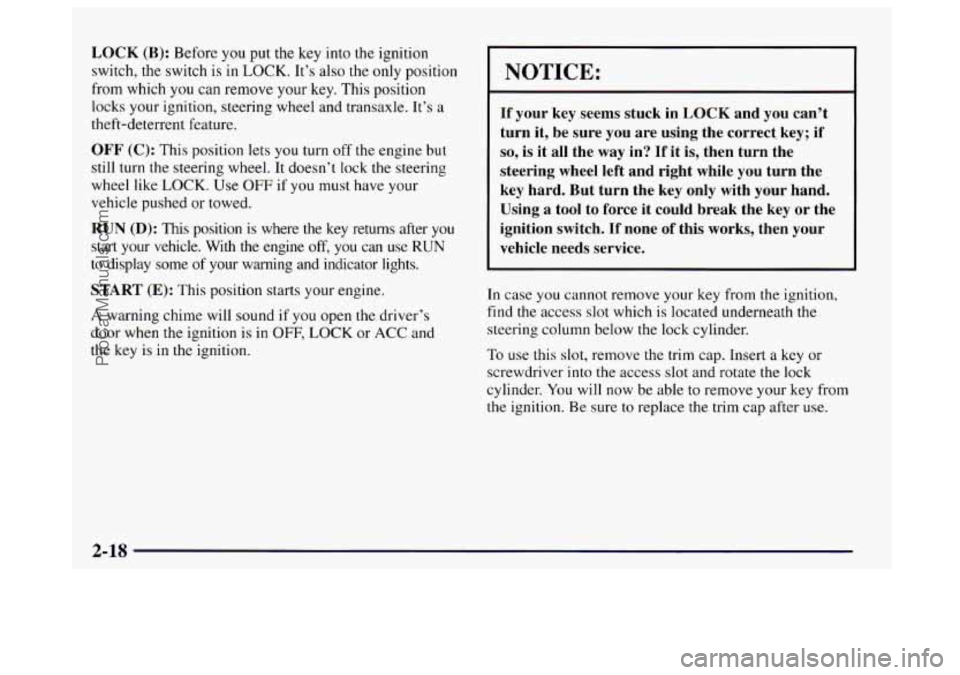
LOCK (B): Before you put the key into the ignition
switch, the switch is in
LOCK. It’s also the only position
from which you
can remove your key. This position
locks your ignition, steering wheel and transaxle. It’s
a
theft-deterrent feature.
OFF (C): This position lets you turn off the engine but
still turn
the steering wheel, It doesn’t lock the steering
wheel like
LOCK. Use OFF if you must have your
vehicle pushed or towed.
RUN (D): This position is where the key returns after you
start your vehicle. With the engine off, you can use RUN
to display some of your warning and indicator lights.
START (E): This position starts your engine.
A warning chime will sound if you open the driver’s
door when the ignition is
in OFF, LOCK or ACC and
the key is in the ignition.
NOTICE:
If your key seems stuck in LOCK and you can’t
turn it, be sure you are using the correct. key; if
so, is it all the way in? If it is, then turn the
steering wheel left and right while you turn the
key hard. But turn the key only with your hand.
Using a tool to force it
could break the key or the
ignition switch.
If none of this works, then your
vehicle needs service.
In case you cannot remove
your key from the ignition,
find the access
slot which is located underneath the
steering column below the lock cylinder.
To use this slot, remove the trim cap. Insert
a key or
screwdriver into the access slot and rotate the lock
cylinder.
You will now be able to remove your key from
the ignition. Be sure to replace the trim cap after use.
2-18
ProCarManuals.com
Page 98 of 406
Automatic Transaxle Operation PARK (P): This locks your front wheels. It’s the best
position to use when you start your engine because your
vehicle can’t move easily.
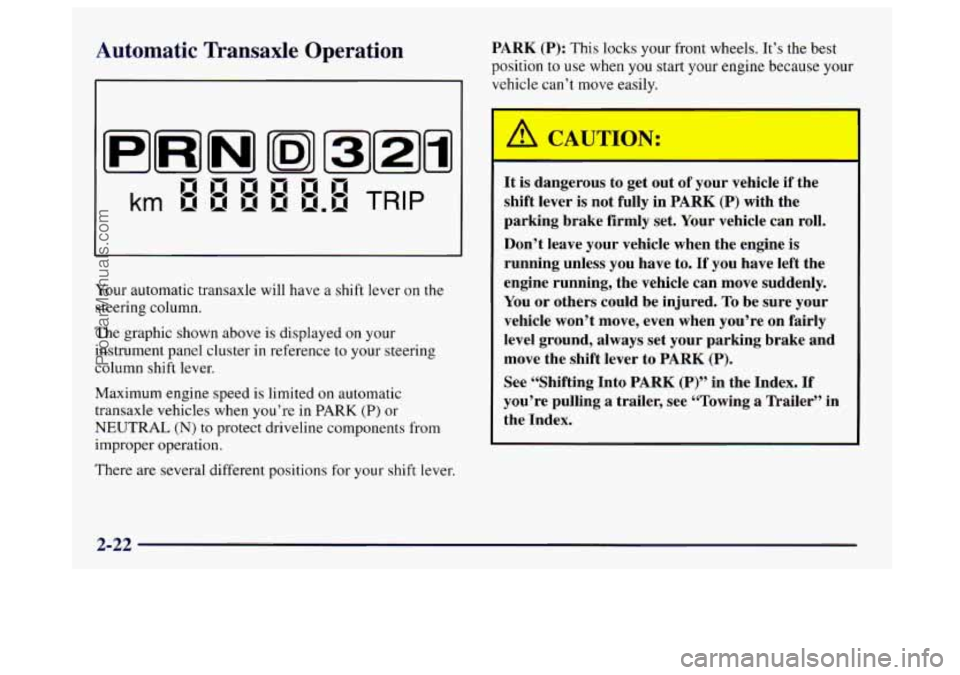
Your automatic transaxle will have
a shift lever on the
steering column.
The graphic shown above is displayed on your
instrument panel cluster
in reference to your steering
column shift lever.
Maximum engine speed is limited on automatic
transaxle vehicles when you’re in
PARK (P) or
NEUTRAL (N) to protect driveline components from
improper operation.
There are several different positions for your shift lever.
L
CAUTIO,. :
It is dangerous to get out of your vehicle if the
shift lever is not fully in
PARK (P) with the
parking brake firmly set. Your vehicle can roll.
Don’t leave your vehicle when the engine is
running unless you have
to. If you have left the
engine running, the vehicle
can move suddenly.
You or others could be injured. To be sure your
vehicle won’t move, even when you’re on fairly
level ground, always set your parking brake and
move the shift lever to
PARK (P).
See “Shifting Into PARK (P)” in the Index. If
you’re pulling a trailer, see “Towing a Trailer” in
the Index.
2-22
ProCarManuals.com
Page 99 of 406
Make sure the shift lever is fully into PARK (P) range
before starting the engine. Your Buick has
a
brake-transaxle shift interlock. You must fully apply
your regular brakes before you can shift from PARK
(P)
when the ignition is in RUN. If you cannot shift out of
PARK (P), ease pressure on the shift lever by pushing it
all the way into PARK (P) while keeping the brake pedal
pushed down. See “Shifting Out of PARK
(P)” in
the Index.
REVERSE (R): Use this gear to back up.
NOTICE:
_____~ ~~ ~~ ~
Shifting to REVERSE (R) while your vehicle is
moving forward could damage your transaxle. Shift to
REVERSE (R) only after your vehicle
is stopped.
To rock your vehicle back and forth to get out of snow,
ice or sand without damaging your transaxle, see
“Stuck:
In Sand, Mud, Ice or Snow” in the Index.
NEUTRAL (N): In this position, your engine
doesn’t connect with the wheels.
To restart when you’re
already moving, use NEUTRAL
(N) only. Also, use
NEUTRAL
(N) when your vehicle is being towed.
Shifting out of
PARK (P) or NEUTRAL (N) while
your engine
is “racing” (running at high speed) is
dangerous. Unless your foot is firmly on the
brake pedal, your vehicle could move very
rapidly. You could lose control and hit people or
objects. Don’t shift out
of PARK (P) or
NEUTRAL (N) while your engine is racing.
NOTICE:
Damage to your transaxle caused by shifting out
of PARK (P) or NEUTRAL (N) with the engine
racing isn’t covered by your warranty.
2-23
ProCarManuals.com