Page 1273 of 1354
SF0RL−02
SF−62
− SFIENGINE CONTROL MODULE (ECM)
1996 RAV4 (RM447U)
INSPECTION
1. REMOVE ECM
2. INSPECT ECM (See page DI−18)
3. REINSTALL ECM
Page 1274 of 1354
SF0RM−02
S01952
Sound
Scope
− SFIFUEL CUT RPM
SF−63
1996 RAV4 (RM447U)
FUEL CUT RPM
INSPECTION
1. WARM UP ENGINE
Allow the engine to warm up to normal operating temperature.
2. CONNECT TOYOTA HAND−HELD TESTER OR OBD II
SCAN TOOL (See page SF−1)
3. INSPECT FUEL CUT−OFF PRM
(a) Increase the engine speed to at least 2,500 rpm.
(b) Use a sound scope to check for injector operating noise.
(c) Check that when the throttle lever is released, injector op-
eration noise stops momentarily and then resumes.
HINT:
Measure with the A/C OFF.
Fuel return rpm: 1,500 rpm
4. DISCONNECT TOYOTA HAND−HELD TESTER OR
OBD II SCAN TOOL
Page 1277 of 1354

P06717
SR0FH−01
Z00038
DENSO Borroughs
P06723
CORRECT WRONG WRONG
− STEERINGDRIVE BELT
SR−3
1996 RAV4 (RM447U)
DRIVE BELT
INSPECTION
INSPECT DRIVE BELT
(a) Visually check the belt for excessive wear, frayed cords
etc.
If any defect has been found, replace the drive belt.
HINT:
Cracks on the rib side of a belt are considered acceptable. If the
belt has chunks missing from the ribs, it should be replaced.
(b) Using a belt tension gauge, measure the belt tension.
Belt tension gauge:
DENSO BTG−20 (95506−00020)
Borroughs No. BT−33−73F
Drive belt tension:
New belt: 95 − 145 lbf
Used belt: 60 − 100 lbf
If the belt tension is not as specified, adjust it.
HINT:
�”New belt” refers to a belt which has been used less than
5 minutes on a running engine.
�”Used belt” refers to a belt which has been used on a run-
ning engine for 5 minutes or more.
�After installing a belt, check that it fits properly in the
ribbed grooves.
�Check with your hand to confirm that the belt has not
slipped out of the groove on the bottom of the pulley.
�After installing a new belt, run the engine for about 5 min-
utes and recheck the belt tension.
Page 1278 of 1354
SR0FF−01
R11229
Normal Abnormal SR−4
− STEERINGPOWER STEERING FLUID
1996 RAV4 (RM447U)
POWER STEERING FLUID
BLEEDING
1. CHECK FLUID LEVEL (See page SR−5)
2. JACK UP FRONT OF VEHICLE AND SUPPORT IT
WITH STANDS
3. TURN STEERING WHEEL
With the engine stopped, turn the wheel slowly from lock to lock
several times.
4. LOWER VEHICLE
5. START ENGINE
Run the engine at idle for a few minutes.
6. TURN STEERING WHEEL
(a) With the engine idling, turn the wheel to left or right full
lock and keep it there for 2−3 seconds, then turn the
wheel to the opposite full lock and keep it there for 2−3 se-
conds.
(b) Repeat (a) several times.
7. STOP ENGINE
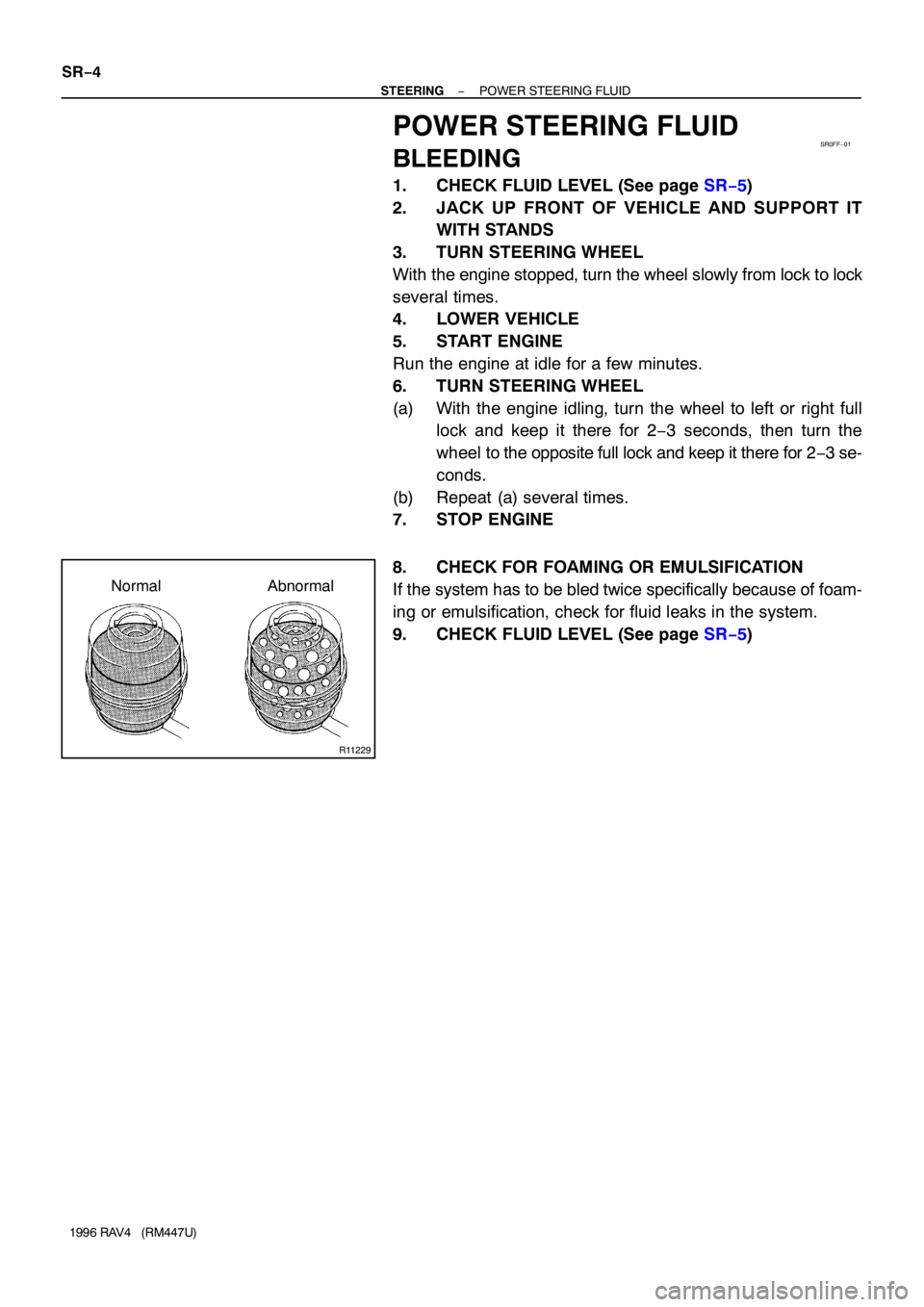
8. CHECK FOR FOAMING OR EMULSIFICATION
If the system has to be bled twice specifically because of foam-
ing or emulsification, check for fluid leaks in the system.
9. CHECK FLUID LEVEL (See page SR−5)
Page 1279 of 1354
SR0FG−01
R00427
R11229
Normal
Abnormal
R11562Engine Idling
Engine Stopped 5 mm (0.2 in.)
or less
− STEERINGPOWER STEERING FLUID
SR−5
1996 RAV4 (RM447U)
INSPECTION
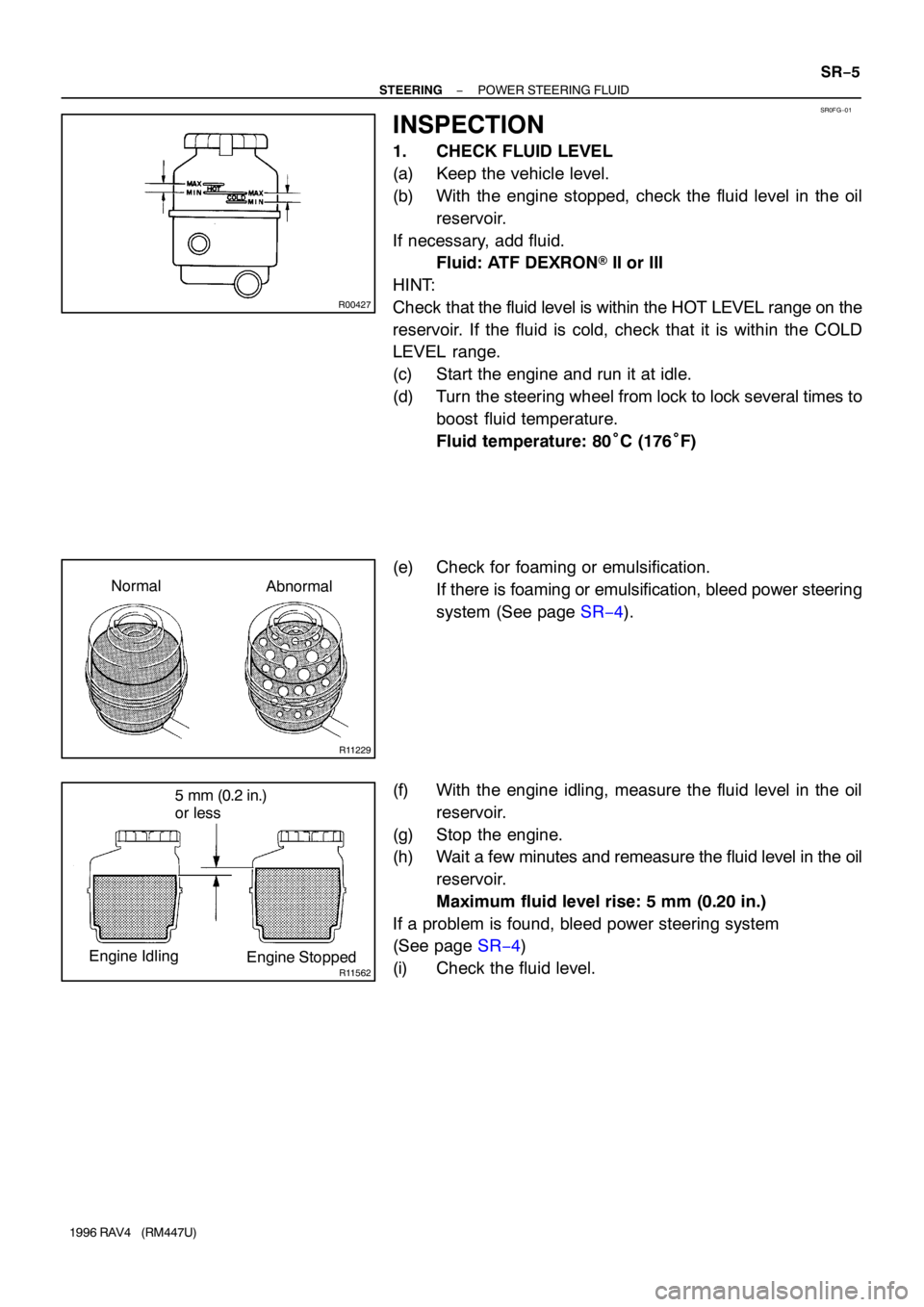
1. CHECK FLUID LEVEL
(a) Keep the vehicle level.
(b) With the engine stopped, check the fluid level in the oil
reservoir.
If necessary, add fluid.
Fluid: ATF DEXRON® II or III
HINT:
Check that the fluid level is within the HOT LEVEL range on the
reservoir. If the fluid is cold, check that it is within the COLD
LEVEL range.
(c) Start the engine and run it at idle.
(d) Turn the steering wheel from lock to lock several times to
boost fluid temperature.
Fluid temperature: 80°C (176°F)
(e) Check for foaming or emulsification.
If there is foaming or emulsification, bleed power steering
system (See page SR−4).
(f) With the engine idling, measure the fluid level in the oil
reservoir.
(g) Stop the engine.
(h) Wait a few minutes and remeasure the fluid level in the oil
reservoir.
Maximum fluid level rise: 5 mm (0.20 in.)
If a problem is found, bleed power steering system
(See page SR−4)
(i) Check the fluid level.
Page 1280 of 1354
W01159
Attachment SST
In
Out
Pressure Feed Tube SR−6
− STEERINGPOWER STEERING FLUID
1996 RAV4 (RM447U)
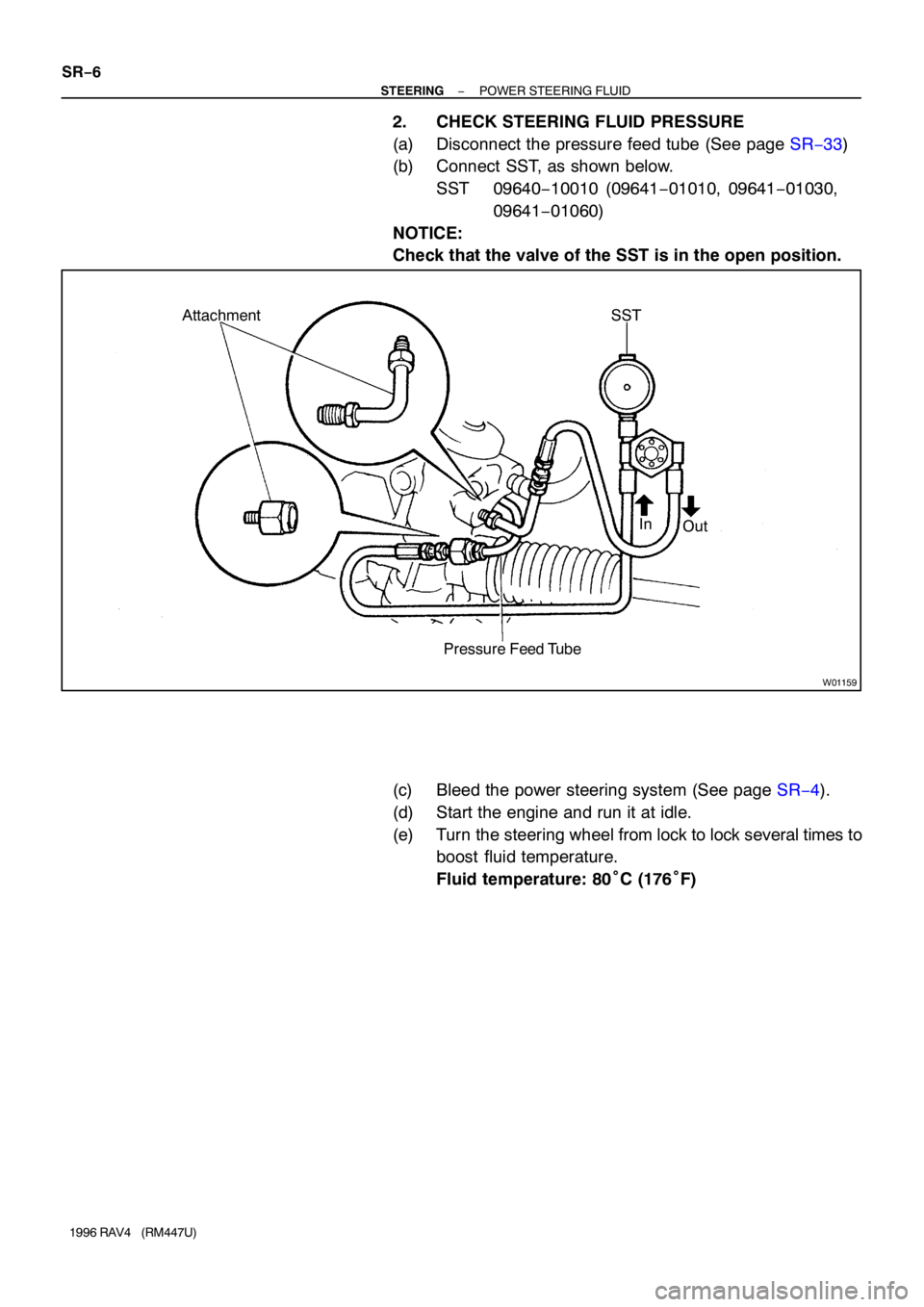
2. CHECK STEERING FLUID PRESSURE
(a) Disconnect the pressure feed tube (See page SR−33)
(b) Connect SST, as shown below.
SST 09640−10010 (09641−01010, 09641−01030,
09641−01060)
NOTICE:
Check that the valve of the SST is in the open position.
(c) Bleed the power steering system (See page SR−4).
(d) Start the engine and run it at idle.
(e) Turn the steering wheel from lock to lock several times to
boost fluid temperature.
Fluid temperature: 80°C (176°F)
Page 1281 of 1354
Z15498
Oil
Reservoir
PS Vane
Pump PS Gear
SST Closed
Z15499
Oil
Reservoir
PS Vane
Pump PS Gear
SST Open
Z15500
Oil
Reservoir
PS Vane
Pump PS Gear
SST Open Lock Position
− STEERINGPOWER STEERING FLUID
SR−7
1996 RAV4 (RM447U)
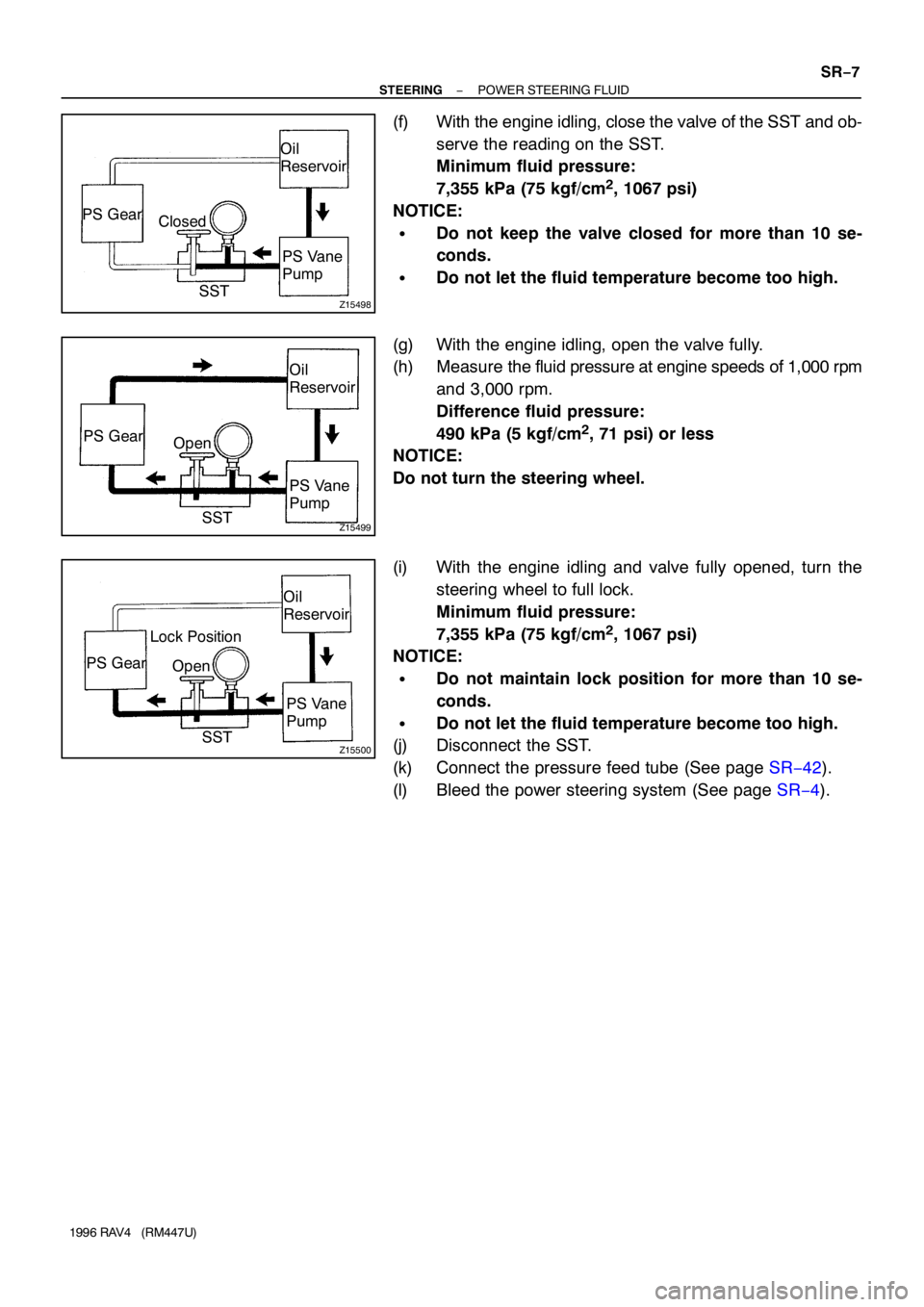
(f) With the engine idling, close the valve of the SST and ob-
serve the reading on the SST.
Minimum fluid pressure:
7,355 kPa (75 kgf/cm
2, 1067 psi)
NOTICE:
�Do not keep the valve closed for more than 10 se-
conds.
�Do not let the fluid temperature become too high.
(g) With the engine idling, open the valve fully.
(h) Measure the fluid pressure at engine speeds of 1,000 rpm
and 3,000 rpm.
Difference fluid pressure:
490 kPa (5 kgf/cm
2, 71 psi) or less
NOTICE:
Do not turn the steering wheel.
(i) With the engine idling and valve fully opened, turn the
steering wheel to full lock.
Minimum fluid pressure:
7,355 kPa (75 kgf/cm
2, 1067 psi)
NOTICE:
�Do not maintain lock position for more than 10 se-
conds.
�Do not let the fluid temperature become too high.
(j) Disconnect the SST.
(k) Connect the pressure feed tube (See page SR−42).
(l) Bleed the power steering system (See page SR−4).
Page 1282 of 1354
R10958
SR0FE−01
SR−8
− STEERINGAIR CONTROL VALVE
1996 RAV4 (RM447U)
AIR CONTROL VALVE
INSPECTION
INSPECT AIR CONTROL VALVE
(a) Turn the air conditioner switch OFF.
(b) Start the engine and run it at idle.
(c) Full turn the steering wheel.
(d) Check that the engine rpm decreases when the vacuum
hose of the air control valve is pinched.
(e) Check that the engine rpm increases when the hose is re-
leased.