Page 271 of 2890
![SUBARU LEGACY 1996 Service Repair Manual
WIRING
DIAGRAM
[D6013]
6-3
6
.
Wiring
Diagram
Data
link
connector
Testmode
878B75
~
B76
YJ
J
~mm
L
J
)
Ref
.
toAir
/
conditioning
system
.
1
Re
f
.to
Radiator
/
fan
system
.
Ref
.
toAT
control](/manual-img/17/57433/w960_57433-270.png "SUBARU LEGACY 1996 Service Repair Manual
WIRING
DIAGRAM
[D6013]
6-3
6
.
Wiring
Diagram
Data
link
connector
Testmode
878B75
~
B76
YJ
J
~mm
L
J
)
Ref
.
toAir
/
conditioning
system
.
1
Re
f
.to
Radiator
/
fan
system
.
Ref
.
toAT
control")
WIRING
DIAGRAM
[D6013]
6-3
6
.
Wiring
Diagram
Data
link
connector
Testmode
878B75
~
B76
YJ
J
~mm
L
J
)
Ref
.
toAir
/
conditioning
system
.
1
Re
f
.to
Radiator
/
fan
system
.
Ref
.
toAT
control
J
system
.
L
F
d'
3L
a0J
mo
O
~VI~
f~
MP
Enginecontro
I
BB4
module
m
>rCD
J3
3
F
.
.
..
--
~
-
S
'
K
J
'
B19
'-
818
v
--
Bl9
rl
CE
r
......
T5
~
..
....
T6
Front
Pressure
sources
oxygen
switchfr
sensor
~
.,
i
o
.,
.
B75
(Green)
2
B78
(Ye
I
low)
12
34
56789
Rear
oxygen
sensor
(California
model)
876
(Green)
2
Rear
oxygensensor
(Other
models)
Bl
(Brown)
12
818
(De
rk
gray)
21
3
OBD-
11
service
connector
N~
BGO
valve
9
(Gray)
T6
Bl9
21
43
840
(Gray)
B84
(L
1
ght
b
I
ue)
1
2
34
56
78
9l0
llt213141516
1
1
1
2
1
3
1
4
1
5
1
6
1
7
8
t718192021222324252627282930
3132
3334
3S
I
36
1
37
1
38
1
39
1
40
1
41
1
44445464748
49
50
5152
535455565758
59
60
6162
1
63
1
64
1
65
1
66
1
67
1
68
1
6
9
70
1
9
1
10
1
11
1
12
1
13
1
14
1
151671
1
72
1
73
1
74
1
75
1
76
1
77
1
78
1
79
1
80
1
81
1
82
1
83
1
84
85
86
87
88
1
89
1
9
0
1,
192
939495
96
BUR10-03B
a
Page 302 of 2890
1. Foreword
This chapter describes major inspection and service pro-
cedures for the engine mounted on the body. For proce-
dures not found in this chapter, refer to the service proce-
dure section in the applicable chapter.
2. Ignition Timing
A: MEASUREMENT
1. 2200 cc MODEL
1) Warm-up the engine.
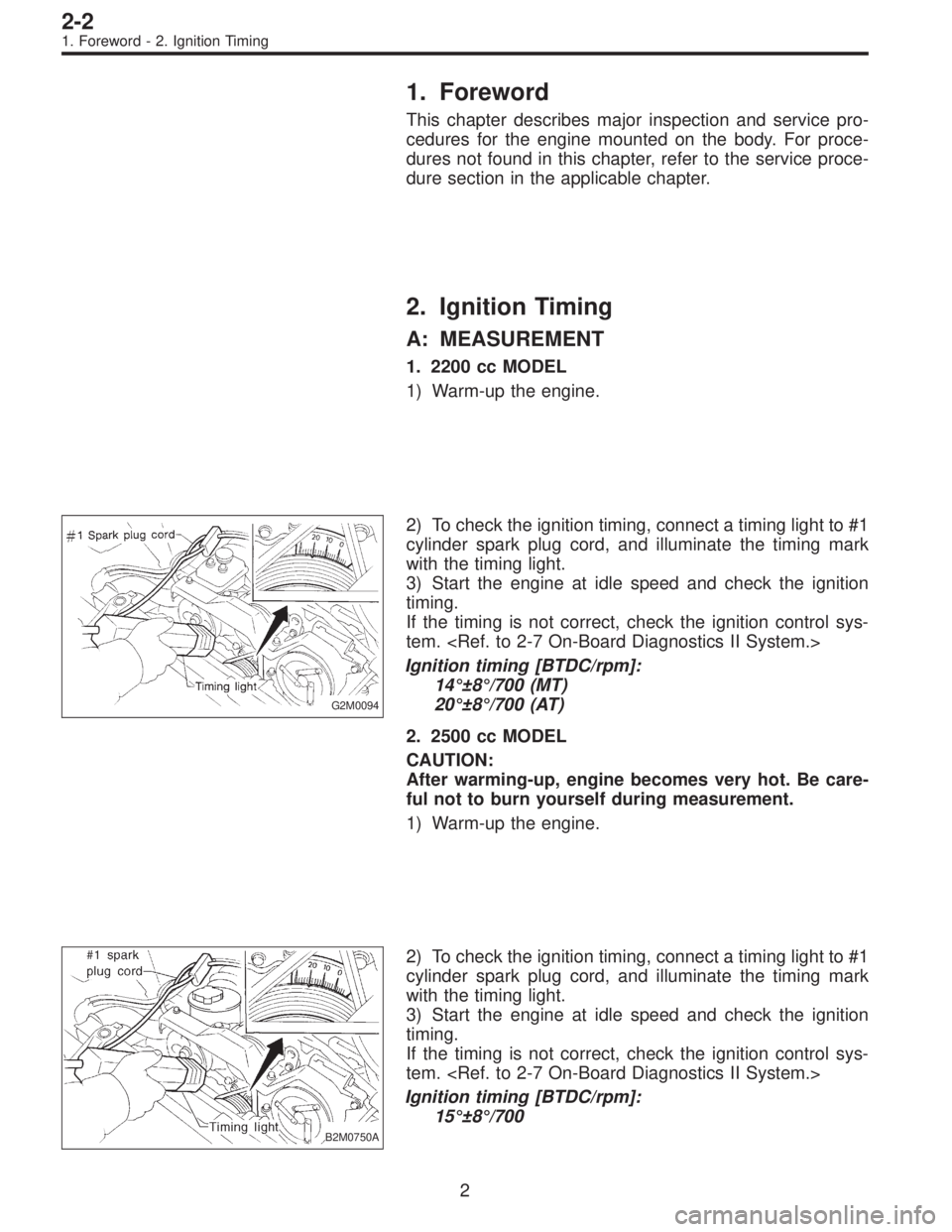
G2M0094
2) To check the ignition timing, connect a timing light to #1
cylinder spark plug cord, and illuminate the timing mark
with the timing light.
3) Start the engine at idle speed and check the ignition
timing.
If the timing is not correct, check the ignition control sys-
tem.
Ignition timing [BTDC/rpm]:
14°±8°/700 (MT)
20°±8°/700 (AT)
2. 2500 cc MODEL
CAUTION:
After warming-up, engine becomes very hot. Be care-
ful not to burn yourself during measurement.
1) Warm-up the engine.
B2M0750A
2) To check the ignition timing, connect a timing light to #1
cylinder spark plug cord, and illuminate the timing mark
with the timing light.
3) Start the engine at idle speed and check the ignition
timing.
If the timing is not correct, check the ignition control sys-
tem.
Ignition timing [BTDC/rpm]:
15°±8°/700
2
2-2
1. Foreword - 2. Ignition Timing
Page 303 of 2890
1. Foreword
This chapter describes major inspection and service pro-
cedures for the engine mounted on the body. For proce-
dures not found in this chapter, refer to the service proce-
dure section in the applicable chapter.
2. Ignition Timing
A: MEASUREMENT
1. 2200 cc MODEL
1) Warm-up the engine.
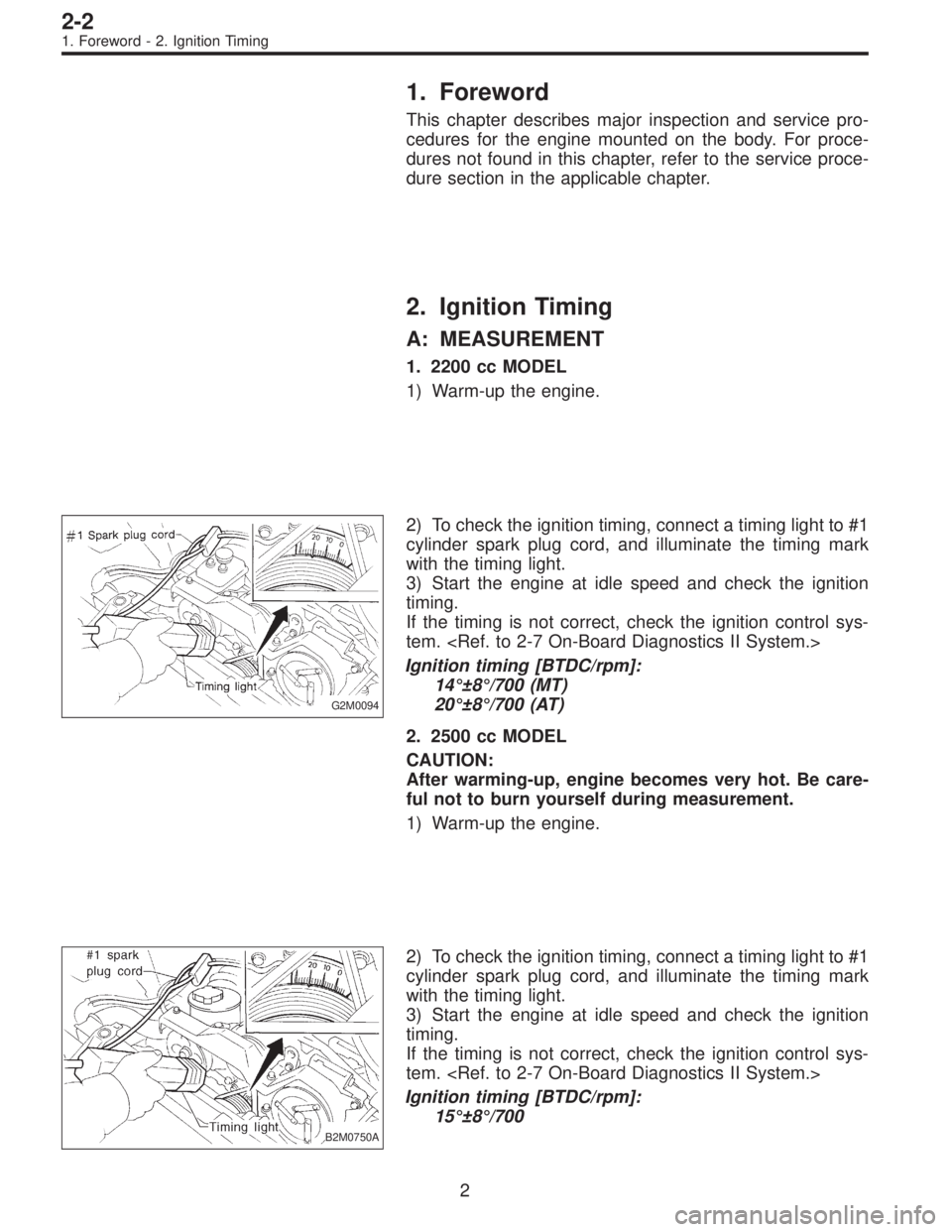
G2M0094
2) To check the ignition timing, connect a timing light to #1
cylinder spark plug cord, and illuminate the timing mark
with the timing light.
3) Start the engine at idle speed and check the ignition
timing.
If the timing is not correct, check the ignition control sys-
tem.
Ignition timing [BTDC/rpm]:
14°±8°/700 (MT)
20°±8°/700 (AT)
2. 2500 cc MODEL
CAUTION:
After warming-up, engine becomes very hot. Be care-
ful not to burn yourself during measurement.
1) Warm-up the engine.
B2M0750A
2) To check the ignition timing, connect a timing light to #1
cylinder spark plug cord, and illuminate the timing mark
with the timing light.
3) Start the engine at idle speed and check the ignition
timing.
If the timing is not correct, check the ignition control sys-
tem.
Ignition timing [BTDC/rpm]:
15°±8°/700
2
2-2
1. Foreword - 2. Ignition Timing
Page 304 of 2890
3. Engine Idle Speed
A: MEASUREMENT
1) Before checking idle speed, check the following:
(1) Ensure that air cleaner element is free from
clogging, ignition timing is correct, spark plugs are in
good condition, and that hoses are connected properly.
(2) Ensure that malfunction indicator light (CHECK
ENGINE light) does not illuminate.
2) Warm-up the engine.
G2M0096
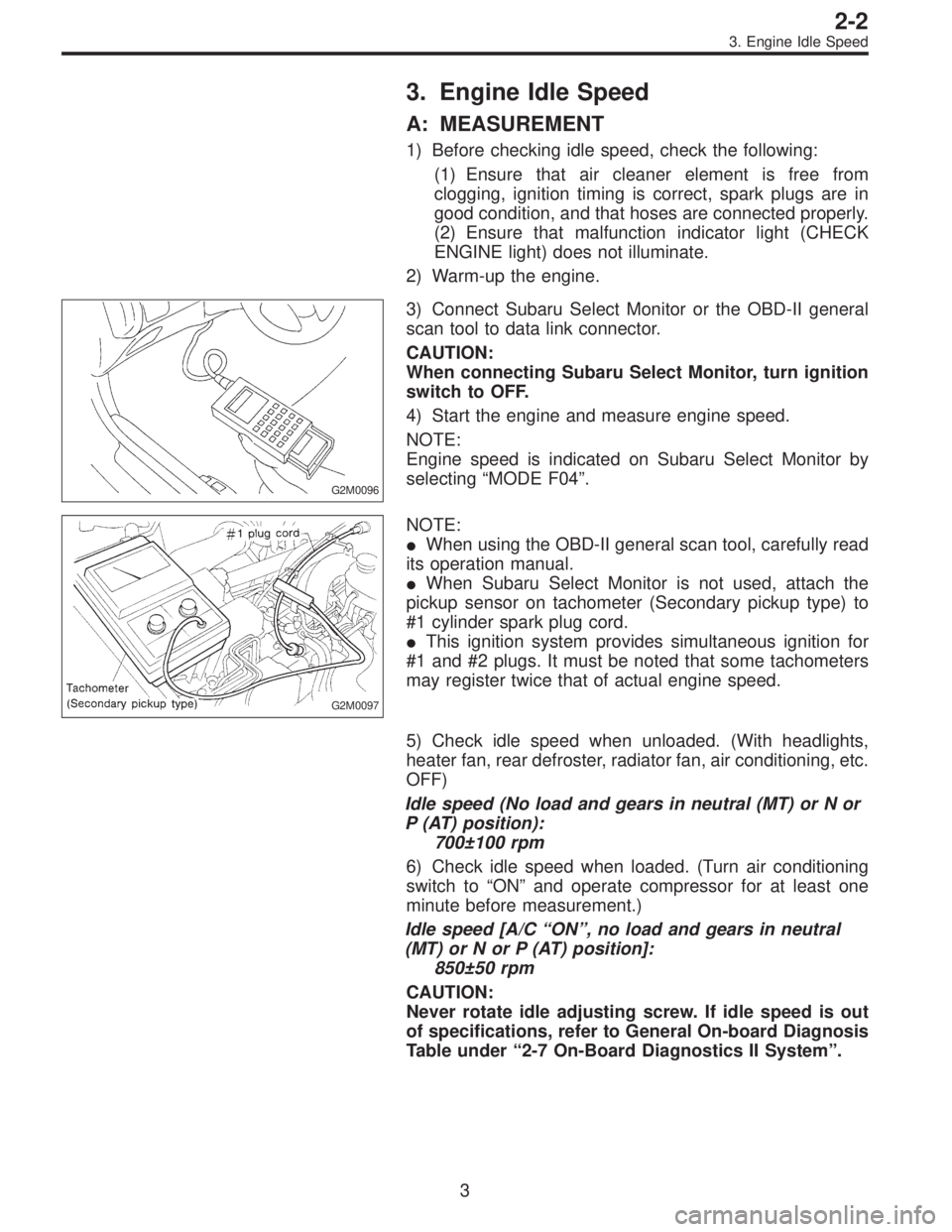
3) Connect Subaru Select Monitor or the OBD-II general
scan tool to data link connector.
CAUTION:
When connecting Subaru Select Monitor, turn ignition
switch to OFF.
4) Start the engine and measure engine speed.
NOTE:
Engine speed is indicated on Subaru Select Monitor by
selecting “MODE F04”.
G2M0097
NOTE:
�When using the OBD-II general scan tool, carefully read
its operation manual.
�When Subaru Select Monitor is not used, attach the
pickup sensor on tachometer (Secondary pickup type) to
#1 cylinder spark plug cord.
�This ignition system provides simultaneous ignition for
#1 and #2 plugs. It must be noted that some tachometers
may register twice that of actual engine speed.
5) Check idle speed when unloaded. (With headlights,
heater fan, rear defroster, radiator fan, air conditioning, etc.
OFF)
Idle speed (No load and gears in neutral (MT) or N or
P (AT) position):
700±100 rpm
6) Check idle speed when loaded. (Turn air conditioning
switch to “ON” and operate compressor for at least one
minute before measurement.)
Idle speed [A/C“ON”, no load and gears in neutral
(MT) or N or P (AT) position]:
850±50 rpm
CAUTION:
Never rotate idle adjusting screw. If idle speed is out
of specifications, refer to General On-board Diagnosis
Table under “2-7 On-Board Diagnostics II System”.
3
2-2
3. Engine Idle Speed
Page 305 of 2890
4. Engine Compression
A: MEASUREMENT
1. 2200 cc MODEL
1) After warming-up the engine, turn ignition switch to
OFF.
2) Make sure that the battery is fully charged.
3) Remove all the spark plugs.
4) Disconnect connectors from fuel injectors.
5) Fully open throttle valve.
6) Check the starter motor for satisfactory performance
and operation.
G2M0098
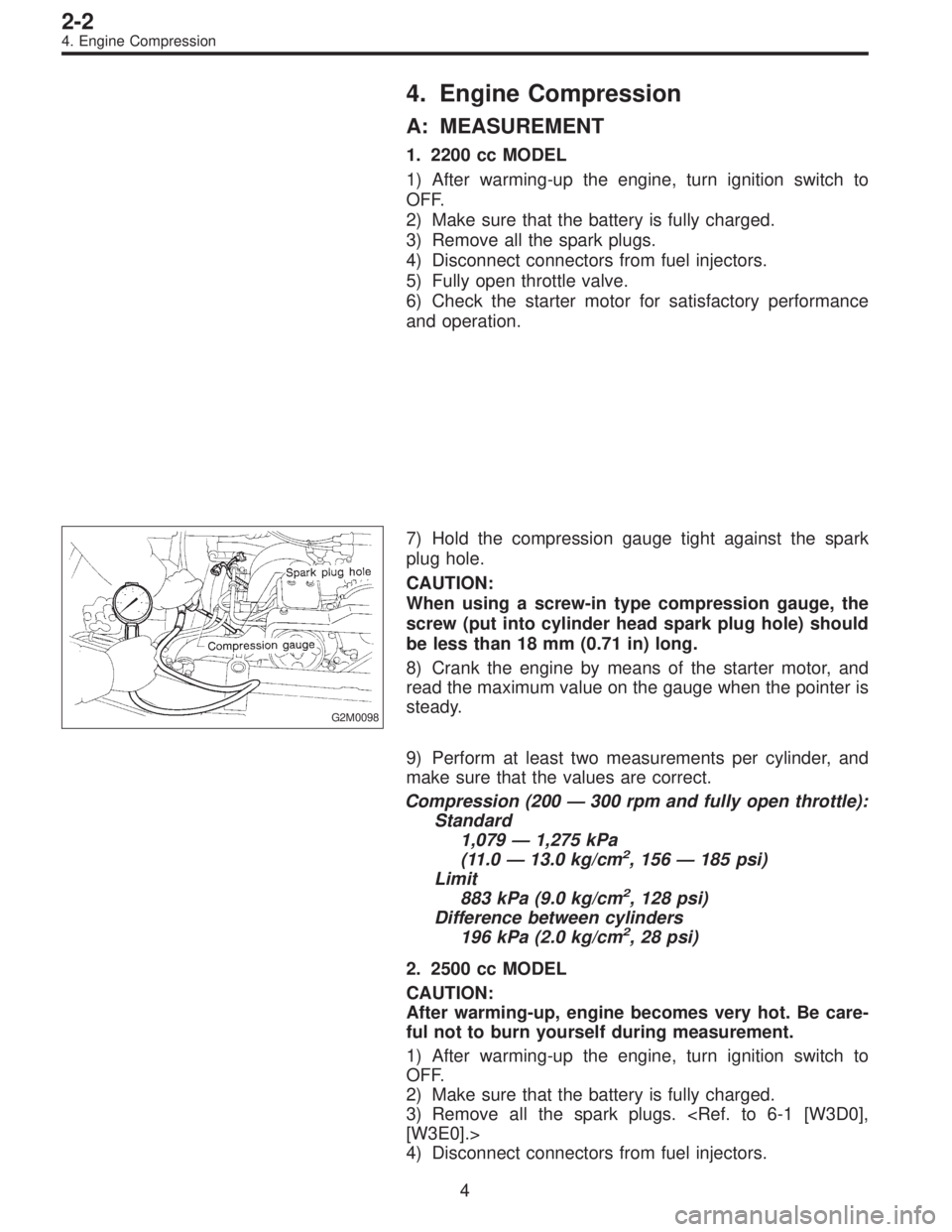
7) Hold the compression gauge tight against the spark
plug hole.
CAUTION:
When using a screw-in type compression gauge, the
screw (put into cylinder head spark plug hole) should
be less than 18 mm (0.71 in) long.
8) Crank the engine by means of the starter motor, and
read the maximum value on the gauge when the pointer is
steady.
9) Perform at least two measurements per cylinder, and
make sure that the values are correct.
Compression (200—300 rpm and fully open throttle):
Standard
1,079—1,275 kPa
(11.0—13.0 kg/cm
2, 156—185 psi)
Limit
883 kPa (9.0 kg/cm
2, 128 psi)
Difference between cylinders
196 kPa (2.0 kg/cm
2, 28 psi)
2. 2500 cc MODEL
CAUTION:
After warming-up, engine becomes very hot. Be care-
ful not to burn yourself during measurement.
1) After warming-up the engine, turn ignition switch to
OFF.
2) Make sure that the battery is fully charged.
3) Remove all the spark plugs.
[W3E0].>
4) Disconnect connectors from fuel injectors.
4
2-2
4. Engine Compression
Page 306 of 2890
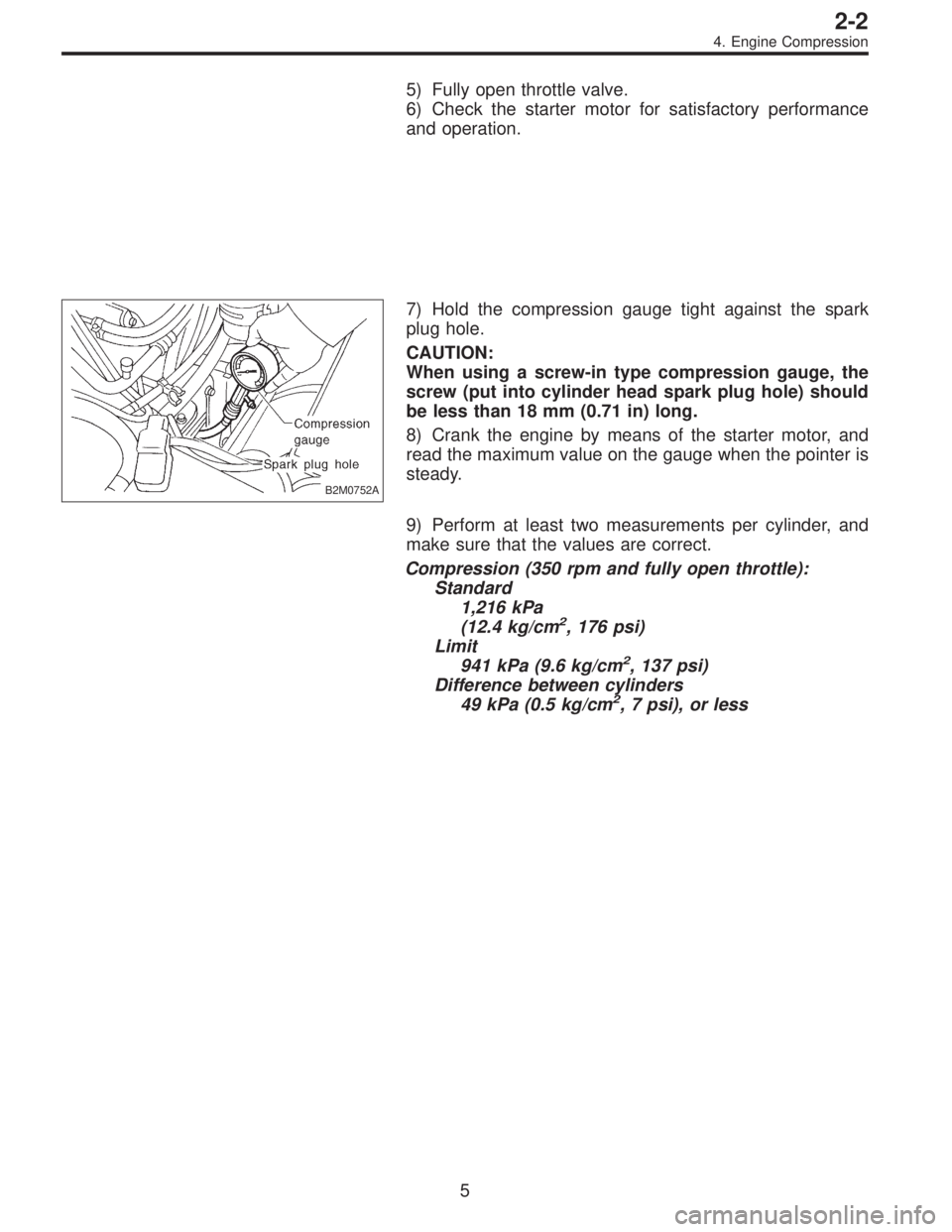
5) Fully open throttle valve.
6) Check the starter motor for satisfactory performance
and operation.
B2M0752A
7) Hold the compression gauge tight against the spark
plug hole.
CAUTION:
When using a screw-in type compression gauge, the
screw (put into cylinder head spark plug hole) should
be less than 18 mm (0.71 in) long.
8) Crank the engine by means of the starter motor, and
read the maximum value on the gauge when the pointer is
steady.
9) Perform at least two measurements per cylinder, and
make sure that the values are correct.
Compression (350 rpm and fully open throttle):
Standard
1,216 kPa
(12.4 kg/cm
2, 176 psi)
Limit
941 kPa (9.6 kg/cm
2, 137 psi)
Difference between cylinders
49 kPa (0.5 kg/cm
2, 7 psi), or less
5
2-2
4. Engine Compression
Page 307 of 2890
5. Intake Manifold Vacuum
A: MEASUREMENT
1) Warm-up the engine.
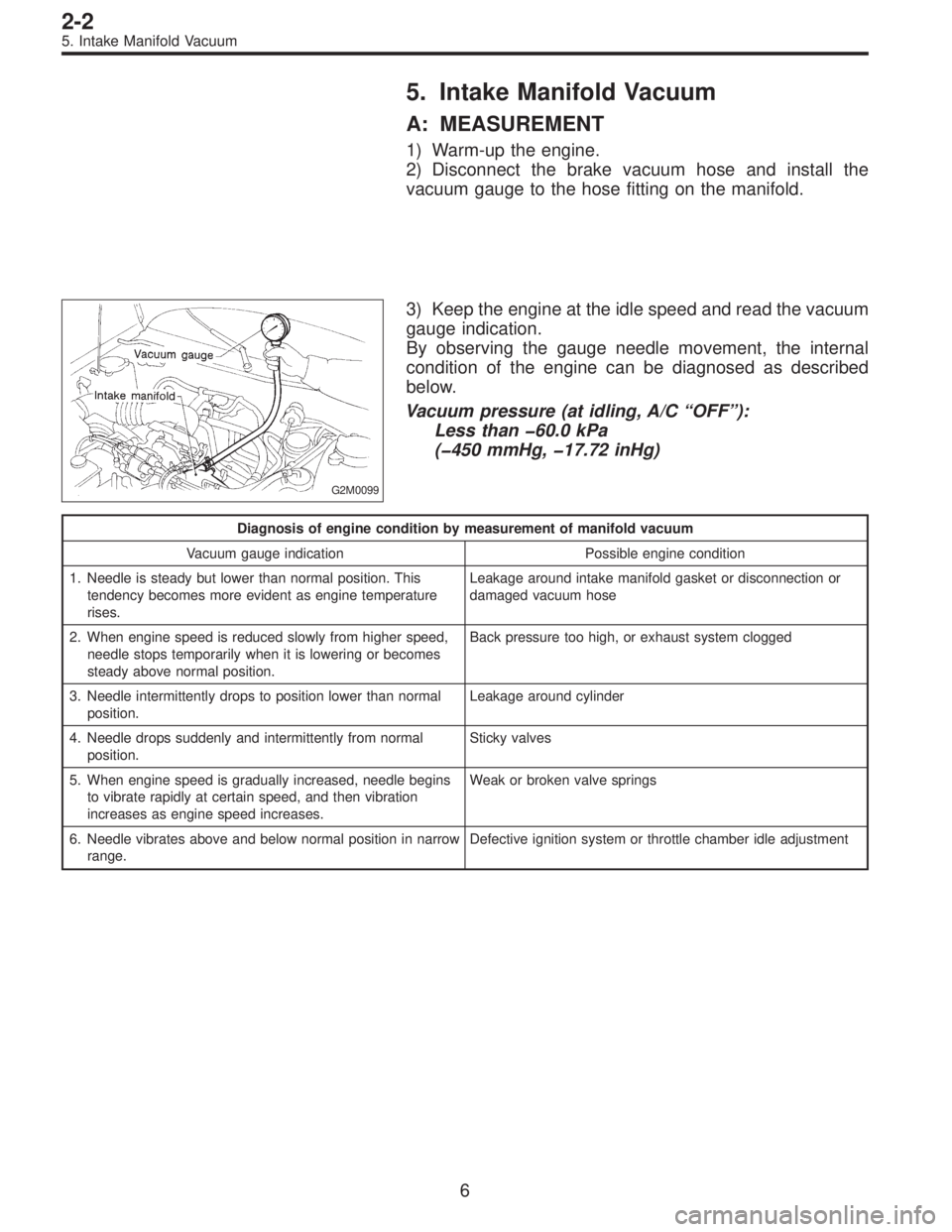
2) Disconnect the brake vacuum hose and install the
vacuum gauge to the hose fitting on the manifold.
G2M0099
3) Keep the engine at the idle speed and read the vacuum
gauge indication.
By observing the gauge needle movement, the internal
condition of the engine can be diagnosed as described
below.
Vacuum pressure (at idling, A/C“OFF”):
Less than 60.0 kPa
(450 mmHg, 17.72 inHg)
Diagnosis of engine condition by measurement of manifold vacuum
Vacuum gauge indication Possible engine condition
1. Needle is steady but lower than normal position. This
tendency becomes more evident as engine temperature
rises.Leakage around intake manifold gasket or disconnection or
damaged vacuum hose
2. When engine speed is reduced slowly from higher speed,
needle stops temporarily when it is lowering or becomes
steady above normal position.Back pressure too high, or exhaust system clogged
3. Needle intermittently drops to position lower than normal
position.Leakage around cylinder
4. Needle drops suddenly and intermittently from normal
position.Sticky valves
5. When engine speed is gradually increased, needle begins
to vibrate rapidly at certain speed, and then vibration
increases as engine speed increases.Weak or broken valve springs
6. Needle vibrates above and below normal position in narrow
range.Defective ignition system or throttle chamber idle adjustment
6
2-2
5. Intake Manifold Vacuum
Page 308 of 2890
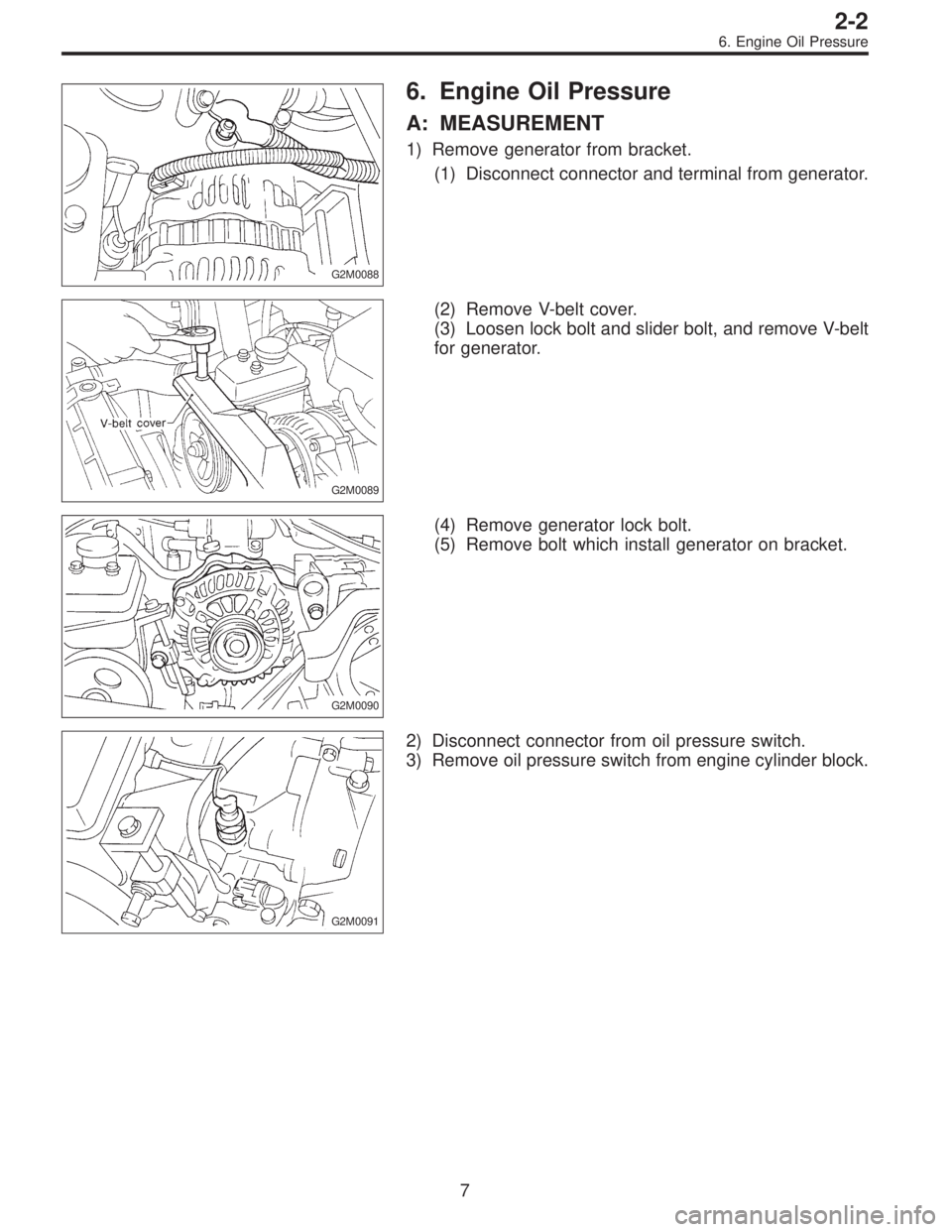
G2M0088
6. Engine Oil Pressure
A: MEASUREMENT
1) Remove generator from bracket.
(1) Disconnect connector and terminal from generator.
G2M0089
(2) Remove V-belt cover.
(3) Loosen lock bolt and slider bolt, and remove V-belt
for generator.
G2M0090
(4) Remove generator lock bolt.
(5) Remove bolt which install generator on bracket.
G2M0091
2) Disconnect connector from oil pressure switch.
3) Remove oil pressure switch from engine cylinder block.
7
2-2
6. Engine Oil Pressure