Page 234 of 320

Use only recommended fuels, lubricants, fluids,
and service parts conforming to Ford
specifications. Motorcraft parts are designed and
built to provide the best performance in your
vehicle. Using these parts for replacement is your
assurance that Ford-buflt quality stays in your
vehicle.
NOTE: Always dispose of used automotive fluids
in a responsible manner. Follow your community's
standards for disposing of these types of fluids.
Call your local recycling center to find out about
recycling automotive fluids.
Accident Damage
Should your vehicle suffer accident damage
requiring new sheet metal or plastic replacement
parts, be sure your repair shop uses only genuine
Ford replacement parts.
While imitation body parts may appear similar to
genuine Ford parts on the surface, differences in
232quality become obvious when both are subjected to
standard Ford quality tests.
Ford tests indicate that you should be concerned with
the quality of the fit and finish, corrosion resistance
and structural integrity of these imitation replacement
parts, and how their use will affect your warranty.
How Can You Protect Yourself?.
Before any repair work begins, tell your adjuster that
you want your vehicle repaired using only genuine
Ford body parts. If the adjuster refuses, contact your
insurance agent for help. If your agent and your
insurance company refuse to repair your vehicle with
original factory parts, you should contact your state
insurance commissioner, the National Highway Traffic
Safety Administration or a local consumer protection
agency.
In Canada, contact provincial insurance
commissioners, Transport Canada or local consumer
protection groups.
Page 238 of 320
Whenever you close the hood, latch it securely.
NOTE: Apply lubricant to the hood latch at six-
month intervals to maintain smooth and trouble-
free operation.
NOTE: Read and understand Precautions When
Servicing Your Vehicle at the beginning of this
chapter before opening the hood.
236Engine Compartment
Your vehicle has a 4.6 liter 4V SFI engine. The
following page shows a diagram of where to find
items that you should regularly service.
Page 239 of 320
Engine coolant reservoir Power steering fluid reservoir Windshield washer fluid reservoir Engine oil filler cap Hood safety release High current fuse box Engine oil
dipstick Air filterEngine compartment service points
237
Page 242 of 320
/!\ WARNINGIf you do not use the proper fuel cap, thepressure in the fuel tank can damage the fuelsystem or cause it to work improperly in acollision.NOTE: If you replace your fuel cap with an
aftermarket fuel filler cap, the customer warranty
may be void for any damage to the fuel tank and/or
fuel system.
Choosing the Right Fuel
Use only PREMIUM UNLEADED FUEL in your
vehicle. Using leaded fuel is prohibited by federal
law. Your warranty may not apply if your vehicle is
damaged because you used the wrong fuel.
Octane recommendations
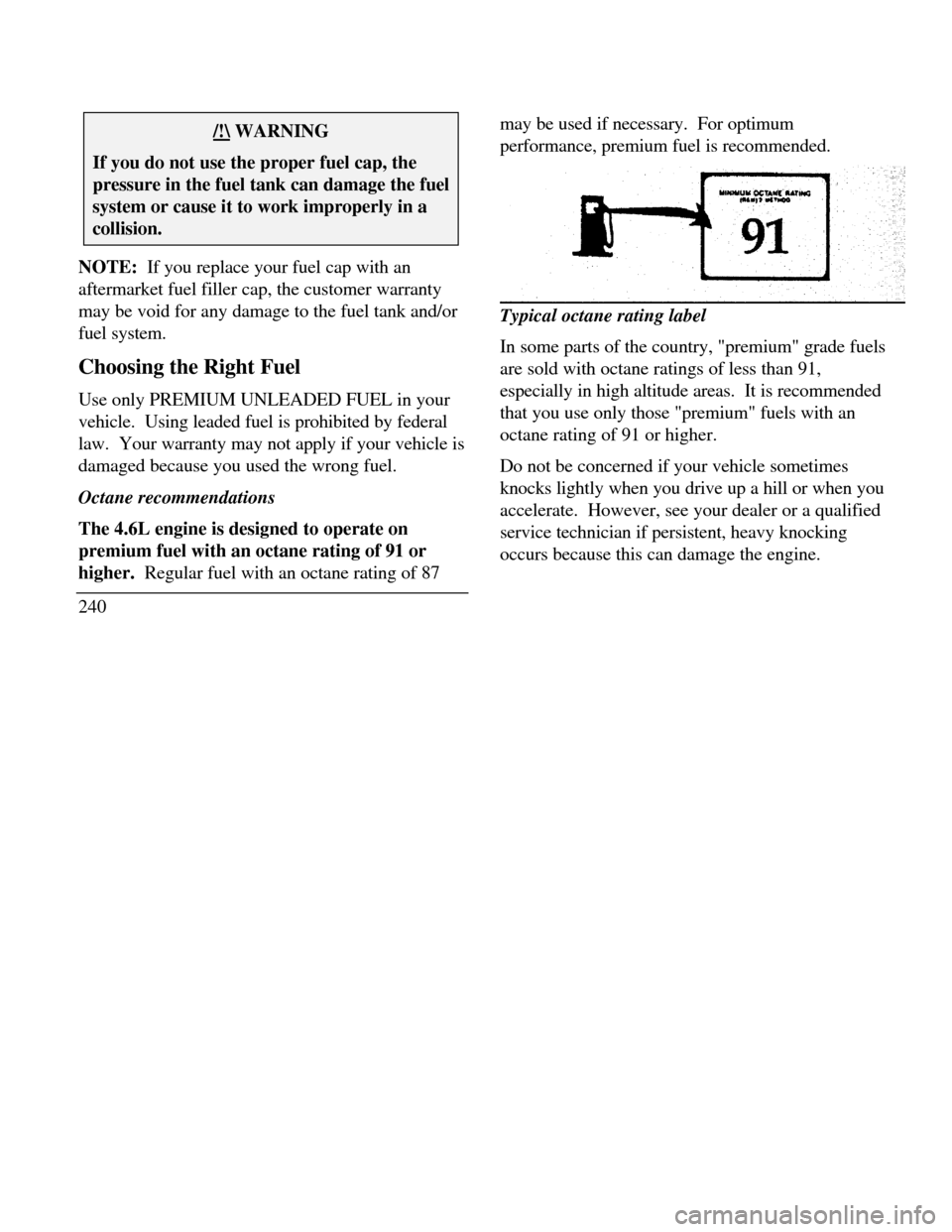
The 4.6L engine is designed to operate on
premium fuel with an octane rating of 91 or
higher. Regular fuel with an octane rating of 87
240may be used if necessary. For optimum
performance, premium fuel is recommended.Typical octane rating label
In some parts of the country, "premium" grade fuels
are sold with octane ratings of less than 91,
especially in high altitude areas. It is recommended
that you use only those "premium" fuels with an
octane rating of 91 or higher.
Do not be concerned if your vehicle sometimes
knocks lightly when you drive up a hill or when you
accelerate. However, see your dealer or a qualified
service technician if persistent, heavy knocking
occurs because this can damage the engine.
Page 243 of 320
If you are experiencing starting, rough idle or
hesitation problems when the engine is cold, it may
be caused by fuel with low volatility. Try a different
brand of fuel. If the condition persists, see your
dealer or a qualified service technician.
Gasolines for clean air
Fuels in certain areas of the country are required to
contain oxygenates to improve air quality.
Common oxygenates are ethanol or grain alcohol
(blended at no more than 10%), methanol or wood
alcohol (blended at no more than 5% with
cosolvents and additives), and MTBE or methyl
tertiary butyl ether (blended at no more than 15%).
Generally, you should not experience difficulties
operating your vehicle on fuels containing
oxygenates. We encourage you to use these fuels.Safety Information Relating to Automotive
Fuels/!\ WARNINGAutomotive fuels can cause serious injury ordeath if misused or mishandled. Turn vehicle off when refueling. Do not smoke when refueling. Fuels are
extremely flammable. Do not siphon any fuel by mouth./!\ WARNINGGasoline or gasoline blended with methanolcan cause blindness and possible death whenswallowed. If any fuel is swallowed, callphysician or poison control centerimmediately.241
Page 246 of 320

Using speed control in hilly terrain Extended use of the A/C, defroster, rear window
defroster and other accessories Underinflated tires Heavy loads Aftermarket add-ons such as bike, ski or luggage
racks, bug deflectors, etc.
Self-Service Pointers
If you choose to do your own fueling, you should
also perform a few simple maintenance routines.
This extra effort will save you additional money and
contribute to the driving efficiency of your vehicle.
The following procedures require only a tire gauge,
a rag, an oil can spout and windshield washer fluid.Check the engine oil at every refueling stopClean the windshield, outside mirrors and
headlights
244 Check windshield washer fluid Check tires for excessive wear or worn edges Check the tire pressure at least monthly
Engine Oil Recommendations
We recommend using Motorcraft oil or an equivalent
oil meeting Ford Specification ESE-M2C153-E and
displaying the American Petroleum Institute
CERTIFICATION MARK on the front of the
container.
Page 250 of 320

Your vehicle's coolant protects your engine from
overheating in the summer and from freezing in the
winter. Check the level of the coolant at least once
a month. Simply look at the engine coolant
reservoir located in the engine compartment. To
locate the reservoir, see the diagram of your
vehicle's engine under Engine Type, in this chapter.
Check the engine coolant level in the engine coolant
reservoir at least once a month using the following
guidelines.
When your vehicle's engine is cool, the coolant level
in the engine coolant reservoir should be at the top
of the clear portion of the reservoir. If the level is
below the cold fill level, coolant may need to be
added.
The coolant additives also protect the entire cooling
system from internal passageway corrosion and
these additives lubricate the water pump. The
coolant should be serviced as noted in the
Maintenance Schedule and Record booklet.
248Adding engine coolant/!\ WARNINGDo not put engine coolant in the containerfor the windshield washer fluid.If sprayed to clean the glass, engine coolant or
antifreeze could make it difficult to see through the
windshield./!\ WARNINGNever remove the pressure cap while theengine is running or hot. Follow these stepsto avoid personal injury that can be causedby escaping steam or engine coolant.1. Before you remove the cap, turn the engine off
and let it cool. Even when the engine is cool, be
careful when you remove the pressure cap.
Page 252 of 320

your engine cooling system. Follow the
recommended service interval for changing your
engine coolant.
NOTE: When you change or add engine coolant, it
is important to maintain your engine coolant
concentration between 40% (-11°F [-24°C]) and
60% (-62°F [-52°C]), depending on your local
climate conditions. Below 40% you will lose freeze
protection; above 60% your engine may overheat
on a warm day.
NOTE: Less than 40% of coolant concentration
may cause engine corrosion and overheating. Plain
water may be used in an emergency only. Replace
it with the specified coolant as quickly as possible.
NOTE: The use of an improper coolant may void
your warranty for the engine cooling system. Use
only a premium, nationally recognized brand name
engine coolant. Do not use alcohol, methanol
antifreeze or engine coolant mixed with alcohol or
methanol antifreeze. If you do not use the proper
250coolant, the aluminum engine on your vehicle will
corrode.
Ford Motor Company expressly authorizes the Ford
Rotunda engine coolant recycling process and
chemicals. Use only Ford Rotunda recycled engine
coolant or an equivalent recycled engine coolant that
is certified by the supplier to meet Ford specification
ESE-M97B44-A.
NOTE: Always dispose of used automotive fluids
in a responsible manner. Follow your community's
standards for disposing of these types of fluids. Call
your local recycling center to find out about
recycling automotive fluids.
Use Ford Premium Cooling System Fluid E2FZ-
19549-AA (in Canada, Motorcraft CXC-8-B) or an
equivalent engine coolant that meets Ford
Specification ESE-M97B44-A.