Page 181 of 320
Some FM radio stations advertise a "rounded-
off" frequency which is not the frequency they
actually broadcast on. For example, a radio
station that is assigned a frequency of 98.7 MHz
may call itself "Radio 99" even though 99.0
MHz is not an allowable FM broadcast
frequency.
178Important Warranty and
Service Information
About Your Warranty
Your sound system is warranted for four
years or 50,000 miles (whichever occurs
first). Consult your vehicle warranty booklet
for further information.
Servicing Your Audio System
At Ford Electronics, we stand behind our
audio systems with a comprehensive service
and repair program. If anything should go
wrong with your Ford audio system, return to
your dealer for service. There is a nationwide
network of qualified Ford authorized repair
centers to assist you.
Page 190 of 320

Brakes
Applying the Brakes
Your vehicle has anti-lock disc brakes on all four
wheels. They adjust automatically as the brake pads
wear down.
When you press down hard on the brake pedal, the
wheels will not lock and slide. The Anti-lock Brake
System (ABS) automatically starts releasing and
reapplying the front brakes independently and the
rear brakes together whenever your wheels start to
lock. When this happens, you will feel the brake
pedal pulsate. This is an indication that the ABS
system is working correctly and is normal.
Each time you turn the ignition key to the ON
position, the anti-lock brake system will function
through one test cycle. When this happens, the ANTI-
LOCK light will come on for up to five seconds and a
clunk may be felt in the pedal. If the light stays on
longer than five seconds, shut off theengine and restart. If it remains on, it means the
anti-lock brake system is disabled and should be
serviced immediately to restore the benefits of
the anti-lock feature. Normal braking is not
affected unless the brake warning light is also lit.
The And-lock Brake System has self-check
capabilities. As described above, the system
turns on the ANTI-LOCK light each time you
start your engine. After the engine is started
and the ANTI-LOCK light turns off, the system
performs another test the first time the vehicle
reaches 14 m.p.h. (22 km/h). The system turns
on the ABS pump motor for approximately 1/2
second. At this time, a mechanical noise may
be heard. This is a normal part of the self-
check feature. If a malfunction is found during
this check the ANTI-LOCK light will come on.
Do not drive with your foot resting on the
brake pedal; you will wear out the linings and
increase your vehicle's stopping distance.
Brake rotor damage may also eventually occur.
187
Page 191 of 320

NOTE: If you are driving down a long or steep hill,
shift to a lower gear and do not apply your brakes
continuously. If you apply your brakes continuously,
they may overheat and become less effective.
Occasional brake squeal during light to moderate
stops does not affect the function of the brake system
and is normal. However, if the squeal becomes
louder or more frequent, have your brakes inspected
by your dealer or a qualified service technician.
Ford Motor Company has not found any detrimental
effects of popular mobile radio transmitting
equipment installed on vehicles with the anti-lock
brake system, if the equipment is installed according
to the manufacturer's instructions. However, if
mobile radio transmitting
188equipment is installed in your vehicle and, if
either the anti-lock brake system cycles or the
ANTI-LOCK light comes on at any time other
than right after you turn the key to the ON
position or during a sudden stop, have your
mobile radio dealer inspect the installation.
Parking Brake
The parking brake should be used whenever
you park your vehicle.
The parking brake is suspended just below the
lower left corner of the instrument panel.
To set the parking brake while parking your
vehicle, apply the brake pedal with your right
foot and hold it while you push the parking
brake down firmly and fully with your left foot.
Page 198 of 320
Service your vehicle more frequently if you tow a
trailer. (See Servicing your vehicle if you tow in
this chapter.)
Ten to 15% of the loaded trailer's weight should be
on the tongue. However, the tongue load should
never exceed 10% of the maximum weight that your
vehicle can safely tow.
New vehicles should be driven 2,000 miles (3,200
km) before towing a trailer./!\ WARNINGTowing trailers beyond the maximumrecommended gross trailer weight exceeds thelimit of the vehicle and could result in enginedamage, transaxle damage, structuraldamage, loss of control, and personal injury./!\ WARNINGDo not tow a trailer when thetemporary spare tire is being used.See the following chart for the amount of
weight your vehicle can tow.
195
Page 201 of 320

Driving While You Tow
Be especially careful when driving while you tow a
trailer. Never drive faster than 45 mph (70 km/h)
when you tow in hilly country on hot days. Also,
anticipate stops so that you can brake gradually.
Towing a trailer increases the load on the engine and
transaxle, particularly in hilly country and with
heavier trailers. Under these conditions you may
experience an excessive amount of shifting between
Overdrive and Third gears. Moving the shift selector
to D (Overdrive Lockout) will keep this from
happening and will provide better engine braking.
When driving in less hilly country or with a lighter
trailer load. you may move the gearshift selector
lever to (Overdrive) without experiencing
excessive shifting.
198When driving down steep hills, you should put
the gearshift selector lever in the I (First)
position to shift the transaxle into second gear.
This will provide additional engine braking.
The automatic transaxle will automatically
downshift to the proper gear for driving up a
grade.
If you use the speed control while you are
towing on very long, steep grades, the speed
control may shut off.
Servicing your vehicle if you tow
If you tow a trailer for a long distance, your
vehicle will need to be serviced more frequently
than usual. See the Maintenance Schedule and
Record booklet.
Page 203 of 320

/! WARNINGBatteries contain sulfuric acid which bumsskin, eyes, and clothing.If the acid touches someone's skin, eyes, or clothing,
immediately flush the area with water for at least 15
minutes. If someone swallows the acid, have him or
her drink lots of milk or water first, then Milk of
Magnesia, a beaten egg, or vegetable oil. Call a
doctor immediately.
To avoid damaging your vehicle or your battery, and
to avoid injury to yourself, follow these directions
for preparing your vehicle to jump-start and
connecting the jumper cables in the order they are
given. If in doubt, call for road service.
200Preparing Your Vehicle
1 .Your vehicle has a 12-volt starting system, so
you need to use a 12-volt jumper system. You
will damage your starting motor, ignition system,
and other electrical parts if you connect them to a
24-volt power supply (either two 12-volt
batteries in series,or a 24-volt generator set).
2.Do not disconnect the battery of the disabled
vehicle. You could damage the vehicle's
electrical system.
3.Park the booster vehicle close to the hood of the
disabled vehicle. Make sure the vehicles do not
touch each other. Set the parking brake on both
vehicles and stay clear of the engine cooling fan
and other moving parts.
4.Check all battery terminals and remove any
excessive corrosion before you attach the jumper
cables.
Page 211 of 320
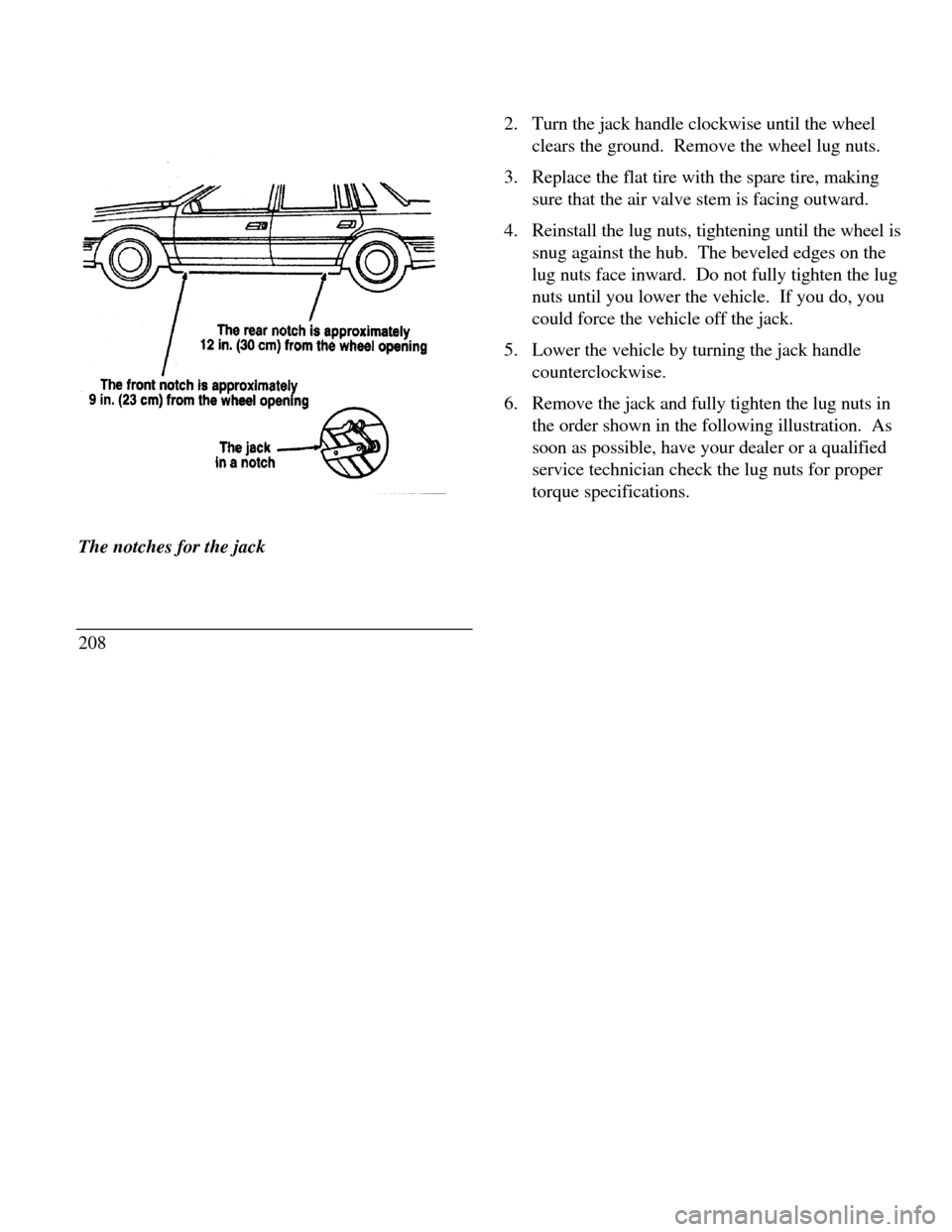
The notches for the jack
2082. Turn the jack handle clockwise until the wheel
clears the ground. Remove the wheel lug nuts.
3. Replace the flat tire with the spare tire, making
sure that the air valve stem is facing outward.
4. Reinstall the lug nuts, tightening until the wheel is
snug against the hub. The beveled edges on the
lug nuts face inward. Do not fully tighten the lug
nuts until you lower the vehicle. If you do, you
could force the vehicle off the jack.
5. Lower the vehicle by turning the jack handle
counterclockwise.
6. Remove the jack and fully tighten the lug nuts in
the order shown in the following illustration. As
soon as possible, have your dealer or a qualified
service technician check the lug nuts for proper
torque specifications.
7.
8.
Page 214 of 320
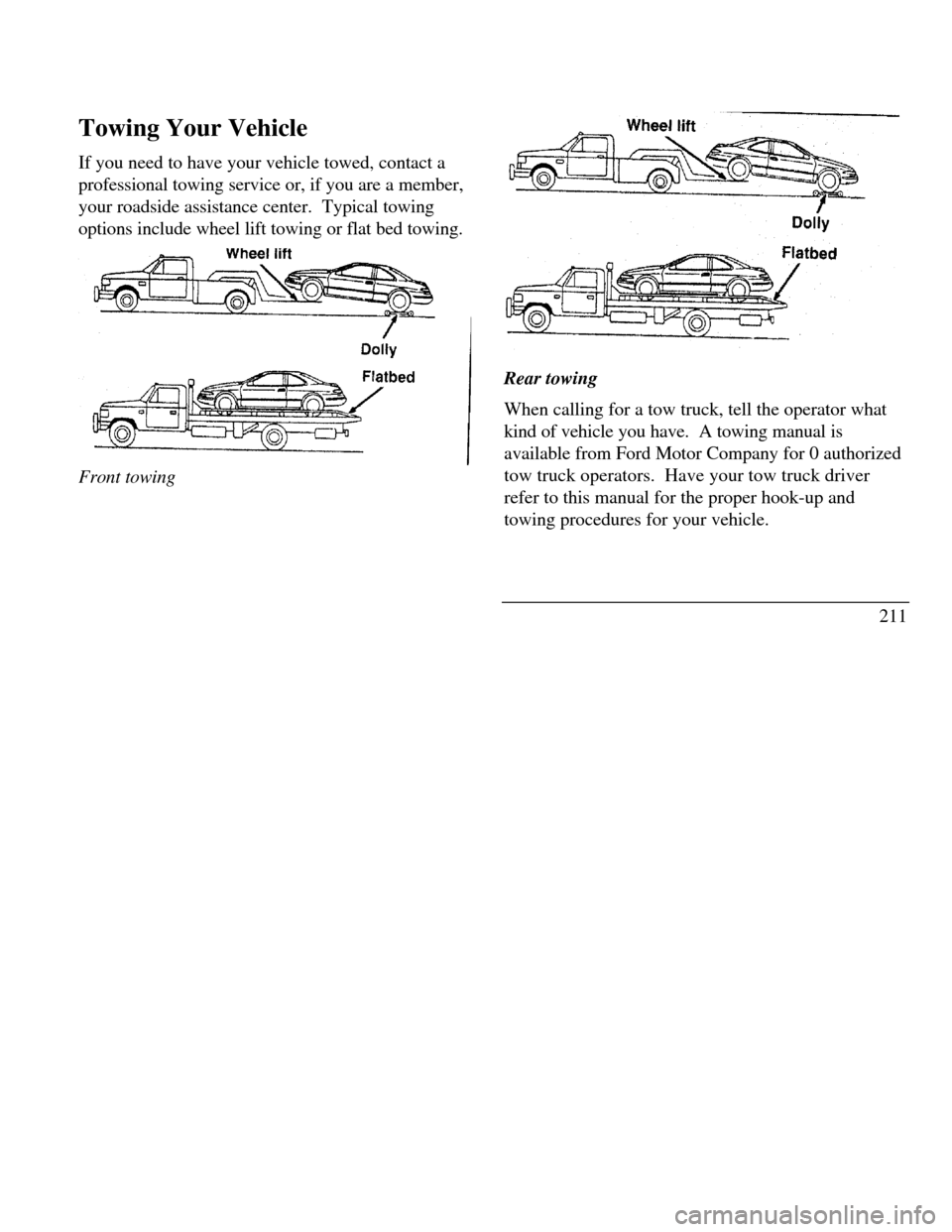
Towing Your Vehicle
If you need to have your vehicle towed, contact a
professional towing service or, if you are a member,
your roadside assistance center. Typical towing
options include wheel lift towing or flat bed towing.Front towingRear towing
When calling for a tow truck, tell the operator what
kind of vehicle you have. A towing manual is
available from Ford Motor Company for 0 authorized
tow truck operators. Have your tow truck driver
refer to this manual for the proper hook-up and
towing procedures for your vehicle.
211