1996 CHRYSLER VOYAGER lock
[x] Cancel search: lockPage 1735 of 1938
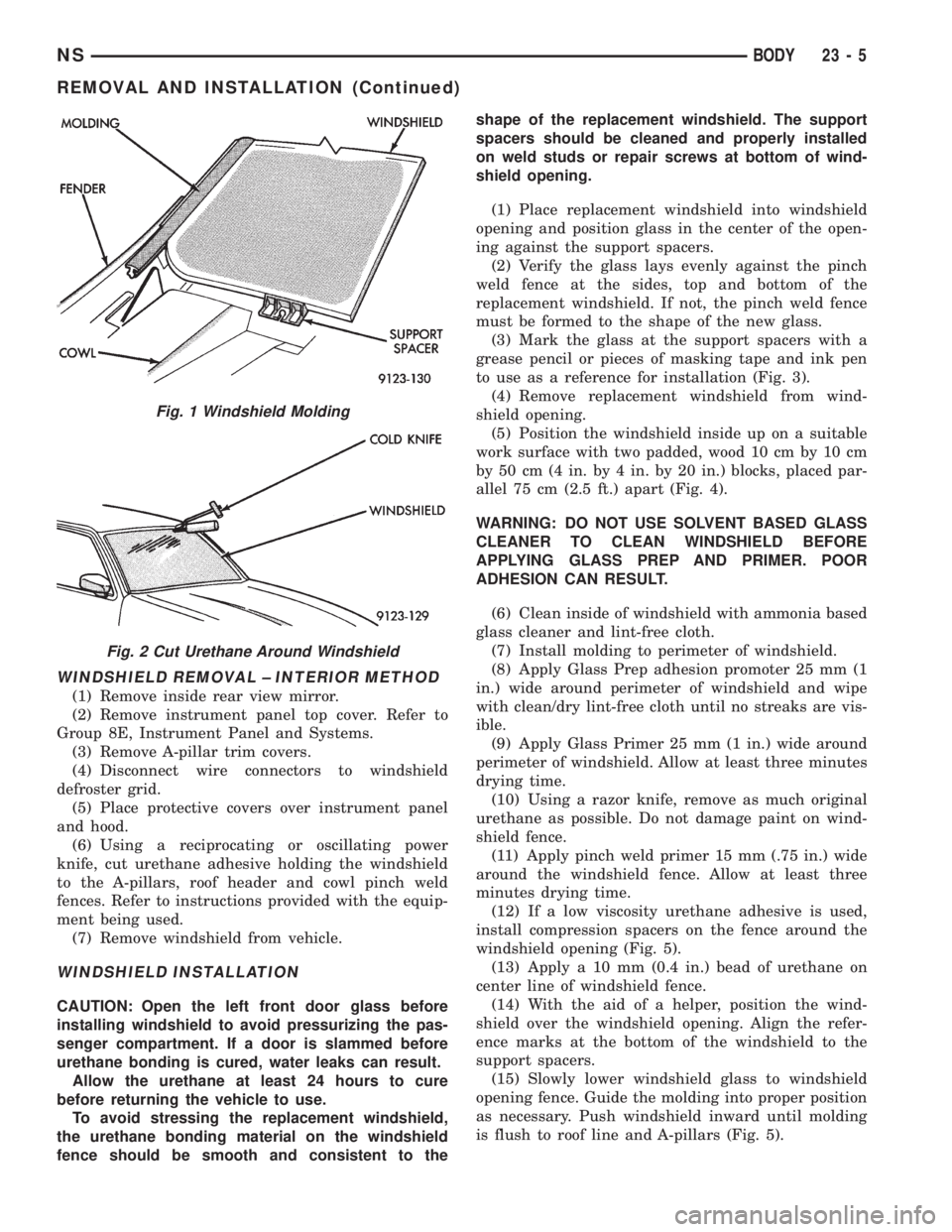
WINDSHIELD REMOVAL ± INTERIOR METHOD
(1) Remove inside rear view mirror.
(2) Remove instrument panel top cover. Refer to
Group 8E, Instrument Panel and Systems.
(3) Remove A-pillar trim covers.
(4) Disconnect wire connectors to windshield
defroster grid.
(5) Place protective covers over instrument panel
and hood.
(6) Using a reciprocating or oscillating power
knife, cut urethane adhesive holding the windshield
to the A-pillars, roof header and cowl pinch weld
fences. Refer to instructions provided with the equip-
ment being used.
(7) Remove windshield from vehicle.
WINDSHIELD INSTALLATION
CAUTION: Open the left front door glass before
installing windshield to avoid pressurizing the pas-
senger compartment. If a door is slammed before
urethane bonding is cured, water leaks can result.
Allow the urethane at least 24 hours to cure
before returning the vehicle to use.
To avoid stressing the replacement windshield,
the urethane bonding material on the windshield
fence should be smooth and consistent to theshape of the replacement windshield. The support
spacers should be cleaned and properly installed
on weld studs or repair screws at bottom of wind-
shield opening.
(1) Place replacement windshield into windshield
opening and position glass in the center of the open-
ing against the support spacers.
(2) Verify the glass lays evenly against the pinch
weld fence at the sides, top and bottom of the
replacement windshield. If not, the pinch weld fence
must be formed to the shape of the new glass.
(3) Mark the glass at the support spacers with a
grease pencil or pieces of masking tape and ink pen
to use as a reference for installation (Fig. 3).
(4) Remove replacement windshield from wind-
shield opening.
(5) Position the windshield inside up on a suitable
work surface with two padded, wood 10 cm by 10 cm
by 50 cm (4 in. by 4 in. by 20 in.) blocks, placed par-
allel 75 cm (2.5 ft.) apart (Fig. 4).
WARNING: DO NOT USE SOLVENT BASED GLASS
CLEANER TO CLEAN WINDSHIELD BEFORE
APPLYING GLASS PREP AND PRIMER. POOR
ADHESION CAN RESULT.
(6) Clean inside of windshield with ammonia based
glass cleaner and lint-free cloth.
(7) Install molding to perimeter of windshield.
(8) Apply Glass Prep adhesion promoter 25 mm (1
in.) wide around perimeter of windshield and wipe
with clean/dry lint-free cloth until no streaks are vis-
ible.
(9) Apply Glass Primer 25 mm (1 in.) wide around
perimeter of windshield. Allow at least three minutes
drying time.
(10) Using a razor knife, remove as much original
urethane as possible. Do not damage paint on wind-
shield fence.
(11) Apply pinch weld primer 15 mm (.75 in.) wide
around the windshield fence. Allow at least three
minutes drying time.
(12) If a low viscosity urethane adhesive is used,
install compression spacers on the fence around the
windshield opening (Fig. 5).
(13) Apply a 10 mm (0.4 in.) bead of urethane on
center line of windshield fence.
(14) With the aid of a helper, position the wind-
shield over the windshield opening. Align the refer-
ence marks at the bottom of the windshield to the
support spacers.
(15) Slowly lower windshield glass to windshield
opening fence. Guide the molding into proper position
as necessary. Push windshield inward until molding
is flush to roof line and A-pillars (Fig. 5).
Fig. 1 Windshield Molding
Fig. 2 Cut Urethane Around Windshield
NSBODY 23 - 5
REMOVAL AND INSTALLATION (Continued)
Page 1737 of 1938
NOTE: Tighten nuts to 3.4 N´m (30 in. lbs.) torque
in the sequence indicated. Do not over torque, or
glass breakage may result (Fig. 6).
(4) Install interior trim.
REAR WINDOW
Refer to the Safety Precautions in this section for
description of tools and adhesive systems that are
recommended for use in this procedure.
REAR WINDOW REMOVAL ± EXTERIOR
METHOD
(1) Remove rear window wiper arm, if equipped.
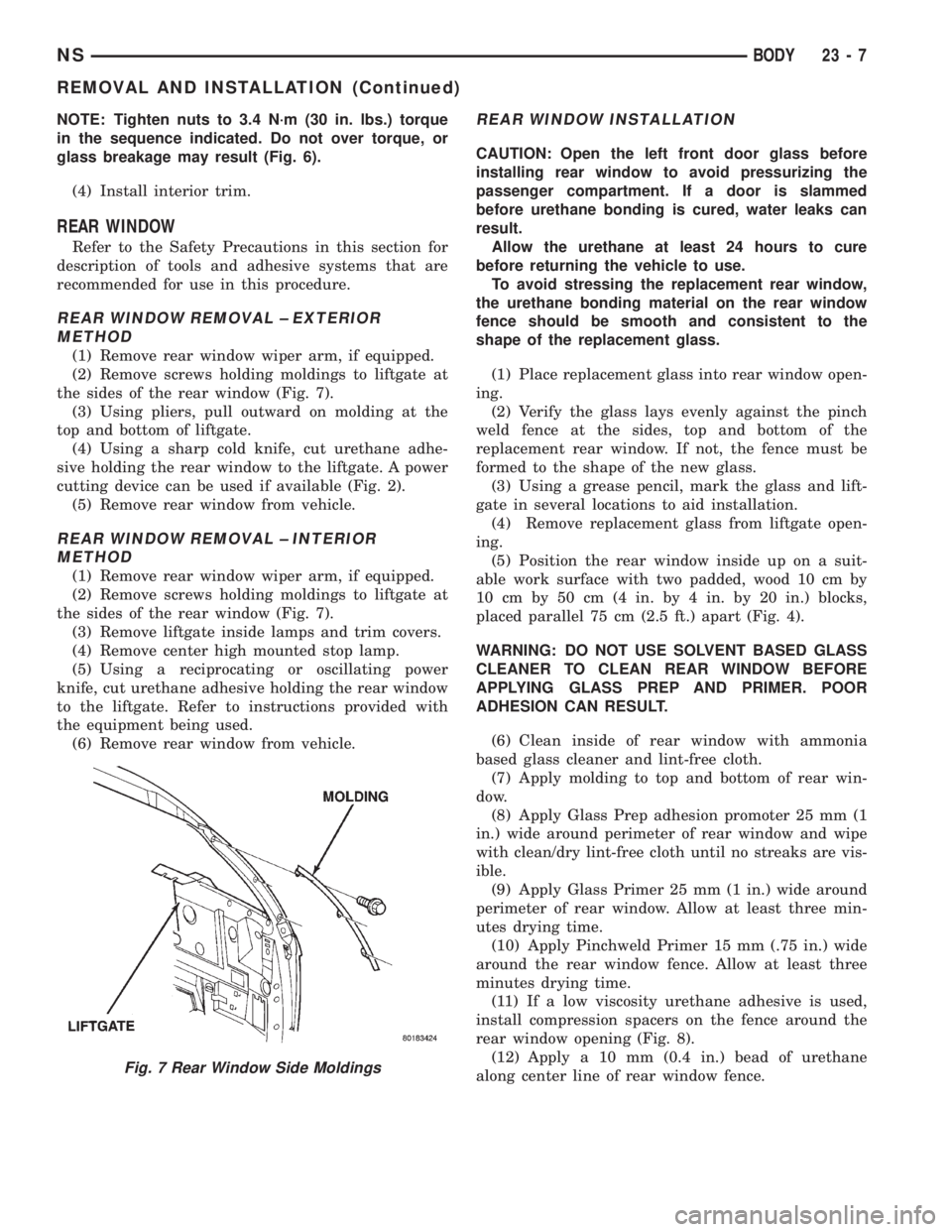
(2) Remove screws holding moldings to liftgate at
the sides of the rear window (Fig. 7).
(3) Using pliers, pull outward on molding at the
top and bottom of liftgate.
(4) Using a sharp cold knife, cut urethane adhe-
sive holding the rear window to the liftgate. A power
cutting device can be used if available (Fig. 2).
(5) Remove rear window from vehicle.
REAR WINDOW REMOVAL ± INTERIOR
METHOD
(1) Remove rear window wiper arm, if equipped.
(2) Remove screws holding moldings to liftgate at
the sides of the rear window (Fig. 7).
(3) Remove liftgate inside lamps and trim covers.
(4) Remove center high mounted stop lamp.
(5) Using a reciprocating or oscillating power
knife, cut urethane adhesive holding the rear window
to the liftgate. Refer to instructions provided with
the equipment being used.
(6) Remove rear window from vehicle.
REAR WINDOW INSTALLATION
CAUTION: Open the left front door glass before
installing rear window to avoid pressurizing the
passenger compartment. If a door is slammed
before urethane bonding is cured, water leaks can
result.
Allow the urethane at least 24 hours to cure
before returning the vehicle to use.
To avoid stressing the replacement rear window,
the urethane bonding material on the rear window
fence should be smooth and consistent to the
shape of the replacement glass.
(1) Place replacement glass into rear window open-
ing.
(2) Verify the glass lays evenly against the pinch
weld fence at the sides, top and bottom of the
replacement rear window. If not, the fence must be
formed to the shape of the new glass.
(3) Using a grease pencil, mark the glass and lift-
gate in several locations to aid installation.
(4) Remove replacement glass from liftgate open-
ing.
(5) Position the rear window inside up on a suit-
able work surface with two padded, wood 10 cm by
10 cm by 50 cm (4 in. by 4 in. by 20 in.) blocks,
placed parallel 75 cm (2.5 ft.) apart (Fig. 4).
WARNING: DO NOT USE SOLVENT BASED GLASS
CLEANER TO CLEAN REAR WINDOW BEFORE
APPLYING GLASS PREP AND PRIMER. POOR
ADHESION CAN RESULT.
(6) Clean inside of rear window with ammonia
based glass cleaner and lint-free cloth.
(7) Apply molding to top and bottom of rear win-
dow.
(8) Apply Glass Prep adhesion promoter 25 mm (1
in.) wide around perimeter of rear window and wipe
with clean/dry lint-free cloth until no streaks are vis-
ible.
(9) Apply Glass Primer 25 mm (1 in.) wide around
perimeter of rear window. Allow at least three min-
utes drying time.
(10) Apply Pinchweld Primer 15 mm (.75 in.) wide
around the rear window fence. Allow at least three
minutes drying time.
(11) If a low viscosity urethane adhesive is used,
install compression spacers on the fence around the
rear window opening (Fig. 8).
(12) Apply a 10 mm (0.4 in.) bead of urethane
along center line of rear window fence.
Fig. 7 Rear Window Side Moldings
NSBODY 23 - 7
REMOVAL AND INSTALLATION (Continued)
Page 1739 of 1938
SEATS
INDEX
page page
REMOVAL AND INSTALLATION
ARM REST.............................. 9
BENCH SEAT BACK COVER................ 9
BENCH SEAT BACK HINGE COVERS........ 10
BENCH SEAT BACK HINGE................. 9
BENCH SEAT RISER ± FIRST REAR......... 11
BENCH SEAT RISER ± SECOND REAR....... 11
BENCH SEAT TRACK ± SECOND REAR...... 11
BUCKET SEAT BACK ASSIST STRAP........ 12
BUCKET SEAT BACK..................... 12
BUCKET SEAT CUSHION PAN.............. 12
BUCKET SEAT CUSHION SIDE COVER....... 13
BUCKET SEAT RECLINER ± MANUAL........ 13
BUCKET SEAT RECLINER ± POWER......... 14
BUCKET SEAT RISER ± MANUAL TRACK..... 14
BUCKET SEAT TRACK FRONT COVER ±
POWER.............................. 15BUCKET SEAT TRACK REAR COVER ±
POWER.............................. 15
BUCKET SEAT TRACK ± MANUAL........... 14
BUCKET SEAT TRACK ± POWER........... 14
CHILD RESTRAINT SEAT MODULE.......... 16
HEAD RESTRAINT SLEEVE................ 18
HEAD RESTRAINT ± BENCH SEAT.......... 16
HEAD RESTRAINT ± BUCKET SEAT......... 17
HEATED SEAT HEATING ELEMENT.......... 18
HEATED SEAT MODULE.................. 18
HEATED SEAT SWITCH................... 19
MECHANICAL LUMBAR HANDLE ASSEMBLY . . 19
PLASTIC GROCERY BAG RETAINER......... 19
POWER SEAT SWITCH................... 20
RECLINER HANDLE ± MANUAL............. 20
UNDER SEAT STORAGE BIN GUIDE......... 21
UNDER SEAT STORAGE BIN LOCK/LATCH.... 21
UNDER SEAT STORAGE BIN............... 20
REMOVAL AND INSTALLATION
ARM REST
REMOVAL
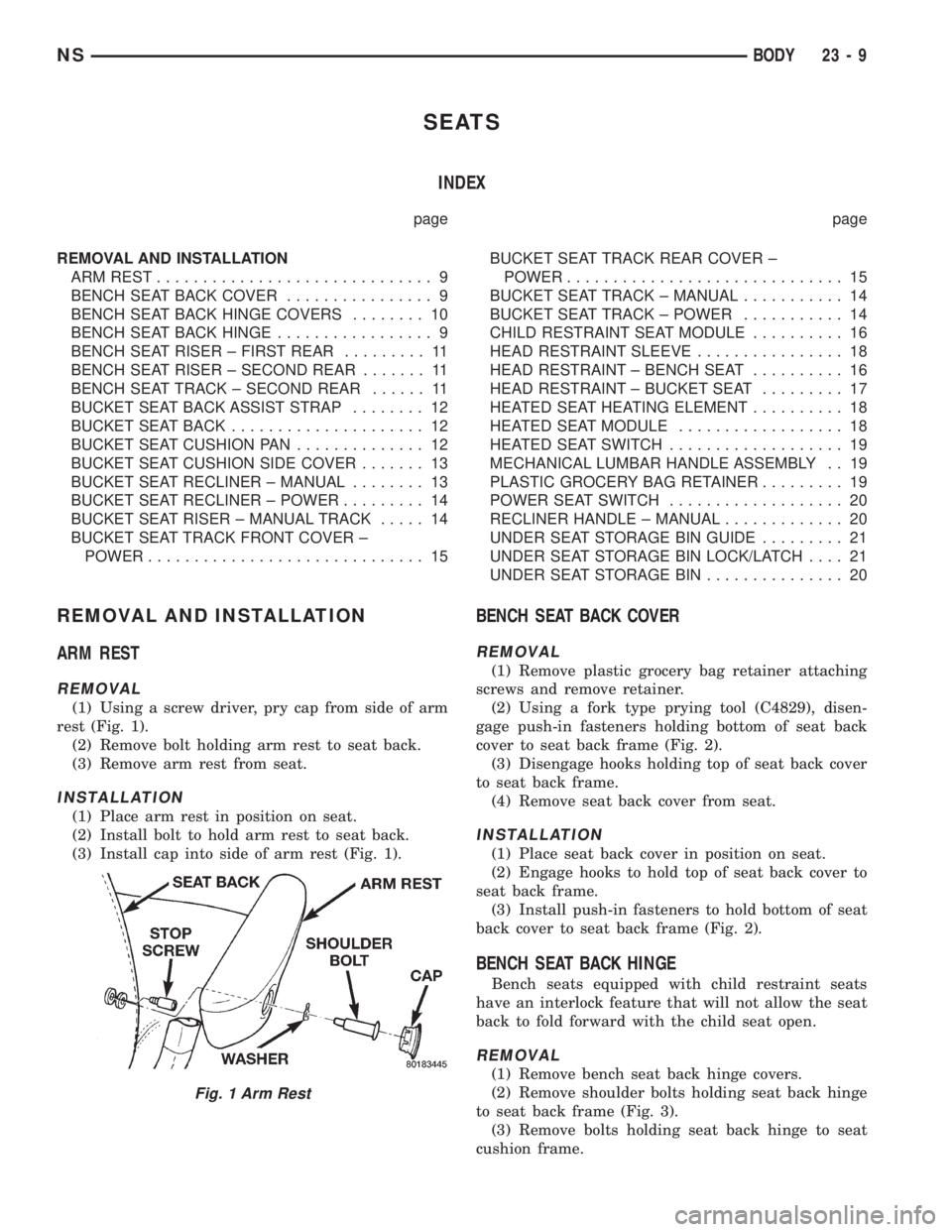
(1) Using a screw driver, pry cap from side of arm
rest (Fig. 1).
(2) Remove bolt holding arm rest to seat back.
(3) Remove arm rest from seat.
INSTALLATION
(1) Place arm rest in position on seat.
(2) Install bolt to hold arm rest to seat back.
(3) Install cap into side of arm rest (Fig. 1).
BENCH SEAT BACK COVER
REMOVAL
(1) Remove plastic grocery bag retainer attaching
screws and remove retainer.
(2) Using a fork type prying tool (C4829), disen-
gage push-in fasteners holding bottom of seat back
cover to seat back frame (Fig. 2).
(3) Disengage hooks holding top of seat back cover
to seat back frame.
(4) Remove seat back cover from seat.
INSTALLATION
(1) Place seat back cover in position on seat.
(2) Engage hooks to hold top of seat back cover to
seat back frame.
(3) Install push-in fasteners to hold bottom of seat
back cover to seat back frame (Fig. 2).
BENCH SEAT BACK HINGE
Bench seats equipped with child restraint seats
have an interlock feature that will not allow the seat
back to fold forward with the child seat open.
REMOVAL
(1) Remove bench seat back hinge covers.
(2) Remove shoulder bolts holding seat back hinge
to seat back frame (Fig. 3).
(3) Remove bolts holding seat back hinge to seat
cushion frame.
Fig. 1 Arm Rest
NSBODY 23 - 9
Page 1746 of 1938
CHILD RESTRAINT SEAT MODULE
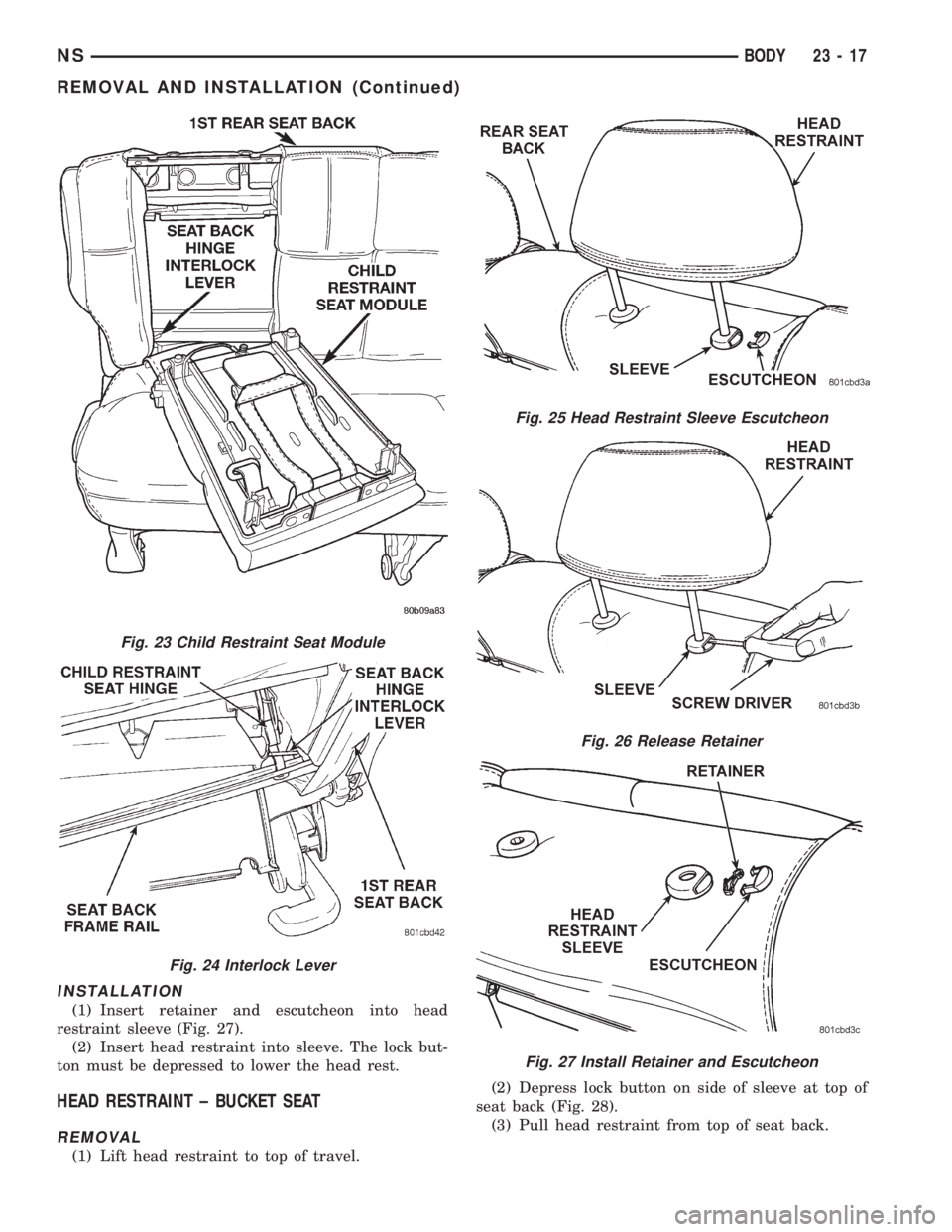
REMOVAL
(1) Close child restraint seat.
(2) Remove seat back cover.
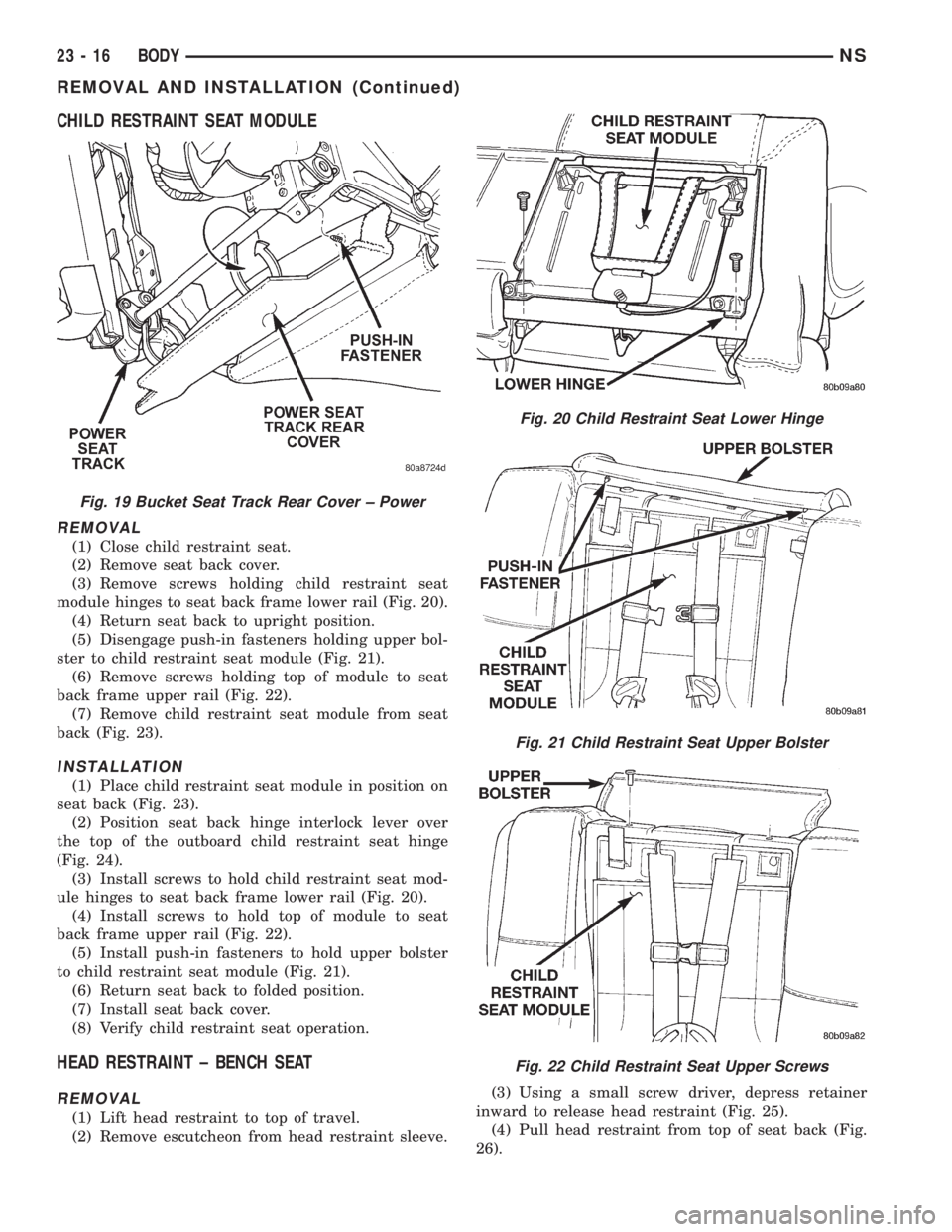
(3) Remove screws holding child restraint seat
module hinges to seat back frame lower rail (Fig. 20).
(4) Return seat back to upright position.
(5) Disengage push-in fasteners holding upper bol-
ster to child restraint seat module (Fig. 21).
(6) Remove screws holding top of module to seat
back frame upper rail (Fig. 22).
(7) Remove child restraint seat module from seat
back (Fig. 23).
INSTALLATION
(1) Place child restraint seat module in position on
seat back (Fig. 23).
(2) Position seat back hinge interlock lever over
the top of the outboard child restraint seat hinge
(Fig. 24).
(3) Install screws to hold child restraint seat mod-
ule hinges to seat back frame lower rail (Fig. 20).
(4) Install screws to hold top of module to seat
back frame upper rail (Fig. 22).
(5) Install push-in fasteners to hold upper bolster
to child restraint seat module (Fig. 21).
(6) Return seat back to folded position.
(7) Install seat back cover.
(8) Verify child restraint seat operation.
HEAD RESTRAINT ± BENCH SEAT
REMOVAL
(1) Lift head restraint to top of travel.
(2) Remove escutcheon from head restraint sleeve.(3) Using a small screw driver, depress retainer
inward to release head restraint (Fig. 25).
(4) Pull head restraint from top of seat back (Fig.
26).
Fig. 19 Bucket Seat Track Rear Cover ± Power
Fig. 20 Child Restraint Seat Lower Hinge
Fig. 21 Child Restraint Seat Upper Bolster
Fig. 22 Child Restraint Seat Upper Screws
23 - 16 BODYNS
REMOVAL AND INSTALLATION (Continued)
Page 1747 of 1938
INSTALLATION
(1) Insert retainer and escutcheon into head
restraint sleeve (Fig. 27).
(2) Insert head restraint into sleeve. The lock but-
ton must be depressed to lower the head rest.
HEAD RESTRAINT ± BUCKET SEAT
REMOVAL
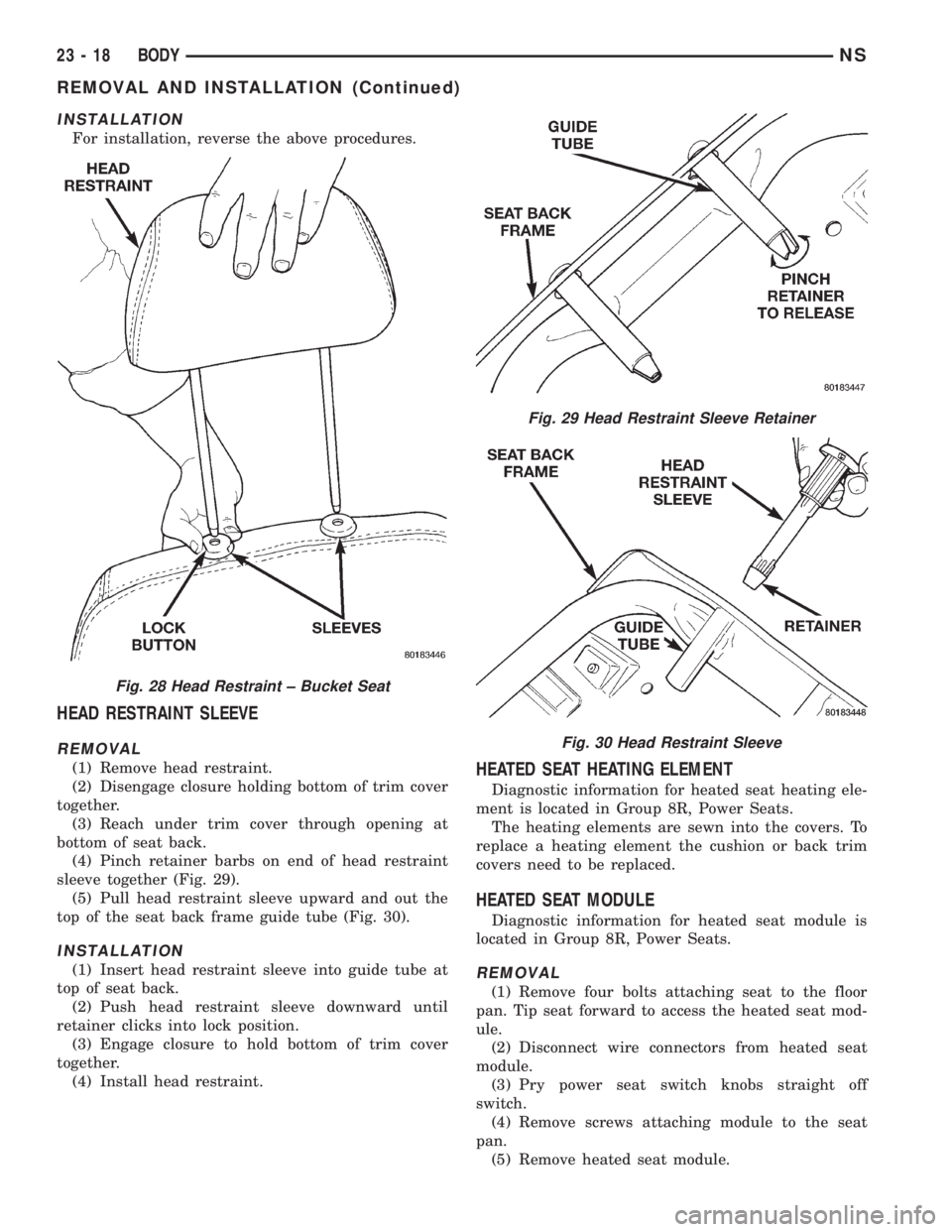
(1) Lift head restraint to top of travel.(2) Depress lock button on side of sleeve at top of
seat back (Fig. 28).
(3) Pull head restraint from top of seat back.
Fig. 23 Child Restraint Seat Module
Fig. 24 Interlock Lever
Fig. 25 Head Restraint Sleeve Escutcheon
Fig. 26 Release Retainer
Fig. 27 Install Retainer and Escutcheon
NSBODY 23 - 17
REMOVAL AND INSTALLATION (Continued)
Page 1748 of 1938
INSTALLATION
For installation, reverse the above procedures.
HEAD RESTRAINT SLEEVE
REMOVAL
(1) Remove head restraint.
(2) Disengage closure holding bottom of trim cover
together.
(3) Reach under trim cover through opening at
bottom of seat back.
(4) Pinch retainer barbs on end of head restraint
sleeve together (Fig. 29).
(5) Pull head restraint sleeve upward and out the
top of the seat back frame guide tube (Fig. 30).
INSTALLATION
(1) Insert head restraint sleeve into guide tube at
top of seat back.
(2) Push head restraint sleeve downward until
retainer clicks into lock position.
(3) Engage closure to hold bottom of trim cover
together.
(4) Install head restraint.
HEATED SEAT HEATING ELEMENT
Diagnostic information for heated seat heating ele-
ment is located in Group 8R, Power Seats.
The heating elements are sewn into the covers. To
replace a heating element the cushion or back trim
covers need to be replaced.
HEATED SEAT MODULE
Diagnostic information for heated seat module is
located in Group 8R, Power Seats.
REMOVAL
(1) Remove four bolts attaching seat to the floor
pan. Tip seat forward to access the heated seat mod-
ule.
(2) Disconnect wire connectors from heated seat
module.
(3) Pry power seat switch knobs straight off
switch.
(4) Remove screws attaching module to the seat
pan.
(5) Remove heated seat module.
Fig. 28 Head Restraint ± Bucket Seat
Fig. 29 Head Restraint Sleeve Retainer
Fig. 30 Head Restraint Sleeve
23 - 18 BODYNS
REMOVAL AND INSTALLATION (Continued)
Page 1749 of 1938
INSTALLATION
(1) Place heated seat module in position on seat
pan.
(2) Install module attaching screws.
(3) Connect module wire connectors.
(4) Install seat.
HEATED SEAT SWITCH
Diagnostic information for heated seat switch is
located in Group 8R, Power Seats.
REMOVAL
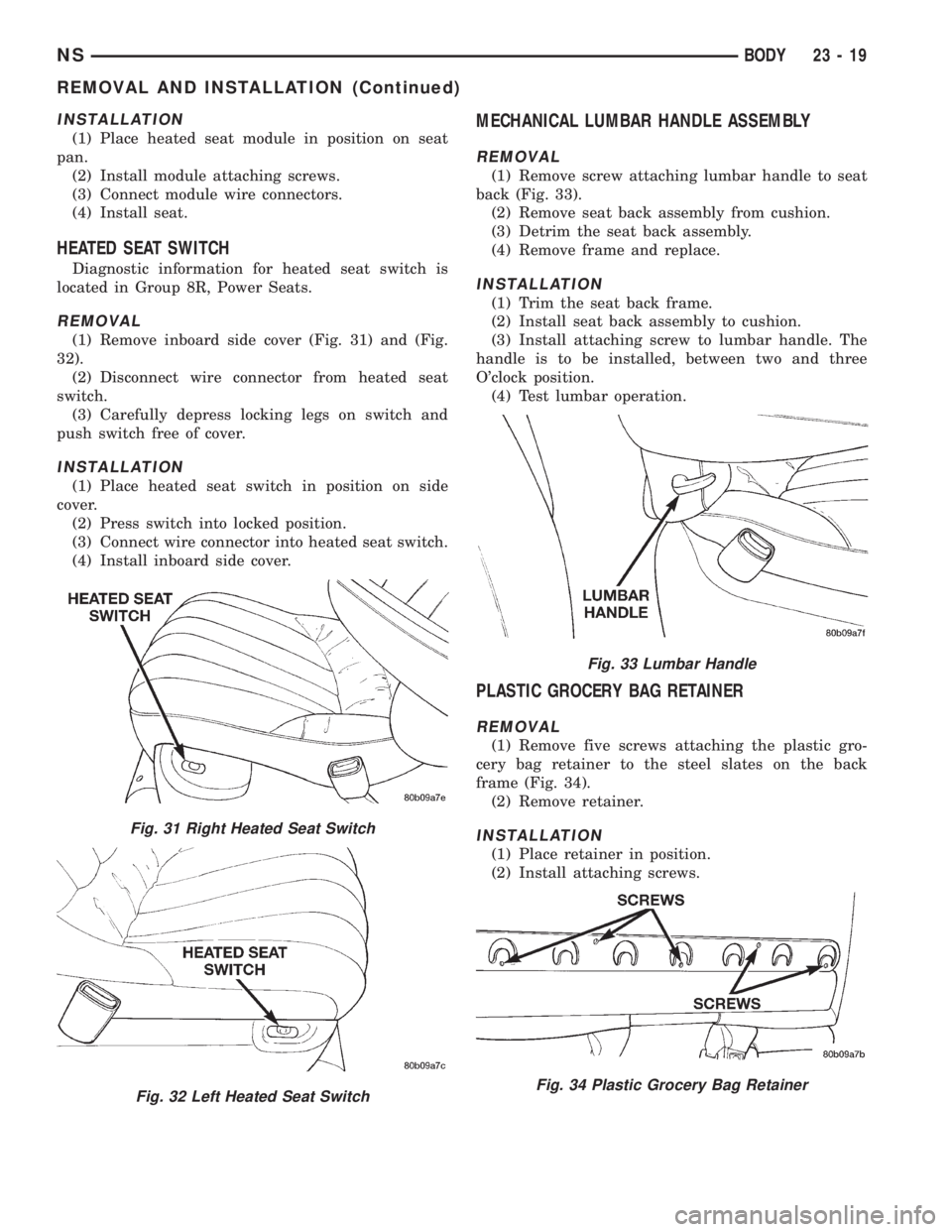
(1) Remove inboard side cover (Fig. 31) and (Fig.
32).
(2) Disconnect wire connector from heated seat
switch.
(3) Carefully depress locking legs on switch and
push switch free of cover.
INSTALLATION
(1) Place heated seat switch in position on side
cover.
(2) Press switch into locked position.
(3) Connect wire connector into heated seat switch.
(4) Install inboard side cover.
MECHANICAL LUMBAR HANDLE ASSEMBLY
REMOVAL
(1) Remove screw attaching lumbar handle to seat
back (Fig. 33).
(2) Remove seat back assembly from cushion.
(3) Detrim the seat back assembly.
(4) Remove frame and replace.
INSTALLATION
(1) Trim the seat back frame.
(2) Install seat back assembly to cushion.
(3) Install attaching screw to lumbar handle. The
handle is to be installed, between two and three
O'clock position.
(4) Test lumbar operation.
PLASTIC GROCERY BAG RETAINER
REMOVAL
(1) Remove five screws attaching the plastic gro-
cery bag retainer to the steel slates on the back
frame (Fig. 34).
(2) Remove retainer.
INSTALLATION
(1) Place retainer in position.
(2) Install attaching screws.
Fig. 31 Right Heated Seat Switch
Fig. 32 Left Heated Seat Switch
Fig. 33 Lumbar Handle
Fig. 34 Plastic Grocery Bag Retainer
NSBODY 23 - 19
REMOVAL AND INSTALLATION (Continued)
Page 1750 of 1938
POWER SEAT SWITCH
Diagnostic information for power seat switch is
located in Group 8R, Power Seats.
REMOVAL
(1) Remove seat cushion side cover.
(2) Disconnect wire connector from power seat
switch.
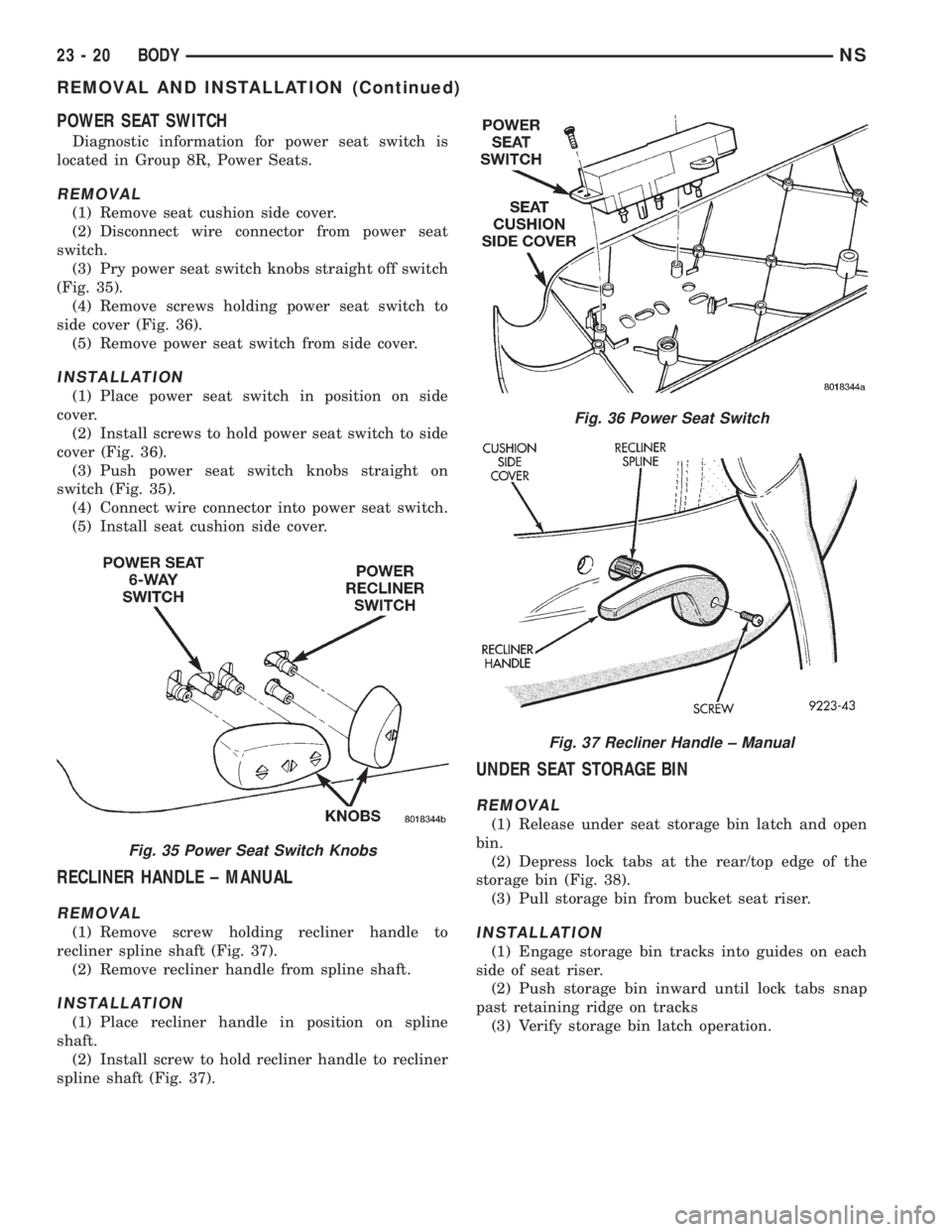
(3) Pry power seat switch knobs straight off switch
(Fig. 35).
(4) Remove screws holding power seat switch to
side cover (Fig. 36).
(5) Remove power seat switch from side cover.
INSTALLATION
(1) Place power seat switch in position on side
cover.
(2) Install screws to hold power seat switch to side
cover (Fig. 36).
(3) Push power seat switch knobs straight on
switch (Fig. 35).
(4) Connect wire connector into power seat switch.
(5) Install seat cushion side cover.
RECLINER HANDLE ± MANUAL
REMOVAL
(1) Remove screw holding recliner handle to
recliner spline shaft (Fig. 37).
(2) Remove recliner handle from spline shaft.
INSTALLATION
(1) Place recliner handle in position on spline
shaft.
(2) Install screw to hold recliner handle to recliner
spline shaft (Fig. 37).
UNDER SEAT STORAGE BIN
REMOVAL
(1) Release under seat storage bin latch and open
bin.
(2) Depress lock tabs at the rear/top edge of the
storage bin (Fig. 38).
(3) Pull storage bin from bucket seat riser.
INSTALLATION
(1) Engage storage bin tracks into guides on each
side of seat riser.
(2) Push storage bin inward until lock tabs snap
past retaining ridge on tracks
(3) Verify storage bin latch operation.
Fig. 35 Power Seat Switch Knobs
Fig. 36 Power Seat Switch
Fig. 37 Recliner Handle ± Manual
23 - 20 BODYNS
REMOVAL AND INSTALLATION (Continued)