1996 CHRYSLER VOYAGER lock
[x] Cancel search: lockPage 1704 of 1938
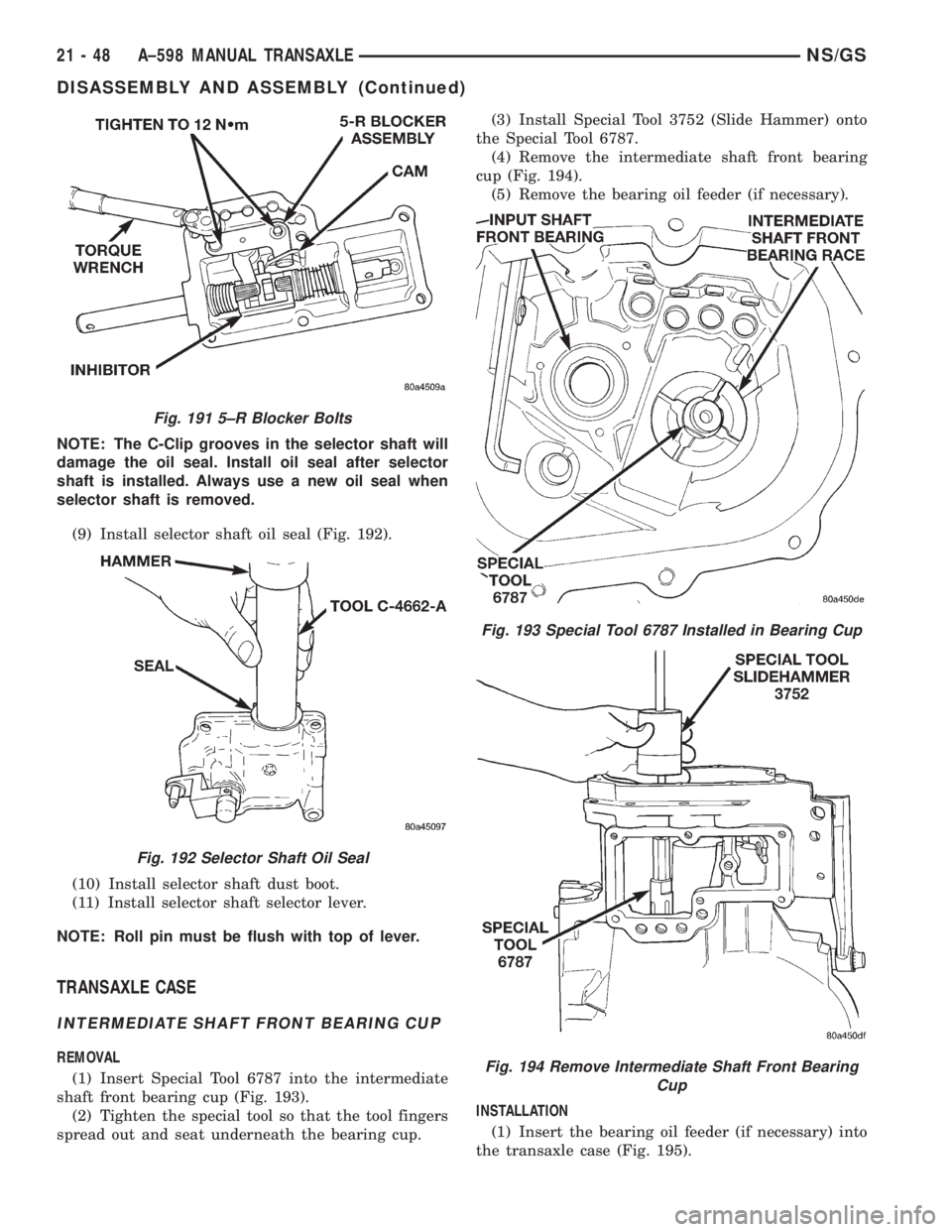
NOTE: The C-Clip grooves in the selector shaft will
damage the oil seal. Install oil seal after selector
shaft is installed. Always use a new oil seal when
selector shaft is removed.
(9) Install selector shaft oil seal (Fig. 192).
(10) Install selector shaft dust boot.
(11) Install selector shaft selector lever.
NOTE: Roll pin must be flush with top of lever.
TRANSAXLE CASE
INTERMEDIATE SHAFT FRONT BEARING CUP
REMOVAL
(1) Insert Special Tool 6787 into the intermediate
shaft front bearing cup (Fig. 193).
(2) Tighten the special tool so that the tool fingers
spread out and seat underneath the bearing cup.(3) Install Special Tool 3752 (Slide Hammer) onto
the Special Tool 6787.
(4) Remove the intermediate shaft front bearing
cup (Fig. 194).
(5) Remove the bearing oil feeder (if necessary).
INSTALLATION
(1) Insert the bearing oil feeder (if necessary) into
the transaxle case (Fig. 195).
Fig. 191 5±R Blocker Bolts
Fig. 192 Selector Shaft Oil Seal
Fig. 193 Special Tool 6787 Installed in Bearing Cup
Fig. 194 Remove Intermediate Shaft Front Bearing
Cup
21 - 48 A±598 MANUAL TRANSAXLENS/GS
DISASSEMBLY AND ASSEMBLY (Continued)
Page 1708 of 1938
REVERSE SHIFT LEVER
REMOVAL
(1) Remove reverse shift lever E-clip.
(2) Remove the flat and wave washers.
(3) Remove the reverse shift lever from the mount-
ing stud.
INSTALLATION
(1) Position the reverse shift lever onto the mount-
ing stud.
(2) Install the washers onto the mounting stud.
(3) Install the E-clip.
CLEANING AND INSPECTION
TRANSAXLE
Clean the gears, bearings, shafts, synchronizers,
thrust washers, oil feeder, shift mechanism, gear
case, and bellhousing with solvent. Dry all parts
except the bearings with compressed air. Allow thebearings to either air dry or wipe them dry with
clean shop towels.
Inspect the gears, bearings, shafts and thrust
washers. Replace the bearings and cups if the rollers
are worn, chipped, cracked, flat spotted, or brin-
nelled, or if the bearing cage is damaged or distorted.
Replace the thrust washers if cracked, chipped, or
worn. Replace the gears if the teeth are chipped,
cracked, or worn thin. Inspect the synchronizers.
Replace the sleeve if worn or damaged in any way.
Replace the stop rings if the friction material is
burned, flaking off, or worn. Check the condition of
the synchro struts and springs. Replace these parts if
worn, cracked, or distorted.
SYNCHRONIZER
CLEAN
Do not attempt to clean the blocking rings in sol-
vent. The friction material will become contaminated.
Place synchronizer components in a suitable holder
and clean with solvent. Air dry.
INSPECT
Proper inspection of components involve:
²Teeth, for wear, scuffed, nicked, burred, or bro-
ken teeth
²Struts, for wear or distortion
²Springs, for distortion, cracks, or wear
If any of these conditions exist in these compo-
nents, replace as necessary.
ADJUSTMENTS
GEARSHIFT CROSSOVER CABLE
Before replacing the gearshift cables for a hard-
shifting complaint, disconnect both cables at the
transaxle. Then, from the driver's seat, manually
operate the gearshift lever through all gear ranges. If
the gearshift lever moves smoothly, the cable(s)
should NOT be replaced. If the gear lever binds
replace the cable that is causing the binding condi-
tion. If the problem still exists, check the crossover
cable adjustment (Fig. 210).
(1) Working over the left front fender, remove the
auxiliary vent from the selector shaft housing (Fig.
211).
(2) Locate the gearshift lock pin that has been
included in the new vehicle packet located in the
glove box.
(3) Place transaxle gearshift in the neutral posi-
tion.
(4) Insert lock pin (so long end is down) into same
threaded hole (Fig. 212). A hole in the selector shaft
will align with the lock pin, allowing the lock pin to
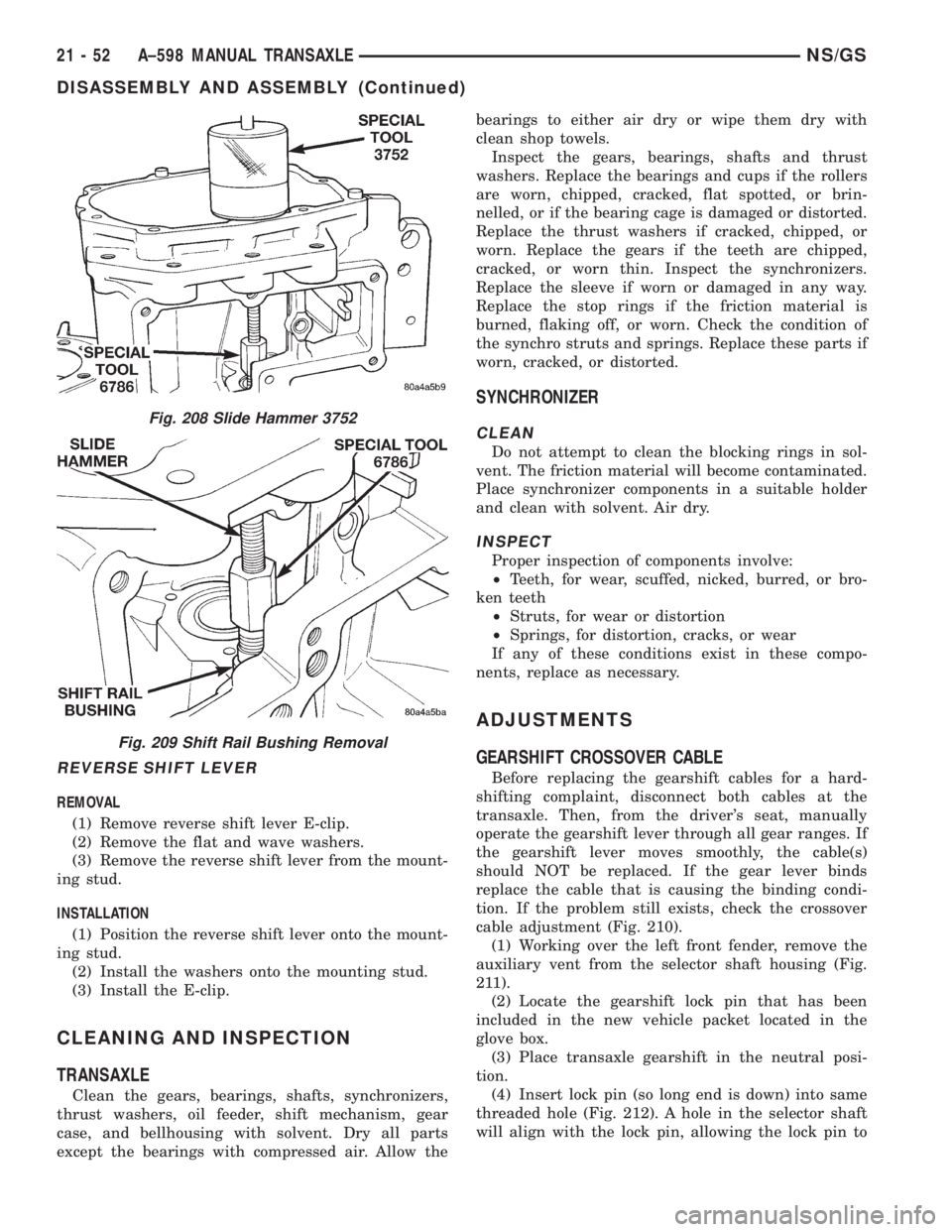
Fig. 208 Slide Hammer 3752
Fig. 209 Shift Rail Bushing Removal
21 - 52 A±598 MANUAL TRANSAXLENS/GS
DISASSEMBLY AND ASSEMBLY (Continued)
Page 1709 of 1938
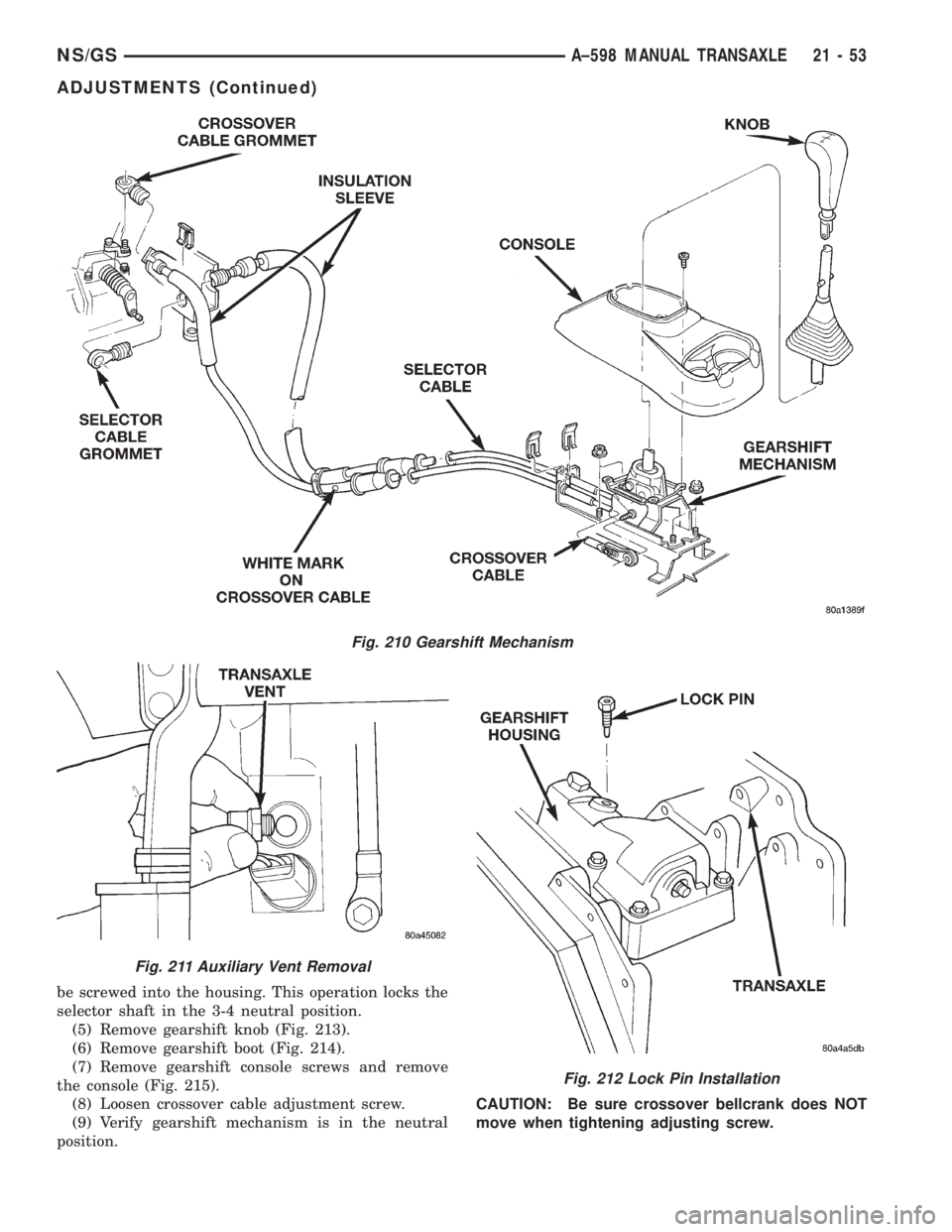
be screwed into the housing. This operation locks the
selector shaft in the 3-4 neutral position.
(5) Remove gearshift knob (Fig. 213).
(6) Remove gearshift boot (Fig. 214).
(7) Remove gearshift console screws and remove
the console (Fig. 215).
(8) Loosen crossover cable adjustment screw.
(9) Verify gearshift mechanism is in the neutral
position.CAUTION: Be sure crossover bellcrank does NOT
move when tightening adjusting screw.
Fig. 210 Gearshift Mechanism
Fig. 211 Auxiliary Vent Removal
Fig. 212 Lock Pin Installation
NS/GSA±598 MANUAL TRANSAXLE 21 - 53
ADJUSTMENTS (Continued)
Page 1710 of 1938
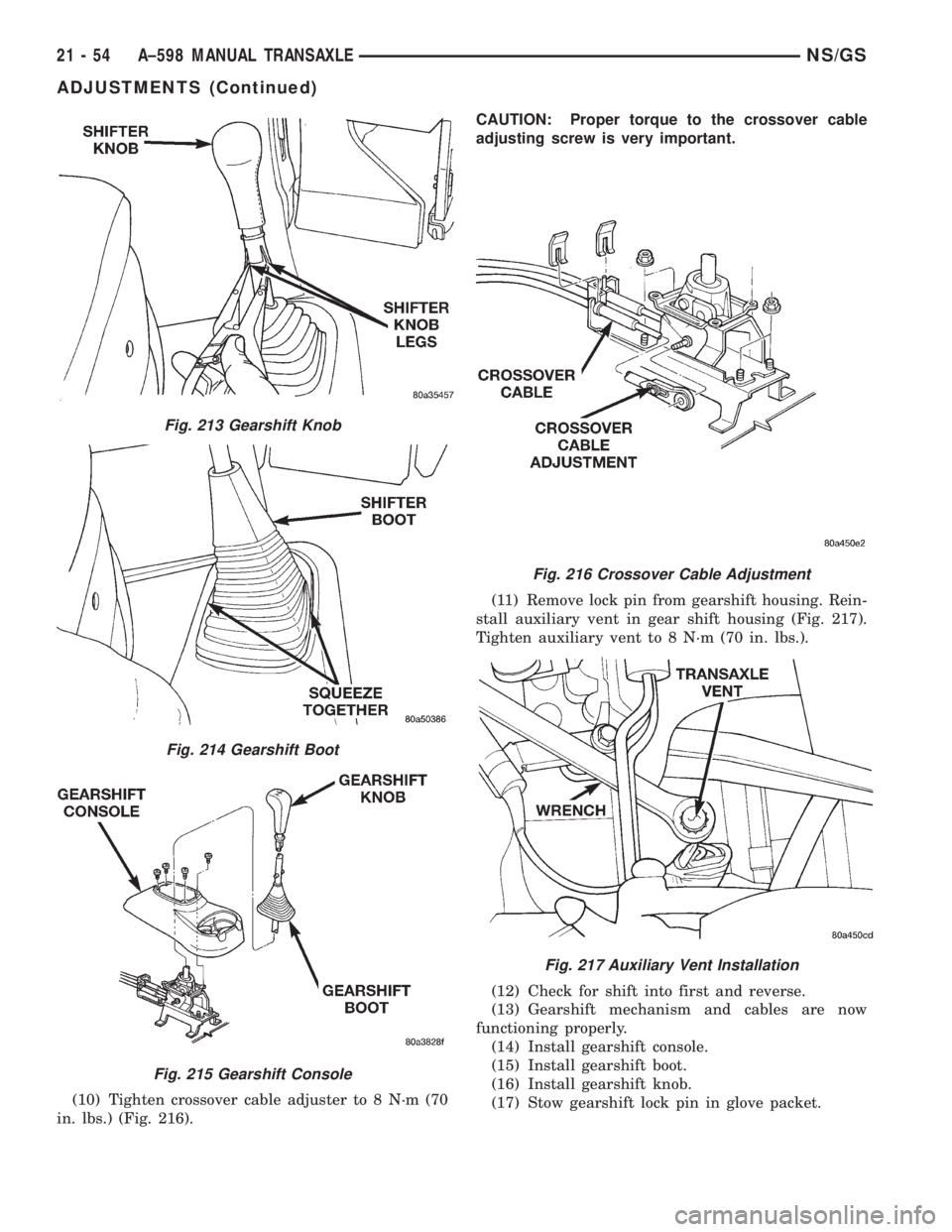
(10) Tighten crossover cable adjuster to 8 N´m (70
in. lbs.) (Fig. 216).CAUTION: Proper torque to the crossover cable
adjusting screw is very important.
(11) Remove lock pin from gearshift housing. Rein-
stall auxiliary vent in gear shift housing (Fig. 217).
Tighten auxiliary vent to 8 N´m (70 in. lbs.).
(12) Check for shift into first and reverse.
(13) Gearshift mechanism and cables are now
functioning properly.
(14) Install gearshift console.
(15) Install gearshift boot.
(16) Install gearshift knob.
(17) Stow gearshift lock pin in glove packet.
Fig. 213 Gearshift Knob
Fig. 214 Gearshift Boot
Fig. 215 Gearshift Console
Fig. 216 Crossover Cable Adjustment
Fig. 217 Auxiliary Vent Installation
21 - 54 A±598 MANUAL TRANSAXLENS/GS
ADJUSTMENTS (Continued)
Page 1711 of 1938
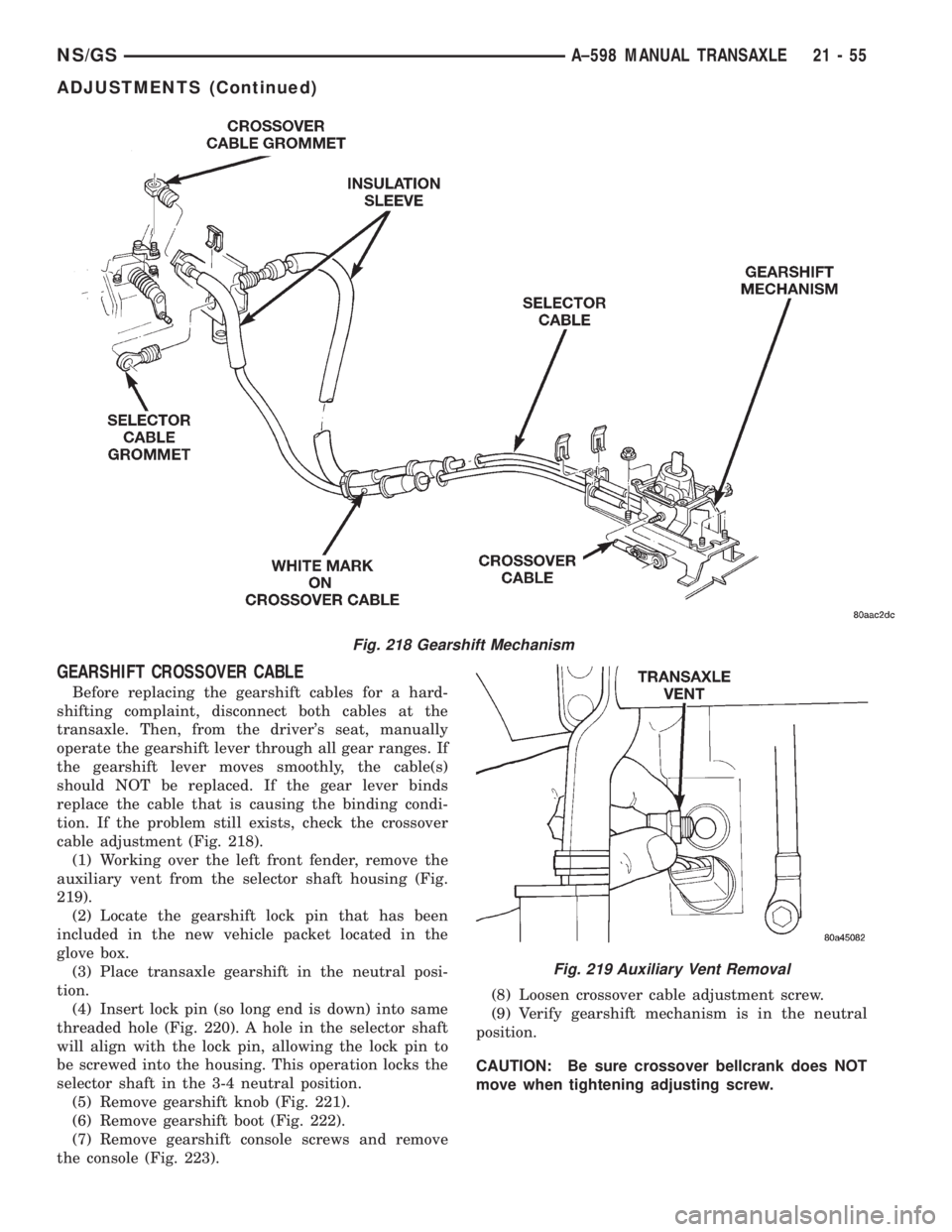
GEARSHIFT CROSSOVER CABLE
Before replacing the gearshift cables for a hard-
shifting complaint, disconnect both cables at the
transaxle. Then, from the driver's seat, manually
operate the gearshift lever through all gear ranges. If
the gearshift lever moves smoothly, the cable(s)
should NOT be replaced. If the gear lever binds
replace the cable that is causing the binding condi-
tion. If the problem still exists, check the crossover
cable adjustment (Fig. 218).
(1) Working over the left front fender, remove the
auxiliary vent from the selector shaft housing (Fig.
219).
(2) Locate the gearshift lock pin that has been
included in the new vehicle packet located in the
glove box.
(3) Place transaxle gearshift in the neutral posi-
tion.
(4) Insert lock pin (so long end is down) into same
threaded hole (Fig. 220). A hole in the selector shaft
will align with the lock pin, allowing the lock pin to
be screwed into the housing. This operation locks the
selector shaft in the 3-4 neutral position.
(5) Remove gearshift knob (Fig. 221).
(6) Remove gearshift boot (Fig. 222).
(7) Remove gearshift console screws and remove
the console (Fig. 223).(8) Loosen crossover cable adjustment screw.
(9) Verify gearshift mechanism is in the neutral
position.
CAUTION: Be sure crossover bellcrank does NOT
move when tightening adjusting screw.
Fig. 218 Gearshift Mechanism
Fig. 219 Auxiliary Vent Removal
NS/GSA±598 MANUAL TRANSAXLE 21 - 55
ADJUSTMENTS (Continued)
Page 1712 of 1938
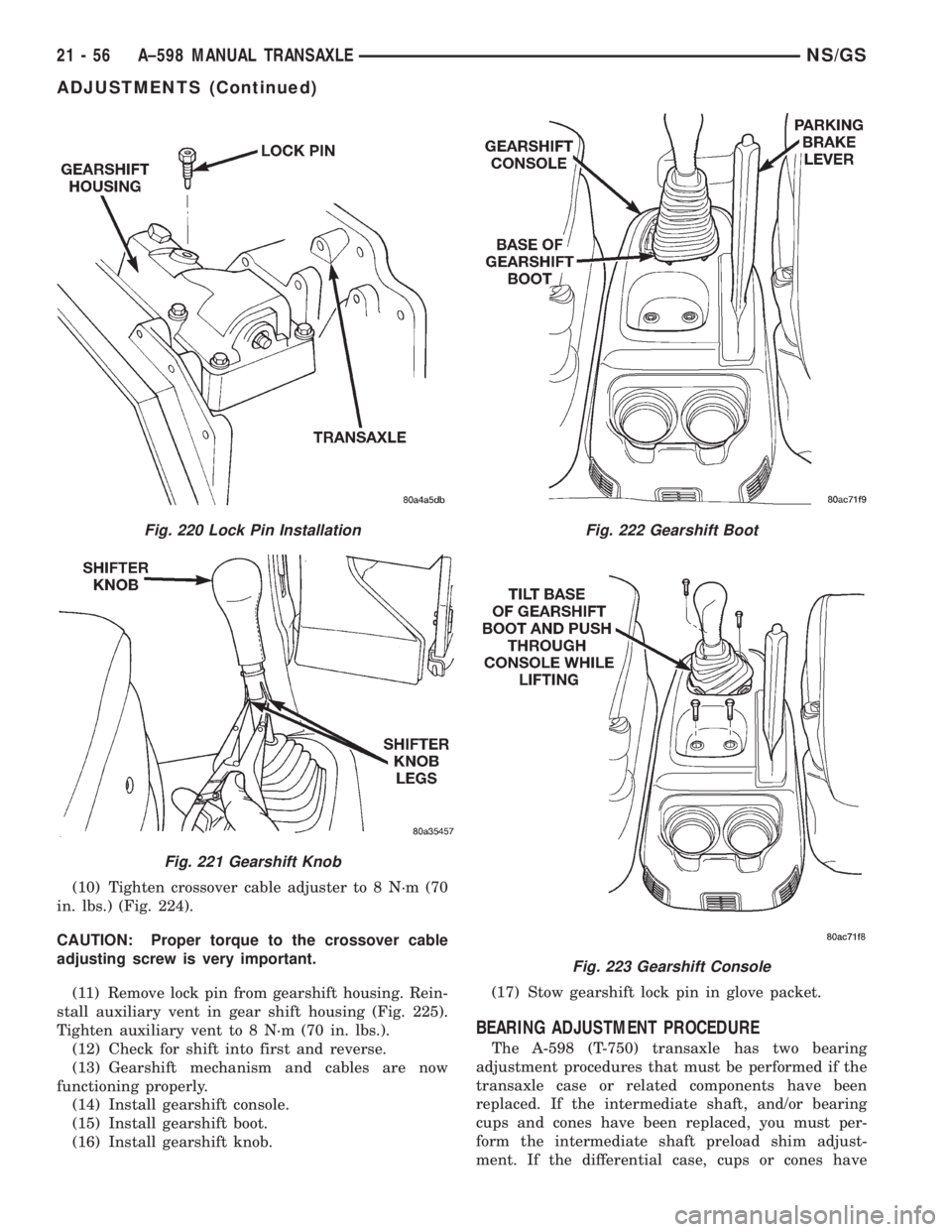
(10) Tighten crossover cable adjuster to 8 N´m (70
in. lbs.) (Fig. 224).
CAUTION: Proper torque to the crossover cable
adjusting screw is very important.
(11) Remove lock pin from gearshift housing. Rein-
stall auxiliary vent in gear shift housing (Fig. 225).
Tighten auxiliary vent to 8 N´m (70 in. lbs.).
(12) Check for shift into first and reverse.
(13) Gearshift mechanism and cables are now
functioning properly.
(14) Install gearshift console.
(15) Install gearshift boot.
(16) Install gearshift knob.(17) Stow gearshift lock pin in glove packet.
BEARING ADJUSTMENT PROCEDURE
The A-598 (T-750) transaxle has two bearing
adjustment procedures that must be performed if the
transaxle case or related components have been
replaced. If the intermediate shaft, and/or bearing
cups and cones have been replaced, you must per-
form the intermediate shaft preload shim adjust-
ment. If the differential case, cups or cones have
Fig. 220 Lock Pin Installation
Fig. 221 Gearshift Knob
Fig. 222 Gearshift Boot
Fig. 223 Gearshift Console
21 - 56 A±598 MANUAL TRANSAXLENS/GS
ADJUSTMENTS (Continued)
Page 1715 of 1938
(14) Apply a bead of MopartGasket Maker or
equivalent onto bearing support plate. Install bearing
support plate.
(15) Install necessary shim calculated from Step
12
(16) Install bearing retainer plate. Tighten bearing
retainer plate to 17 N´m (250 in. lbs.).
(17) Install 5th drive gear onto the input shaft.
(18) Install 5th gear, synchro, fork, and plate.
(19) Install 5th gear synchro snap ring.
(20) Install 5th gear shift fork roll pin.
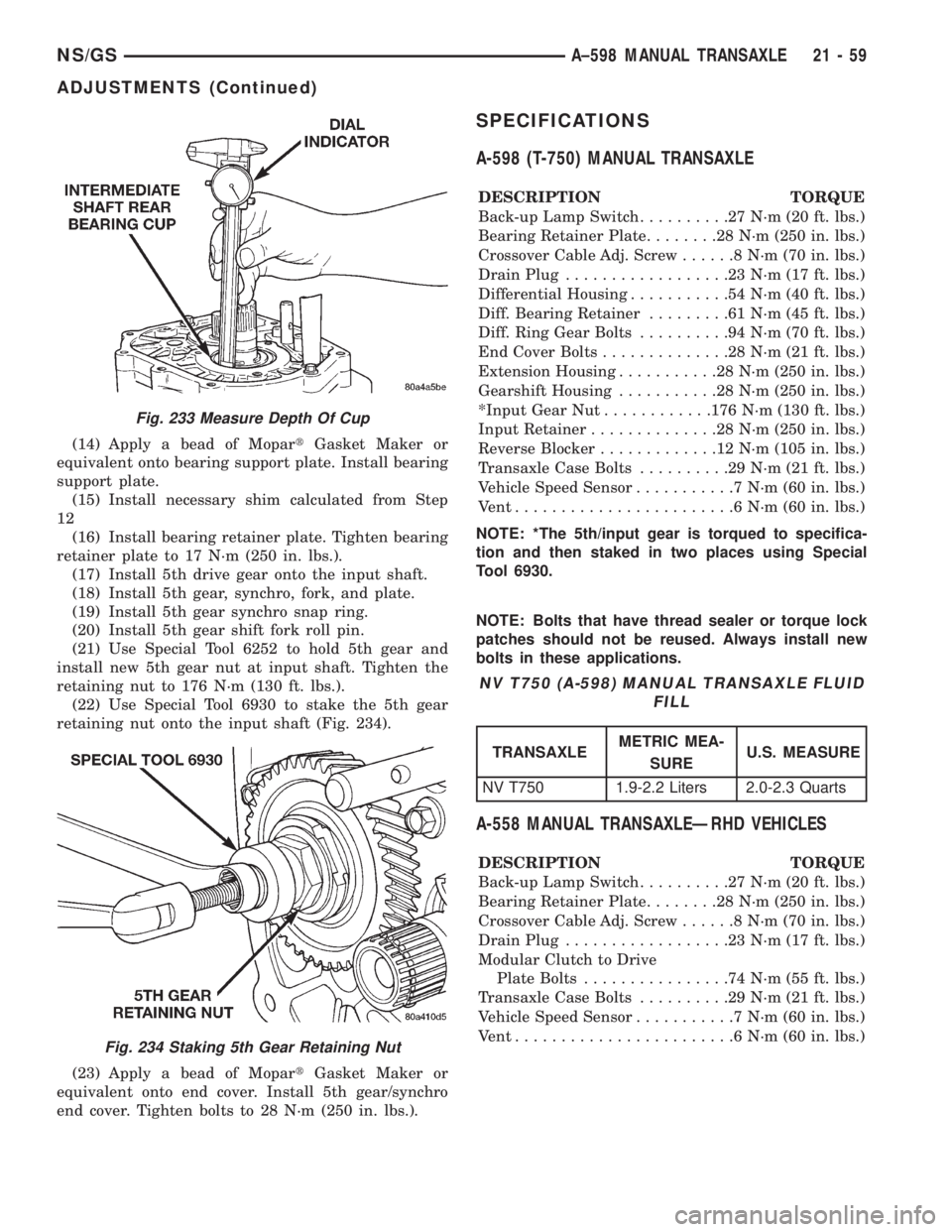
(21) Use Special Tool 6252 to hold 5th gear and
install new 5th gear nut at input shaft. Tighten the
retaining nut to 176 N´m (130 ft. lbs.).
(22) Use Special Tool 6930 to stake the 5th gear
retaining nut onto the input shaft (Fig. 234).
(23) Apply a bead of MopartGasket Maker or
equivalent onto end cover. Install 5th gear/synchro
end cover. Tighten bolts to 28 N´m (250 in. lbs.).
SPECIFICATIONS
A-598 (T-750) MANUAL TRANSAXLE
DESCRIPTION TORQUE
Back-up Lamp Switch..........27N´m(20ft.lbs.)
Bearing Retainer Plate........28N´m(250 in. lbs.)
Crossover Cable Adj. Screw......8N´m(70in.lbs.)
Drain Plug..................23N´m(17ft.lbs.)
Differential Housing...........54N´m(40ft.lbs.)
Diff. Bearing Retainer.........61N´m(45ft.lbs.)
Diff. Ring Gear Bolts..........94N´m(70ft.lbs.)
End Cover Bolts..............28N´m(21ft.lbs.)
Extension Housing...........28N´m(250 in. lbs.)
Gearshift Housing...........28N´m(250 in. lbs.)
*Input Gear Nut............176 N´m (130 ft. lbs.)
Input Retainer..............28N´m(250 in. lbs.)
Reverse Blocker.............12N´m(105 in. lbs.)
Transaxle Case Bolts..........29N´m(21ft.lbs.)
Vehicle Speed Sensor...........7N´m(60in.lbs.)
Vent........................6N´m(60in.lbs.)
NOTE: *The 5th/input gear is torqued to specifica-
tion and then staked in two places using Special
Tool 6930.
NOTE: Bolts that have thread sealer or torque lock
patches should not be reused. Always install new
bolts in these applications.
A-558 MANUAL TRANSAXLEÐRHD VEHICLES
DESCRIPTION TORQUE
Back-up Lamp Switch..........27N´m(20ft.lbs.)
Bearing Retainer Plate........28N´m(250 in. lbs.)
Crossover Cable Adj. Screw......8N´m(70in.lbs.)
Drain Plug..................23N´m(17ft.lbs.)
Modular Clutch to Drive
Plate Bolts................74N´m(55ft.lbs.)
Transaxle Case Bolts..........29N´m(21ft.lbs.)
Vehicle Speed Sensor...........7N´m(60in.lbs.)
Vent........................6N´m(60in.lbs.)
Fig. 233 Measure Depth Of Cup
Fig. 234 Staking 5th Gear Retaining Nut
NV T750 (A-598) MANUAL TRANSAXLE FLUID
FILL
TRANSAXLEMETRIC MEA-
SUREU.S. MEASURE
NV T750 1.9-2.2 Liters 2.0-2.3 Quarts
NS/GSA±598 MANUAL TRANSAXLE 21 - 59
ADJUSTMENTS (Continued)
Page 1720 of 1938
snow chain or other type of traction aid is not
to be used on the compact spare tire.
RADIAL-PLY TIRES
Radial-ply tires improve handling, tread life, ride
quality and decrease rolling resistance.
Radial-ply tires must always be used in sets of four
and under no circumstances should they be used on
the front only. They may be mixed with a temporary
spare tire when necessary. A maximum speed of 50
MPH is recommended while a temporary spare is in
use.
Radial-ply tires have the same load-carrying capac-
ity as other types of tires of the same size. They also
use the same recommended inflation pressures.
The use of oversized tires, either in the front or
rear of the vehicle, can cause vehicle drive train fail-
ure. This could also cause inaccurate wheel speed
signals when the vehicle is equipped with Anti-Lock
Brakes.
It is recommended that tires from different manu-
factures NOT be mixed. The proper tire pressure
should be maintained on all four tires. For proper
tire pressure refer to the Tire Inflation Pressure
Placard located in the glove box.
SPARE TIRE (TEMPORARY)
The temporary spare tire is designed for emer-
gency use only. The original tire should be repaired
and reinstalled at the first opportunity, or replaced
with a new. Do not exceed speeds of 50 MPH when
the temporary spare tire is in use on the vehicle.
Refer to the Owner's Manual for complete details.
TIRE INFLATION PRESSURES
WARNING: OVER OR UNDER INFLATED TIRES
CAN AFFECT VEHICLE HANDLING. THE TIRE CAN
FAIL SUDDENLY, RESULTING IN LOSS OF VEHICLE
CONTROL.
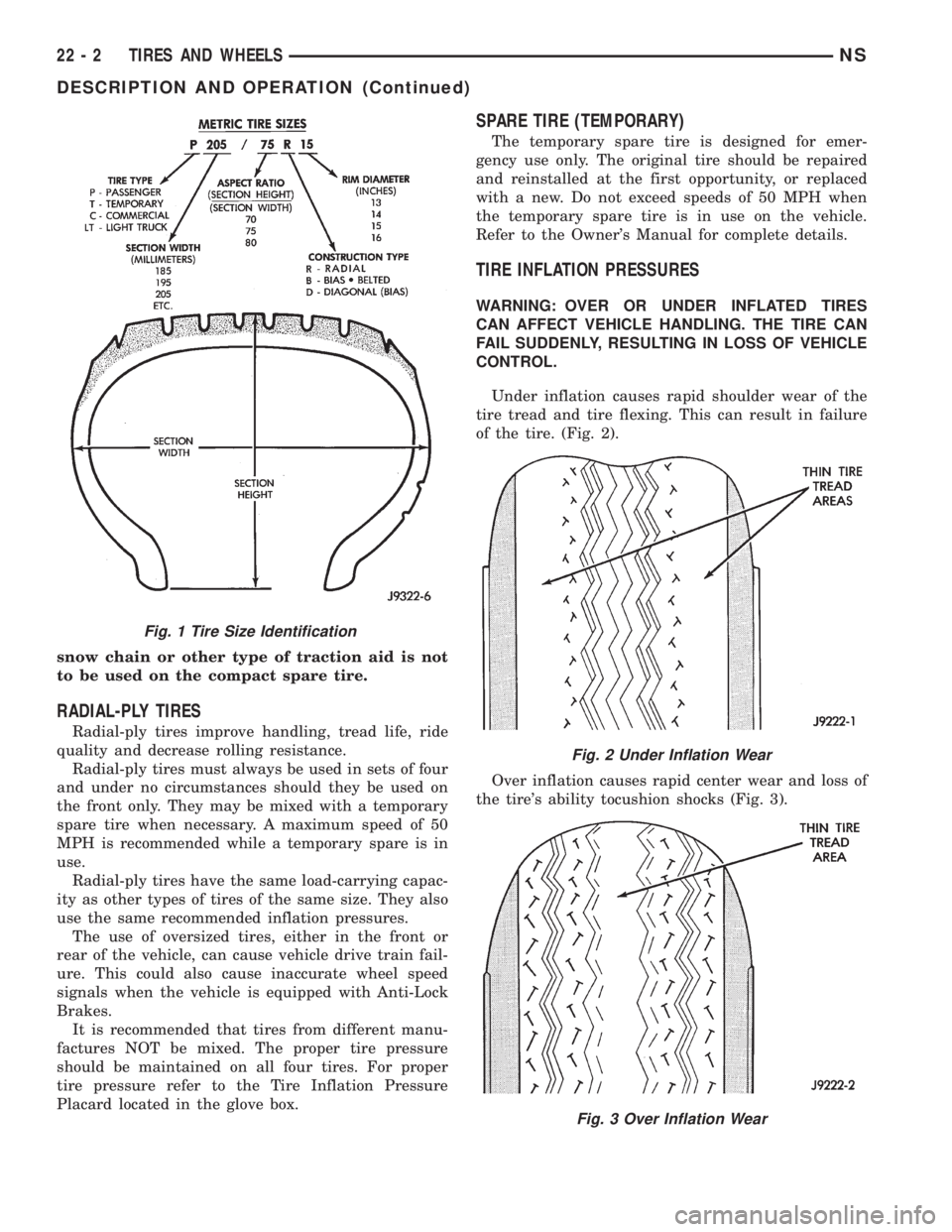
Under inflation causes rapid shoulder wear of the
tire tread and tire flexing. This can result in failure
of the tire. (Fig. 2).
Over inflation causes rapid center wear and loss of
the tire's ability tocushion shocks (Fig. 3).
Fig. 1 Tire Size Identification
Fig. 2 Under Inflation Wear
Fig. 3 Over Inflation Wear
22 - 2 TIRES AND WHEELSNS
DESCRIPTION AND OPERATION (Continued)