1996 CHRYSLER VOYAGER tow
[x] Cancel search: towPage 307 of 1938

sure that the spark plugs are firing. Inspect the dis-
tributor rotor, cap, spark plug cables, and spark
plugs. If they are in proper working order, the igni-
tion system is not the reason why the engine will not
start. Inspect the fuel system and engine for proper
operation.
CHECK COIL TESTÐ2.4L
Coil one fires cylinders 1 and 4, coil two fires
cylinders 2 and 3. Each coil tower is labeled
with the number of the corresponding cylinder.
(1) Remove ignition cables and measure the resis-
tance of the cables. Resistance must be within the
range shown in the Cable Resistance Chart in Spec-
ifications. Replace any cable not within tolerance.
(2) Disconnect the electrical connector from the
coil pack.
(3) Measure the primary resistance of each coil. At
the coil, connect an ohmmeter between the B+ pin
and the pin corresponding to the cylinders in ques-
tion (Fig. 17). Resistance on the primary side of each
coil should be 0.45 - 0.65 ohm at (70É to 80É F).
Replace the coil if resistance is not within tolerance.
(4) Remove ignition cables from the secondary tow-
ers of the coil. Measure the secondary resistance of
the coil between the towers of each individual coil
(Fig. 18). Secondary resistance should be 7,000 to
15,800 ohms. Replace the coil if resistance is not
within tolerance.
CHECK COIL TESTÐ3.3/3.8L
Coil 1 fires cylinders 1 and 4, coil 2 fires cyl-
inders 2 and 5, and coil 3 fires cylinders 3 and
6. Each coil tower is labeled with the number of
the corresponding cylinder.
(1) Disconnect the electrical connector from the
coil pack (Fig. 19).
(2) Measure the primary resistance of each coil. At
the coil, connect an ohmmeter between the B+ pinand the pin corresponding to the cylinders in ques-
tion (Fig. 20). Resistance on the primary side of each
coil should be 0.45 - 0.65 ohm at 21É to 27ÉC (70É to
80ÉF). A coil that has not been allowed to cool off,
would result in inaccurate measurement results.
Replace the coil if resistance is not within tolerance.
Fig. 17 Terminal Identification
Fig. 18 Checking Ignition Coil Secondary
Resistance
Fig. 19 Ignition Coil Electrical Connector
Fig. 20 Ignition Coil Terminal Identification
NSIGNITION SYSTEM 8D - 9
DIAGNOSIS AND TESTING (Continued)
Page 308 of 1938
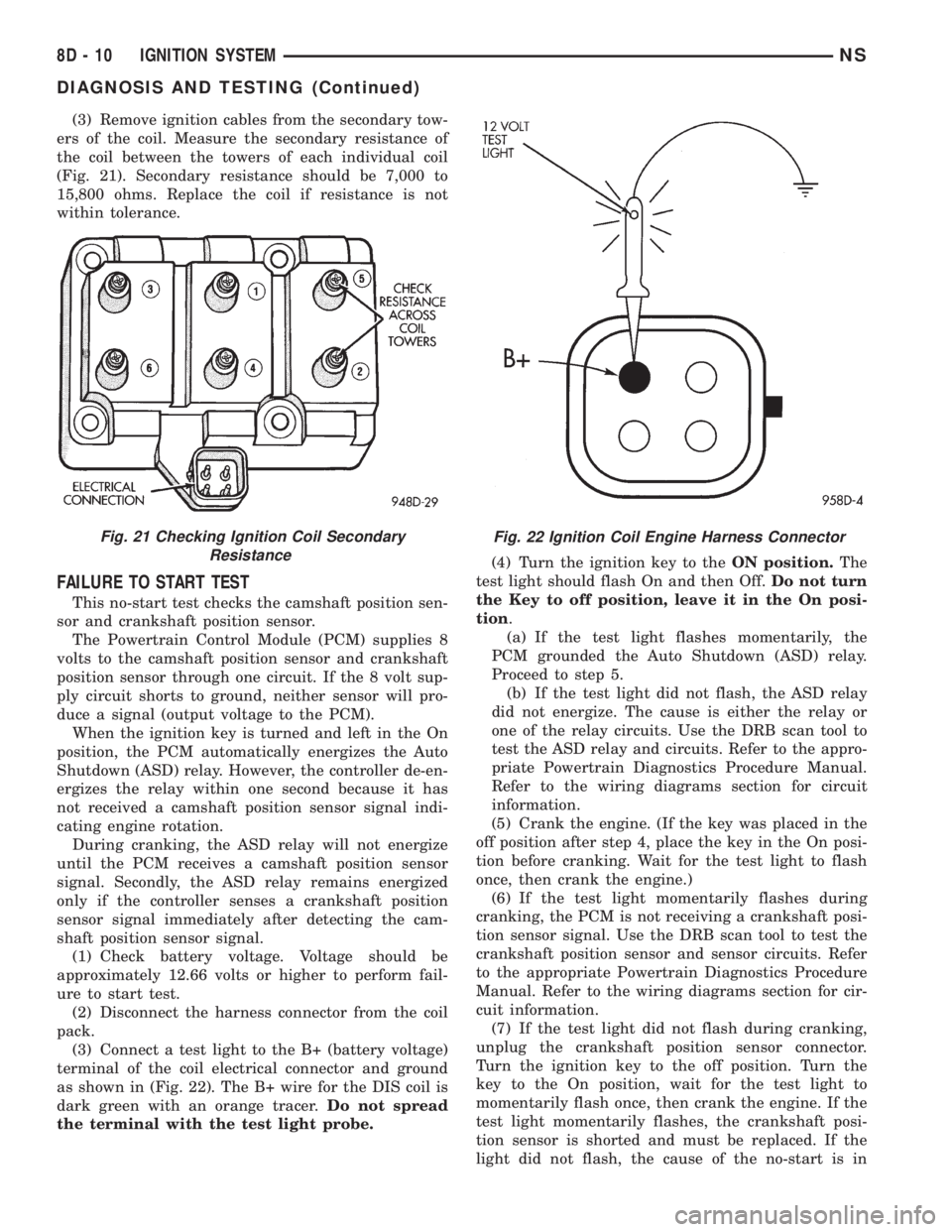
(3) Remove ignition cables from the secondary tow-
ers of the coil. Measure the secondary resistance of
the coil between the towers of each individual coil
(Fig. 21). Secondary resistance should be 7,000 to
15,800 ohms. Replace the coil if resistance is not
within tolerance.
FAILURE TO START TEST
This no-start test checks the camshaft position sen-
sor and crankshaft position sensor.
The Powertrain Control Module (PCM) supplies 8
volts to the camshaft position sensor and crankshaft
position sensor through one circuit. If the 8 volt sup-
ply circuit shorts to ground, neither sensor will pro-
duce a signal (output voltage to the PCM).
When the ignition key is turned and left in the On
position, the PCM automatically energizes the Auto
Shutdown (ASD) relay. However, the controller de-en-
ergizes the relay within one second because it has
not received a camshaft position sensor signal indi-
cating engine rotation.
During cranking, the ASD relay will not energize
until the PCM receives a camshaft position sensor
signal. Secondly, the ASD relay remains energized
only if the controller senses a crankshaft position
sensor signal immediately after detecting the cam-
shaft position sensor signal.
(1) Check battery voltage. Voltage should be
approximately 12.66 volts or higher to perform fail-
ure to start test.
(2) Disconnect the harness connector from the coil
pack.
(3) Connect a test light to the B+ (battery voltage)
terminal of the coil electrical connector and ground
as shown in (Fig. 22). The B+ wire for the DIS coil is
dark green with an orange tracer.Do not spread
the terminal with the test light probe.(4) Turn the ignition key to theON position.The
test light should flash On and then Off.Do not turn
the Key to off position, leave it in the On posi-
tion.
(a) If the test light flashes momentarily, the
PCM grounded the Auto Shutdown (ASD) relay.
Proceed to step 5.
(b) If the test light did not flash, the ASD relay
did not energize. The cause is either the relay or
one of the relay circuits. Use the DRB scan tool to
test the ASD relay and circuits. Refer to the appro-
priate Powertrain Diagnostics Procedure Manual.
Refer to the wiring diagrams section for circuit
information.
(5) Crank the engine. (If the key was placed in the
off position after step 4, place the key in the On posi-
tion before cranking. Wait for the test light to flash
once, then crank the engine.)
(6) If the test light momentarily flashes during
cranking, the PCM is not receiving a crankshaft posi-
tion sensor signal. Use the DRB scan tool to test the
crankshaft position sensor and sensor circuits. Refer
to the appropriate Powertrain Diagnostics Procedure
Manual. Refer to the wiring diagrams section for cir-
cuit information.
(7) If the test light did not flash during cranking,
unplug the crankshaft position sensor connector.
Turn the ignition key to the off position. Turn the
key to the On position, wait for the test light to
momentarily flash once, then crank the engine. If the
test light momentarily flashes, the crankshaft posi-
tion sensor is shorted and must be replaced. If the
light did not flash, the cause of the no-start is in
Fig. 21 Checking Ignition Coil Secondary
ResistanceFig. 22 Ignition Coil Engine Harness Connector
8D - 10 IGNITION SYSTEMNS
DIAGNOSIS AND TESTING (Continued)
Page 311 of 1938

29). The increase in electrode gap will be consider-
ably in excess of 0.001 in per 1000 miles of operation.
This suggests that a plug with a cooler heat range
rating should be used. Over advanced ignition tim-
ing, detonation and cooling system malfunctions also
can cause spark plug overheating.
THROTTLE POSITION SENSOR
To perform a complete test of the this sensor and
its circuitry, refer to the DRB scan tool and appropri-
ate Powertrain Diagnostics Procedures manual. To
test the throttle position sensor only, refer to the fol-
lowing:
The Throttle Position Sensor (TPS) can be tested
with a digital voltmeter (DVM). The center terminal
of the sensor is the output terminal. One of the other
terminals is a 5 volt supply and the remaining ter-
minal is ground.
Connect the DVM between the center and sensor
ground terminal. Refer to Group 8W - Wiring Dia-
grams for correct pinout.With the ignition switch in the ON position, check
the output voltage at the center terminal wire of the
connector. Check the output voltage at idle and at
Wide-Open-Throttle (WOT). At idle, TPS output volt-
age should be approximately 0.38 volts to 1.2 volts.
At wide open throttle, TPS output voltage should be
approximately 3.1 volts to 4.4 volts. The output volt-
age should gradually increase as the throttle plate
moves slowly from idle to WOT.
Check for spread terminals at the sensor and PCM
connections before replacing the TPS.
SERVICE PROCEDURES
SPARK PLUG GAP ADJUSTMENT
Check the spark plug gap with a gap gauge. If the
gap is not correct, adjust it by bending the ground
electrode (Fig. 30).
CAUTION: The Platinum pads can be damaged dur-
ing the measurement of checking the gap if extreme
care is not used.
Refer to 3.3/3.8L Spark Plug Gap Measurment in
this section.
POWERTRAIN CONTROL MODULE
REMOVAL
(1) Disconnect both cables from battery, negative
cable first.
(2) Remove 2 screws holding Power Distribution
Center (PDC) to bracket (Fig. 31).
(3) Remove heat shield from battery (Fig. 32).
(4) Remove nut and clamp holding battery to bat-
tery tray (Fig. 33).
(5) Remove battery from vehicle.
(6) Rotate PDC toward center of vehicle to remove
from rear bracket (Fig. 34).
Fig. 27 Chipped Electrode Insulator
Fig. 28 Preignition Damage
Fig. 29 Spark Plug Overheating
NSIGNITION SYSTEM 8D - 13
DIAGNOSIS AND TESTING (Continued)
Page 316 of 1938

REMOVAL AND INSTALLATION
SPARK PLUG CABLE SERVICEÐ2.4L
The cables insulate the spark plugs and covers the
top of the spark plug tube (Fig. 6). To remove the
cables, lightly grasp the top of the cable. Rotate the
insulator 90É and pull straight up. To replace the
cables, disconnect the cable from the ignition coil.
Ensure the #1 and #4 cables run under the #2
and #3 ignition coil towers. Keep #4 cable away
from the oil fill cap.
SPARK PLUG SERVICE
When replacing the spark plugs and spark plug
cables, route the cables correctly and secure them inthe appropriate retainers. Failure to route the cables
properly can cause the radio to reproduce ignition
noise, cross ignition of the spark plugs orshort cir-
cuit the cables to ground.
Never Wire Brush Spark Plugs.The spark plug
insulator tip is harder than the bristles of wire
brushes. Bristles of wire brushes can leave a conduc-
tive, metallic film on the insulator which could lead
to conductive deposits. Conductive deposits can cause
spark plug failure and engine misfire. Use a jewelers
file to remove deposits from the electrode gap or use
a spark plug cleaning machine to clean spark plugs.
REMOVAL
Always remove cables by grasping at the boot,
rotating the boot 1/2 turn, and pulling straight back
in a steady motion.
(1) Prior to removing the spark plug, spray com-
pressed air around the spark plug hole and the area
around the spark plug.
(2) Remove the spark plug using a quality socket
with a foam insert.
(3) Inspect the spark plug condition. Refer to
Spark Plug Condition in this section.
INSTALLATION
(1) To avoid cross threading, start the spark plug
into the cylinder head by hand.
(2) Tighten spark plugs to 28 N´m (20 ft. lbs.)
torque.
(3) Install spark plug cables over spark plugs. A
click will be heard and felt when the cable properly
attaches to the spark plug.
IGNITION COILÐ2.4L
REMOVAL
REMOVAL
(1) Remove spark plug cables from coil (Fig. 7).
Always twist the coil boots to break the seal with the
coil and pull straight back on the boot.
(2) Remove ignition coil electrical connector.
(3) Remove ignition coil mounting bolts, throttle
cable bracket or clip.
(4) Remove ignition coil.
INSTALLATION
(1) Reverse the above procedure for installation.
Tighten mounting screws to 12 N´m (105 in. lbs.)
torque.
(2) Transfer ignition cables to new coil pack. The
coil pack towers and cables are numbered with cylin-
der identification.
Fig. 5 Intake Air Temperature Sensor
Fig. 6 Spark Plug Cables
8D - 18 IGNITION SYSTEMNS
DESCRIPTION AND OPERATION (Continued)
Page 320 of 1938

SPECIFICATIONS
IGNITION COIL
SPARK PLUG
TORQUE
DESCRIPTION......................TORQUE
2.4L Target Magnet Screw.......3N´m(30in.lbs.)
2.4L Camshaft Position Sensoe Screw . .9 N´m (80 in.
lbs.)
Ignition Switch...............2N´m(17in.lbs.)
Spark Plugs.................28N´m(60in.lbs.)
SPARK PLUG CABLE RESISTANCEÐ2.4L
Coil ManufacturePrimary Resistance at 21ÉC-27ÉC
(70ÉF-80ÉF)Secondary Resistance at 21ÉC-
27ÉC (70ÉF-80ÉF)
Weastec (Steel Towers) 0.45 to 0.65 Ohms 7,000 to 15,800 Ohms
Coil Polarity
Engine Spark Plug Gap Thread Size
2.4L RC12YC5 0.048 TO 0.053 14mm (3/4 in.) reach
CABLE Maximum
Resistance
#1 & #4 4.2K ohms
#2 & #3 3.2K ohms
8D - 22 IGNITION SYSTEMNS
Page 324 of 1938

DISASSEMBLY AND ASSEMBLY
DISTRIBUTORÐ3.0L
REMOVAL
(1) Disconnect distributor connector from distribu-
tor (Fig. 6).
(2) Loosen distributor cap retaining screws.
(3) Lift cap of off distributor.
(4) Rotate engine crankshaft until the distributor
rotor points to the intake manifold plenum. Scribe a
mark on the plenum in line with the rotor. The scribe
line indicates where to position the rotor when rein-
stalling the distributor.
(5) Remove distributor hold down nut (Fig. 7).
(6) Carefully lift the distributor from the engine.
INSTALLATION
(1) Position distributor in engine. Make certain
that the O-ring is properly seated on distributor. If
O-ring is cracked or nicked replace with new one.
(2) Carefully engage distributor drive with gear on
camshaft. When the distributor is installed properly,
the rotor will be in line with previously scribe line on
air intake plenum.If engine was cranked while
distributor was removed, it will be necessary to
establish proper relationship between the dis-
tributor shaft and Number 1 piston position as
follows:
(a) Rotate the crankshaft until number one pis-
ton is at top of compression stroke.
(b) Rotate rotor to number one rotor terminal
(Fig. 8).
(c) Lower the distributor into the opening,
engaging distributor drive with drive on camshaft.
With distributor fully seated on engine, rotor
should be under the number 1 terminal.
(3) Install the distributor cap. Ensure sure all high
tension wires are firmly in the cap towers.
(4) Install hold-down nut and tighten (Fig. 7).
(5) Connect distributor electrical connector to dis-
tributor (Fig. 6).
CLEANING AND INSPECTION
DISTRIBUTOR CAP
Remove the distributor cap and inspect the inside
for flashover, cracking of carbon button, lack of
spring tension on carbon button, cracking of cap, and
burned, worn terminals (Fig. 9). Also check for bro-
ken distributor cap towers. If any of these conditions
are present the distributor cap and/or cables should
be replaced.
Fig. 6 Distributor Electrical ConnectorÐ3.0L Engine
Fig. 7 Distributor Hold-Down
Fig. 8 Distributor Cap Terminal Routing, View from
TopofCap
8D - 26 IGNITION SYSTEMNS
Page 325 of 1938

When replacing the distributor cap, transfer spark
plug wires from the original cap to the new cap one
at a time. Ensure that each wire is installed into the
tower of the new cap that corresponds to its tower
position in the original cap. Fully seat the wires into
the towers. If necessary, refer to the engine firing
order diagram.
Light scaling of the terminals can be cleaned with
a sharp knife. If the terminals are heavily scaled,
replace the distributor cap.
A cap that is greasy, dirty or has a powder-like
substance on the inside should be cleaned with asolution of warm water and a mild detergent. Scrub
the cap with a soft brush. Thoroughly rinse the cap
and dry it with a clean soft cloth.
DISTRIBUTOR ROTORÐ3.0L
Replace the rotor if it is cracked, the tip is exces-
sively burned or heavily scaled (Fig. 10).
SPECIFICATIONS
SPARK PLUG
TORQUE
DESCRIPTION......................TORQUE
Distributor Hold Down........14N´m(124 in. lbs.)
Ignition Coil Bracket..........10N´m(96in.lbs.)
Ignition Switch...............2N´m(17in.lbs.)
Spark Plugs.................28N´m(60in.lbs.)
SPARK PLUG CABLE RESISTANCEÐ3.0L
Fig. 9 Distributor Cap InspectionÐTypical
Fig. 10 Rotor InspectionÐTypical
Engine Spark Plug Gap Thread Size
3.0L RN11YC4 0.039 TO 0.044 14mm (3/4 in.) reach
CABLE Maximum
Resistance
#1 14.0K ohms
#2 10.4K ohms
#3 14.9K ohms
#4 11.5K ohms
#5 17.5K ohms
#6 10.3K ohms
Coil Lead 11.1K ohms
NSIGNITION SYSTEM 8D - 27
CLEANING AND INSPECTION (Continued)
Page 328 of 1938

(5) Install intake strut bolt to cylinder head at cyl-
inder head.
(6) Tighten bolt to intake strut at intake.
(7) Tighten bolt at cylinder head.
(8) Install the resonator.
SPARK PLUG #1
REMOVAL
(1) Remove the accessory drive belt, refer to Group
7, Cooling.
(2) Remove the 4 bolts from the upper half of the
generator bracket.
(3) Push the Generator rearward.
(4) Grasp the spark plug boot/shield assembly as
close as possible to the spark plug.Twist the boot/
shield assembly slightly to break its seal with
the plug and pull straight out. Do not use pli-
ers, pull on the ignition cable, or pull the spark
plug boot at an angle.This could damage the
spark plug insulator, terminal, or the insulation.
Wipe spark plug insulator clean with a dry cloth
before installation.
(5) Remove spark plug
INSTALLATION
(1) Install spark plug and tighten to 28 N´m (20 ft.
lbs.).
(2) When installing the spark plug cables, make
sure the coil or spark plug insulator and terminals
are fully seated. Aclick sound should be heard or
felt when the terminals are properly attached.
(3) Pull Generator back into place.
(4) Install upper Generator bracket with the 4
bolts.
(5) Install the accessory drive belt, refer to Group
7, Cooling.
IGNITION COIL
REMOVAL
(1) Remove spark plug cables from coil (Fig. 2).
Always twist the spark plug boots to break the seal
with the plug and pull straight back on the boot.
(2) Remove ignition coil electrical connector.
(3) Remove ignition coil mounting screws.
(4) Remove ignition coil.
INSTALLATION
(1) Reverse the above procedure for installation.
Tighten mounting screws to 12 N´m (105 in. lbs.)
torque.
(2) Transfer spark plug cables to new coil pack.
The coil pack towers and cables are numbered with
the cylinder identification.
CRANKSHAFT POSITION SENSOR
REMOVAL
(1) Raise and support vehicle.
(2) Disconnect crankshaft position sensor electrical
connector from the wiring harness connector (Fig. 3).
(3) Remove crankshaft position sensor retaining
bolt.
(4) Pull crankshaft position sensor straight up out
of the transaxle housing.
INSTALLATION
NOTE: If the removed sensor is to be reinstalled,
clean off the old spacer on the sensor face. A NEW
SPACER must be attached to the sensor face before
installation. If the sensor is being replaced, confirm
that the paper spacer is attached to the face of the
new sensor (Fig. 4).
(1) Install sensor in transaxle and push sensor
down until contact is made with the drive plate.
Fig. 2 Ignition Coil Removal
Fig. 3 Crankshaft Position Sensor Connector
8D - 30 IGNITION SYSTEMNS
REMOVAL AND INSTALLATION (Continued)