1996 CHRYSLER VOYAGER tow
[x] Cancel search: towPage 188 of 1938

(7) Remove the wheel speed sensor cable grommets
from the retaining bracket (Fig. 37).(8) Remove front wheel speed sensor assembly
from the vehicle.
INSTALL
CAUTION: Proper installation of wheel speed sen-
sor cables is critical to continued system operation.
Be sure that cables are installed in retainers. Fail-
ure to install cables in retainers as shown in this
section may result in contact with moving parts
and/or over extension of cables, resulting in an
open circuit.
(1) Connect the front wheel speed sensor cable to
the vehicle wiring harness connector (Fig. 35). Be
sure speed sensor cable connector is fully seated and
locked into vehicle wiring harness connector, then
insert cable and grommet into hole in strut tower
(Fig. 35).
CAUTION: When installing channel bracket, do not
pinch the speed sensor cable under the channel
bracket.
(2) Install the channel bracket and grommet
retainer on the frame rail (Fig. 34).
(3) Install the 2 bolts (Fig. 34) attaching the chan-
nel bracket to frame. Tighten the 2 attaching bolts to
a torque of 11 N´m (95 in. lbs.).
(4) Insert speed sensor cable grommets into inter-
mediate bracket on strut (Fig. 37). Route cable from
strut to steering knuckle on the rearward side of the
stabilizer bar link.
(5) Install the wheel speed sensor to steering
knuckle attaching bolt (Fig. 36). Tighten the speed
sensor attaching bolt to a torque of 12 N´m (105 in.
lbs.)
(6) Check the air gap between the face of the
wheel speed sensor and the top surface of the tone-
wheel. Air gap must be less then the maximum
allowable tolerance of 1.2 mm (.047 in.).
(7) Install the wheel and tire assembly on vehicle.
(8) Road test vehicle to ensure proper operation of
the base and ABS brake systems.
WHEEL SPEED SENSOR (REAR FWD)
REMOVE
(1) Raise vehicle on jack stands or centered on a
frame contact type hoist. See Hoisting in the Lubri-
cation and Maintenance section of this manual, for
the required lifting procedure to be used for this
vehicle.
(2) Remove the tire and wheel assembly from the
vehicle.
Fig. 35 Speed Sensor Cable To Vehicle Wiring
Harness
Fig. 36 Front Wheel Speed Sensor Attaching Bolt
Fig. 37 Front Wheel Speed Sensor Cable Routing
5 - 106 BRAKESNS
REMOVAL AND INSTALLATION (Continued)
Page 206 of 1938

CLUTCH COVER AND DISC RUNOUT
Check condition of the clutch cover before installa-
tion. A warped cover or diaphragm spring will cause
grab and/or incomplete release or engagement. Use
care when handling the clutch assembly. Impact can
distort the cover, diaphragm spring, and release fin-
gers.
CLUTCH CHATTER COMPLAINTS
For all clutch chatter complaints, do the following:
(1) Check for loose, misaligned, or broken engine
and transmission mounts. If present, they should be
corrected at this time. Test vehicle for chatter. If
chatter is gone, there is no need to go any further. If
chatter persists:
(2) Check to see if clutch cable routing is correct
and operates smoothly (LHD applications).
(3) Check for loose connections in drivetrain. Cor-
rect any problems and determine if clutch chatter
complaints have been satisfied. If not:
(4) Remove transaxle. See Group 21, Manual Tran-
saxle for procedure.
(5) Check to see if the release bearing is sticky or
binding. Replace bearing, if needed.
(6) Check linkage for excessive wear on the pivot
shaft, fork, and bushings. Replace all worn parts.
(7) Check clutch assembly for contamination (dirt,
oil). Replace clutch assembly, if required.
(8) Check to see if the clutch disc hub splines are
damaged. Replace with new clutch assembly, if nec-
essary.
(9) Check input shaft splines for damage. Replace,
if necessary.
(10) Check for uneven wear on clutch fingers.
(11) Check for broken clutch cover diaphragm
spring fingers. Replace with new clutch assembly, if
necessary.
CLASH±INTO±REVERSE COMPLAINTS
(1) Depress clutch pedal to floor and hold. After
three seconds, shift to reverse. If clash is present,
clutch has excessive spin time.
NOTE: Verify that nothing is obstructing pedal
travel. Floormats or other articles located under-
neath the clutch pedal could prevent the clutch
from disengaging fully.
(2) Remove transaxle. See Group 21, Manual Tran-
saxle for procedure.
(3) Check the input shaft spline, clutch disc
splines, and release bearing for dry rust. If present,
clean rust off and apply a light coat of bearing grease
to the input shaft splines. Apply grease on the input
shaft splines only where the clutch disc slides. Verify
that the clutch disc slides freely along the input shaft
spline.(4) Check to see if the clutch disc hub splines are
damaged, and replace with new clutch assembly if
required.
(5) Check the input shaft for damaged splines.
Replace as necessary.
(6) Check for broken clutch cover diaphragm
spring fingers.
(7) Install clutch assembly and transaxle.
REMOVAL AND INSTALLATION
CLUTCH CABLE SYSTEM Ð LHD
REMOVAL
(1) Hoist vehicle
(2) Using a pair of pliers, grasp end of clutch cable
and pull downward.
(3) Remove clutch cable retaining clip from clutch
release lever (Fig. 9).
(4) Guide cable through slot in transaxle and dis-
connect (Fig. 10).
(5) Unsnap cable from the cable guide located at
the left shock tower (Fig. 10).
(6) Inside the vehicle, remove the driver side lower
dash cover and steel support plate. This provides
access to the top of the clutch pedal.
(7) Disconnect clutch cable upstop/spacer with
cable strand from clutch pedal (Fig. 11) (Fig. 12).
Fig. 9 Clutch Cable Retaining Clip Ð LHD
6 - 8 CLUTCHNS/GS
DIAGNOSIS AND TESTING (Continued)
Page 207 of 1938

NOTE: Depressing the clutch pedal to the floor pro-
vides access to the clutch cable strand. Disconnect
the cable upstop/spacer from the pedal pivot pin by
removing the retaining clip at the top of the clutch
pedal. Wedge a flat blade pry tool in the clip slot to
remove the clip. Remove the clutch pedal upstop/
spacer from the pedal by wedging a flat blade pry
tool between the spacer and pedal. It may be nec-
essary to push the steel support bracket supporting
the electrical junction block slightly to the left for
clearance to remove the upstop/spacer from the
pedal. Push the cable end fitting out of upstop/
spacer.
CAUTION: Use caution if lifting the clutch pedal
once the clutch pedal/upstop spacer has been
removed. The clutch pedal assist spring provides
enough pedal force to cause an injury. Also, on 2.5L
Turbo Diesel vehicles, lifting the clutch pedal with
the upstop/spacer removed may bend the cruise
control cutout switch bracket located near the top
of the clutch pedal. This will result in non-opera-
tional cruise control.
CAUTION: Do not pull on the clutch cable to
remove it from the dash panel. Damage to the cable
self-adjuster may occur.NOTE: It may be helpful to remove the battery and
clutch cable guide from the left shock tower to
improve access to the clutch cable dash panel
grommet.
Fig. 10 Clutch Cable Routing Ð LHDFig. 11 Clutch Cable Retaining (Upstop) Clip Ð LHD
Fig. 12 Upstop/Spacer Ð LHD
NS/GSCLUTCH 6 - 9
REMOVAL AND INSTALLATION (Continued)
Page 208 of 1938
(8) Use a slight twisting motion while grasping the
grommet and body to remove the cable from the dash
panel and clutch bracket.
INSTALLATION
(1) Using a slight twisting motion, insert the self-
±adjuster mechanism end of the clutch cable through
the dash panel hole and into the bracket.
NOTE: It may be helpful to lubricate the dash panel
grommet using MoparTDoor-Ease or equivalent to
aid installation.
(2) Seat the cylindrical part of the cable grommet
in the dash panel. Be sure the self±adjuster is firmly
seated against the clutch bracket to ensure proper
adjuster mechanism function.
(3) Connect the clutch cable to the upstop/spacer.
(4) Connect the upstop/spacer to the clutch pedal.
(5) Replace the upstop/spacer retainer clip.
(6) Lift the clutch pedal and perform the Adjuster
Mechanism Function Check before finishing installa-
tion.
NOTE: If the adjuster mechanism does not function
properly, the most likely cause is that the cable is
not properly seated in the bracket.
ADJUSTER MECHANISM FUNCTION CHECK Ð LHD
(1) With slight pressure, pull the clutch release
lever end of the cable to draw the cable taut. Push
the clutch cable housing toward the dash panel (With
less than 20 lbs. of effort, the cable housing should
move 30-50mm.). This indicates proper adjuster
mechanism function. If the cable does not adjust,
determine if the mechanism is properly seated on the
bracket.
(2) If the adjust mechanism functions properly,
route cable to the transaxle. Install battery and cable
guide.
(3) Snap cable into cable guide located at the left
shock tower.
(4) Insert cable into transaxle and through clutch
release lever. Ensure the cable is routed through the
smaller hole in the transaxle deck (Fig. 10).
(5) Pull down on cable and insert cable retaining
clip onto clutch cable end.
(6) Check clutch pedal position switch operation.
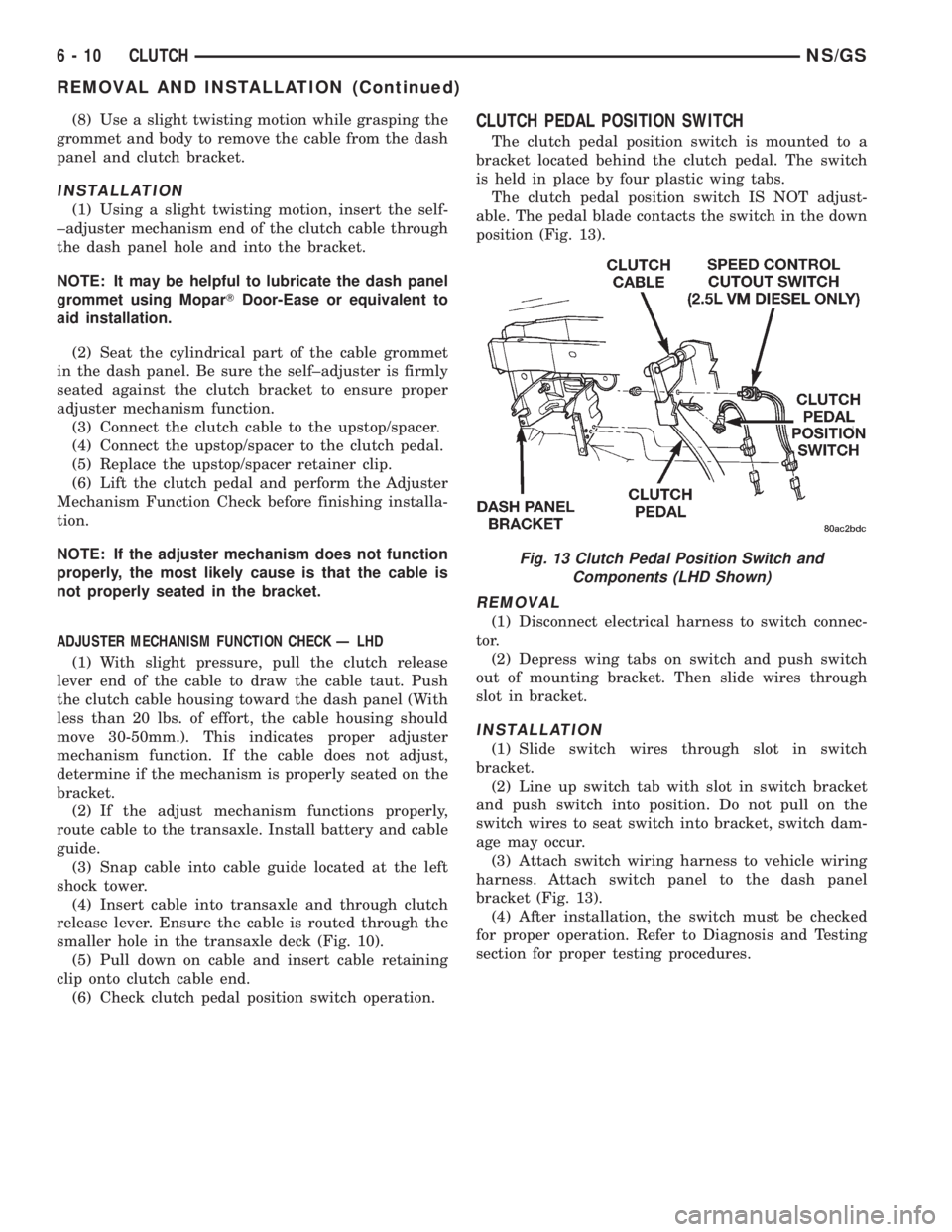
CLUTCH PEDAL POSITION SWITCH
The clutch pedal position switch is mounted to a
bracket located behind the clutch pedal. The switch
is held in place by four plastic wing tabs.
The clutch pedal position switch IS NOT adjust-
able. The pedal blade contacts the switch in the down
position (Fig. 13).
REMOVAL
(1) Disconnect electrical harness to switch connec-
tor.
(2) Depress wing tabs on switch and push switch
out of mounting bracket. Then slide wires through
slot in bracket.
INSTALLATION
(1) Slide switch wires through slot in switch
bracket.
(2) Line up switch tab with slot in switch bracket
and push switch into position. Do not pull on the
switch wires to seat switch into bracket, switch dam-
age may occur.
(3) Attach switch wiring harness to vehicle wiring
harness. Attach switch panel to the dash panel
bracket (Fig. 13).
(4) After installation, the switch must be checked
for proper operation. Refer to Diagnosis and Testing
section for proper testing procedures.
Fig. 13 Clutch Pedal Position Switch and
Components (LHD Shown)
6 - 10 CLUTCHNS/GS
REMOVAL AND INSTALLATION (Continued)
Page 214 of 1938

ADJUSTMENTS
CLUTCH CABLE Ð LHD
The manual transaxle clutch release system has a
unique self-adjusting mechanism to compensate for
clutch disc wear. This adjuster mechanism is located
within the clutch cable assembly. The preload spring
maintains tension on the cable. This tension keeps
the clutch release bearing continuously loaded
against the fingers of the clutch cover assembly.
ADJUSTER MECHANISM FUNCTION CHECK Ð
LHD
(1) With slight pressure, pull the clutch release
lever end of the cable to draw the cable taut. Push
the clutch cable housing toward the dash panel (With
less than 20 lbs. of effort, the cable housing should
move 30-50mm.). This indicates proper adjuster
mechanism function. If the cable does not adjust,
determine if the mechanism is properly seated on the
bracket.
(2) If the adjust mechanism functions properly,
route cable to the transaxle.
(3) Insert cable into transaxle and through clutch
release lever. Ensure the cable is routed through the
smaller hole in the transaxle deck (Fig. 10).
(4) Pull down on cable and insert cable retaining
clip onto clutch cable end.
(5) Check clutch pedal position switch operation.
CLUTCH PEDAL POSITION SWITCH
The clutch pedal position switch is mounted to a
bracket located behind the clutch pedal. The switch
is held in place by four plastic wing tabs.
The clutch pedal position switch IS NOT adjust-
able. The pedal blade contacts the switch in the down
position.
SPECIFICATIONS
CLUTCH TIGHTENING REFERENCE
2.0/2.4 LITER GASOLINE ENGINE
DESCRIPTION TORQUE
Drive Plate Bolts............95N´m(70ft.lbs.)
Lower Trans. Cover.........12N´m(105 in. lbs.)
Modular Clutch Bolts.........74N´m(55ft.lbs.)
Upper Trans. Cover.........12N´m(105 in. lbs.)
2.5 LITER DIESEL ENGINE
DESCRIPTION TORQUE
Flywheel Bolts..............95N´m(70ft.lbs.)
Lower Trans. Cover.........12N´m(105 in. lbs.)
Clutch Pressure Plate Bolts....27N´m(20ft.lbs.)
Upper Trans. Cover.........12N´m(105 in. lbs.)
6 - 16 CLUTCHNS/GS
Page 218 of 1938

ties to keep the engine satisfactorily cooled (Fig. 5),
(Fig. 6), (Fig. 7) and (Fig. 8).
CAUTION: Plastic tanks, while stronger then brass
are subject to damage by impact, such as wrenches
etc., or by excessive torque on hose clamps.
If the plastic tank is damaged, replace the radia-
tor.
RADIATOR PRESSURE CAP
The radiator is equipped with a pressure cap that
releases excessive cooling system pressure; maintain-
ing a range of 97-124 kPa (14-18 psi).
The cooling system will operate at higher than
atmospheric pressure. The higher pressure raises thecoolant boiling point thus, allowing increased radia-
tor cooling capacity.
There is also a vent valve in the center of the cap.
This valve also opens when coolant is cooling and
contracting allowing coolant to return to radiator
from coolant reserve system tank by vacuum through
connecting hose.If valve is stuck shut, or the
coolant recovery hose is pinched, the radiator
hoses will be collapsed on cool down. Clean the
vent valve (Fig. 9) and inspect coolant recovery
hose routing, to ensure proper sealing when
boiling point is reached.
The gasket in the cap seals the filler neck, so that
vacuum can be maintained, allowing coolant to be
drawn back into the radiator from the reserve tank.
Fig. 5 Cooling ModuleÐ2.4L
Fig. 6 Cooling ModuleÐTrailer Tow (With Rear A/C)
7 - 4 COOLING SYSTEMNS
GENERAL INFORMATION (Continued)
Page 220 of 1938

DESCRIPTION AND OPERATION
WATER PIPESÐ3.0L ENGINE
The 3.0L engine uses metal piping beyond the
lower radiator hose to route (suction) coolant to the
water pump, which is located in the V of the cylinder
banks (Fig. 10).
These pipes are provided with inlet nipples for
thermostat bypass and heater return coolant hoses,
and brackets for rigid engine attachment. The pipes
employ O-rings for sealing at their interconnection
and to the water pump (Fig. 10).
COOLANT PERFORMANCE
Performance is measurable. For heat transfer pure
water excels (Formula = 1 btu per minute for each
degree of temperature rise for each pound of water).
This formula is altered when necessary additives to
control boiling, freezing, and corrosion are added as
follows:
²Pure Water (1 btu) boils at 100ÉC (212ÉF) and
freezes at 0ÉC (32ÉF)
²100 percent Glycol (.7 btu) can cause a hot
engine and detonation and will lower the freeze point
to -22ÉC (-8ÉF).
²50/50 Glycol and Water (.82 btu) is the recom-
mended combination that provides a freeze point of
-37ÉC (-35ÉF). The radiator, water pump, engine
water jacket, radiator pressure cap, thermostat, tem-
perature gauge, sending unit and heater are all
designed for 50/50 glycol.CAUTION: Do not use well water, or suspect water
supply in cooling system. A 50/50 ethylene glycol
and distilled water mix is recommended.
Where required, a 56 percent glycol and 44 percent
water mixture will provide a freeze point of -59ÉC
(-50ÉF).
CAUTION: Richer mixtures cannot be measured
with field equipment. This can lead to problems
associated with 100 percent glycol.
RADIATOR HOSES AND CLAMPS
WARNING: IF VEHICLE HAS BEEN RUN
RECENTLY, WAIT 15 MINUTES BEFORE WORKING
ON VEHICLE. RELIEVE PRESSURE BY PLACING A
SHOP TOWEL OVER THE CAP AND WITHOUT
PUSHING DOWN ROTATE IT COUNTERCLOCKWISE
TO THE FIRST STOP. ALLOW FLUIDS AND STEAM
TO ESCAPE THROUGH THE OVERFLOW TUBE.
THIS WILL RELIEVE SYSTEM PRESSURE
The hoses are removed by using constant tension
clamp pliers to compress the hose clamp.
A hardened, cracked, swollen or restricted hose
should be replaced. Do not damage radiator inlet and
outlet when loosening hoses.
Radiator hoses should be routed without any kinks
and indexed as designed. The use of molded hoses is
recommended.
Spring type hose clamps are used in all applica-
tions. If replacement is necessary replace with the
original MOPARtequipment spring type clamp.
WATER PUMPÐ2.4L ENGINE
The water pump has a diecast aluminum body and
housing with a stamped steel impeller. The water
pump bolts directly to the block. Cylinder block to
water pump sealing is provided by a rubber O-ring.
The water pump is driven by the timing belt. Refer
to Timing Belt in Group 9, Engine for component
removal providing access to water pump.
WATER PUMPÐ3.0L ENGINE
The pump bolts directly to the engine block, using
a gasket for pump to block sealing (Fig. 11). The
pump is serviced as a unit.
The water pump is driven by the timing belt. See
Timing Belt in Group 9, Engine for component
removal providing access to water pump.
Fig. 10 Engine Inlet Coolant Pipes 3.0L Engine
7 - 6 COOLING SYSTEMNS
Page 229 of 1938

WARNING: WITH TOOL IN PLACE, PRESSURE
WILL BUILD UP FAST. EXCESSIVE PRESSURE
BUILT UP, BY CONTINUOUS ENGINE OPERATION,
MUST BE RELEASED TO A SAFE PRESSURE
POINT. NEVER PERMIT PRESSURE TO EXCEED 138
kPa (20 psi).
If the needle on the dial does not fluctuate, race
the engine a few times. If an abnormal amount of
coolant or steam emits from the tail pipe, it may
indicate a coolant leak caused by a faulty head gas-
ket, cracked engine block, or cracked cylinder head.
There may be internal leaks that can be deter-
mined by removing the oil dipstick. If water globules
appear intermixed with the oil it will indicate an
internal leak in the engine. If there is an internal
leak, the engine must be disassembled for repair.
RADIATOR CAP TO FILLER NECK SEAL PRESSURE
RELIEF CHECK
The pressure cap upper gasket (seal) pressure
relief can be checked by removing the overflow hose
at the radiator filler neck nipple (Fig. 13). Attach the
Radiator Pressure Tool to the filler neck nipple and
pump air into the radiator. Pressure cap upper gas-
ket should relieve at 69-124 kPa (10-18 psi) and hold
pressure at 55 kPa (8 psi) minimum.
WARNING: THE WARNING WORDS ªDO NOT
OPEN HOTº ON THE RADIATOR PRESSURE CAP IS
A SAFETY PRECAUTION. WHEN HOT, PRESSURE
BUILDS UP IN COOLING SYSTEM. TO PREVENT
SCALDING OR INJURY, THE RADIATOR CAP
SHOULD NOT BE REMOVED WHILE THE SYSTEM
IS HOT OR UNDER PRESSURE.
There is no need to remove the radiator cap at any
timeexceptfor the following purposes:
(1) Check and adjust coolant freeze point. By add-
ing or subtracting coolant through CRS bottle.
(2) Refill system with new coolant.
(3) Conducting service procedures.
(4) Checking for vacuum leaks.WARNING: IF VEHICLE HAS BEEN RUN
RECENTLY, WAIT 15 MINUTES BEFORE REMOVING
CAP. THEN PLACE A SHOP TOWEL OVER THE CAP
AND WITHOUT PUSHING DOWN ROTATE COUN-
TERCLOCKWISE TO THE FIRST STOP. ALLOW FLU-
IDS TO ESCAPE THROUGH THE OVERFLOW TUBE
AND WHEN THE SYSTEM STOPS PUSHING COOL-
ANT AND STEAM INTO THE CRS TANK AND PRES-
SURE DROPS PUSH DOWN AND REMOVE THE CAP
COMPLETELY. SQUEEZING THE RADIATOR INLET
HOSE WITH A SHOP TOWEL (TO CHECK PRES-
SURE) BEFORE AND AFTER TURNING TO THE
FIRST STOP IS RECOMMENDED.
PRESSURE TESTING RADIATOR CAP
Dip the pressure cap in water, clean any deposits
off the vent valve or its seat and apply cap to end of
Radiator Pressure Tool. Working the plunger, bring
the pressure to 104 kPa (15 psi) on the gauge. If the
pressure cap fails to hold pressure of at least 97 kPa
(14 psi) replace cap. SeeCAUTION.
If the pressure cap tests properly while positioned
on Radiator Pressure Tool (Fig. 14), but will not hold
pressure or vacuum when positioned on the radiator.
Inspect the radiator filler neck and cap top gasket for
irregularities that may prevent the cap from sealing
properly.
CAUTION: Radiator Pressure Tool is very sensitive
to small air leaks that will not cause cooling system
problems. A pressure cap that does not have a his-
tory of coolant loss should not be replaced just
because it leaks slowly when tested with this tool.
Add water to the tool. Turn tool upside down and
recheck pressure cap to confirm that cap is bad.
LOW COOLANT LEVEL AERATION
Low coolant level in a cross flow radiator will
equalize in both tanks with engine off. With engine
Fig. 13 Radiator Pressure Cap Filler Neck
Fig. 14 Pressure Testing Radiator Cap
NSCOOLING SYSTEM 7 - 15
DIAGNOSIS AND TESTING (Continued)