1996 CHRYSLER VOYAGER tow
[x] Cancel search: towPage 64 of 1938

²Inspect jounce bumper for cracks and signs of
deterioration.
(13) Replace any components of the strut assembly
found to be worn or defective during the inspection,
before re-assembling the strut.
ASSEMBLY
(1) Clamp strut in vise, with strut in vertical posi-
tion.Do not clamp strut in vise by body of strut,
only by the clevis bracket (Fig. 68).
(2) Install the spring isolator on the strut lower
spring seat (Fig. 74). When installing the spring iso-
lator, be sure the 2 retaining tabs on the spring iso-
lator (Fig. 74) are installed in the 2 holes in the
spring seat. When properly installed, the oversize
holes in the spring seat should line up with the holes
in the spring isolator.
(3) Install the jounce bumper (Fig. 75) on the strut
shaft. Jounce bumper is to be installed with the
small end of the jounce bumper pointing down (Fig.
75).
(4) Install dust shield (Fig. 76) on the strut.After
dust shield is installed on strut, collapse dust
shield down on top of jounce bumper until
jounce bumper snaps into dust shield. Then
return the dust shield to its fully extended
length.
(5) Install coil spring on strut. Spring is to be
installed with the end of the bottom coil aligned with
the clevis bracket on the strut assembly (Fig. 77).
(6) Install the upper spring seat on the coil spring
(Fig. 77). Spring seat must be installed with the
notch in the spring seat (Fig. 77) aligned with the
clevis bracket on the strut.
WARNING: WHEN COMPRESSING THE COIL
SPRING, THE COIL SPRING UPPER SEAT AND THE
BOTTOM COIL OF THE SPRING MUST BE CAP-TURED BY THE JAWS OF THE COIL SPRING COM-
PRESSOR.
(7) Compress strut coil spring using Pentastar Ser-
vice Equipment Spring Compressor, 7522A (Fig. 69).
Be sure the top and bottom attachment shoe selected,
(Fig. 69) properly fit the coil spring.
(8) Install the pivot bearing on the top of the
upper spring seat (Fig. 78).Bearing must be
installed on spring seat with the smaller diam-
eter side of the pivot bearing toward the spring
seat (Fig. 78). Also, be sure the pivot bearing is
sitting flat on the spring seat.
(9) Install the strut mount on the upper spring
seat of the strut. Loosely install the nut on strut
shaft.
WARNING: THE FOLLOWING 2 STEPS MUST BE
COMPLETELY DONE BEFORE SPRING COMPRES-
SOR IS RELEASED FROM THE COIL SPRING.
Fig. 75 Correctly Installed Jounce Bumper
Fig. 76 Installing Dust Boot
Fig. 77 Coil Spring And Spring Seat Correctly
Installed
2 - 32 SUSPENSIONNS
DISASSEMBLY AND ASSEMBLY (Continued)
Page 68 of 1938

NOTE: Bushings must be installed on stabilizer bar
so the square corner of the bushing will be down
and slit in bushing will be facing the rear of the
vehicle when the stabilizer is installed (Fig. 88).SPECIFICATIONS
FRONT SUSPENSION FASTENER TORQUES
DESCRIPTION TORQUE
McPHERSON STRUT:
To Strut Tower
Attaching Nuts............28N´m(250 in. lbs.)
Clevis Bracket To Steering
Knuckle..................88N´m(65ft.lbs.)
Plus 1/4 Additional Turn
Strut Shaft Nut.............100 N´m (75 ft. lbs.)
STEERING KNUCKLE:
Ball Joint Stud To Steering
Knuckle Nut/Bolt.........136 N´m (100 ft. lbs.)
Disc Brake Caliper Bolts.......22N´m(16ft.lbs.)
Wheel Stop..................95N´m(70ft.lbs.)
STEERING GEAR:
To Suspension Cradle
Attaching Bolts...........183 N´m (135 ft. lbs.)
Tie Rod End Adjusting
Sleeve Nut................75N´m(55ft.lbs.)
Tie Rod End To Steering
Knuckle Nut...............61N´m(45ft.lbs.)
FRONT SUSPENSION CRADLE:
To Body Attaching Bolts......163 N´m (120 ft. lbs.)
Lower Control Arm
Pivot Bolt...............185 N´m (137 ft. lbs.)
Lower Control Arm Rear
Bushing Retainer Bolt.......68N´m(50ft.lbs.)
Reinforcement Plate
Attaching Bolts M-12.......108 N´m (80 ft. lbs.)
Reinforcement Plate
Attaching Bolts M-14......166 N´m (123 ft. lbs.)
STABILIZER BAR:
Bushing Retainer ToSuspension
Cradle Attaching Bolts.......70N´m(50ft.lbs.)
Attaching Link Nuts...........88N´m(65ft.lbs.)
HUB AND BEARING:
To Steering Knuckle Bolts......110N´m(80ft.lbs.)
Front Stub Axle To Hub
Bearing Nut.............183 N´m (135 ft. lbs.)
Wheel Mounting
LugNut...........110-135 N´m (85-115 ft. lbs.)
Fig. 88 Correctly Installed Stabilizer Bar To Cradle
Bushing
2 - 36 SUSPENSIONNS
DISASSEMBLY AND ASSEMBLY (Continued)
Page 77 of 1938

SHOCK ABSORBER
REMOVE/INSTALL
(1) Raise vehicle. Vehicle is to be raised and sup-
ported on jackstands or on a frame contact type
hoist. See Hoisting in the Lubrication And Mainte-
nance section of this service manual.
(2) Support the rear axle of the vehicle using 2
jackstands positioned at the outer ends of the axle.
NOTE: If the shock absorber lower mounting bolt
deflects upward during removal, raise axle by
adjusting the support jack. If the lower shock
absorber bolt deflects downward during removal,
lower the axle by adjusting the support jack.
(3) Remove the shock absorber lower mounting
bolt.
(4) While holding shock absorber, remove the
shock absorber upper mounting bolt.
(5) To install the shock absorber use the reverse
sequence of its removal.
(6) Lower the vehicle to the ground so the full
weight of the vehicle is supported by the suspension.
(7) Tighten the upper and lower shock absorber
mounting bolt to their specified torques.
REAR TRACK BAR
REMOVE
(1) Remove the nut and bolt mounting the track
bar to the rear axle (Fig. 19).
(2) Remove the nut and bolt attaching the track
bar to the track bar mount on the body of the vehicle.
Remove the track bar from the track bar mount.
INSTALL
(1) Install the track bar first into the body mount
for the track bar (Fig. 20). Install the track bar boltwith the head of the bolt facing toward the rear of
the vehicle (Fig. 21). Do not tighten.
(2) Install the track bar into its mounting bracket
on the rear axle (Fig. 19). Install the track bar bolt
with the head of the bolt facing toward the rear of
the vehicle. Do not tighten.
(3) Lower the vehicle to the ground until the full
weight of the vehicle is supported by the wheels.
Tighten both track bar attaching bolts to a torque of
95 N´m (70 ft. lbs.).
TRACK BAR MOUNT
REMOVE
(1) Remove the track bar from the track bar
mount.
(2) Remove the three bolts attaching the track bar
mount to the body (Fig. 22).
Fig. 19 Track Bar Mounting To Axle
Fig. 20 Track Bar Installation
Fig. 21 Track Bar Bolt Installation
NSSUSPENSION 2 - 45
REMOVAL AND INSTALLATION (Continued)
Page 83 of 1938

BRAKES
CONTENTS
page page
ANTILOCK BRAKE SYSTEM ±
TEVES MARK-20....................... 85BASE BRAKE SYSTEM..................... 3
GENERAL INFORMATION................... 1
GENERAL INFORMATION
INDEX
page page
GENERAL INFORMATION
BASE BRAKE SYSTEM COMPONENT
DESCRIPTION......................... 1GENERAL VEHICLE SERVICE CAUTIONS...... 1
GENERAL INFORMATION
GENERAL VEHICLE SERVICE CAUTIONS
CAUTION: At no time when servicing a vehicle, can a
sheet metal screw, bolt or other metal fastener be
installed in the shock tower to take the place of an
original plastic clip. Also, NO holes can be drilled into
the front shock tower in the area shown in (Fig. 1), for
the installation of any metal fasteners into the shock
tower. Because of the minimum clearance in this area
(Fig. 1), installation of metal fasteners could damage
the coil spring coating and lead to a corrosion failure
of the spring. If a plastic clip is missing, or is lost or
broken during servicing a vehicle, replace only with
the equivalent part listed in the Mopar parts catalog.
CAUTION: Only the recommended jacking or hoisting
positions for this vehicle are to be used whenever it is
necessary to lift a vehicle. Failure to raise a vehicle
from the recommended locations could result in lifting
a vehicle by the hydraulic control unit mounting
bracket. Lifting a vehicle by the hydraulic control unit
mounting bracket will result in damage to the mount-
ing bracket and the hydraulic control unit.
BASE BRAKE SYSTEM COMPONENT DESCRIPTION
The standard brake system on this vehicle consists
of the following components:
²Double pin floating caliper disc front brakes.
²Double pin floating caliper rear disc brakes on
all wheel drive applications.²Rear automatic adjusting drum brakes.
²Master cylinder with brake fluid level sensor.
²Vacuum booster.
²Height sensing proportioning valve (non-antilock
brake applications)
²Non-height sensing proportioning valve (antilock
brake applications)
The brakes hydraulic system on both non-antilock
and antilock brake systems is diagonally split (Fig. 2)
(Fig. 3). A diagonally split brake system means the
left front and right rear brakes on one hydraulic sys-
tem and the right front and left rear on the other.
Fig. 1 Shock Tower To Spring Minimum Clearance
Area
NSBRAKES 5 - 1
Page 103 of 1938

NOTE: The following wheel sequence should be
used when bleeding the brake hydraulic system.
The use of this wheel sequence will ensure ade-
quate removal of all trapped air from the brake
hydraulic system.
²Left Rear Wheel
²Right Front Wheel
²Right Rear Wheel
²Left Front Wheel
(4) Open the left rear wheel bleeder screw at least
one full turnor more to obtain an adequate flow of
brake fluid (Fig. 29).
CAUTION: Just cracking the bleeder screw often
restricts fluid flow, and a slow, weak fluid discharge
will NOT get all the air out.
(5) After 4 to 8 ounces of brake fluid has been bled
through the hydraulic system, and an air-free flow is
maintained in the hose and jar, this will indicate agood bleed of the hydraulic system has been
obtained.
(6) Repeat the procedure at all the other remain-
ing bleeder screws. Then check the pedal for travel.
If pedal travel is excessive or has not been improved,
enough fluid has not passed through the system to
expel all the trapped air. Be sure to monitor the fluid
level in the pressure bleeder, so it stays at a proper
level so air will not enter the brake system through
the master cylinder.
(7) Perform a final adjustment of the rear brake
shoes and then test drive vehicle to be sure brakes
are operating correctly and that pedal is solid.
BLEEDING WITHOUT A PRESSURE BLEEDER
NOTE: Correct manual bleeding of the brakes
hydraulic system will require the aid of a helper.
NOTE: To adequately bleed the brakes using the
manual bleeding procedure the rear brakes must be
correctly adjusted. Prior to the manual bleeding of
the brake hydraulic system, correctly adjust the
rear brakes.
NOTE: The following wheel sequence should be
used when bleeding the brake hydraulic system.
The use of this wheel sequence will ensure ade-
quate removal of all trapped air from the brake
hydraulic system.
²Left Rear Wheel
²Right Front Wheel
²Right Rear Wheel
²Left Front Wheel
(1) Pump the brake pedal three or four times and
hold it down before the bleeder screw is opened.
(2) Push the brake pedal toward the floor and hold
it down. Then open the left rear bleeder screw at
least 1 full turn. When the bleeder screw opens the
brake pedal will drop all the way to the floor.
(3) Release the brake pedal onlyafterthe bleeder
screw is closed.
(4) Repeat steps 1 through 3, four or five times, at
each bleeder screw in the required sequence. This
should pass a sufficient amount of fluid to expel all
the trapped air from the brake system. Be sure to
monitor the fluid level in the master cylinder, so it
stays at a proper level so air will not enter the brake
system through the master cylinder.
(5) Perform a final adjustment of the rear brake
shoes and then test drive vehicle to be sure brakes
are operating correctly and that pedal is solid.Fig. 28 Pressure Bleeding Cap Installed On Master
Cylinder
Fig. 29 Rear Wheel Cylinder Bleeder Screw
NSBRAKES 5 - 21
SERVICE PROCEDURES (Continued)
Page 109 of 1938

(4) Remove the locking pliers from the front park
brake cable. This will allow the adjuster in the park
brake pedal mechanism to rotate around to its stop.
This will remove the tension from the adjuster and
front park brake cable.
Use the following procedure to reset the auto
adjuster in the park brake pedal mechanism.
(5) Grasp the exposed section of the front park
brake cable and pull rearward on it. While holding
the park brake in this position, install a pair of lock-
ing pliers on the front park brake cable just rearward
of the second body outrigger bracket (Fig. 42).
(6) Install the equalizer on the front park brake
cable.
(7) Install the left rear and intermediate park
brake cable in the correct location on the park brake
cable equalizer (Fig. 43).
(8) Remove the locking pliers from the front park
brake cable. This will allow the adjuster in the park
brake pedal mechanism to tension the park brake
cables.
(9) Apply and release the park brake pedal one
time. This will seat the park brake cables and allow
the auto adjuster in the park brake pedal mechanism
to correctly tension the park brake cables.
REMOVAL AND INSTALLATION
WHEEL AND TIRE INSTALLATION
To install the wheel and tire assembly, first posi-
tion it properly on the mounting surface using the
hub pilot as a guide. Then progressively tighten thelug nuts in the proper sequence to half of the
required torque. Finally tighten the lug nuts in the
proper sequence to 129 N´m (95 ft. lbs.). Never use
oil or grease on studs or nuts.
FRONT DISC BRAKE CALIPER
SERVICE PRECAUTIONS
WARNING: ALTHOUGH FACTORY INSTALLED
BRAKE LININGS ARE MADE FROM ASBESTOS
FREE MATERIALS, SOME AFTER MARKET BRAKE
LINING MAY CONTAIN ASBESTOS. THIS SHOULD
BE TAKEN INTO ACCOUNT WHEN SERVICING A
VEHICLE'S BRAKE SYSTEM, WHEN AFTERMARKET
BRAKE LININGS MAY HAVE BEEN INSTALLED ON
THE VEHICLE. ALWAYS WEAR A RESPIRATOR
WHEN CLEANING BRAKE COMPONENTS AS
ASBESTOS CAN CAUSE SERIOUS BODILY HARM
SUCH AS ASBESTOSIS AND OR CANCER. NEVER
CLEAN BRAKE COMPONENTS BY USING COM-
PRESSED AIR, USE ONLY A VACUUM CLEANER
SPECIFICALLY DESIGNED FOR THE REMOVAL OF
BRAKE DUST. IF A VACUUM CLEANER IS NOT
AVAILABLE, CLEAN BRAKE PARTS USING ONLY
WATER±DAMPENED SHOP TOWELS. DO NOT CRE-
ATE BRAKELINING DUST BY SANDING BRAKE LIN-
INGS WHEN SERVICING A VEHICLE. DISPOSE OF
ALL DUST AND DIRT SUSPECTED OF CONTAINING
ASBESTOS FIBERS USING ONLY SEALED AIR-
TIGHT BAGS OR CONTAINERS. FOLLOW ALL REC-
OMMENDED SAFETY PRACTICES PRESCRIBED BY
THE OCCUPATIONAL SAFETY AND HEALTH ADMIN-
ISTRATION (OSHA) AND THE ENVIRONMENTAL
PROTECTION AGENCY (EPA), FOR HANDLING AND
DISPOSAL OF PRODUCTS CONTAINING ASBES-
TOS.
CAUTION: During service procedures, grease or
any other foreign material must be kept off brake
shoe assemblies, and braking surfaces of brake
drum and external surfaces of hub/bearing assem-
bly.
REMOVE
(1) Raise vehicle on jackstands or centered on a
hoist. See Hoisting in the Lubrication and Mainte-
nance group of this service manual.
(2) Remove front wheel and tire assemblies.
Fig. 43 Park Brake Cable Attachment To Equalizer
NSBRAKES 5 - 27
SERVICE PROCEDURES (Continued)
Page 112 of 1938

(9) Road test the vehicle and make several stops to
wear off any foreign material on the brakes and to
seat the brake shoe linings.
FRONT DISC BRAKE PADS
REMOVE
WARNING: ALTHOUGH FACTORY INSTALLED
BRAKE LININGS ARE MADE FROM ASBESTOS
FREE MATERIALS, SOME AFTERMARKET BRAKE
LININGS MAY CONTAIN ASBESTOS. THIS SHOULD
BE TAKEN INTO ACCOUNT WHEN SERVICING A
VEHICLE'S BRAKE SYSTEM, WHEN AFTERMARKET
BRAKE LININGS MAY HAVE BEEN INSTALLED ON
THE VEHICLE. ALWAYS WEAR A RESPIRATOR
WHEN CLEANING BRAKE COMPONENTS AS
ASBESTOS CAN CAUSE SERIOUS BODILY HARM
SUCH AS ASBESTOSIS AND OR CANCER. NEVER
CLEAN BRAKE COMPONENTS BY USING COM-
PRESSED AIR, USE ONLY A VACUUM CLEANER
SPECIFICALLY DESIGNED FOR THE REMOVAL OF
BRAKE DUST. IF A VACUUM CLEANER IS NOT
AVAILABLE, CLEAN BRAKE PARTS USING ONLY
WATER±DAMPENED SHOP TOWELS. DO NOT CRE-
ATE BRAKELINING DUST BY SANDING BRAKE LIN-
INGS WHEN SERVICING A VEHICLE. DISPOSE OF
ALL DUST AND DIRT SUSPECTED OF CONTAINING
ASBESTOS FIBERS USING ONLY SEALED AIR-
TIGHT BAGS OR CONTAINERS. FOLLOW ALL REC-
OMMENDED SAFETY PRACTICES PRESCRIBED BY
THE OCCUPATIONAL SAFETY AND HEALTH ADMIN-
ISTRATION (OSHA) AND THE ENVIRONMENTAL
PROTECTION AGENCY (EPA), FOR HANDLING AND
DISPOSAL OF PRODUCTS CONTAINING ASBES-
TOS.
CAUTION: During service procedures, grease or
any other foreign material must be kept off brake
shoe assemblies, and braking surfaces of brake
drum and external surfaces of hub/bearing assem-
bly.
(1) Remove outboard brake pad, by prying the pad
retaining clip over raised area on caliper (Fig. 50).
Then slide the pad down and off the caliper.
(2) Pull inboard brake pad away from piston, until
retaining clip on brake pad is free from cavity in cal-
iper piston (Fig. 51).
INSTALL
(1) Completely retract caliper piston back into pis-
ton bore of caliper assembly. This is required for cal-
iper installation with new brake pad assemblies.
(2) Remove the protective paper from the noise
suppression gasket on both the inner and outer brake
pad assemblies (if equipped).
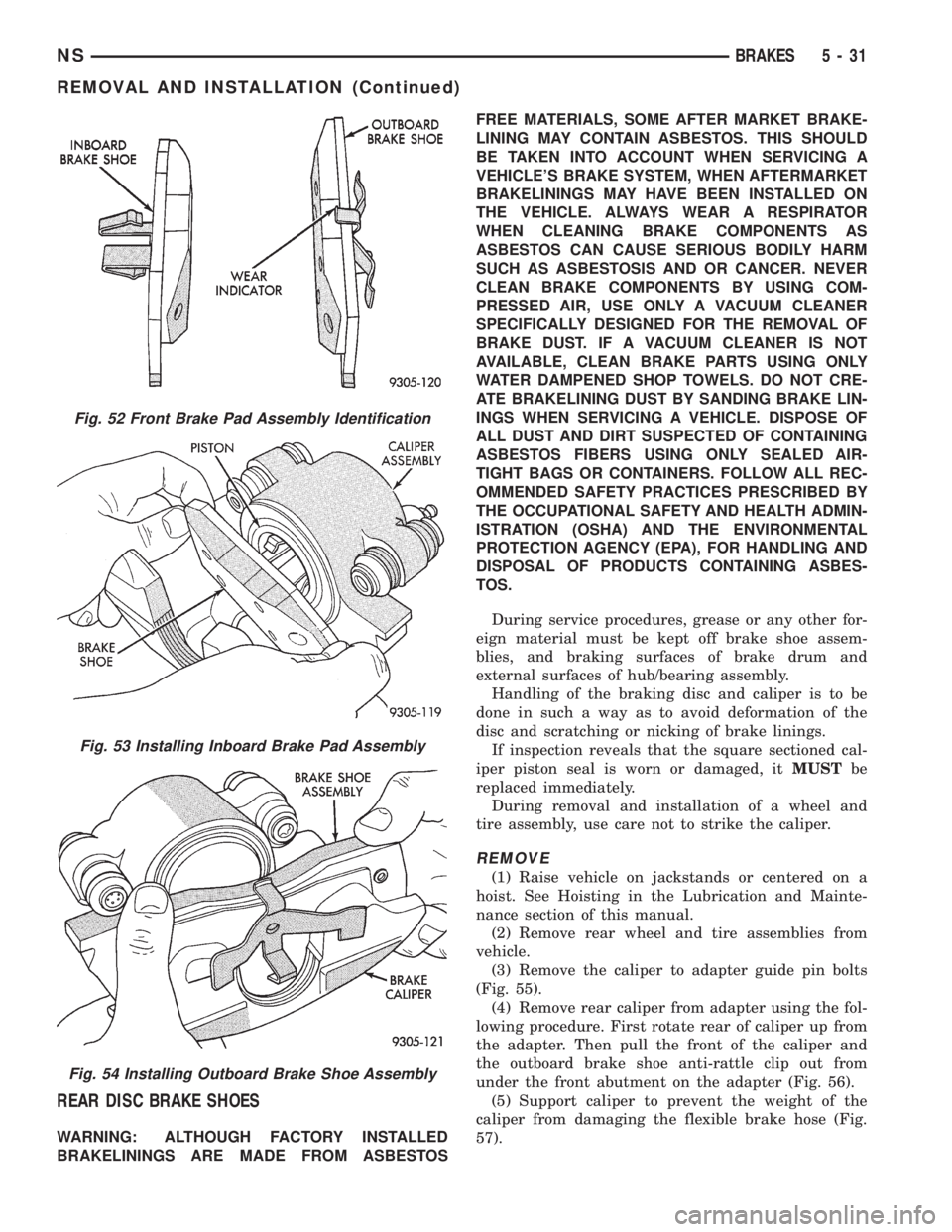
NOTE: The inboard and outboard brake pads are
not common, refer to (Fig. 52) for inboard and out-
board brake pad assembly identification.
(3) Install the new inboard brake pad assembly
into the caliper piston by firmly pressing into piston
bore (Fig. 53). Be sure inboard brake pad assembly is
positioned squarely against face of caliper piston.
(4) Slide the new outboard brake pad assembly
onto the caliper assembly (Fig. 54).
Fig. 50 Removing Outboard Brake Pad From Caliper
Fig. 51 Removing Inboard Brake Pad From Piston
5 - 30 BRAKESNS
REMOVAL AND INSTALLATION (Continued)
Page 113 of 1938
REAR DISC BRAKE SHOES
WARNING: ALTHOUGH FACTORY INSTALLED
BRAKELININGS ARE MADE FROM ASBESTOSFREE MATERIALS, SOME AFTER MARKET BRAKE-
LINING MAY CONTAIN ASBESTOS. THIS SHOULD
BE TAKEN INTO ACCOUNT WHEN SERVICING A
VEHICLE'S BRAKE SYSTEM, WHEN AFTERMARKET
BRAKELININGS MAY HAVE BEEN INSTALLED ON
THE VEHICLE. ALWAYS WEAR A RESPIRATOR
WHEN CLEANING BRAKE COMPONENTS AS
ASBESTOS CAN CAUSE SERIOUS BODILY HARM
SUCH AS ASBESTOSIS AND OR CANCER. NEVER
CLEAN BRAKE COMPONENTS BY USING COM-
PRESSED AIR, USE ONLY A VACUUM CLEANER
SPECIFICALLY DESIGNED FOR THE REMOVAL OF
BRAKE DUST. IF A VACUUM CLEANER IS NOT
AVAILABLE, CLEAN BRAKE PARTS USING ONLY
WATER DAMPENED SHOP TOWELS. DO NOT CRE-
ATE BRAKELINING DUST BY SANDING BRAKE LIN-
INGS WHEN SERVICING A VEHICLE. DISPOSE OF
ALL DUST AND DIRT SUSPECTED OF CONTAINING
ASBESTOS FIBERS USING ONLY SEALED AIR-
TIGHT BAGS OR CONTAINERS. FOLLOW ALL REC-
OMMENDED SAFETY PRACTICES PRESCRIBED BY
THE OCCUPATIONAL SAFETY AND HEALTH ADMIN-
ISTRATION (OSHA) AND THE ENVIRONMENTAL
PROTECTION AGENCY (EPA), FOR HANDLING AND
DISPOSAL OF PRODUCTS CONTAINING ASBES-
TOS.
During service procedures, grease or any other for-
eign material must be kept off brake shoe assem-
blies, and braking surfaces of brake drum and
external surfaces of hub/bearing assembly.
Handling of the braking disc and caliper is to be
done in such a way as to avoid deformation of the
disc and scratching or nicking of brake linings.
If inspection reveals that the square sectioned cal-
iper piston seal is worn or damaged, itMUSTbe
replaced immediately.
During removal and installation of a wheel and
tire assembly, use care not to strike the caliper.
REMOVE
(1) Raise vehicle on jackstands or centered on a
hoist. See Hoisting in the Lubrication and Mainte-
nance section of this manual.
(2) Remove rear wheel and tire assemblies from
vehicle.
(3) Remove the caliper to adapter guide pin bolts
(Fig. 55).
(4) Remove rear caliper from adapter using the fol-
lowing procedure. First rotate rear of caliper up from
the adapter. Then pull the front of the caliper and
the outboard brake shoe anti-rattle clip out from
under the front abutment on the adapter (Fig. 56).
(5) Support caliper to prevent the weight of the
caliper from damaging the flexible brake hose (Fig.
57).
Fig. 52 Front Brake Pad Assembly Identification
Fig. 53 Installing Inboard Brake Pad Assembly
Fig. 54 Installing Outboard Brake Shoe Assembly
NSBRAKES 5 - 31
REMOVAL AND INSTALLATION (Continued)