1996 CHRYSLER VOYAGER lock
[x] Cancel search: lockPage 140 of 1938

INSTALL
(1) Install the hooked end of the actuator on the
proportioning valve lever (Fig. 136).Be sure isola-
tor bushing on lever of proportioning valve
(Fig. 136) is fully seated in hook of actuator.
NOTE: When installing height sensing proportion-
ing valve on mounting bracket be sure proportion-
ing valve shield (Fig. 135) is installed between the
proportioning valve and the mounting bracket.
(2) Install height sensing proportioning valve on
mounting bracket. Install the proportioning valve
attaching bolts (Fig. 135). Tighten the attaching bolts
to a torque of 23 N´m (200 in. lbs.).
(3) Install the 4 chassis brake lines (Fig. 134) into
the inlet and outlet ports of the proportioning valve.
Tighten all 4 line nuts to a torque of 16 N´m (142 in.
lbs.).
(4) Adjust the proportioning valve actuator. See
Height Sensing Proportioning Valve in the Adjust-
ment Section in this group of the service manual for
the adjustment procedure.
(5) Bleed the brake system thoroughly to ensure
that all air has been expelled from the hydraulic sys-
tem. See Bleeding Brake System in the Service
Adjustments section in this group of the service man-
ual for the proper bleeding procedure.
(6) Lower the vehicle to the ground.
(7) Road test the vehicle to verify proper operation
of the vehicles brake system.
HYDRAULIC BRAKE TUBES AND HOSES
CAUTION: When installing brake chassis lines or
flex hoses on the vehicle, the correct fasteners
must be used to attach the routing clips or hoses to
the front suspension cradle. The fasteners used toattach components to the front suspension cradle
have an antiÐcorrosion coating due to the suspen-
sion cradle being made of aluminum. Only Mopar
replacement fasteners with the required anti-corro-
sion coating are to be used if a replacement fas-
tener is required when installing a brake chassis
line or flex hose.
Only double wall 4.75mm (3/16 in.) steel tubing
with Al-rich/ZW-AC alloy coating and the correct tube
nuts are to be used for replacement of a hydraulic
brake tube.
NOTE: On vehicles equipped with traction control,
the primary and secondary hydraulic tubes between
the master cylinder and the hydraulic control unit
are 6 mm (15/64 in.). These tubes are also coated
with the Al-rich/ZW-AC alloy and must be replaced
with tubes having the same anti-corrosion coating.
Be sure that the correct tube nuts are used for the
replacement of these hydraulic brake tubes.
Care should be taken when replacing brake tubing,
to be sure the proper bending and flaring tools and
procedures are used, to avoid kinking. Do not route
the tubes against sharp edges, moving components or
into hot areas. All tubes should be properly attached
with recommended retaining clips.
If the primary or secondary brake tube from the
master cylinder to the ABS Hydraulic Control Unit
(HCU) or the brake tubes from the HCU to the pro-
portioing valve require replacement,onlythe origi-
nal factory brake line containing the flexible section
can be used as the replacement part. This is required
due to cradle movement while the vehicle is in
motion.
PARK BRAKE PEDAL MECHANISM
REMOVE
(1) Disconnect negative (ground) cable from the
battery and isolate cable from battery terminal.
(2) Remove sill scuff plate from left door sill.
(3) Remove the left side kick panel.
(4) Remove the steering column cover from the
lower instrument panel.
(5) Remove the reinforcement from the lower
instrument panel.
(6) Lock out front park brake cable using the fol-
lowing procedure. Grasp the exposed section of the
front park brake cable and pull rearward on it. While
holding the park brake in this position, install a pair
of locking pliers on the front park brake cable just
rearward of the second body outrigger bracket (Fig.
137).
(7) Remove the front park brake cable from the
park brake cable equalizer.
Fig. 136 Actuator Attachment To Proportioning
Valve
5 - 58 BRAKESNS
REMOVAL AND INSTALLATION (Continued)
Page 141 of 1938

(8) Remove tension from front park brake cable.
Tension is removed by releasing the locking pliers
from the front park brake cable.
(9) Remove the 3 bolts mounting the wiring junc-
tion block to the instrument panel.
NOTE: When removing the lower mounting bolt,
push the park brake pedal down 5 clicks to access
the lower mounting bolt.
(10) Remove the lower bolt mounting the park
brake pedal to the body.
(11) Remove the forward bolt mounting the park
brake pedal to the body.
(12) Remove the upper bolt mounting the park
brake pedal to the body.
(13) Disconnect the electrical connector for the
brake light switch (Fig. 138).
(14) Pull downward on front park brake cable
while rotating park brake pedal mechanism out from
behind junction block.
(15) Remove park brake pedal release cable (Fig.
138) from park brake mechanism.
(16) Remove the ground switch for the red brake
warning lamp from the park brake pedal mechanism.
(17) Remove front park brake cable button from
park brake pedal mechanism. Tap end housing of
front park brake cable out of park brake pedal mech-
anism (Fig. 138).
INSTALL
(1) Install the ground switch for the red brake
warning lamp on the park brake pedal mechanism
(2) Install park brake cable end housing (Fig. 138)
into park brake pedal mechanism.
(3) Install cable retainer (Fig. 138) onto the park
brake cable strand and then install retainer into
pedal bracket.(4) Install cable strand button into the clevis on
the park brake pedal mechanism.
(5) Install wiring harness connector on red brake
warning lamp ground switch.
(6) Install the park brake release cable on the
release mechanism of the park brake pedal.
(7) Position the park brake pedal mechanism into
its installed position on the body of the vehicle.
(8) Remove the lock-out pin from the park brake
pedal release mechanism.
(9) Loosely install the top bolt (Fig. 138) mounting
the park brake pedal mechanism to the body.
(10) Loosely install the forward bolt (Fig. 138)
mounting the park brake pedal mechanism to the
body.
(11) Loosely install the lower bolt (Fig. 138)
mounting the park brake pedal mechanism to the
body.
(12) Tighten pedal mechanism attaching bolts to
28 N´m (250 in. lbs.).
(13) Verify that the park brake pedal is in the fully
released (full up) position.
(14) Raise vehicle.
(15) Install the front park brake cable on the park
brake cable equalizer.
(16) Lower vehicle.
(17) Remove the lock-out pin (Fig. 138) from the
automatic cable adjuster on the park brake pedal
mechanism.
(18) Install the electrical junction block on the
instrument panel.
(19) Install the reinforcement on the lower instru-
ment panel.
(20) Install the steering column cover on the lower
instrument panel.
(21) Install the left side kick panel.
(22) Install the sill scuff plate on the lower sill of
the left door.
Fig. 137 Locking Out Automatic AdjusterFig. 138 Park Brake Pedal Mounting
NSBRAKES 5 - 59
REMOVAL AND INSTALLATION (Continued)
Page 142 of 1938
(23) Install the negative (ground) cable on the bat-
tery.
(24) Cycle the park brake pedal one time. This will
seat the park brake cables and will allow the auto-
matic self adjuster to properly tension the park brake
cables.
PARK BRAKE SHOES (WITH REAR DISC BRAKES)
On this vehicle, the park brake shoes are removed
from the disc brake adapter with the disc brake
adapter removed from the vehicle.
REMOVE
(1) Set the parking brake.The parking brake is
set to keep the hub/bearing and axle shaft from
rotating when loosening the hub nut.
(2) Raise vehicle. Vehicle is to be raised and sup-
ported on jackstands or on a frame contact type
hoist. See Hoisting in the Lubrication And Mainte-
nance section of this service manual.
(3) Remove the wheel/tire.
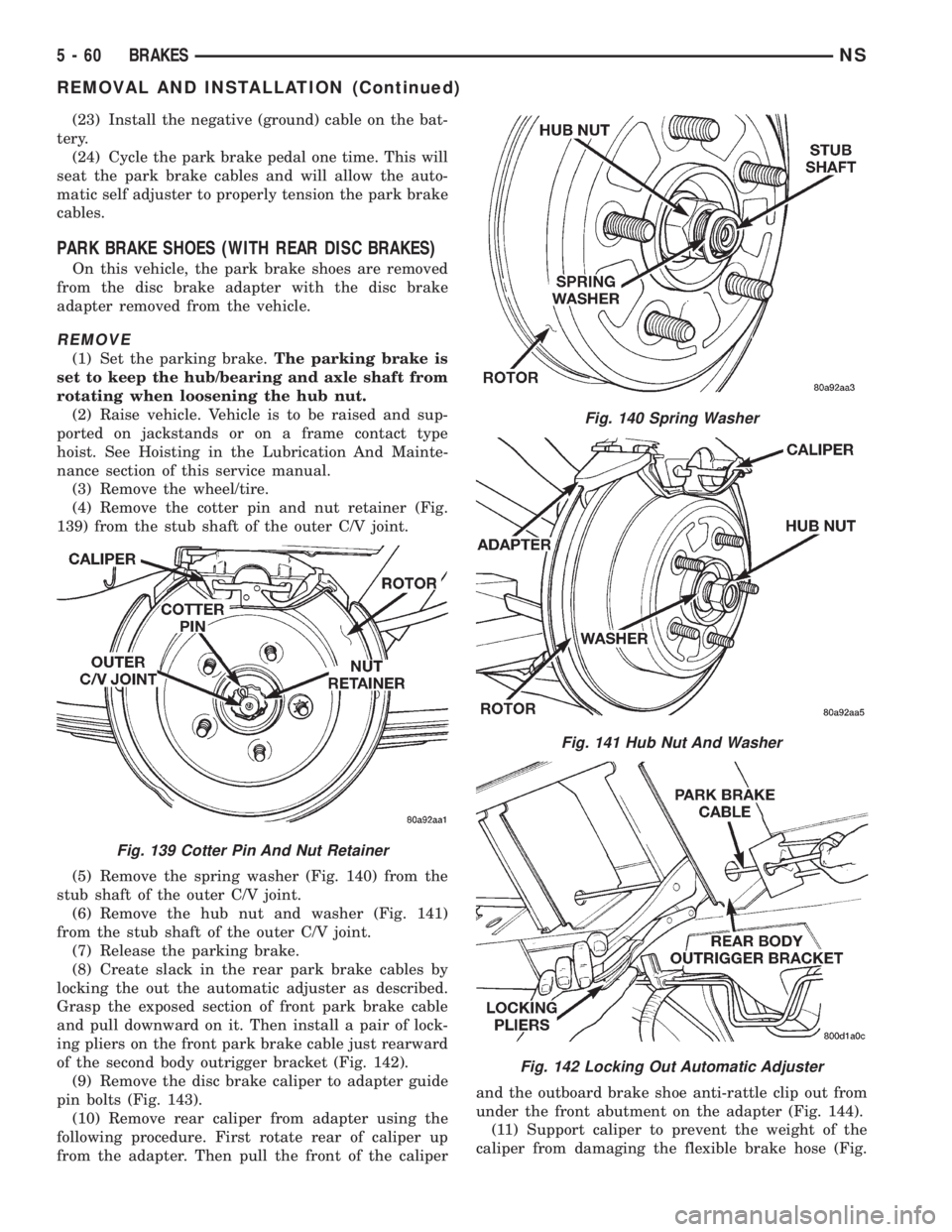
(4) Remove the cotter pin and nut retainer (Fig.
139) from the stub shaft of the outer C/V joint.
(5) Remove the spring washer (Fig. 140) from the
stub shaft of the outer C/V joint.
(6) Remove the hub nut and washer (Fig. 141)
from the stub shaft of the outer C/V joint.
(7) Release the parking brake.
(8) Create slack in the rear park brake cables by
locking the out the automatic adjuster as described.
Grasp the exposed section of front park brake cable
and pull downward on it. Then install a pair of lock-
ing pliers on the front park brake cable just rearward
of the second body outrigger bracket (Fig. 142).
(9) Remove the disc brake caliper to adapter guide
pin bolts (Fig. 143).
(10) Remove rear caliper from adapter using the
following procedure. First rotate rear of caliper up
from the adapter. Then pull the front of the caliperand the outboard brake shoe anti-rattle clip out from
under the front abutment on the adapter (Fig. 144).
(11) Support caliper to prevent the weight of the
caliper from damaging the flexible brake hose (Fig.
Fig. 139 Cotter Pin And Nut Retainer
Fig. 140 Spring Washer
Fig. 141 Hub Nut And Washer
Fig. 142 Locking Out Automatic Adjuster
5 - 60 BRAKESNS
REMOVAL AND INSTALLATION (Continued)
Page 143 of 1938

145).(12) Remove the rotor from the hub/bearing.
(13) Remove the horseshoe clip (Fig. 146) from the
retainer on the end of the park brake cable.
(14) Remove the end of the park brake cable from
the actuator lever on the adapter (Fig. 146).
(15) Remove the end of the park brake cable from
the adapter. Park brake cable is removed from
adapter using a 1/2 wrench slipped over the park
brake cable retainer as show in (Fig. 147) to com-
press the locking tabs on the park brake cable
retainer.
(16) Remove the attaching bolt from the wheel
speed sensor (Fig. 148). Then remove wheel speed
sensor from hub/bearing and adapter.
(17) Remove the hub/bearing to axle mounting
bolts (Fig. 149).
(18) Remove the hub/bearing from the axle and the
stub shaft of the outer C/V joint (Fig. 150).
(19) Remove the adapter from the rear axle.
(20) Mount the adapter in a vise using the anchor
boss for the park brake cable (Fig. 151).
Fig. 143 Removing Caliper Guide Pin Bolts
Fig. 144 Removing / Installing Caliper
Fig. 145 Correctly Supported Caliper
Fig. 146 Park Brake Cable Attachment To Actuator
Fig. 147 Park Brake Cable Removal From Adapter
NSBRAKES 5 - 61
REMOVAL AND INSTALLATION (Continued)
Page 146 of 1938

NOTE: When the hold down pin is installed, the
long part of the hold down pin is to be positioned
strait up and down. This will ensure that the hold
down pin is correctly engaged with the adapter.
(6) Install the hold down spring and pin (Fig. 153)
on the leading park brake shoe.
(7) Install the lower return spring (Fig. 152) on
the leading and trailing park brake shoes.When
installing the hold down spring it is to be
installed behind the park brake shoes (Fig.
152).
(8) Install the 4 mounting bolts for the adapter
and hub/bearing into the bolt holes in the axle.
(9) Position the adapter on the 4 mounting bolts
installed in the rear axle (Fig. 158).
(10) Install the hub/bearing on the stub shaft of
outer C/V joint and into the end of the axle. (Fig.
150).
(11) In a progressive criss-cross pattern, tighten
the 4 hub/bearing mounting bolts until the hub/bear-
ing is squarely seated against the axle. Then tighten
the hub/bearing mounting bolts to a torque of 129
N´m (95 ft. lbs.).
(12) Install the wheel speed sensor on the hub/
bearing and adapter. Install the wheel speed sensor
attaching bolt (Fig. 148). Tighten the wheel speed
sensor attaching bolt to a torque of 12 N´m (105 in.
lbs).
(13) Install the park brake cable into its mounting
hole in the adapter.Be sure all the locking tabs
on the park brake cable retainer are expanded
out to ensure the cable will not pull out of the
adapter.
(14) Install the end of the park brake cable on the
park brake actuator lever (Fig. 146).
NOTE: The horseshoe clip must be installed and
installed properly when the park brake cable isinstalled in the adapter. The purpose of the horse-
shoe clip is to prevent park brake cable retainer
from moving in the adapter. If horseshoe clip is not
installed the park brake cable retainer will rattle in
the adapter.
(15) Install aNEWhorseshoe clip on the park
brake cable retainer (Fig. 146). The horseshoe clip is
installed between the retainer for the park brake
cable and the adapter. Horseshoe clip must be
installed with the curved end of the clip pointing
straight up and the edge of the curved end facing
toward the rear of the vehicle (Fig. 146).
(16) Remove the locking pliers (Fig. 142) from the
front park brake cable.
(17) Adjust the park brake drum-in-hat brake
shoes. See Park Brake Shoe Adjustment in the
adjustment section in this group of the service man-
ual for the proper park brake shoe adjustment proce-
dure.
(18) Install the rotor on the hub/bearing.
(19) Carefully lower caliper and brake shoes over
rotor and onto the adapter using the reverse proce-
dure for removal (Fig. 144).
CAUTION: When installing guide pin bolts extreme
caution should be taken not to crossthread the cal-
iper guide pin bolts.
(20) Install the caliper guide pin bolts (Fig. 143).
Tighten the guide pin bolts to a torque of 22 N´m
(192 in. lbs.).
(21) Clean all foreign material off the threads of
the outer C/V joint stub shaft. Install the washer and
hub nut (Fig. 141) on the stub shaft of the outer C/V
joint.
(22) Set the parking brake.
(23) Tighten the hub nut to a torque of 244 N´m
(180 ft. lbs.).
(24) Install the spring washer (Fig. 140) on the
stub shaft of the outer C/V joint.
(25) Install the nut retainer and cotter pin (Fig.
139) on the stub shaft of the outer C/V joint.
(26) Install the wheel and tire assembly.
(27) Tighten the wheel mounting stud nuts in
proper sequence until all nuts are torqued to half
specification. Then repeat the tightening sequence to
the full specified torque of 129 N´m (95 ft. lbs.).
(28) Remove jackstands or lower hoist.
(29)Fully apply and release the park brake
pedal one time. This will seat and correctly
adjust the park brake cables.
CAUTION: Before moving vehicle, pump the brake
pedal several times to insure the vehicle has a firm
brake pedal to adequately stop vehicle.
Fig. 158 Adapter Installed On Mounting Bolts
5 - 64 BRAKESNS
REMOVAL AND INSTALLATION (Continued)
Page 147 of 1938

(30) Road test the vehicle and make several stops
to wear off any foreign material on the brakes and to
seat the brake shoe linings.
FRONT PARK BRAKE CABLE
REMOVE
(1) Raise vehicle on jackstands or centered on a
hoist. See Hoisting in the Lubrication and Mainte-
nance group of this service manual.
(2) Manually lockout the automatic self adjusting
mechanism of the park brake pedal assembly. Refer
to Manual Lockout Of Auto Adjuster Mechanism in
this section of the service manual for the required
procedure.
(3) Remove the intermediate and left rear park
brake cable from the park brake cable equalizer (Fig.
159).
(4) Remove the front park cable housing retainer
from body outrigger bracket (Fig. 160). Cable is
removable by sliding a 14 mm box wrench over cable
retainer and compressing the three retaining fingers.
Alternate method is to use an aircraft type hose
clamp and screwdriver.
(5) Lower vehicle.
(6) Remove the left front door sill molding.
(7) Remove the left front kick panel for access to
the park brake cable and park brake pedal assembly.
(8) Lift floor mat for access to park brake cable
and floor pan. Pull the seal and the park brake cable
(Fig. 161) out of the floor pan of vehicle.
(9) Pull park brake cable strand end forward and
disconnect button from clevis. Tap cable housing end
fitting out of pedal assembly bracket.
(10) Remove cable retainer from the park brake
pedal assembly bracket.
(11) Pull park brake cable assembly out of vehicle
through hole in floor pan.
INSTALL
(1) Pass park brake cable assembly through hole
in floor pan from the inside of the vehicle.
(2) Pass cable strand button through the hole in
the pedal assembly bracket.
(3) Install cable retainer onto the park brake cable
and then install cable retainer into pedal assembly
bracket.
(4) Install the end of the park brake cable into the
retainer previously installed into the park brake
pedal bracket.
(5) Install cable strand button into the clevis on
the park brake pedal mechanism.
(6) Install the front park brake cable floor pan seal
into hole in floor pan. Seal is to be installed so the
flange on the seal is flush with the floor pan (Fig.
161). Fold carpeting back down on floor.
(7) Raise vehicle.
(8) Insert brake cable and housing into body out-
rigger bracket making certain that housing retainer
fingers lock the housing firmly into place (Fig. 160).
Fig. 159 Park Brake Cable Attachment To Equalizer
Fig. 160 Front Park Brake Cable Attachment To
Body
Fig. 161 Front Park Brake Cable At Floor Pan
NSBRAKES 5 - 65
REMOVAL AND INSTALLATION (Continued)
Page 148 of 1938

(9) Assemble the park brake cables onto the park
brake cable equalizer (Fig. 159).
(10) Release the automatic adjuster mechanism on
the park brake pedal assembly. Refer to Parking
Brake Automatic Adjuster in the Service Procedures
Section in this group of the service manual for the
required procedure.
(11) Lower vehicle and apply the park brake pedal
1 time, this will seat the park brake cables.
INTERMEDIATE PARK BRAKE CABLE
REMOVE
(1) Raise vehicle on jackstands or centered on a
hoist. See Hoisting in the Lubrication and Mainte-
nance group of this service manual.
(2) Manually lockout the automatic self adjusting
mechanism of the park brake pedal assembly. Refer
to Manual Lockout Of Auto Adjuster Mechanism in
this section of the service manual for the required
procedure.
(3) Remove the intermediate park brake cable
from the park brake cable equalizer (Fig. 162).
(4) Remove the intermediate park brake cable
from the cable connector attaching it to the right
rear park brake cable (Fig. 163)
(5) Remove the intermediate park brake cable
from the cable guides on the frame rails (Fig. 163).
INSTALL
(1) Install the ends of the park brake cables
through the cable guides.
(2) Install the intermediate park brake cable on
the cable connector at the right rear park brake cable
(Fig. 163).
(3) Install the intermediate park brake cable on
the cable equalizer (Fig. 162).(4) Remove the locking pliers from the front park
brake cable. This will activate the automatic adjuster
and correctly adjust the park brake cables.
(5) Install and position the foam collar on the park
brake cable to prevent it from rattling against floor.
(6) Lower vehicle and apply the park brake pedal
1 time, this will seat the park brake cables.
RIGHT REAR PARK BRAKE CABLE
REMOVE
(1) Raise vehicle on jackstands or centered on a
hoist. See Hoisting in the Lubrication and Mainte-
nance group of this service manual.
(2) Remove rear tire and wheel assembly.
(3) Remove rear brake drum from the rear wheel
of the vehicle requiring service to the rear park
brake cable.
(4) Create slack in the rear park brake cables by
locking out the automatic adjuster as described.
Grasp exposed section of front park brake cable and
pull down on it. Then install a pair of locking pliers
on the cable just rearward of the second body outrig-
ger bracket (Fig. 164).
(5) Disconnect the right rear park brake cable
from the connector on the intermediate cable (Fig.
165).
(6) To remove the right park brake cable housing
from the body bracket, slide a 14 mm box end wrench
over the end of cable retainer to compress the retain-
ing fingers (Fig. 166). The alternate method using an
aircraft type hose clamp will not work on the right
side of the vehicle.
(7) Remove the brake shoes from the brake sup-
port plate. Refer to Rear Brake Shoes in the Removal
And Installation Section of this service manual for
the required procedure.
Fig. 162 Park Brake Cable Attachment To Equalizer
Fig. 163 Intermediate Cable Attachment To Right
Rear Cable
5 - 66 BRAKESNS
REMOVAL AND INSTALLATION (Continued)
Page 149 of 1938

(8) Disconnect park brake cable from park brake
actuator lever.(9) Remove the park brake cable housing retainer
from the brake support plate using a 14mm wrench
to compress the retaining fingers (Fig. 167).
INSTALL
(1) Install the park brake cable in the brake sup-
port plate. Insert cable housing retainer into brake
support plate making certain that cable housing
retainer fingers lock the housing and retainer firmly
into place.
(2) Attach the park brake cable onto the park
brake actuator lever.
(3) Install the brake shoes on the rear brake sup-
port plate. Refer to Rear Brake Shoes in the Removal
And Installation Section of this service manual for
the required procedure.
(4) Insert cable housing retainer into body bracket
making certain that cable housing retainer fingers
lock the housing firmly into place.
(5) Connect the right rear park brake cable to the
connector on the intermediate park brake cable (Fig.
165).
(6) Install the brake drum, and the wheel and tire
assembly.
(7) Remove the locking pliers from the front park
brake cable. This will automatically adjust the park
brake cables.
(8) Apply and release park brake pedal 1 time,
this will seat the park brake cables.
LEFT REAR PARK BRAKE CABLE
REMOVE
(1) Raise vehicle on jackstands or centered on a
hoist. See Hoisting in the Lubrication and Mainte-
nance group of this service manual.
(2) Remove rear tire and wheel assembly.
Fig. 164 Locking Out Automatic Adjuster
Fig. 165 Right Rear Cable Connection To
Intermediate Cable
Fig. 166 Right Park Brake Cable Removal From
Body Bracket
Fig. 167 Removing Park Brake Cable From Brake
Support Plate
NSBRAKES 5 - 67
REMOVAL AND INSTALLATION (Continued)