1996 CHRYSLER VOYAGER lock
[x] Cancel search: lockPage 188 of 1938

(7) Remove the wheel speed sensor cable grommets
from the retaining bracket (Fig. 37).(8) Remove front wheel speed sensor assembly
from the vehicle.
INSTALL
CAUTION: Proper installation of wheel speed sen-
sor cables is critical to continued system operation.
Be sure that cables are installed in retainers. Fail-
ure to install cables in retainers as shown in this
section may result in contact with moving parts
and/or over extension of cables, resulting in an
open circuit.
(1) Connect the front wheel speed sensor cable to
the vehicle wiring harness connector (Fig. 35). Be
sure speed sensor cable connector is fully seated and
locked into vehicle wiring harness connector, then
insert cable and grommet into hole in strut tower
(Fig. 35).
CAUTION: When installing channel bracket, do not
pinch the speed sensor cable under the channel
bracket.
(2) Install the channel bracket and grommet
retainer on the frame rail (Fig. 34).
(3) Install the 2 bolts (Fig. 34) attaching the chan-
nel bracket to frame. Tighten the 2 attaching bolts to
a torque of 11 N´m (95 in. lbs.).
(4) Insert speed sensor cable grommets into inter-
mediate bracket on strut (Fig. 37). Route cable from
strut to steering knuckle on the rearward side of the
stabilizer bar link.
(5) Install the wheel speed sensor to steering
knuckle attaching bolt (Fig. 36). Tighten the speed
sensor attaching bolt to a torque of 12 N´m (105 in.
lbs.)
(6) Check the air gap between the face of the
wheel speed sensor and the top surface of the tone-
wheel. Air gap must be less then the maximum
allowable tolerance of 1.2 mm (.047 in.).
(7) Install the wheel and tire assembly on vehicle.
(8) Road test vehicle to ensure proper operation of
the base and ABS brake systems.
WHEEL SPEED SENSOR (REAR FWD)
REMOVE
(1) Raise vehicle on jack stands or centered on a
frame contact type hoist. See Hoisting in the Lubri-
cation and Maintenance section of this manual, for
the required lifting procedure to be used for this
vehicle.
(2) Remove the tire and wheel assembly from the
vehicle.
Fig. 35 Speed Sensor Cable To Vehicle Wiring
Harness
Fig. 36 Front Wheel Speed Sensor Attaching Bolt
Fig. 37 Front Wheel Speed Sensor Cable Routing
5 - 106 BRAKESNS
REMOVAL AND INSTALLATION (Continued)
Page 190 of 1938

INSTALL
CAUTION: Proper installation of wheel speed sen-
sor cables is critical to continued system operation.
Be sure that cables are installed in retainers. Fail-
ure to install cables in retainers as shown in this
section may result in contact with moving parts
and/or over extension of cables, resulting in an
open circuit.
(1) Install wheel speed sensor head. Note, the plas-
tic anti rotation pin must be fully seated prior to
installing the attaching bolt.
CAUTION: Prior to installing the speed sensor
head attaching bolt, the plastic anti-rotation pin
must be fully seated into the bearing flange.
(2) Install the wheel speed sensor head to bearing
flange attaching bolt (Fig. 42). Tighten the attaching
bolt to a torque 12 N´m (105 in. lbs.)
(3) Check the air gap between the face of the
wheel speed sensor and the top surface of the tone-
wheel. Air gap must be less then the maximum
allowable tolerance of 1.2 mm (.047 in.).
(4) Install the 2 routing brackets attaching the
speed sensor cable and brake tube to the rear axle
(Fig. 41).The rear wheel speed sensor cable
should be routed under the rear brake tube
(Fig. 41).
CAUTION: When installing rear wheel speed sen-
sor cable in the routing clips on rear brake flex
hose, be sure not to damage the routing clips.
Routing clips are molded onto the hose and will
require replacement of the brake flex hose if dam-
aged during installation of the wheel speed sensor
cable.(5) Install speed sensor cable into routing clips on
rear brake flex hose (Fig. 41).
(6) If installing a right rear speed sensor cable,
install the speed sensor cable grommet on the axle
brake flex hose bracket (Fig. 40).
CAUTION: The wheel speed sensor cable connec-
tors for the left and right rear wheel speed sensors
are keyed differently. Therefore, when connecting a
wheel speed sensor cable to the vehicle wiring har-
ness, do not force the connectors together. If the
connectors are forced together, damage to the con-
nectors will occur.
(7) Plug speed sensor cable connector into vehicle
wiring harness (Fig. 38).Be sure speed sensor
cable connector is fully seated and locked into
vehicle wiring harness connector.
(8) Install the speed sensor cable grommet into the
body, being sure the grommet is fully seated into the
body hole.
(9) Install the tire and wheel assembly on vehicle.
(10) Road test vehicle to ensure proper operation
of the base and ABS braking systems.
WHEEL SPEED SENSOR (REAR AWD)
REMOVE
(1) Raise vehicle on jack stands or centered on a
frame contact type hoist. See Hoisting in the Lubri-
cation and Maintenance section of this manual, for
the required lifting procedure to be used for this
vehicle.
(2) Remove the tire and wheel assembly from the
vehicle.
CAUTION: When unplugging speed sensor cable
from vehicle wiring harness be careful not to dam-
age pins on the electrical connectors. Also inspect
connectors for any signs of previous damage.
(3) Remove grommet from floor pan of vehicle and
unplug speed sensor cable connector from vehicle
wiring harness (Fig. 43).
CAUTION: When removing rear wheel speed sen-
sor cable from routing clips on rear brake flex hose,
be sure not to damage the routing clips. Routing
clips are molded onto the hose and will require
replacement of the brake flex hose if damaged dur-
ing removal of the speed sensor cable.
Fig. 42 Rear Wheel Speed Sensor Attaching Bolt
5 - 108 BRAKESNS
REMOVAL AND INSTALLATION (Continued)
Page 192 of 1938
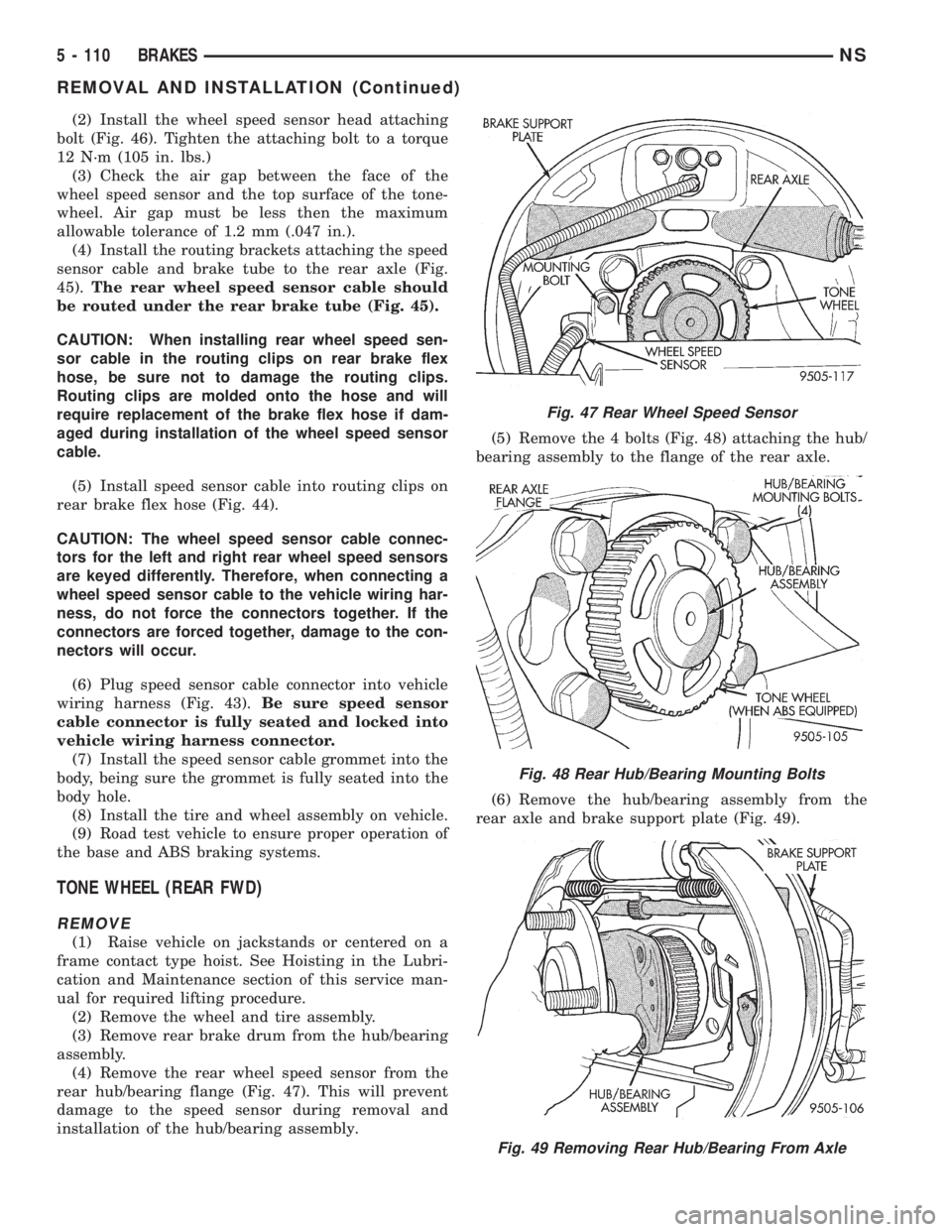
(2) Install the wheel speed sensor head attaching
bolt (Fig. 46). Tighten the attaching bolt to a torque
12 N´m (105 in. lbs.)
(3) Check the air gap between the face of the
wheel speed sensor and the top surface of the tone-
wheel. Air gap must be less then the maximum
allowable tolerance of 1.2 mm (.047 in.).
(4) Install the routing brackets attaching the speed
sensor cable and brake tube to the rear axle (Fig.
45).The rear wheel speed sensor cable should
be routed under the rear brake tube (Fig. 45).
CAUTION: When installing rear wheel speed sen-
sor cable in the routing clips on rear brake flex
hose, be sure not to damage the routing clips.
Routing clips are molded onto the hose and will
require replacement of the brake flex hose if dam-
aged during installation of the wheel speed sensor
cable.
(5) Install speed sensor cable into routing clips on
rear brake flex hose (Fig. 44).
CAUTION: The wheel speed sensor cable connec-
tors for the left and right rear wheel speed sensors
are keyed differently. Therefore, when connecting a
wheel speed sensor cable to the vehicle wiring har-
ness, do not force the connectors together. If the
connectors are forced together, damage to the con-
nectors will occur.
(6) Plug speed sensor cable connector into vehicle
wiring harness (Fig. 43).Be sure speed sensor
cable connector is fully seated and locked into
vehicle wiring harness connector.
(7) Install the speed sensor cable grommet into the
body, being sure the grommet is fully seated into the
body hole.
(8) Install the tire and wheel assembly on vehicle.
(9) Road test vehicle to ensure proper operation of
the base and ABS braking systems.
TONE WHEEL (REAR FWD)
REMOVE
(1) Raise vehicle on jackstands or centered on a
frame contact type hoist. See Hoisting in the Lubri-
cation and Maintenance section of this service man-
ual for required lifting procedure.
(2) Remove the wheel and tire assembly.
(3) Remove rear brake drum from the hub/bearing
assembly.
(4) Remove the rear wheel speed sensor from the
rear hub/bearing flange (Fig. 47). This will prevent
damage to the speed sensor during removal and
installation of the hub/bearing assembly.(5) Remove the 4 bolts (Fig. 48) attaching the hub/
bearing assembly to the flange of the rear axle.
(6) Remove the hub/bearing assembly from the
rear axle and brake support plate (Fig. 49).
Fig. 47 Rear Wheel Speed Sensor
Fig. 48 Rear Hub/Bearing Mounting Bolts
Fig. 49 Removing Rear Hub/Bearing From Axle
5 - 110 BRAKESNS
REMOVAL AND INSTALLATION (Continued)
Page 194 of 1938

SPECIFICATIONS
SPEED SENSOR TONE WHEEL RUNOUT
The total indicator runout allowed for both the
front and rear tone wheel measured using a dial indi-
cator is 0.15 mm (.006 in.).
WHEEL SPEED SENSOR TO TONE WHEEL
CLEARANCE
FRONT WHEEL
Minimum Clearance .35mm (.014 in.)
Maxamum Clearance 1.2 mm (.047 in.)
REAR WHEEL
Minimum Clearance .40mm (.016 in.)
Maxamum Clearance 1.2 mm (.047 in.)
BRAKE FASTENER TORQUE SPECIFICATIONS
DESCRIPTION TORQUE
BRAKE TUBES:
Tube Nuts To Fittings And
Components..............17N´m(145 in. lbs.)
BRAKE HOSE:
To Caliper Banjo Bolt..........48N´m(35ft.lbs.)
Intermediate Bracket.........12N´m(105 in. lbs.)
MASTER CYLINDER:
To Vacuum Booster
Mounting Nut............25N´m(225 in. lbs.)
FIXED PROPORTIONING VALVE:
To Frame Rail Attaching
Bolts....................14N´m(125 in. lbs.)
HEIGHT SENSING PROPORTIONING VALVE:
To Mounting Bracket
Attaching Bolts...........23N´m(200 in. lbs.)
Actuator Assembly
Adjustment Nut.............5N´m(45in.lbs.)
Mounting Bracket To
Frame Rail Bolts..........17N´m(150 in. lbs.)
JUNCTION BLOCK (NON-ABS BRAKES)
To Suspension Cradle
Mounting Bolt............28N´m(250 in. lbs.)
VACUUM BOOSTER:
To Dash Panel Mounting
Nuts....................28N´m(250 in. lbs.)DESCRIPTION TORQUE
REAR WHEEL CYLINDER:
To Support Plate Mounting
Bolts.....................8N´m(75in.lbs.)
Bleeder Screw...............10N´m(80in.lbs.)
BRAKE SUPPORT PLATE:
To Rear Axle Mounting Bolts . . .130 N´m (95 ft. lbs.)
DISC BRAKE CALIPER:
Guide Pin Bolts..............41N´m(30ft.lbs.)
Bleeder Screw..............15N´m(125 in. lbs.)
ABS HYDRAULIC CONTROL UNIT:
Mounting Bracket To
Suspension Cradle Bolts.....28N´m(250 in. lbs.)
To Mounting Bracket Isolator
Attaching Bolts............11N´m(97in.lbs.)
CAB To HCU Mounting Screws . . .2 N´m (17 in. lbs.)
WHEEL SPEED SENSOR:
To Axle Or Steering Knuckle
Mounting Bolt............12N´m(105 in. lbs.)
PARKING BRAKE:
Pedal Assembly Mounting
Bolts....................28N´m(250 in. lbs.)
REAR HUB AND BEARING:
To Axle Mounting Bolts........129 N´m (95 ft. lbs.)
WHEEL:
Stud Lug Nut........115±156 N´m (84-115 ft. lbs.)
5 - 112 BRAKESNS
Page 202 of 1938

DESCRIPTION AND OPERATION
CLUTCH RELEASE SYSTEM
CLUTCH CABLE Ð LHD
The manual transaxle clutch release system has a
unique self-adjusting mechanism to compensate for
clutch disc wear (Fig. 7). This adjuster mechanism is
located within the clutch cable assembly. The preload
spring maintains tension on the cable. This tension
keeps the clutch release bearing continuously loaded
against the fingers of the clutch cover assembly.
HYDRAULIC CLUTCH Ð RHD
Leverage, clamping force, and friction are what
make the clutch work. The disc serves as the friction
element and a diaphragm spring and pressure plate
provide the clamping force. The clutch pedal, hydrau-
lic linkage, release lever and bearing provide the
leverage to disengage and engage the modular clutch
assembly.
The modular clutch assembly contains the cover,
diaphragm spring, pressure plate, disc and flywheel
in one unit. The modular clutch also uses a drive
plate and is bolted to and driven by the drive plate.
The clutch linkage uses hydraulic pressure to oper-
ate the clutch. The clutch master cylinder push rod is
connected to the clutch pedal and the slave cylinder
push rod is connected to the release lever in the
clutch housing.
Depressing the clutch pedal develops fluid pressure
in the clutch master cylinder. This pressure is trans-
mitted to the slave cylinder through a connecting
line. In turn, the slave cylinder operates the clutch
release lever.
The clutch release bearing is mounted on the
transmission front bearing retainer. The bearing is
attached to the release lever, which moves the bear-
ing into contact with the clutch cover diaphragm
spring.Slave cylinder force causes the release lever to
move the release bearing into contact with the dia-
phragm spring. As additional force is applied, the
bearing presses the diaphragm spring fingers inward
on the fulcrums. This action moves the pressure
plate rearward relieving clamp force on the disc. The
clutch disc is disengaged and not driven at this point.
The process of clutch engagement is simply the
reverse of what occurs during disengagement. Releas-
ing pedal pressure removes clutch linkage pressure.
The release bearing moves away from the diaphragm
spring which allows the pressure plate to exert
clamping force on the clutch disc.
CLUTCH PEDAL POSITION SWITCH
The clutch pedal position switch functions as a
safety interlock device. It prevents possible engine
cranking with the clutch engaged.
The clutch pedal position switch is wired in series
between the starter relay coil and the ignition
switch.
The clutch pedal position switch is mounted to a
bracket located behind the clutch pedal. The switch
is held in place by four plastic wing tabs.
The clutch pedal position switch IS NOT adjust-
able. The pedal blade contacts the switch in the down
position (Fig. 8).
DIAGNOSIS AND TESTING
CLUTCH PEDAL POSITION SWITCH
CLUTCH PEDAL POSITION
SWITCH±ELECTRICAL TEST
Disconnect clutch pedal position switch harness
from instrument panel wiring harness. Using an
ohmmeter, check for continuity between the two ter-
minals in the connector on the switch harness. There
should be no continuity between the terminals when
Fig. 7 Clutch Cable Ð LHD
Fig. 8 Clutch Pedal Position Switch and
Components Ð LHD Shown
6 - 4 CLUTCHNS/GS
Page 207 of 1938

NOTE: Depressing the clutch pedal to the floor pro-
vides access to the clutch cable strand. Disconnect
the cable upstop/spacer from the pedal pivot pin by
removing the retaining clip at the top of the clutch
pedal. Wedge a flat blade pry tool in the clip slot to
remove the clip. Remove the clutch pedal upstop/
spacer from the pedal by wedging a flat blade pry
tool between the spacer and pedal. It may be nec-
essary to push the steel support bracket supporting
the electrical junction block slightly to the left for
clearance to remove the upstop/spacer from the
pedal. Push the cable end fitting out of upstop/
spacer.
CAUTION: Use caution if lifting the clutch pedal
once the clutch pedal/upstop spacer has been
removed. The clutch pedal assist spring provides
enough pedal force to cause an injury. Also, on 2.5L
Turbo Diesel vehicles, lifting the clutch pedal with
the upstop/spacer removed may bend the cruise
control cutout switch bracket located near the top
of the clutch pedal. This will result in non-opera-
tional cruise control.
CAUTION: Do not pull on the clutch cable to
remove it from the dash panel. Damage to the cable
self-adjuster may occur.NOTE: It may be helpful to remove the battery and
clutch cable guide from the left shock tower to
improve access to the clutch cable dash panel
grommet.
Fig. 10 Clutch Cable Routing Ð LHDFig. 11 Clutch Cable Retaining (Upstop) Clip Ð LHD
Fig. 12 Upstop/Spacer Ð LHD
NS/GSCLUTCH 6 - 9
REMOVAL AND INSTALLATION (Continued)
Page 210 of 1938

QUICK CONNECT COUPLING Ð RHD
CAUTION: Do not actuate the master cylinder or
step on the clutch pedal before the quick connect
coupling is joined, or an over pressure condition
could result in damage to the master cylinder, the
quick connect coupling, or the dash panel.
REMOVAL
1. Disconnect the quick connect coupling by lightly
pushing down on the black release collar on the male
side of the quick connect coupling while separating it
from the female side of the quick connect coupling
(Fig. 14).
INSTALLATION
1. Connect the male side of the quick connect cou-
pling (part of the master cylinder assembly) by hold-
ing the clutch tube at the rear and inserting it into
the female side of the quick connect coupling (part of
the slave cylinder assembly) until an audible click is
heard (Fig. 14).Do not push on the black release
collar on the male side of the quick connect
coupling while inserting it into the female side
of the quick connect coupling.
2. Confirm the connection by pulling firmly on the
clutch tube.
MASTER CYLINDER SYSTEM Ð RHD
REMOVAL
(1) Disconnect the quick connect coupling. Refer to
the ªQuick Connect Couplingº removal and installa-
tion procedure in this section.
(2) Remove the master cylinder pushrod from the
clutch pedal pin by prying between the self-retaining
snap-on bushing, located in the master cylinder
pushrod, and the clutch pedal pin (Fig. 15).
(3) Disconnect the hydraulic line from the weld
stud clips (Fig. 14).
(4) Remove the rubber grommet at the master cyl-
inder pass through in the dash panel (Fig. 16).
(5) Remove the master cylinder assembly from the
engine compartment by rotating it clockwise from the
12 o'clock lock position to the 2 o'clock unlock posi-
tion and pulling the master cylinder out tilted 20
degrees down.NOTE: A ªTwist and Lockº type
mechanism is used to secure the master cylin-
der to the clutch pedal bracket which is
attached to the dash panel.
INSTALLATION
(1) Position the master cylinder assembly to the
clutch pedal bracket by tilting it 20 degrees upward
and at the 2 o'clock unlocked position.
(2) Rotate the master cylinder counterclockwise to
the 12 o'clock locked position.
(3) Install the rubber grommet into the dash panel
at the master cylinder pass through (Fig. 16).
(4) Connect the hydraulic line to the weld stud
clips in the engine compartment (Fig. 14).
(5) Connect the quick connect coupling. Refer to
the ªQuick Connect Couplingº removal and installa-
tion procedure in this section.
(6) Install the self-retaining snap-on bushing into
the master cylinder pushrod, if necessary.
(7) Install the master cylinder pushrod with self-
retaining snap-on bushing onto the clutch pedal pin
by pressing it onto the clutch pedal pin until seats in
the groove of the clutch pedal pin.
SLAVE CYLINDER ASSEMBLY Ð RHD
REMOVAL
1. Disconnect the quick connect coupling. Refer to
the ªQuick Connect Couplingº removal and installa-
tion procedure in this section.
2. Remove the nut and washer assemblies (2)
retaining the slave cylinder and mounting bracket
assembly to the transaxle (Fig. 14).
3. Remove the slave cylinder assembly from the
transaxle.
Fig. 16 Clutch Master Cylinder Ð RHD
6 - 12 CLUTCHNS/GS
REMOVAL AND INSTALLATION (Continued)
Page 215 of 1938

COOLING SYSTEM
CONTENTS
page page
GENERAL INFORMATION
ACCESSORY DRIVE BELTS................ 1
AUTOMATIC TRANSMISSION OIL COOLERÐ
2.4L................................. 3
COOLANT RECOVERY SYSTEM (CRS)....... 3
COOLANT.............................. 3
COOLING SYSTEM....................... 2
ENGINE BLOCK HEATER.................. 5
ENGINE THERMOSTAT.................... 3
RADIATOR PRESSURE CAP................ 4
RADIATOR............................. 3
WATER PUMPS......................... 3
DESCRIPTION AND OPERATION
COOLANT PERFORMANCE................. 6
RADIATOR HOSES AND CLAMPS........... 6
WATER PIPESÐ3.0L ENGINE.............. 6
WATER PUMPÐ3.3/3.8L ENGINES.......... 7
WATER PUMPÐ2.4L ENGINE.............. 6
WATER PUMPÐ3.0L ENGINE.............. 6
DIAGNOSIS AND TESTING
ACCESSORY DRIVE BELT.................. 7
COOLING SYSTEM DIAGNOSIS............. 8
DEAERATION.......................... 16
ELECTRIC FAN MOTOR TEST.............. 14
LOW COOLANT LEVEL AERATION.......... 15
PRESSURE TESTING RADIATOR CAP....... 15
RADIATOR CAP TO FILLER NECK SEAL
PRESSURE RELIEF CHECK.............. 15
RADIATOR COOLANT FLOW TEST.......... 14
RADIATOR FAN CONTROL................ 14
TEMPERATURE GAUGE INDICATION........ 16
TESTING COOLING SYSTEM FOR LEAKS.... 14
SERVICE PROCEDURES
COOLANT LEVEL CHECKÐROUTINE........ 16
COOLANT LEVEL SERVICE................ 16COOLANTÐADDING ADDITIONAL.......... 16
COOLING SYSTEMÐDRAINING............ 16
COOLING SYSTEMÐREFILLING........... 16
REMOVAL AND INSTALLATION
ACCESSORY DRIVE BELTSÐ2.4L.......... 23
ACCESSORY DRIVE BELTSÐ3.0L.......... 24
ACCESSORY DRIVE BELTÐ3.3/3.8L........ 24
ENGINE BLOCK HEATER................. 23
FAN MODULE.......................... 22
RADIATOR DRAINCOCK.................. 21
RADIATOR............................ 21
THERMOSTATÐ2.4L ENGINE............. 19
THERMOSTATÐ3.0L ENGINE............. 20
THERMOSTATÐ3.3/3.8L ENGINES......... 20
WATER PUMP INLET TUBEÐ2.4L ENGINE . . . 17
WATER PUMPÐ3.3/3.8L ENGINES......... 19
WATER PUMPÐ2.4L ENGINE............ 17
WATER PUMPÐ3.0L ENGINE............. 18
CLEANING AND INSPECTION
ACCESSORY DRIVE BELT................. 25
CHEMICAL CLEANING................... 25
COOLING SYSTEM CLEANING............. 25
RADIATOR PRESSURE CAP............... 25
REVERSE FLUSHING THE ENGINE......... 25
REVERSE FLUSHING THE RADIATOR....... 25
WATER PUMP......................... 24
ADJUSTMENTS
BELT TENSION CHART................... 26
BELT TENSION GAUGE METHOD........... 26
PROPER BELT TENSION................. 25
SPECIFICATIONS
COOLING SYSTEM CAPACITY............. 26
TORQUE CHART........................ 26
SPECIAL TOOLS
COOLING............................. 26
GENERAL INFORMATION
ACCESSORY DRIVE BELTS
The accessory drive system utilizes two different
style of drive belts. The conventional V-belt and the
Poly-V belt are used to drive the generator, air con-
ditioning compressor, power steering pump and waterpump. Satisfactory performance of these belts
depends on belt condition and proper belt tension.
Belt tensioning should be performed with the aid of a
Burroughs gauge Special Tool C-4162. Because of
space limitations in the engine compartment, the use
of the gauge may be restricted. Raise the vehicle on a
hoist and then remove the splash shield to gain
access to the drive belts.
NSCOOLING SYSTEM 7 - 1