1996 CHRYSLER VOYAGER torque
[x] Cancel search: torquePage 1792 of 1938
INSTALLATION
For installation, reverse the above procedures.
Tighten all seat belts to 39 N´m (29 ft. lbs.) torque.
SEAT BELT SECOND RIGHT REAR OUTBOARD ±
LW B
REMOVAL
(1) Remove second rear seat from vehicle. Refer to
Owner's Manual for proper procedures.
(2) Slide lower anchor cover from over the anchor
shoulder-nut.
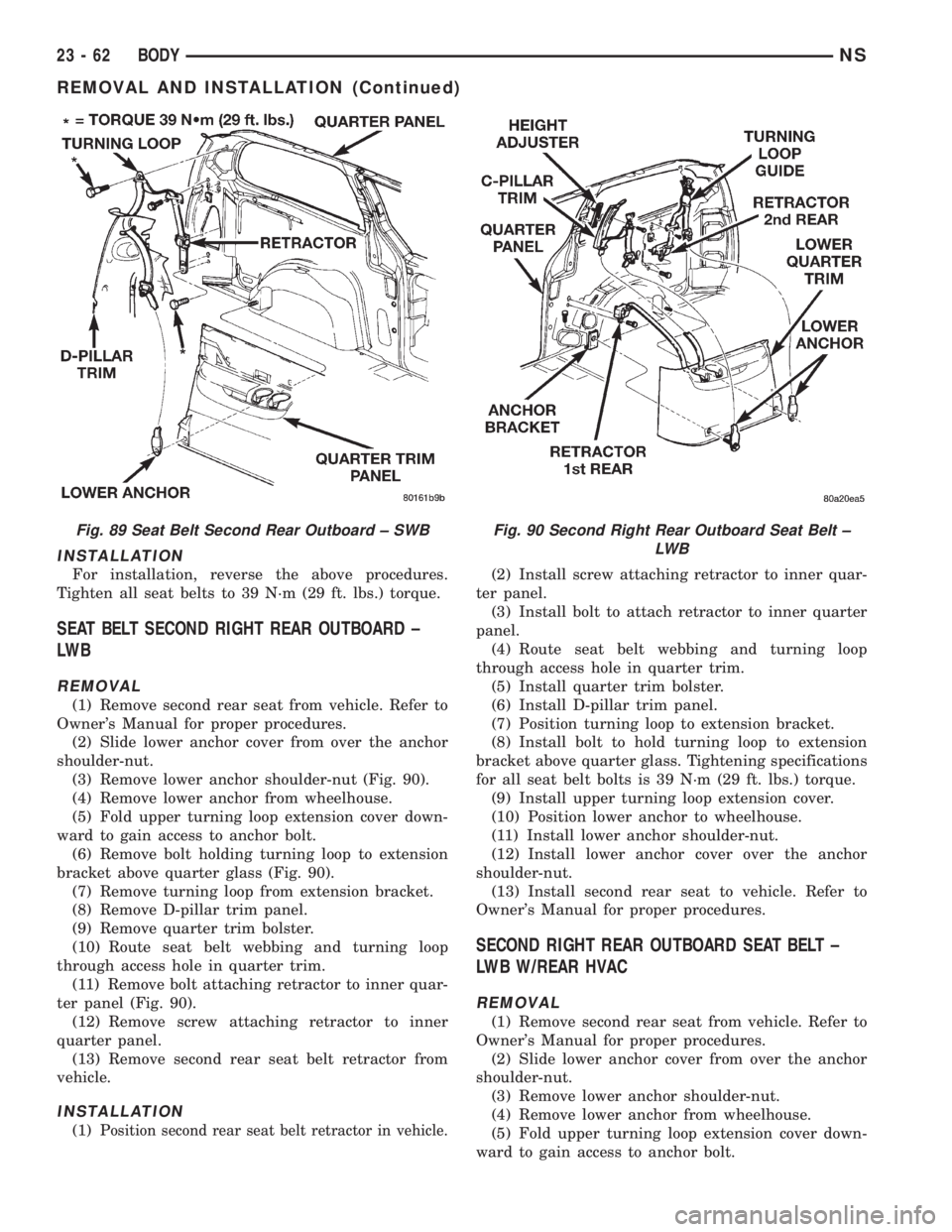
(3) Remove lower anchor shoulder-nut (Fig. 90).
(4) Remove lower anchor from wheelhouse.
(5) Fold upper turning loop extension cover down-
ward to gain access to anchor bolt.
(6) Remove bolt holding turning loop to extension
bracket above quarter glass (Fig. 90).
(7) Remove turning loop from extension bracket.
(8) Remove D-pillar trim panel.
(9) Remove quarter trim bolster.
(10) Route seat belt webbing and turning loop
through access hole in quarter trim.
(11) Remove bolt attaching retractor to inner quar-
ter panel (Fig. 90).
(12) Remove screw attaching retractor to inner
quarter panel.
(13) Remove second rear seat belt retractor from
vehicle.
INSTALLATION
(1) Position second rear seat belt retractor in vehicle.
(2) Install screw attaching retractor to inner quar-
ter panel.
(3) Install bolt to attach retractor to inner quarter
panel.
(4) Route seat belt webbing and turning loop
through access hole in quarter trim.
(5) Install quarter trim bolster.
(6) Install D-pillar trim panel.
(7) Position turning loop to extension bracket.
(8) Install bolt to hold turning loop to extension
bracket above quarter glass. Tightening specifications
for all seat belt bolts is 39 N´m (29 ft. lbs.) torque.
(9) Install upper turning loop extension cover.
(10) Position lower anchor to wheelhouse.
(11) Install lower anchor shoulder-nut.
(12) Install lower anchor cover over the anchor
shoulder-nut.
(13) Install second rear seat to vehicle. Refer to
Owner's Manual for proper procedures.
SECOND RIGHT REAR OUTBOARD SEAT BELT ±
LWB W/REAR HVAC
REMOVAL
(1) Remove second rear seat from vehicle. Refer to
Owner's Manual for proper procedures.
(2) Slide lower anchor cover from over the anchor
shoulder-nut.
(3) Remove lower anchor shoulder-nut.
(4) Remove lower anchor from wheelhouse.
(5) Fold upper turning loop extension cover down-
ward to gain access to anchor bolt.
Fig. 89 Seat Belt Second Rear Outboard ± SWBFig. 90 Second Right Rear Outboard Seat Belt ±
LW B
23 - 62 BODYNS
REMOVAL AND INSTALLATION (Continued)
Page 1794 of 1938
SHOULDER BELT HEIGHT ADJUSTER±BOR
C-PILLAR
REMOVAL
(1) Remove B or C-pillar trim cover.
(2) Remove screws holding shoulder belt height
adjuster to pillar.
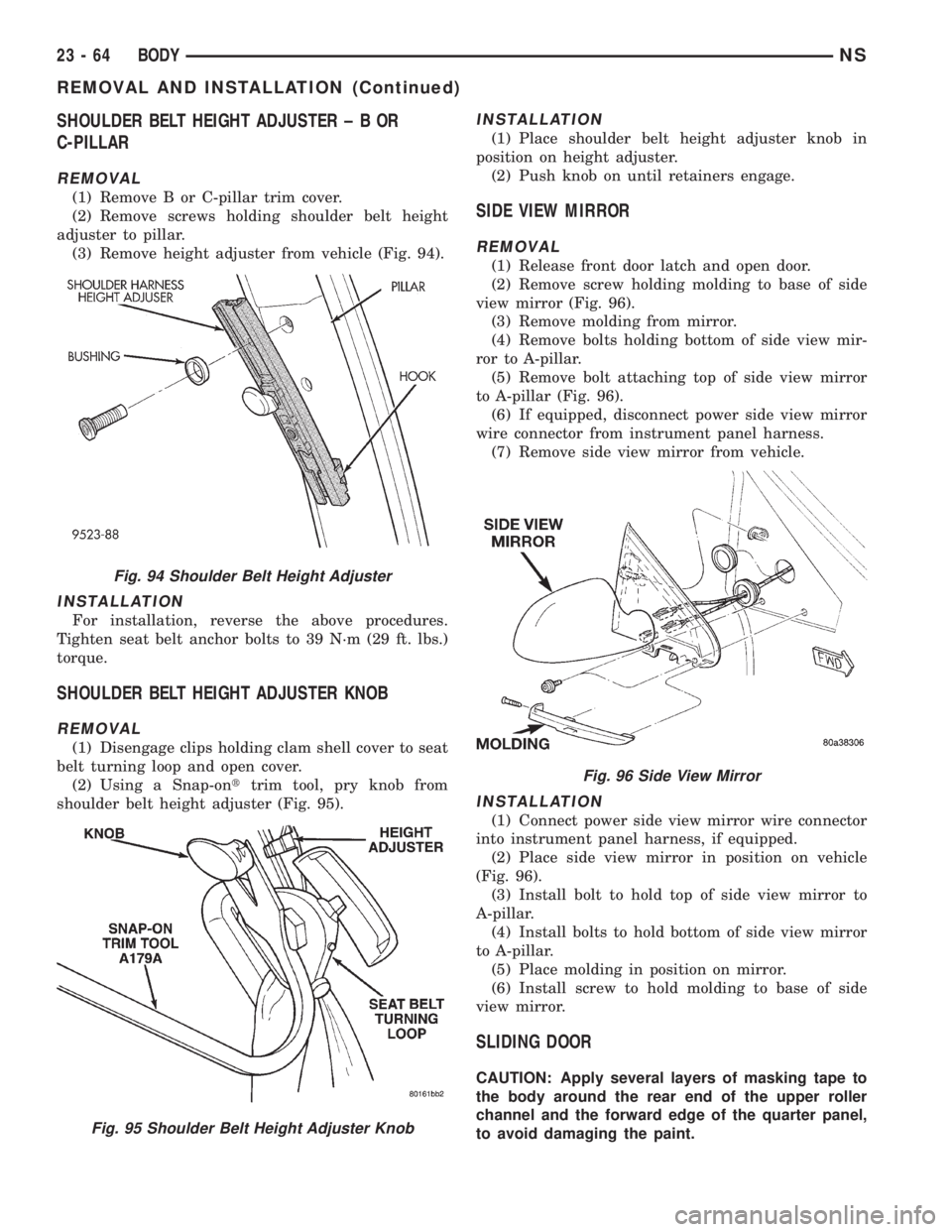
(3) Remove height adjuster from vehicle (Fig. 94).
INSTALLATION
For installation, reverse the above procedures.
Tighten seat belt anchor bolts to 39 N´m (29 ft. lbs.)
torque.
SHOULDER BELT HEIGHT ADJUSTER KNOB
REMOVAL
(1) Disengage clips holding clam shell cover to seat
belt turning loop and open cover.
(2) Using a Snap-onttrim tool, pry knob from
shoulder belt height adjuster (Fig. 95).
INSTALLATION
(1) Place shoulder belt height adjuster knob in
position on height adjuster.
(2) Push knob on until retainers engage.
SIDE VIEW MIRROR
REMOVAL
(1) Release front door latch and open door.
(2) Remove screw holding molding to base of side
view mirror (Fig. 96).
(3) Remove molding from mirror.
(4) Remove bolts holding bottom of side view mir-
ror to A-pillar.
(5) Remove bolt attaching top of side view mirror
to A-pillar (Fig. 96).
(6) If equipped, disconnect power side view mirror
wire connector from instrument panel harness.
(7) Remove side view mirror from vehicle.
INSTALLATION
(1) Connect power side view mirror wire connector
into instrument panel harness, if equipped.
(2) Place side view mirror in position on vehicle
(Fig. 96).
(3) Install bolt to hold top of side view mirror to
A-pillar.
(4) Install bolts to hold bottom of side view mirror
to A-pillar.
(5) Place molding in position on mirror.
(6) Install screw to hold molding to base of side
view mirror.
SLIDING DOOR
CAUTION: Apply several layers of masking tape to
the body around the rear end of the upper roller
channel and the forward edge of the quarter panel,
to avoid damaging the paint.
Fig. 94 Shoulder Belt Height Adjuster
Fig. 95 Shoulder Belt Height Adjuster Knob
Fig. 96 Side View Mirror
23 - 64 BODYNS
REMOVAL AND INSTALLATION (Continued)
Page 1803 of 1938
SLIDING DOOR REAR LATCH
REMOVAL
(1) Remove sliding door trim panel.
(2) Remove water shield as necessary.
(3) Open sliding door to the ajar position.
(4) Disengage clip holding linkage to rear latch.
(5) Remove screws holding rear latch to sliding
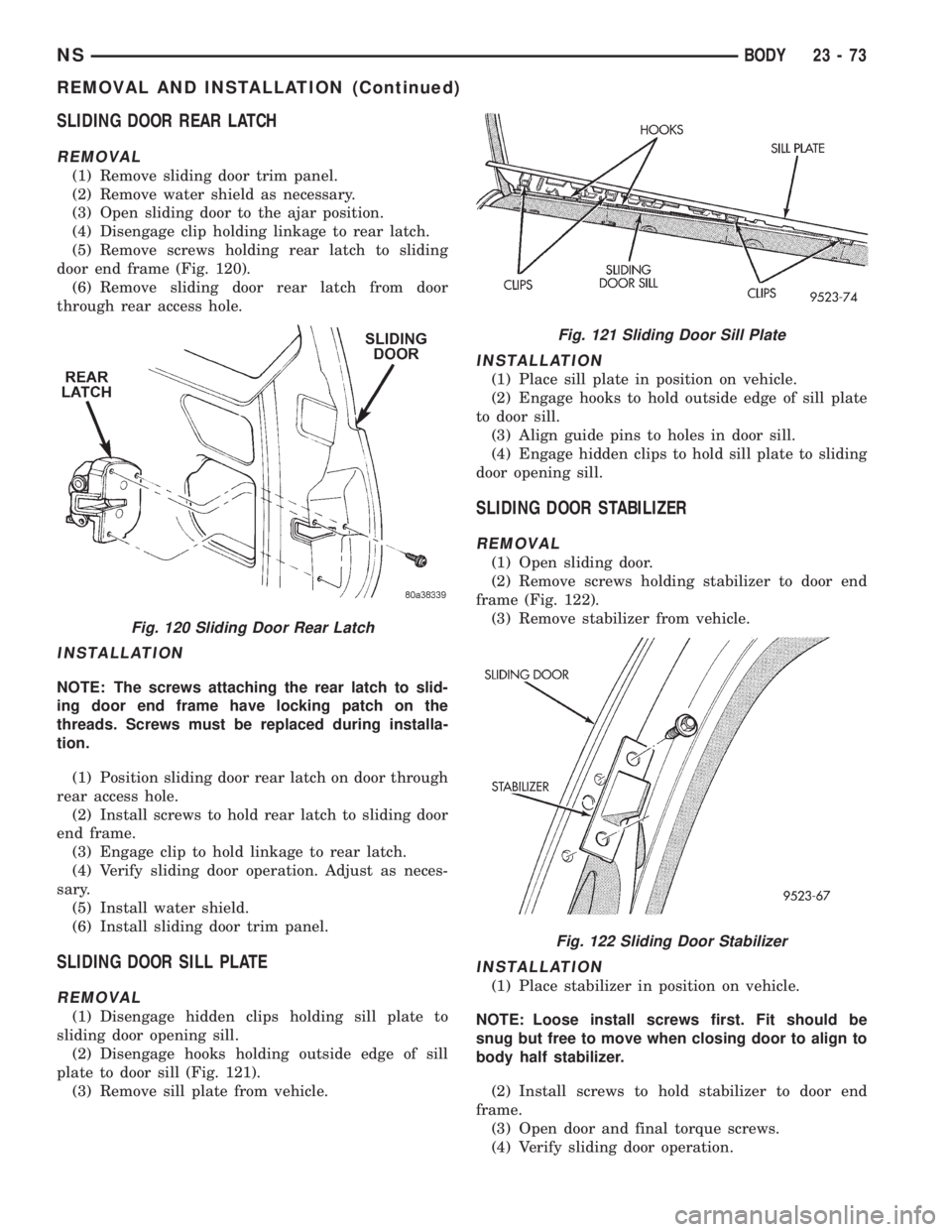
door end frame (Fig. 120).
(6) Remove sliding door rear latch from door
through rear access hole.
INSTALLATION
NOTE: The screws attaching the rear latch to slid-
ing door end frame have locking patch on the
threads. Screws must be replaced during installa-
tion.
(1) Position sliding door rear latch on door through
rear access hole.
(2) Install screws to hold rear latch to sliding door
end frame.
(3) Engage clip to hold linkage to rear latch.
(4) Verify sliding door operation. Adjust as neces-
sary.
(5) Install water shield.
(6) Install sliding door trim panel.
SLIDING DOOR SILL PLATE
REMOVAL
(1) Disengage hidden clips holding sill plate to
sliding door opening sill.
(2) Disengage hooks holding outside edge of sill
plate to door sill (Fig. 121).
(3) Remove sill plate from vehicle.
INSTALLATION
(1) Place sill plate in position on vehicle.
(2) Engage hooks to hold outside edge of sill plate
to door sill.
(3) Align guide pins to holes in door sill.
(4) Engage hidden clips to hold sill plate to sliding
door opening sill.
SLIDING DOOR STABILIZER
REMOVAL
(1) Open sliding door.
(2) Remove screws holding stabilizer to door end
frame (Fig. 122).
(3) Remove stabilizer from vehicle.
INSTALLATION
(1) Place stabilizer in position on vehicle.
NOTE: Loose install screws first. Fit should be
snug but free to move when closing door to align to
body half stabilizer.
(2) Install screws to hold stabilizer to door end
frame.
(3) Open door and final torque screws.
(4) Verify sliding door operation.
Fig. 120 Sliding Door Rear Latch
Fig. 121 Sliding Door Sill Plate
Fig. 122 Sliding Door Stabilizer
NSBODY 23 - 73
REMOVAL AND INSTALLATION (Continued)
Page 1809 of 1938
INSTALLATION
(1) Insert seat belt through B-pillar trim and web
guide.
(2) Place B-pillar trim cover in position on vehicle.
(3) Engage hidden clips to hold trim cover to B-pil-
lar.
(4) Install screw to hold trim cover to B-pillar
inside bezel cavity.
(5) Install shoulder belt bezel into trim cover.(6) Install height adjuster knob.
(7) Install shoulder belt turning loop onto height
adjuster.
(8) Place seat anchor in position on floor so web-
bing is pointed rearward and slightly outboard.
(9) Install bolt to hold lower seat belt anchor to
floor. Tighten seat belt bolts to 39 N´m (29 in. lbs.)
torque.
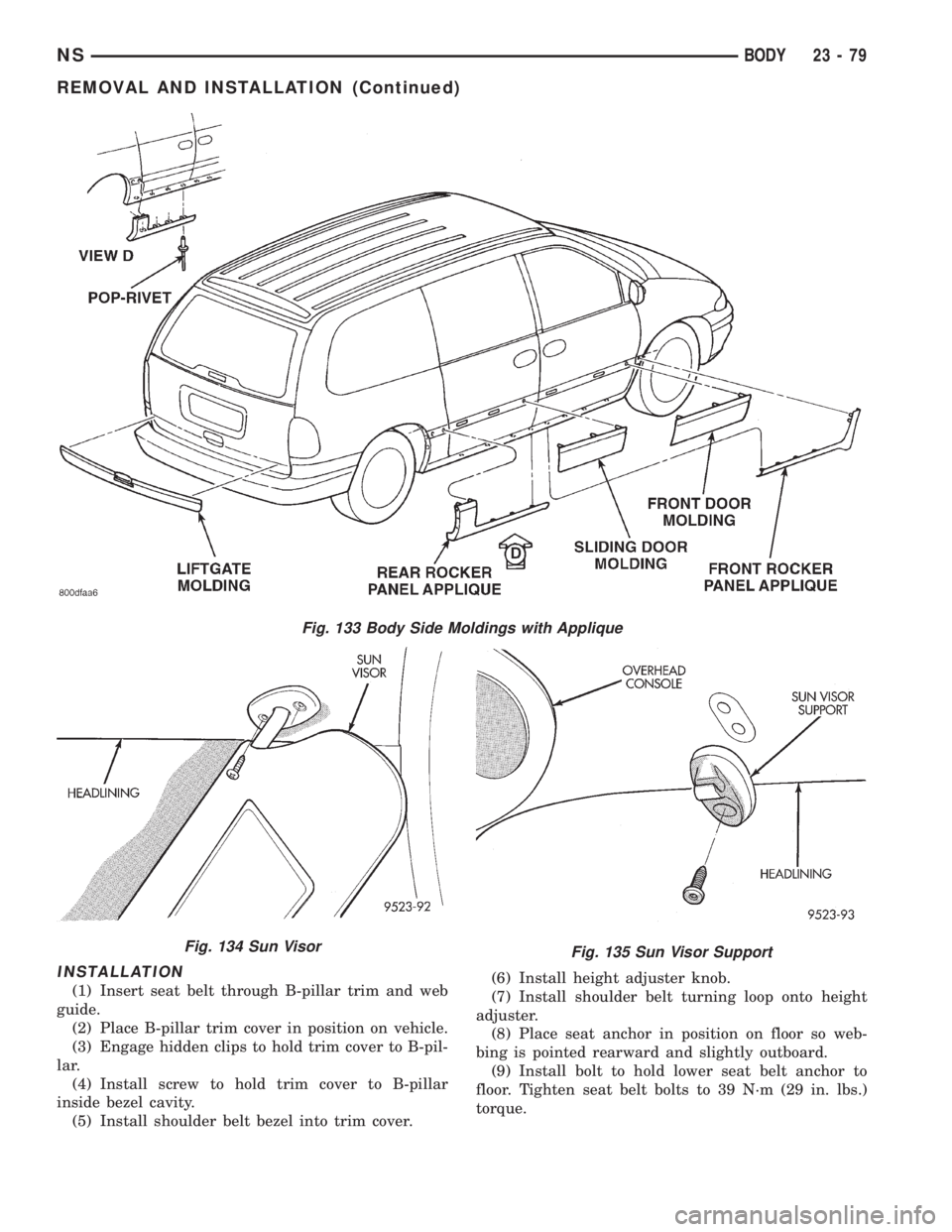
Fig. 133 Body Side Moldings with Applique
Fig. 134 Sun VisorFig. 135 Sun Visor Support
NSBODY 23 - 79
REMOVAL AND INSTALLATION (Continued)
Page 1810 of 1938
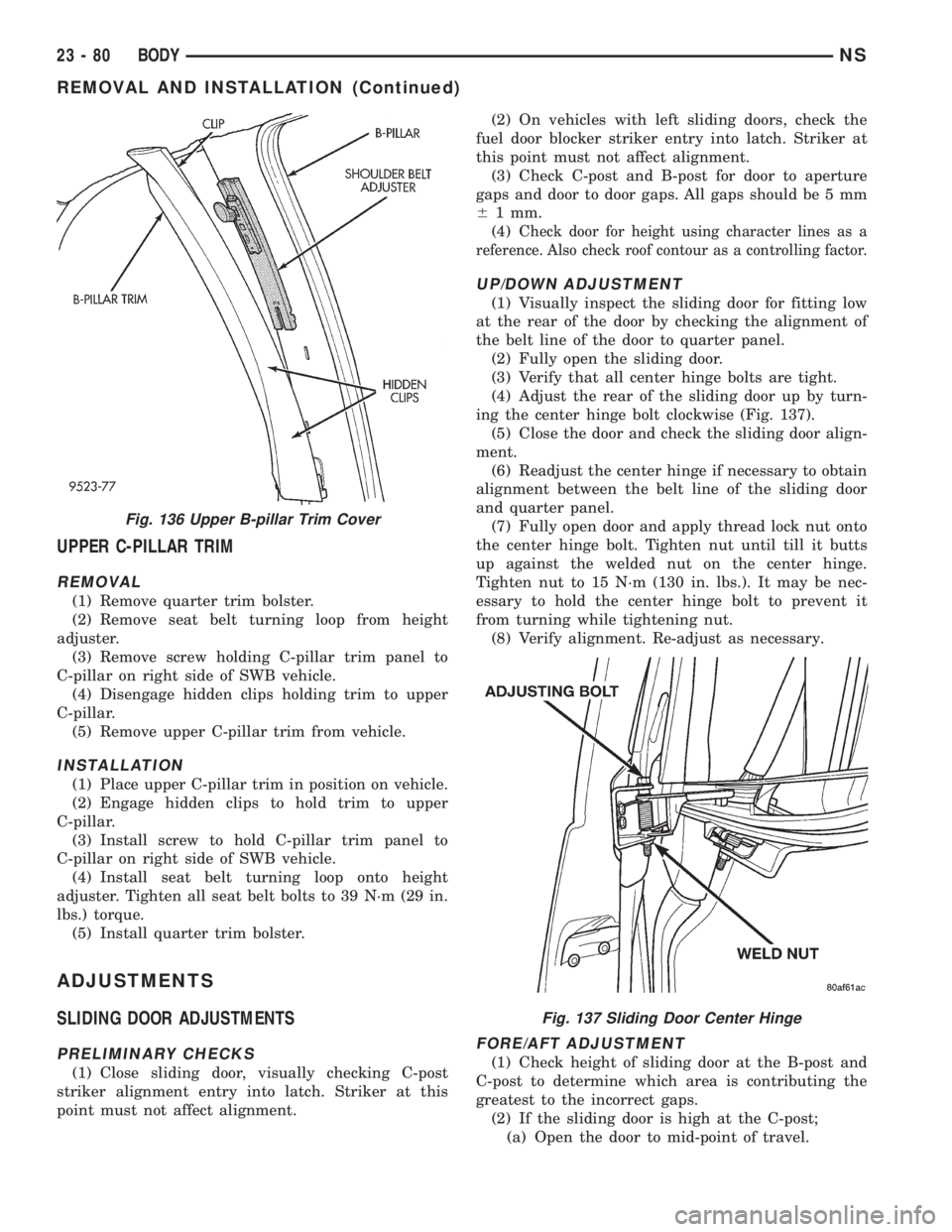
UPPER C-PILLAR TRIM
REMOVAL
(1) Remove quarter trim bolster.
(2) Remove seat belt turning loop from height
adjuster.
(3) Remove screw holding C-pillar trim panel to
C-pillar on right side of SWB vehicle.
(4) Disengage hidden clips holding trim to upper
C-pillar.
(5) Remove upper C-pillar trim from vehicle.
INSTALLATION
(1) Place upper C-pillar trim in position on vehicle.
(2) Engage hidden clips to hold trim to upper
C-pillar.
(3) Install screw to hold C-pillar trim panel to
C-pillar on right side of SWB vehicle.
(4) Install seat belt turning loop onto height
adjuster. Tighten all seat belt bolts to 39 N´m (29 in.
lbs.) torque.
(5) Install quarter trim bolster.
ADJUSTMENTS
SLIDING DOOR ADJUSTMENTS
PRELIMINARY CHECKS
(1) Close sliding door, visually checking C-post
striker alignment entry into latch. Striker at this
point must not affect alignment.(2) On vehicles with left sliding doors, check the
fuel door blocker striker entry into latch. Striker at
this point must not affect alignment.
(3) Check C-post and B-post for door to aperture
gaps and door to door gaps. All gaps should be 5 mm
61 mm.
(4) C
heck door for height using character lines as a
reference. Also check roof contour as a controlling factor.
UP/DOWN ADJUSTMENT
(1) Visually inspect the sliding door for fitting low
at the rear of the door by checking the alignment of
the belt line of the door to quarter panel.
(2) Fully open the sliding door.
(3) Verify that all center hinge bolts are tight.
(4) Adjust the rear of the sliding door up by turn-
ing the center hinge bolt clockwise (Fig. 137).
(5) Close the door and check the sliding door align-
ment.
(6) Readjust the center hinge if necessary to obtain
alignment between the belt line of the sliding door
and quarter panel.
(7) Fully open door and apply thread lock nut onto
the center hinge bolt. Tighten nut until till it butts
up against the welded nut on the center hinge.
Tighten nut to 15 N´m (130 in. lbs.). It may be nec-
essary to hold the center hinge bolt to prevent it
from turning while tightening nut.
(8) Verify alignment. Re-adjust as necessary.
FORE/AFT ADJUSTMENT
(1) Check height of sliding door at the B-post and
C-post to determine which area is contributing the
greatest to the incorrect gaps.
(2) If the sliding door is high at the C-post;
(a) Open the door to mid-point of travel.
Fig. 136 Upper B-pillar Trim Cover
Fig. 137 Sliding Door Center Hinge
23 - 80 BODYNS
REMOVAL AND INSTALLATION (Continued)
Page 1841 of 1938
CAUTION: The clutch pulley and the front plate
were mated at the factory by a burnishing opera-
tion. No attempt should be made to separately
replace either part. This will result in clutch slip-
page due to insufficient contact area.
INSTALLATION
(1) Align pin in back of field coil with hole in com-
pressor end housing, and position field coil into place.
Make sure that lead wires are properly routed, and
fasten with the wire clip screw.
(2) Install field coil retaining snap ring with snap
ring pliers. The bevel side of the snap ring facing
outward. Also both snap ring eyelets must be to the
right or left of the pin on compressor. Press snap ring
to make sure it is properly seated in the groove.
CAUTION: If snap ring is not fully seated it will
vibrate out, resulting in a clutch failure and severe
damage to the front face of the compressor.
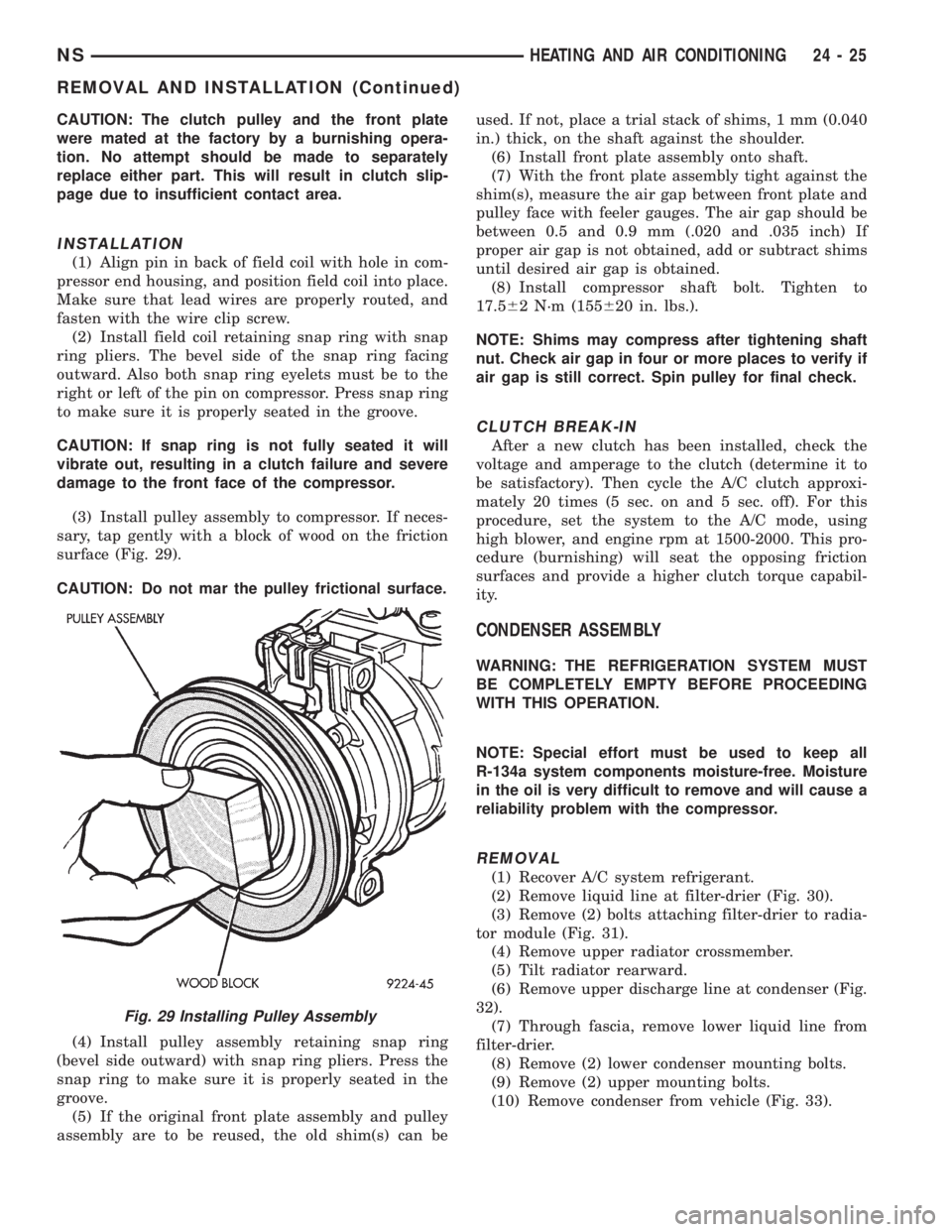
(3) Install pulley assembly to compressor. If neces-
sary, tap gently with a block of wood on the friction
surface (Fig. 29).
CAUTION: Do not mar the pulley frictional surface.
(4) Install pulley assembly retaining snap ring
(bevel side outward) with snap ring pliers. Press the
snap ring to make sure it is properly seated in the
groove.
(5) If the original front plate assembly and pulley
assembly are to be reused, the old shim(s) can beused. If not, place a trial stack of shims, 1 mm (0.040
in.) thick, on the shaft against the shoulder.
(6) Install front plate assembly onto shaft.
(7) With the front plate assembly tight against the
shim(s), measure the air gap between front plate and
pulley face with feeler gauges. The air gap should be
between 0.5 and 0.9 mm (.020 and .035 inch) If
proper air gap is not obtained, add or subtract shims
until desired air gap is obtained.
(8) Install compressor shaft bolt. Tighten to
17.562 N´m (155620 in. lbs.).
NOTE: Shims may compress after tightening shaft
nut. Check air gap in four or more places to verify if
air gap is still correct. Spin pulley for final check.
CLUTCH BREAK-IN
After a new clutch has been installed, check the
voltage and amperage to the clutch (determine it to
be satisfactory). Then cycle the A/C clutch approxi-
mately 20 times (5 sec. on and 5 sec. off). For this
procedure, set the system to the A/C mode, using
high blower, and engine rpm at 1500-2000. This pro-
cedure (burnishing) will seat the opposing friction
surfaces and provide a higher clutch torque capabil-
ity.
CONDENSER ASSEMBLY
WARNING: THE REFRIGERATION SYSTEM MUST
BE COMPLETELY EMPTY BEFORE PROCEEDING
WITH THIS OPERATION.
NOTE: Special effort must be used to keep all
R-134a system components moisture-free. Moisture
in the oil is very difficult to remove and will cause a
reliability problem with the compressor.
REMOVAL
(1) Recover A/C system refrigerant.
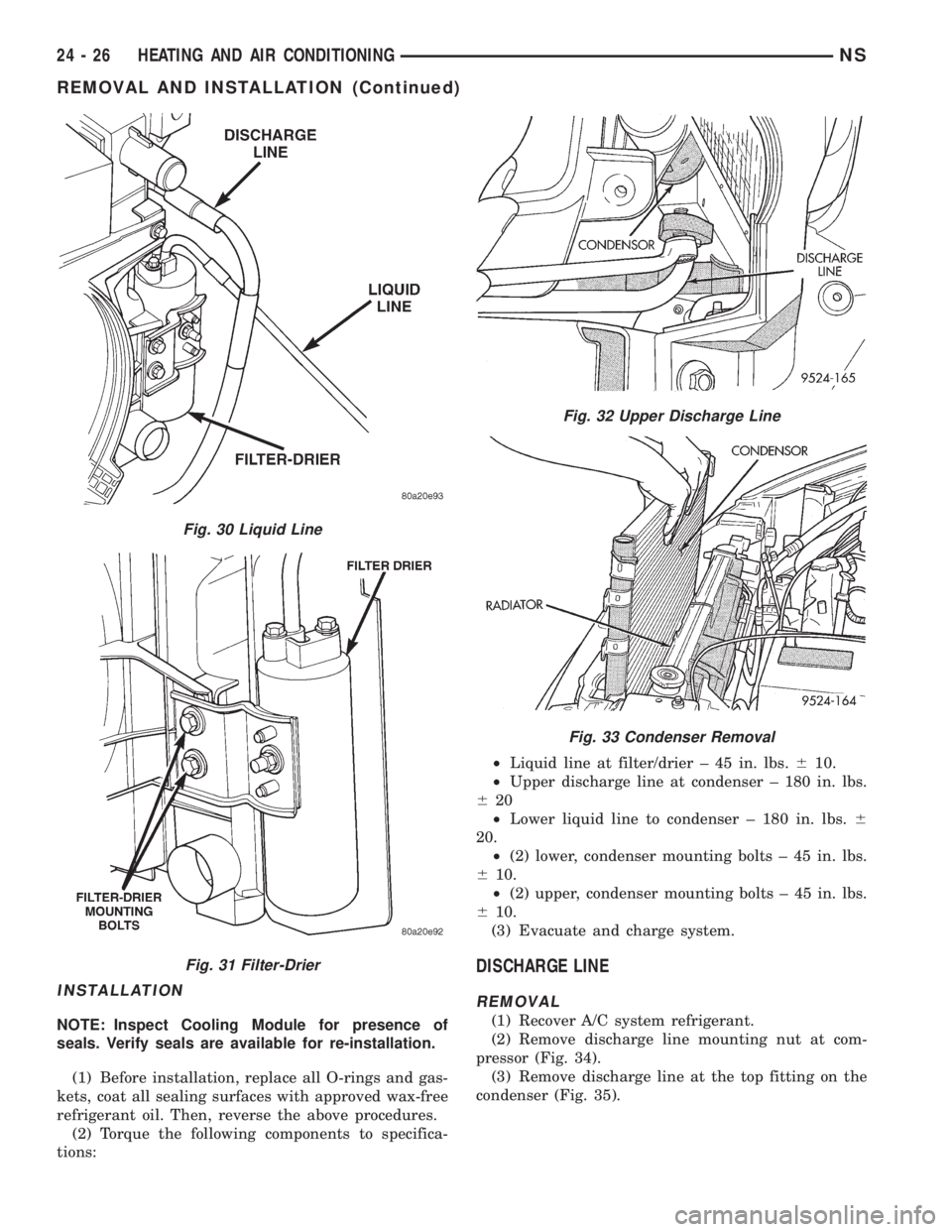
(2) Remove liquid line at filter-drier (Fig. 30).
(3) Remove (2) bolts attaching filter-drier to radia-
tor module (Fig. 31).
(4) Remove upper radiator crossmember.
(5) Tilt radiator rearward.
(6) Remove upper discharge line at condenser (Fig.
32).
(7) Through fascia, remove lower liquid line from
filter-drier.
(8) Remove (2) lower condenser mounting bolts.
(9) Remove (2) upper mounting bolts.
(10) Remove condenser from vehicle (Fig. 33).
Fig. 29 Installing Pulley Assembly
NSHEATING AND AIR CONDITIONING 24 - 25
REMOVAL AND INSTALLATION (Continued)
Page 1842 of 1938
INSTALLATION
NOTE: Inspect Cooling Module for presence of
seals. Verify seals are available for re-installation.
(1) Before installation, replace all O-rings and gas-
kets, coat all sealing surfaces with approved wax-free
refrigerant oil. Then, reverse the above procedures.
(2) Torque the following components to specifica-
tions:²Liquid line at filter/drier ± 45 in. lbs.610.
²Upper discharge line at condenser ± 180 in. lbs.
620
²Lower liquid line to condenser ± 180 in. lbs.6
20.
²(2) lower, condenser mounting bolts ± 45 in. lbs.
610.
²(2) upper, condenser mounting bolts ± 45 in. lbs.
610.
(3) Evacuate and charge system.
DISCHARGE LINE
REMOVAL
(1) Recover A/C system refrigerant.
(2) Remove discharge line mounting nut at com-
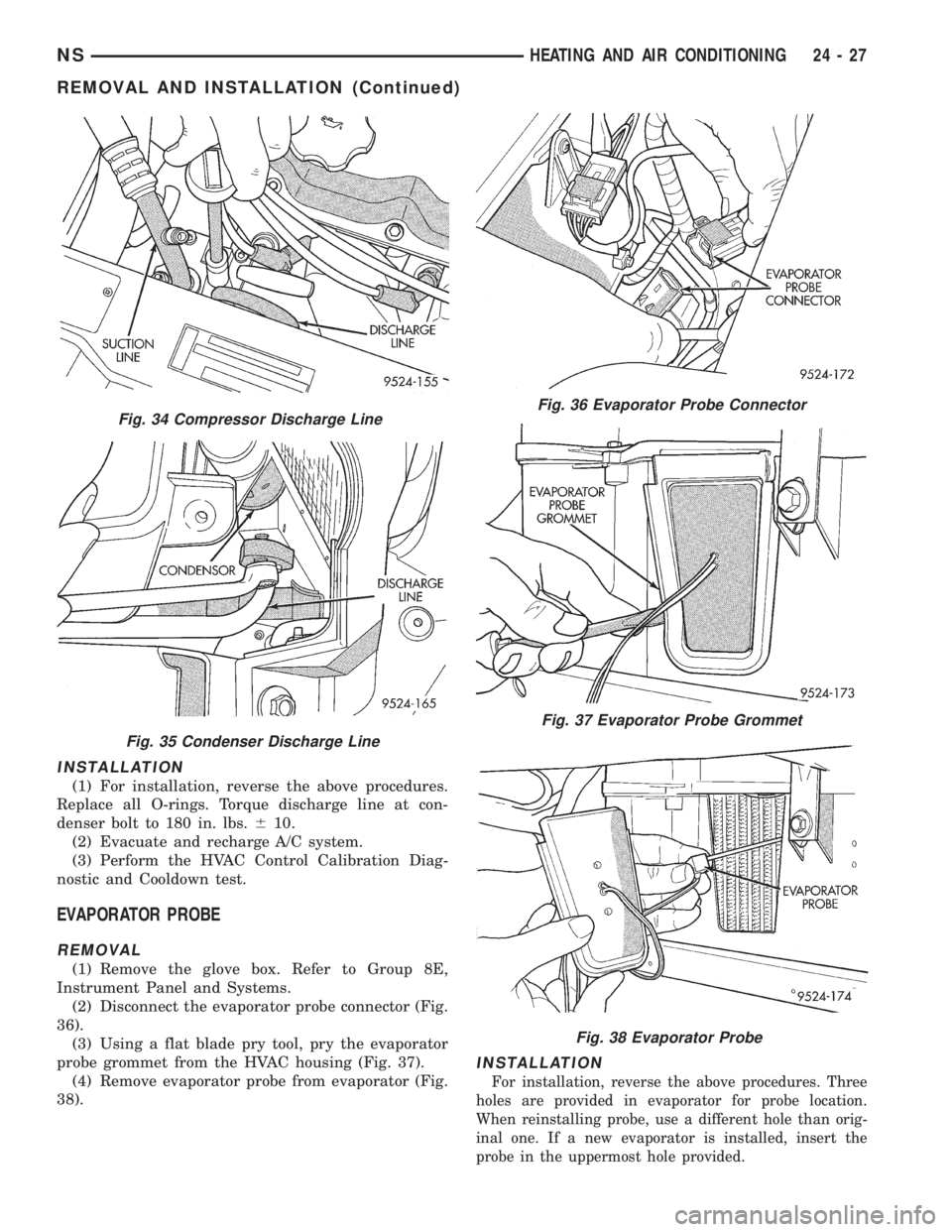
pressor (Fig. 34).
(3) Remove discharge line at the top fitting on the
condenser (Fig. 35).
Fig. 30 Liquid Line
Fig. 31 Filter-Drier
Fig. 32 Upper Discharge Line
Fig. 33 Condenser Removal
24 - 26 HEATING AND AIR CONDITIONINGNS
REMOVAL AND INSTALLATION (Continued)
Page 1843 of 1938
INSTALLATION
(1) For installation, reverse the above procedures.
Replace all O-rings. Torque discharge line at con-
denser bolt to 180 in. lbs.610.
(2) Evacuate and recharge A/C system.
(3) Perform the HVAC Control Calibration Diag-
nostic and Cooldown test.
EVAPORATOR PROBE
REMOVAL
(1) Remove the glove box. Refer to Group 8E,
Instrument Panel and Systems.
(2) Disconnect the evaporator probe connector (Fig.
36).
(3) Using a flat blade pry tool, pry the evaporator
probe grommet from the HVAC housing (Fig. 37).
(4) Remove evaporator probe from evaporator (Fig.
38).
INSTALLATION
For installation, reverse the above procedures. Three
holes are provided in evaporator for probe location.
When reinstalling probe, use a different hole than orig-
inal one. If a new evaporator is installed, insert the
probe in the uppermost hole provided.
Fig. 34 Compressor Discharge Line
Fig. 35 Condenser Discharge Line
Fig. 36 Evaporator Probe Connector
Fig. 37 Evaporator Probe Grommet
Fig. 38 Evaporator Probe
NSHEATING AND AIR CONDITIONING 24 - 27
REMOVAL AND INSTALLATION (Continued)