1996 CHRYSLER VOYAGER torque
[x] Cancel search: torquePage 1926 of 1938
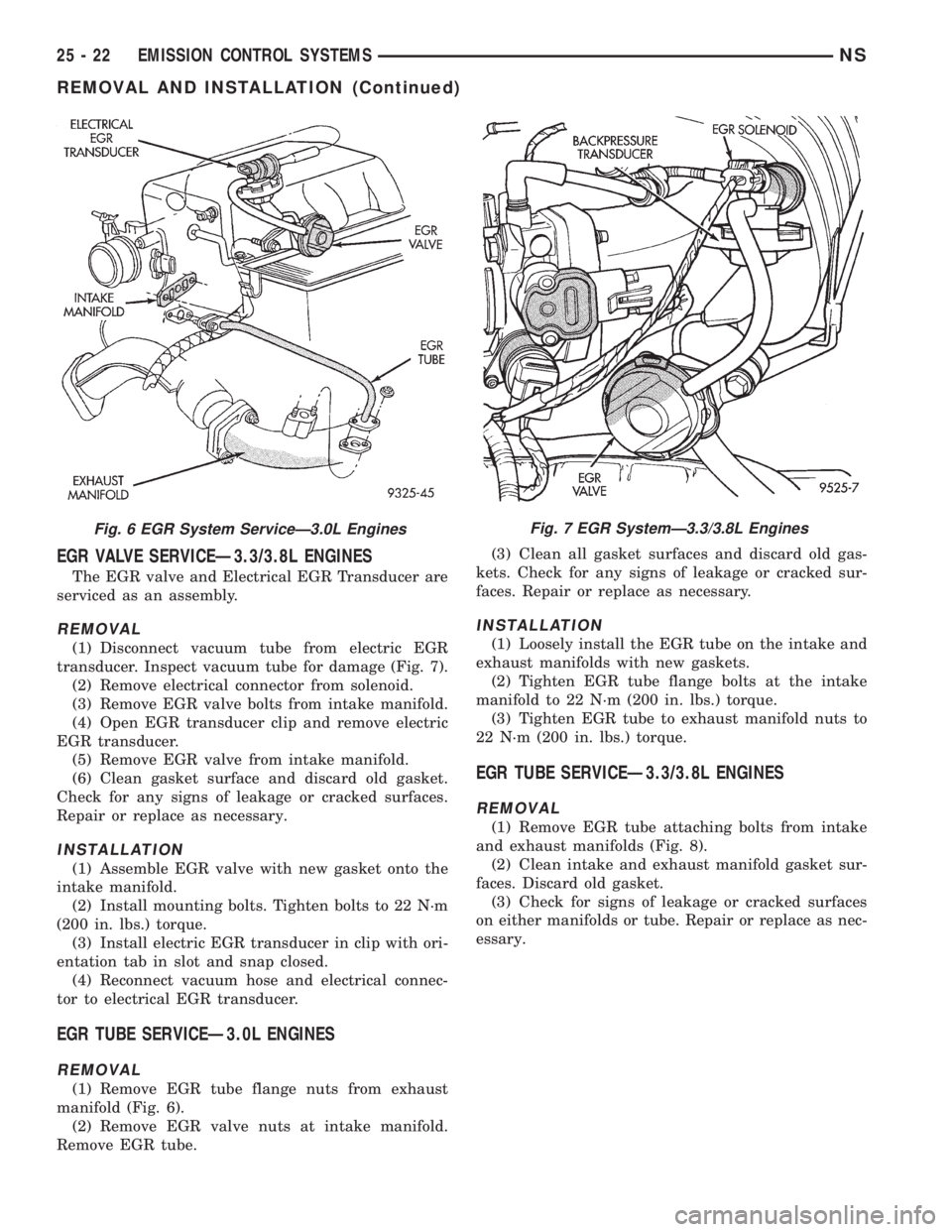
EGR VALVE SERVICEÐ3.3/3.8L ENGINES
The EGR valve and Electrical EGR Transducer are
serviced as an assembly.
REMOVAL
(1) Disconnect vacuum tube from electric EGR
transducer. Inspect vacuum tube for damage (Fig. 7).
(2) Remove electrical connector from solenoid.
(3) Remove EGR valve bolts from intake manifold.
(4) Open EGR transducer clip and remove electric
EGR transducer.
(5) Remove EGR valve from intake manifold.
(6) Clean gasket surface and discard old gasket.
Check for any signs of leakage or cracked surfaces.
Repair or replace as necessary.
INSTALLATION
(1) Assemble EGR valve with new gasket onto the
intake manifold.
(2) Install mounting bolts. Tighten bolts to 22 N´m
(200 in. lbs.) torque.
(3) Install electric EGR transducer in clip with ori-
entation tab in slot and snap closed.
(4) Reconnect vacuum hose and electrical connec-
tor to electrical EGR transducer.
EGR TUBE SERVICEÐ3.0L ENGINES
REMOVAL
(1) Remove EGR tube flange nuts from exhaust
manifold (Fig. 6).
(2) Remove EGR valve nuts at intake manifold.
Remove EGR tube.(3) Clean all gasket surfaces and discard old gas-
kets. Check for any signs of leakage or cracked sur-
faces. Repair or replace as necessary.
INSTALLATION
(1) Loosely install the EGR tube on the intake and
exhaust manifolds with new gaskets.
(2) Tighten EGR tube flange bolts at the intake
manifold to 22 N´m (200 in. lbs.) torque.
(3) Tighten EGR tube to exhaust manifold nuts to
22 N´m (200 in. lbs.) torque.
EGR TUBE SERVICEÐ3.3/3.8L ENGINES
REMOVAL
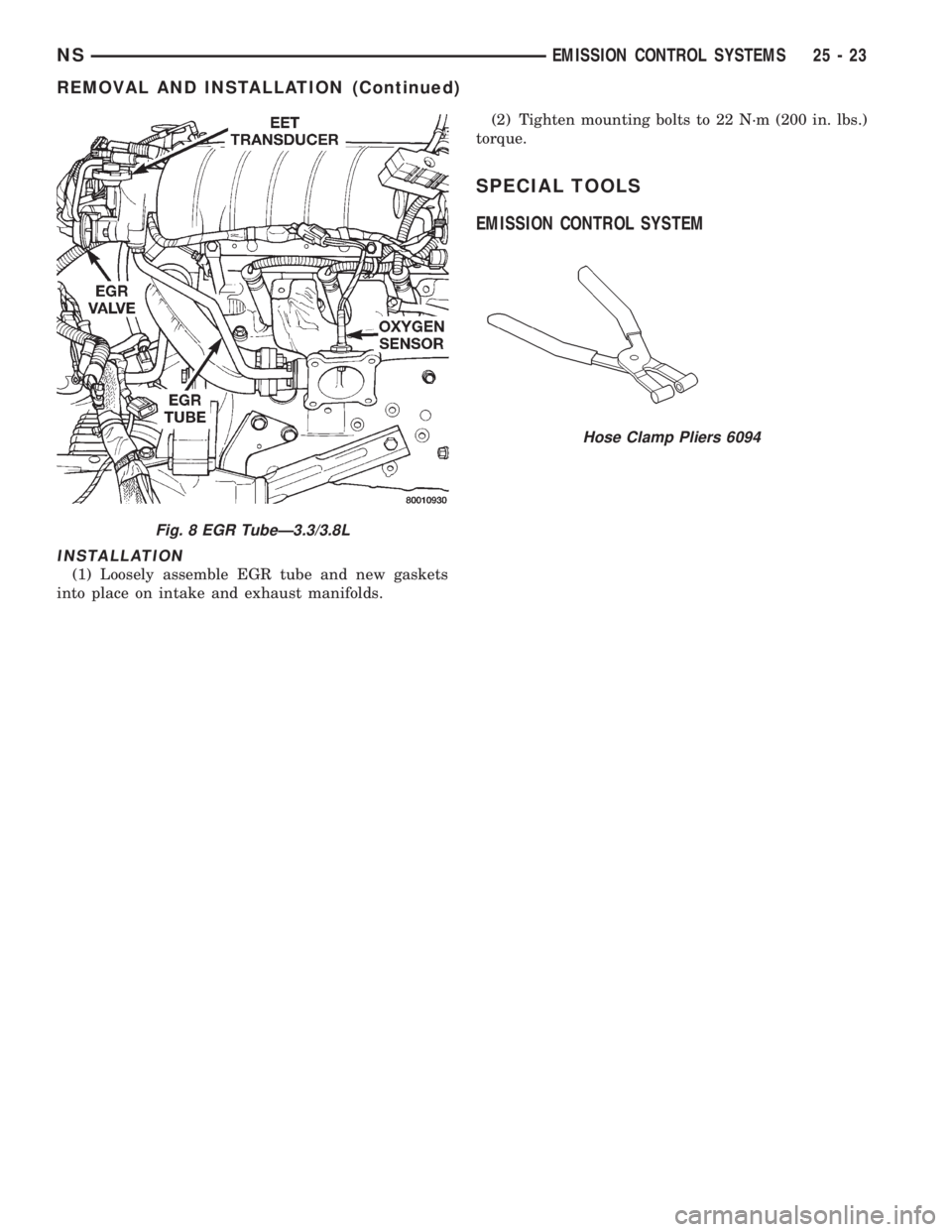
(1) Remove EGR tube attaching bolts from intake
and exhaust manifolds (Fig. 8).
(2) Clean intake and exhaust manifold gasket sur-
faces. Discard old gasket.
(3) Check for signs of leakage or cracked surfaces
on either manifolds or tube. Repair or replace as nec-
essary.
Fig. 6 EGR System ServiceÐ3.0L EnginesFig. 7 EGR SystemÐ3.3/3.8L Engines
25 - 22 EMISSION CONTROL SYSTEMSNS
REMOVAL AND INSTALLATION (Continued)
Page 1927 of 1938
INSTALLATION
(1) Loosely assemble EGR tube and new gaskets
into place on intake and exhaust manifolds.(2) Tighten mounting bolts to 22 N´m (200 in. lbs.)
torque.
SPECIAL TOOLS
EMISSION CONTROL SYSTEM
Fig. 8 EGR TubeÐ3.3/3.8L
Hose Clamp Pliers 6094
NSEMISSION CONTROL SYSTEMS 25 - 23
REMOVAL AND INSTALLATION (Continued)
Page 1933 of 1938
EXHAUST EMISSION CONTROLSÐ2.5L DIESEL ENGINE
INDEX
page page
DESCRIPTION AND OPERATION
EXHAUST GAS RECIRCULATION (EGR)
SYSTEM............................. 5
VACUUM HOSE ROUTING SCHEMATIC...... 5
DIAGNOSIS AND TESTING
EGR GAS FLOW TEST................... 6
ELECTRIC VACUUM MODULATOR (EVM)
TEST............................... 7REMOVAL AND INSTALLATION
EGR TUBE............................. 7
EGRVALVE ............................ 7
ELECTRIC VACUUM MODULATOR (EVM)..... 7
SPECIFICATIONS
TORQUE CHARTÐ2.5L DIESEL............ 8
DESCRIPTION AND OPERATION
VACUUM HOSE ROUTING SCHEMATIC
Vacuum for the EGR system is supplied by the
internal engine mounted vacuum pump. Refer to
EGR System Operation for vacuum pump informa-
tion. Vacuum harness routing for emission related
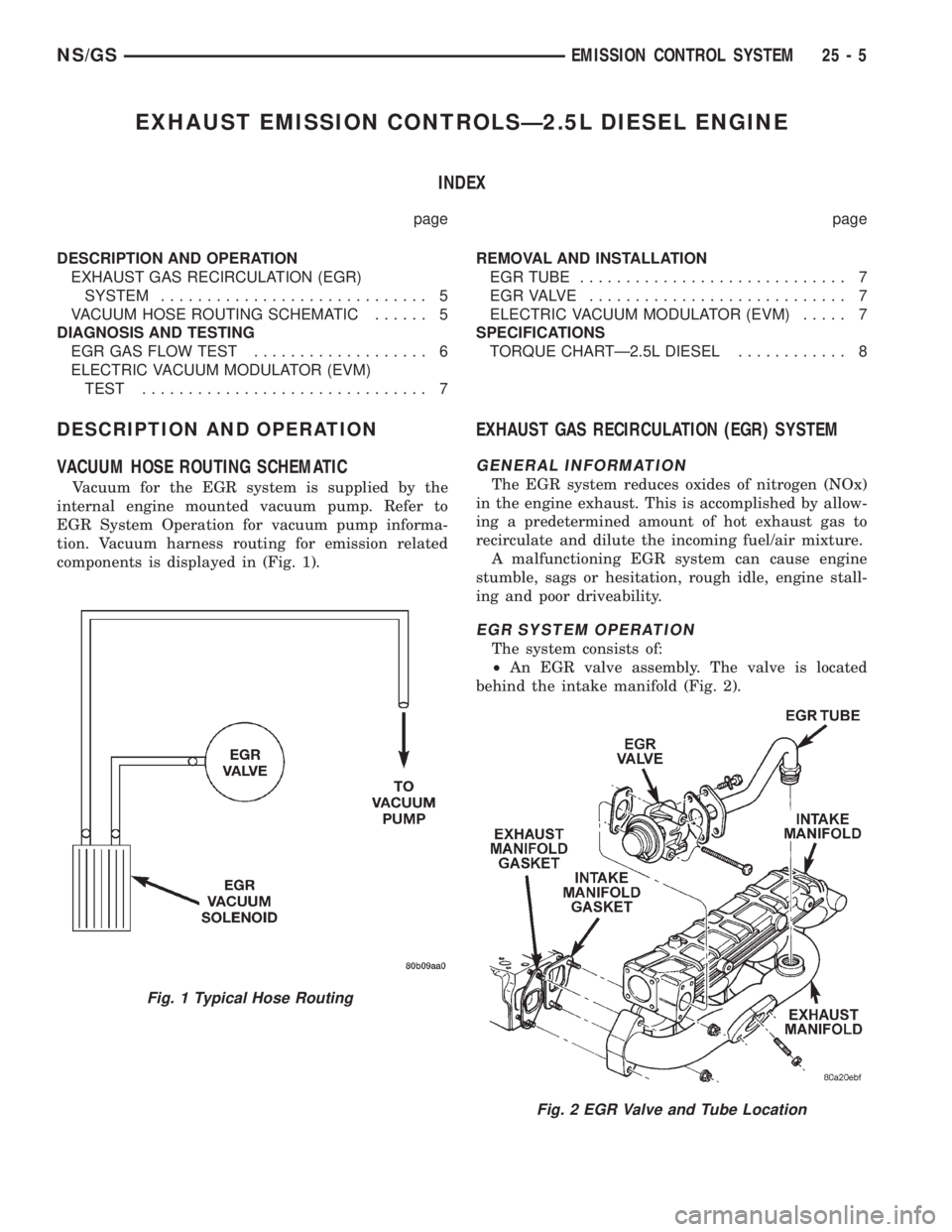
components is displayed in (Fig. 1).
EXHAUST GAS RECIRCULATION (EGR) SYSTEM
GENERAL INFORMATION
The EGR system reduces oxides of nitrogen (NOx)
in the engine exhaust. This is accomplished by allow-
ing a predetermined amount of hot exhaust gas to
recirculate and dilute the incoming fuel/air mixture.
A malfunctioning EGR system can cause engine
stumble, sags or hesitation, rough idle, engine stall-
ing and poor driveability.
EGR SYSTEM OPERATION
The system consists of:
²An EGR valve assembly. The valve is located
behind the intake manifold (Fig. 2).
Fig. 1 Typical Hose Routing
Fig. 2 EGR Valve and Tube Location
NS/GSEMISSION CONTROL SYSTEM 25 - 5
Page 1935 of 1938
(5) Slowly apply 10 inches of vacuum to the fitting
on the EGR valve motor. Vacuum should hold steady
at 10 inches. If not, replace the EGR valve. If vac-
uum holds steady at 10 inches, proceed to next step.
(6) While applying vacuum, and with the engine
running at idle speed, the idle speed should drop, a
rough idle may occur, or the engine may even stall.
This is indicating that exhaust gas is flowing through
the EGR tube between the intake and exhaust man-
ifolds.
(7) If the engine speed did not change, the EGR
valve may be defective, the EGR tube may be
plugged with carbon, or the passages in the intake
and exhaust manifolds may be plugged with carbon.
(a) Remove EGR valve from engine. Refer to
EGR Valve Removal in this group.
(b) Apply vacuum to the vacuum motor fitting
and observe the stem on the EGR valve. If the
stem is moving, it can be assumed that the EGR
valve is functioning correctly. The problem is in
either a plugged EGR tube or plugged passages at
the intake or exhaust manifolds. Refer to step (c).
If the stem will not move, replace the EGR valve.
(c) Remove the EGR tube between the intake
and exhaust manifolds. Check and clean the EGR
tube and its related openings on the manifolds.
Refer to EGR Tube in this group for procedures.
Do not attempt to clean the EGR valve. If the
valve shows evidence of heavy carbon build±up near
the base, replace it.
ELECTRIC VACUUM MODULATOR (EVM) TEST
VACUUM TEST
With the engine running, disconnect the vacuum
supply line at the fitting on the EVM. Minimum vac-
uum should be no less than 20 inches. If vacuum is
lower, check for leaks in vacuum supply line. If leaks
cannot be found, check for low vacuum at vacuum
pump. Refer to Group 5, Brake System for proce-
dures.
REMOVAL AND INSTALLATION
EGR VALVE
REMOVAL
(1) Remove the rubber hose from turbocharger to
metal tube.
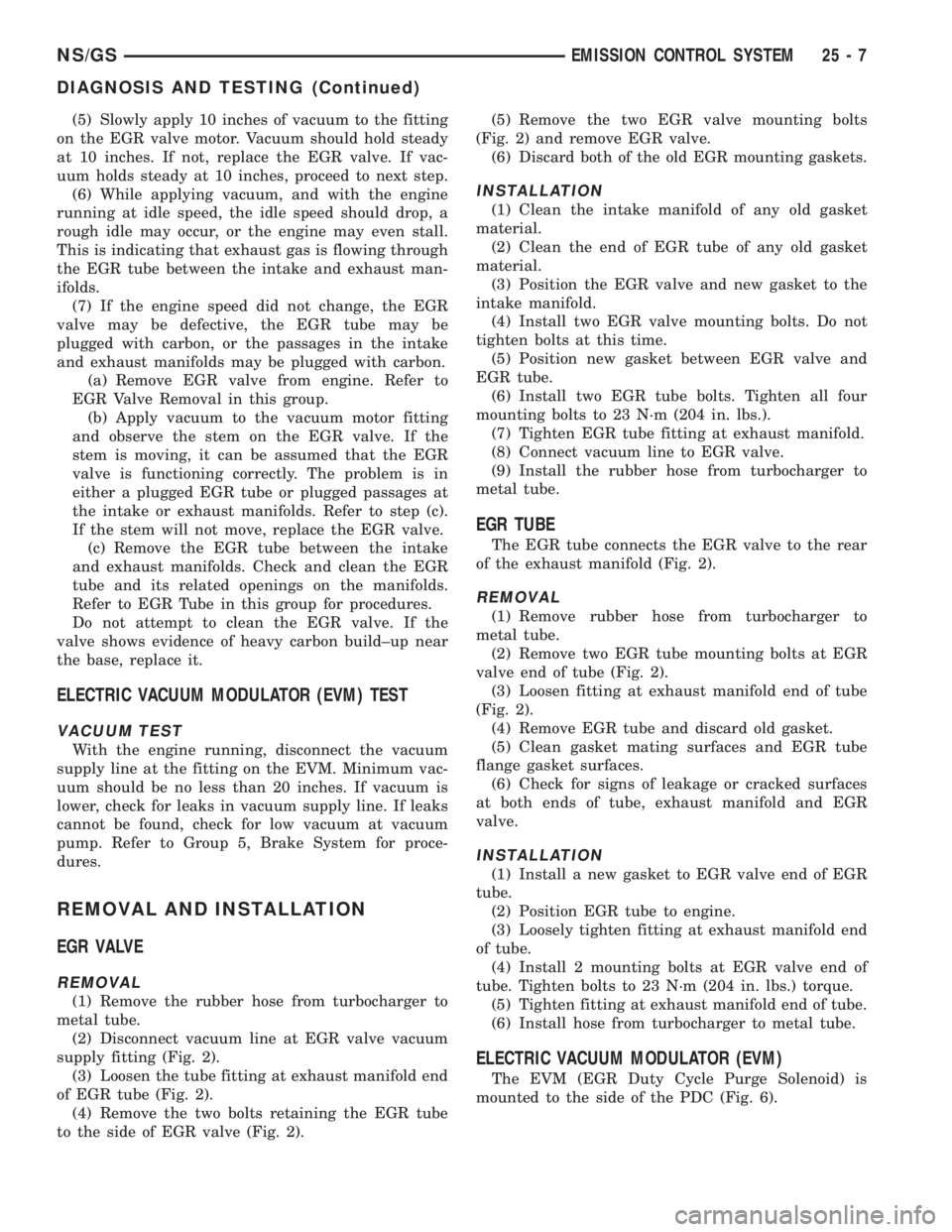
(2) Disconnect vacuum line at EGR valve vacuum
supply fitting (Fig. 2).
(3) Loosen the tube fitting at exhaust manifold end
of EGR tube (Fig. 2).
(4) Remove the two bolts retaining the EGR tube
to the side of EGR valve (Fig. 2).(5) Remove the two EGR valve mounting bolts
(Fig. 2) and remove EGR valve.
(6) Discard both of the old EGR mounting gaskets.
INSTALLATION
(1) Clean the intake manifold of any old gasket
material.
(2) Clean the end of EGR tube of any old gasket
material.
(3) Position the EGR valve and new gasket to the
intake manifold.
(4) Install two EGR valve mounting bolts. Do not
tighten bolts at this time.
(5) Position new gasket between EGR valve and
EGR tube.
(6) Install two EGR tube bolts. Tighten all four
mounting bolts to 23 N´m (204 in. lbs.).
(7) Tighten EGR tube fitting at exhaust manifold.
(8) Connect vacuum line to EGR valve.
(9) Install the rubber hose from turbocharger to
metal tube.
EGR TUBE
The EGR tube connects the EGR valve to the rear
of the exhaust manifold (Fig. 2).
REMOVAL
(1) Remove rubber hose from turbocharger to
metal tube.
(2) Remove two EGR tube mounting bolts at EGR
valve end of tube (Fig. 2).
(3) Loosen fitting at exhaust manifold end of tube
(Fig. 2).
(4) Remove EGR tube and discard old gasket.
(5) Clean gasket mating surfaces and EGR tube
flange gasket surfaces.
(6) Check for signs of leakage or cracked surfaces
at both ends of tube, exhaust manifold and EGR
valve.
INSTALLATION
(1) Install a new gasket to EGR valve end of EGR
tube.
(2) Position EGR tube to engine.
(3) Loosely tighten fitting at exhaust manifold end
of tube.
(4) Install 2 mounting bolts at EGR valve end of
tube. Tighten bolts to 23 N´m (204 in. lbs.) torque.
(5) Tighten fitting at exhaust manifold end of tube.
(6) Install hose from turbocharger to metal tube.
ELECTRIC VACUUM MODULATOR (EVM)
The EVM (EGR Duty Cycle Purge Solenoid) is
mounted to the side of the PDC (Fig. 6).
NS/GSEMISSION CONTROL SYSTEM 25 - 7
DIAGNOSIS AND TESTING (Continued)
Page 1936 of 1938
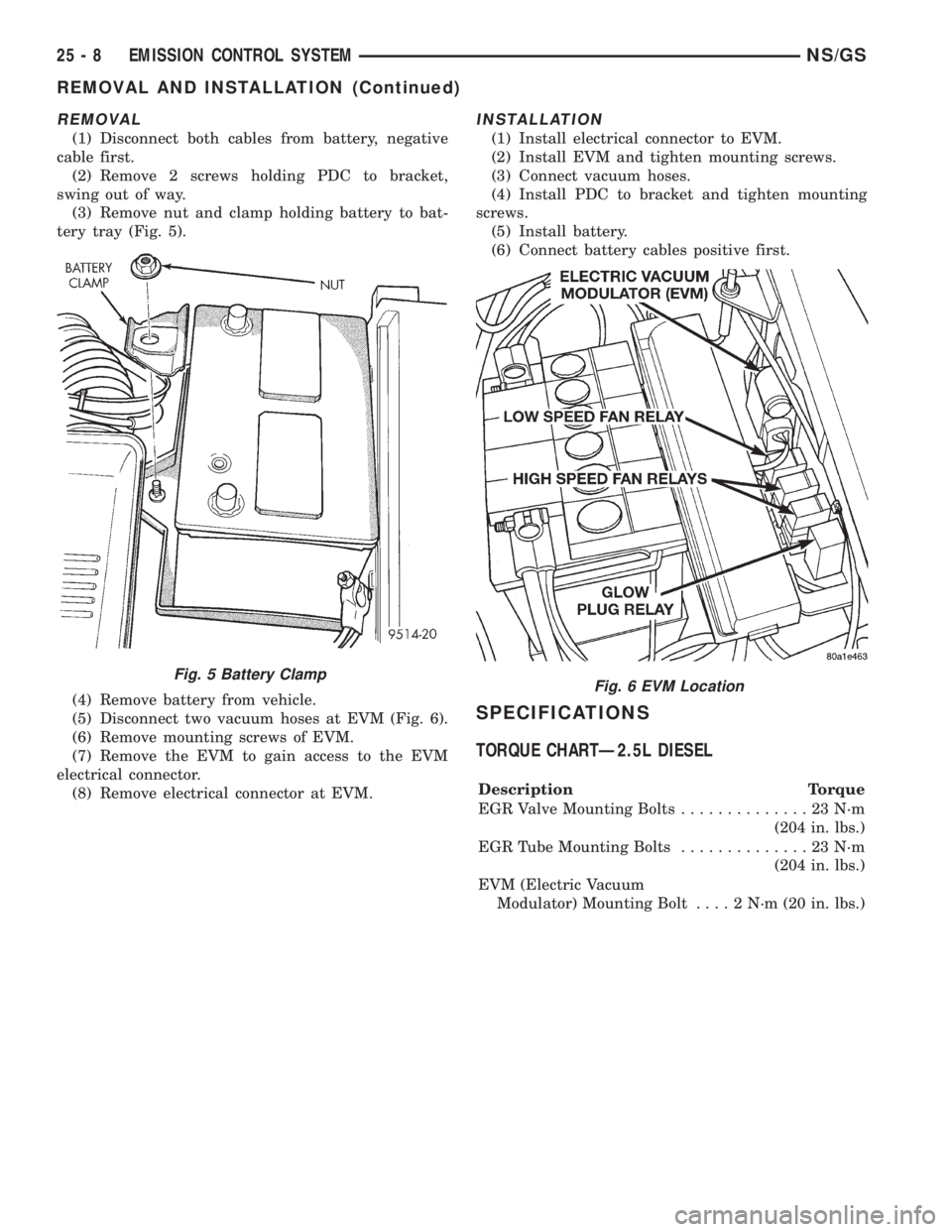
REMOVAL
(1) Disconnect both cables from battery, negative
cable first.
(2) Remove 2 screws holding PDC to bracket,
swing out of way.
(3) Remove nut and clamp holding battery to bat-
tery tray (Fig. 5).
(4) Remove battery from vehicle.
(5) Disconnect two vacuum hoses at EVM (Fig. 6).
(6) Remove mounting screws of EVM.
(7) Remove the EVM to gain access to the EVM
electrical connector.
(8) Remove electrical connector at EVM.
INSTALLATION
(1) Install electrical connector to EVM.
(2) Install EVM and tighten mounting screws.
(3) Connect vacuum hoses.
(4) Install PDC to bracket and tighten mounting
screws.
(5) Install battery.
(6) Connect battery cables positive first.
SPECIFICATIONS
TORQUE CHARTÐ2.5L DIESEL
Description Torque
EGR Valve Mounting Bolts..............23N´m
(204 in. lbs.)
EGR Tube Mounting Bolts..............23N´m
(204 in. lbs.)
EVM (Electric Vacuum
Modulator) Mounting Bolt. . . . 2 N´m (20 in. lbs.)
Fig. 5 Battery ClampFig. 6 EVM Location
25 - 8 EMISSION CONTROL SYSTEMNS/GS
REMOVAL AND INSTALLATION (Continued)
Page 1937 of 1938
EMISSION CONTROL SYSTEMÐ2.0L ENGINE
INDEX
page page
GENERAL INFORMATION
GENERAL INFORMATION................. 9
POSITIVE CRANKCASE VENTILATION SYSTEM
(PCV) SYSTEMÐ2.0L ENGINE............ 9REMOVAL AND INSTALLATION
EGR TUBE............................ 10
EGRVALVE ............................ 9
TORQUE............................. 10
GENERAL INFORMATION
GENERAL INFORMATION
The emission control system for the 2.0L engine
functions the same as the systems for the 2.4/3.0/3.3/
3.8L engines. Refer to group 25 for more information
about Diagnostic Trouble Codes and other system
features.
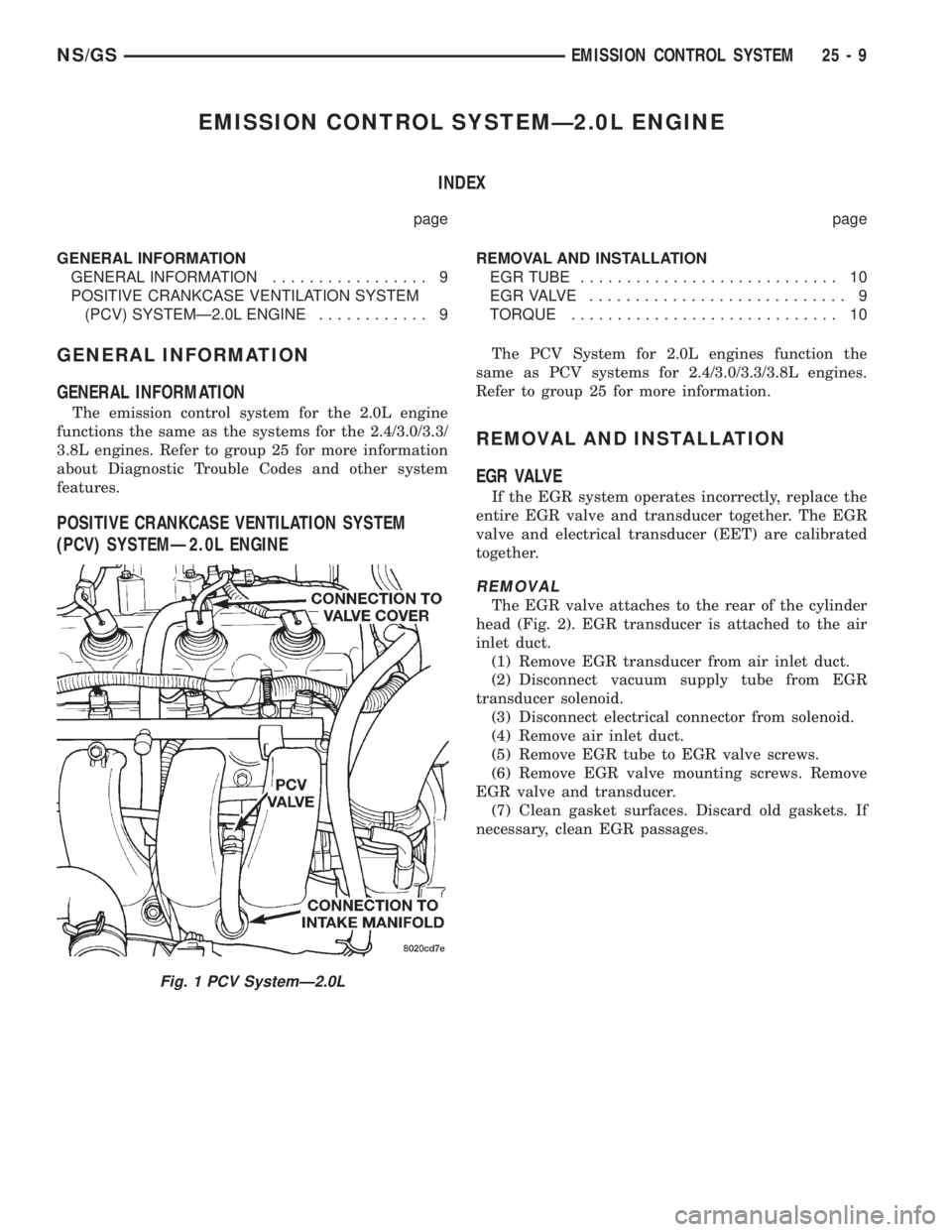
POSITIVE CRANKCASE VENTILATION SYSTEM
(PCV) SYSTEMÐ2.0L ENGINE
The PCV System for 2.0L engines function the
same as PCV systems for 2.4/3.0/3.3/3.8L engines.
Refer to group 25 for more information.
REMOVAL AND INSTALLATION
EGR VALVE
If the EGR system operates incorrectly, replace the
entire EGR valve and transducer together. The EGR
valve and electrical transducer (EET) are calibrated
together.
REMOVAL
The EGR valve attaches to the rear of the cylinder
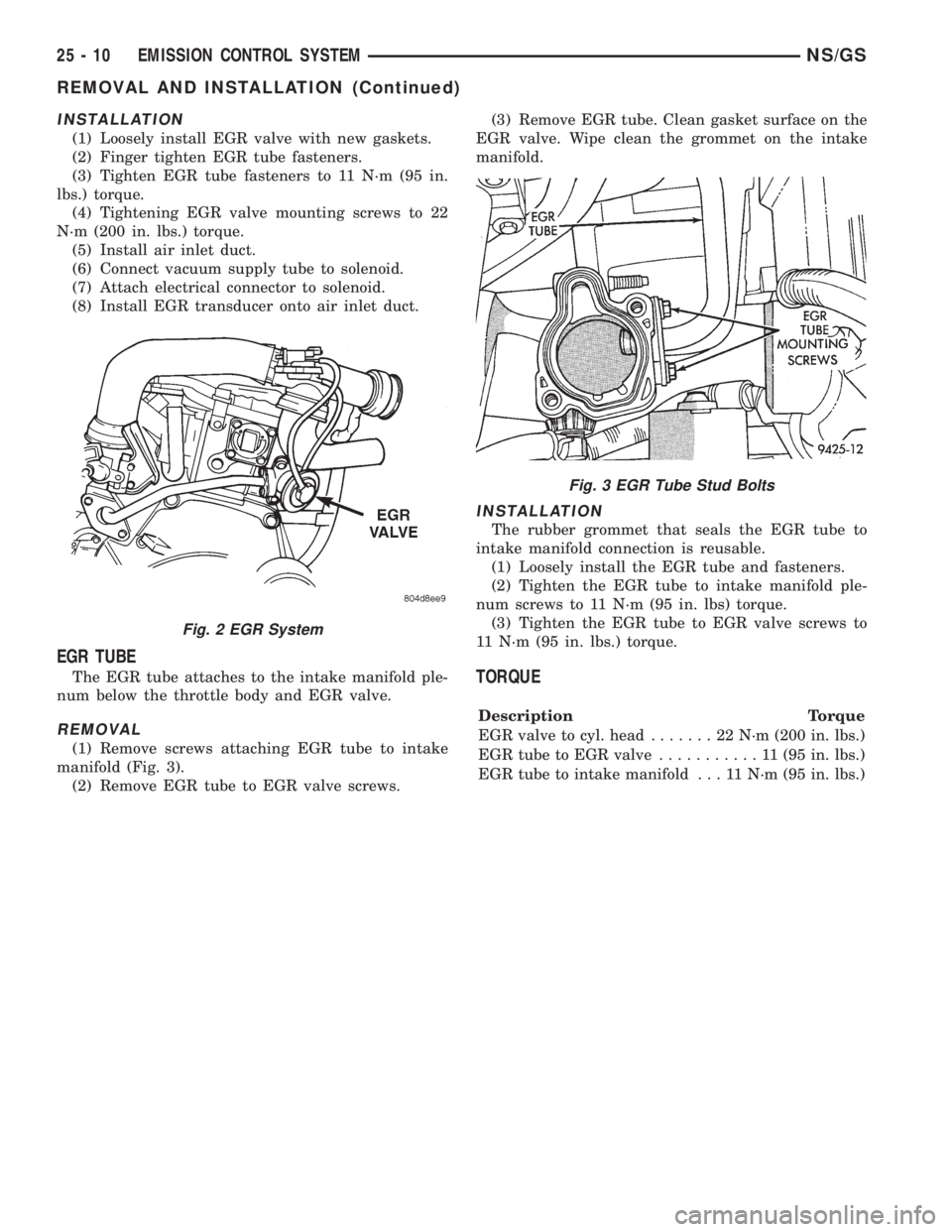
head (Fig. 2). EGR transducer is attached to the air
inlet duct.
(1) Remove EGR transducer from air inlet duct.
(2) Disconnect vacuum supply tube from EGR
transducer solenoid.
(3) Disconnect electrical connector from solenoid.
(4) Remove air inlet duct.
(5) Remove EGR tube to EGR valve screws.
(6) Remove EGR valve mounting screws. Remove
EGR valve and transducer.
(7) Clean gasket surfaces. Discard old gaskets. If
necessary, clean EGR passages.
Fig. 1 PCV SystemÐ2.0L
NS/GSEMISSION CONTROL SYSTEM 25 - 9
Page 1938 of 1938
INSTALLATION
(1) Loosely install EGR valve with new gaskets.
(2) Finger tighten EGR tube fasteners.
(3) Tighten EGR tube fasteners to 11 N´m (95 in.
lbs.) torque.
(4) Tightening EGR valve mounting screws to 22
N´m (200 in. lbs.) torque.
(5) Install air inlet duct.
(6) Connect vacuum supply tube to solenoid.
(7) Attach electrical connector to solenoid.
(8) Install EGR transducer onto air inlet duct.
EGR TUBE
The EGR tube attaches to the intake manifold ple-
num below the throttle body and EGR valve.
REMOVAL
(1) Remove screws attaching EGR tube to intake
manifold (Fig. 3).
(2) Remove EGR tube to EGR valve screws.(3) Remove EGR tube. Clean gasket surface on the
EGR valve. Wipe clean the grommet on the intake
manifold.
INSTALLATION
The rubber grommet that seals the EGR tube to
intake manifold connection is reusable.
(1) Loosely install the EGR tube and fasteners.
(2) Tighten the EGR tube to intake manifold ple-
num screws to 11 N´m (95 in. lbs) torque.
(3) Tighten the EGR tube to EGR valve screws to
11 N´m (95 in. lbs.) torque.
TORQUE
Description Torque
EGR valve to cyl. head.......22N´m(200 in. lbs.)
EGR tube to EGR valve...........11(95in.lbs.)
EGR tube to intake manifold . . . 11 N´m (95 in. lbs.)
Fig. 2 EGR System
Fig. 3 EGR Tube Stud Bolts
25 - 10 EMISSION CONTROL SYSTEMNS/GS
REMOVAL AND INSTALLATION (Continued)