Page 1639 of 1938
POWER TRANSFER UNIT
INDEX
page page
GENERAL INFORMATION
POWER TRANSFER UNIT................ 165
DIAGNOSIS AND TESTING
FLUID LEAK DIAGNOSIS................. 167
SEAL IDENTIFICATION................... 165
REMOVAL AND INSTALLATION
DIFFERENTIAL CARRIER SEAL............ 170
END COVER BALL BEARING.............. 178
END COVER SEAL...................... 169
HALF SHAFT INNER SEAL................ 175
INPUT SHAFT COVER SEAL.............. 174
INPUT SHAFT END SEAL................. 177INPUT SHAFT SEAL..................... 169
OUTER HALF SHAFT SEAL............... 177
POWER TRANSFER UNIT (P.T.U.).......... 167
POWER TRANSFER UNIT OUTPUT SEAL.... 171
REAR COVER O-RING................... 171
ADJUSTMENTS
OUTPUT FLANGE SHIM SELECTION........ 180
SPECIFICATIONS
TORQUE............................. 180
SPECIAL TOOLS
SDP POWER TRANSFER UNIT............ 181
GENERAL INFORMATION
POWER TRANSFER UNIT
The Power Transfer Unit (P.T.U.) is attached to a
modified automatic transaxle case where the right
half shaft extension housing would normally be
located. The Transfer Unit provides the power to the
rear wheels through a hypoid ring gear and pinion
set.
The Power Transfer Unit is sealed from the tran-
saxle and has its own oil sump. The Unit uses SAE
85W-90 gear lubricant and holds 1.15 liters (1.22
quarts).
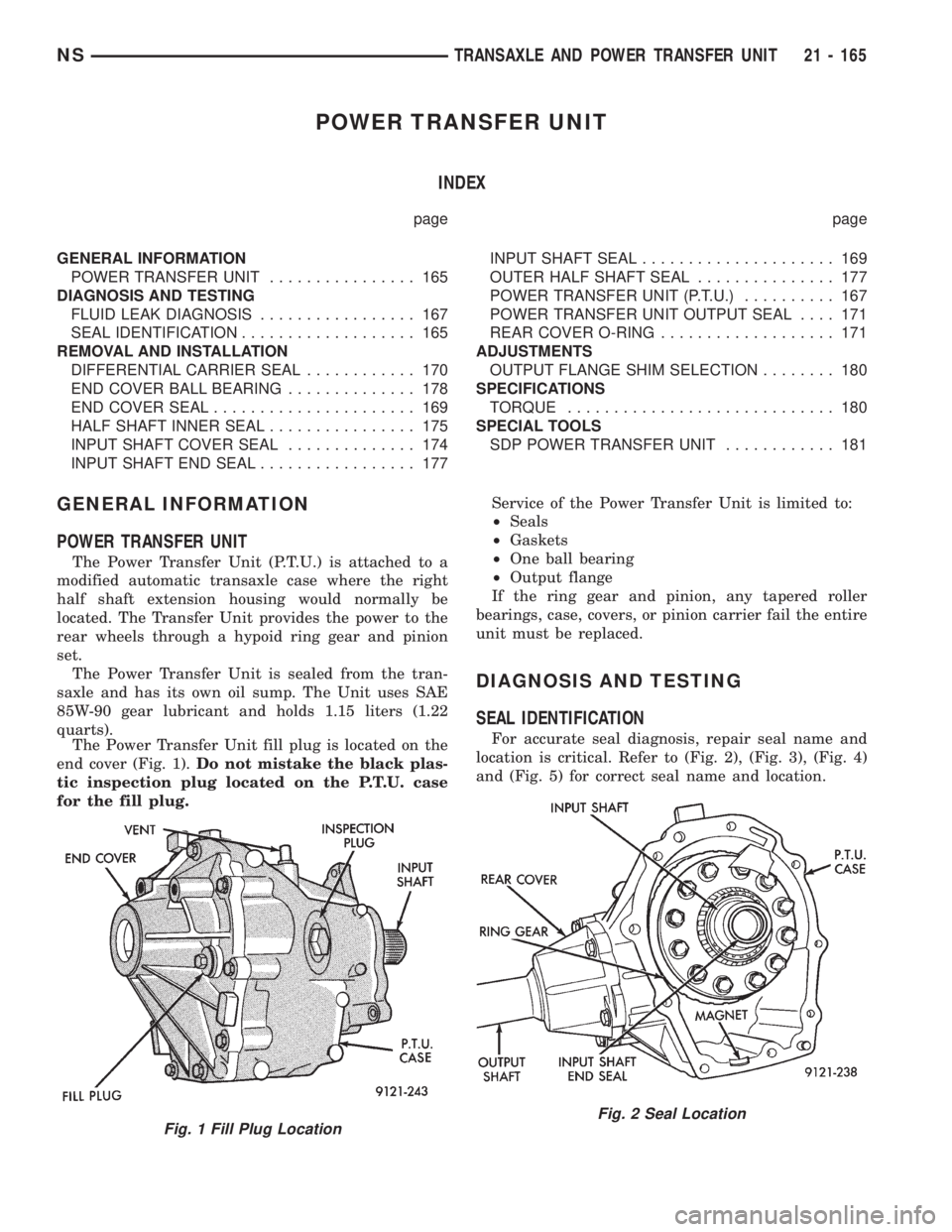
The Power Transfer Unit fill plug is located on the
end cover (Fig. 1).Do not mistake the black plas-
tic inspection plug located on the P.T.U. case
for the fill plug.Service of the Power Transfer Unit is limited to:
²Seals
²Gaskets
²One ball bearing
²Output flange
If the ring gear and pinion, any tapered roller
bearings, case, covers, or pinion carrier fail the entire
unit must be replaced.
DIAGNOSIS AND TESTING
SEAL IDENTIFICATION
For accurate seal diagnosis, repair seal name and
location is critical. Refer to (Fig. 2), (Fig. 3), (Fig. 4)
and (Fig. 5) for correct seal name and location.
Fig. 1 Fill Plug LocationFig. 2 Seal Location
NSTRANSAXLE AND POWER TRANSFER UNIT 21 - 165
Page 1643 of 1938
INSTALLATION
(1) To install, reverse removal procedure. Check
transaxle fluid and P.T.U. fluid and fill to level.
(2) Refer to the Specifications section for the
proper torque specifications.
END COVER SEAL
The Power Transfer Unit must be removed from
the vehicle to perform this operation. Refer to Power
Transfer Unit Removal in this section for procedures.
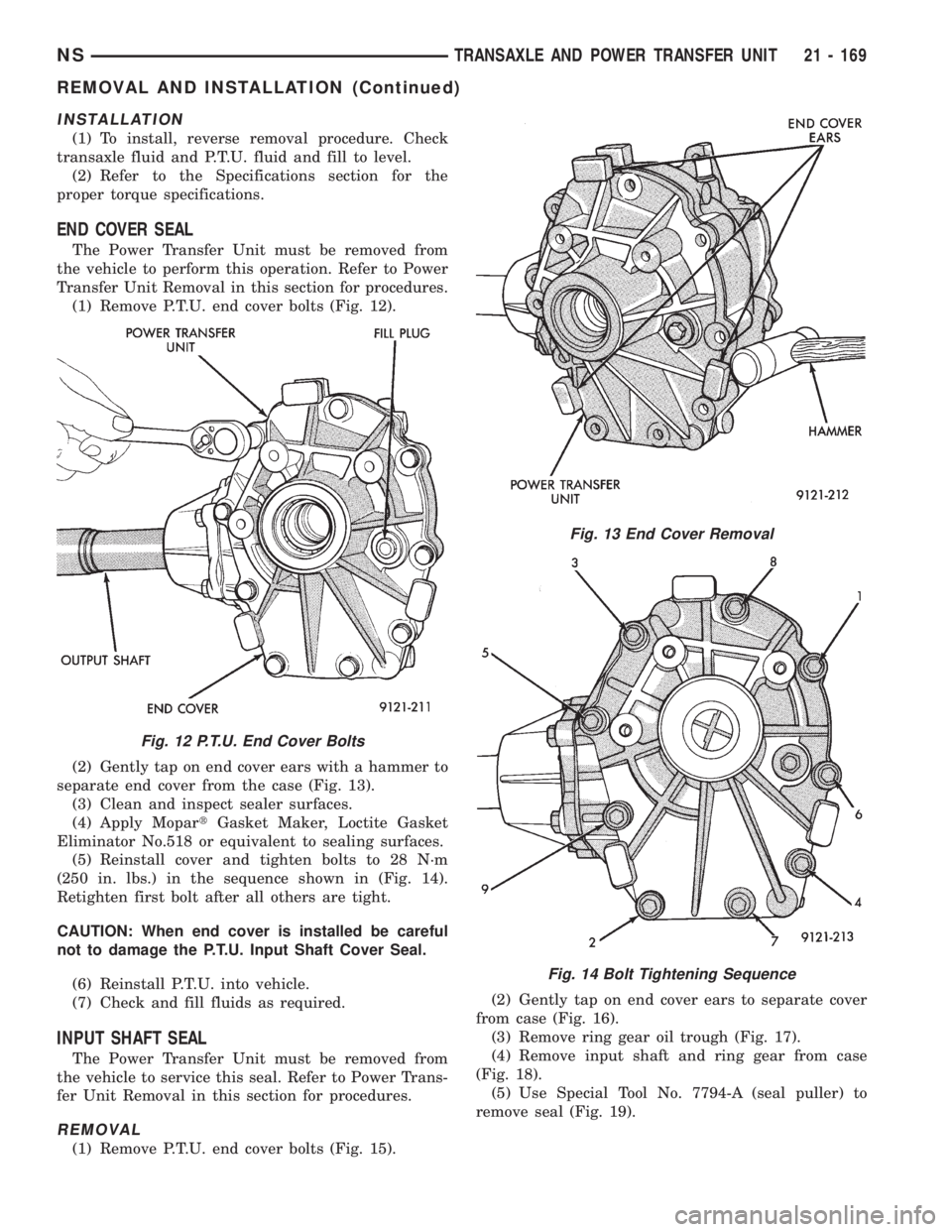
(1) Remove P.T.U. end cover bolts (Fig. 12).
(2) Gently tap on end cover ears with a hammer to
separate end cover from the case (Fig. 13).
(3) Clean and inspect sealer surfaces.
(4) Apply MopartGasket Maker, Loctite Gasket
Eliminator No.518 or equivalent to sealing surfaces.
(5) Reinstall cover and tighten bolts to 28 N´m
(250 in. lbs.) in the sequence shown in (Fig. 14).
Retighten first bolt after all others are tight.
CAUTION: When end cover is installed be careful
not to damage the P.T.U. Input Shaft Cover Seal.
(6) Reinstall P.T.U. into vehicle.
(7) Check and fill fluids as required.
INPUT SHAFT SEAL
The Power Transfer Unit must be removed from
the vehicle to service this seal. Refer to Power Trans-
fer Unit Removal in this section for procedures.
REMOVAL
(1) Remove P.T.U. end cover bolts (Fig. 15).(2) Gently tap on end cover ears to separate cover
from case (Fig. 16).
(3) Remove ring gear oil trough (Fig. 17).
(4) Remove input shaft and ring gear from case
(Fig. 18).
(5) Use Special Tool No. 7794-A (seal puller) to
remove seal (Fig. 19).
Fig. 12 P.T.U. End Cover Bolts
Fig. 13 End Cover Removal
Fig. 14 Bolt Tightening Sequence
NSTRANSAXLE AND POWER TRANSFER UNIT 21 - 169
REMOVAL AND INSTALLATION (Continued)
Page 1654 of 1938
ADJUSTMENTS
OUTPUT FLANGE SHIM SELECTION
This procedure is used when the output flange is
replaced. Replacement of the output flange requires
installation of the correct size shim to maintain bear-
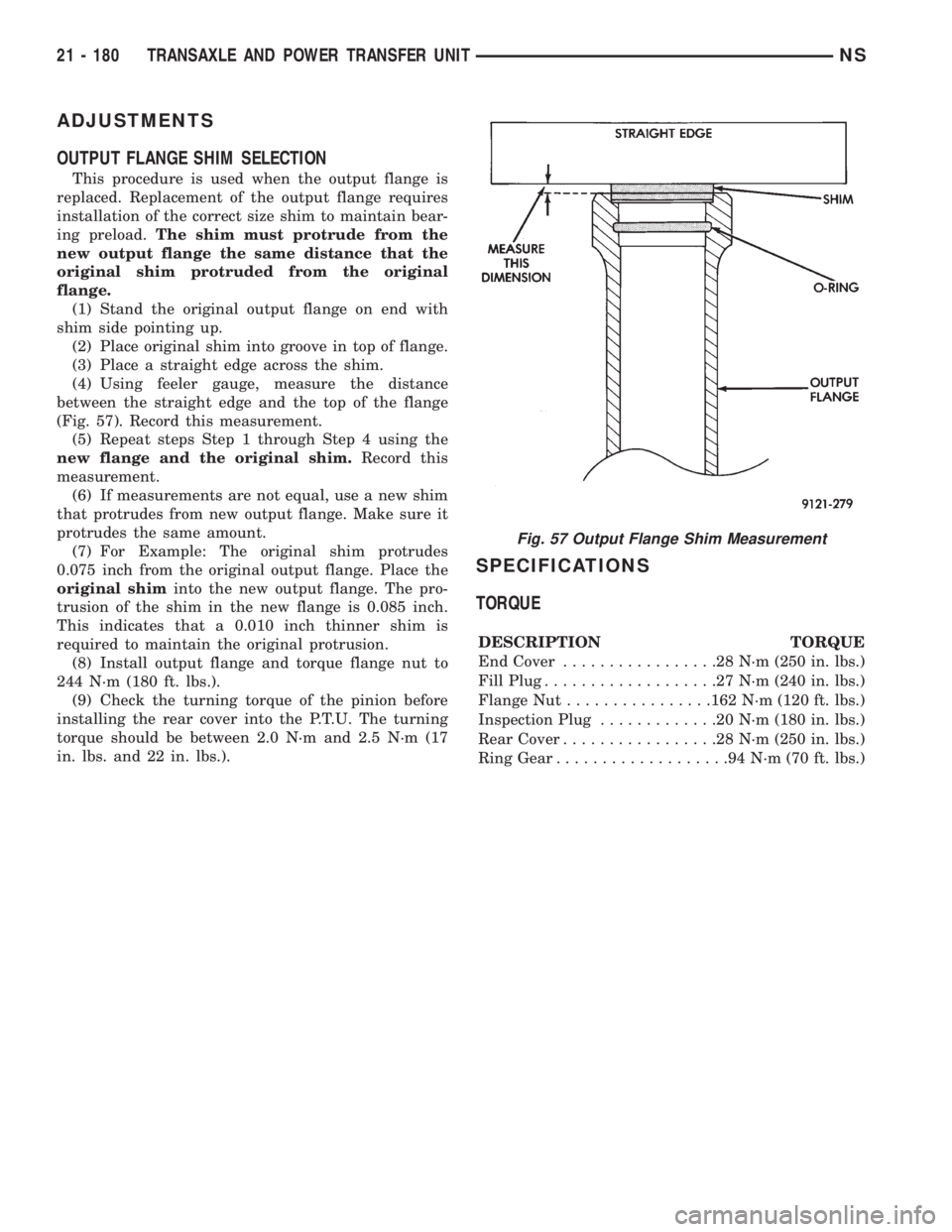
ing preload.The shim must protrude from the
new output flange the same distance that the
original shim protruded from the original
flange.
(1) Stand the original output flange on end with
shim side pointing up.
(2) Place original shim into groove in top of flange.
(3) Place a straight edge across the shim.
(4) Using feeler gauge, measure the distance
between the straight edge and the top of the flange
(Fig. 57). Record this measurement.
(5) Repeat steps Step 1 through Step 4 using the
new flange and the original shim.Record this
measurement.
(6) If measurements are not equal, use a new shim
that protrudes from new output flange. Make sure it
protrudes the same amount.
(7) For Example: The original shim protrudes
0.075 inch from the original output flange. Place the
original shiminto the new output flange. The pro-
trusion of the shim in the new flange is 0.085 inch.
This indicates that a 0.010 inch thinner shim is
required to maintain the original protrusion.
(8) Install output flange and torque flange nut to
244 N´m (180 ft. lbs.).
(9) Check the turning torque of the pinion before
installing the rear cover into the P.T.U. The turning
torque should be between 2.0 N´m and 2.5 N´m (17
in. lbs. and 22 in. lbs.).
SPECIFICATIONS
TORQUE
DESCRIPTION TORQUE
End Cover.................28N´m(250 in. lbs.)
Fill Plug...................27N´m(240 in. lbs.)
Flange Nut................162 N´m (120 ft. lbs.)
Inspection Plug.............20N´m(180 in. lbs.)
Rear Cover.................28N´m(250 in. lbs.)
Ring Gear...................94N´m(70ft.lbs.)
Fig. 57 Output Flange Shim Measurement
21 - 180 TRANSAXLE AND POWER TRANSFER UNITNS
Page 1695 of 1938
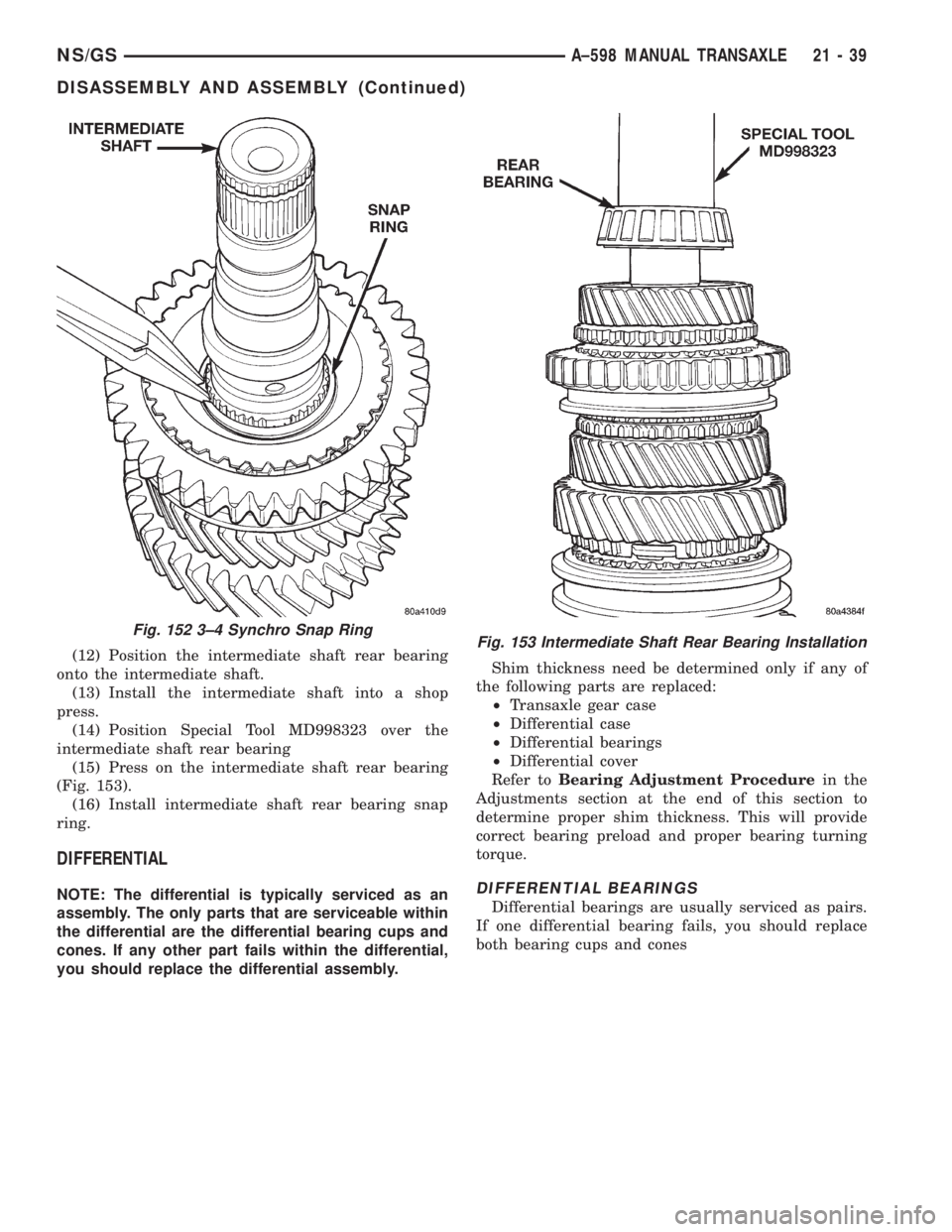
(12) Position the intermediate shaft rear bearing
onto the intermediate shaft.
(13) Install the intermediate shaft into a shop
press.
(14) Position Special Tool MD998323 over the
intermediate shaft rear bearing
(15) Press on the intermediate shaft rear bearing
(Fig. 153).
(16) Install intermediate shaft rear bearing snap
ring.
DIFFERENTIAL
NOTE: The differential is typically serviced as an
assembly. The only parts that are serviceable within
the differential are the differential bearing cups and
cones. If any other part fails within the differential,
you should replace the differential assembly.Shim thickness need be determined only if any of
the following parts are replaced:
²Transaxle gear case
²Differential case
²Differential bearings
²Differential cover
Refer toBearing Adjustment Procedurein the
Adjustments section at the end of this section to
determine proper shim thickness. This will provide
correct bearing preload and proper bearing turning
torque.DIFFERENTIAL BEARINGS
Differential bearings are usually serviced as pairs.
If one differential bearing fails, you should replace
both bearing cups and cones
Fig. 152 3±4 Synchro Snap RingFig. 153 Intermediate Shaft Rear Bearing Installation
NS/GSA±598 MANUAL TRANSAXLE 21 - 39
DISASSEMBLY AND ASSEMBLY (Continued)
Page 1698 of 1938
RING GEAR
CAUTION: Always install new ring gear bolts.
Tighten ring gear bolts to 94 N´m (70 ft. lbs.) torque.
DIFFERENTIAL GEARS
REMOVAL
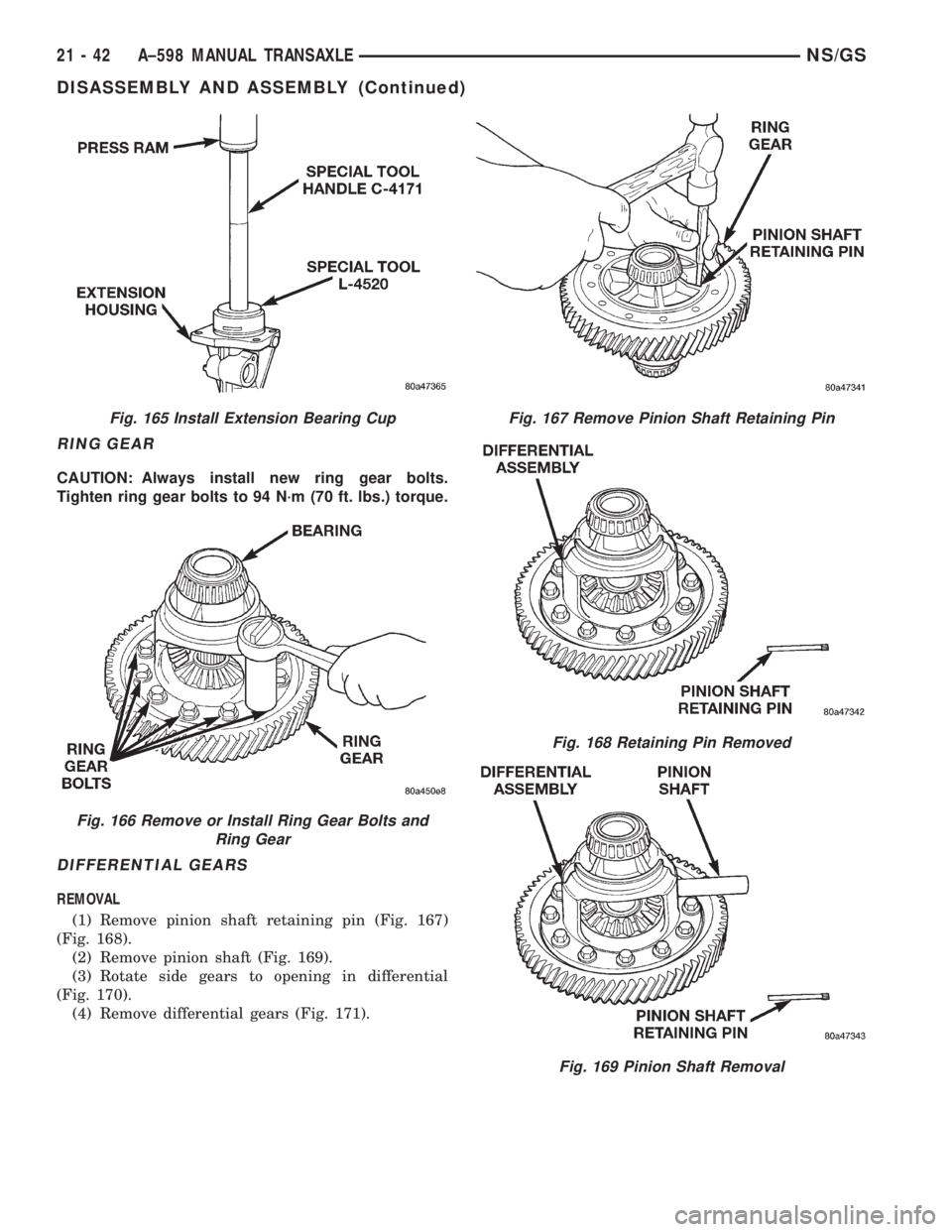
(1) Remove pinion shaft retaining pin (Fig. 167)
(Fig. 168).
(2) Remove pinion shaft (Fig. 169).
(3) Rotate side gears to opening in differential
(Fig. 170).
(4) Remove differential gears (Fig. 171).
Fig. 165 Install Extension Bearing Cup
Fig. 166 Remove or Install Ring Gear Bolts and
Ring Gear
Fig. 167 Remove Pinion Shaft Retaining Pin
Fig. 168 Retaining Pin Removed
Fig. 169 Pinion Shaft Removal
21 - 42 A±598 MANUAL TRANSAXLENS/GS
DISASSEMBLY AND ASSEMBLY (Continued)
Page 1703 of 1938
NOTE: Drive roll pin out far enough to clear the
selector shaft, but not through. The pin must
remain in the selector so not to break the housing.
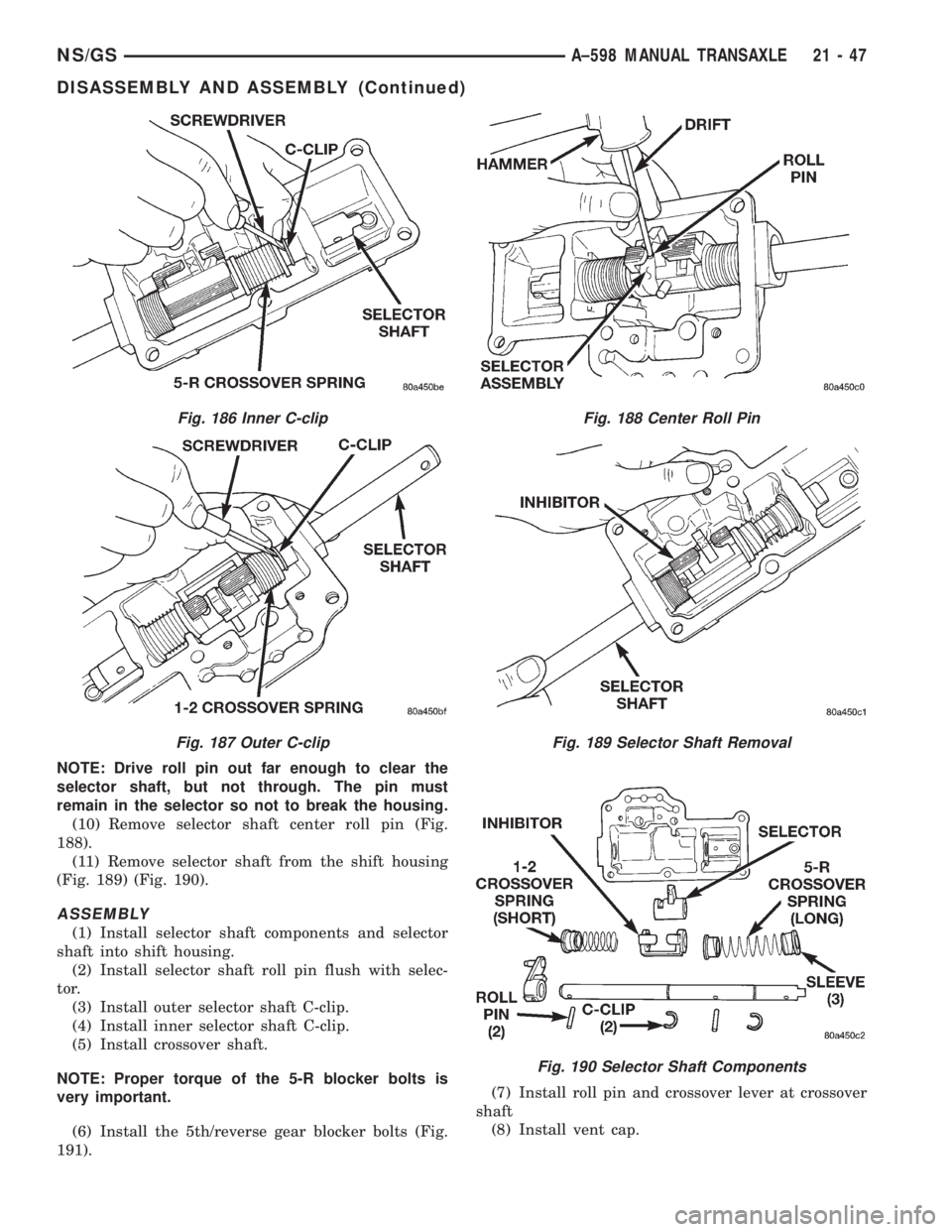
(10) Remove selector shaft center roll pin (Fig.
188).
(11) Remove selector shaft from the shift housing
(Fig. 189) (Fig. 190).
ASSEMBLY
(1) Install selector shaft components and selector
shaft into shift housing.
(2) Install selector shaft roll pin flush with selec-
tor.
(3) Install outer selector shaft C-clip.
(4) Install inner selector shaft C-clip.
(5) Install crossover shaft.
NOTE: Proper torque of the 5-R blocker bolts is
very important.
(6) Install the 5th/reverse gear blocker bolts (Fig.
191).(7) Install roll pin and crossover lever at crossover
shaft
(8) Install vent cap.
Fig. 186 Inner C-clip
Fig. 187 Outer C-clip
Fig. 188 Center Roll Pin
Fig. 189 Selector Shaft Removal
Fig. 190 Selector Shaft Components
NS/GSA±598 MANUAL TRANSAXLE 21 - 47
DISASSEMBLY AND ASSEMBLY (Continued)
Page 1710 of 1938
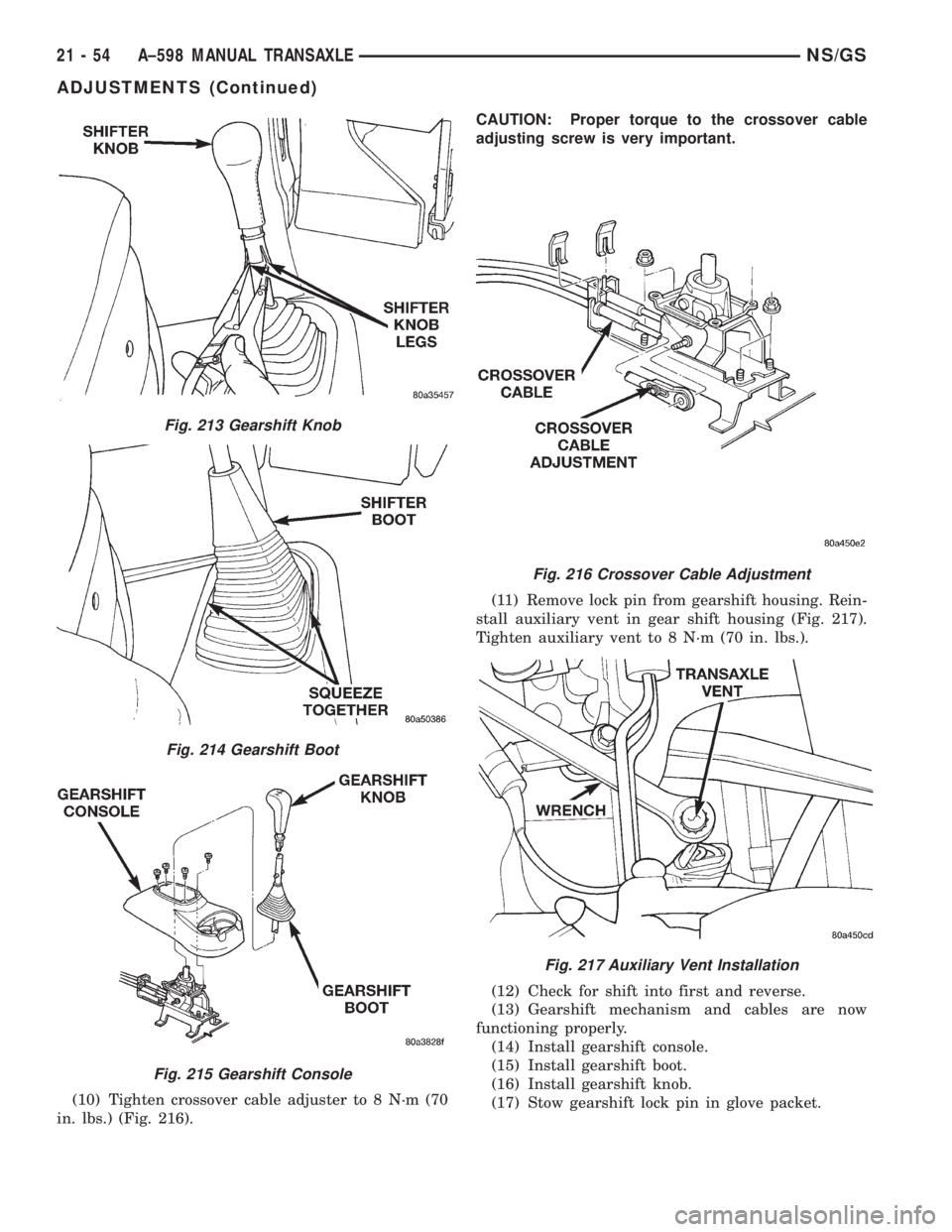
(10) Tighten crossover cable adjuster to 8 N´m (70
in. lbs.) (Fig. 216).CAUTION: Proper torque to the crossover cable
adjusting screw is very important.
(11) Remove lock pin from gearshift housing. Rein-
stall auxiliary vent in gear shift housing (Fig. 217).
Tighten auxiliary vent to 8 N´m (70 in. lbs.).
(12) Check for shift into first and reverse.
(13) Gearshift mechanism and cables are now
functioning properly.
(14) Install gearshift console.
(15) Install gearshift boot.
(16) Install gearshift knob.
(17) Stow gearshift lock pin in glove packet.
Fig. 213 Gearshift Knob
Fig. 214 Gearshift Boot
Fig. 215 Gearshift Console
Fig. 216 Crossover Cable Adjustment
Fig. 217 Auxiliary Vent Installation
21 - 54 A±598 MANUAL TRANSAXLENS/GS
ADJUSTMENTS (Continued)
Page 1712 of 1938
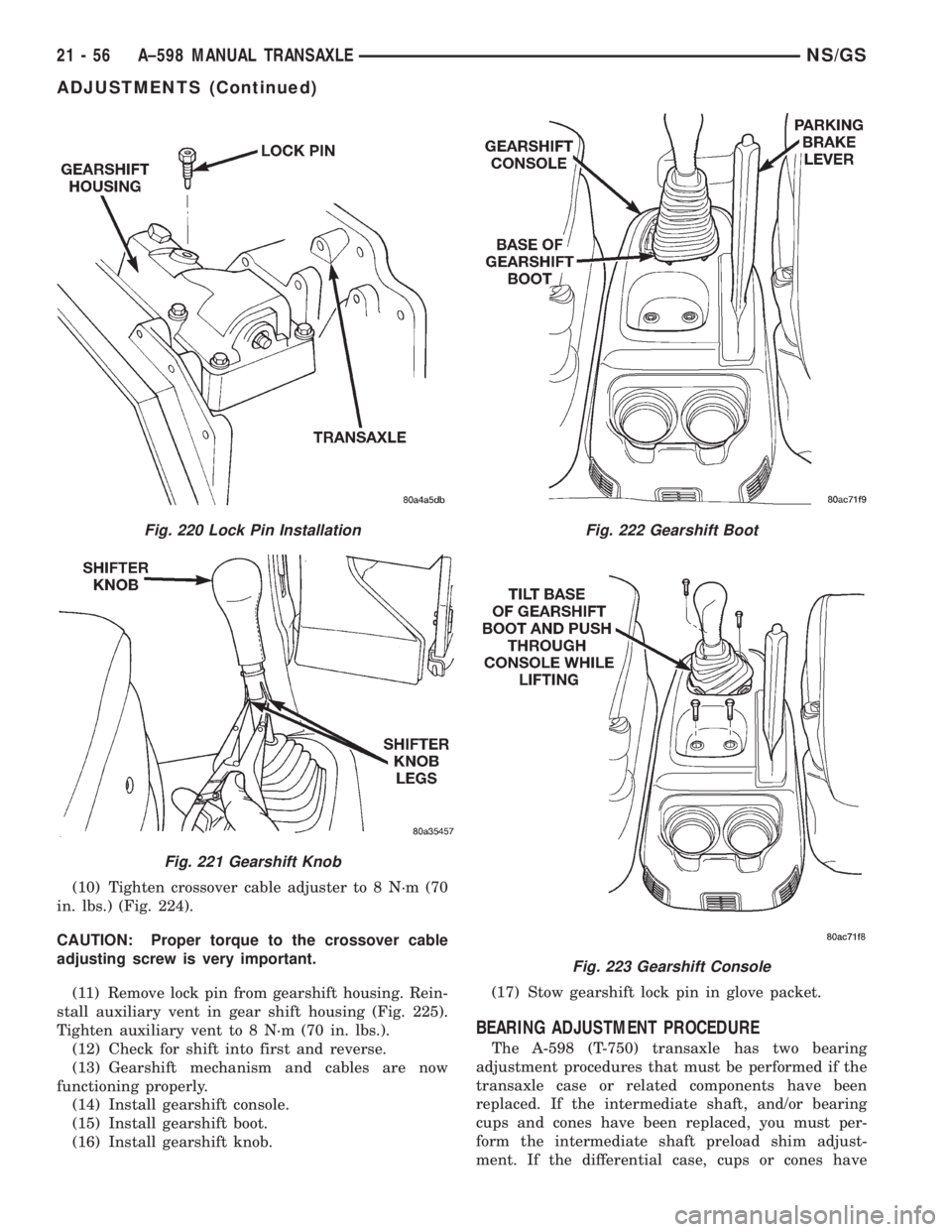
(10) Tighten crossover cable adjuster to 8 N´m (70
in. lbs.) (Fig. 224).
CAUTION: Proper torque to the crossover cable
adjusting screw is very important.
(11) Remove lock pin from gearshift housing. Rein-
stall auxiliary vent in gear shift housing (Fig. 225).
Tighten auxiliary vent to 8 N´m (70 in. lbs.).
(12) Check for shift into first and reverse.
(13) Gearshift mechanism and cables are now
functioning properly.
(14) Install gearshift console.
(15) Install gearshift boot.
(16) Install gearshift knob.(17) Stow gearshift lock pin in glove packet.
BEARING ADJUSTMENT PROCEDURE
The A-598 (T-750) transaxle has two bearing
adjustment procedures that must be performed if the
transaxle case or related components have been
replaced. If the intermediate shaft, and/or bearing
cups and cones have been replaced, you must per-
form the intermediate shaft preload shim adjust-
ment. If the differential case, cups or cones have
Fig. 220 Lock Pin Installation
Fig. 221 Gearshift Knob
Fig. 222 Gearshift Boot
Fig. 223 Gearshift Console
21 - 56 A±598 MANUAL TRANSAXLENS/GS
ADJUSTMENTS (Continued)