1996 CHRYSLER VOYAGER Index
[x] Cancel search: IndexPage 1396 of 1938
FUEL DELIVERY SYSTEMÐ2.0L ENGINE
INDEX
page page
DESCRIPTION AND OPERATION
ELECTRIC FUEL PUMP.................. 28
FUEL DELIVERY SYSTEM................ 28
FUEL INJECTORS...................... 28
FUEL LEVEL SENSOR................... 28
FUEL PRESSURE REGULATOR........... 28
FUEL PUMP MODULE................... 28
FUEL TANK........................... 28
PRESSURE-VACUUM FILLER CAPÐ
2.0L ENGINE......................... 28
QUICK-CONNNECT FITTINGSÐ
2.0L ENGINE......................... 28
DIAGNOSIS AND TESTING
FUEL INJECTORSÐ2.0L ENGINE.......... 29
FUEL LEVEL SENSORÐ2.0L ENGINE....... 28
FUEL PUMP PRESSURE TESTÐ
2.0L ENGINE......................... 28SERVICE PROCEDURES
FUEL SYSTEM PRESSURE RELEASE
PROCEDUREÐ2.0L ENGINE............ 29
HOSES AND CLAMPSÐ2.0L ENGINE....... 29
QUICK-CONNNECT FITTINGSÐ2.0L ENGINE . 29
REMOVAL AND INSTALLATION
ACCELERATOR PEDAL.................. 31
FUEL FILTERÐ2.0L ENGINE.............. 29
FUEL INJECTORS...................... 30
FUEL LEVEL SENSORÐ2.0L ENGINE....... 30
FUEL PRESSURE REGULATORÐ
2.0L ENGINE......................... 29
FUEL PRESSURE REGULATORÐ
2.0L ENGINE......................... 29
FUEL PUMP MODULEÐ2.0L ENGINE....... 29
FUEL TANKÐ2.0L ENGINE............... 30
TORQUE SPECIFICATION................ 31
DESCRIPTION AND OPERATION
FUEL DELIVERY SYSTEM
Refer to the Fuel Delivery Sytem in the Fuel Deliv-
ery Section of group 14 for the 2.4/3.0/3.3/3.8L
engines for more information.
FUEL PUMP MODULE
Refer to the Fuel Pump Module for the 2.4/3.0/3.3/
3.8L engines in the Fuel Delivery System section of
group 14.
ELECTRIC FUEL PUMP
Refer to the Electric Fuel Pump for the 2.4/3.0/3.3/
3.8L engines in the Fuel Delivery System Section of
group 14 for more information.
FUEL LEVEL SENSOR
Refer to the Fuel Level Sensor for the 2.4/3.0/3.3/
3.8L engines in the Fuel Delivery System section of
group 14 for more information.
FUEL PRESSURE REGULATOR
Refer to the Fuel Pressure Regulator for the 2.4/
3.0/3.3/3.8L engines in the Fuel Delivery System sec-
tion of group 14 for more information.
FUEL INJECTORS
Refer to the Fuel Injectors for the 2.4/3.0/3.3/3.8L
engines in the Fuel Delivery System section of group
14 for more information.
FUEL TANK
Refer to the Fuel Tank for the 2.4/3.0/3.3/3.8L
engines in the Fuel Delivery System section of group
14 for more information.
PRESSURE-VACUUM FILLER CAPÐ2.0L ENGINE
Refer to the Pressure-Vacuum Filler Cap for the
2.4/3.0/3.3/3.8L engines in the Fuel Delivery System
section of group 14 for more information.
QUICK-CONNNECT FITTINGSÐ2.0L ENGINE
Refer to the Quick Connect Fittings for the 2.4/3.0/
3.3/3.8L engines in the Fuel Delivery System section
of group 14 for more information.
DIAGNOSIS AND TESTING
FUEL PUMP PRESSURE TESTÐ2.0L ENGINE
Refer to the Fuel Pressure Test for the 2.4/3.0/3.3/
3.8L engines in the Fuel Delivery System section of
group 14 for more information.
FUEL LEVEL SENSORÐ2.0L ENGINE
Refer to the Fuel Level Sensor for the 2.4/3.0/3.3/
3.8L engines in the Fuel Delivery System section of
group 14 for more information.
14 - 28 FUEL SYSTEMÐ2.5L DIESEL ENGINE/2.0L GAS ENGINENS/GS
Page 1400 of 1938
FUEL INJECTION SYSTEMÐ2.0L ENGINE
INDEX
page page
GENERAL INFORMATION
INTRODUCTIONÐ2.0L ENGINE............ 32
MODES OF OPERATIONÐ2.0L ENGINE..... 32
DESCRIPTION AND OPERATION
AIR CONDITIONING (A/C) RELAYÐPCM
OUTPUTÐ2.0L ENGINE................ 35
AIR CONDITIONING PRESSURE
TRANSDUCERÐPCM INPUTÐ
2.0L ENGINE......................... 33
AIR CONDITIONING SWITCH SENSEÐ
PCM INPUTÐ2.0L ENGINE.............. 33
AUTOMATIC SHUTDOWN (ASD) SENSEÐ
PCM INPUTÐ2.0L ENGINE.............. 33
AUTOMATIC SHUTDOWN RELAYÐ
PCM OUTPUTÐ2.0L ENGINE............ 35
BATTERY VOLTAGEÐPCM INPUTÐ
2.0L ENGINE......................... 33
CAMSHAFT POSITION SENSORÐ
PCM INPUTÐ2.0L ENGINE.............. 33
CRANKSHAFT POSITION SENSORÐ
PCM INPUTÐ2.0L ENGINE.............. 33
DATA LINK CONNECTORÐPCM OUTPUTÐ
2.0L ENGINE......................... 35
ELECTRONIC EGR TRANSDUCERÐ
PCM OUTPUTÐ2.0L ENGINE............ 35
ENGINE COOLANT TEMPERATURE SENSORÐ
PCM INPUTÐ2.0L ENGINE.............. 33
FUEL INJECTORSÐPCM OUTPUTÐ
2.0L ENGINE......................... 35
FUEL PUMP RELAYÐPCM OUTPUTÐ
2.0L ENGINE......................... 35
GENERATOR FIELDÐPCM OUTPUTÐ
2.0L ENGINE......................... 35
HEATED OXYGEN SENSORÐPCM INPUTÐ
2.0L ENGINE......................... 33
IDLE AIR CONTROL MOTORÐPCM OUTPUTÐ
2.0L ENGINE......................... 35
IGNITION COILÐPCM OUTPUTÐ
2.0L ENGINE......................... 36KNOCK SENSORÐPCM INPUTÐ
2.0L ENGINE......................... 34
MALFUNCTION INDICATOR (CHECK ENGINE)
LAMPÐPCM OUTPUTÐ2.0L ENGINE...... 36
MANIFOLD ABSOLUTE PRESSURE
(MAP SENSOR)ÐPCM INPUTÐ
2.0L ENGINE......................... 34
POWERTRAIN CONTROL MODULEÐ
2.0L ENGINE......................... 33
RADIATOR FAN CONTROL MODULEÐ
PCM OUTPUTÐ2.0L ENGINE............ 36
SPEED CONTROL SOLENOIDSÐ
PCM OUTPUTÐ2.0L ENGINE............ 36
SPEED CONTROLÐPCM INPUTÐ
2.0L ENGINE......................... 34
STARTER RELAYÐPCM OUTPUTÐ
2.0L ENGINE......................... 35
SYSTEM DIAGNOSISÐ2.0L ENGINE........ 33
TACHOMETERÐPCM OUTPUTÐ
2.0L ENGINE......................... 36
THROTTLE BODYÐ2.0L ENGINE.......... 36
THROTTLE POSITION SENSOR/ IDLE AIR
CONTROL MOTORÐPCM INPUTÐ
2.0L ENGINE......................... 35
DIAGNOSIS AND TESTING
ASD AND FUEL PUMP RELAYSÐ
2.0L ENGINE......................... 39
CAMSHAFT AND CRANKSHAFT
POSITION SENSOR................... 40
ENGINE COOLANT TEMPERATURE
SENSOR............................ 40
KNOCK SENSORÐ2.0L ENGINE........... 40
MANIFOLD ABSOLUTE PRESSURE
(MAP) SENSORÐ2.0L ENGINE........... 39
THROTTLE BODY MINIMUM AIR FLOW..... 41
THROTTLE POSITION SENSOR........... 40
VISUAL INSPECTIONÐSOHC............. 36
SPECIFICATIONS
TORQUE............................. 42
GENERAL INFORMATION
INTRODUCTIONÐ2.0L ENGINE
Refer to the Introduction for 2.4/3.0/3.3/3.8L
engines under General Information in the Fuel Injec-
tion System section of group 14 for more information.
MODES OF OPERATIONÐ2.0L ENGINE
Refer to the Modes of Operation for 2.4/3.0/3.3/3.8L
engines under General Information in the Fuel Injec-
tion System section of group 14 for more information.
14 - 32 FUEL SYSTEMÐ2.5L DIESEL ENGINE/2.0L GAS ENGINENS/GS
Page 1411 of 1938
FUEL INJECTION SYSTEMÐ2.5L DIESEL ENGINE
INDEX
page page
GENERAL INFORMATION
INTRODUCTION....................... 43
DESCRIPTION AND OPERATION
AIR CONDITIONING (A/C) CONTROLSÐ
PCM INPUTS........................ 47
AIR CONDITIONING RELAYÐPCM OUTPUT . . 48
BATTERY VOLTAGEÐPCM INPUT.......... 45
BOOST PRESSURE SENSOR............. 45
BRAKE SWITCHÐPCM INPUT............. 47
DATA LINK CONNECTORÐ
PCM INPUT AND OUTPUT.............. 47
DIESEL PCM RELAYÐPCM INPUT......... 48
ENGINE COOLANT GAUGEÐPCM OUTPUT . . 48
ENGINE COOLANT TEMPERATURE SENSORÐ
PCM INPUT......................... 46
ENGINE OIL PRESSURE GAUGEÐ
PCM OUTPUT........................ 48
ENGINE SPEED SENSORÐPCM INPUT..... 46
EXHAUST GAS RECIRCULATION (EGR)
SOLENOIDÐPCM OUTPUT............. 50
FIVE VOLT POWERÐPCM OUTPUT........ 48
FUEL INJECTOR SENSORÐGROUND...... 46
FUEL TIMING SOLENOIDÐPCM OUTPUT.... 48
GLOW PLUG LAMPÐPCM OUTPUT........ 48
GLOW PLUG RELAYÐPCM OUTPUT....... 49
GLOW PLUGS......................... 49
IGNITION CIRCUIT SENSEÐPCM INPUT.... 45
NEEDLE MOVEMENT OR INSTRUMENTED
FIRST INJECTORÐPCM INPUT.......... 45
POWER GROUND...................... 45
POWERTRAIN CONTROL MODULE (PCM) . . . 44
SENSOR RETURNÐPCM INPUT (ANALOG
GROUND)........................... 45SIGNAL GROUNDÐPCM INPUT........... 45
SPEED CONTROLÐPCM INPUTS.......... 48
SPEED CONTROLÐPCM OUTPUTS........ 48
START SIGNALÐPCM INPUT............. 45
TACHOMETERÐPCM OUTPUT............ 49
VEHICLE SPEED SENSORÐPCM INPUT.... 47
VEHICLE THEFT ALARM................. 45
DIAGNOSIS AND TESTING
BOOST PRESSURE SENSOR............. 53
DIAGNOSTIC TROUBLE CODES........... 53
DIESEL DIAGNOSTICS.................. 50
DIESEL PCM RELAY TEST............... 50
ENGINE COOLANT TEMPERATURE
SENSOR TEST....................... 50
ENGINE SPEED SENSOR TEST........... 50
GLOW PLUG RELAY TEST............... 51
GLOW PLUG TEST..................... 51
RELAYSÐOPERATION/TESTING........... 52
VEHICLE SPEED SENSOR TEST........... 53
REMOVAL AND INSTALLATION
A/C CLUTCH RELAY.................... 53
DIESEL PCM RELAY.................... 53
ENGINE COOLANT TEMPERATURE
SENSOR............................ 54
ENGINE SPEED SENSOR................ 53
GLOW PLUG RELAY.................... 55
GLOW PLUGS......................... 54
POWERTRAIN CONTROL MODULE (PCM) . . . 55
VEHICLE SPEED SENSOR............... 55
SPECIFICATIONS
GLOW PLUG CURRENT DRAW............ 56
TORQUE CHARTÐ2.5L DIESEL............ 57
GENERAL INFORMATION
INTRODUCTION
This section will cover components either regulated
or controlled by the Powertrain Control Module
(PCM). The fuel heater relay, fuel heater and fuel
gauge are not operated by the PCM. These compo-
nents are controlled by the ignition (key) switch. All
other fuel system electrical components necessary to
operate the engine are controlled or regulated by the
PCM. Refer to the following PCM description for
more information.
Certain fuel system component failures may cause
a no start, or prevent the engine from running. It is
important to know that the PCM has a featurewhere, if possible, it will ignore the failed sensor, set
a code related to the sensor, and operate the engine
in a ªLimp Homeº mode. When the PCM is operating
in a ªLimp Homeº mode, the Diesel Glow Plug lamp
on the instrument panel will be constantly illumi-
nated, and the engine will most likely have a notice-
able loss of performance. An example of this would be
an Accelerator Pedal Position Sensor failure, and in
that situation, the engine would run at a constant
1100 RPM, regardless of the actual position of the
pedal. This is the most extreme of the three ªLimp
Homeº modes.
In addition to indicating that the glow plugs are
hot enough to start combustion, the Glow Plug Lamp
is also used in the diagnosis of the PCM, and when
NS/GSFUEL SYSTEMÐ2.5L DIESEL ENGINE/2.0L GAS ENGINE 14 - 43
Page 1427 of 1938
STEERING
CONTENTS
page page
GENERAL INFORMATION................... 1
POWER STEERING GEAR.................. 26POWER STEERING PUMP.................. 9
STEERING COLUMN...................... 36
GENERAL INFORMATION
INDEX
page page
GENERAL INFORMATION
STEERING SYSTEM AND COMPONENT
DESCRIPTION......................... 1DIAGNOSIS AND TESTING
STEERING SYSTEM DIAGNOSIS CHARTS..... 2
GENERAL INFORMATION
STEERING SYSTEM AND COMPONENT
DESCRIPTION
The power steering system consists of these four
major components. Power Steering Pump, Power
Steering Gear, Pressure Hose, and Return Line.
Turning of the steering wheel is converted into linear
travel through the meshing of the helical pinion
teeth with the rack teeth. Power assist steering is
provided by an open center, rotary type control valve.
It is used to direct oil from the pump to either side of
the integral steering rack piston.
Road feel is controlled by the diameter of a torsion
bar which initially steers the vehicle. As requiredsteering effort increases, as in a turn, the torsion bar
twists, causing relative rotary motion between the
rotary valve body and the valve spool. This move-
ment directs oil behind the integral rack piston,
which, in turn, builds up hydraulic pressure and
assists in the turning effort.
Drive tangs on the power steering gear pinion
shaft, mate loosely with the shaft of the steering
gear. This is to allow manual steering control to be
maintained, if the drive belt on the power steering
pump should break. However, under these conditions,
steering effort will significantly increase.
NSSTEERING 19 - 1
Page 1435 of 1938
POWER STEERING PUMP
INDEX
page page
DESCRIPTION AND OPERATION
POWER STEERING PUMP OPERATION....... 9
DIAGNOSIS AND TESTING
POWER STEERING PUMP FLOW RATE AND
PRESSURE TEST....................... 9
SERVICE PROCEDURES
POWER STEERING PUMP INITIAL
OPERATION.......................... 10
POWER STEERING SYSTEM FLUID LEVEL
CHECK.............................. 10
REMOVAL AND INSTALLATION
2.4 LITER POWER STEERING PUMP......... 11
3.0 LITER POWER STEERING PUMP........ 13
3.3/3.8 LITER POWER STEERING PUMP...... 16
POWER STEERING FLUID PRESSURE HOSE . . 19POWER STEERING FLUID RESERVOIR TO
PUMP SUPPLY HOSE................... 18
POWER STEERING FLUID RETURN HOSE.... 21
REMOTE POWER STEERING FLUID
RESERVOIR.......................... 22
DISASSEMBLY AND ASSEMBLY
POWER STEERING PUMP FLOW CONTROL
VALVE SEAL.......................... 23
POWER STEERING PUMP PULLEY.......... 23
SPECIFICATIONS
POWER STEERING PUMP FASTENER
TORQUE SPECIFICATIONS.............. 24
POWER STEERING SYSTEM
SPECIFICATIONS...................... 24
SPECIAL TOOLS
POWER STEERING PUMP................. 25
DESCRIPTION AND OPERATION
POWER STEERING PUMP OPERATION
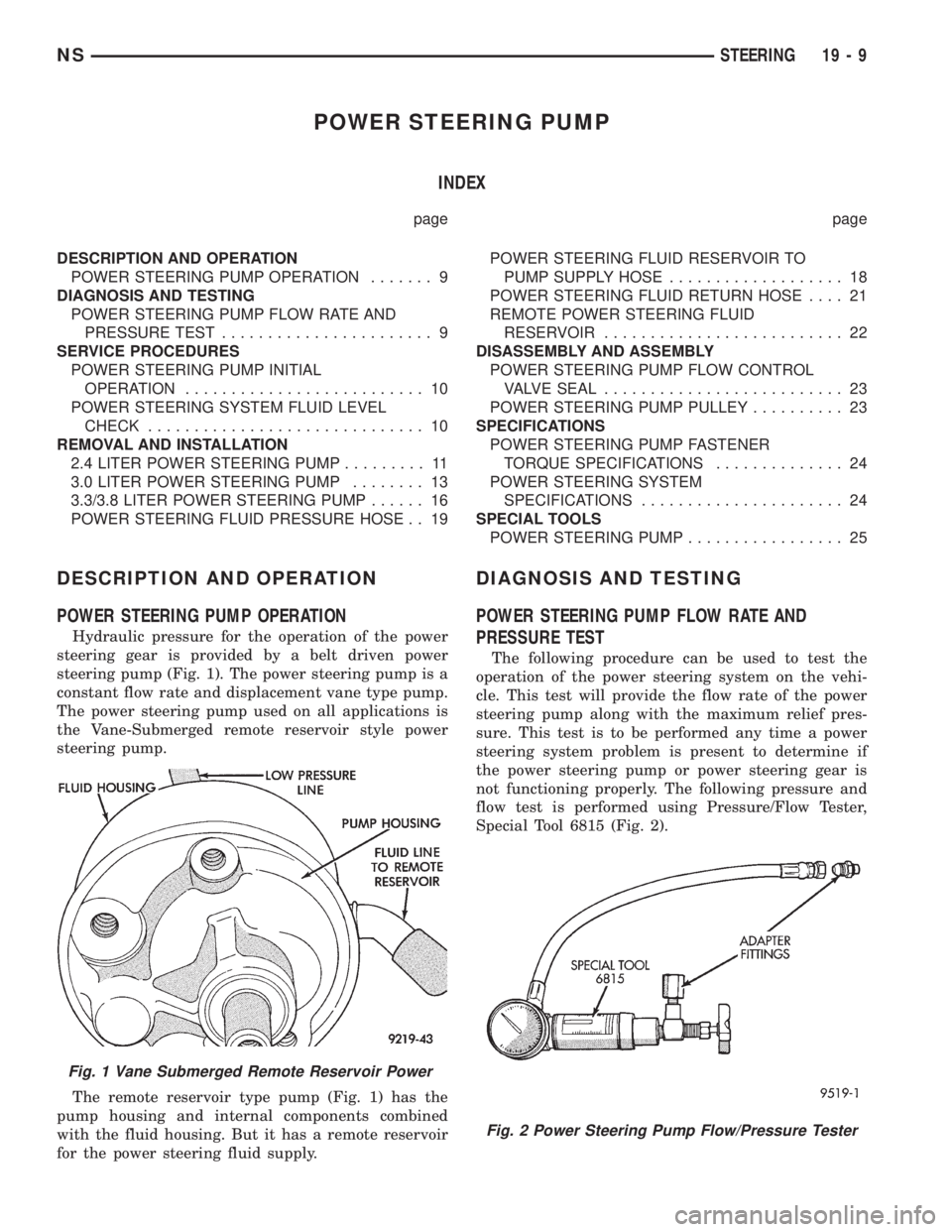
Hydraulic pressure for the operation of the power
steering gear is provided by a belt driven power
steering pump (Fig. 1). The power steering pump is a
constant flow rate and displacement vane type pump.
The power steering pump used on all applications is
the Vane-Submerged remote reservoir style power
steering pump.
The remote reservoir type pump (Fig. 1) has the
pump housing and internal components combined
with the fluid housing. But it has a remote reservoir
for the power steering fluid supply.
DIAGNOSIS AND TESTING
POWER STEERING PUMP FLOW RATE AND
PRESSURE TEST
The following procedure can be used to test the
operation of the power steering system on the vehi-
cle. This test will provide the flow rate of the power
steering pump along with the maximum relief pres-
sure. This test is to be performed any time a power
steering system problem is present to determine if
the power steering pump or power steering gear is
not functioning properly. The following pressure and
flow test is performed using Pressure/Flow Tester,
Special Tool 6815 (Fig. 2).
Fig. 1 Vane Submerged Remote Reservoir Power
Fig. 2 Power Steering Pump Flow/Pressure Tester
NSSTEERING 19 - 9
Page 1452 of 1938
POWER STEERING GEAR
INDEX
page page
DESCRIPTION AND OPERATION
STEERING GEAR OPERATION DESCRIPTION . 26
DIAGNOSIS AND TESTING
POWER STEERING GEAR................. 27
REMOVAL AND INSTALLATION
STEERING GEAR....................... 27
DISASSEMBLY AND ASSEMBLY
OUTER TIE ROD END................... 33STEERING GEAR INNER TIE ROD BOOT..... 31
SPECIFICATIONS
STEERING GEAR FASTENER TORQUE
SPECIFICATIONS...................... 34
SPECIAL TOOLS
POWER STEERING GEAR................. 35
DESCRIPTION AND OPERATION
STEERING GEAR OPERATION DESCRIPTION
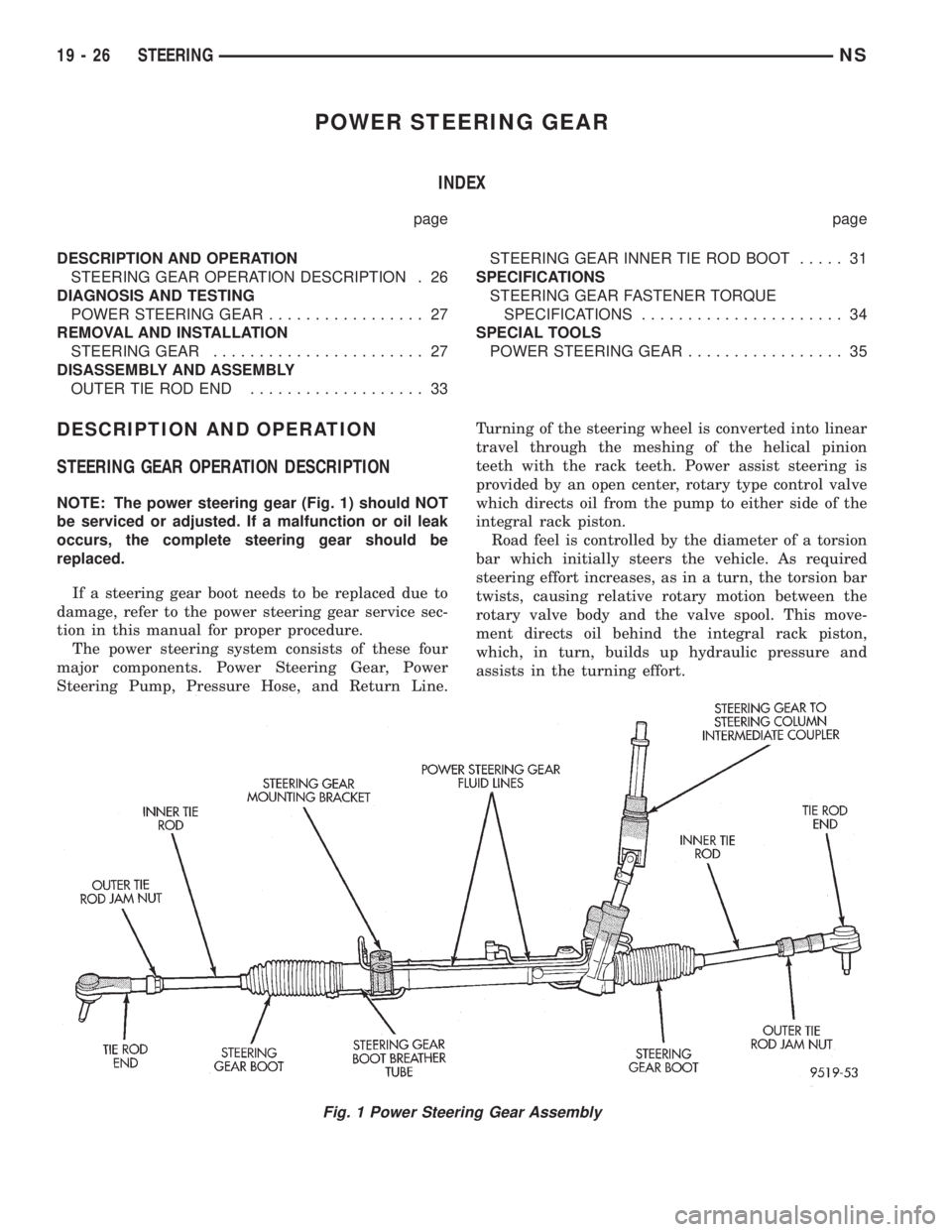
NOTE: The power steering gear (Fig. 1) should NOT
be serviced or adjusted. If a malfunction or oil leak
occurs, the complete steering gear should be
replaced.
If a steering gear boot needs to be replaced due to
damage, refer to the power steering gear service sec-
tion in this manual for proper procedure.
The power steering system consists of these four
major components. Power Steering Gear, Power
Steering Pump, Pressure Hose, and Return Line.Turning of the steering wheel is converted into linear
travel through the meshing of the helical pinion
teeth with the rack teeth. Power assist steering is
provided by an open center, rotary type control valve
which directs oil from the pump to either side of the
integral rack piston.
Road feel is controlled by the diameter of a torsion
bar which initially steers the vehicle. As required
steering effort increases, as in a turn, the torsion bar
twists, causing relative rotary motion between the
rotary valve body and the valve spool. This move-
ment directs oil behind the integral rack piston,
which, in turn, builds up hydraulic pressure and
assists in the turning effort.
Fig. 1 Power Steering Gear Assembly
19 - 26 STEERINGNS
Page 1462 of 1938
STEERING COLUMN
INDEX
page page
DESCRIPTION AND OPERATION
STEERING COLUMN DESCRIPTION......... 36
DIAGNOSIS AND TESTING
STEERING COLUMN..................... 38
SERVICE PROCEDURES
STEERING COLUMN SERVICE PROCEDURE
WARNINGS........................... 38REMOVAL AND INSTALLATION
STEERING COLUMN ASSEMBLY............ 38
SPECIFICATIONS
STEERING COLUMN FASTENER TORQUE
SPECIFICATIONS...................... 45
DESCRIPTION AND OPERATION
STEERING COLUMN DESCRIPTION
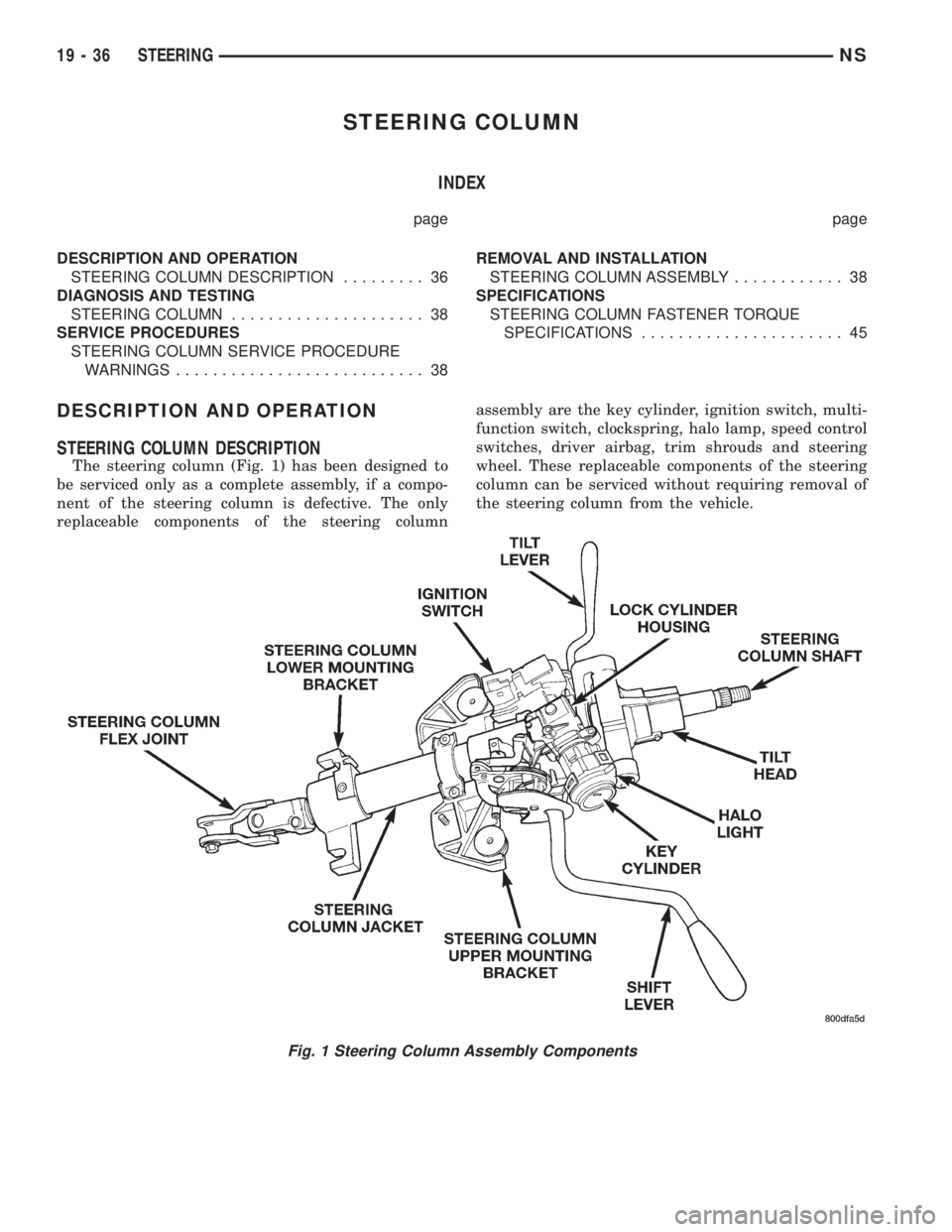
The steering column (Fig. 1) has been designed to
be serviced only as a complete assembly, if a compo-
nent of the steering column is defective. The only
replaceable components of the steering columnassembly are the key cylinder, ignition switch, multi-
function switch, clockspring, halo lamp, speed control
switches, driver airbag, trim shrouds and steering
wheel. These replaceable components of the steering
column can be serviced without requiring removal of
the steering column from the vehicle.
Fig. 1 Steering Column Assembly Components
19 - 36 STEERINGNS
Page 1473 of 1938
STEERING
CONTENTS
page
POWER STEERINGÐ2.5L VM DIESEL....... 1
POWER STEERINGÐ2.5L VM DIESEL
INDEX
page page
GENERAL INFORMATION
POWER STEERING GEAR................ 1
POWER STEERING PUMP................ 1
STEERING GEAR OPERATIONÐRHD & LHD
VEHICLES........................... 1SERVICE PROCEDURES
POWER STEERING PUMP ± INITIAL
OPERATION.......................... 1
REMOVAL AND INSTALLATION
POWER STEERING PUMPÐ2.5L DIESEL..... 2
GENERAL INFORMATION
POWER STEERING PUMP
The power steering pump used with the 2.5L VM
Diesel engine operates the same way as the power
steering pump used with the 2.5/4.0L gasoline
engines. Refer to the Description and Operation sec-
tion for the 2.5/4.0L gasoline engine power steering
pump for more information.
STEERING GEAR OPERATIONÐRHD & LHD
VEHICLES
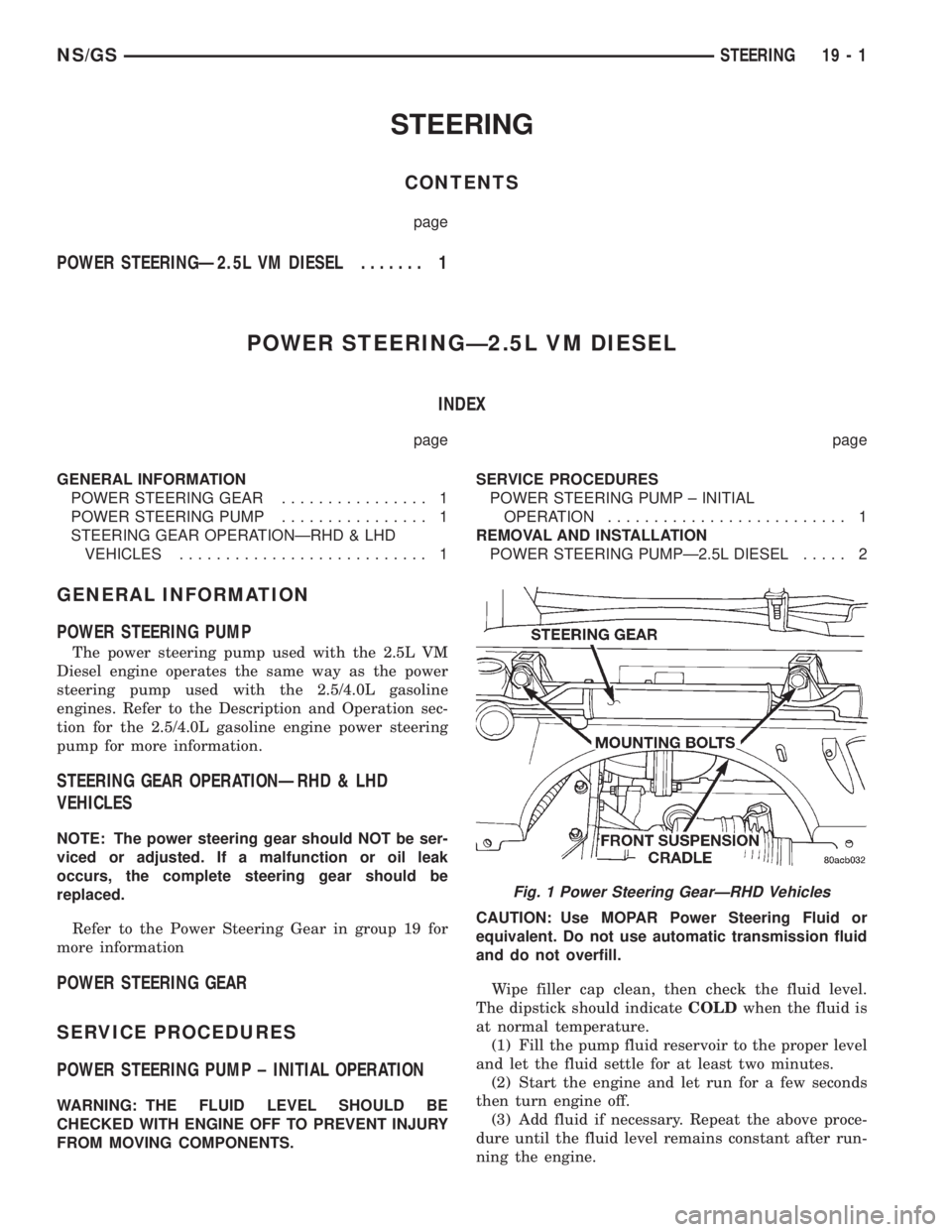
NOTE: The power steering gear should NOT be ser-
viced or adjusted. If a malfunction or oil leak
occurs, the complete steering gear should be
replaced.
Refer to the Power Steering Gear in group 19 for
more information
POWER STEERING GEAR
SERVICE PROCEDURES
POWER STEERING PUMP ± INITIAL OPERATION
WARNING: THE FLUID LEVEL SHOULD BE
CHECKED WITH ENGINE OFF TO PREVENT INJURY
FROM MOVING COMPONENTS.CAUTION: Use MOPAR Power Steering Fluid or
equivalent. Do not use automatic transmission fluid
and do not overfill.
Wipe filler cap clean, then check the fluid level.
The dipstick should indicateCOLDwhen the fluid is
at normal temperature.
(1) Fill the pump fluid reservoir to the proper level
and let the fluid settle for at least two minutes.
(2) Start the engine and let run for a few seconds
then turn engine off.
(3) Add fluid if necessary. Repeat the above proce-
dure until the fluid level remains constant after run-
ning the engine.
Fig. 1 Power Steering GearÐRHD Vehicles
NS/GSSTEERING 19 - 1