1996 CHRYSLER VOYAGER Index
[x] Cancel search: IndexPage 1817 of 1938
HEATING AND AIR CONDITIONING
CONTENTS
page page
FRONT HEATING AND AIR CONDITIONING
SYSTEM............................... 1REAR HEATING AND AIR CONDITIONING
SYSTEM.............................. 41
FRONT HEATING AND AIR CONDITIONING SYSTEM
INDEX
page page
GENERAL INFORMATION
INTRODUCTION......................... 2
SAFETY PRECAUTIONS AND WARNINGS...... 2
DESCRIPTION AND OPERATION
A/C PRESSURE TRANSDUCER.............. 2
A/C SERVICE PORTS..................... 2
AIR DISTRIBUTION DUCTS................. 2
COMPRESSOR HIGH-PRESSURE RELIEF
VALVE................................ 3
CONDENSATE DRAIN..................... 3
ENGINE COOLING SYSTEM REQUIREMENTS . . 3
EVAPORATOR PROBE..................... 3
HANDLING TUBING AND FITTINGS........... 3
HVAC CONTROL MODULE................. 4
REAR BLOWER SPEED SWITCH............ 3
SIDE DOOR HEATER A/C OUTLETS.......... 4
SIDE WINDOW DEMISTER................. 4
SYSTEM AIRFLOW....................... 4
SYSTEM OIL LEVEL...................... 5
DIAGNOSIS AND TESTING
A/C PERFORMANCE TEST................ 12
A/C PRESSURE TRANSDUCER............. 12
ACTUATOR CALIBRATION/DIAGNOSTICS AND
COOLDOWN TEST...................... 6
BLOWER MOTOR AND WHEEL ASSEMBLY.... 13
COMPRESSOR CLUTCH/COIL.............. 13
COMPRESSOR NOISE DIAGNOSIS.......... 13
EXPANSION VALVE...................... 13
HEATER PERFORMANCE TEST............ 15
HVAC CONTROL DIAGNOSTIC CONDITIONS . . . 9
SYSTEM CHARGE LEVEL TEST............ 16SERVICE PROCEDURES
CHARGING REFRIGERANT SYSTEM........ 17
EVACUATING REFRIGERANT SYSTEM....... 18
R-134a REFRIGERANT................... 16
STICKING HVAC CONTROL MODULE PUSH
BUTTONS............................ 19
SYSTEM LEAK CHECKING................ 19
THERMOCOUPLE PROBE................. 19
REMOVAL AND INSTALLATION
A/C PRESSURE TRANSDUCER............. 20
A/C SERVICE PORTS.................... 20
BLEND-AIR DOOR ACTUATOR............. 20
BLOWER MOTOR AND WHEEL ASSEMBLY.... 21
BLOWER MOTOR RESISTOR BLOCK........ 21
BLOWER MOTOR WHEEL................. 22
COMPRESSOR CLUTCH/COIL.............. 23
COMPRESSOR......................... 23
CONDENSER ASSEMBLY................. 25
DISCHARGE LINE....................... 26
EVAPORATOR PROBE.................... 27
EXPANSION VALVE...................... 28
FILTER-DRIER ASSEMBLY................. 28
HEATER A/C UNIT HOUSING............... 29
HEATER CORE......................... 30
HEATER HOSES........................ 31
LIQUID LINE........................... 32
MODE DOOR ACTUATOR................. 32
RECIRC DOOR ACTUATOR................ 34
SIDE WINDOW DEMISTER DUCTS.......... 33
SUCTION LINE.......................... 33
DISASSEMBLY AND ASSEMBLY
HEATER A/C UNIT RECONDITION........... 34
NSHEATING AND AIR CONDITIONING 24 - 1
Page 1857 of 1938
REAR HEATING AND AIR CONDITIONING SYSTEM
INDEX
page page
GENERAL INFORMATION
INTRODUCTION......................... 41
DESCRIPTION AND OPERATION
REAR BLOWER RESISTOR BLOCK.......... 41
REAR HEATER AND A/C LINES............. 41
SYSTEM OPERATION.................... 41
DIAGNOSIS AND TESTING
DIAGNOSTIC PROCEDURES............... 43
REMOVAL AND INSTALLATION
AIR DISTRIBUTION DUCT-A/C.............. 43
AIR DISTRIBUTION DUCT-HEATER.......... 43
EVAPORATOR AND EXPANSION VALVE...... 44MODE DOOR ACTUATOR................. 49
MODE DOOR........................... 49
REAR AIR CONDITIONING LINES........... 45
REAR HEATER A/C AIR OUTLETS........... 45
REAR HEATER A/C BLOWER MOTOR........ 46
REAR HEATER A/C UNIT.................. 46
REAR HEATER CORE.................... 48
REAR HEATER LINES.................... 49
REAR HEATER-A/C AUXILIARY CONDENSER . . 45
REAR HEATER-A/C CONTROL ILLUMINATION
BULB............................... 46
GENERAL INFORMATION
INTRODUCTION
For proper operation of the rear heating A/C sys-
tem, refer to Owner's Manual supplied with the vehi-
cle.
DESCRIPTION AND OPERATION
REAR BLOWER RESISTOR BLOCK
The rear blower motor resistor is not serviceable
separately. The resistor is integral to the blower
motor. If resistor is faulty, it is necessary to replace
the complete blower motor.
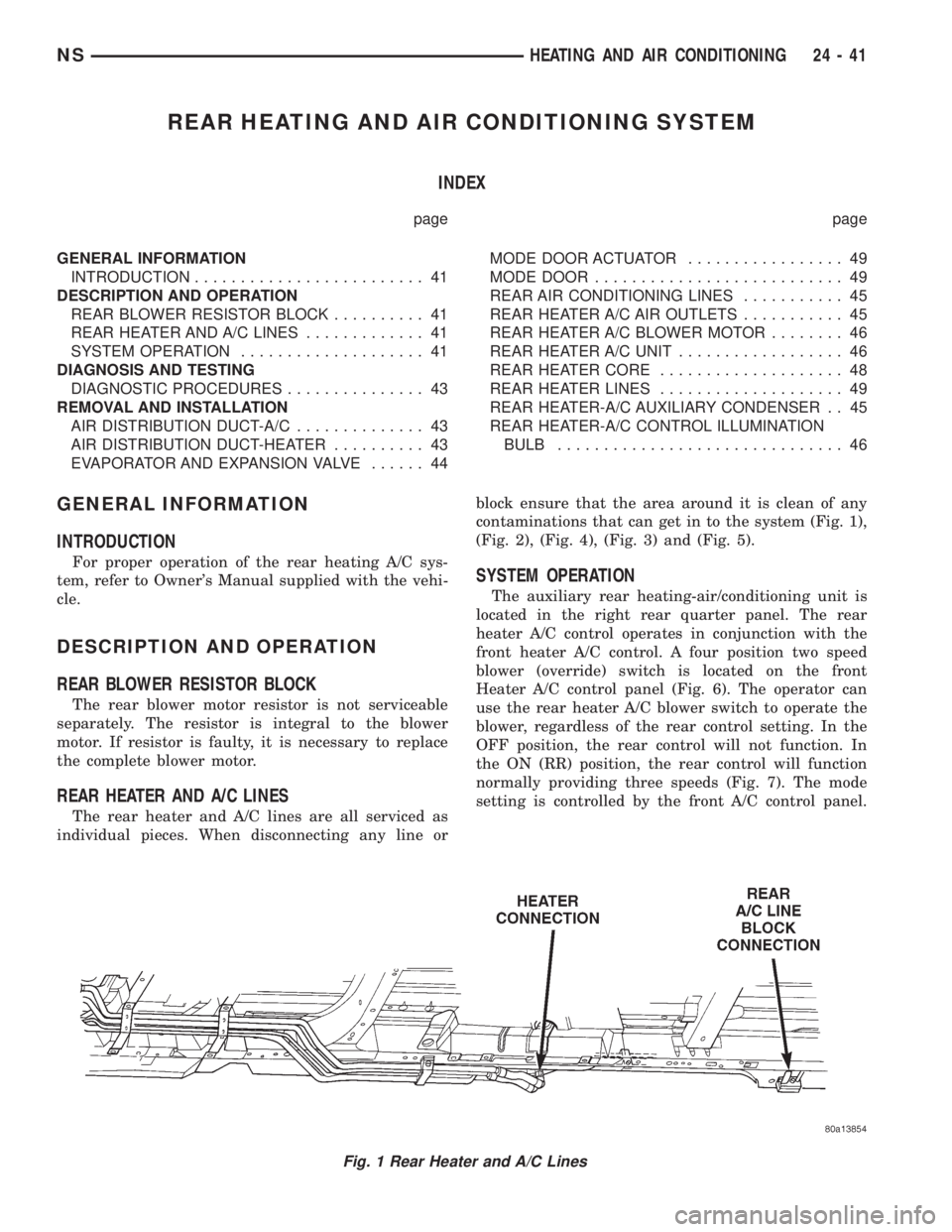
REAR HEATER AND A/C LINES
The rear heater and A/C lines are all serviced as
individual pieces. When disconnecting any line orblock ensure that the area around it is clean of any
contaminations that can get in to the system (Fig. 1),
(Fig. 2), (Fig. 4), (Fig. 3) and (Fig. 5).
SYSTEM OPERATION
The auxiliary rear heating-air/conditioning unit is
located in the right rear quarter panel. The rear
heater A/C control operates in conjunction with the
front heater A/C control. A four position two speed
blower (override) switch is located on the front
Heater A/C control panel (Fig. 6). The operator can
use the rear heater A/C blower switch to operate the
blower, regardless of the rear control setting. In the
OFF position, the rear control will not function. In
the ON (RR) position, the rear control will function
normally providing three speeds (Fig. 7). The mode
setting is controlled by the front A/C control panel.
Fig. 1 Rear Heater and A/C Lines
NSHEATING AND AIR CONDITIONING 24 - 41
Page 1905 of 1938
EMISSION CONTROL SYSTEMS
CONTENTS
page page
EVAPORATIVE EMISSION CONTROLS........ 13
EXHAUST GAS RECIRCULATION (EGR)
SYSTEM.............................. 18ON-BOARD DIAGNOSTICS.................. 1
ON-BOARD DIAGNOSTICS
INDEX
page page
GENERAL INFORMATION
SYSTEM DESCRIPTION................... 1
DESCRIPTION AND OPERATION
CIRCUIT ACTUATION TEST MODE........... 3
COMPONENT MONITORS................. 10
DIAGNOSTIC TROUBLE CODES............. 3
HIGH AND LOW LIMITS................... 11LOAD VALUE........................... 12
MALFUNCTION INDICATOR LAMP (MIL)....... 1
MONITORED SYSTEMS.................... 8
NON-MONITORED CIRCUITS............... 11
STATE DISPLAY TEST MODE............... 2
TRIP DEFINITION........................ 10
GENERAL INFORMATION
SYSTEM DESCRIPTION
The Powertrain Control Module (PCM) monitors
many different circuits in the fuel injection, ignition,
emission and engine systems. If the PCM senses a
problem with a monitored circuit often enough to
indicate an actual problem, it stores a Diagnostic
Trouble Code (DTC) in the PCM's memory. If the
code applies to a non-emissions related component or
system, and the problem is repaired or ceases to
exist, the PCM cancels the code after 40 warmup
cycles. Diagnostic trouble codes that affect vehicle
emissions illuminate the Malfunction Indicator Lamp
(MIL). Refer to Malfunction Indicator Lamp in this
section.
Certain criteria must be met before the PCM
stores a DTC in memory. The criteria may be a spe-
cific range of engine RPM, engine temperature,
and/or input voltage to the PCM.
The PCM might not store a DTC for a monitored
circuit even though a malfunction has occurred. This
may happen because one of the DTC criteria for the
circuit has not been met.For example, assume the
diagnostic trouble code criteria requires the PCM to
monitor the circuit only when the engine operates
between 750 and 2000 RPM. Suppose the sensor'soutput circuit shorts to ground when engine operates
above 2400 RPM (resulting in 0 volt input to the
PCM). Because the condition happens at an engine
speed above the maximum threshold (2000 rpm), the
PCM will not store a DTC.
There are several operating conditions for which
the PCM monitors and sets DTC's. Refer to Moni-
tored Systems, Components, and Non-Monitored Cir-
cuits in this section.
NOTE: Various diagnostic procedures may actually
cause a diagnostic monitor to set a DTC. For
instance, pulling a spark plug wire to perform a
spark test may set the misfire code. When a repair
is completed and verified, use the DRB scan tool to
erase all DTC's and extinguish the MIL.
Technicians can display stored DTC's by using the
DRB scan tool. Refer to Diagnostic Trouble Codes in
this section. For DTC information, refer to charts in
this section.
DESCRIPTION AND OPERATION
MALFUNCTION INDICATOR LAMP (MIL)
As a functional test, the Malfunction Indicator
Lamp (MIL) illuminates at key-on before engine
NSEMISSION CONTROL SYSTEMS 25 - 1
Page 1917 of 1938
EVAPORATIVE EMISSION CONTROLS
INDEX
page page
DESCRIPTION AND OPERATION
CRANKCASE VENT FILTER................ 16
EVAPORATION CONTROL SYSTEM......... 13
EVAPORATIVE (EVAP) CANISTER........... 13
LEAK DETECTION PUMP................. 14
POSITIVE CRANKCASE VENTILATION (PCV)
SYSTEMS............................ 15
PRESSURE-VACUUM FILLER CAP.......... 14
PROPORTIONAL PURGE SOLENOID......... 13ROLLOVER VALVE....................... 13
VEHICLE EMISSION CONTROL INFORMATION
LABEL............................... 16
DIAGNOSIS AND TESTING
LEAK DETECTION PUMP................. 16
PCV VALVE TEST....................... 16
REMOVAL AND INSTALLATION
LEAK DETECTION PUMP REPLACEMENT.... 16
ROLLOVER VALVES..................... 17
DESCRIPTION AND OPERATION
EVAPORATION CONTROL SYSTEM
The evaporation control system prevents the emis-
sion of fuel tank vapors into the atmosphere. When
fuel evaporates in the fuel tank, the vapors pass
through vent hoses or tubes to a charcoal filled evap-
orative canister. The canister temporarily holds the
vapors. The Powertrain Control Module (PCM) allows
intake manifold vacuum to draw vapors into the com-
bustion chambers during certain operating condi-
tions.
All engines use a duty cycle purge system. The
PCM controls vapor flow by operating the duty cycle
EVAP purge solenoid. Refer to Duty Cycle EVAP
Purge Solenoid in this section.
NOTE: The evaporative system uses specially man-
ufactured hoses. If they need replacement, only use
fuel resistant hose.
ROLLOVER VALVE
All vehicles have a rollover valve. The valve also
prevents fuel flow through the fuel tank vent valve
hoses should the vehicle rollover. All vehicles pass a
360É rollover.
The charcoal filled evaporative canister stores the
vapors. The rollover valve is not a serviceable item.
EVAPORATIVE (EVAP) CANISTER
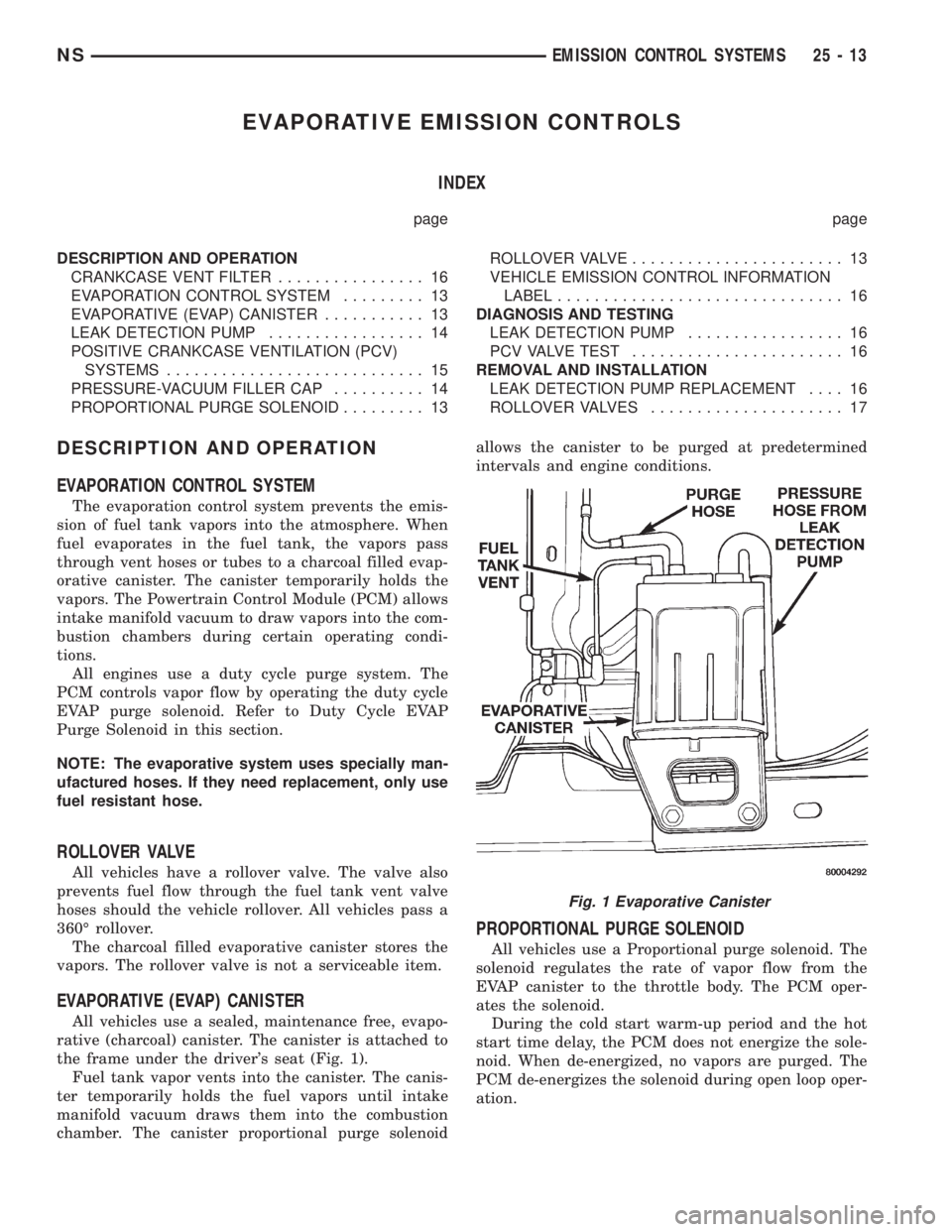
All vehicles use a sealed, maintenance free, evapo-
rative (charcoal) canister. The canister is attached to
the frame under the driver's seat (Fig. 1).
Fuel tank vapor vents into the canister. The canis-
ter temporarily holds the fuel vapors until intake
manifold vacuum draws them into the combustion
chamber. The canister proportional purge solenoidallows the canister to be purged at predetermined
intervals and engine conditions.
PROPORTIONAL PURGE SOLENOID
All vehicles use a Proportional purge solenoid. The
solenoid regulates the rate of vapor flow from the
EVAP canister to the throttle body. The PCM oper-
ates the solenoid.
During the cold start warm-up period and the hot
start time delay, the PCM does not energize the sole-
noid. When de-energized, no vapors are purged. The
PCM de-energizes the solenoid during open loop oper-
ation.
Fig. 1 Evaporative Canister
NSEMISSION CONTROL SYSTEMS 25 - 13
Page 1922 of 1938
EXHAUST GAS RECIRCULATION (EGR) SYSTEM
INDEX
page page
DESCRIPTION AND OPERATION
GENERAL INFORMATION................. 18
DIAGNOSIS AND TESTING
EGR GAS FLOW TEST................... 20
EGR SYSTEM ON-BOARD DIAGNOSTICS..... 19
EGR SYSTEM TEST..................... 19
EGR VALVE CONTROL (TRANSDUCER) TEST . 21
EGR VALVE LEAKAGE TEST............... 20REMOVAL AND INSTALLATION
EGR TUBE SERVICEÐ3.0L ENGINES........ 22
EGR TUBE SERVICEÐ3.3/3.8L ENGINES..... 22
EGR VALVE SERVICEÐ3.0L ENGINES....... 21
EGR VALVE SERVICEÐ3.3/3.8L ENGINES.... 22
SPECIAL TOOLS
EMISSION CONTROL SYSTEM............. 23
DESCRIPTION AND OPERATION
GENERAL INFORMATION
Refer to Monitored Systems - EGR Monitor in this
group for more information.
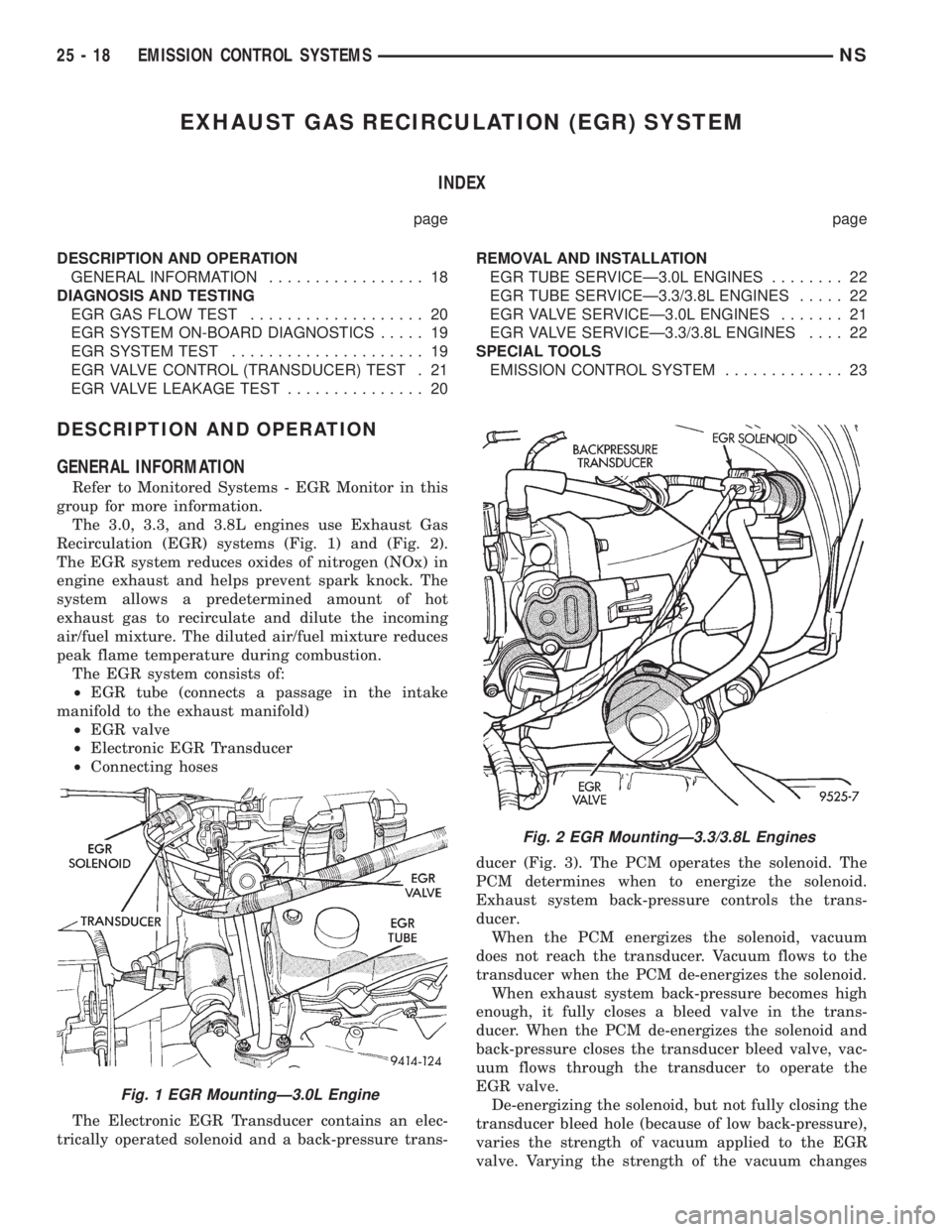
The 3.0, 3.3, and 3.8L engines use Exhaust Gas
Recirculation (EGR) systems (Fig. 1) and (Fig. 2).
The EGR system reduces oxides of nitrogen (NOx) in
engine exhaust and helps prevent spark knock. The
system allows a predetermined amount of hot
exhaust gas to recirculate and dilute the incoming
air/fuel mixture. The diluted air/fuel mixture reduces
peak flame temperature during combustion.
The EGR system consists of:
²EGR tube (connects a passage in the intake
manifold to the exhaust manifold)
²EGR valve
²Electronic EGR Transducer
²Connecting hoses
The Electronic EGR Transducer contains an elec-
trically operated solenoid and a back-pressure trans-ducer (Fig. 3). The PCM operates the solenoid. The
PCM determines when to energize the solenoid.
Exhaust system back-pressure controls the trans-
ducer.
When the PCM energizes the solenoid, vacuum
does not reach the transducer. Vacuum flows to the
transducer when the PCM de-energizes the solenoid.
When exhaust system back-pressure becomes high
enough, it fully closes a bleed valve in the trans-
ducer. When the PCM de-energizes the solenoid and
back-pressure closes the transducer bleed valve, vac-
uum flows through the transducer to operate the
EGR valve.
De-energizing the solenoid, but not fully closing the
transducer bleed hole (because of low back-pressure),
varies the strength of vacuum applied to the EGR
valve. Varying the strength of the vacuum changes
Fig. 1 EGR MountingÐ3.0L Engine
Fig. 2 EGR MountingÐ3.3/3.8L Engines
25 - 18 EMISSION CONTROL SYSTEMSNS
Page 1929 of 1938
EMISSION CONTROL SYSTEM
CONTENTS
page page
EMISSION CONTROL SYSTEMÐ
2.0L ENGINE.......................... 9
EXHAUST EMISSION CONTROLSÐ
2.5L DIESEL ENGINE................... 5ON-BOARD DIAGNOSTICSÐ
2.5L DIESEL ENGINE................... 1
ON-BOARD DIAGNOSTICSÐ2.5L DIESEL ENGINE
INDEX
page page
GENERAL INFORMATION
SYSTEM DESCRIPTIONÐ
2.5L DIESEL ENGINE................... 1DESCRIPTION AND OPERATION
DIAGNOSTIC TROUBLE CODES............ 2
GENERAL INFORMATION
SYSTEM DESCRIPTIONÐ2.5L DIESEL ENGINE
The 2.5L diesel Powertrain Control Module (PCM)
monitors and controls many different circuits in the
fuel injection pump and engine systems. If the PCM
senses a problem with a monitored circuit that indi-
cates an actual problem, a Diagnostic Trouble Code
(DTC) will be stored in the PCM's memory, and even-
tually will illuminate the Diesel Glow Plug lamp con-
stantly while the key is on. If the problem is
repaired, or is intermittent, the PCM will erase the
DTC after 40 warm-up cycles. A warm-up cycle con-
sists of starting the vehicle when the engine is cold,
then the engine to warms up to a certain tempera-
ture, and finally, the engine temperature falls to a
normal operating temperature, then the key is
turned off.
Certain criteria must be met for a DTC to be
entered into PCM memory. The criteria may be a
specific range of engine rpm, engine or fuel tempera-
ture and/or input voltage to the PCM. A DTC indi-
cates that the PCM has identified an abnormal
signal in a circuit or the system. A DTC may indicate
the result of a failure, but never identify the failed
component directly.
There are several operating conditions that the
PCM does not monitor and set a DTC for. Refer to
the following Monitored Circuits and Non±Monitored
Circuits in this section.
MONITORED CIRCUITS
The PCM can detect certain problems in the elec-
trical system.
Open or Shorted Circuit± The PCM can deter-
mine if sensor output (which is the input to PCM) is
within proper range. It also determines if the circuit
is open or shorted.
Output Device Current Flow± The PCM senses
whether the output devices are electrically connected.
If there is a problem with the circuit, the PCM
senses whether the circuit is open, shorted to ground
(±), or shorted to (+) voltage.
NON±MONITORED CIRCUITS
The PCM does not monitor the following circuits,
systems or conditions that could have malfunctions
that result in driveability problems. A DTC will not
be displayed for these conditions.
Fuel Pressure:Fuel pressure is controlled by the
fuel injection pump. The PCM cannot detect prob-
lems in this component.
Cylinder Compression:The PCM cannot detect
uneven, low, or high engine cylinder compression.
Exhaust System:The PCM cannot detect a
plugged, restricted or leaking exhaust system.
Fuel Injector Malfunctions:The PCM cannot
determine if the fuel injector is clogged, or the wrong
injector is installed. The fuel injectors on the diesel
engine arenot controlledby the PCM, although a
NS/GSEMISSION CONTROL SYSTEM 25 - 1
Page 1933 of 1938
EXHAUST EMISSION CONTROLSÐ2.5L DIESEL ENGINE
INDEX
page page
DESCRIPTION AND OPERATION
EXHAUST GAS RECIRCULATION (EGR)
SYSTEM............................. 5
VACUUM HOSE ROUTING SCHEMATIC...... 5
DIAGNOSIS AND TESTING
EGR GAS FLOW TEST................... 6
ELECTRIC VACUUM MODULATOR (EVM)
TEST............................... 7REMOVAL AND INSTALLATION
EGR TUBE............................. 7
EGRVALVE ............................ 7
ELECTRIC VACUUM MODULATOR (EVM)..... 7
SPECIFICATIONS
TORQUE CHARTÐ2.5L DIESEL............ 8
DESCRIPTION AND OPERATION
VACUUM HOSE ROUTING SCHEMATIC
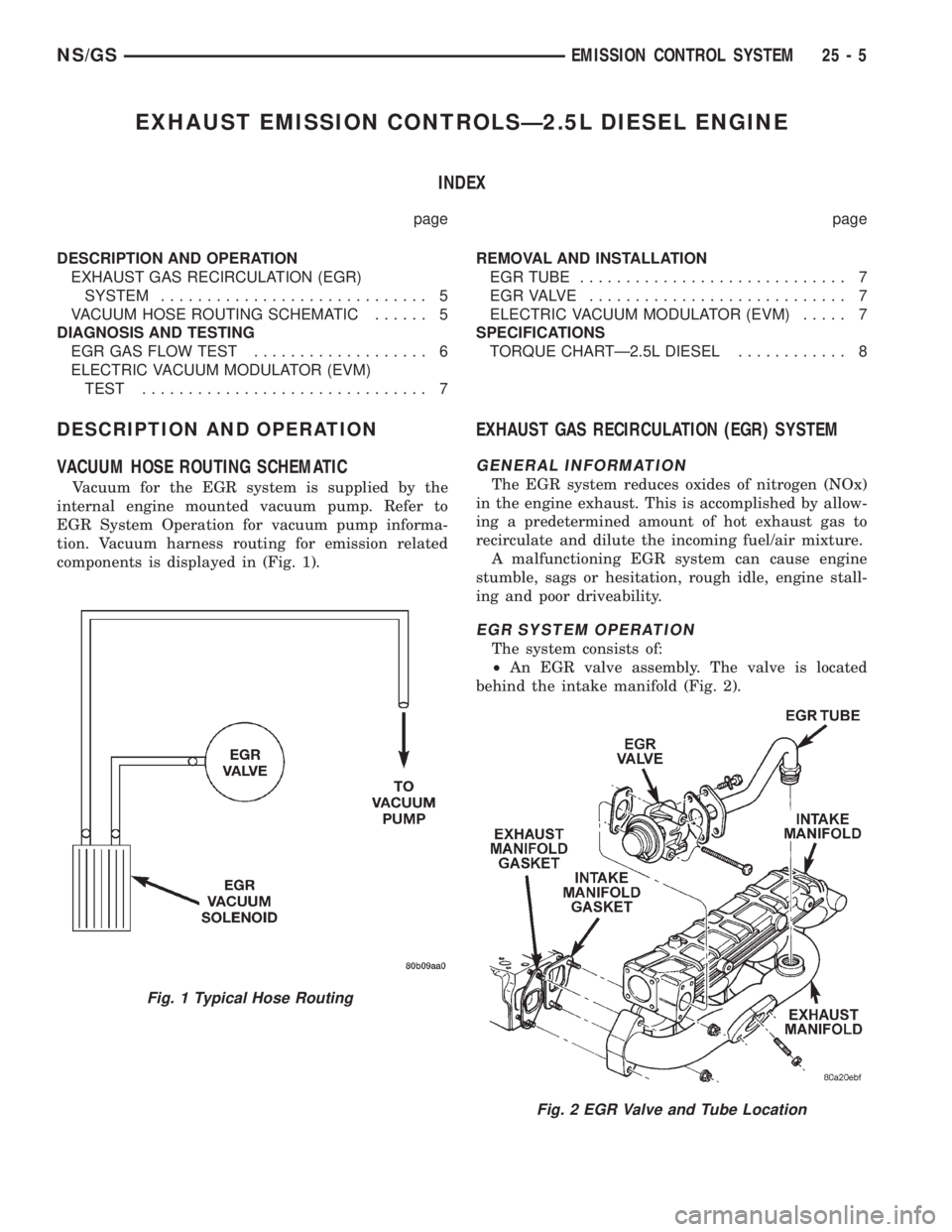
Vacuum for the EGR system is supplied by the
internal engine mounted vacuum pump. Refer to
EGR System Operation for vacuum pump informa-
tion. Vacuum harness routing for emission related
components is displayed in (Fig. 1).
EXHAUST GAS RECIRCULATION (EGR) SYSTEM
GENERAL INFORMATION
The EGR system reduces oxides of nitrogen (NOx)
in the engine exhaust. This is accomplished by allow-
ing a predetermined amount of hot exhaust gas to
recirculate and dilute the incoming fuel/air mixture.
A malfunctioning EGR system can cause engine
stumble, sags or hesitation, rough idle, engine stall-
ing and poor driveability.
EGR SYSTEM OPERATION
The system consists of:
²An EGR valve assembly. The valve is located
behind the intake manifold (Fig. 2).
Fig. 1 Typical Hose Routing
Fig. 2 EGR Valve and Tube Location
NS/GSEMISSION CONTROL SYSTEM 25 - 5
Page 1937 of 1938
EMISSION CONTROL SYSTEMÐ2.0L ENGINE
INDEX
page page
GENERAL INFORMATION
GENERAL INFORMATION................. 9
POSITIVE CRANKCASE VENTILATION SYSTEM
(PCV) SYSTEMÐ2.0L ENGINE............ 9REMOVAL AND INSTALLATION
EGR TUBE............................ 10
EGRVALVE ............................ 9
TORQUE............................. 10
GENERAL INFORMATION
GENERAL INFORMATION
The emission control system for the 2.0L engine
functions the same as the systems for the 2.4/3.0/3.3/
3.8L engines. Refer to group 25 for more information
about Diagnostic Trouble Codes and other system
features.
POSITIVE CRANKCASE VENTILATION SYSTEM
(PCV) SYSTEMÐ2.0L ENGINE
The PCV System for 2.0L engines function the
same as PCV systems for 2.4/3.0/3.3/3.8L engines.
Refer to group 25 for more information.
REMOVAL AND INSTALLATION
EGR VALVE
If the EGR system operates incorrectly, replace the
entire EGR valve and transducer together. The EGR
valve and electrical transducer (EET) are calibrated
together.
REMOVAL
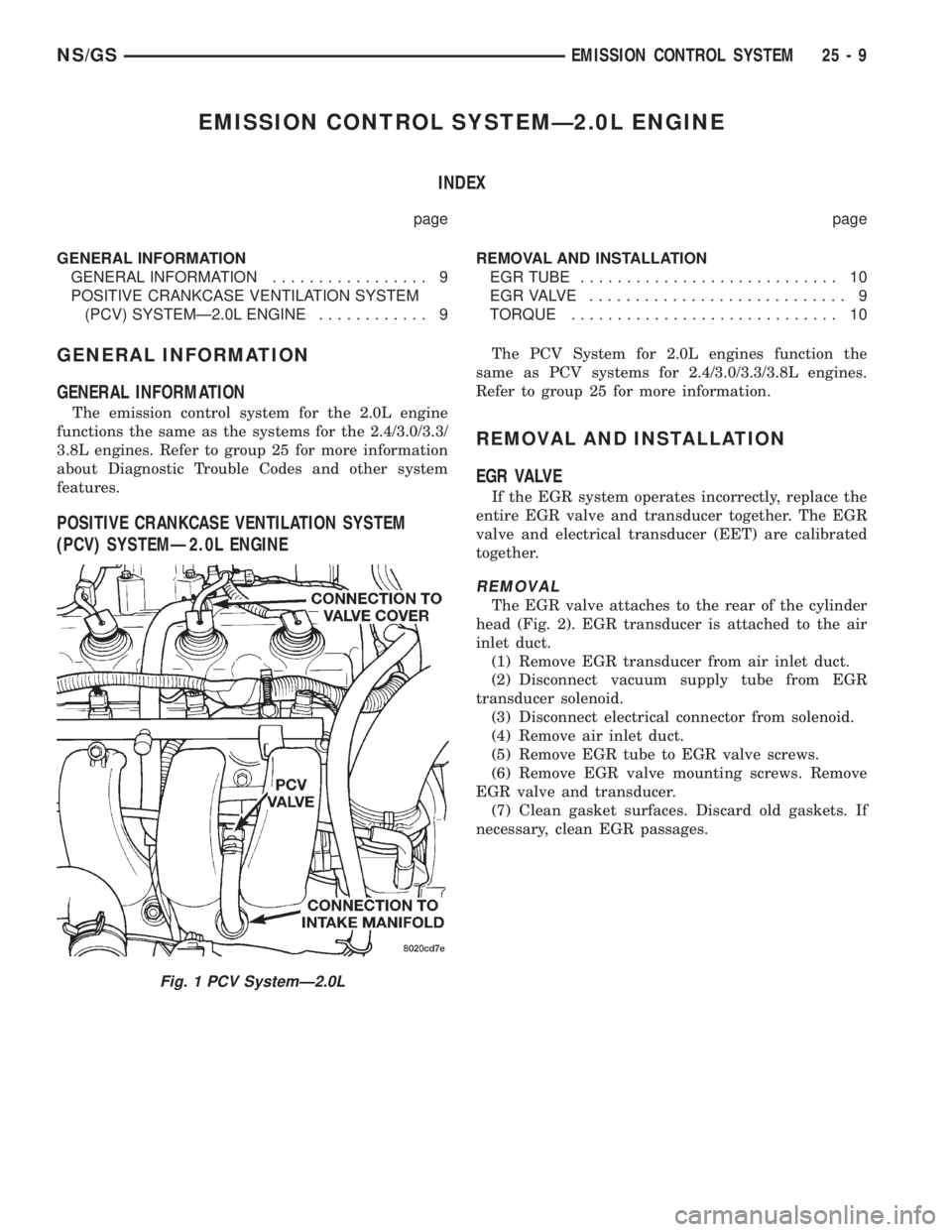
The EGR valve attaches to the rear of the cylinder
head (Fig. 2). EGR transducer is attached to the air
inlet duct.
(1) Remove EGR transducer from air inlet duct.
(2) Disconnect vacuum supply tube from EGR
transducer solenoid.
(3) Disconnect electrical connector from solenoid.
(4) Remove air inlet duct.
(5) Remove EGR tube to EGR valve screws.
(6) Remove EGR valve mounting screws. Remove
EGR valve and transducer.
(7) Clean gasket surfaces. Discard old gaskets. If
necessary, clean EGR passages.
Fig. 1 PCV SystemÐ2.0L
NS/GSEMISSION CONTROL SYSTEM 25 - 9