1996 CHEVROLET S10 key
[x] Cancel search: keyPage 127 of 375
Downloaded from www.Manualslib.com manuals search engine RCL: Press this button to see what track is playing.
Press
it again within five seconds to see how long it has
been playing. The track number also appears when you
change the volume or when a new track starts to play.
COMP (2): Press this button to make loud and soft
passages more nearly equal in volume. COMP
will
appear on the display while using this control.
RDM (3): Press this button to play tracks in a random,
rather than sequential, order. RDM will appear on the
display while using this control. Press the button again
to return to normal sequence.
REV (4): Press and hold this button to return to a
passage quickly. Release
it to play the passage. The
counter reading will appear on
the display while using
this control.
FWD (5): Press and hold this button to advance to a
passage quickly. Release it to resume playing. Watch the
display
to stop at a specific passage.
SCAN: Press this button to listen to each selection for
about six seconds. The disc will go to the next selection,
stop for a few seconds, then go to the next selection.
Press
RDM, SCAN or any other motion button again to
stop scanning.
PREV: Hold the backward arrow or press it more than
once to return the disc to previous tracks.
NEXT Press the forward arrow to hear the next track
now instead of waiting
until the current track is finished.
If you hold this button or press it more than once, the
disc will advance further.
ST-PL: Press this button to stop the disc and play the
radio. Press
it again to restart the disc at the point where
it stopped.
Press the POWER-VOL knob or turn the ignition key
off to stop the disc player. The disc stays in the player
and will resume playing at the point where it stopped.
E JCT Press this button to eject the disc and play the
radio. The disc
will start at track one when you reinsert it.
Theft-Deterrent Feature
Delco LOC II@ is a theft-deterrent feature for the
compact disc player. It can be used or ignored.
If ignored,
the system plays normally. If used, your player won’t be
usable
if it is ever stolen, because it won’t turn on.
The instructions below tell you how to enter a secret code
into the system. It is recommended that you read through
all 11 steps before starting the procedure. If your vehicle
loses battery power for any reason, you must unlock the system with your secret code before the radio will
turn on.
NOTE: If you allow more than 15 seconds to elapse
between
any steps, the radio automatically .reverts to
time and you must start the procedure over at Step
4.
3-14
Page 133 of 375
Downloaded from www.Manualslib.com manuals search engine Drunken Driving
Death and injury associated with drinking and driving is
a national tragedy. It’s the number one contributor to
the highway death toll, claiming thousands of victims
every year.
Alcohol affects four things that anyone needs to drive
a
vehicle:
Judgment
0 Muscular Coordination
Vision
Attentiveness.
Police records show that almost half
of all motor
vehicle-related deaths involve alcohol. In most cases,
these deaths are
the result of someone who was drinking
and driving. In recent years, some 18,000 annual motor
vehicle-related deaths have been associated with the
use
of alcohol, with more than 300,000 people injured.
Many adults
-- by some estimates, nearly half the adult
population
-- choose never to drink alcohol, so they
never drive after drinking. For persons under 2
1, it’s
against the law in every U.S. state
to drink alcohol.
There are good medical, psychological and
developmental reasons for these laws. The
obvious way
to solve this highway safety problem
is for people never
to drink alcohol and then drive. But
what if people do? How much
is “too much” if the
driver plans to drive? It’s a lot less than many might
think. Although it depends on each person and situation,
here is some general information
on the problem.
The Blood Alcohol Concentration (BAC)
of someone
who is drinking depends upon four things:
The amount of alcohol consumed
0 The drinker’s body weight
The amount of food that is consumed before and
during drinking
The length of time it has taken the drinker to
consume the alcohol.
According to the American Medical Association, a
180-lb. (82 kg) person who drinks three 12-ounce
(355 ml) bottles of beer in an hour will end up with a
BAC of about
0.06 percent. The person would reach the
same BAC by drinking three 4-ounce (120 ml) glasses
of wine or three mixed drinks if each had 1-1/2 ounces
(45 ml)
of a liquor like whiskey, gin or vodka.
Page 147 of 375
Downloaded from www.Manualslib.com manuals search engine Controlling your vehicle is the key to successful
off-road driving. One
of the best ways to control your
vehicle is to control your speed. Here are some things
to
keep in mind. At higher speeds:
you approach things faster and you have less time to
scan the terrain for obstacles.
0 you have less time to react.
you have more vehicle bounce when you drive
over obstacles.
0 you’ll need more distance for braking, especially
since you’re on an unpaved surface.
When you’re driving off-road, bouncing and
quick changes in direction can easily throw you
out of position. This could cause you to lose
control and crash.
So, whether you’re driving on
or
off the road, you and your passengers should
wear safety belts.
Scanning the Terrain
Off-road driving can take you over many different kinds
of terrain. You need to be familiar with
the terrain and its
many different features. Here are some things to consider.
Su$ace Conditions. Off-roading can take you over
hard-packed dirt, gravel, rocks, grass, sand, mud, snow or
ice. Each of these surfaces
affects the steering, acceleration
and braking
of your vehicle in different ways. Depending
upon the kind
of surface you are on, you may experience
slipping, sliding, wheel spinning, delayed acceleration,
poor traction and longer braking distances.
Surface Obstacles. Unseen or hidden obstacles can be
hazardous. A rock, log, hole, rut or bump can startle you
if you’re not prepared for them. Often these obstacles are
hidden by grass, bushes, snow or even the rise and fall
of
the terrain itself. Here are some things to consider:
Is the path ahead clear?
0 Will the surface texture change abruptly up ahead?
0 Does the travel take you uphill or downhill?
(There’s more discussion
of these subjects later.)
0 Will you have to stop suddenly or change direction
quickly?
4-16
Page 172 of 375
Downloaded from www.Manualslib.com manuals search engine Recreational Vehicle Towing
(Four-wheel Drive Oniy)
1.
2.
3.
4.
Set the parking brake firmly.
Place
an automatic transmission in PARK (P) or a
manual transmission in FIRST (1).
Firmly attach the vehicle being towed to the tow
vehicle.
Do not tow the vehicle by the rear bumper
bar. Refer to
the hitch manufacturer’s instructions.
Place the transfer case shift lever in NEUTRAL (N).
Recreational vehicle towing is not recommended for
vehicles
with the optional electronic shift transfer case
because the transfer case has
no neutral position.
Shifting the transfer case into NEUTRAL (N) can
cause your vehicle to roll even if the transmission
is in
PARK (P), for an automatic transmission,
or if your vehicle is in gear, for a manual
transmission. This is because the transfer case
overrides the transmission.
5. Release the parking brake only after the vehicle
being towed is firmly attached to the tow vehicle.
6. Insert the ignition key into the ignition switch and
turn it one notch forward of the LOCK position. This
places the key
in the OFF position, which unlocks
the steering column while preventing battery drain.
Unlocking the steering
column will allow for proper
movement
of the front wheelshires during towing.
4-41
Page 190 of 375
Downloaded from www.Manualslib.com manuals search engine Section 5 Problems on the Road
Here you'll find what to do about some problems that
can occur
on the road.
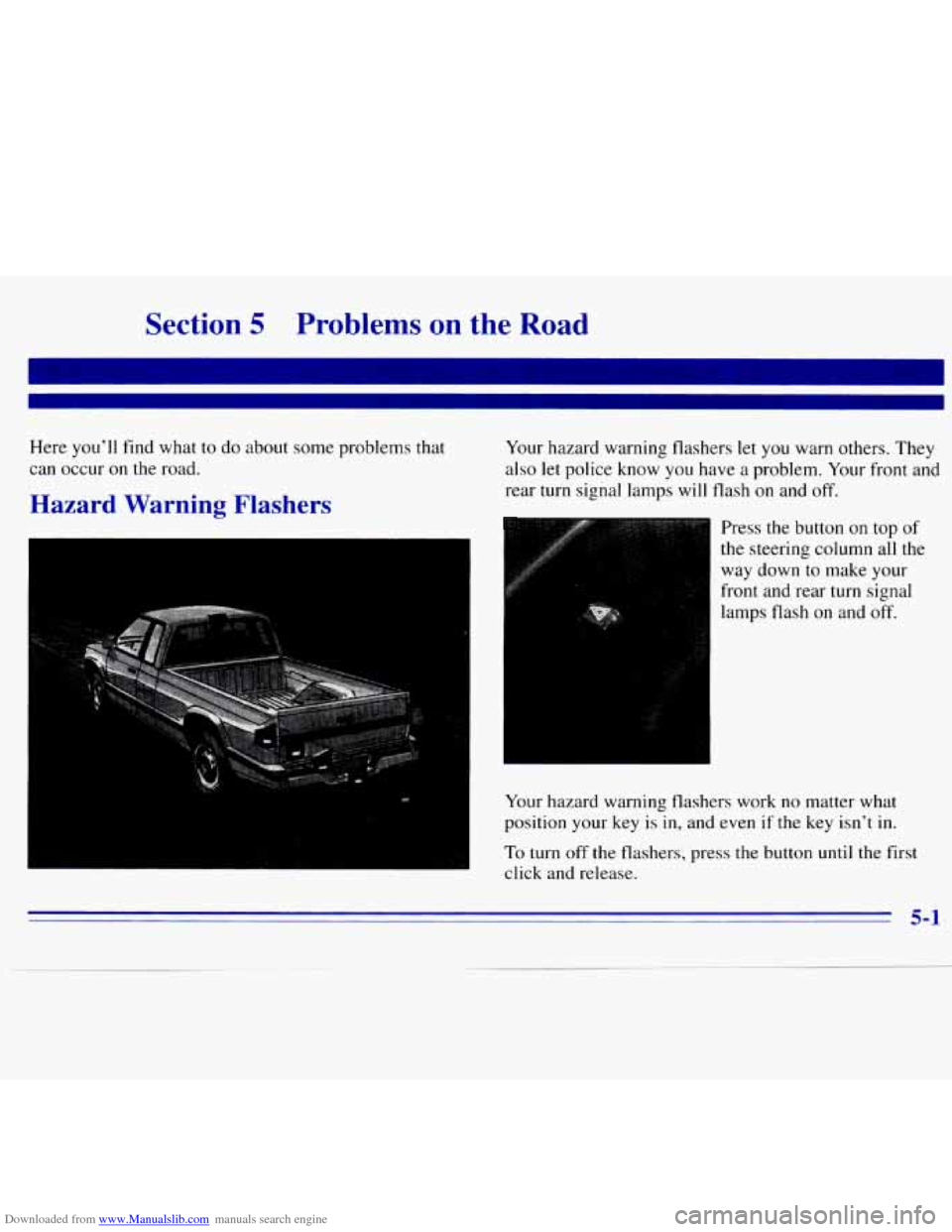
Hazard Warning Flashers
Your hazard warning flashers let you warn others. They
also let police know you have a problem. Your front and
rear turn signal lamps will flash
on and off.
Press the button on top of
the steering column all the
way down to make your
front and rear turn signal
lamps flash on and off.
Your hazard warning flashers work
no matter what
position
your key is in, and even if the key isn't in.
To turn off the flashers, press the button until the first
click and release.
5-1
Page 197 of 375
Downloaded from www.Manualslib.com manuals search engine mm
A vehicle can fall from a car carrier if it isn’t
adequately secured, This can cause a collision,
serious personal injury and vehicle damage. The
vehicle should be tightly secured with chains or
steel cables before
it is transported.
Don’t use substitutes (ropes, leather straps,
canvas webbing, etc.) that can be cut by sharp
edges underneath the towed vehicle. Always use
T-hooks inserted in the T-hook slots, Never use
J-hooks. They will damage drivetrain and
suspension components, When your vehicle
is being towed, have the ignition key
turned
to the OFF position. The steering wheel should
be clamped in a straight-ahead position with a clamping device designed for towing service.
Do not use the
vehicle’s steering column lock for this. The transmission
should be in
NEUTRAL (N) and the transfer case, if
you have one, should be in 2HI. The parking brake
should be released.
Don’t have your vehicle towed on the drive wheels
unless you must.
If the vehicle must be towed on the
drive wheels, be sure to follow the speed and distance
restrictions later in this section or your transmission will
be damaged. If these limitations must be exceeded, then
the drive wheels have
to be supported on a dolly.
5-8
Page 290 of 375

Downloaded from www.Manualslib.com manuals search engine FuseKircuit Usage Breaker
A
B
1
Power Door Locks, Power Seat, Power
Seat Lumbar, Remote Keyless Entry
Power Windows
Stoplamps, Hazard Lamps, Chime,
Center High-Mounted Stoplamp Relay,
Center High-Mounted Stoplamp
3
4
5
6
FuseKircuit Usage
Breaker
2 Dome Lamps, Visor Vanity Mirror,
Cigarette Lighter, Inside Rearview
Mirror Lamp, Overhead Console
Lamps, Glove
Box Lamp, Horns, Horn
Relay, IP Courtesy Lamps, Power
Outside Rearview Mirror, Illuminated
Entry Module
Parking Lamps, License Plate Lamps,
Electric Shift Transfer Case Module,
Underhood Lamp, Ashtray Lamp,
Door Switch Lamp
Alternator Field, A/C Compressor
Relay, Cluster Chime Module, DRL
Relay Coil, Four-Wheel-Drive
Indicator Lamp, DRL Module,
Transfer Case Control Module Ignition, SIR Redundant Ignition,
RKE Ignition
Oxygen Sensor Heater, Exhaust Gas
Recirculation, Cam Sensor, CANN.
Purge, MAS
Blower Motor, Temperature Door
Motor,
HI Blower Relay Coil
6-64
Page 344 of 375
Downloaded from www.Manualslib.com manuals search engine At Least Twice a Year
Restraint System Check
Make sure the safety belt reminder light and all your
belts, buckles, latch plates, retractors and anchorages are
working properly. Look for any other loose or damaged
safety belt system parts. If you see anything that might
keep a safety belt system from doing its job, have it
repaired. Have any torn or frayed safety belts replaced.
Also look for any opened or broken air bag covers, and
have them repaired
or replaced. (The air bag system
does not need regular maintenance.)
Manual Transmission Check
Check the transmission fluid level; add if needed. See
“Manual Transmission” in the Index. A fluid
loss may
indicate a problem. Check the system and repair if needed.
Automatic Transmission Check
Check the transmission fluid level; add if needed. See
“Automatic Transmission” in the Index.
A fluid loss may
indicate a problem. Check the system and repair if needed.
Hydraulic Clutch System Check
At Least Four Times a Year
Tailgate Lubrication Service
Lubricate tailgate latch bolt, handle assembly pivot
points, and hinges with lubricant recommended in
Part
D. Lubricate every 3,000 miles (5 000 km) if
following schedule I or every
7,500 miles (12 500 km)
if following schedule 11.
At Least Once a Year
Key Lock Cylinders Service
Lubricate the key lock cylinders with the lubricant
specified in Part
D.
Body Lubrication Service
Lubricate all body door and fuel door hinges, latches
and locks including the glove box, console doors and the
body hood, and any moving seat hardware. Lubricate
the hood safety lever pivot and prop rod pivot. Part
D
tells you what to use. More frequent lubrication may be
required when exposed to a corrosive environment.
Check the fluid level in the clutch reservoir. See
“Hydraulic Clutch Fluid” in the Index.
A fluid loss in
this system could indicate a problem. Have the system
inspected and repaired at once.
7-48