1996 CHEVROLET S10 window
[x] Cancel search: windowPage 10 of 375
Downloaded from www.Manualslib.com manuals search engine 1
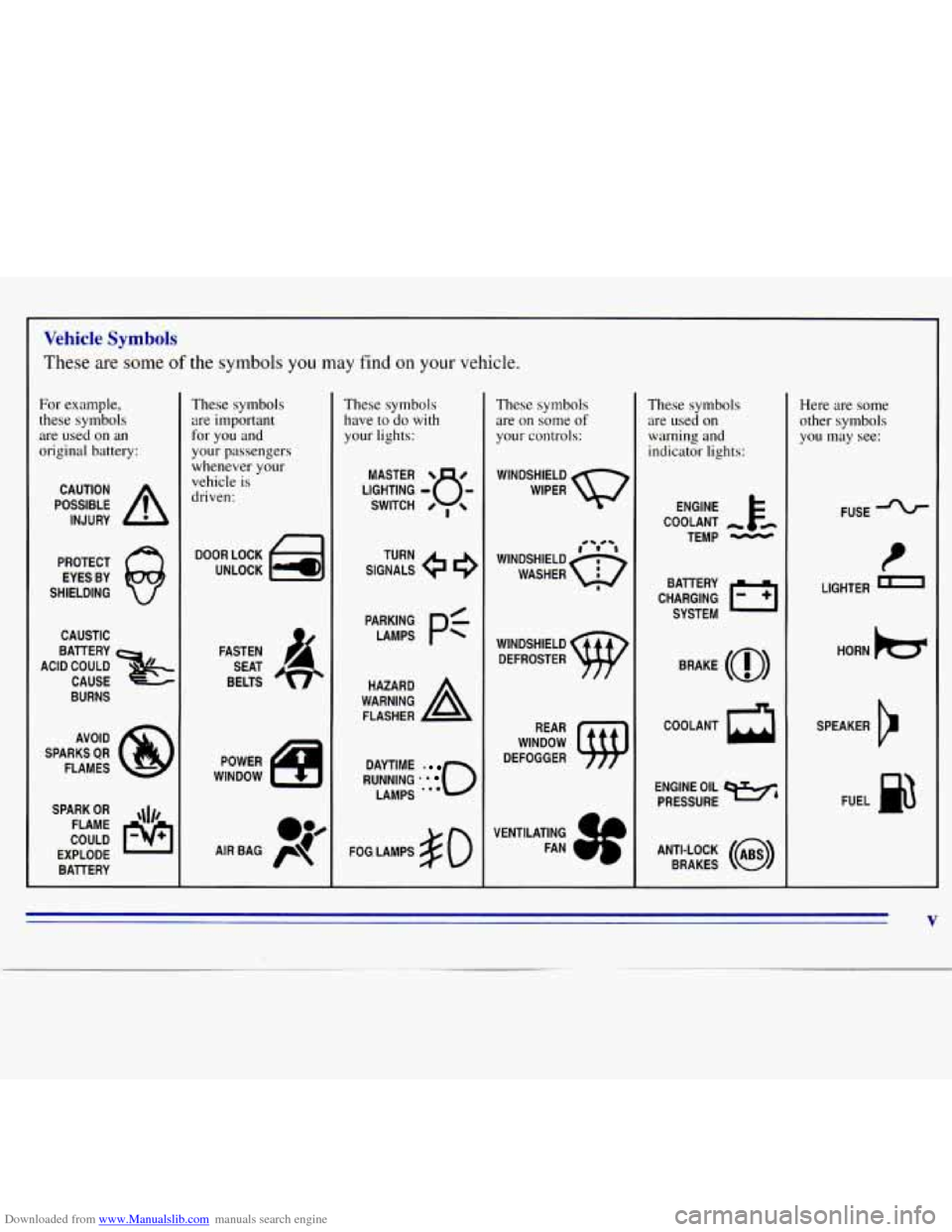
Vehicle Symbols
These are some of the symbols you may find on your vehicle.
For example,
these symbols
are used on an
original battery:
POSSIBLE A
CAUTION
INJURY
PROTECT EYES BY
SHIELDING
CAUSTIC
BURNS
SPARK
OR ,111,
COULD FLAME
EXPLODE BATTERY
These symbols are important
for you and
your passengers
whenever your vehicle
is
driven:
DOOR LOCK
UNLOCK
FASTEN SEAT
BELTS
POWER
WINDOW
These symbols have
to do with
your lights:
SIGNALS e
TURN
RUNNING
* 0
DAYTIME -
LAMPS '.*
FOG LAMPS $0
These symbols
are on some
of
your controls:
WINDSHIELD
WIPER
WINDSHIELD DEFROSTER
VENTILATING FAN
These symbols are used on
warning and
indicator lights:
COOLANT -
TEMP -
CHARGING I-1
BATTERY
SYSTEM
BRAKE
(0)
COOLANT a
ENGINE PRESSURE OIL e,
ANTI-LOCK (@)
BRAKES
Here are some
other symbols
you may see:
FUSE
LIGHTER
m
HORN k3
SPEAKER
b
FUEL B3
V
Page 33 of 375

Downloaded from www.Manualslib.com manuals search engine What will you see after an air bag inflates?
After the
air bag inflates, it quickly deflates. This occurs
so quickly that some people may not even realize the air
bag inflated. Some components of the air bag module
in
the steering wheel hub will be hot for a short time. The
part
of the bag that comes into contact with you may be
warm, but it will never be too hot to touch. There will be
some smoke and dust coming from vents
in the deflated
air bag.
Air bag inflation will not prevent the driver
from seeing or from being able to steer the vehicle, nor
will it stop people from leaving the vehicle.
When an air bag inflates, there is dust in the air.
This dust could cause breathing problems for
people with a history
of asthma or other
breathing trouble.
To avoid this, everyone in the
vehicle should get out as soon as it
is safe to do so.
If you have breathing problems but can’t get out
of the vehicle after an air bag inflates, then get
fresh air
by opening a window or door.
0
0
0
The air bag is designed to inflate only once. After it
inflates, you’ll need some new parts for your air bag
system.
If you don’t get them, the air bag system
won’t be there to help protect you
in another crash.
A new system will include the air bag module and
possibly other parts. The service manual for your
vehicle covers the need to replace other parts.
Your vehicle is equipped with
a diagnostic module,
which records information about
the air bag system.
The module records information about the readiness
of
the system, when the sensors are activated and
driver’s safety belt usage at deployment.
Let only qualified technicians work on your air
bag system. Improper service can mean that your
air bag system won’t work properly. See your dealer
for service.
NOTICE:
If you damage the cover for the driver’s air bag,
it may not work properly. You may have to
replace the air bag module.
Do not open or break
the air bag cover.
1-22
Page 52 of 375
Downloaded from www.Manualslib.com manuals search engine Section 2 Features and Controls
Here you can learn about the many standard and
optional features on
your vehicle, and information on
starting, shifting and braking. Also explained are the
instrument panel and the warning systems
that tell you if
everything is working properly -- and what to do if you
have a problem.
K -1s
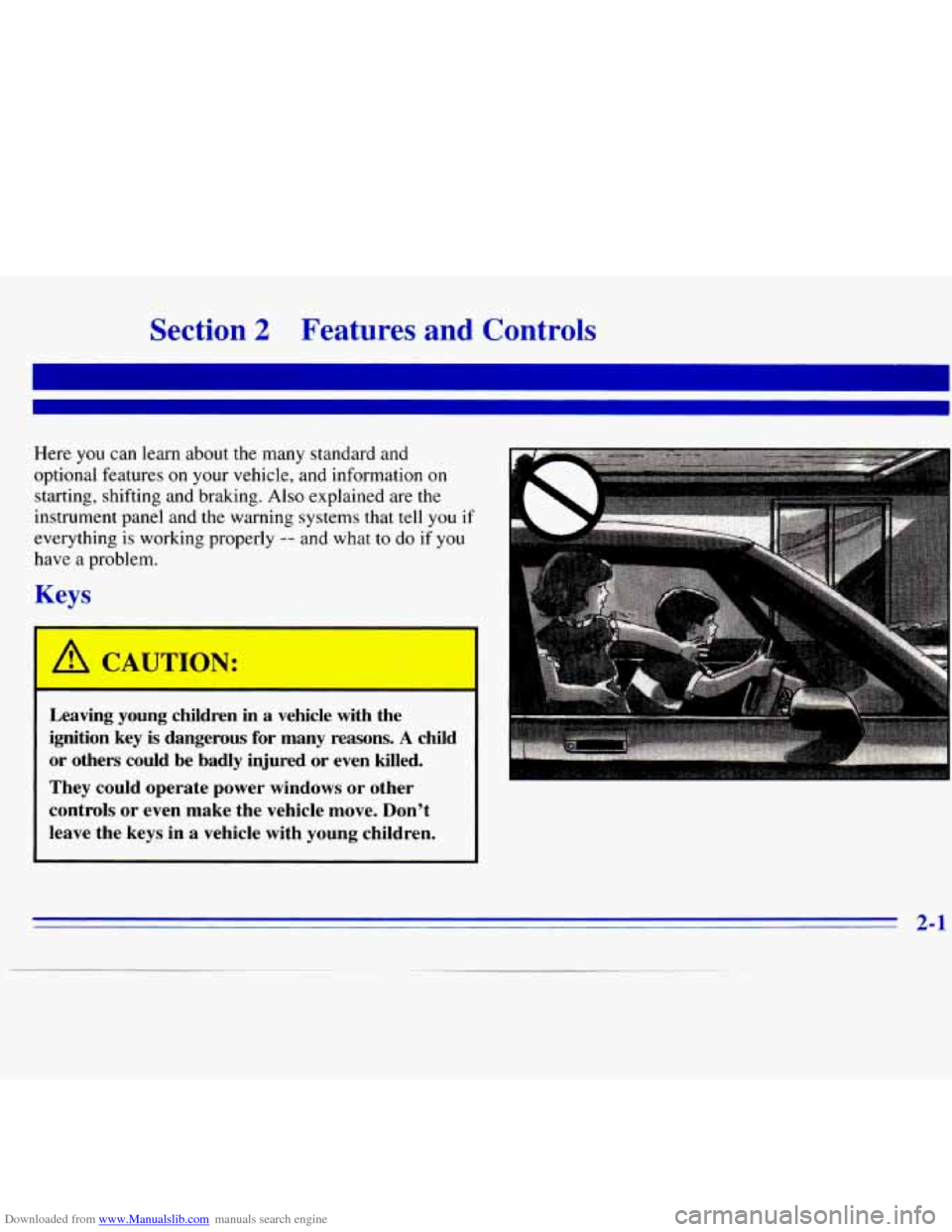
I A CAUT'3N:
Leaving young children in a vehicle with the
ignition key
is dangerous for many reasons. A chilc
or others could be badly injured or even killed.
They could operate power windows or other
controls or even make the vehicle move. Don't
leave the keys in
a vehicle with young children.
2-1
Page 58 of 375
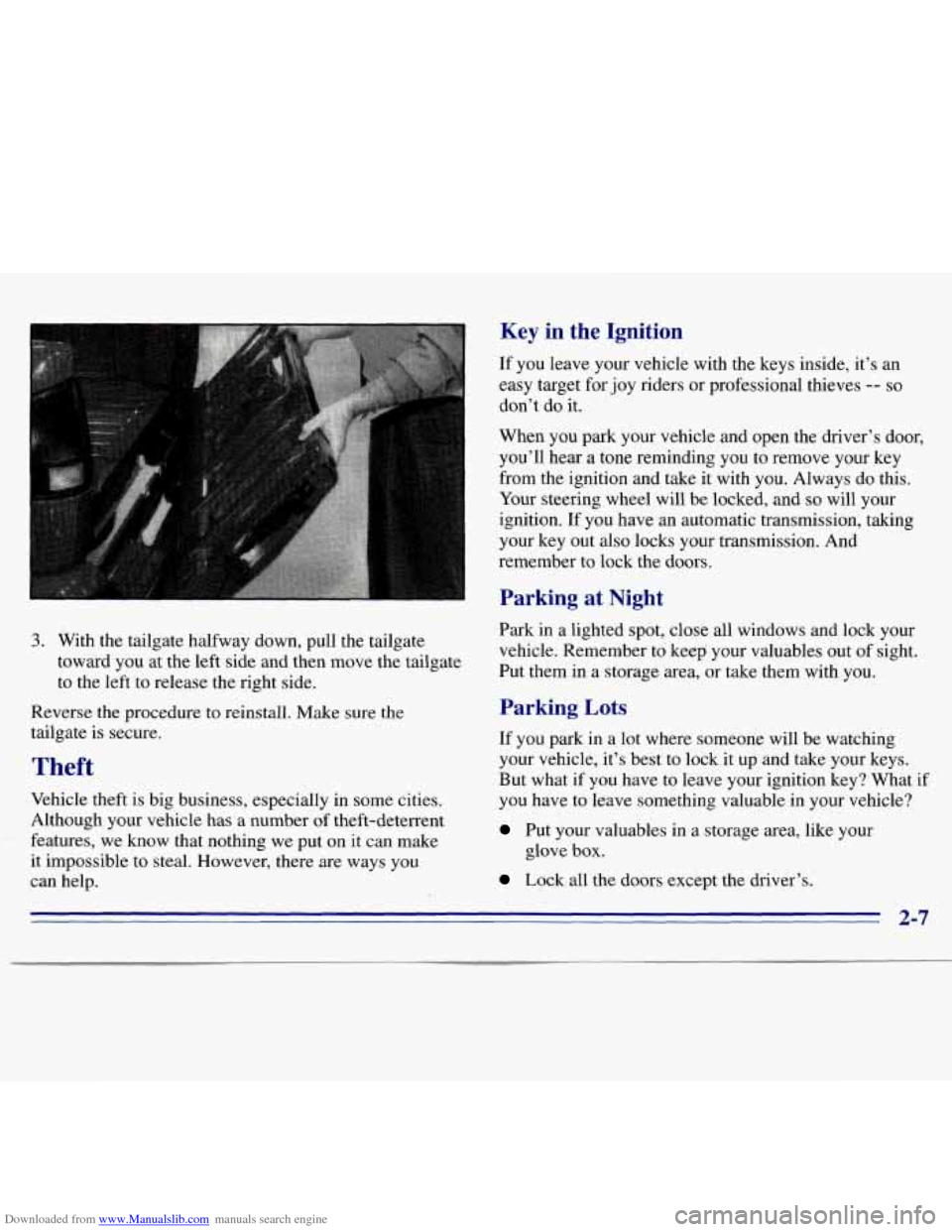
Downloaded from www.Manualslib.com manuals search engine 3. With the tailgate halfway down, pull the tailgate
toward you at the left side and then move the tailgate
to the left to release the right side.
Reverse the procedure to reinstall. Make sure the
tailgate is secure.
Theft
Vehicle theft is big business, especially in some cities.
Although your vehicle has a number
of theft-deterrent
features, we know that nothing we put on it can make
it impossible to steal. However, there are ways you
can help.
Key in the Ignition
If you leave your vehicle with the keys inside, it’s an
easy target for joy riders or professional thieves
-- so
don’t do it.
When you park your vehicle and open the driver’s door,
you’ll hear a tone reminding you to remove your key
from the ignition and take it with you. Always do this.
Your steering wheel will
be locked, and so will your
ignition. If you have
an automatic transmission, taking
your key out
also locks your transmission. And
remember to lock the doors.
Parking at Night
Park in a lighted spot, close all windows and lock your
vehicle. Remember to keep your valuables out of sight.
Put them in a storage area, or take them with you.
Parking Lots
If you park in a lot where someone will be watching
your vehicle, it’s best to lock it up
and take your keys.
But what if you have to leave your ignition key? What if
you have to leave something valuable in your vehicle?
Put your valuables in a storage area, like your
Lock all the doors except the driver’s. glove
box.
2-7
Page 81 of 375
Downloaded from www.Manualslib.com manuals search engine Engine Exhaust
Engine exhaust can kill. It contains the gas
carbon monoxide
(CO), which you can’t see or
smell. It can cause unconsciousness and death.
You might have exhaust coming in if:
Your exhaust system sounds strange
Your vehicle gets rusty underneath.
0 Your vehicle was damaged in a collision.
0 Your vehicle was damaged when driving over
high points on the road or over road debris.
0 Repairs weren’t done correctly.
0 Your vehicle or exhaust system had been
If you ever suspect exhaust is coming into
your vehicle:
Drive it only with all the windows down to
Have your vehicle fixed immediately.
or
different.
modified improperly.
blow out any
CO; and
Running Your Engine While You’re
Parked (Automatic Transmission)
It’s better not to park with the engine running. But if you
ever have to, here
are some things to know.
--
A CAUTION:
Idling the engine with the air system control off
could allow dangerous exhaust into your vehicle
(see the earlier Caution under “Engine Exhaust”).
Also, idling in a closed-in place can let deadly
carbon monoxide
(CO) into your vehicle even if
the fan switch is at the highest setting. One place
this can happen is a garage. Exhaust
-- with
CO -- can come in easily. NEVER park in a
garage with the engine running.
Another closed-in place can be a blizzard. (See
“Blizzard”
in the Index.)
2-30
Page 82 of 375
Downloaded from www.Manualslib.com manuals search engine I b CAUTION:
-
It can be dangerous to get out of your vehicle if
the shift lever
is not fully in PARK (P) with the
parking brake firmly set. Your vehicle can roll.
Don’t leave your vehicle when the engine
is
running unless you have to. If you’ve left the
engine running, the vehicle can move suddenly.
You or others could be injured.
To be sure your
vehicle won’t move, even when you’re on fairly
level ground, always set your parking brake and
move the shift lever
to PARK (P). !
If you have four-wheel drive with a manual transfer case
shift lever and your transfer case is in NEUTRAL (N),
your vehicle will be free to roll, even if your shift lever
is in PARK
(P). So, be sure the transfer case is in a drive
gear
-- not in NEUTRAL (N). Always set your parking
brake. Follow the proper steps to be sure your vehicle
won’t move. See “Shifting Into PARK
(P)” in the Index.
If you’re pulling a trailer, see “Towing a Trailer’’ in
the Index.
Windows
Manual Windows
Turn the hand crank on each door to raise or lower your
m&ual side door windows.
Power Windows (Option)
If you have the optional power windows, the controls
are on each of the side doors. Your power windows will
only work when the ignition has been turned to RUN.
The driver’s door has a switch for the passenger’s
window as well.
2-3 1
Page 83 of 375
Downloaded from www.Manualslib.com manuals search engine Express-Down Window
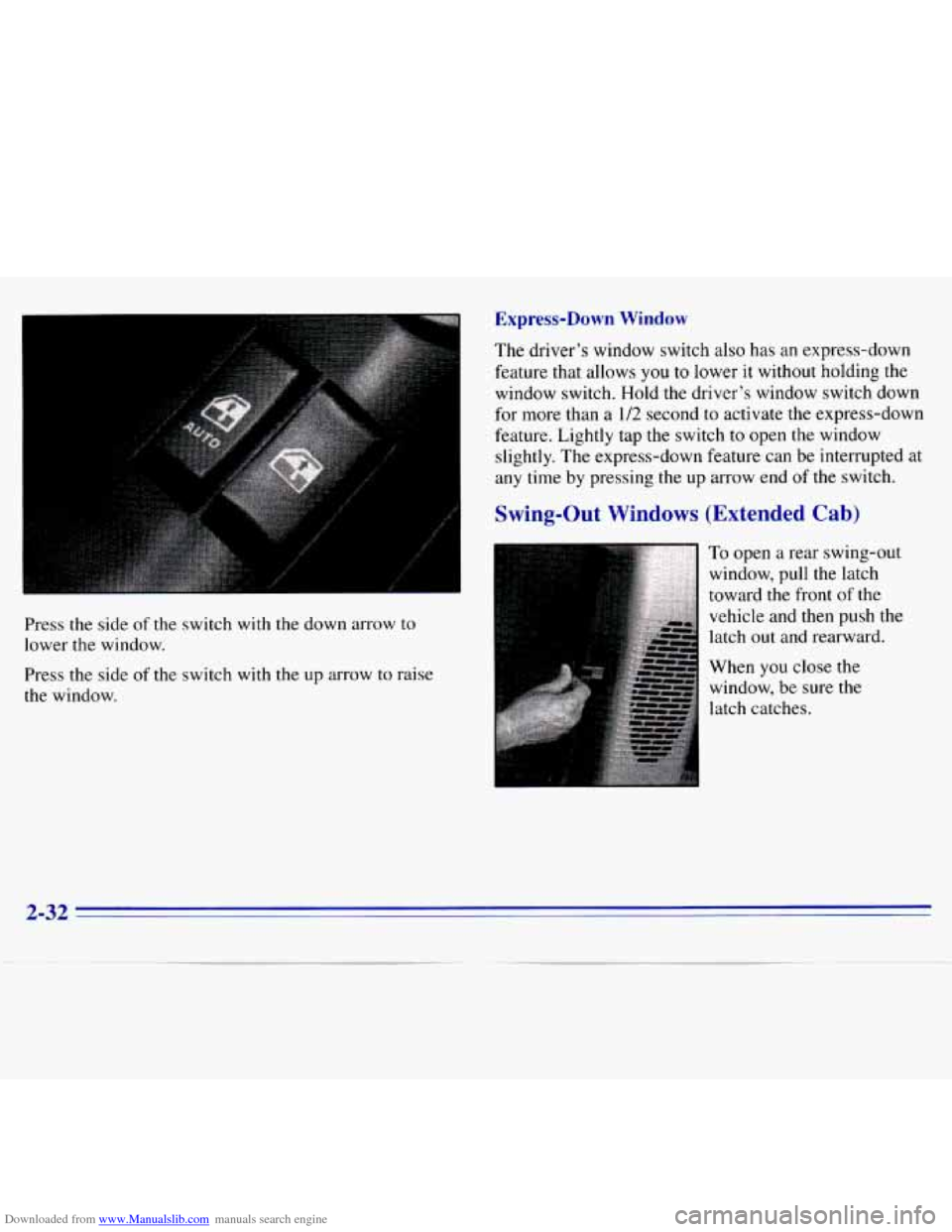
Press the side of the switch with the down arrow to
lower the window.
Press the side
of the switch with the up arrow to raise
the window. The driver’s
window switch also has an express-down
feature that
allows you to lower it without holding the
window switch. Hold the driver’s window switch down
for more than a 1/2 second to activate the express-down
feature. Lightly tap the switch
to open the window
slightly. The express-down feature can be interrupted at
any time by pressing the up arrow end of the switch.
Swing-Out Windows (Extended Cab)
To open a rear swing-out
window, pull the latch
toward the front
of the
vehicle and then push the
latch out and rearward.
When
you close the
window, be sure the
latch catches.
2-32
Page 84 of 375
Downloaded from www.Manualslib.com manuals search engine Sliding Rear Window (Option) Tilt Wheel (Option)
If you have the tilt steering
wheel, you should adjust
the steering wheel before you drive.
You can raise
it to the
highest level
to give your
legs more room when
you
enter and exit the vehicle.
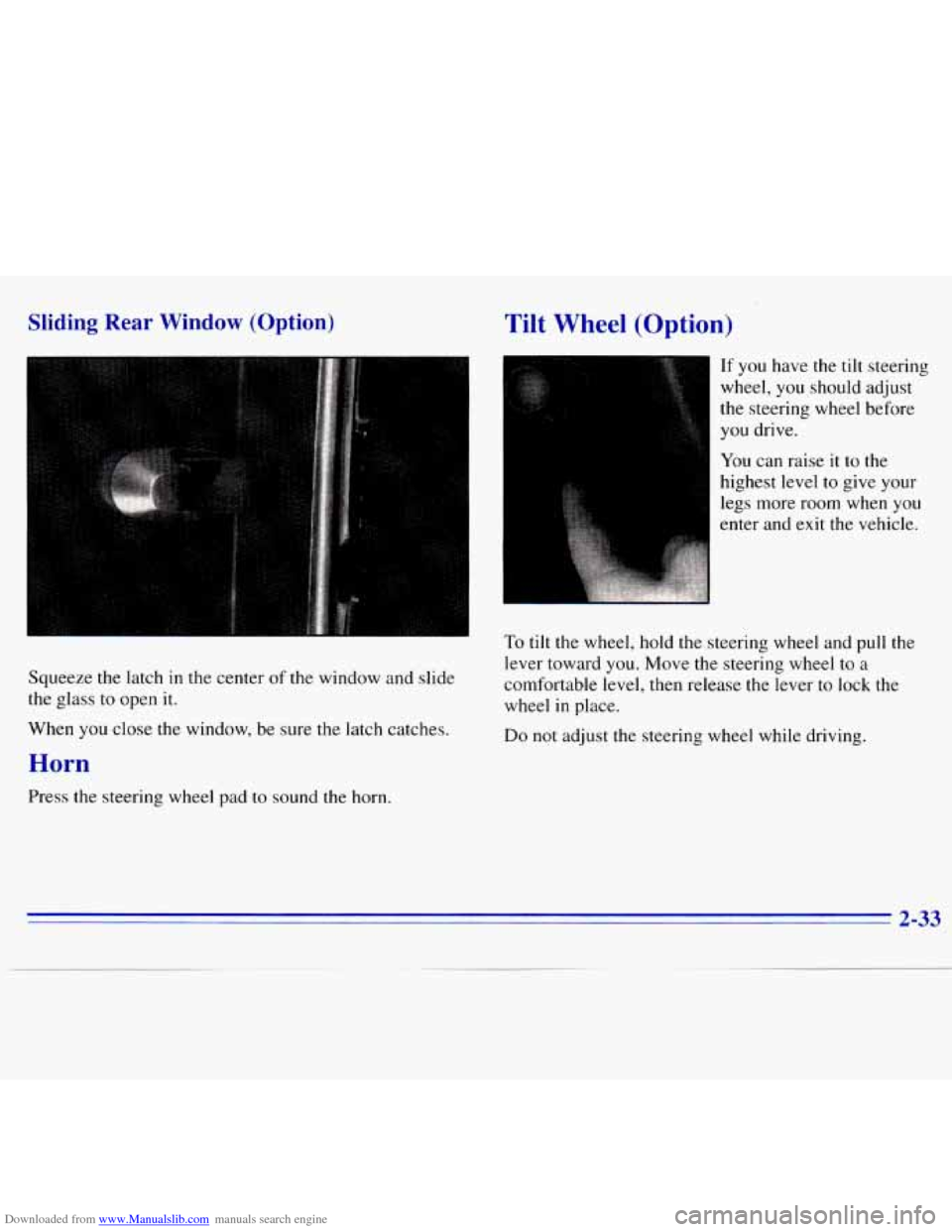
Squeeze
the latch in the center of the window and slide
the glass
to open it.
To tilt the wheel, hold the steering wheel and pull the
lever toward you. Move the steering wheel
to a
comfortable level, then release the lever to lock the
wheel
in place.
When
you close the window, be sure the latch catches.
Horn
Do not adjust the steering wheel while driving.
Press the steering wheel pad
to sound the horn.