1996 CHEVROLET S10 torque
[x] Cancel search: torquePage 79 of 375
Downloaded from www.Manualslib.com manuals search engine If you have to leave your vehicle with the engine
running, be sure your vehicle
is in PARK (P) and your
parking brake is firmly set before you leave
it. After
you’ve moved the shift lever into the PARK (P)
position, hold the regular brake pedal down. Then, see if
you can move the shift lever away from PARK (P)
without first pulling it toward you. If
you can, it means
that the shift lever wasn’t fully locked into PARK (P).
Torque Lock (Automatic Transmission)
If you are parking on a hill and you don’t shift your
transmission into PARK (P) properly, the weight of the
vehicle may put too much force
on the parking pawl in
the transmission. You may find it difficult to pull the
shift lever out
of PARK (P). This is called “torque lock.”
To prevent torque lock, set the parking brake and then
shift into PARK (P) properly before you leave the
driver’s seat.
To find out how, see “Shifting Into
PARK (P)” in the Index.
When you are ready to drive, move the shift lever
out of
PARK (P)
before you release the parking brake.
If torque lock does occur, you may need to have another
vehicle push yours a little uphill
to take some of the
pressure from the transmission,
so you can pull the shift
lever
out of PARK (P).
Shifting Out of PARK (P)
(Automatic Transmission)
Your vehicle has a brake-transmission shift interlock.
You have to fully apply your regular brake before you
can shift from
PARK (P) when the ignition is in the
RUN position. See “Automatic Transmission Operation”
in the Index.
If
you cannot shift out of PARK (P), ease pressure
on the shift lever -- push the shift lever all the way
into PARK (P) as you maintain brake application. Then
move the shift lever into the gear you want.
If you ever hold the brake pedal down but still can’t
shift out
of PARK (P), try this:
1. Turn the key to OFF.
2. Apply and hold the brake until the end of Step 4.
3. Shift to NEUTRAL (N).
4. Start the vehicle and then shift to the drive gear
you want.
5. Have the vehicle fixed as soon as you can.
2-28
Page 219 of 375
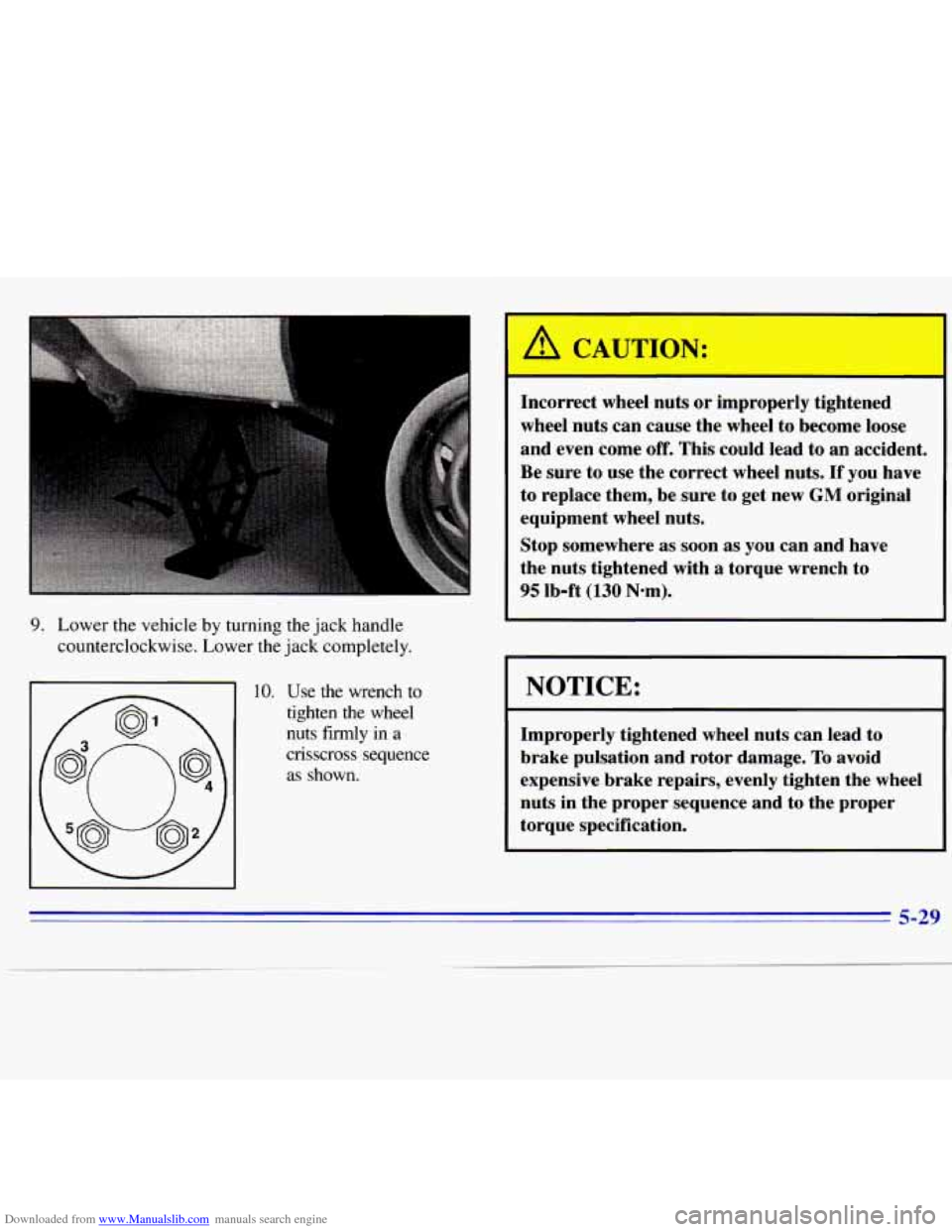
Downloaded from www.Manualslib.com manuals search engine 9. Lower the vehicle by turning the jack handle
counterclockwise. Lower
the jack completely.
10. Use the wrench to
tighten the wheel
nuts
firmly in a
i crisscross sequence
i as shown.
d CAUTION:
I
I
Incorrect wheel nuts or improperly tightened
wheel nuts can cause the wheel to become loose
and even come
off. This could lead to an accident.
Be sure to use the correct wheel nuts.
If you have
to replace them, be sure to get new
GM original
equipment wheel nuts.
Stop somewhere as soon
as you can and have
the nuts tightened with
a torque wrench to
95 lb-ft (130 Nom).
I NOTICE:
Improperly tightened wheel nuts can lead to
brake pulsation and rotor damage.
To avoid
expensive brake repairs, evenly tighten the wheel
nuts in the proper sequence and to the proper
torque specification.
5-29
Page 260 of 375
Downloaded from www.Manualslib.com manuals search engine Some driving conditions or climates may cause a brake
squeal when the brakes are first applied or lightly
applied. This does not mean something is wrong
with
your brakes.
Free movement of brake calipers and properly torqued
wheel nuts are necessary to help prevent brake
pulsation. When tires are rotated, inspect brake calipers
for movement, brake pads
for wear, and evenly torque
wheel nuts in the proper sequence to
GM specifications.
Your rear drum brakes don’t have wear indicators, but if
you ever hear
a rear brake rubbing noise, have the rear
brake linings inspected. Also, the rear brake drums
should be removed and inspected each time the tires are
removed for rotation or changing. When
you have the
front brakes replaced, have the rear brakes inspected, too.
Brake linings should always be replaced as complete
axle sets.
Brake Pedal Travel
See your dealer if the brake pedal does not return to
normal height, or if there is a rapid increase in pedal
travel. This could be
a sign of brake trouble.
Brake Adjustment
Every time you make a brake stop, your disc brakes
adjust for wear.
If your brake pedal goes down farther than normal, your
rear drum brakes may need adjustment. Adjust them by
backing
up and firmly applying the brakes a few times.
Replacing Brake System Parts
The braking system on a modern vehicle is complex.
Its many parts have to be of top quality
and work well
together if the vehicle is to have really good braking.
Vehicles we design and test have top-quality
GM brake
parts
in them, as your vehicle does when it is new. When
you replace parts of your braking system
-- for example,
when your brake linings wear down and you have to
have new ones put in
-- be sure you get new genuine
GM replacement parts. If you don’t, your brakes may no
longer work properly. For example,
if someone puts in
brake linings that are wrong for your vehicle, the balance
between your front and rear brakes can change
-- for the
worse. The braking performance you’ve come
to expect
can change
in many other ways if someone puts in the
wrong replacement brake parts.
6-34
Page 273 of 375
Downloaded from www.Manualslib.com manuals search engine After the tires have been rotated, adjust the front and rear
inflation pressures as shown on the Certificatioflire label.
Make certain that all wheel nuts are properly tightened. See ‘”Wheel Nut Torque” in the Index.
Rust or dirt on a wheel, or on the parts to which
it is fastened, can make wheel nuts become loose
after
a time. The wheel could come off and cause
an accident. When you change
a wheel, remove
any rust or dirt from places where the wheel
attaches to the vehicle. In an emergency, you can
use a cloth or
a paper towel to do this; but be
sure
to use a scraper or wire brush later, if you
need to, to get all the rust or dirt off. (See
“Changing a Flat Tire” in the Index.) When
It’s Time for New Tires
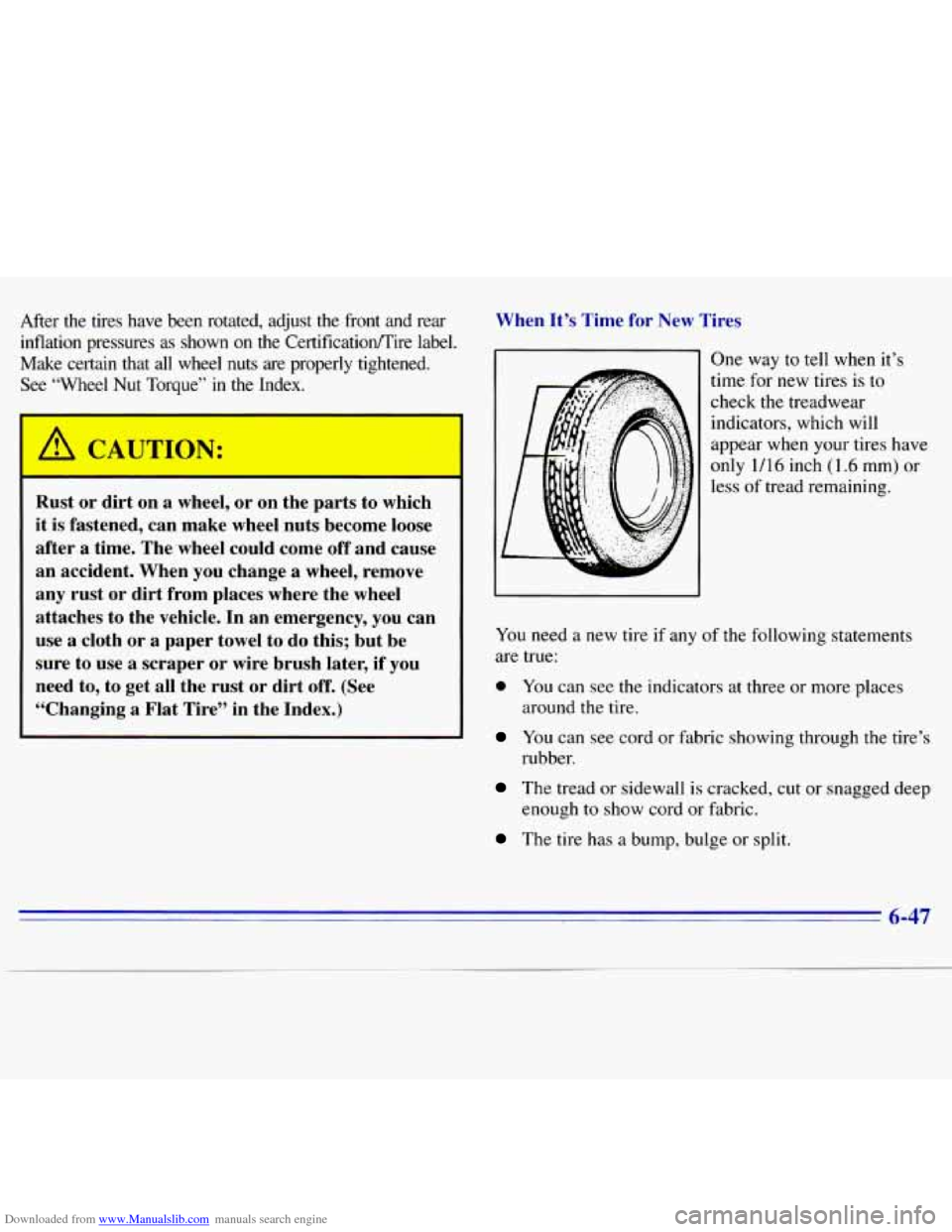
11 One way to tell when it’s
time for new tires is to
check the treadwear
indicators, which will
appear when your tires have
only
1/16 inch (1.6 mm) or
less of tread remaining.
You need a new tire if any of the following statements
are true:
0 You can see the indicators at three or more places
You can see cord or fabric showing through the tire’s
The tread or sidewall is cracked, cut or snagged deep
around
the tire.
rubber.
enough
to show cord or fabric.
The tire has a bump, bulge or dit.
6-47
Page 294 of 375
Downloaded from www.Manualslib.com manuals search engine Wheels and Tires
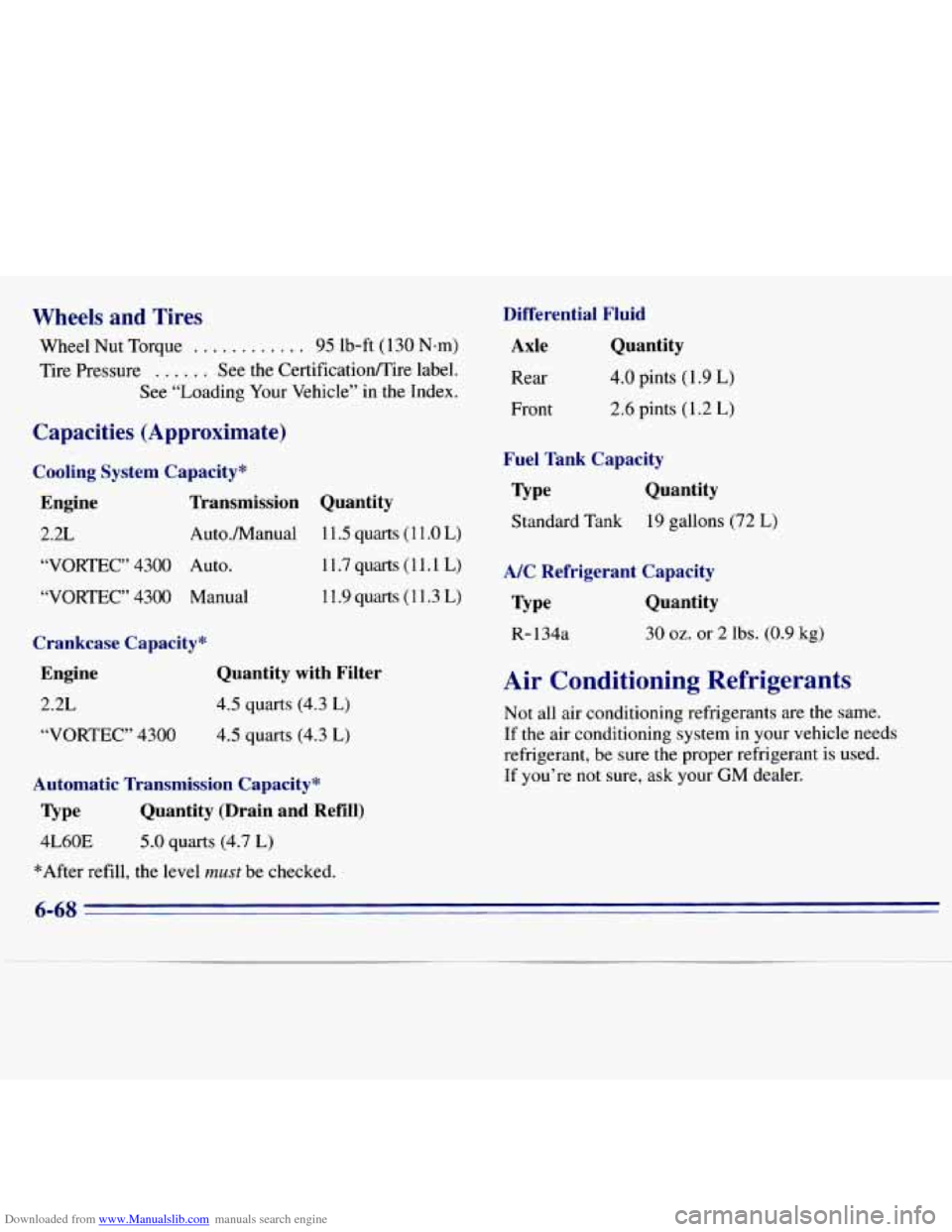
Wheel Nut Torque . . . . . . . . . . . . 95 lb-ft (130 N-m)
Tire Pressure . . . . . . See the Certificatiod‘Tire label.
See “Loading Your Vehicle”
in the Index.
Capacities (Approximate)
Cooling System Capacity*
Engine Transmission Quantity
2.2L Auto./Manual 1 1.5 quarts (1 1 .O L)
“VORTEC” 4300 Auto. 11.7quarts(11.1
L)
“VORTEC” 4300 Manual
11.9quarts(11.3L)
Crankcase Capacity*
Engine Quantity with Filter
2.2L 4.5 quarts (4.3 L)
“VORTEC” 4300 4.5 quarts (4.3 L)
Automatic Transmission Capacity*
Type Quantity (Drain and Refill)
4L60E 5.0 quarts (4.7 L)
*After refill, the level must be checked.
Differential Fluid
Axle Quantity
Rear 4.0 pints (1.9 L)
Front 2.6 pints (1.2 L)
Fuel Tank Capacity
Type Quantity
Standard Tank 19 gallons (72 L)
A/C Refrigerant Capacity
Type Quantity
R- 134a 30 oz. or 2 lbs. (0.9 kg)
Air Conditioning Refrigerants
Not all air conditioning refrigerants are the same.
If the air conditioning system in your vehicle needs
refrigerant, be sure the proper refrigerant is used.
If you’re not sure, ask your GM dealer.
6-68
Page 373 of 375
Downloaded from www.Manualslib.com manuals search engine SIR .......................................... 1-18
Skidding
...................................... 4-12
Sliding Rear Windows
........................... 2-33
SpareTire
..................................... 5-23
Specifications and Capacities
................. 6-66, 6-68
Speech Impaired, Customer Assistance
............... 8-3
Speedometer
................................... 2-52
Stains, Cleaning
................................ 6-54
Starting Your Engine
............................ 2- 10
Steering
......................................... 4-8
Column Lock Check
.......................... 7-50
In Emergencies ................................ 4-9
Power
........................................ 4-8
Steering Wheel, Tilt
............................. 2-33
Storage Compartments
........................... 2-44
Storage, Vehicle
................................ 6-35
Stuck:
In Sand, Mud, Ice or Snow .................. 5-33
Sunvisors
.................................... 2-46
Supplemental Inflatable Restraint
................... 1 -I8
Symbols, Vehicle
................................... v
Tachometer .................................. 2-52
Tailgate
........................................ 2-6
Taillamp Bulb Replacement
....................... 6-40
TapePlayerCare
............................... 3-18
Theft
........................................... 2-7
Theft-Deterrent Feature,
CD Player ................. 3- 14
Thermostat
.................................... 6-28
Third Gear, Manual Transmission
................... 2- 18
Starter Switch Check
....................... ., .... 7-49
Steam
........................................ 5-11 Tilt
Steering Wheel
............................. 2-33
Time. Setting
................................... 3-5
Tires Tire Chains
.................................... 6-52 .
Alignment and Balance ........................ 6-50
Buying New
................................. 6-48
Changing a Flat
.............................. 5-22
Cleaning
..................................... 6-58
Inflation
.................................... 6-45
Inspection and Rotation
........................ 6-46
Pressure
.................................... 6-45
Spare
...................................... 5-23
Temperature
.......................... ...... 6-50
Traction
.................................... 6-49
Treadwear
................................... 6-49
Uniform Quality Grading
....................... 6-49
Wear Indicators
.............................. 6-47
Wheel Replacement
.................... ...... 6-50
When It’s Time for New
....................... 6-47
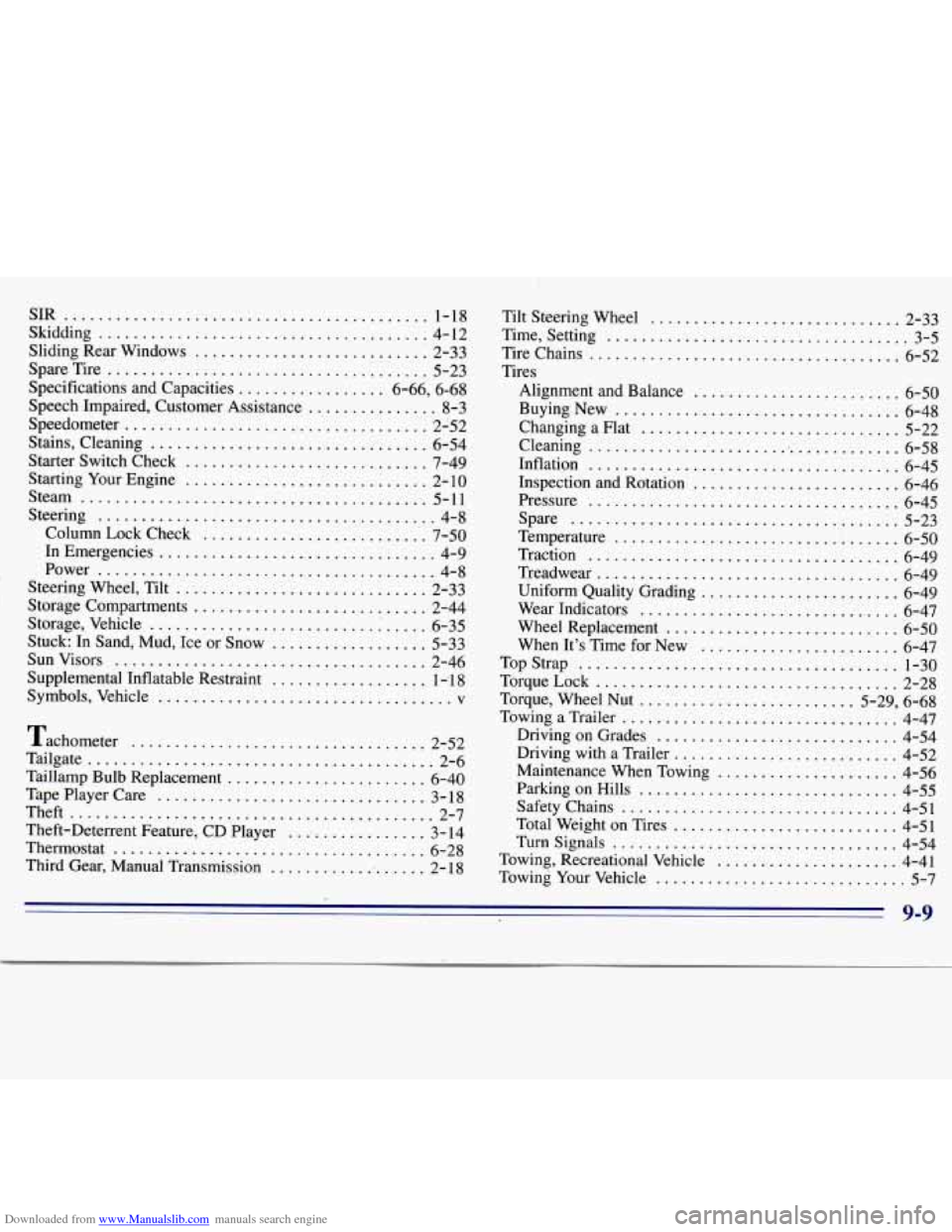
TorqueLock
................................... 2-28
Torque, Wheel Nut
......................... 5-29, 6-68
TowingaTrailer ................................. 4-47
Driving on Grades
............................ 4-54
Driving with a Trailer
.......................... 4-52 1
Maintenance When Towing ..................... 4-56
Parking on Hills
.............................. 4-55 ~ 1
Safety Chains ................................ 4-51
Total Weight on Tires
.......................... 4-51
Turn Signals
.................................. 4-54
Towing, Recreational Vehicle
..................... 4-41
Towing
Your Vehicle ............................. 5-7
TopStrap
..................................... 1-30
9-9
J
Page 374 of 375
Downloaded from www.Manualslib.com manuals search engine Trailer Brakes .................................. 4-52
Trailer Hitches
................................. 4-5 1
Trailer Recommendations ........................ 4-47
.Trailer Tongue Weight
............................ 4-50
Trailer Weight
.................................. 4-49
Trailer Wiring Harness
............................ 4-56
Transfer Case
............................. 2-20, 6-22
Electronic
................................... 2-23
TrailerTowing
................................. 4-47
Manual
..................................... 2-20
'Transmission Fluid
Automatic
............................... 6-16, 6-68
Manual
..................................... 6-19
Transmitters, Keyless Entry
......................... 2-5
Transportation. Courtesy
.......................... 8-6
Trip, Before Leaving
............................ 4-34
Trip Odometer
................................. 2-52
Turn Signal and Lane Change Signals
............... 2-34
Two-Tiered Loading
............................ 4-44
TTYUsers
..................................... 8-3
Turn Signals
When Towing a Trailer ................. 4-54
Underbody Maintenance
........................ 6-59
Vanity Mirror Lamp Bulb Replacement
............ 6-41
Underhood Lamp Bulb Replacement
................ 6-41
Used Replacement Wheels
......... : .............. 6-51
Vehicle Control
....................................... 4-5
Damage Warnings
.............................. iv
Dimensions ................................. 6-68
Loading
.................................... 4-42
Ventilation System
............................... 3-4
Voltmeter ..................................... 2-55
Identification
Number
......................... 6-61
. Storage ........ ............................ 6-35
Visors, Sun
..................................... 2-46
warning Devices
........................ ........ 5-1
Warning Lights. Gages and Indicators
............... 2-53
Washer Fluid. Windshield
......................... 6-29
Washing Your Vehicle
........................... 6-57
Weatherstrips
.................................. 6-56
Wheel Alignment
............................... 6-50
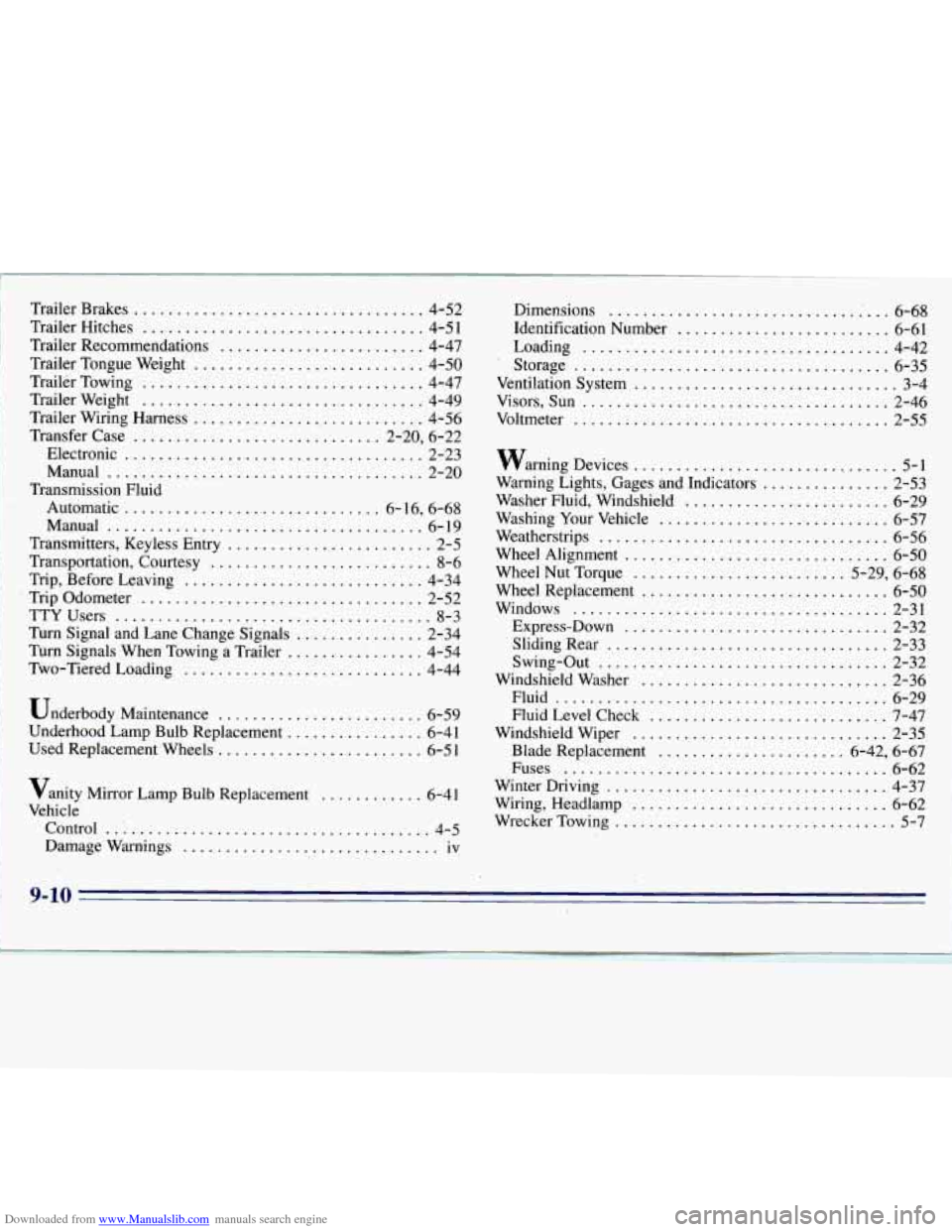
Wheel Nut Torque
......................... 5-29. 6-68
Wheel Replacement
............................. 6-50
Sliding Rear
................................. 2-33
Windshield Washer
............................. 2-36
Fluid Level Check
............................ 7-47
Windshield Wiper
.............................. 2-35
Blade Replacement
...................... 6-42, 6-67
Winter Driving
................................. 4-37
Wiring, Headlamp
............................... 6-62
Wrecke~Towing
.................................. 5-7
Windows
..................................... 2-31
Express-Down
................................ 2-32
Swing-Out
.................................. 2-32
Fluid
....................................... 6-29
Fuses
...................................... 6-62
9-10 .