1996 CHEVROLET S10 cooling
[x] Cancel search: coolingPage 114 of 375
Downloaded from www.Manualslib.com manuals search engine Section 3 Comfort, Controls and Audio Systems
In this section you’ll find out how to operate the comfort
control and audio systems offered with your vehicle. Be
sure to read about the particular systems supplied with
your vehicle.
Comfort Controls
With these systems- you can control the heating, cooling
and ventilation in your vehicle.
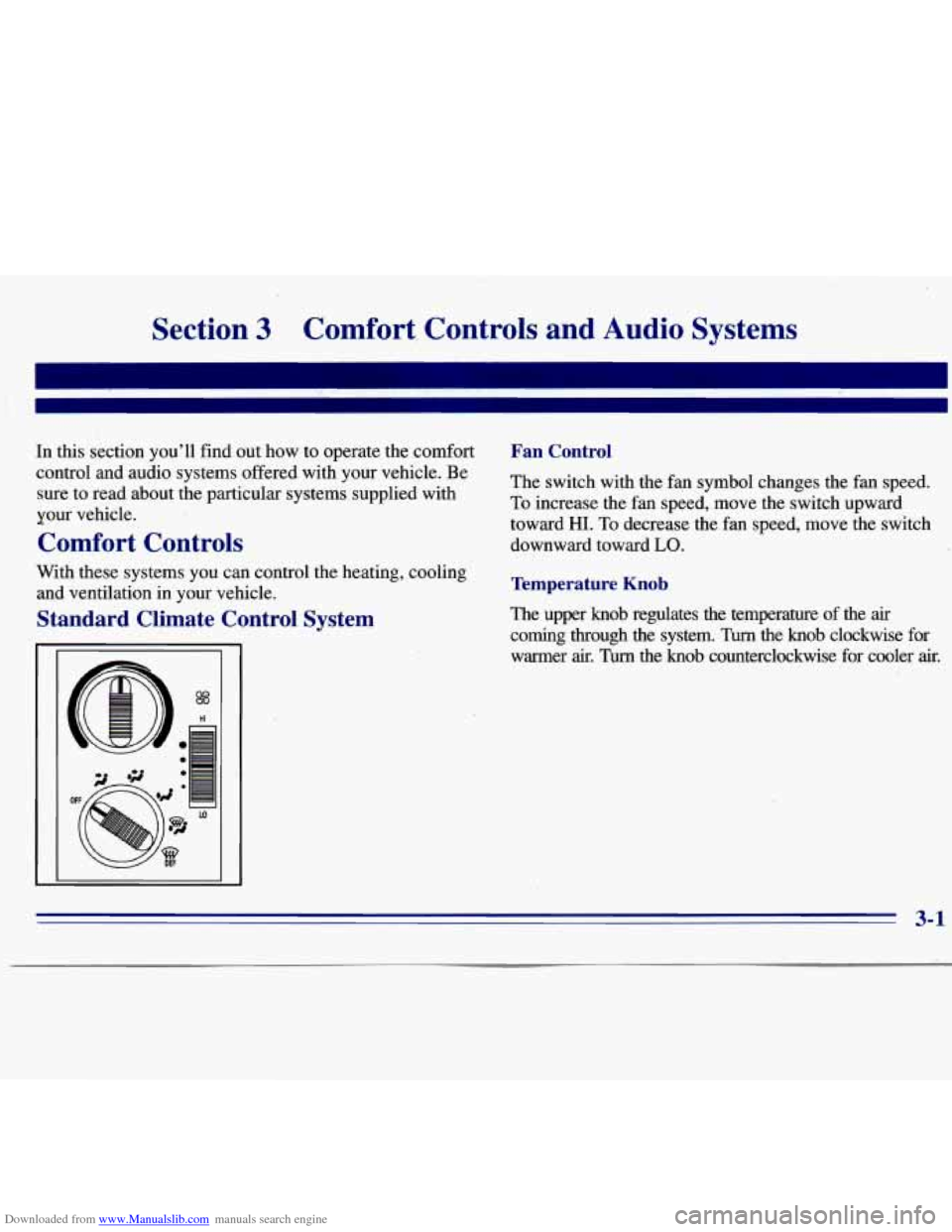
Standard Climate Control System
Fan Control
The switch with the fan symbol changes the fan speed.
To increase the fan speed, move the switch upward
toward HI. To decrease the fan speed, move the switch
downward toward
LO.
Temperature Knob
The upper knob regulates the temperature of the air
coming through the system. Turn the knob clockwise for
warmer
air. Turn the knob counterclockwise for cooler air.
3-1
Page 116 of 375
Downloaded from www.Manualslib.com manuals search engine Temperature Knob
The upper knob regulates the temperature of the air
coming through the system. Turn the knob clockwise for warmer
air. Turn the knob counterclockwise for cooler air.
Mode Knob
The lower knob allows you to choose the direction of
air delivery.
OFF: This setting turns the system off. Some outside air
will still enter the vehicle whenever the vehicle is
moving forward.
MAX NC: This setting provides maximum cooling
with the least amount of work. MAX A/C recirculates
much
of the air inside your vehicle so it cools quickly.
A/C: This setting cools the air entering your vehicle and
directs it through the instrument panel outlets.
+# BI-LEVEL A/C: Air is delivered through the heater
floor outlets
as well as the instrument panel outlets.
+e
/J VENT: This setting directs airflow through the
instrument panel outlets. The air conditioning
compressor is not working when VENT is selected.
+’ HEATER: This setting directs warmed air through
the heater floor outlets and windshield defroster outlets.
+e
0
w.
+’ BLEND: Airflow is divided equally between the
heater floor outlet and the windshield defroster outlets.
DEFROST: This setting directs most air through
the windshield defroster
outlets and some through the
heater outlets.
Air Conditioning (Option)
On hot days, open the windows long enough to let hot
inside air escape. This reduces the time
it takes for your
vehicle to cool down. Then keep your windows closed
for the air conditioner to work its best.
For quick cool-down
on very hot days, use MAX A/C
with the temperature knob turned counterclockwise. This
setting should be used to keep odors and/or dust from
entering the vehicle. For normal cooling on hot days, use
A/C with the temperature knob turned counterclockwise.
On
cool but sunny days, use BI-LEVEL A/C to deliver
warm air to the floor and cooler air to the instrument
panel outlets.
If you have the “VORTEC”
4300 engine, when the air
conditioner is on, you may sometimes notice slight
changes in your vehicle’s engine speed and power. This
is normal because the system is designed to cycle the
compressor on and
off to keep the desired temperature.
3-3
Page 117 of 375
Downloaded from www.Manualslib.com manuals search engine Heating
The heater works best if you keep your windows closed
while using it. On cold days, use
HEATER with the
temperature knob turned clockwise.
BLEND is useful in
cool weather when you have fog or ice on the
windshield or side windows.
If you use the optional engine coolant heater before
starting your engine, your heating system will produce
warmer air faster
to heat the passenger compartment in
cold weather. See “Engine Coolant Heater” in the Index.
Ventilation System
For mild outside temperatures when little heating or
cooling is needed, use
VENT to direct outside air
through your vehicle. Airflow is through the instrument
panel outlets.
Your vehicle’s ventilation system supplies outside air
to
the inside of your vehicle when it is moving. When the
vehicle
is not moving, you can get outside air to flow
through by selecting any mode. and any fan speed.
.. ..
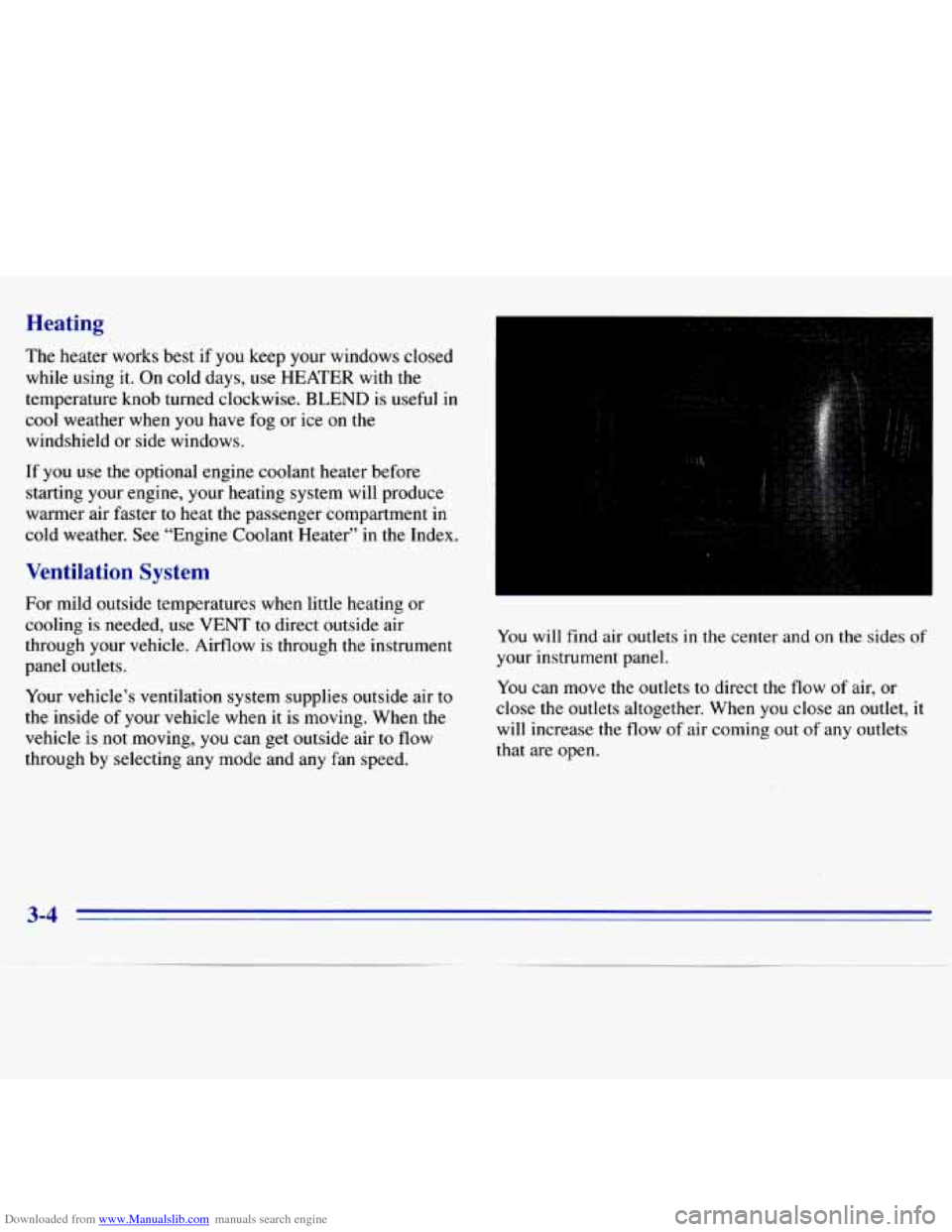
You will find air outlets in the center and on the sides of
your instrument panel.
You can move the outlets to direct the flow of air, or
close the outlets altogether. When you close an outlet, it
will increase the flow of air coming out of any outlets
that are open.
3-4
Page 158 of 375
Downloaded from www.Manualslib.com manuals search engine If the water isn’t too deep, then drive through it slowly.
At fast speeds, water splashes
on your ignition system
and your vehicle can stall. Stalling can also occur if you
get your tailpipe under water. And, as long as your
tailpipe is under water, you’ll never be able to start your
engine. When
you go through water, remember that
when your brakes get wet, it may take you longer
to stop.
Driving through rushing water can be dangerous.
Deep water can sweep your vehicle downstream
and you and your passengers could drown.
If it’s
only shallow water, it can still wash away the
ground from under your tires, and you could lose
traction and roll the vehicle over. Don’t drive
through rushing water.
See “Driving Through Water” in the Index for more
information on driving through water.
After Off-Road Driving
Remove any brush or debris that has collected on the
underbody, chassis or under the hood. These
accumulations
can be a fire hazard.
After operation in mud
or sand, have the brake linings
cleaned and checked. These substances can cause
glazing and uneven bralung. Check the body structure,
steering, suspension, wheels, tires and exhaust system
for damage. Also, check the fuel lines and cooling
system for any leakage.
Your vehicle will require more frequent service due to
off-road use. Refer to the Maintenance Schedule for
additional information.
4-27
Page 167 of 375
Downloaded from www.Manualslib.com manuals search engine Keep your vehicle in good shape. Check all fluid
levels and also the brakes, tires, cooling system
and
transmission. These parts can work hard on
mountain roads.
0 Know how to go down hills. The most important
thing to know is this: let your engine do some
of the
slowing down. Shift
to a lower gear when you go
down a steep or long hill.
If you don’t shift down, your brakes could get so
hot that they wouldn’t work well. You would
then have poor braking or even none going
down
a hill. You could crash. Shift down to let
your engine assist your brakes on a steep
downhill slope. Coasting
downhill in
NEUTRAL (N) or with the
ignition
off is dangerous. Your brakes will have to
do
all the work of slowing down. They could get so
hot that they wouldn’t work well. You would then
have poor braking or even none going down
a hill.
You could crash. Always have your engine running
and your vehicle in gear when you go downhill.
0
0
0
0
Know how to go uphill. You may want to shift down
to a lower gear. The lower gears help cool your engine
and transmission, and you can climb the hill better.
Stay
in your own lane when driving on two-lane
roads in hills or mountains. Don’t swing wide
or cut
across the center
of the road. Drive at speeds that let
you stay in your own lane.
As you go over the top of a hill, be alert. There could be
something
in your lane, like a stalled car or an accident.
You may see highway signs on mountains that
warn of
special problems. Examples are long grades, passing or
no-passing zones, a falling rocks area or winding
roads. Be alert to these and take appropriate action.
4-36
Page 187 of 375
Downloaded from www.Manualslib.com manuals search engine When You Are Ready to Leave After
Parking on a Hill
1. Apply your regular brakes and hold the pedal down
while
you:
Start your engine;
0 Shift into a gear; and
0 Release the parking brake.
2. Let up on the brake pedal.
3. Drive slowly until the trailer is clear of the chocks.
4. Stop and have someone pick up and store the chocks.
Maintenance When Trailer Towing
Your vehicle will need service more often when you’re
pulling a trailer. See the Maintenance Schedule for more
on this. Things that are especially important in trailer
operation are automatic transmission fluid (don’t
overfill), engine oil, axle lubricant, belt, cooling system
and brake adjustment. Each
of these is covered in this
manual, and the Index will help
you find them quickly.
If you’re trailering, it’s
a good idea to review these
sections before you start your trip.
Check periodically to see that all hitch nuts and bolts
are tight.
Trailer Wiring Harness
The eight-wire harness is stored under your vehicle
along
the rear frame crossmember. This harness has a
30-amp feed wire with an inline fuse located in the
instrument panel fuse block and no connector. It should
be wired by a qualified electrical technician. The
technician can use
the following color code chart when
connecting the wiring harness to your trailer.
0 DARK BLUE: Use for electric trailer brakes or
0 RED: Use for battery charging; it connects to the
LIGHT GREEN: Back-up lamps.
0 BROWN: Taillamps and parking lamps.
0 YELLOW Left stoplamp and turn signal.
0 DARK GREEN: Right stoplamp and turn signal.
0 WHITE (Heavy Gage): Ground wire.
0 WHITE (Light Gage): Auxiliary stoplamp.
Securely attach the harness to the trailer, then tape or
strap it to your vehicle’s frame rail. Be sure
you leave
it loose enough
so the wiring doesn’t bend or break,
but not so
loose that it drags on the ground. Store the
harness in its original place. Wrap the harness together
and tie
it neatly so it won’t be damaged.
auxiliary wiring.
starter solenoid.
4-56
Page 204 of 375
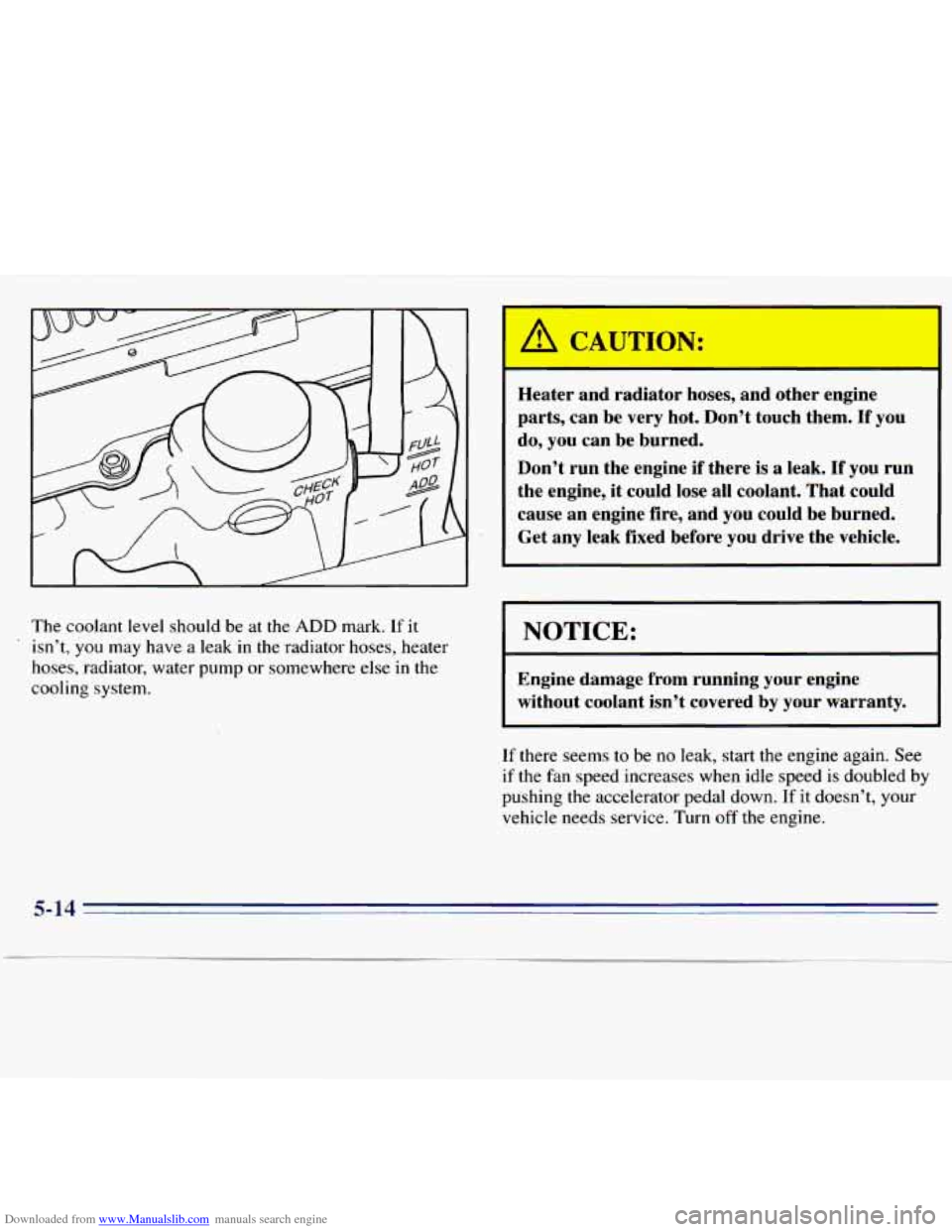
Downloaded from www.Manualslib.com manuals search engine The coolant level should be at the ADD mark. If it
‘ isn’t, you may have a leak in the radiator hoses, heater
hoses, radiator, water pump
or somewhere else in the
cooling system.
A CAUTION:
Heater and radiator hoses, and other e Jne
parts, can be very hot. Don’t touch them.
If you
do, you can be burned.
Don’t run the engine if there is a leak.
If you run
the engine, it could lose all coolant. That could
cause an engine fire, and you could be burned.
Get any leak fixed before you drive the vehicle.
I NOTICE:
I
Engine damage from running your engine
without coolant isn’t covered by your warranty.
If there seems to be no leak, start the engine again. See
if the fan speed increases when idle speed is doubled by
pushing the accelerator pedal down.
If it doesn’t, your
vehicle needs service. Turn off the engine.
5-14
Page 205 of 375
Downloaded from www.Manualslib.com manuals search engine How to Add Coolant to the
Coolant Recovery Tank
If you haven’t found a problem yet, but the coolant level
isn’t at
ADD, add a 50/50 mixture of clean water
(preferably distilled) and DEX-COOL TM (orange-colored,
silicate-free) antifreeze at the coolant recovery tank. (See
“Engine Coolant” in the Index for more information.)
k!, CAUTICJ:
Adding only plain. water to your cooling system
can be dangerous. Plain water, or some other
liquid like alcohol, can boil before the proper
coolant mix will. Your vehicle’s coolant warning
system
is set for the proper coolant mix. With
plain water or the wrong mix, your engine could
get too hot but you wouldn’t get the overheat
warning. Your engine could catch fire and you
or
others could be burned. Use a 5W50 mix of clean
water and
DEX-COOL TM antifreeze.
I NOTICE:
In cold weather, water can freeze and crack the
engine, radiator, heater core and other parts.
Use the recommended coolant and the proper
coolant mix.