1996 CHEVROLET BLAZER lock
[x] Cancel search: lockPage 344 of 392
Downloaded from www.Manualslib.com manuals search engine -a r Trip/Highway Maintenance Schedule I
The services shown in this schedule up to 100,000 miles
(166 000 km) should be performed after 100,000 miles
(166 000 km) at the same intervals.
Footnotes
The U.S. Environmental Protection Agency or the
California Air Resources Board has determined that the
failure to perform this maintenance item will not nullify
the emission warranty or limit recall liability prior to the
completion of the vehicle’s useful life. We, however,
urge that all recommended maintenance services be
performed at the indicated intervals and the maintenance
be recorded.
** Drive axle service:
0
0
0
Locking Differential -- Drain fluid and refill at first
engine oil change. At subsequent oil changes, check
fluid level and add fluid as needed. If driving in
dusty areas or towing a trailer, drain fluid and refill
every 15,000 miles
(25 000 km).
Standard Differential
-- Check fluid level and add
fluid as needed at every engine oil change. If driving
in dusty areas or towing a trailer, drain fluid and
refill every
15,000 miles (25 000 km).
More frequent lubrication may be required for
heavy-duty or off-road
use.
7-32
Page 360 of 392
Downloaded from www.Manualslib.com manuals search engine At Least Twice a Year
Restraint System Check
Make sure the safety belt reminder light and all your
belts, buckles, latch plates, retractors and anchorages are working properly. Look for any other loose or damaged
safety belt system parts. If
you see anything that might
keep a safety belt system from doing its job, have
it
repaired. Have any torn or frayed safety belts replaced.
Also look for any opened or broken air bag covers, and
have them repaired or replaced. (The air bag system
does not need regular maintenance.)
Manual Transmission Check
Check the transmission fluid level; add if needed.
See “Manual Transmission” in the Index.
A fluid loss
may indicate a problem. Check the system and repair
if needed.
Automatic Transmission Check
Check the transmission fluid level; add if needed. See
“Automatic Transmission” in the Index.
A fluid loss
may indicate a problem. Check the system and repair
if needed.
Hydraulic Clutch System Check
Check the fluid level in the clutch reservoir. See
“Hydraulic Clutch Fluid” in the Index.
A fluid loss in
this system could indicate a problem. Have the system
inspected and repaired at once.
At Least Once a Year
Key Lock Cylinders Service
Lubricate the key lock cylinders with the lubricant
specified in Part
D.
Body Lubrication Service
Lubricate all body door and fuel door hinges, rear
compartment hinges, latches and locks including the
glove box, console doors and
the body hood and any
moving seat hardware. Lubricate the hood safety lever
pivot and prop rod pivot. Part
D tells you what to use.
More frequent lubrication may be required when
exposed to a corrosive environment.
7-48
Page 361 of 392
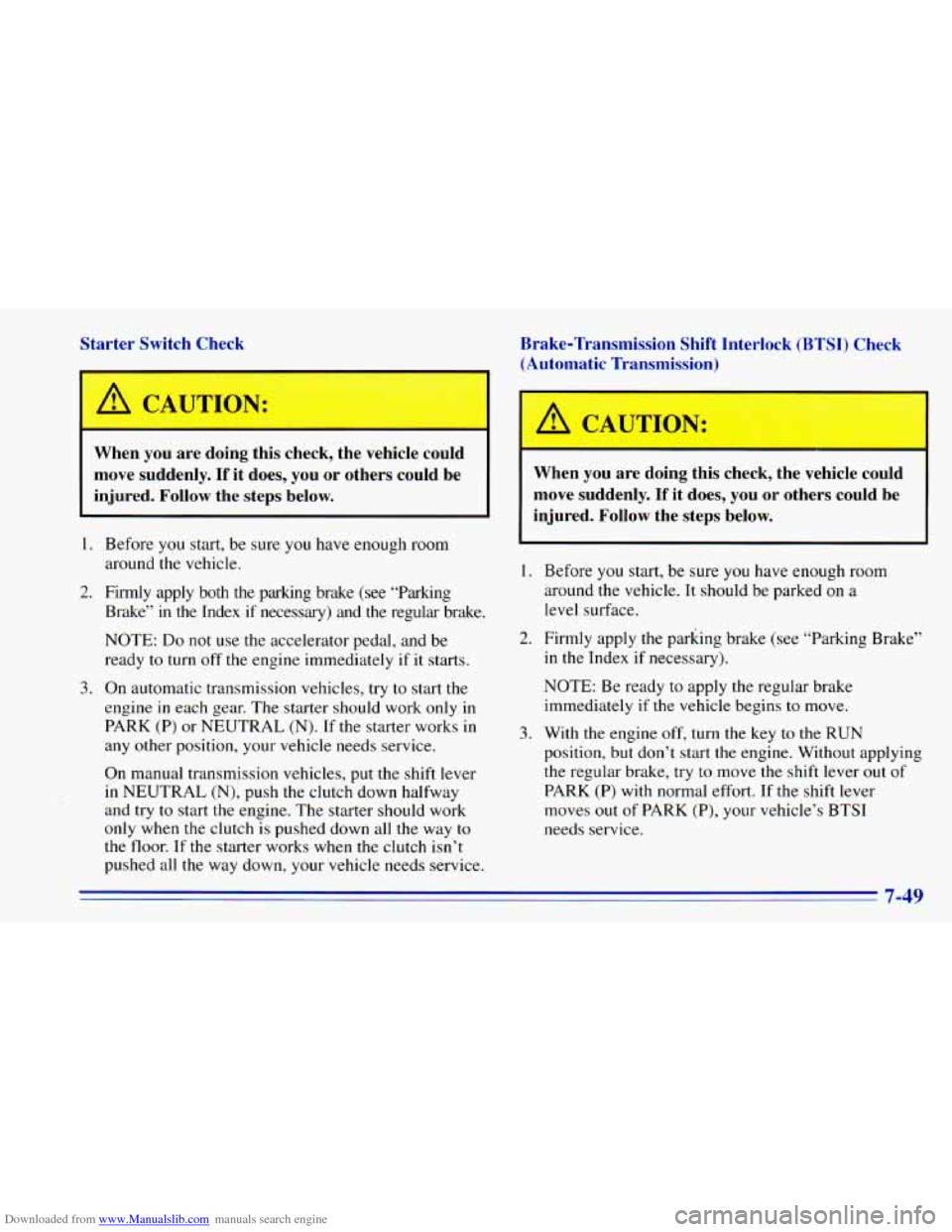
Downloaded from www.Manualslib.com manuals search engine Starter Switch Check
When you are doing this check, the vehicle could
move suddenly. If it does, you or others could be
injured. Follow the steps below. Brake-Transmission Shift Interlock
(BTSI) Check
(Automatic Transmission)
1. Before you start, be sure you have enough room
around the vehicle.
2. Firmly apply both the parking brake (see “Parking
Brake” in the Index if necessary) and the regular brake.
NOTE: Do not use the accelerator pedal, and be
ready to turn
off the engine immediately if it starts.
3. On automatic transmission vehicles, try to start the
engine
in each gear. The starter should work only in
PARK (P) or NEUTRAL
(N). If the starter works in
any other position, your vehicle needs service.
On manual transmission vehicles, put the shift lever
in NEUTRAL (N), push the clutch down halfway
and try
to start the engine. The starter should work
only when
the clutch is pushed down all the way to
the floor. If the starter works when the clutch isn’t
pushed all the way down,
your vehicle needs service.
When you are doing this check, the vehicle could
move suddenly.
If it does, you or others could be
injured. Follow the steps below.
1. Before you start, be sure you have enough room
around the vehicle. It should be parked
on a
level surface.
2. Firmly apply the parking brake (see “Parking Brake”
in the Index if necessary).
NOTE: Be ready to apply the regular brake
immediately
if the vehicle begins to move.
3. With the engine off, turn the key to the RUN
position, but don’t start the engine. Without applying
the regular brake, try to move the shift lever out of
PARK (P) with normal effort. If the shift lever
moves out
of PARK (P), your vehicle’s BTSI
needs service.
7-49
Page 362 of 392
Downloaded from www.Manualslib.com manuals search engine Steering Column Lock Check While parked, and with the parking brake set, try to turn
the key to LOCK in each shift lever position.
With an automatic transmission, the key should turn
to LOCK only when the shift lever
is in PARK (P).
With a manual transmission, the key should
turn to LOCK only when the shift lever is in
REVERSE (R).
On vehicles with a key release button, try to turn the key
to LOCK without pressing the button. The key should
turn to LOCK only when
you press the key button.
On
dl vehicles, the key should come out only in LOCK.
.f
Parking Brake and Automatic Transmission
PARK
(P) Mechanism Check
/! CAUTION:
When you are doing this check, your vehicle
could begin to move. You or others could be
injured and property could be damaged, Make
sure there
is room in front of your vehicle in case
it begins to roll, Be ready to apply the regular
brake at once should the vehicle begin to move.
Park
on a fairly steep hill, with the vehicle facing
downhill. Keeping your
foot on the regular brake, set the
parking brake.
To check the parking brake: With the engine running
and transmission in
NEUTRAL (N), slowly remove
foot pressure from the regular brake pedal. Do this
until the vehicle is held by the parking brake
only.
To check the PARK (P) mechanism’s holding ability:
With the engine running, shift
to PARK (P). Then
release all brakes.
7-50
Page 366 of 392
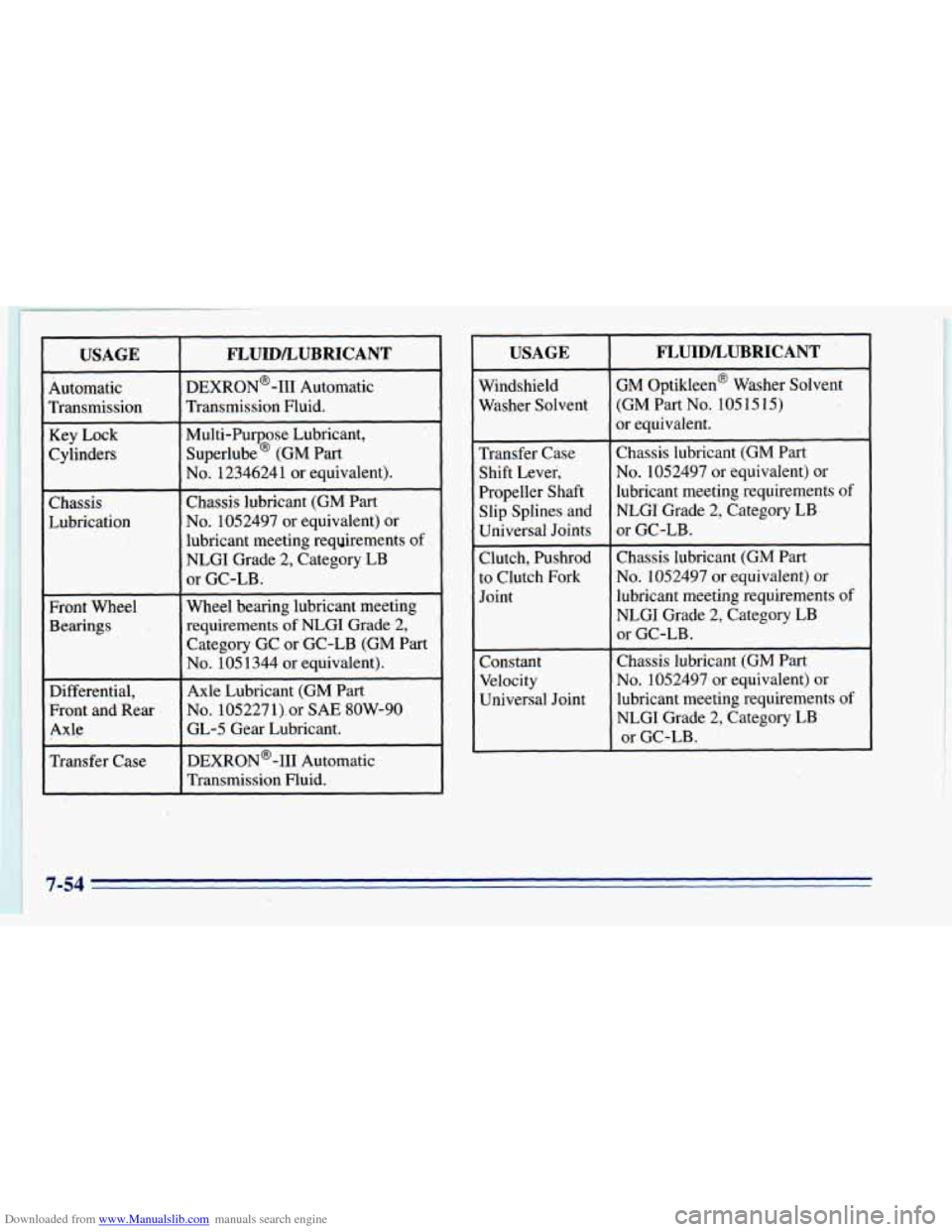
Downloaded from www.Manualslib.com manuals search engine USAGE
Automatic
Transmission
Key Lock
Cylinders
-~ ~~~
Chassis
Lubrication
Front Wheel
Bearin
Differential,
Front and Rear
Axle
FLUID/LUBRICANT
DEXRON@-I11 Automatic
Transmission Fluid.
Multi-Purpose Lubricant, Superlube
@ (GM Part
No. 12346241 or equivalent).
Chassis lubricant (GM Part
No. 1052497 or equivalent) or
lubricant meeting requirements of
NLGI Grade
2, Category LB
or GC-LB;
Wheel bearing lubricant meeting requirements of
NLGI Grade 2,
Category GC or GC-LB (GM Part
No. 105 1344 'or equivalent).
Axle Lubricant (GM Part
No. 1052271)-or
SAE 8OW-90
GL-5 Gear Lubricant.
'
DEXRON@-I11 Automatic
Transmission Fluid.
USAGE
Windshield
Washer Solvent
Transfer Case Shift Lever,
Propeller Shaft
Slip Splines and
Universal Joints
~~
Clutch, Pushrod
to Clutch Fork
Joint
Constant Velocity
Universal Joint
FLUIDILUBRICANT
GM Optikleen' Washer Solvent
(GM Part No.
1051515)
or equivalent. .
Chassis lubricant (GM Part
No. 1052497 or equivalent) or
lubricant meeting requirements of
NLGI Grade
2, Category LB
or GC-LB.
Chassis lubricant (GM Part
No. 1052497 or equivalent) or
lubricant meeting requirements of
NLGI Grade 2, Category LB
or
GC-LB.
Chassis lubricant (GM Part
No. 1052497
or equivalent) or
lubricant meeting requirements of
NLGI Grade
2, Category LB
or GC-LB.
Page 374 of 392
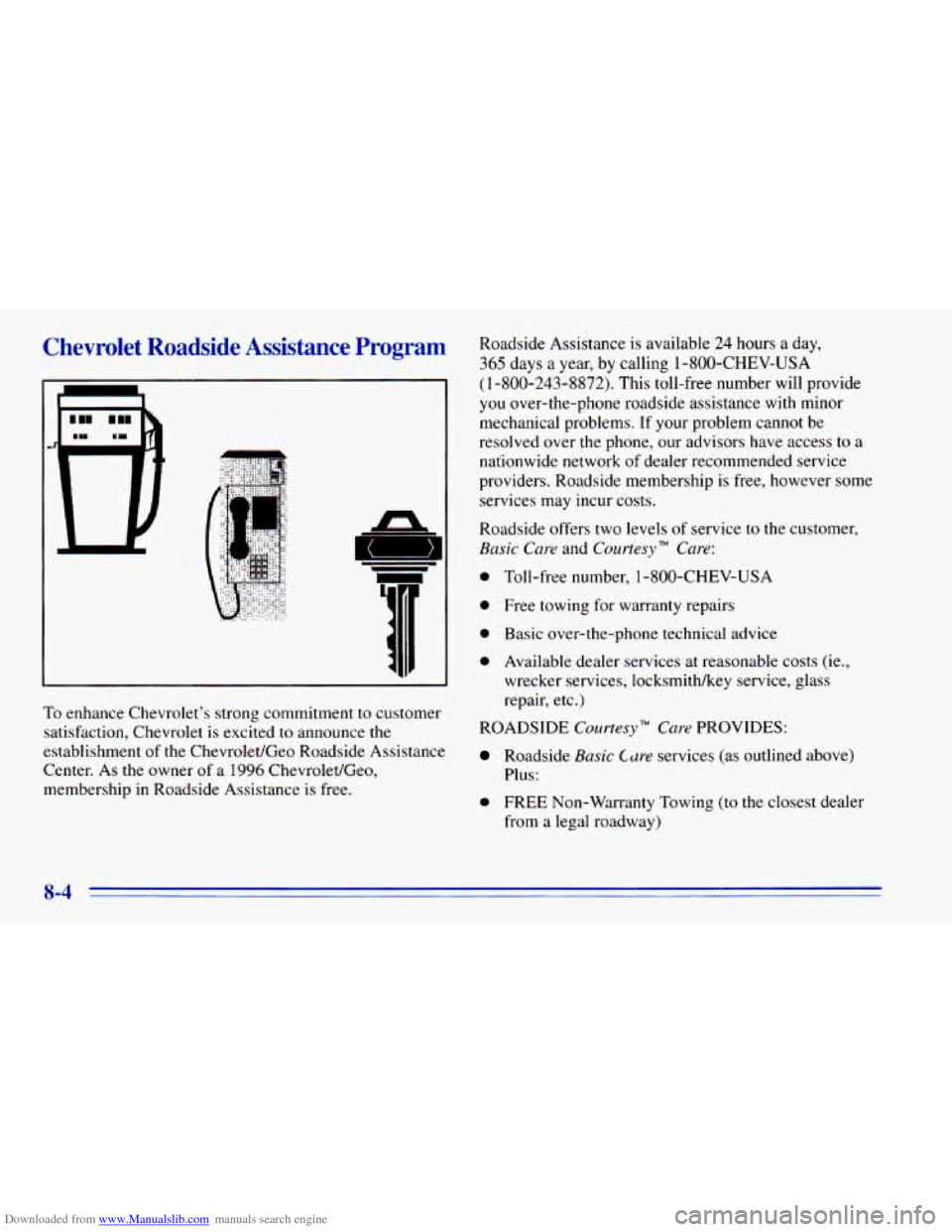
Downloaded from www.Manualslib.com manuals search engine Chevrolet Roadside Assistance Program
To enhance Chevrolet’s strong commitment to customer
satisfaction, Chevrolet
is excited to announce the
establishment of the Chevrolet/Geo Roadside Assistance
Center. As the owner
of a 1996 Chevrolet/Geo,
membership in Roadside Assistance is free. Roadside Assistance is available
24 hours a day,
365 days a year, by
calling 1-800-CHEV-USA
(1 -800-243-8872). This toll-free number will provide
you over-the-phone roadside assistance with minor
mechanical problems. If your problem cannot be
resolved over the phone, our advisors have access
to a
nationwide network of dealer recommended service
providers. Roadside membership is free, however some
services may incur costs.
Roadside offers two levels
of service to the customer,
Basic Care and Courtesy” Care:
0 Toll-free number, 1 -800-CHEV-USA
0 Free towing for warranty repairs
0 Basic over-the-phone technical advice
0 Available dealer services at reasonable costs (ie.,
wrecker services, locksmith/key service, glass
repair, etc.)
ROADSIDE
Courtesy” Care PROVIDES:
Roadside Basic Cure services (as outlined above)
0 FREE Non-Warranty Towing (to the closest dealer
Plus:
from a legal roadway)
8-4
Page 375 of 392
Downloaded from www.Manualslib.com manuals search engine FREE Locksmith/Key Service (when keys are lost
on the road or locked inside)
0 FREE Flat Tire Service (spare installed on the road)
FREE Jump Start (at home or on the road)
0 FREE Fuel Delivery ($5 of fuel delivered on
the road)
Chevrolet/Geo offers Courtesy Transportation
for customers needing warranty service. Courtesy
Transportation
will be offered in conjunction with the
coverage provided by the Bumper
To Bumper New
Vehicle Limited Warranty to eligible purchasers of
1996
Chevrolet/Geo passenger car and light duty trucks.
(Please see your selling dealer for details.)
Note:
Courtesy Care is available to Retail and Retail Lease
Customers operating
1996 and newer Chevrolet/Geo
vehicles for a period
of 36 months/36,000 miles,
whichever occurs first.
All Courtesy Care services must
be pre-arranged by Chevrolet Roadside or Dealer
Service Management.
Basic Care and Courtesy Care are not part of or
included
in the coverage provided by the New Vehicle
Limited Warranty. Chevrolet reserves the right to
modify or discontinue
Basic Care and Courtesy Cure
at any time. For
complete program details, see your Chevrolet/Geo
dealer
to obtain a Roadside Assistance Center brochure.
The Roadside Assistance Center uses companies that
will provide you with quality and priority service. When
roadside services are required, our advisors will explain
any payment obligations that may be incurred for
utilizing outside services.
For prompt assistance when calling, please have the
following available to give to the advisor:
Vehicle Identification Number
License plate number
Vehicle color
Vehicle location
0 Telephone number where you can be reached
0 Vehicle mileage
0 Description of problem
Please refer to the Roadside Assistance brochure inside
your owner information portfolio for
full program details.
8-5
Page 381 of 392

Downloaded from www.Manualslib.com manuals search engine Section 9 Index
Accessory Power Outlet ......................... 2-59
Adding Sound Equipment
........................ 3-17
Add-on Equipment
............................. 4-46
AirBag
....................................... 1-18
Adding Equipment
.......................... .' . 1-23
How Does it Restrain
.......................... 1-21
How
it Works ................................ 1-20
Location
.................................... 1-20
Readiness Light
......................... I . 19. 2-66
Servicing
................................... 1-23
What Makes
it Inflate .......................... 1-21
What You See After
it Inflates ................... 1-22
When Should
it Inflate ......................... 1-21
Aircleaner
.................................... 6-13
Air Conditioning
................................ 3-2
Refrigerants
................................. 6-64
Alignment and Balance. Tire
...................... 6-46
All-Wheel Drive
.......................... 2.21. 6.20
Aluminum Wheels. Cleaning
...................... 6-54
Antenna. Fixed
................................. 3-18
Anti-Lock Brake System Warning Light
......... 2.68. 4.6
Appearancecare
............................... 6-48
Materials
.................................... 6-56
Arbitration Program
.............................. 8-7
Armrest. Storage
........................ 2.53. 2.54 Ashtrays
...................................... 2-58
Audio Systems
.................................. 3-5
Automatic Overdrive
............................
Check ...................................... 7-48
Fluid
....................................... 6-14
Operation
................................... 2-16
Park Mechanism Check
........................ 7-50
Shifting ..................................... 2-16
Starting Your Engine
.......................... 2-13
Front
....................................... 6-21
Rear
....................................... 6-19
Backglass Wipers, Blade Replacement
............. 6-40
Battery
....................................... 6-32
ChargeLight
................................ 2-66
Jump Starting ................................. 5-2
Replacement, Keyless Entry
..................... 2-6
Warnings
.................................... 5-2
BBB Auto Line
................................. 8-7
Better Business Bureau Mediation
................... 8-7
BrakeFluid
.................................... 6-28
Brake, Parking
................................. 2-26
Brake System Warning Light
............. ... 2-67
Axle
9-1