Page 242 of 392
Downloaded from www.Manualslib.com manuals search engine Storing a Flat or Spare Tire -..ne Tn4s
Storing a jack, a tire or other equipment in the
passenger compartment
of the vehicle could
cause injury. In a sudden
stop or collision, loose
equipment could strike someone. Store all these in the proper place.
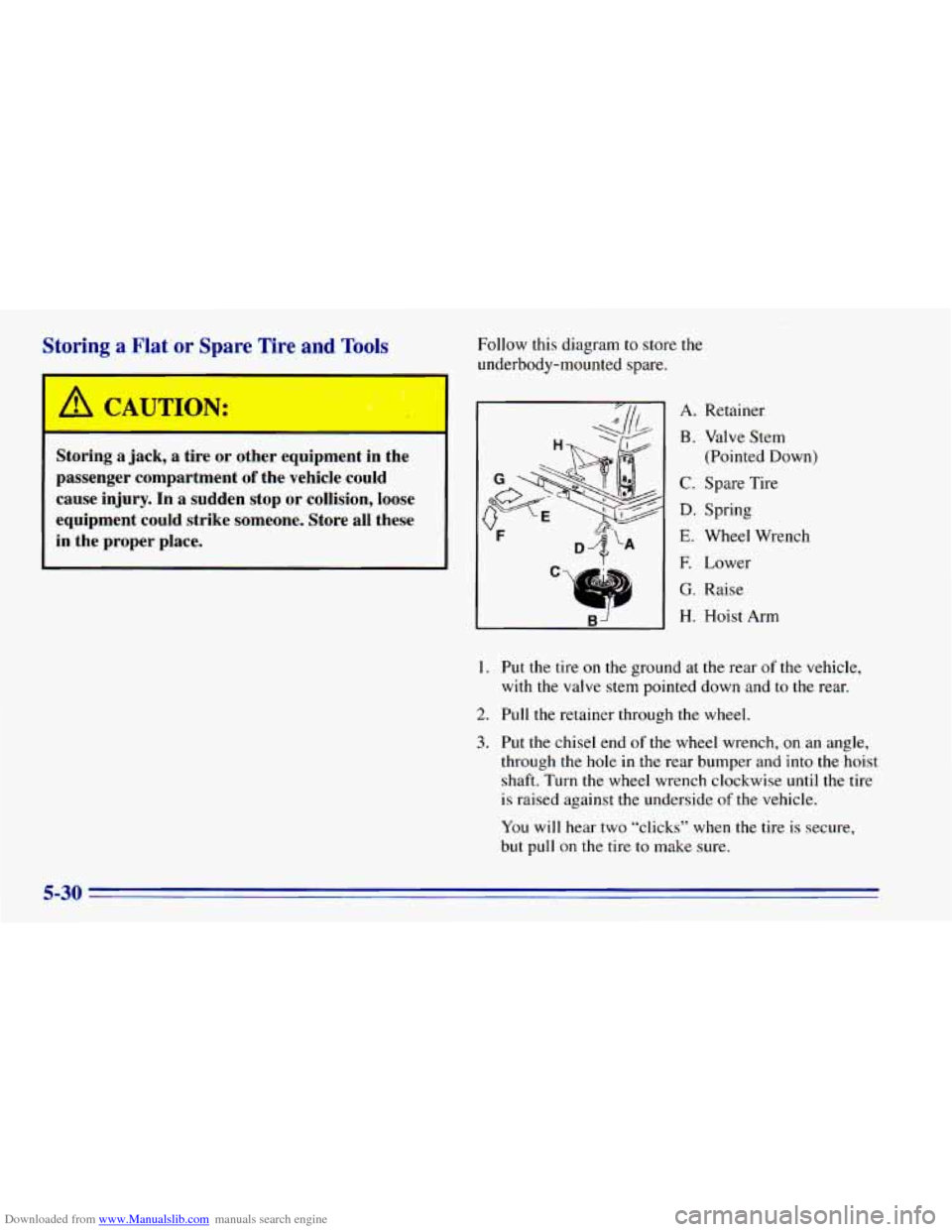
Follow this diagram to store the
underbody-mounted spare.
cTD B
A. Retainer
B. Valve Stem
(Pointed Down)
C. Spare Tire
D. Spring
E. Wheel Wrench
E Lower
G. Raise
H. Hoist Arm
1. Put the tire on the ground at the rear of the vehicle,
with the valve stem pointed down and
to the rear.
2. Pull the retainer through the wheel.
3. Put the chisel end of the wheel wrench, on an angle,
through the hole
in the rear bumper and into the hoist
shaft. Turn the wheel wrench clockwise until the tire
is raised against
the underside of the vehicle.
You will hear two “clicks” when the tire is secure,
but
pull on the tire to make sure.
5-30
Page 243 of 392
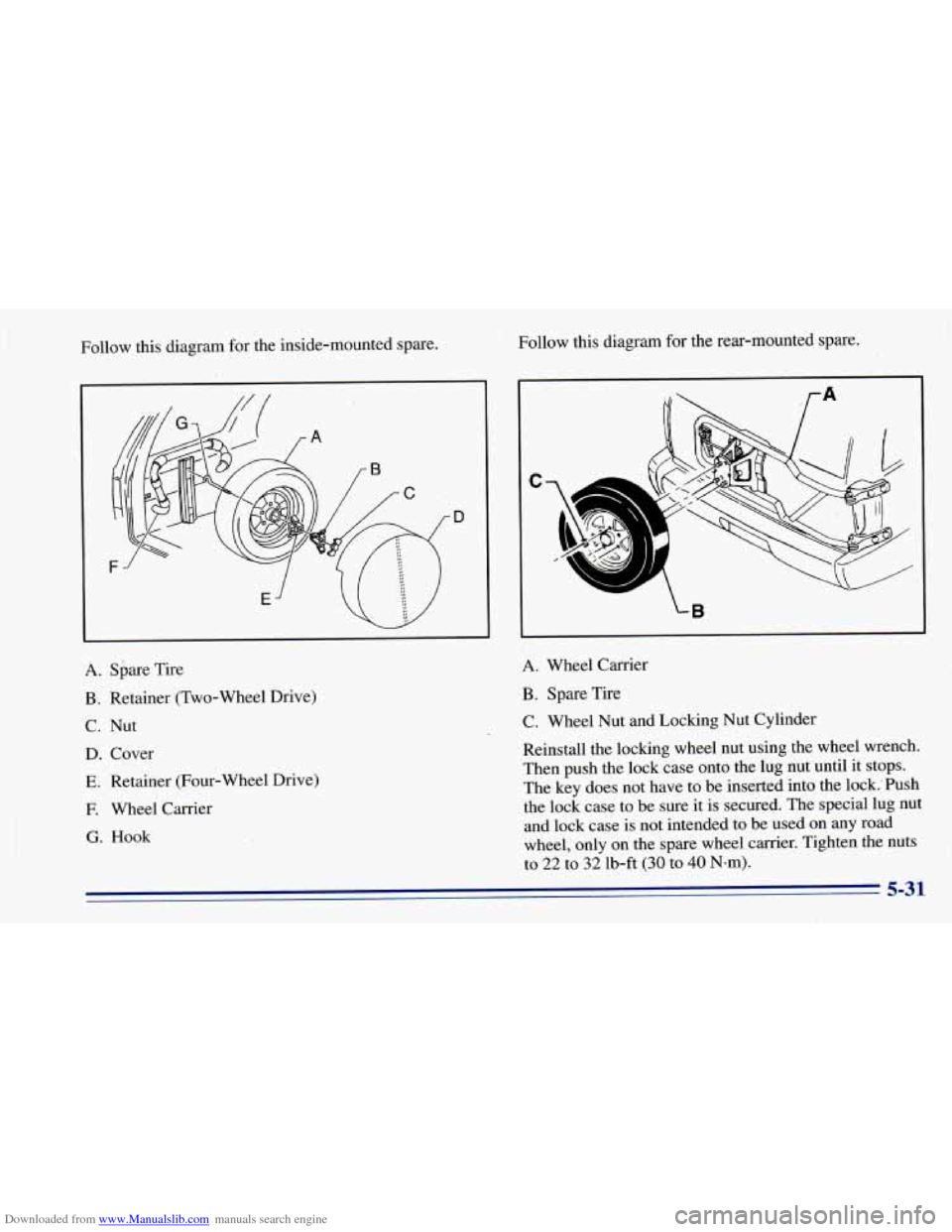
Downloaded from www.Manualslib.com manuals search engine Follow this diagram for the inside-mounted spare.
D
A. Spare Tire
B. Retainer (Two-Wheel Drive)
C. Nut
D. Cover
E. Retainer (Four-wheel Drive)
E Wheel Carrier
G. Hook Follow this diagram
for the rear-mounted spare.
A. Wheel Carrier
B. Spare Tire
C. Wheel Nut and Locking Nut Cylinder
Reinstall the locking wheel nut using the wheel wrench.
Then push the lock case onto the lug nut until it stops.
The key does not have to be inserted into. the 1ock:Push
the lock case
to be sure it is secured. The special lug nut
and lock case is not intended to be used on
any road
wheel, only on the spare wheel carrier. Tighten the nuts
to
22 to 32 lb-ft (30 to 40 N-m).
5-31
Page 244 of 392
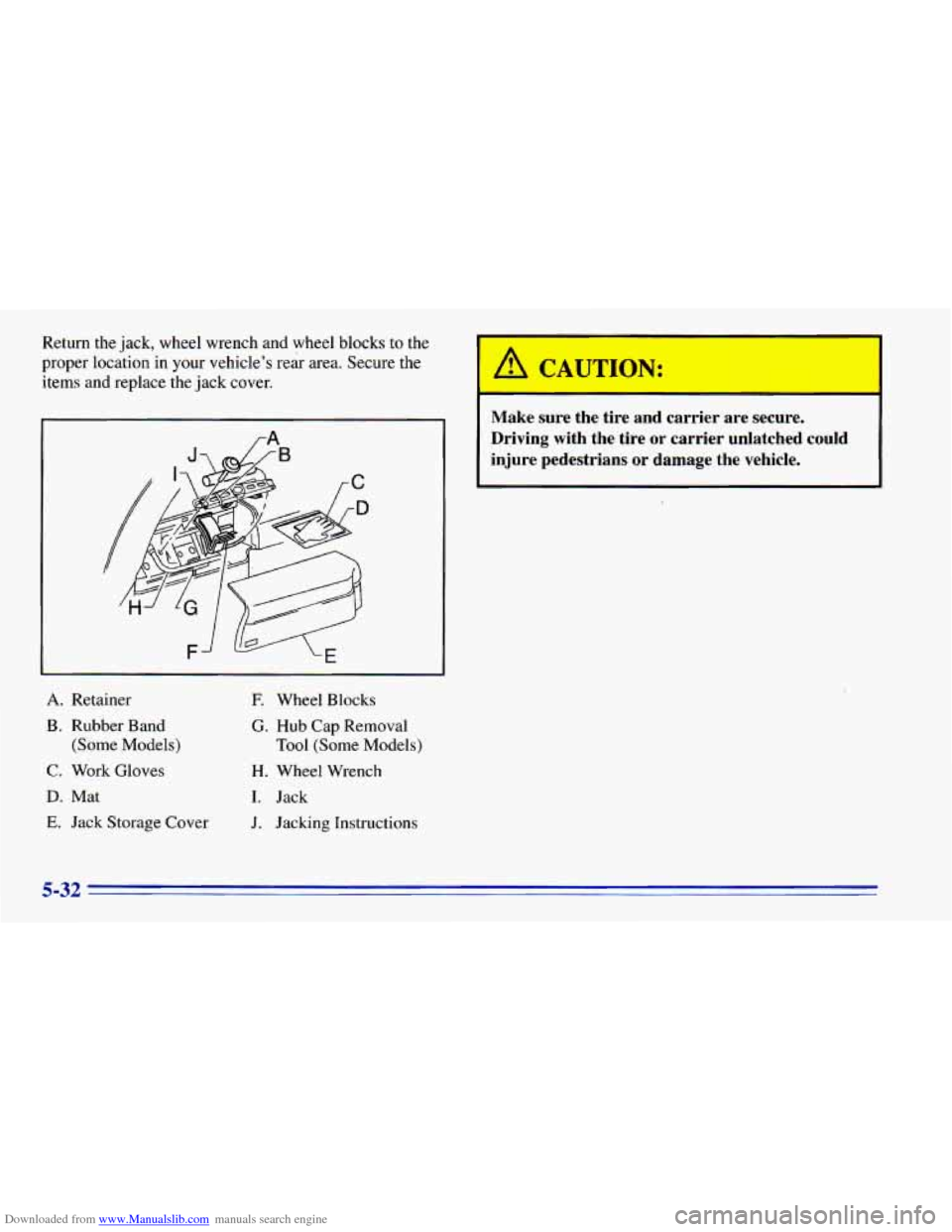
Downloaded from www.Manualslib.com manuals search engine Return the jack, wheel wrench and wheel blocks to the
proper location in your vehicle’s rear area. Secure the
items and replace the jack cover.
A. Retainer
B. Rubber Band
(Some Models)
C. Work Gloves
D. Mat
E. Jack Storage Cover
E Wheel Blocks
G. Hub Cap Removal
H. Wheel Wrench
I. Jack Tool
(Some Models)
J. Jacking Instructions
I A CAUTION:
Make sure the tire and carrier are secure.
Driving with the tire or carrier unlatched could
injure pedestrians
or damage the vehicle.
5-32
Page 253 of 392
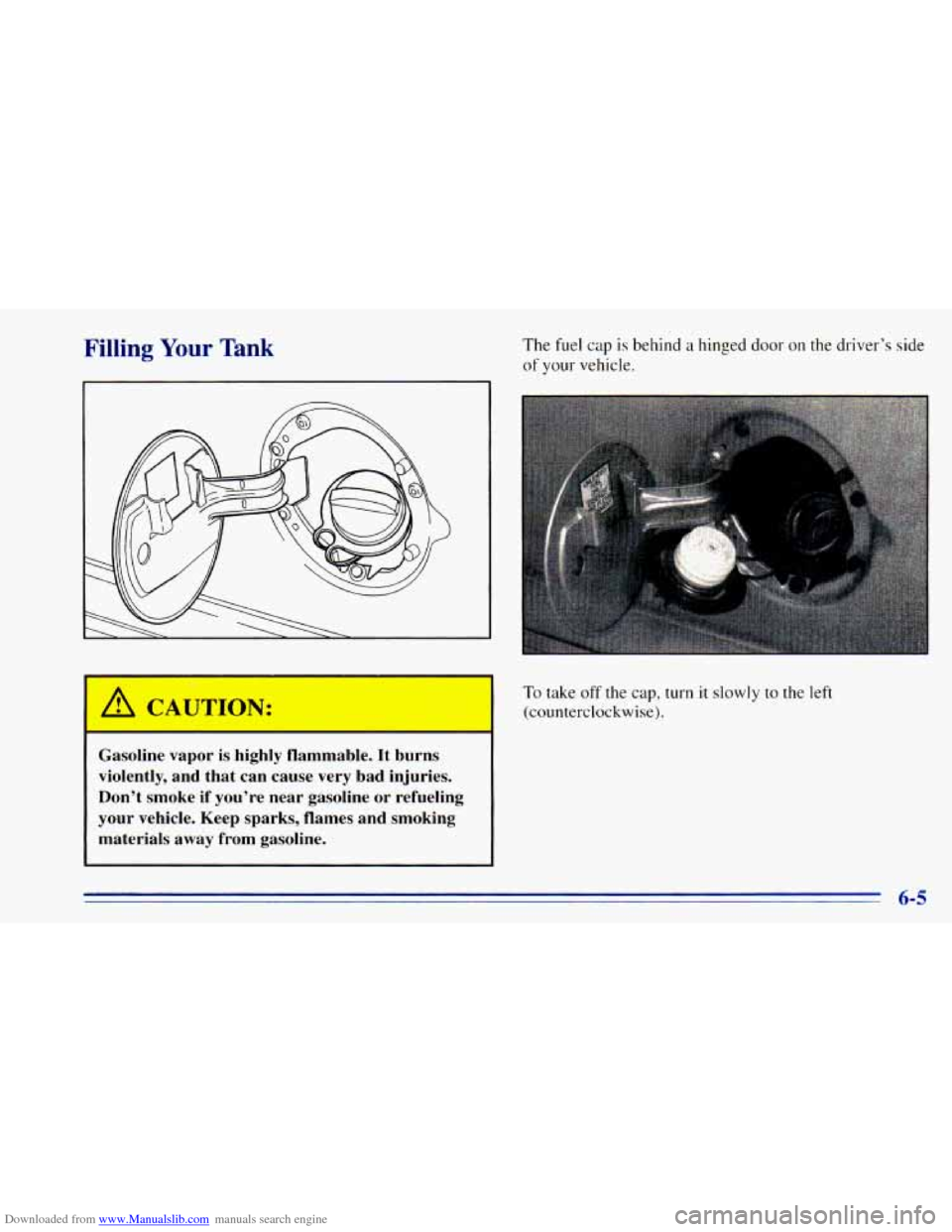
Downloaded from www.Manualslib.com manuals search engine Filling Your Tank The fuel cap is behind a hinged door on the driver’s side
of your vehicle.
To take off the cap, turn it slowly to the left
(counterclockwise).
JTION:
-
Gasoline vapor is highly flammable. It burns
violently, and that can cause very bad injuries.
Don’t smoke if you’re near gasoline or refueling
your vehicle. Keep sparks, flames and smoking
materials away from gasoline.
- 6-5
Page 260 of 392
Downloaded from www.Manualslib.com manuals search engine When to Change Engine Oil
See if any one of these is true for you:
e
0
0
e
e
Most trips are less than 5 to 10 miles (8 to 16 km),
This is particularly important when outside
temperatures are below freezing.
Most trips include extensive idling (such as frequent
driving in stop-and-go traffic).
You operate your vehicle in dusty areas or off-road
frequently.
You frequently tow a trailer or use a carrier on top of
your vehicle.
The vehicle is used for delivery service, police, taxi
or other commercial application.
Driving under these conditions causes engine oil
to
break down sooner. If any one of these is true for your
vehicle, then you need to change your oil and filter
every
3,000 miles (5 000 km) or 3 months -- whichever
occurs first.
If none of them is true, change the oil and filter every
7,500 miles (12 500 km) or 12 months -- whichever
occurs first. Driving a vehicle with a
fully warmed
engine under highway conditions causes engine oil
to
break down slower.
Remote Oil Filter (Four-Wheel Drive)
The access door for the remote oil filter is in the steering
linkage shield assembly located under the radiator
support. Twist the screw to unlock or lock the door.
What to Do with Used Oil
Did you know that used engine oil contains certain
elements that may be unhealthy for your skin and could
even cause cancer? Don’t let used oil stay
on your skin
for very long. Clean
your skin and nails with soap and
water, or a good hand cleaner. Wash or properly throw
away clothing or rags containing used engine oil. (See
the manufacturer’s warnings about the use and disposal
of
oil products.)
Used oil can be a real threat to the environment.
If you
change your own oil, be sure to drain all free-flowing oil
from the filter before disposal. Don’t ever dispose of oil
by putting
it in the trash, pouring it on the ground, into
sewers, or into streams or bodies
of water. Instead,
recycle
it by taking it to a place that collects used oil. If
you have a problem properly disposing of your used oil,
ask your dealer, a service station or
a local recycling
center for help.
6-12
Page 264 of 392
Downloaded from www.Manualslib.com manuals search engine 2. Push it back in all the way, wait three seconds and
then
pull it back out again,
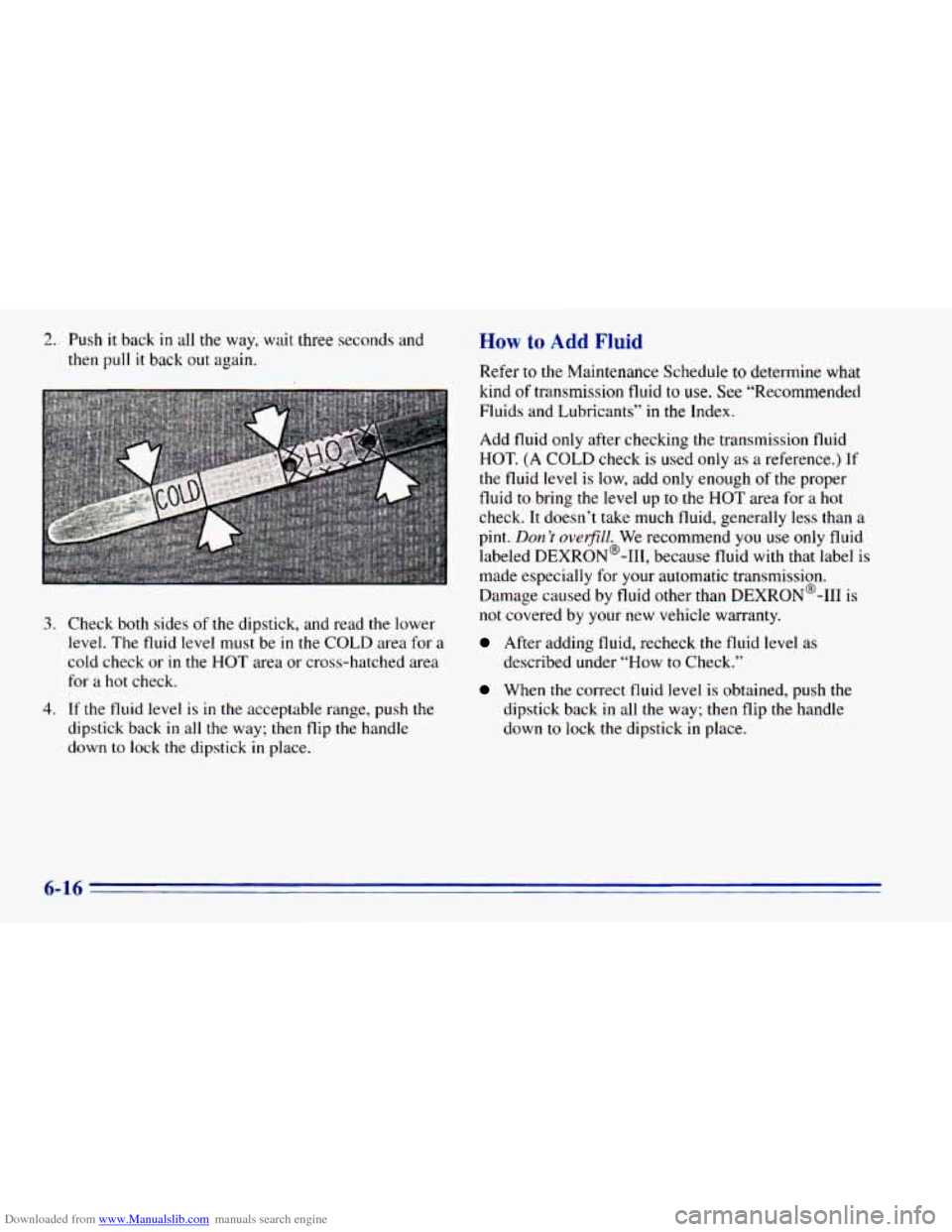
3. Check both sides of the dipstick, and read the lower
level. The fluid level must be in the COLD area for a
cold check or in the HOT area or cross-hatched area
for a hot check.
4. If the fluid level is in the acceptable range, push the
dipstick back in all
the way; then flip the handle
down
to lock the dipstick in place.
How to Add Fluid
Refer to the Maintenance Schedule to determine what
kind
of transmission fluid to use. See “Recommended
Fluids and Lubricants”
in the Index.
Add fluid only after checking the transmission fluid
HOT. (A COLD check is used only as
a reference.) If
the fluid level is low, add only enough
of the proper
fluid to bring the level up
to the HOT area for a hot
check. It doesn’t take much fluid, generally less than a
pint. Don ’t overfill. We recommend you use only fluid
labeled DEXR0N’-111, because fluid with that label is
made especially
for your automatic transmission.
Damage caused by fluid other than DEXRON@-I11 is
not covered by your new vehicle warranty.
After adding fluid, recheck the fluid level as
described under “How to Check.”
When the correct fluid level is obtained, push the
dipstick back in all the way; then flip the handle
down to lock the dipstick in place.
Page 283 of 392
Downloaded from www.Manualslib.com manuals search engine 5. Turn the bulb
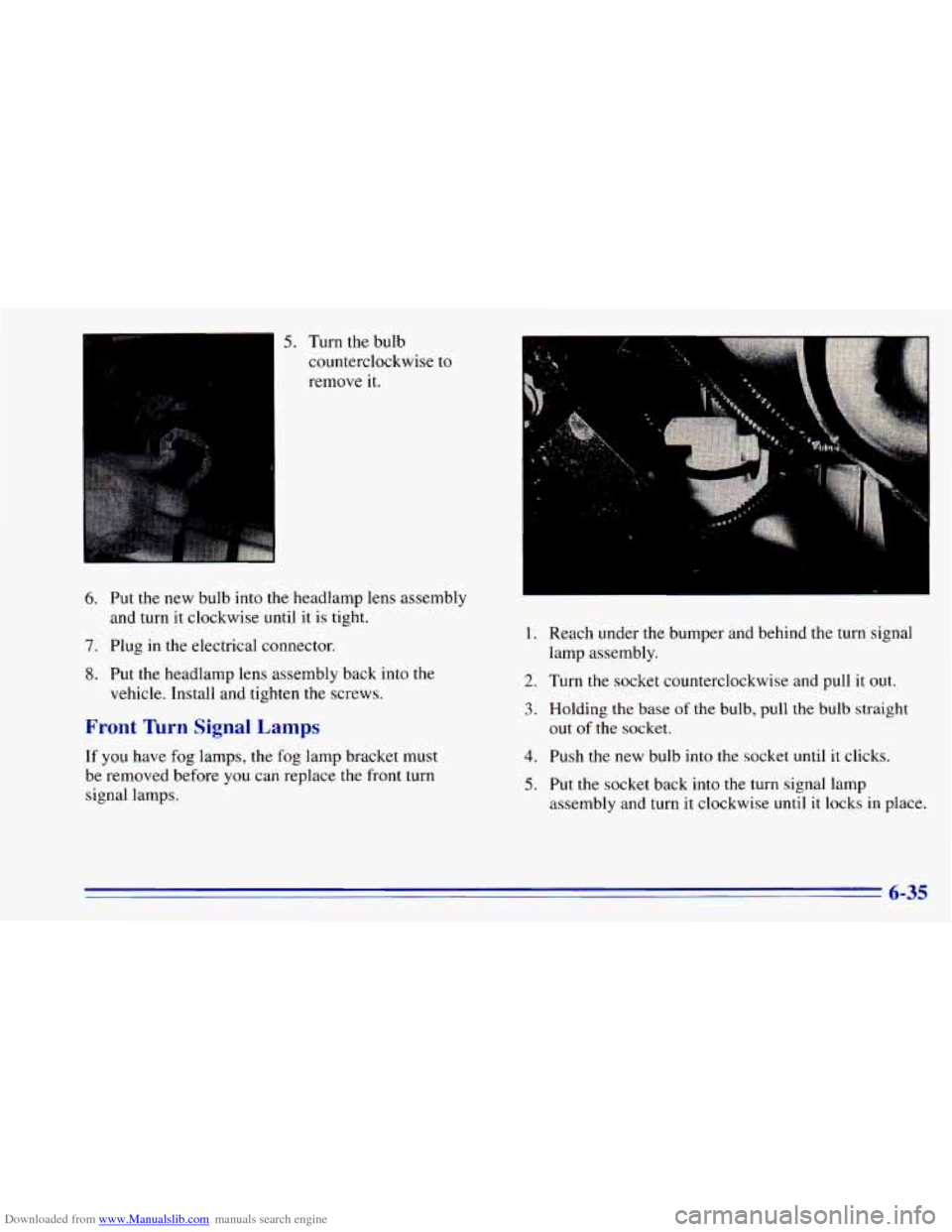
counterclockwise to remove it.
6. Put the new bulb into the headlamp lens assembly
and turn it clockwise until it is tight.
7. Plug in the electrical connector.
8. Put the headlamp lens assembly back into the
vehicle. Install and tighten the screws.
Front Turn Signal Lamps
If you have fog lamps, the fog lamp bracket must
be removed before you can replace the front turn
signal lamps.
.
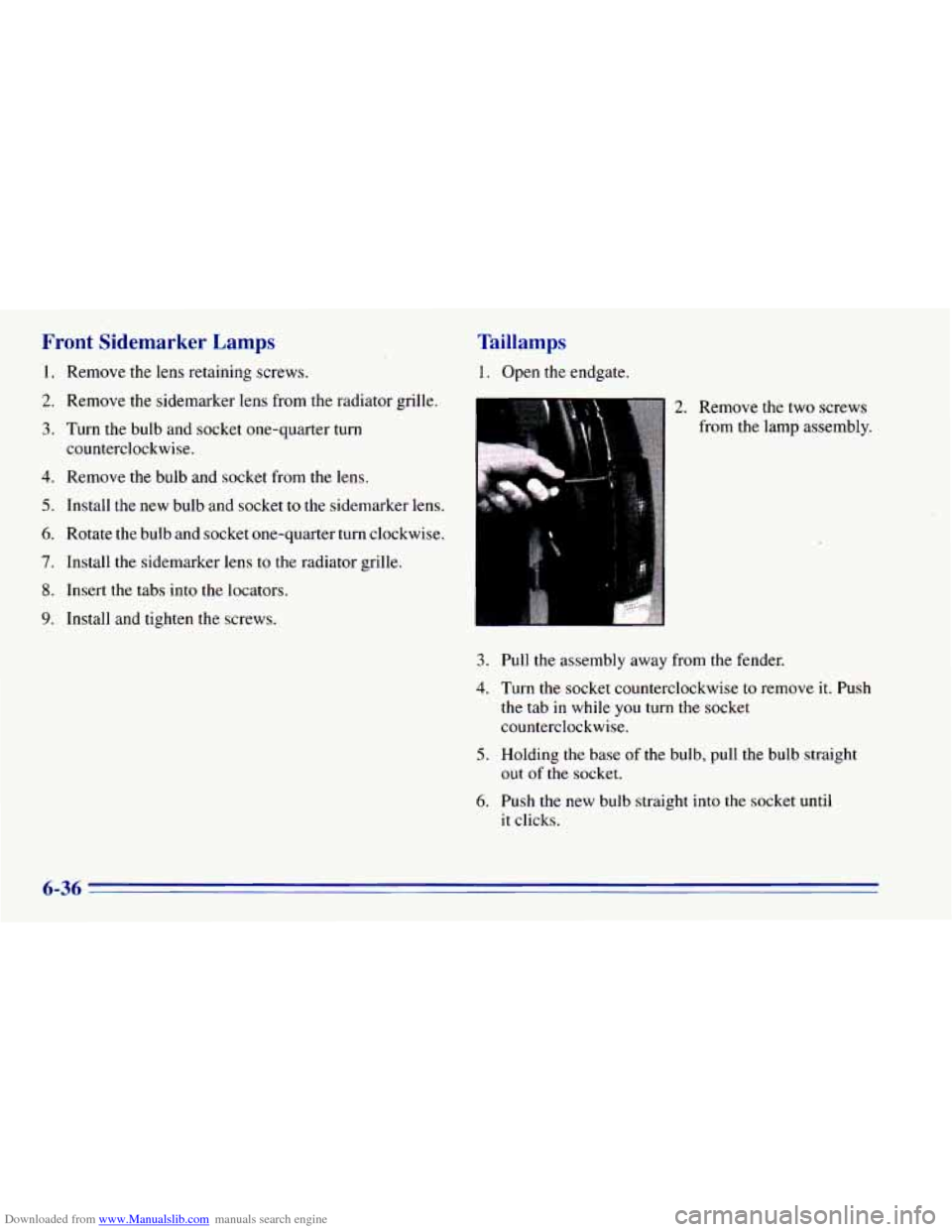
1. Reach under the bumper and behind the turn signal
2. Turn the socket counterclockwise and pull it out.
3. Holding the base of the bulb, pull the bulb straight
lamp
assembly.
out of the socket.
4. Push the new bulb into the socket until it clicks.
5. Put the socket back into the turn signal lamp
assembly and turn it clockwise until
it locks in place.
6-35
Page 284 of 392
Downloaded from www.Manualslib.com manuals search engine Front Sidemarker Lamps
1. Remove the lens retaining screws.
2. Remove the sidemarker lens from the radiator grille.
3. Turn the bulb and socket one-quarter turn
4. Remove the bulb and socket from the lens.
5. Install the new bulb and socket to the sidemarker lens.
6. Rotate the bulb and socket one-quarter turn clockwise.
7. Install the sidemarker lens to the radiator grille.
8. Insert the tabs into the locators.
counterclockwise.
9. Install and
tighten the screws.
Taillamps
1. Open the endgate.
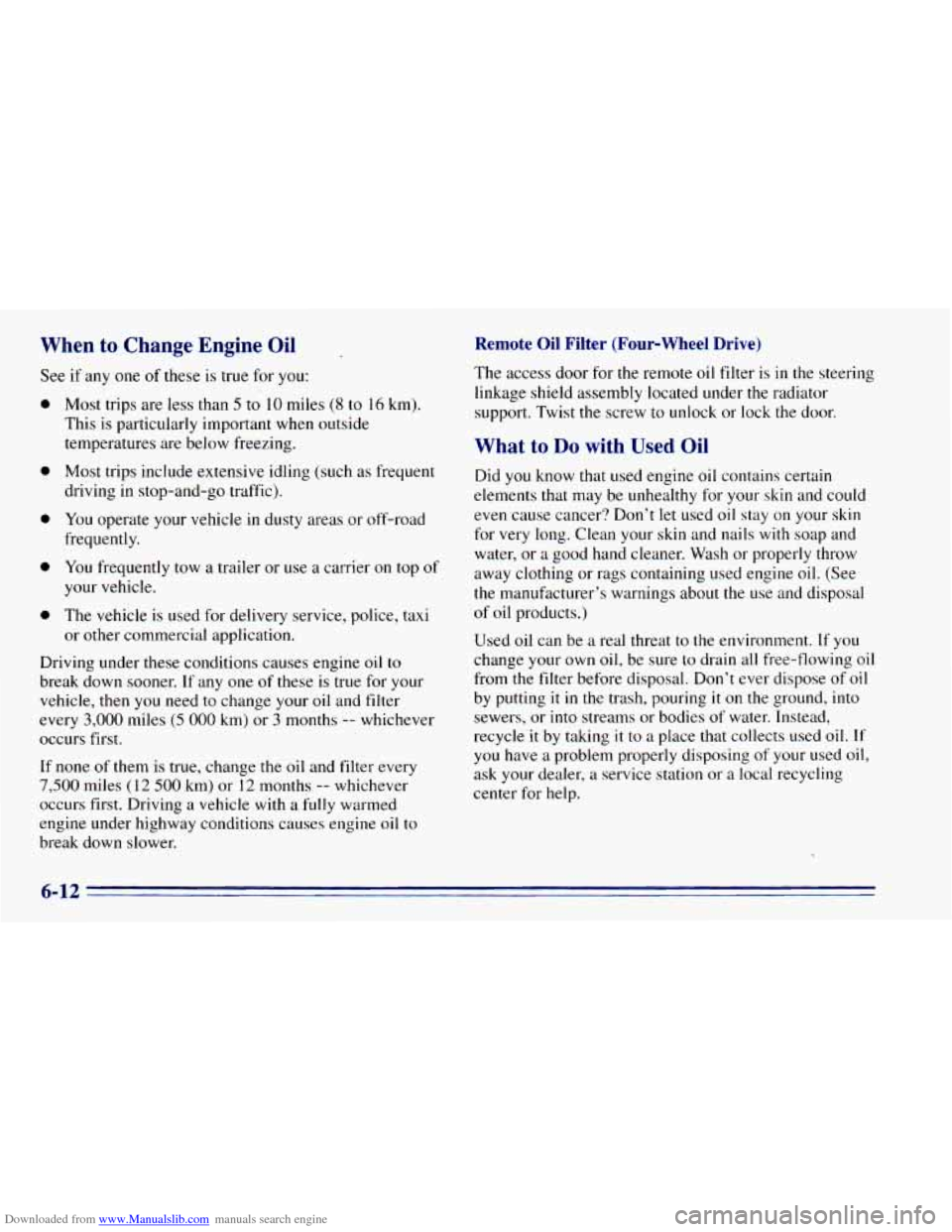
2. Remove the two screws
from the lamp assembly.
3. Pull the assembly away from me fender.
4. Turn the socket counterclockwise to remove it. Push
the tab
in while you turn the socket
counterclockwise.
5. Holding the base of the bulb, pull the bulb straight
out of the socket.
6. Push the new bulb straight into the socket until
it clicks.
6-36