Page 665 of 2248
![SUBARU LEGACY 1995 Service Repair Manual 6. Control Valve (Power Steering
Gearbox) [RHD model]
NOTE:
This section focuses on the disassembly and reassembly
of control valve. For the inspection and adjustment and the
service procedures for as](/manual-img/17/57432/w960_57432-664.png "SUBARU LEGACY 1995 Service Repair Manual 6. Control Valve (Power Steering
Gearbox) [RHD model]
NOTE:
This section focuses on the disassembly and reassembly
of control valve. For the inspection and adjustment and the
service procedures for as")
6. Control Valve (Power Steering
Gearbox) [RHD model]
NOTE:
This section focuses on the disassembly and reassembly
of control valve. For the inspection and adjustment and the
service procedures for associated parts, refer to“Steering
Gearbox”.
B4M0668A
A: CHECKING OIL LEAKING POINTS
1. OIL LEAKING POINTS
1) If leak point is other than a, b, c, or d, perform check
step 5) in [W6A2] before dismounting gearbox from
vehicle. If gearbox is dismounted without confirming where
the leak is, it must be mounted again to locate the leak
point.
2) Even if the location of the leak can be easily found by
observing the leaking condition, it is necessary to thor-
oughly remove the oil from the suspected portion and turn
the steering wheel from lock to lock about 30 to 40 times
with engine running, then make comparison of the sus-
pected portion between immediately after and several
hours after this operation.
3) Before starting oil leak repair work, be sure to clean the
gearbox, hoses, pipes, and surrounding parts. After com-
pleting repair work, clean these areas again.
49
4-3SERVICE PROCEDURE
6. Control Valve (Power Steering Gearbox) [RHD model]
Page 666 of 2248

2. OIL LEAK CHECK PROCEDURE AND
REPLACEMENT PARTS
NOTE:
Parts requiring replacement are described in the smallest
unit of spare parts including damaged parts and spare
parts damaged. In actual disassembly work, accidental
damage as well as inevitable damage to some related
parts must be taken into account, and spare parts for them
must also be prepared. However, it is essential to pinpoint
the cause of trouble, and limit the number of replacement
parts as much as possible.
1) Leakage from“a”
The oil seal is damaged. Replace valve assembly with a
new one.
2) Leakage from“b”
The torsion bar O-ring is damaged. Replace valve assem-
bly with a new one.
3) Leakage from“c”
The oil seal is damaged. Replace valve assembly with a
new one.
4) Leakage from“d”
The pipe is damaged. Replace the faulty pipe or O-ring.
5) If leak is other than a, b, c, or d, and if oil is leaking from
the gearbox, move the right and left boots toward tie-rod
end side, respectively, with the gearbox mounted to the
vehicle, and remove oil from the surrounding portions.
Then, turn the steering wheel from lock to lock 30 to 40
times with the engine running, then make comparison of
the leaked portion immediately after and several hours
after this operation.
6) Leakage from“e”
There are two possible causes. Take following step first.
Remove the pipe assembly B from the valve housing, and
close the circuit with ST.
ST 926420000 PLUG
Turn the steering wheel from lock to lock 30 to 40 times
with the engine running, then make comparison of the
leaked portion between immediately after and several
hours after this operation.
CAUTION:
�If leakage from“e”is noted again:
The oil seal of pinion and valve assembly is damaged.
Replace pinion and valve assembly with a new one. Or
replace the oil seal and the parts that are damaged
during disassembly with new ones.
�If oil stops leaking from“e”:
The oil seal of rack housing is damaged.
Replace the oil seal and the parts that are damaged
during disassembly with new ones.
50
4-3SERVICE PROCEDURE
6. Control Valve (Power Steering Gearbox) [RHD model]
Page 696 of 2248
6) Check
(1) When reassembly procedures have been
completed, turn shaft by hand to ensure it turns
smoothly. If it binds or other unusual conditions are
evident, disassemble again and check for foreign mat-
ter trapped on sliding surfaces and improper installa-
tion. Eliminate the cause of trouble.
(2) Check followings by referring to“CHECK”article.
�Excessive play in pulley shaft
�Ditch deflection of pulley
�Resistance to rotation of pulley
�Measurement of generated oil pressure
F: INSTALLATION
1) Install bracket on engine.
Tightening torque:
22±2 N⋅m (2.2±0.2 kg-m, 15.9±1.4 ft-lb)
2) Install oil pump on oil tank as follows outside the
vehicle:
NOTE:
Prior to installation, make sure that all oil is removed from
oil pump, oil tank and pipe.
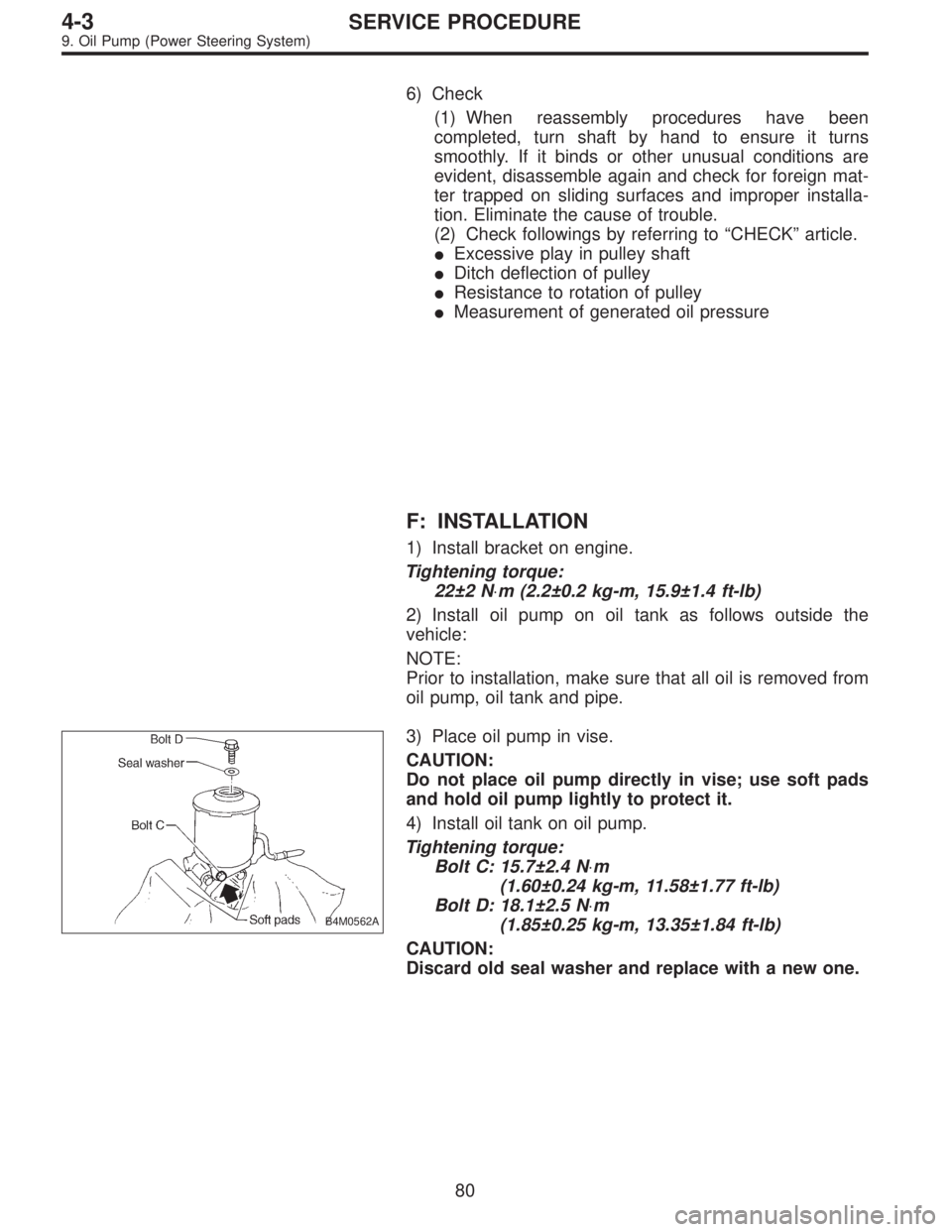
B4M0562A
3) Place oil pump in vise.
CAUTION:
Do not place oil pump directly in vise; use soft pads
and hold oil pump lightly to protect it.
4) Install oil tank on oil pump.
Tightening torque:
Bolt C: 15.7±2.4 N⋅m
(1.60±0.24 kg-m, 11.58±1.77 ft-lb)
Bolt D: 18.1±2.5 N⋅m
(1.85±0.25 kg-m, 13.35±1.84 ft-lb)
CAUTION:
Discard old seal washer and replace with a new one.
80
4-3SERVICE PROCEDURE
9. Oil Pump (Power Steering System)
Page 699 of 2248
10) Check the fluid leakage at flare nuts after turning
steering wheel from lock to lock with engine running.
CAUTION:
�Before checking, wipe off any fluid on flare nuts and
piping.
�In case the fluid leaks from flare nut, it is caused by
dust (or the like) and/or damage between flare and
tapered seat in piping.
�So remove the flare nut, tighten again it to the speci-
fied torque after cleaning flare and tapered seat. If flare
or tapered seat is damaged, replace it with a new one.
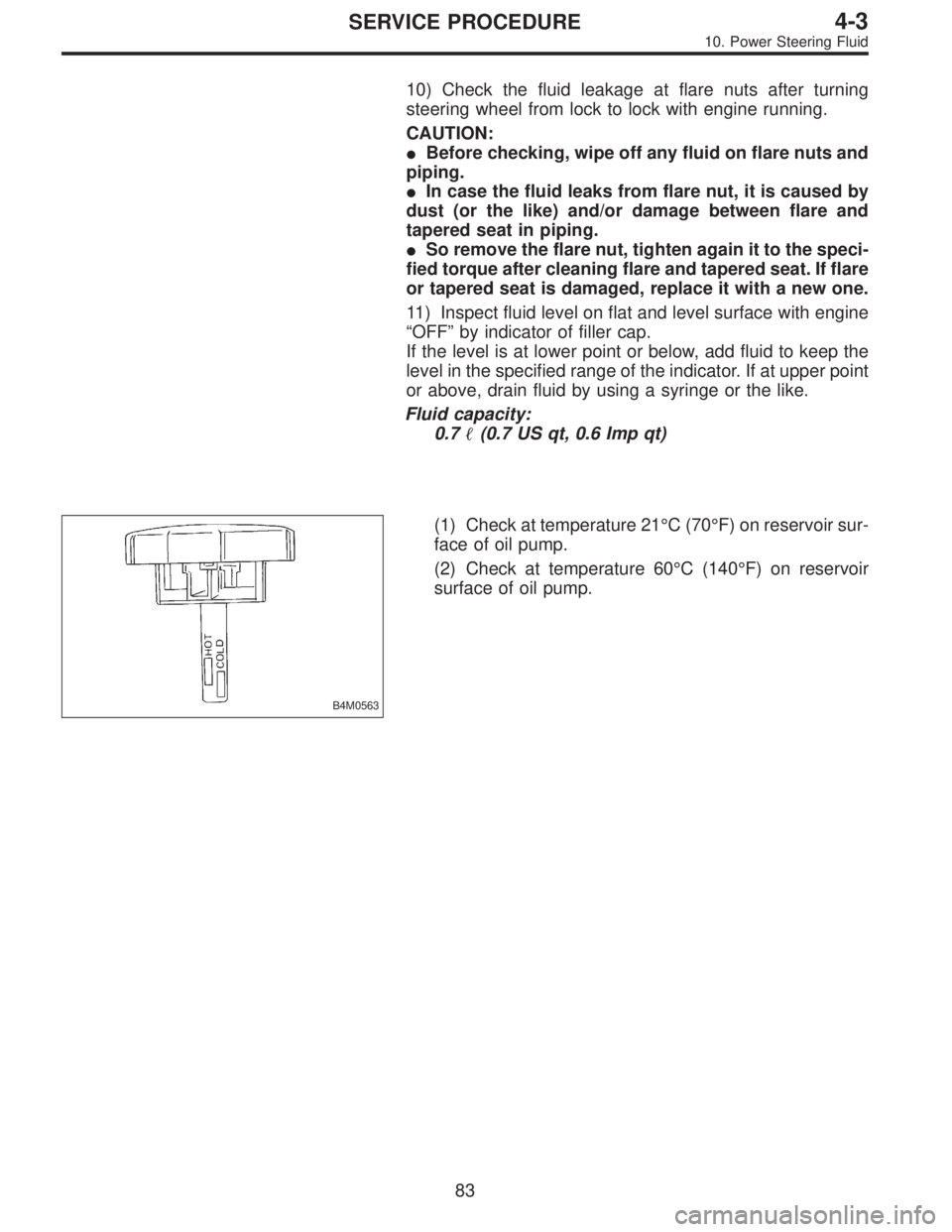
11) Inspect fluid level on flat and level surface with engine
“OFF”by indicator of filler cap.
If the level is at lower point or below, add fluid to keep the
level in the specified range of the indicator. If at upper point
or above, drain fluid by using a syringe or the like.
Fluid capacity:
0.7�(0.7 US qt, 0.6 Imp qt)
B4M0563
(1) Check at temperature 21°C (70°F) on reservoir sur-
face of oil pump.
(2) Check at temperature 60°C (140°F) on reservoir
surface of oil pump.
83
4-3SERVICE PROCEDURE
10. Power Steering Fluid
Page 703 of 2248
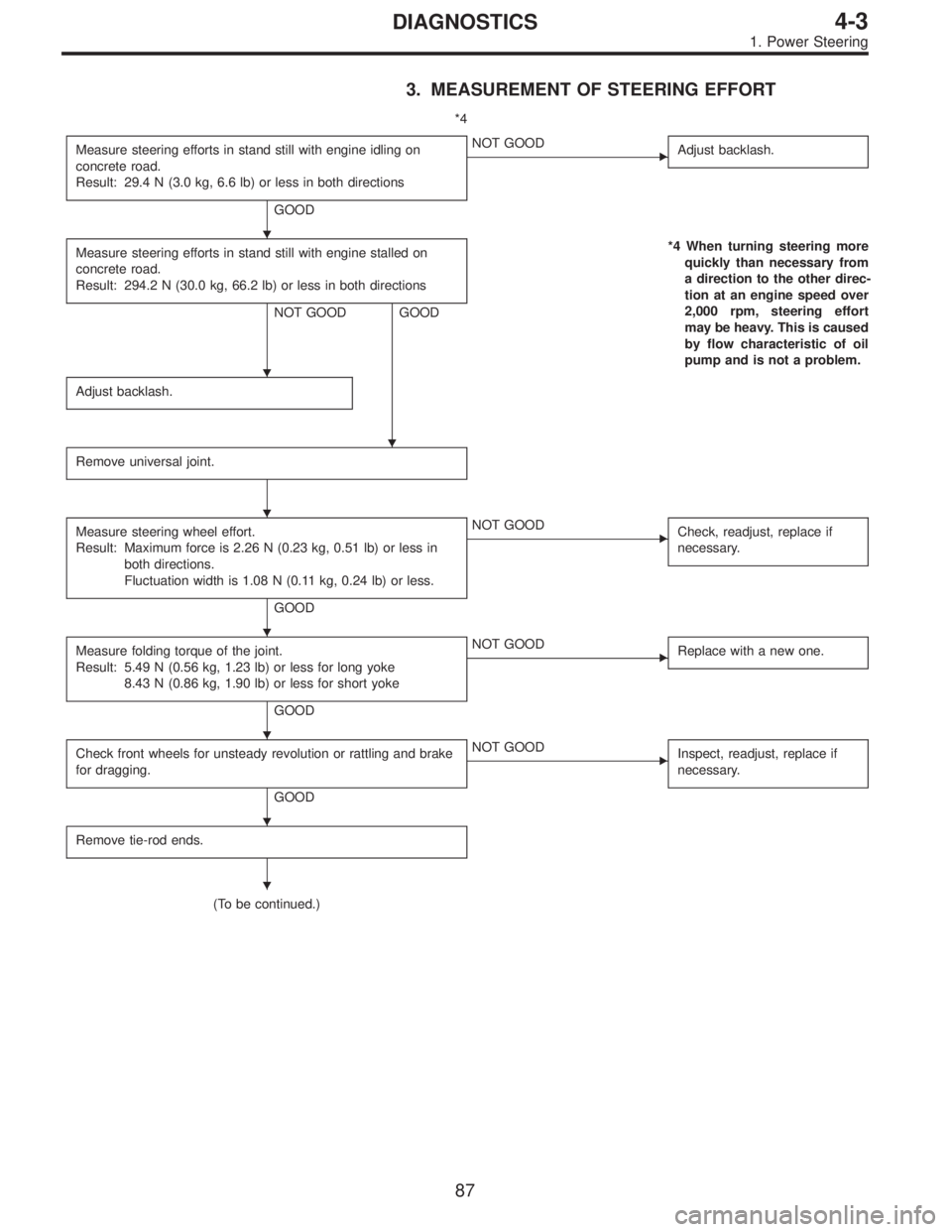
3. MEASUREMENT OF STEERING EFFORT
*4
Measure steering efforts in stand still with engine idling on
concrete road.
Result: 29.4 N (3.0 kg, 6.6 lb) or less in both directions
GOOD
�NOT GOOD
Adjust backlash.
Measure steering efforts in stand still with engine stalled on
concrete road.
Result: 294.2 N (30.0 kg, 66.2 lb) or less in both directions
NOT GOOD GOOD*4 When turning steering more
quickly than necessary from
a direction to the other direc-
tion at an engine speed over
2,000 rpm, steering effort
may be heavy. This is caused
by flow characteristic of oil
pump and is not a problem.
Adjust backlash.
Remove universal joint.
Measure steering wheel effort.
Result: Maximum force is 2.26 N (0.23 kg, 0.51 lb) or less in
both directions.
Fluctuation width is 1.08 N (0.11 kg, 0.24 lb) or less.
GOOD
�NOT GOOD
Check, readjust, replace if
necessary.
Measure folding torque of the joint.
Result: 5.49 N (0.56 kg, 1.23 lb) or less for long yoke
8.43 N (0.86 kg, 1.90 lb) or less for short yoke
GOOD
�NOT GOOD
Replace with a new one.
Check front wheels for unsteady revolution or rattling and brake
for dragging.
GOOD
�NOT GOOD
Inspect, readjust, replace if
necessary.
Remove tie-rod ends.
(To be continued.)
�
�
�
�
�
�
�
�
87
4-3DIAGNOSTICS
1. Power Steering
Page 711 of 2248
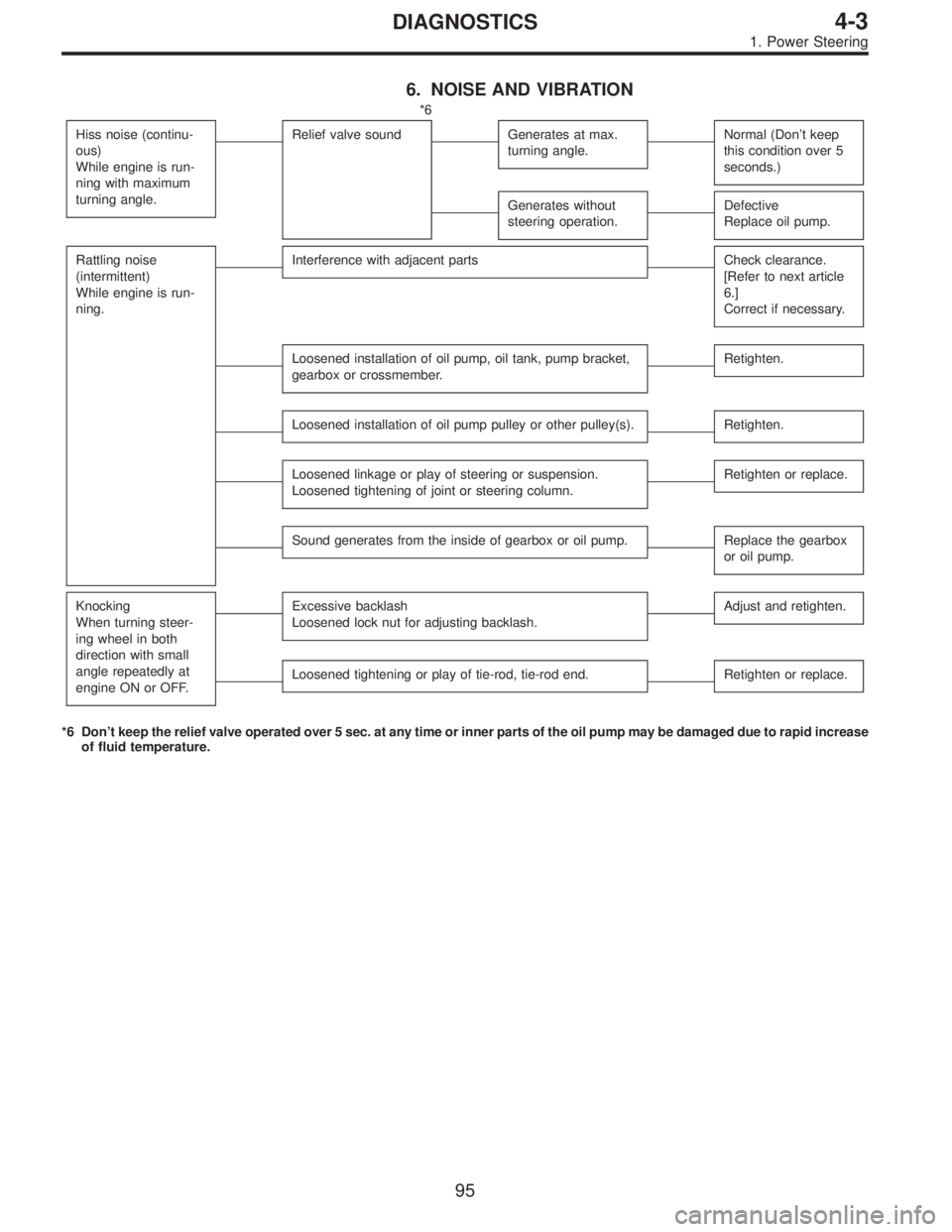
6. NOISE AND VIBRATION
*6
Hiss noise (continu-
ous)
While engine is run-
ning with maximum
turning angle.
Relief valve soundGenerates at max.
turning angle.Normal (Don’t keep
this condition over 5
seconds.)
Generates without
steering operation.Defective
Replace oil pump.
Rattling noise
(intermittent)
While engine is run-
ning.Interference with adjacent partsCheck clearance.
[Refer to next article
6.]
Correct if necessary.
Loosened installation of oil pump, oil tank, pump bracket,
gearbox or crossmember.Retighten.
Loosened installation of oil pump pulley or other pulley(s).Retighten.
Loosened linkage or play of steering or suspension.
Loosened tightening of joint or steering column.Retighten or replace.
Sound generates from the inside of gearbox or oil pump.Replace the gearbox
or oil pump.
Knocking
When turning steer-
ing wheel in both
direction with small
angle repeatedly at
engine ON or OFF.Excessive backlash
Loosened lock nut for adjusting backlash.Adjust and retighten.
Loosened tightening or play of tie-rod, tie-rod end.Retighten or replace.
*6 Don’t keep the relief valve operated over 5 sec. at any time or inner parts of the oil pump may be damaged due to rapid increase
of fluid temperature.
95
4-3DIAGNOSTICS
1. Power Steering
Page 761 of 2248
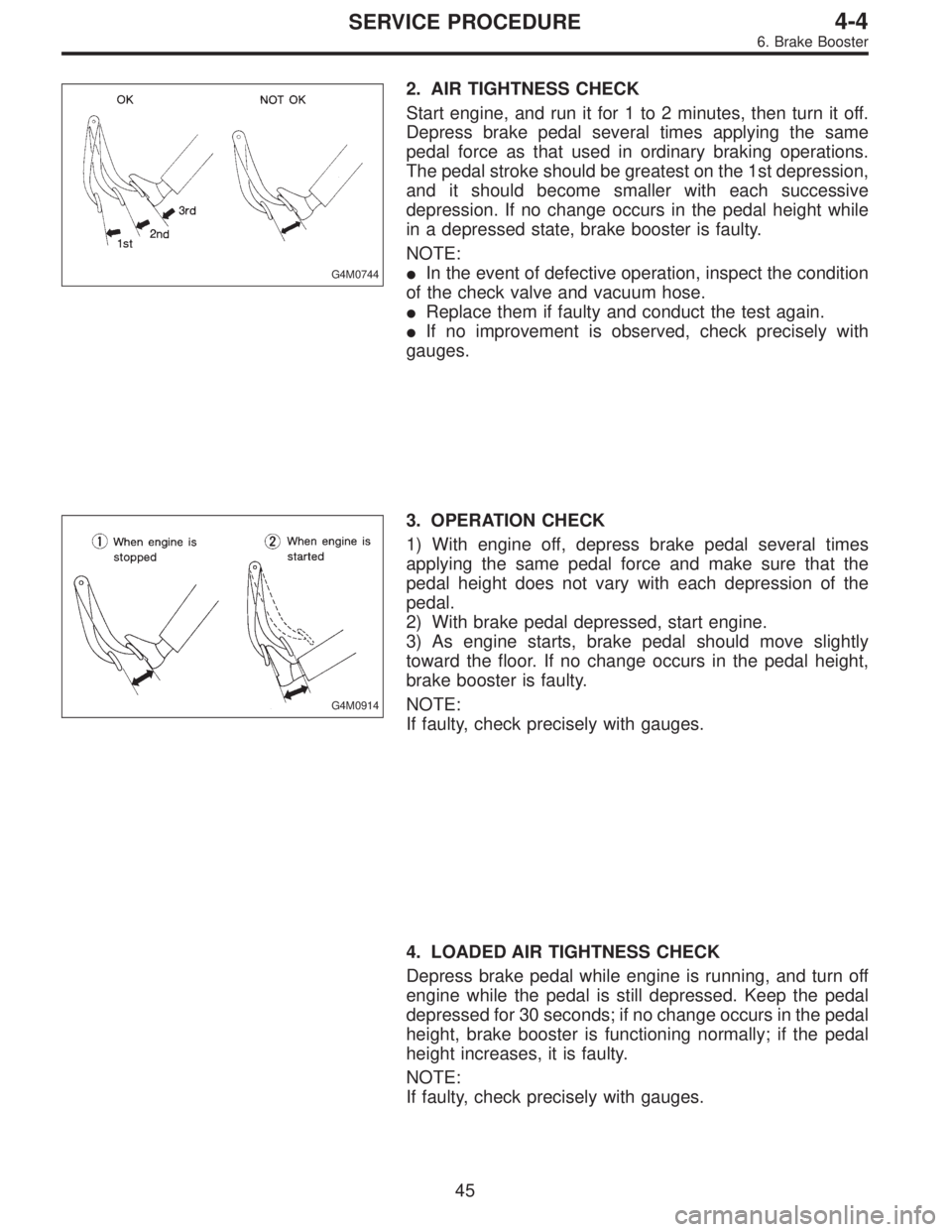
G4M0744
2. AIR TIGHTNESS CHECK
Start engine, and run it for 1 to 2 minutes, then turn it off.
Depress brake pedal several times applying the same
pedal force as that used in ordinary braking operations.
The pedal stroke should be greatest on the 1st depression,
and it should become smaller with each successive
depression. If no change occurs in the pedal height while
in a depressed state, brake booster is faulty.
NOTE:
�In the event of defective operation, inspect the condition
of the check valve and vacuum hose.
�Replace them if faulty and conduct the test again.
�If no improvement is observed, check precisely with
gauges.
G4M0914
3. OPERATION CHECK
1) With engine off, depress brake pedal several times
applying the same pedal force and make sure that the
pedal height does not vary with each depression of the
pedal.
2) With brake pedal depressed, start engine.
3) As engine starts, brake pedal should move slightly
toward the floor. If no change occurs in the pedal height,
brake booster is faulty.
NOTE:
If faulty, check precisely with gauges.
4. LOADED AIR TIGHTNESS CHECK
Depress brake pedal while engine is running, and turn off
engine while the pedal is still depressed. Keep the pedal
depressed for 30 seconds; if no change occurs in the pedal
height, brake booster is functioning normally; if the pedal
height increases, it is faulty.
NOTE:
If faulty, check precisely with gauges.
45
4-4SERVICE PROCEDURE
6. Brake Booster
Page 762 of 2248
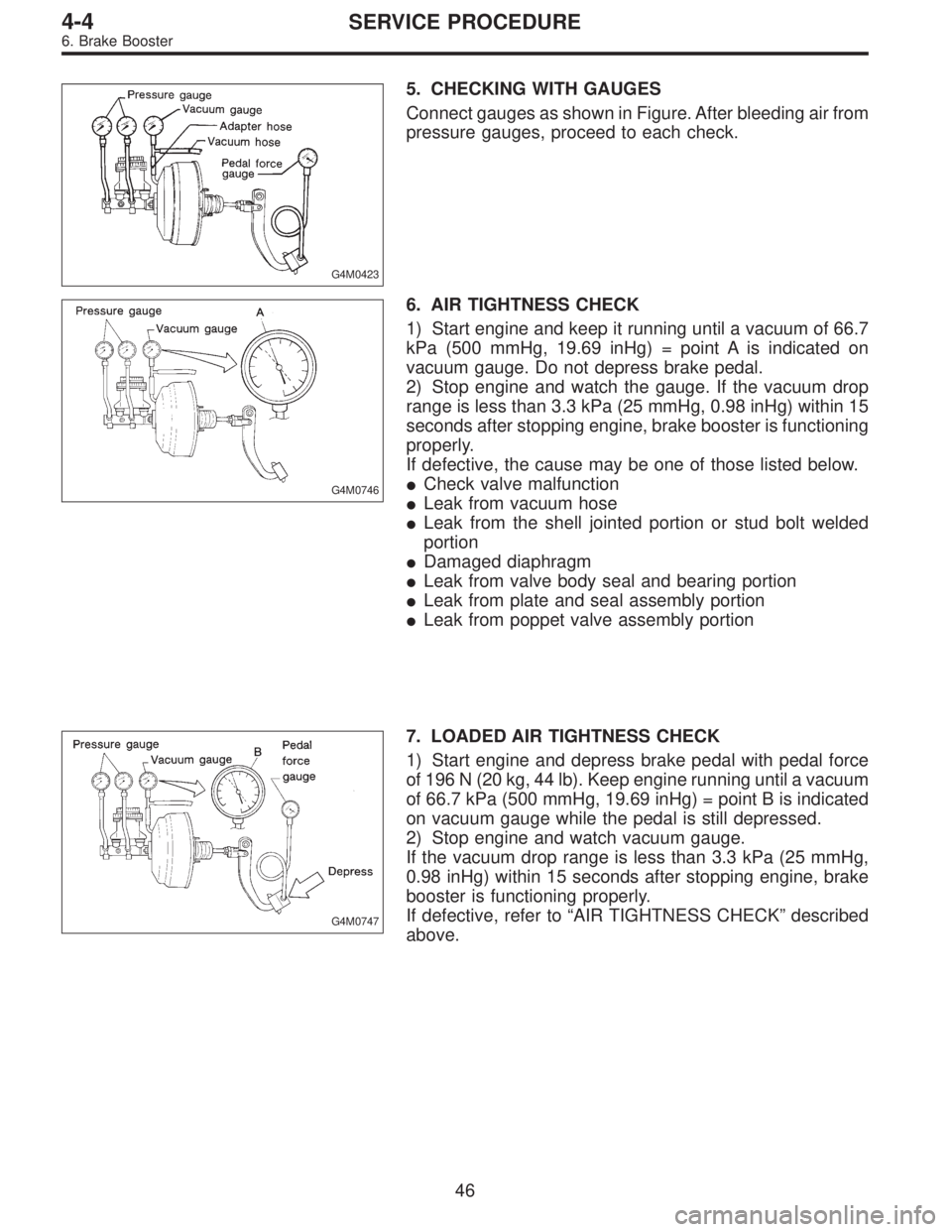
G4M0423
5. CHECKING WITH GAUGES
Connect gauges as shown in Figure. After bleeding air from
pressure gauges, proceed to each check.
G4M0746
6. AIR TIGHTNESS CHECK
1) Start engine and keep it running until a vacuum of 66.7
kPa (500 mmHg, 19.69 inHg) = point A is indicated on
vacuum gauge. Do not depress brake pedal.
2) Stop engine and watch the gauge. If the vacuum drop
range is less than 3.3 kPa (25 mmHg, 0.98 inHg) within 15
seconds after stopping engine, brake booster is functioning
properly.
If defective, the cause may be one of those listed below.
�Check valve malfunction
�Leak from vacuum hose
�Leak from the shell jointed portion or stud bolt welded
portion
�Damaged diaphragm
�Leak from valve body seal and bearing portion
�Leak from plate and seal assembly portion
�Leak from poppet valve assembly portion
G4M0747
7. LOADED AIR TIGHTNESS CHECK
1) Start engine and depress brake pedal with pedal force
of 196 N (20 kg, 44 lb). Keep engine running until a vacuum
of 66.7 kPa (500 mmHg, 19.69 inHg) = point B is indicated
on vacuum gauge while the pedal is still depressed.
2) Stop engine and watch vacuum gauge.
If the vacuum drop range is less than 3.3 kPa (25 mmHg,
0.98 inHg) within 15 seconds after stopping engine, brake
booster is functioning properly.
If defective, refer to“AIR TIGHTNESS CHECK”described
above.
46
4-4SERVICE PROCEDURE
6. Brake Booster