Page 179 of 2248
B2M0358
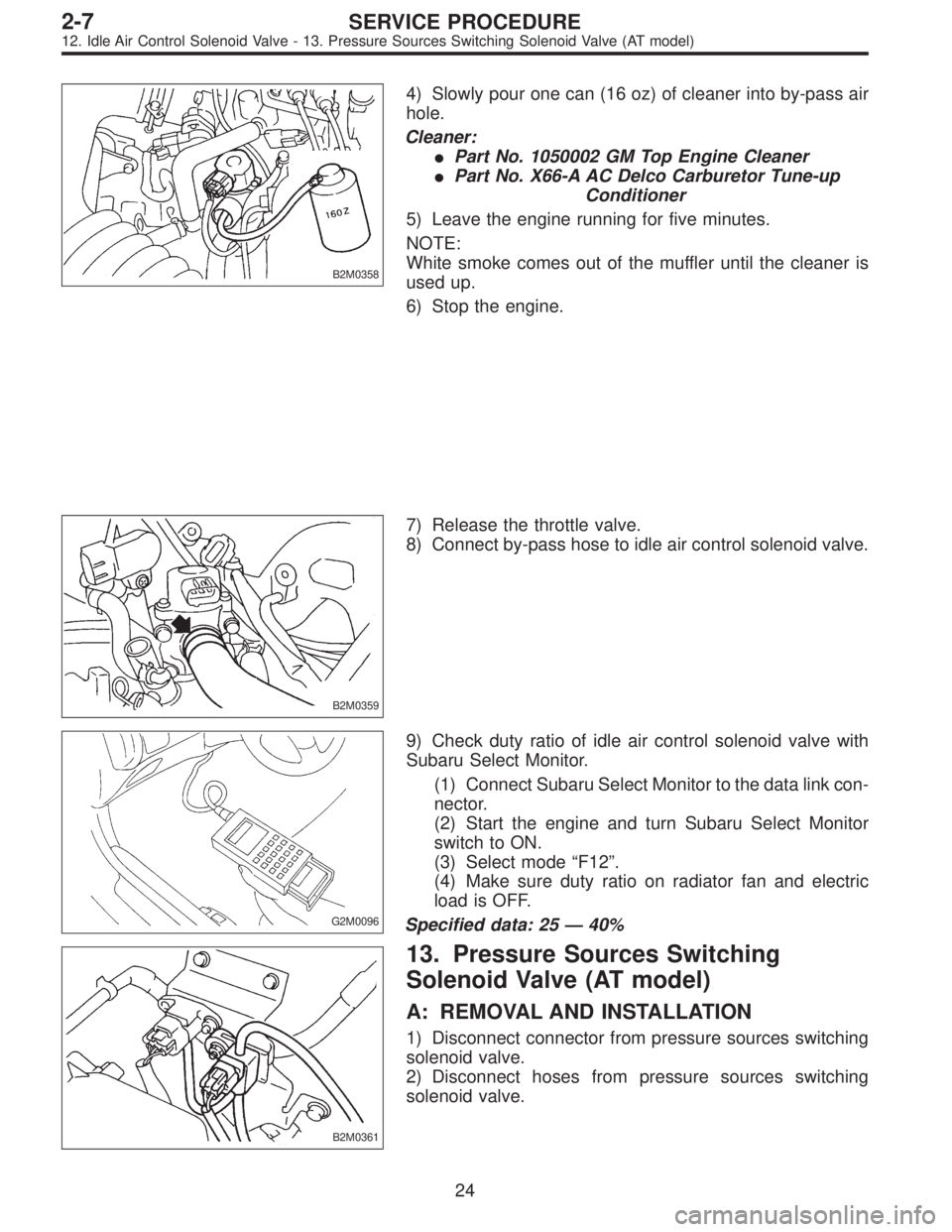
4) Slowly pour one can (16 oz) of cleaner into by-pass air
hole.
Cleaner:
�Part No. 1050002 GM Top Engine Cleaner
�Part No. X66-A AC Delco Carburetor Tune-up
Conditioner
5) Leave the engine running for five minutes.
NOTE:
White smoke comes out of the muffler until the cleaner is
used up.
6) Stop the engine.
B2M0359
7) Release the throttle valve.
8) Connect by-pass hose to idle air control solenoid valve.
G2M0096
9) Check duty ratio of idle air control solenoid valve with
Subaru Select Monitor.
(1) Connect Subaru Select Monitor to the data link con-
nector.
(2) Start the engine and turn Subaru Select Monitor
switch to ON.
(3) Select mode“F12”.
(4) Make sure duty ratio on radiator fan and electric
load is OFF.
Specified data: 25—40%
B2M0361
13. Pressure Sources Switching
Solenoid Valve (AT model)
A: REMOVAL AND INSTALLATION
1) Disconnect connector from pressure sources switching
solenoid valve.
2) Disconnect hoses from pressure sources switching
solenoid valve.
24
2-7SERVICE PROCEDURE
12. Idle Air Control Solenoid Valve - 13. Pressure Sources Switching Solenoid Valve (AT model)
Page 192 of 2248
B2M0049
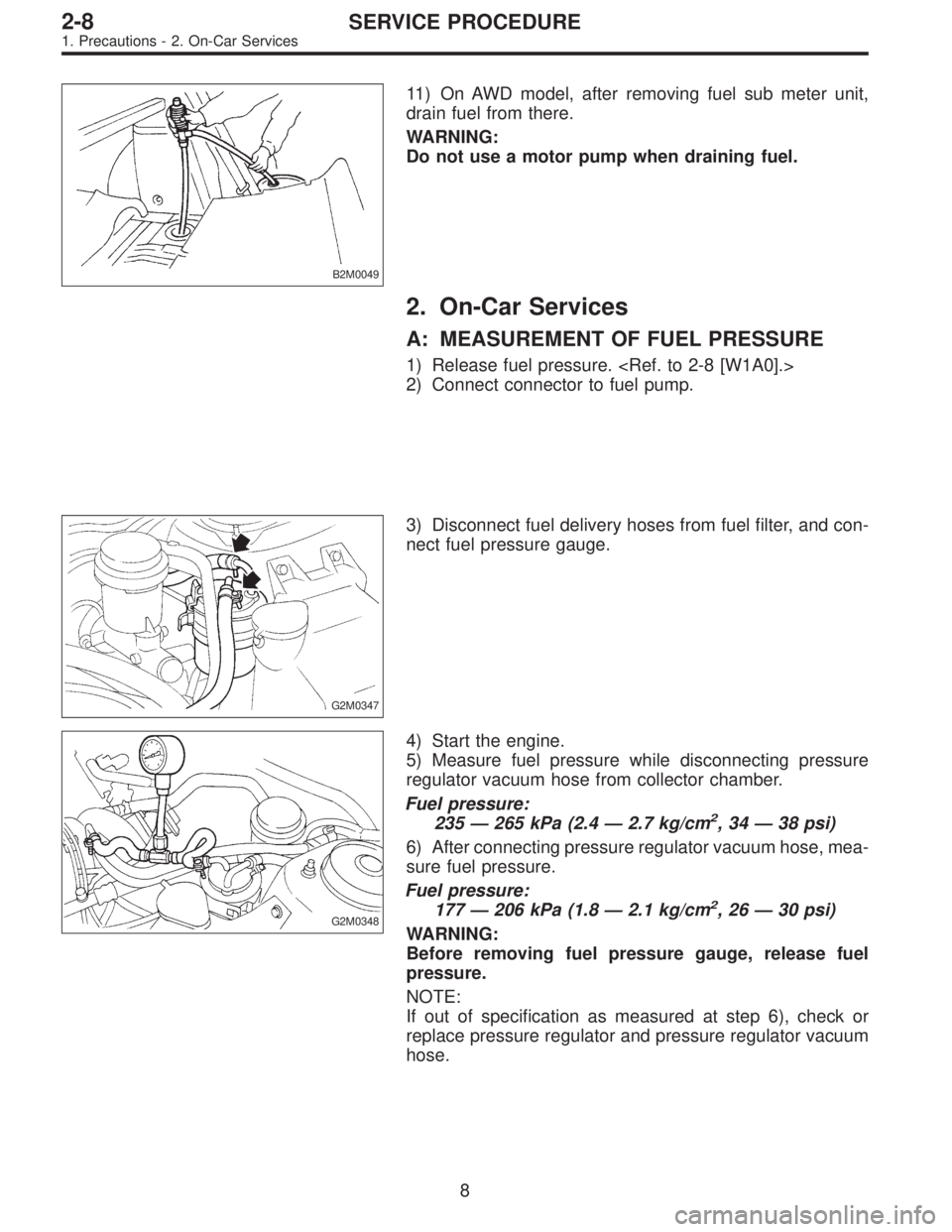
11) On AWD model, after removing fuel sub meter unit,
drain fuel from there.
WARNING:
Do not use a motor pump when draining fuel.
2. On-Car Services
A: MEASUREMENT OF FUEL PRESSURE
1) Release fuel pressure.
2) Connect connector to fuel pump.
G2M0347
3) Disconnect fuel delivery hoses from fuel filter, and con-
nect fuel pressure gauge.
G2M0348
4) Start the engine.
5) Measure fuel pressure while disconnecting pressure
regulator vacuum hose from collector chamber.
Fuel pressure:
235 — 265 kPa (2.4 — 2.7 kg/cm
2, 34 — 38 psi)
6) After connecting pressure regulator vacuum hose, mea-
sure fuel pressure.
Fuel pressure:
177 — 206 kPa (1.8 — 2.1 kg/cm
2, 26 — 30 psi)
WARNING:
Before removing fuel pressure gauge, release fuel
pressure.
NOTE:
If out of specification as measured at step 6), check or
replace pressure regulator and pressure regulator vacuum
hose.
8
2-8SERVICE PROCEDURE
1. Precautions - 2. On-Car Services
Page 193 of 2248
B2M0049
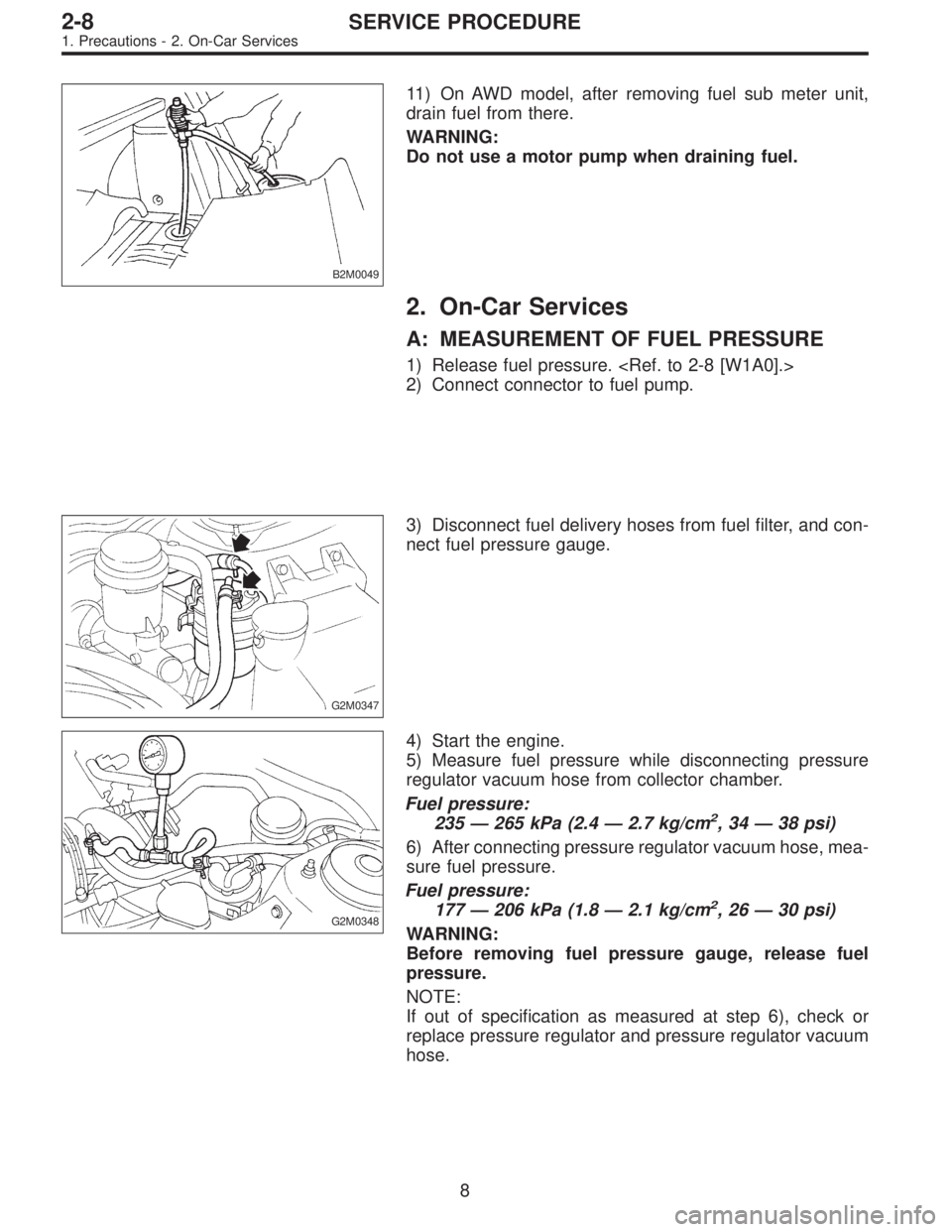
11) On AWD model, after removing fuel sub meter unit,
drain fuel from there.
WARNING:
Do not use a motor pump when draining fuel.
2. On-Car Services
A: MEASUREMENT OF FUEL PRESSURE
1) Release fuel pressure.
2) Connect connector to fuel pump.
G2M0347
3) Disconnect fuel delivery hoses from fuel filter, and con-
nect fuel pressure gauge.
G2M0348
4) Start the engine.
5) Measure fuel pressure while disconnecting pressure
regulator vacuum hose from collector chamber.
Fuel pressure:
235 — 265 kPa (2.4 — 2.7 kg/cm
2, 34 — 38 psi)
6) After connecting pressure regulator vacuum hose, mea-
sure fuel pressure.
Fuel pressure:
177 — 206 kPa (1.8 — 2.1 kg/cm
2, 26 — 30 psi)
WARNING:
Before removing fuel pressure gauge, release fuel
pressure.
NOTE:
If out of specification as measured at step 6), check or
replace pressure regulator and pressure regulator vacuum
hose.
8
2-8SERVICE PROCEDURE
1. Precautions - 2. On-Car Services
Page 250 of 2248
G2M0294
15) Separate torque converter from drive plate. (AT model)
(1) Lower the vehicle.
(2) Remove service hole plug.
(3) Remove bolts which hold torque converter to drive
plate.
(4) Remove other bolts while rotating the engine using
ST.
ST 499977000 CRANK PULLEY WRENCH
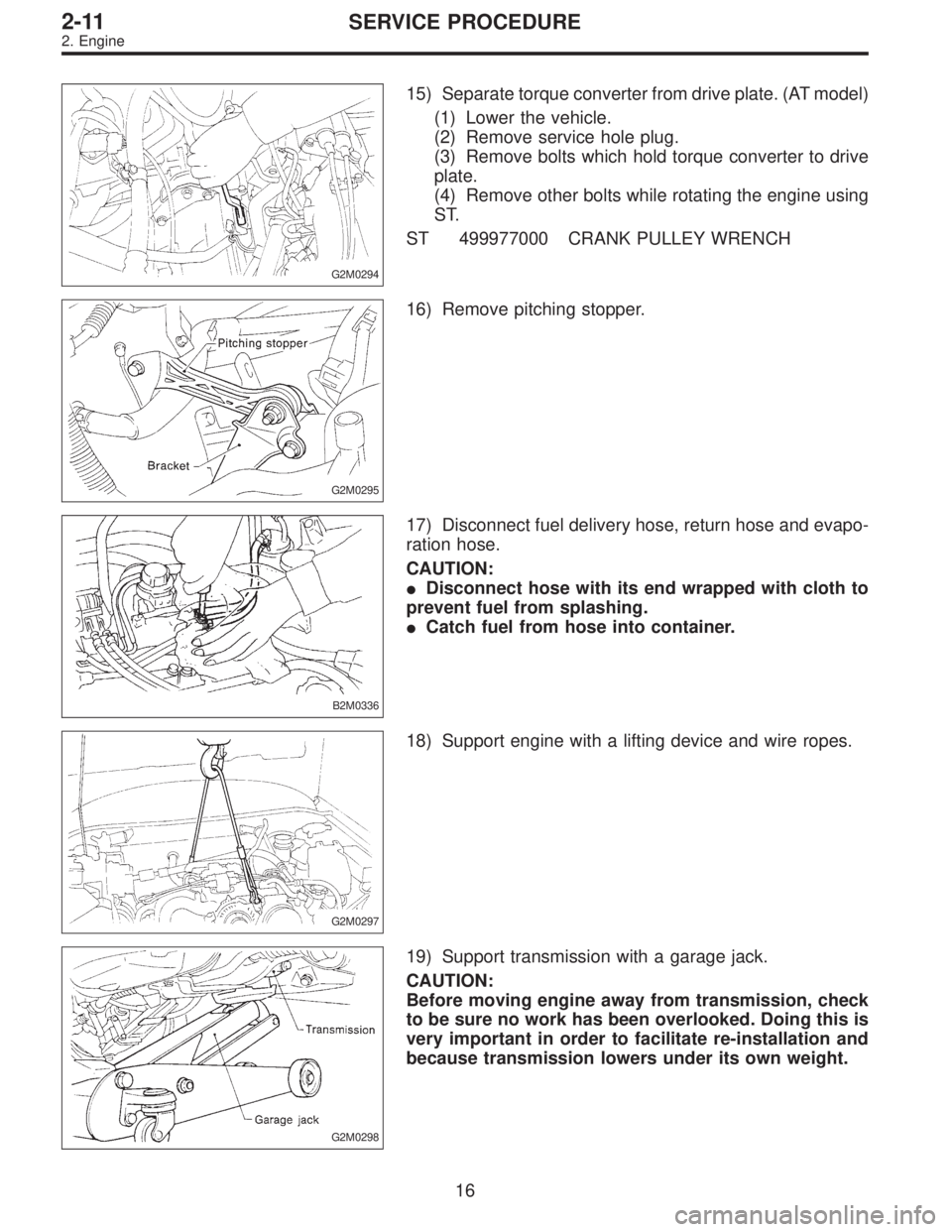
G2M0295
16) Remove pitching stopper.
B2M0336
17) Disconnect fuel delivery hose, return hose and evapo-
ration hose.
CAUTION:
�Disconnect hose with its end wrapped with cloth to
prevent fuel from splashing.
�Catch fuel from hose into container.
G2M0297
18) Support engine with a lifting device and wire ropes.
G2M0298
19) Support transmission with a garage jack.
CAUTION:
Before moving engine away from transmission, check
to be sure no work has been overlooked. Doing this is
very important in order to facilitate re-installation and
because transmission lowers under its own weight.
16
2-11SERVICE PROCEDURE
2. Engine
Page 252 of 2248
B: INSTALLATION
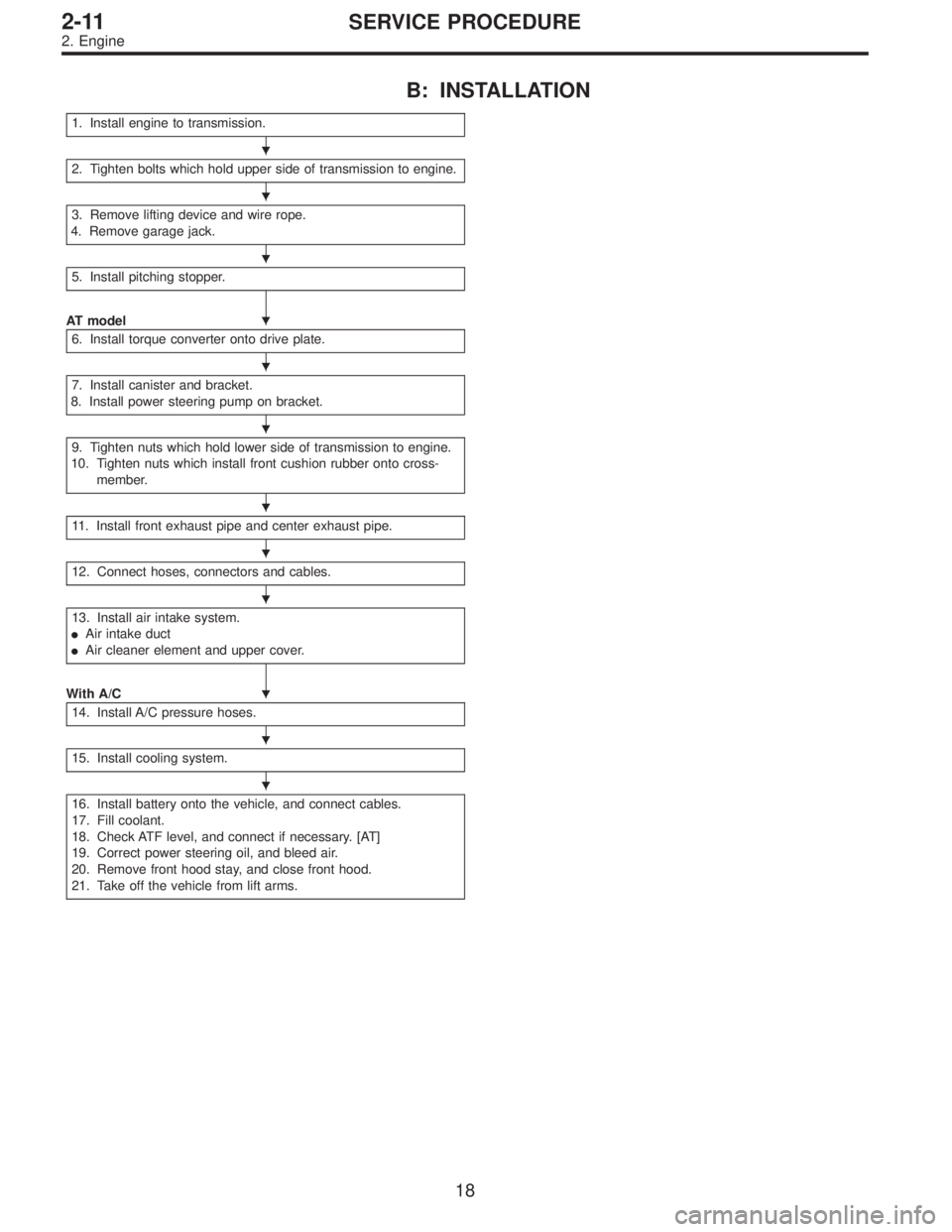
1. Install engine to transmission.
2. Tighten bolts which hold upper side of transmission to engine.
3. Remove lifting device and wire rope.
4. Remove garage jack.
5. Install pitching stopper.
AT model
6. Install torque converter onto drive plate.
7. Install canister and bracket.
8. Install power steering pump on bracket.
9. Tighten nuts which hold lower side of transmission to engine.
10. Tighten nuts which install front cushion rubber onto cross-
member.
11. Install front exhaust pipe and center exhaust pipe.
12. Connect hoses, connectors and cables.
13. Install air intake system.
�Air intake duct
�Air cleaner element and upper cover.
With A/C
14. Install A/C pressure hoses.
15. Install cooling system.
16. Install battery onto the vehicle, and connect cables.
17. Fill coolant.
18. Check ATF level, and connect if necessary. [AT]
19. Correct power steering oil, and bleed air.
20. Remove front hood stay, and close front hood.
21. Take off the vehicle from lift arms.
�
�
�
�
�
�
�
�
�
�
�
�
18
2-11SERVICE PROCEDURE
2. Engine
Page 258 of 2248
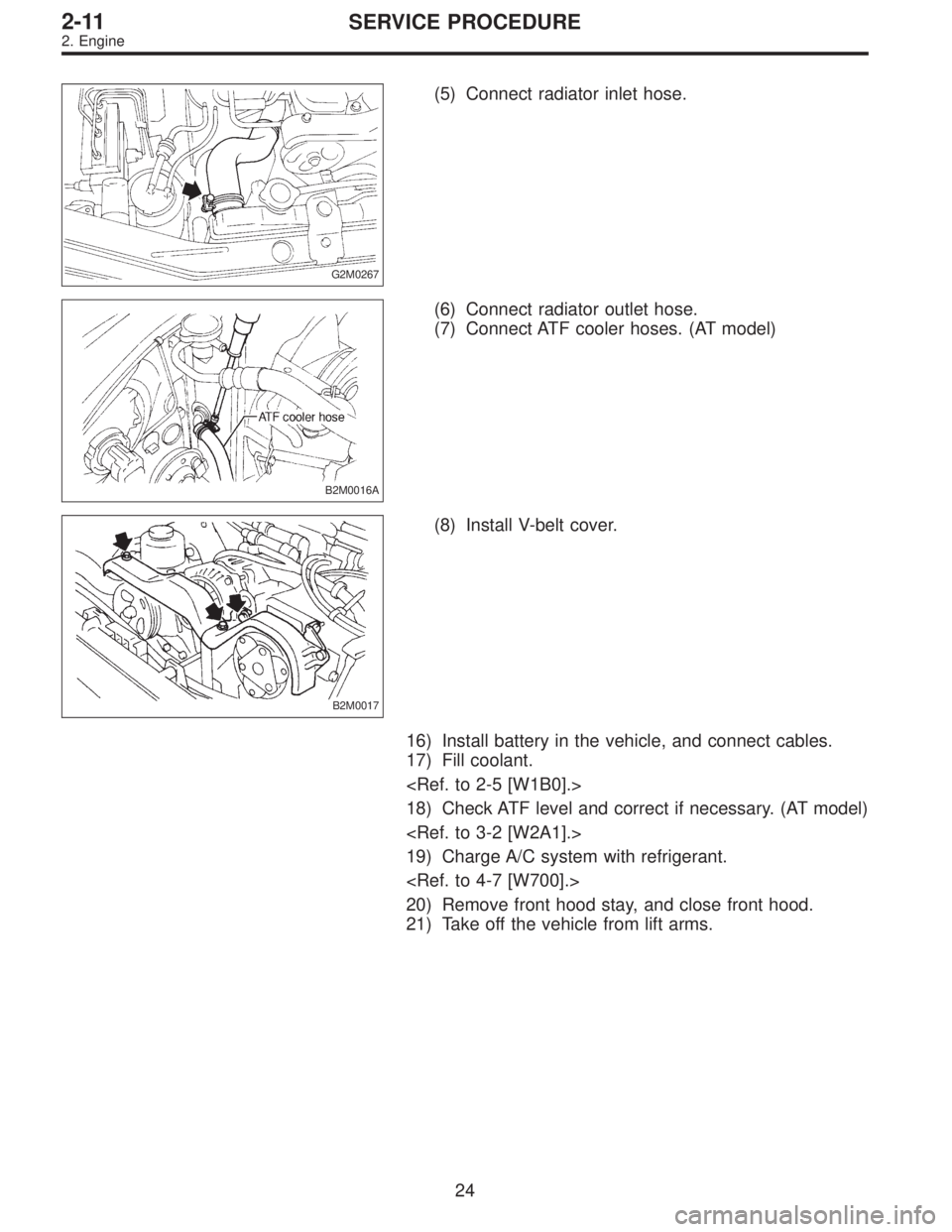
G2M0267
(5) Connect radiator inlet hose.
B2M0016A
(6) Connect radiator outlet hose.
(7) Connect ATF cooler hoses. (AT model)
B2M0017
(8) Install V-belt cover.
16) Install battery in the vehicle, and connect cables.
17) Fill coolant.
18) Check ATF level and correct if necessary. (AT model)
19) Charge A/C system with refrigerant.
20) Remove front hood stay, and close front hood.
21) Take off the vehicle from lift arms.
24
2-11SERVICE PROCEDURE
2. Engine
Page 344 of 2248
1. Manual Transmission and
Differential
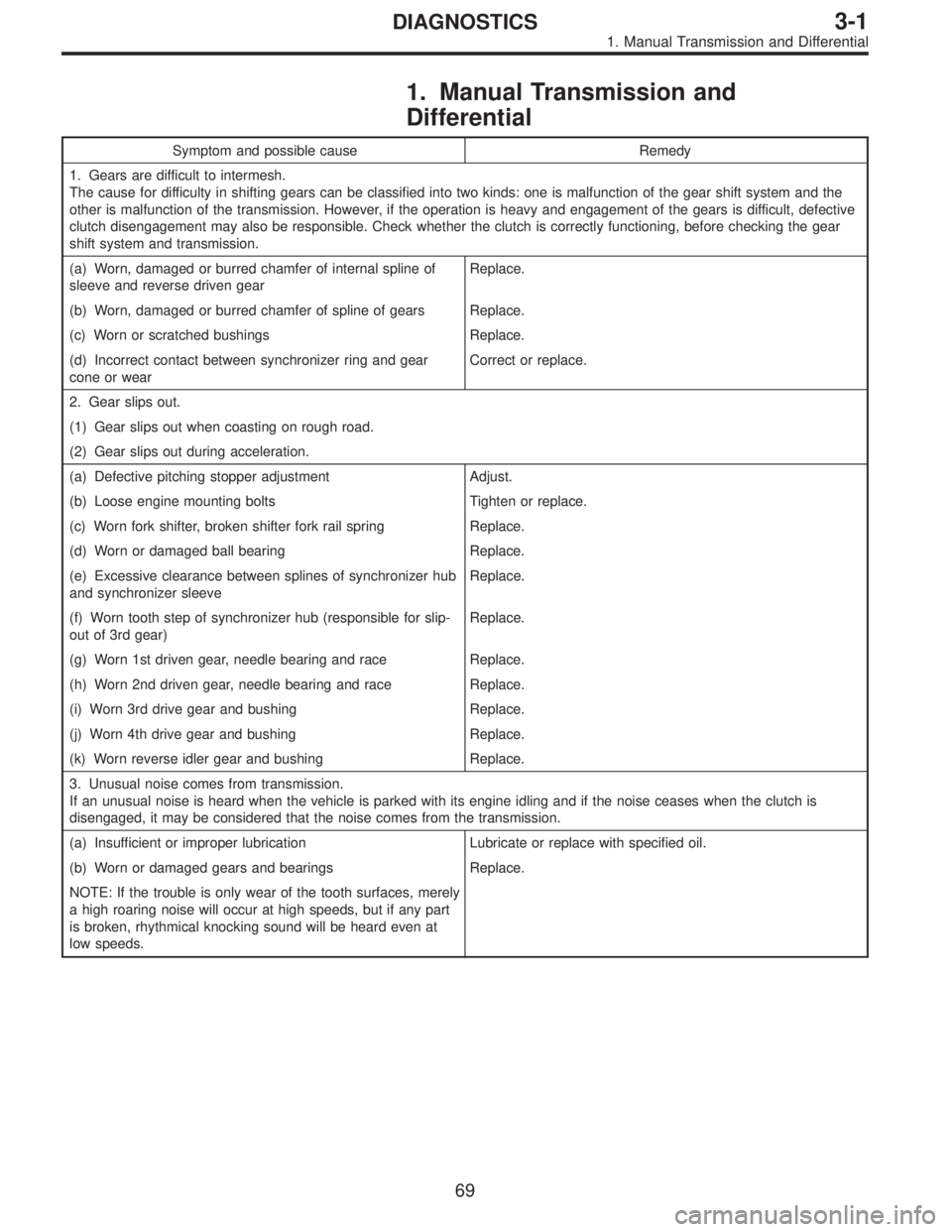
Symptom and possible cause Remedy
1. Gears are difficult to intermesh.
The cause for difficulty in shifting gears can be classified into two kinds: one is malfunction of the gear shift system and the
other is malfunction of the transmission. However, if the operation is heavy and engagement of the gears is difficult, defective
clutch disengagement may also be responsible. Check whether the clutch is correctly functioning, before checking the gear
shift system and transmission.
(a) Worn, damaged or burred chamfer of internal spline of
sleeve and reverse driven gearReplace.
(b) Worn, damaged or burred chamfer of spline of gears Replace.
(c) Worn or scratched bushings Replace.
(d) Incorrect contact between synchronizer ring and gear
cone or wearCorrect or replace.
2. Gear slips out.
(1) Gear slips out when coasting on rough road.
(2) Gear slips out during acceleration.
(a) Defective pitching stopper adjustment Adjust.
(b) Loose engine mounting bolts Tighten or replace.
(c) Worn fork shifter, broken shifter fork rail spring Replace.
(d) Worn or damaged ball bearing Replace.
(e) Excessive clearance between splines of synchronizer hub
and synchronizer sleeveReplace.
(f) Worn tooth step of synchronizer hub (responsible for slip-
out of 3rd gear)Replace.
(g) Worn 1st driven gear, needle bearing and race Replace.
(h) Worn 2nd driven gear, needle bearing and race Replace.
(i) Worn 3rd drive gear and bushing Replace.
(j) Worn 4th drive gear and bushing Replace.
(k) Worn reverse idler gear and bushing Replace.
3. Unusual noise comes from transmission.
If an unusual noise is heard when the vehicle is parked with its engine idling and if the noise ceases when the clutch is
disengaged, it may be considered that the noise comes from the transmission.
(a) Insufficient or improper lubrication Lubricate or replace with specified oil.
(b) Worn or damaged gears and bearings Replace.
NOTE: If the trouble is only wear of the tooth surfaces, merely
a high roaring noise will occur at high speeds, but if any part
is broken, rhythmical knocking sound will be heard even at
low speeds.
69
3-1DIAGNOSTICS
1. Manual Transmission and Differential
Page 345 of 2248
Symptom and possible cause Remedy
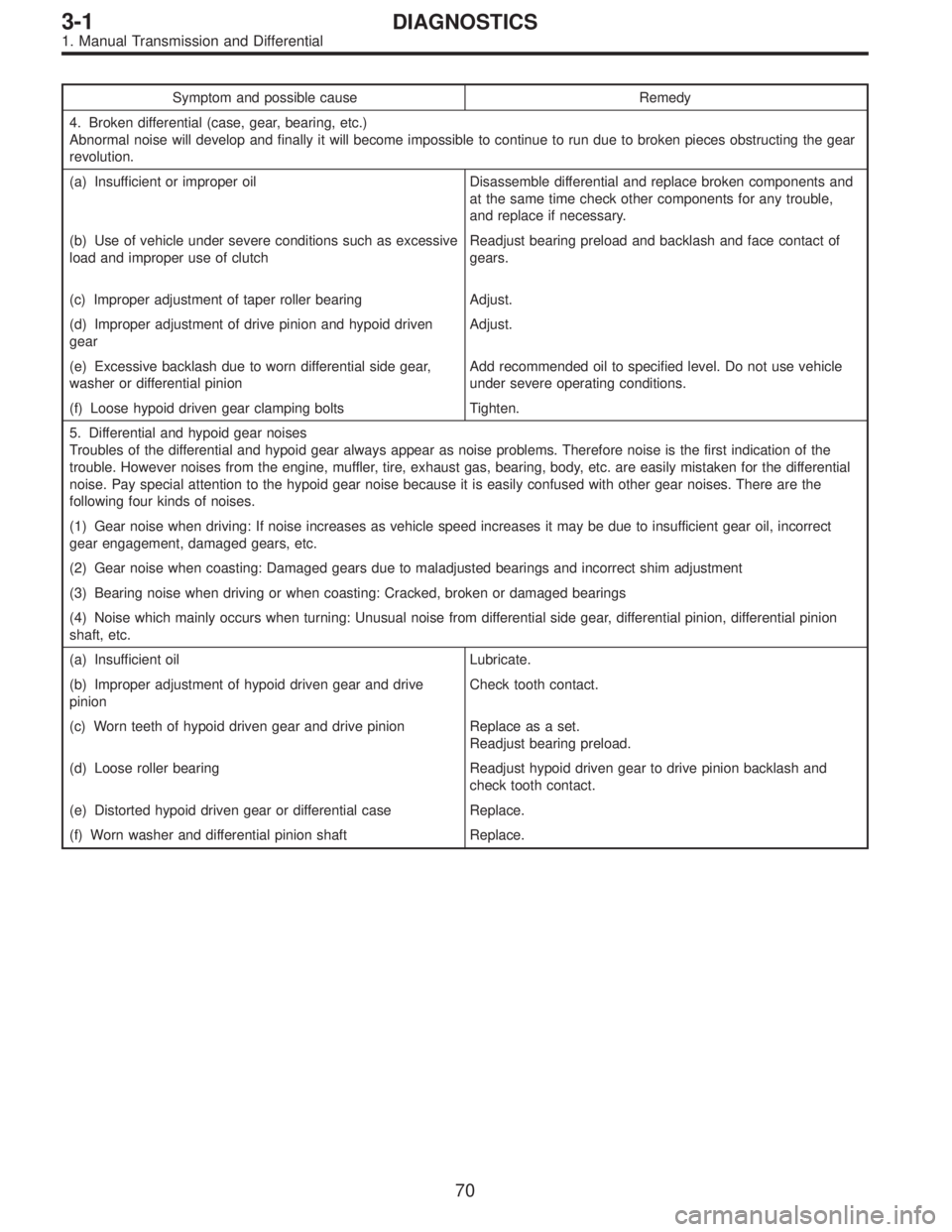
4. Broken differential (case, gear, bearing, etc.)
Abnormal noise will develop and finally it will become impossible to continue to run due to broken pieces obstructing the gear
revolution.
(a) Insufficient or improper oil Disassemble differential and replace broken components and
at the same time check other components for any trouble,
and replace if necessary.
(b) Use of vehicle under severe conditions such as excessive
load and improper use of clutchReadjust bearing preload and backlash and face contact of
gears.
(c) Improper adjustment of taper roller bearing Adjust.
(d) Improper adjustment of drive pinion and hypoid driven
gearAdjust.
(e) Excessive backlash due to worn differential side gear,
washer or differential pinionAdd recommended oil to specified level. Do not use vehicle
under severe operating conditions.
(f) Loose hypoid driven gear clamping bolts Tighten.
5. Differential and hypoid gear noises
Troubles of the differential and hypoid gear always appear as noise problems. Therefore noise is the first indication of the
trouble. However noises from the engine, muffler, tire, exhaust gas, bearing, body, etc. are easily mistaken for the differential
noise. Pay special attention to the hypoid gear noise because it is easily confused with other gear noises. There are the
following four kinds of noises.
(1) Gear noise when driving: If noise increases as vehicle speed increases it may be due to insufficient gear oil, incorrect
gear engagement, damaged gears, etc.
(2) Gear noise when coasting: Damaged gears due to maladjusted bearings and incorrect shim adjustment
(3) Bearing noise when driving or when coasting: Cracked, broken or damaged bearings
(4) Noise which mainly occurs when turning: Unusual noise from differential side gear, differential pinion, differential pinion
shaft, etc.
(a) Insufficient oil Lubricate.
(b) Improper adjustment of hypoid driven gear and drive
pinionCheck tooth contact.
(c) Worn teeth of hypoid driven gear and drive pinion Replace as a set.
Readjust bearing preload.
(d) Loose roller bearing Readjust hypoid driven gear to drive pinion backlash and
check tooth contact.
(e) Distorted hypoid driven gear or differential case Replace.
(f) Worn washer and differential pinion shaft Replace.
70
3-1DIAGNOSTICS
1. Manual Transmission and Differential