Page 85 of 354
Torque Lock
If you are parking on a hill and you don’t shift your
transaxle into PARK (P) properly, the weight of the
vehicle may put to@ much force on the parking pawl in
the transaxle. You may find it difficult to pull the shift
lever out of PARK (P). This is called “torque lock.” To
prevent torque lock, set the parking brake and then
shift
into PARK (P) properly before you leave the driver’s
seat.
To find out how, see “Shifting Into PARK (P)” in
the Index.
When you are ready to drive, move the shift lever out of
PARK
(P) before you release the parking brake.
If “torque lock” does occur, you may need to have
another vehicle push yours a little uphill to take some of
the pressure from the transaxle,
so you can pull the shift
lever out
of PARK (P).
Shifting Out of PARK (P)
Your Pontiac has a brake-transaxle shift interlock. You
must fully apply your regular brakes before you can shift from
PARK (P) when the ignition is in RUN. See
“Automatic Transaxle” in the Index.
lr you cannot shift out of PARK (P), ease pressure on
the shift lever by pushing it all the way into PARK (P)
while keeping the brake pedal pushed down. Release the
shift lever button
if you have a console shift. Then move
the
shift lever out of PARK (P), being sure to press the
shift lever button if you have a console shift.
If you ever hold the brake pedal down but still can’t
shift out
of PARK (P), try this:
1. Turn the key to OFF.
2. Apply and hold the brake until the end of Step 4.
3. Shift to NEUTRAL (N).
4. Start the vehicle and shift to the drive gear you want.
5. Have the vehicle fixed as soon as you can.
2-24
ProCarManuals.com
Page 98 of 354

Sustained Interior Illumination
Your courtesy lamps will come on and stay on for a set
time whenever you:
Open a door.
Press UNLOCK on the Remote Lock Control
(if equipped).
Press DOOR on the Remote Lock Control
(if equipped).
If
you open a door, the lamps will stay on while it’s open
and then turn
off automatically about 18 seconds after
you close
it. If you don’t open a door, the lamps will
turn off after about 18 seconds, unless you pressed
UNLOCK on the Remote Lock Control. If you pressed
UNLOCK and don’t open a door, the lamps will turn off
after about
55 seconds.
Sustained interior illumination includes a feature called
theater dimming. With theater dimming, the lamps don’t
just turn off at the end of the delay time. Instead, they
slowly dim during the delay time until they
go out. The
delay time
is cancelled if you turn the ignition key to
RUN or START, so the lamps will go out right away.
When the ignition is on, Sustained Interior Illumination is
inactive, which means the courtesy lamps won’t come
on.
Rearview Mirror Reading Lamps
These lamps go on when you open the doors. When the
doors are closed, turn them on and off with the switches.
2-37
ProCarManuals.com
Page 111 of 354
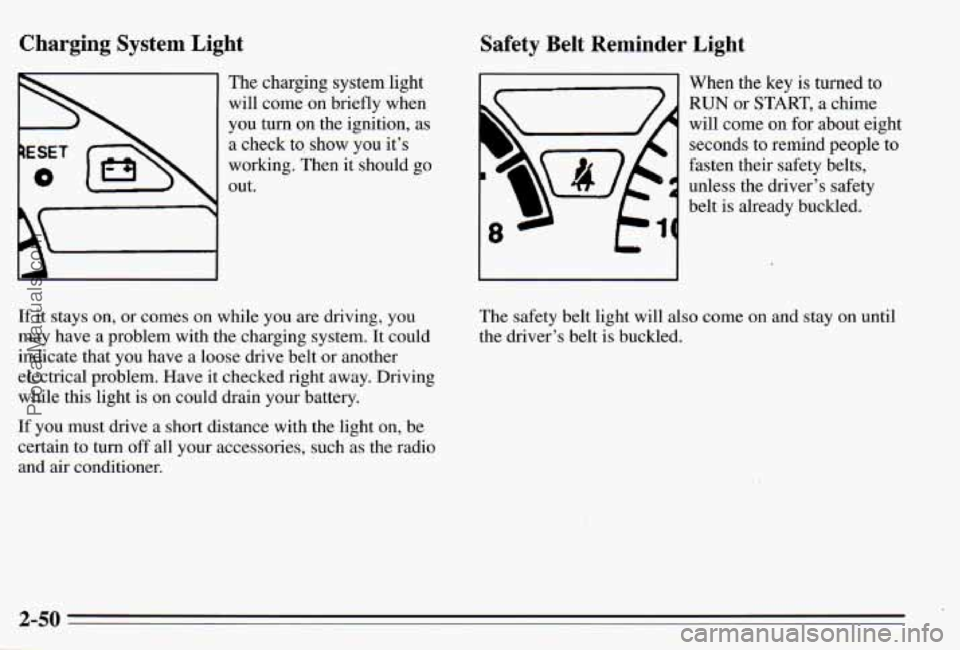
Charging System Light
The charging system light
will come on briefly when
you turn
on the ignition, as
a check to, show you it’s
working. Then it should
go
out.
If it stays on, or comes on while you are driving, you
may have a problem with the charging system. It could
indicate that you have a loose drive belt
or another
electrical problem. Have it checked right away. Driving
while this light is on could drain your battery.
If you must drive a short distance with the light on, be certain to
turn off all your accessories, such as the radio
and
air conditioner.
Safety Belt Reminder Light
When the key is turned to
RUN or START, a chime
will come on for about eight
seconds to remind people to
fasten their safety belts,
unless the driver’s safety
belt is already buckled.
I-
The safety belt light will also come on and stay on until
the driver’s belt is buckled.
ProCarManuals.com
Page 119 of 354

Low Oil Level Light Security Light
Your engine is equipped
with an oil level monitoring
system. When the ignition
key is turned on, the LOW
OIL LEVEL light will
briefly flash. If the light
does not flash, have it fixed
so it will be ready to warn
you if there’s
a problem.
If the light stays on, stop the vehicle on a level surface
and
turn the engine off. Check the oil level using the
This light will come on
when you turn the key to
START and stay on until the
vehicle starts. It will also
come on and stay on if your
key is too
dirty or wet for
the PASS-Key@II system to
read the resistor pellet.
If the resistor pellet is damaged or missing, the light will
flash.
engine oil dipstick. (See “Engine Oil” in the Index.) If you’re driving and the light comes on and remains on,
If‘ the light does not flash, have the low oil level sensor your PASS,Key~II system is not working properly.
a problem. and you system repaired SO it will be ready to warn you if there’s Your vehicle is not protected by
should see your dealer.
The
oil level monitoring system only checks oil level
during the brief period between key on and engine
crank.
It does not monitor engine oil level when the
engine is running. Additionally, an oil level check is
only performed
if the engine has been turned off for a
considerable period of time, allowing the oil normally
in
circulation to drain back into the oil pan.
2-58
ProCarManuals.com
Page 121 of 354
Control Buttons
The trip calculator has three buttons that control its
functions.
MODE: Press this button to change the mode being
displayed.
EM: Press this button to change the display from
English to metric units or metric to English.
RESET Press this button for one second to reset the
mode displayed.
If you push and hold RESET for more
than five seconds, all the modes will reset. You can’t
reset
INST ECON, RANGE or EXT TEMP.
Head-Up Display (Option)
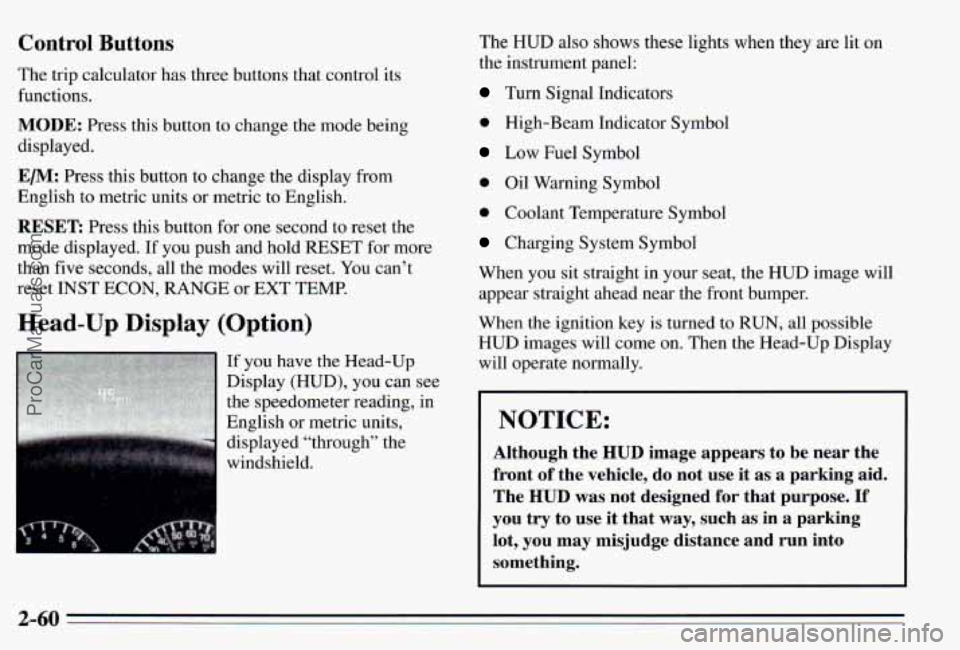
If you have the Head-Up
Display (HUD), you can see
the speedometer reading, in
English or metric units,
displayed “through” the
windshield. The
HUD also shows these lights when they are
lit on
the instrument panel:
Turn Signal Indicators
0 High-Beam Indicator Symbol
Low Fuel Symbol
0 Oil Warning Symbol
0 Coolant Temperature Symbol
Charging System Symbol
When you sit straight in your seat, the HUD image will appear straight ahead near the front bumper.
When the ignition key is turned
to RUN, all possible
HUD images will come on. Then the Head-Up Display
will operate normally.
NOTICE:
Although the HUD image appears to be near the
front
of the vehicle, do not use it as a parking aid.
The
HUD was not designed for that purpose. If
you try to use it that way, such as in a parking
lot, you may misjudge distance and run into
something.
2-60
ProCarManuals.com
Page 145 of 354
Drunken Driving
Death and injury associated with drinking and driving is
a national tragedy. It’s the number one contributor to the
highway death toll, claiming thousands of victims every
year.
Alcohol affects four things that anyone needs to drive a
vehicle:
Judgment
Muscular Coordination
Vision
Attentiveness
Police records show that almost half of all motor
vehicle-related deaths involve alcohol. In most cases,
these deaths are the result of someone who was drinking
and driving. In recent years, some 18,000 annual motor
vehicle-related deaths have been associated
with the use
of alcohol, with more than
300,000 people injured.
Many adults
-- by some estimates, nearly half the adult
population
-- choose never to drink alcohol, so they
never drive after drinking. For persons under
2 1, it’s
against the law in every U.S. state to drink alcohol.
There are good medical, psychological and
developmental reasons for these laws. The
obvious
way to solve this bghway safety problem
is for people never to
drink alcohol and then drive. But
what
if people do? How much is “too much” if the
driver plans to drive? It’s a lot less than many might
think. Although it depends
on each person and situation,
here is some general information on the problem.
The Blood Alcohol Concentration (BAC) of someone
who is drinking depends upon four things:
0 How much alcohol consumed
0 The drinker’s body weight
0 The amount of food that is consumed before and
during drinking
consume the alcohol
The length of time it .has taken the drinker to
According to the American Medical Association, a
180-pound (82 kg) person who drinks three 12-ounce
(355 ml) bottles of beer in an hour will end up with a
BAC of about
0.06 percent. The person would reach the
same BAC by drinking three 4-ounce
(120 ml) glasses
of wine or three mixed drinks
if each had 1 - 1/2 ounces
(45 ml) of a liquor like whiskey, gin or vodka.
ProCarManuals.com
Page 180 of 354
Section 5 Problems on the Road
Here you'll find what to do about some problems that
can occur on the road.
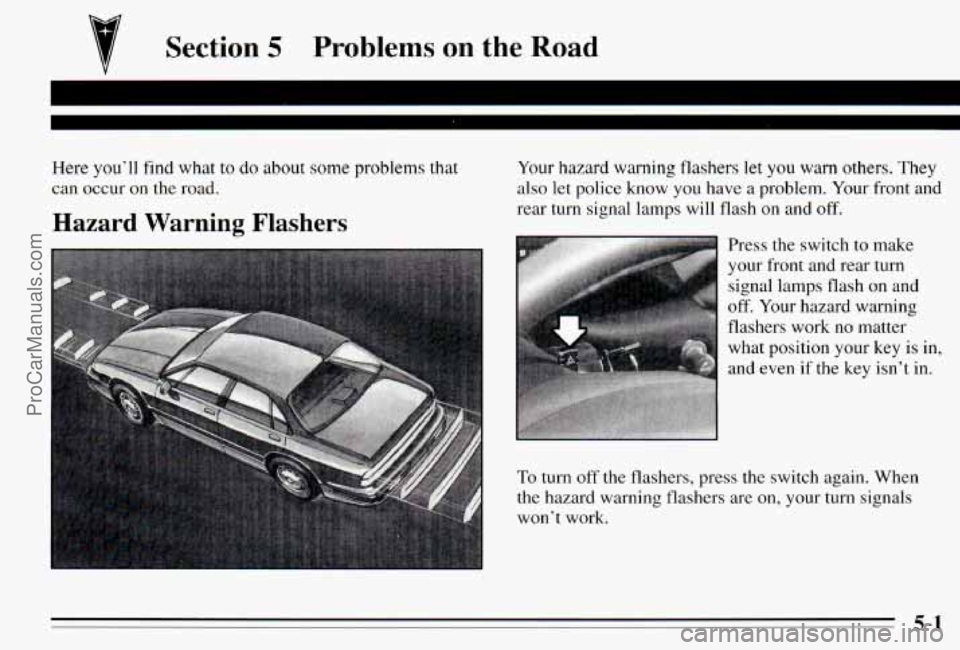
Hazard Warning Flashers
Your hazard warning flashers let you warn others. They
also let police know you have
a problem. Your front and
rear turn signal lamps will flash
on and off.
Press the switch to
make
your front and rear turn
signal lamps flash on and
off. Your hazard warning
flashers work
no matter
what position your key is
in,
To turn off the flashers, press the switch again. When
the hazard warning flashers are on, your
turn signals
won't work.
5-1
ProCarManuals.com
Page 187 of 354
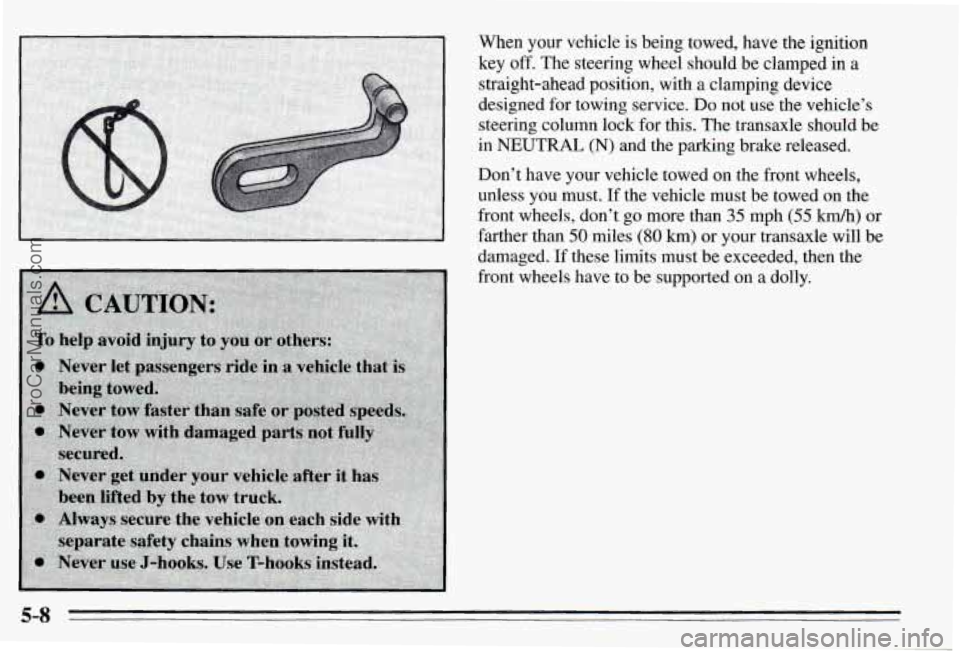
When your vehicle is being towed, have the ignition
key
off. The steering wheel should be clamped in a
straight-ahead position, with
a clamping device
designed for towing service. Do not use the vehicle’s
steering column lock for this. The transaxle should be
in
NEUTRAL (N) and the parking brake released.
Don’t have your vehicle towed
on the front wheels,
unless you must.
If the vehicle must be towed on the
front wheels, don’t
go more than 35 mph (55 km/h) or
farther than
50 miles (80 km) or your transaxle will be
damaged.
If these limits must be exceeded, then the
front wheels have to be supported on a dolly.
5-8
ProCarManuals.com