Page 203 of 354
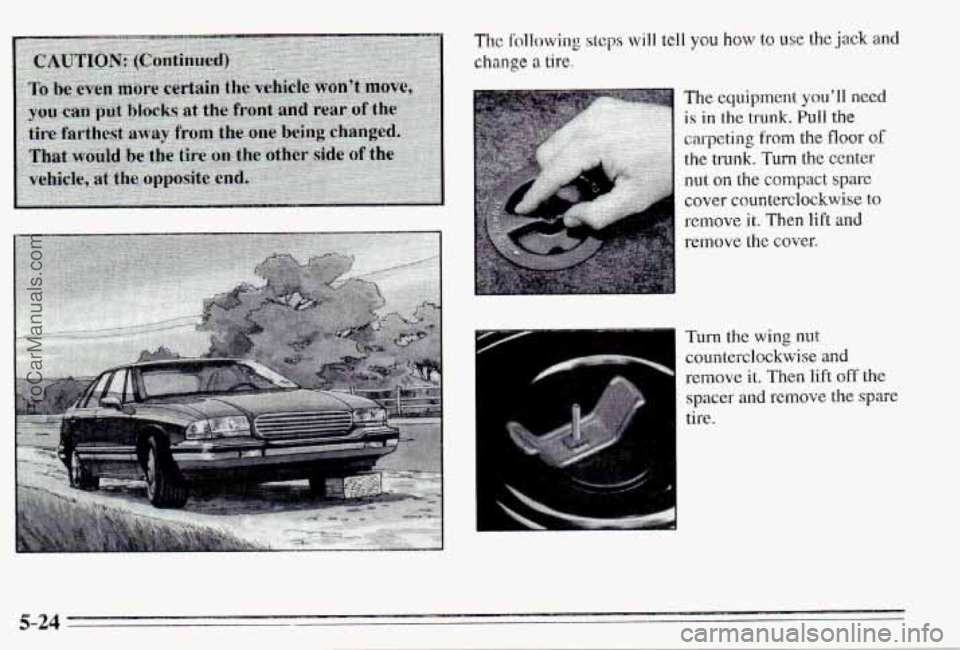
cover counterclockwise to
remove it. Then lift and
remove the cover.
Turn the wing nut
counterclockwise and
remove it. Then lift off the
spacer
and remove the spare
tire.
5-24
ProCarManuals.com
Page 206 of 354
Put the compact spare tire near you.
I
I NOTICE:
the vehicle to fall off the jack. Be sure to fit the
jack lift head into the
proper location before
raising your vehicle.
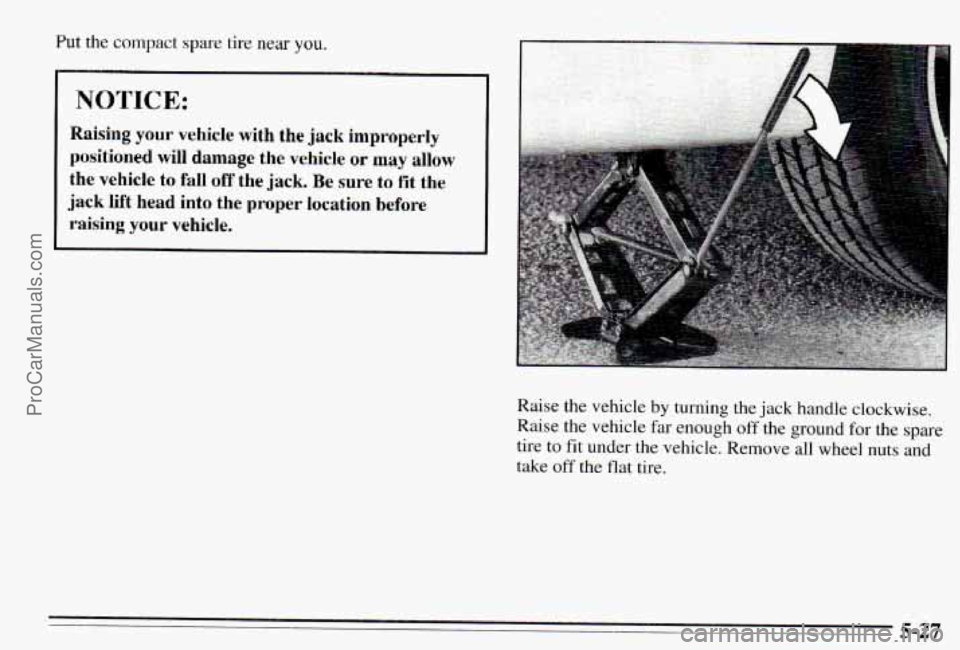
Raise the vehicle by turning the jack handle clockwise.
Raise the vehicle far enough off the ground for the spare
tire to fit under the vehicle. Remove all wheel nuts and
take off the flat tire.
5-27 ProCarManuals.com
Page 209 of 354
Don’t try to put the wheel cover on your compact spare
tire. It won‘t fit. Store the wheel cover in the trunk until
you have the flat tire repaired or replaced.
I NOTICE:
Wheel covers won’t fit on your compact spare. If
you try to put a wheel cover on your compact
spare, you could damage the cover or the spare.
After you’ve put the compact spare tire on your vehicle,
you’ll need
to store the flat tire in your trunk. Use the
following procedure to secure the flat tire in the trunk.
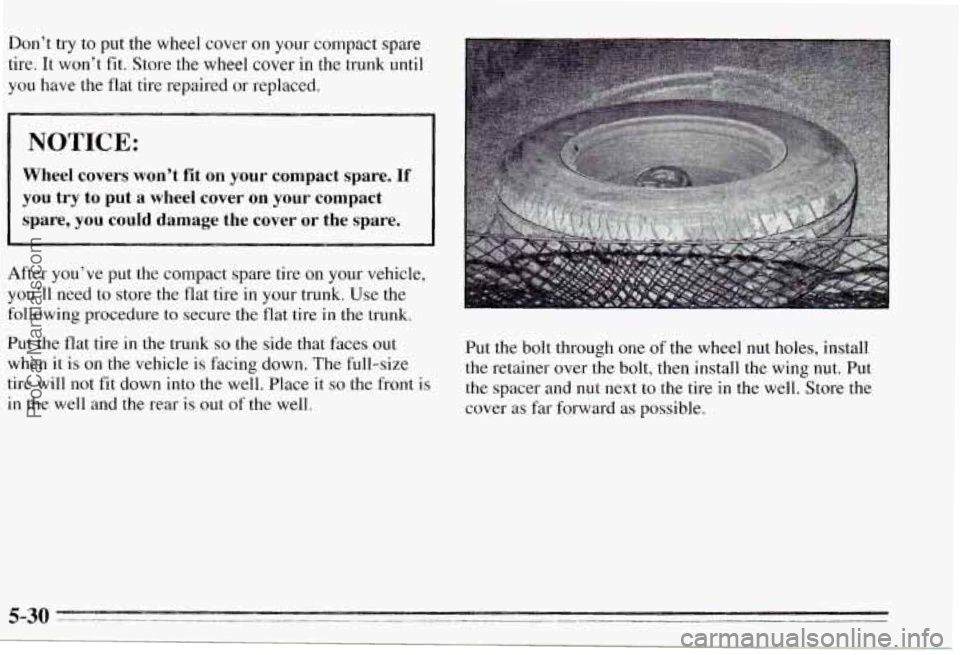
Put the flat tire in the trunk
so the side that faces out
Put the bolt through one of the wheel nut holes, install
when it
is on the vehicle is facing down. The full-size
the retainer over the bolt, then install the wing nut. Put
tire will not
fit down into the well. Place it SO the front is the spacer and nut next to the tire in the well. Store the
in the well and the rear is out of the well.
cover as far forward as possible.
ProCarManuals.com
Page 210 of 354
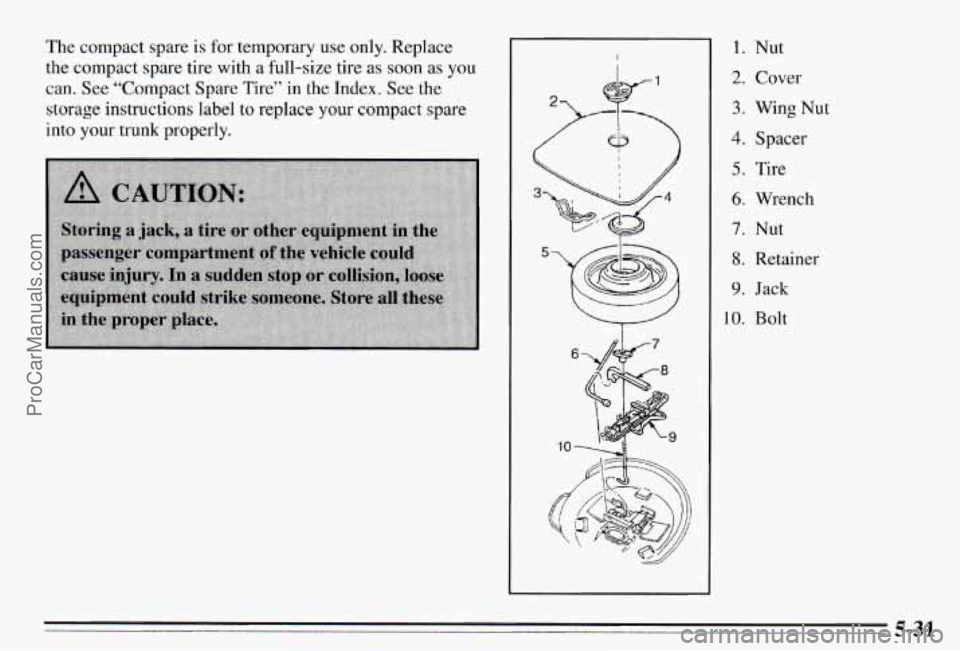
The compact spare is for temporary use only. Replace
the compact spare tire with a full-size tire as
soon as you
can. See “Compact Spare Tire” in the Index. See the
storage instructions label to replace your compact spare
into your trunk properly.
1. Nut
2. Cover
3. Wing Nut
4. Spacer
5. Tire
6. Wrench
7. Nut
8. Retainer
9. Jack
1.0. Bolt
5-31
ProCarManuals.com
Page 211 of 354
Compact Spare Tire
Although the compact spare was fully inflated when
your vehicle was new, it can lose air after a time. Check
the inflation pressure regularly. It should be
60 psi
(420 kPa). After installing the compact spare on your
vehicle,
you should stop as soon as possible and make
sure your spare tire is correctly inflated. The compact
spare is made to perform well at posted speed limits for
distances up to
3,000 miles (5-000 km), so you can
finish your trip and have your full-size tire repaired
or
replaced where you want. Of course, it’s best to replace
your spare with a full-size tire as soon as you can.
Your
spare will last longer and be in good shape in case you
need it again.
NOTICE:
Don’t take your compact spare through an
automatic car wash with guide rails. The
compact spare can get caught on the rails. That
can damage the tire and wheel, and maybe other
parts
of your vehicle.
Don’t use your compact spare on some other vehicle.
And don’t mix your compact spare
or wh.ee1 with other
wheels or tires. They won’t fit. Keep your spare and its
wheel together.
NOTICE:
Tire chains won’t fit your compact spare. Using
them will damage your vehicle and destroy the
chains too. Don’t use tire chains on your compact
spare.
5-32
ProCarManuals.com
Page 261 of 354
NOTICE: (Continued)
If your tires have too much air (overinflation),
you can get:
0 Unusual wear
Bad handling
Rough ride
0 Needless damage from road hazards.
P en to Check
Check your tires once a month or more.
,Don’t forget your compact spare tire.
It should be at
60 psi (420 kPa).
How to Check
Use a good quality pocket-type gage to check tire
pressure. Simply looking at the tires will not tell you the
pressure, especially if you have radial tires
-- which
may look properly inflated even
if they’re underinflated.
If your tires have valve caps, be sure to put them back
on. They help prevent leaks by keeping out dirt and
moisture.
Tire Inspection and Rotation
Tires should be inspected every 6,000 to 8,000 miles
(10 000 to 13 000 km) for any signs of unusual wear.
If unusual wear is present, rotate your tires as soon as
possible and check wheel alignment.
Also check for
damaged tires or wheels. See “When It’s Time for New
Tires” and “Wheel Replacement” later in this section for
more information.
The purpose of regularrotation is to achieve more
uniform wear for
all tires on the vehicle. The first rotation
is the most important. See “Scheduled Maintenance
Services”
in the Index for scheduled rotation intervals.
I
n
6-48
ProCarManuals.com
Page 262 of 354
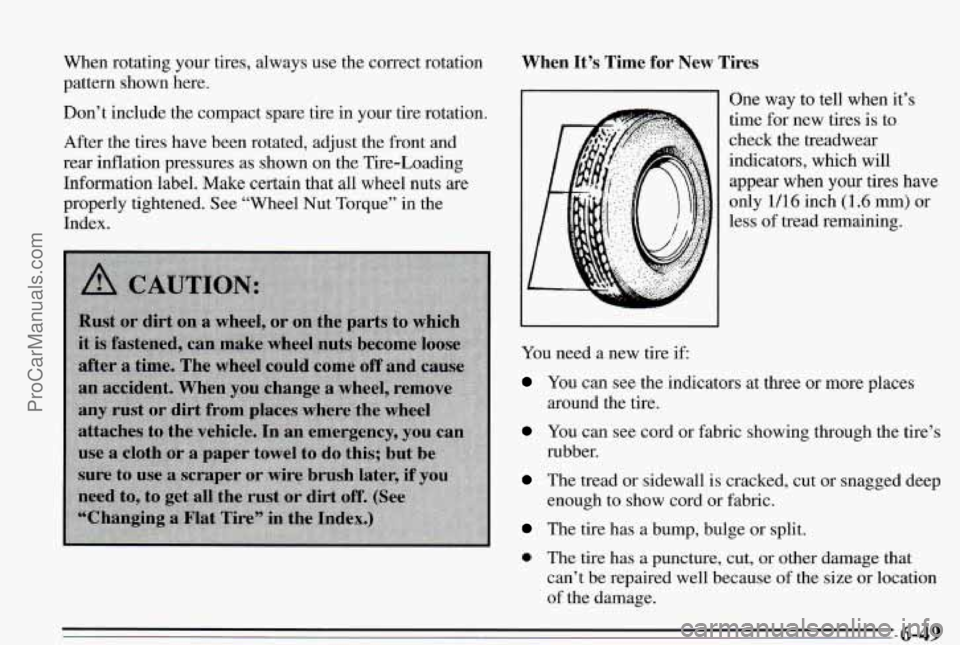
When rotating your tires, always use the correct rotation
pattern shown here.
Don’t include the compact spare tire in
your tire rotation.
After the tires have been rotated, adjust the front
and
rear inflation pressures as shown on the Tire-Loading
Information label. Make
certain that all wheel nuts are
properly tightened. See “Wheel Nut Torque” in the
Index.
When It’s Time for New Tires
.. .
One way to tell when it’s
time for new tires
is to
check the treadwear
indicators, which will
appear when your tires have
only 1/16 inch (1.6 mm) or
less
of tread remaining.
You need a new tire if
You can see the indicators at three or more places
around the tire.
You can see cord or fabric showing through the tire’s
rubber.
The tread or sidewall is cracked, cut or snagged deep
enough to show cord or fabric.
The tire has a bump, bulge or split.
0 The tire has a puncture, cut, or other damage that
can’t be repaired well because of the size
or location
of the damage.
6-49 ProCarManuals.com
Page 276 of 354
Vehicle Identification Number (VIN)
UXSMJ72675 Ictn)
4-
-- ~
1995
PLANT MODEL YEAR
ASSEMBLY
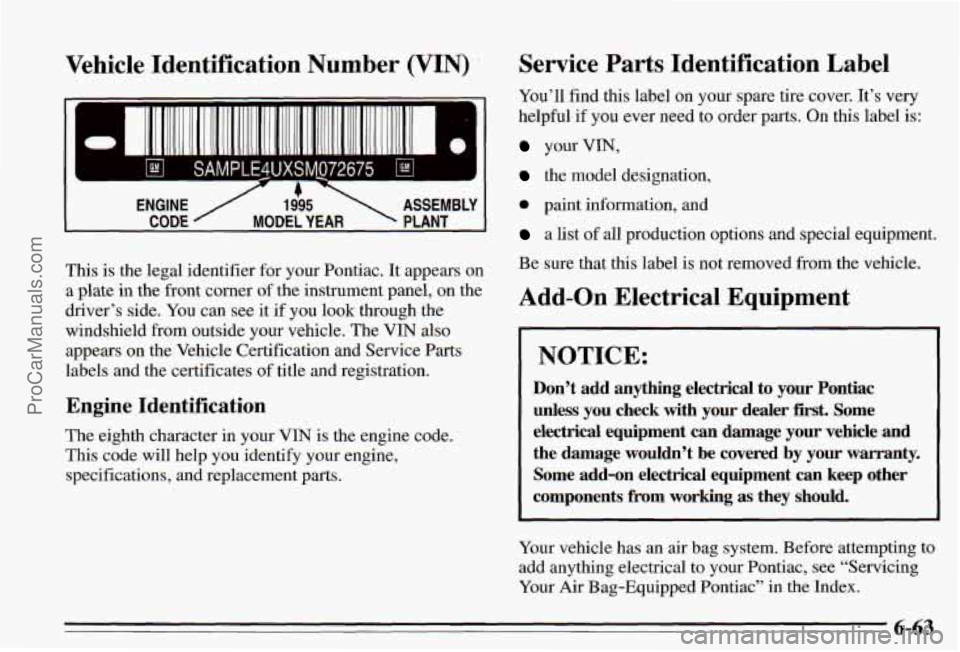
This is the legal identifier for your Pontiac. It appears on
a plate
in the front corner of the instrument panel, on the
driver’s side. You can see it
if you look through the
windshield from outside your vehicle. The
VIN also
appears on the Vehicle Certification and Service Parts
labels and the certificates of title and registration.
Engine Identification
The eighth character in your VIN is the engine code.
This code will help you identify your engine,
specifications, and replacement parts.
Service Parts Identification Label
You’ll find this label on your spare tire cover. It’s very
helphl if you ever need to order parts. On this label is:
yoLlrvIN,
the model designation,
0 paint information, and
a list of all production options and special equipment.
Be sure that this label is not removed from the vehicle.
Add-on Electrical Equipment
I NOTICE:
Don’t add anything electrical to your Pontiac
unless you check with your dealer first. Some
electrical equipment
can damage your vehicle and
the damage wouldn’t be covered by your warranty. Some add-on electrical equipment
can keep other
components
from working as they should.
Your vehicle has an air bag system. Before attempting to
add anything electrical to your Pontiac, see “Servicing
Your Air Bag-Equipped Pontiac” in the Index.
6-63
ProCarManuals.com