1995 PONTIAC PONTIAC tire type
[x] Cancel search: tire typePage 156 of 354
0 Check your mirrors, glance over your shoulder, and
start your left lane change signal before moving out
of the right lane to pass. When you are far enough
ahead of the passed vehicle to see its front in your
inside mirror, activate your right lane change signal
and move back into the right lane. (Remember that
your right outside mirror is convex. The vehicle you
just passed may seem to be farther away from you
than it really
is.)
Try not to pass more than one vehicle at a time on
two-lane roads. Reconsider before passing the next
vehicle.
Don’t overtake a slowly moving vehicle too rapidly.
Even though the brake lights are not flashing,
it may
be slowing down or starting to turn.
If you’re being passed, make it easy for the
following driver to get ahead of you. Perhaps you
can ease a little to the right.
Loss of Control
Let’s review what driving experts say about what
happens when the three control systems (brakes, steering
and acceleration) don’t have enough friction where the
tires meet the road to do what the driver has asked.
In any emergency, don’t give up. Keep trying to steer
and constantly seek an escape route or area of less
danger.
Skidding
In a skid, a driver can lose control of the vehicle.
Defensive drivers avoid most skids by taking reasonable
care suited to existing conditions, and by not
“overdriving” those conditions. But skids are always
possible.
The three types of skids correspond to your Pontiac’s
three control systems. In the braking skid your wheels
aren’t rolling.
In the steering or cornering skid, too
much speed or steering in a curve causes tires to slip and
lose cornering force. And in the acceleration skid too
much throttle causes the driving wheels to spin.
A cornering skid and an acceleration skid are best
handled by easing your foot off the accelerator pedal.
4-13
ProCarManuals.com
Page 186 of 354
Towing Your Vehicle
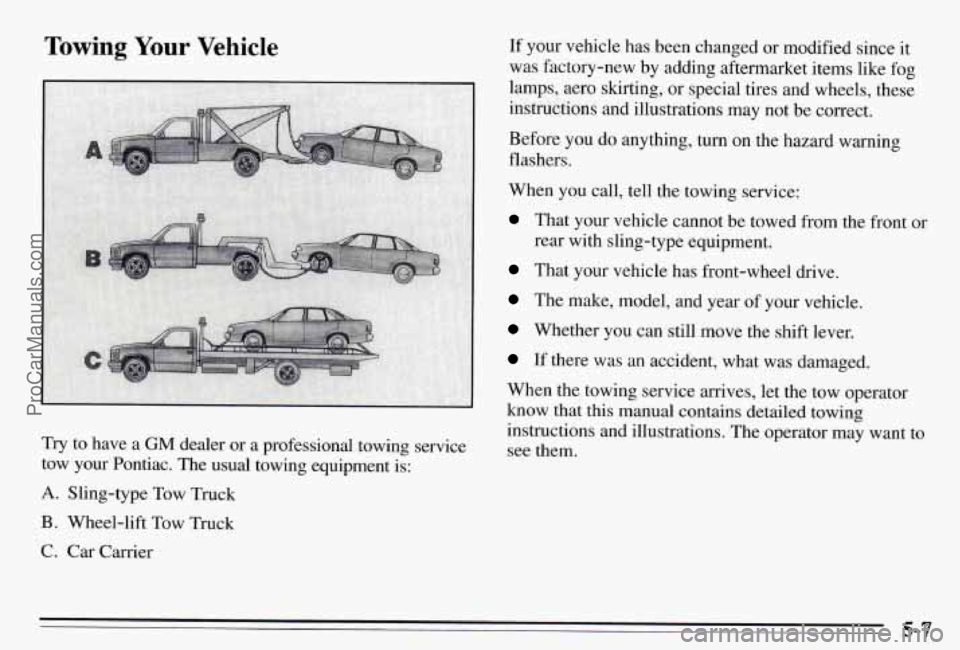
Try to have a GM dealer or a professional towing service
tow your Pontiac. The usual towing equipment is:
A. Sling-type Tow Truck
B. Wheel-lift Tow Truck
C. Car Carrier
If your vehicle has been changed or modified since it
was factory-new by adding aftermarket items like
fog
lamps, aero skirting, or special tires and wheels, these
instructions and illustrations may not be correct.
Before you do anything,
turn on the hazard warning
flashers.
When you call, tell the towing service:
That your vehicle cannot be towed from the front or
rear with sling-type equipment.
That your vehicle has front-wheel drive.
The make, model, and year of your vehicle.
Whether you can still move the shift lever.
If there was an accident, what was damaged.
When the towing service arrives, let the tow operator
know that this manual contains detailed towing
instructions and illustrations. The operator may want to
see them.
~- .
5-7 ProCarManuals.com
Page 261 of 354
NOTICE: (Continued)
If your tires have too much air (overinflation),
you can get:
0 Unusual wear
Bad handling
Rough ride
0 Needless damage from road hazards.
P en to Check
Check your tires once a month or more.
,Don’t forget your compact spare tire.
It should be at
60 psi (420 kPa).
How to Check
Use a good quality pocket-type gage to check tire
pressure. Simply looking at the tires will not tell you the
pressure, especially if you have radial tires
-- which
may look properly inflated even
if they’re underinflated.
If your tires have valve caps, be sure to put them back
on. They help prevent leaks by keeping out dirt and
moisture.
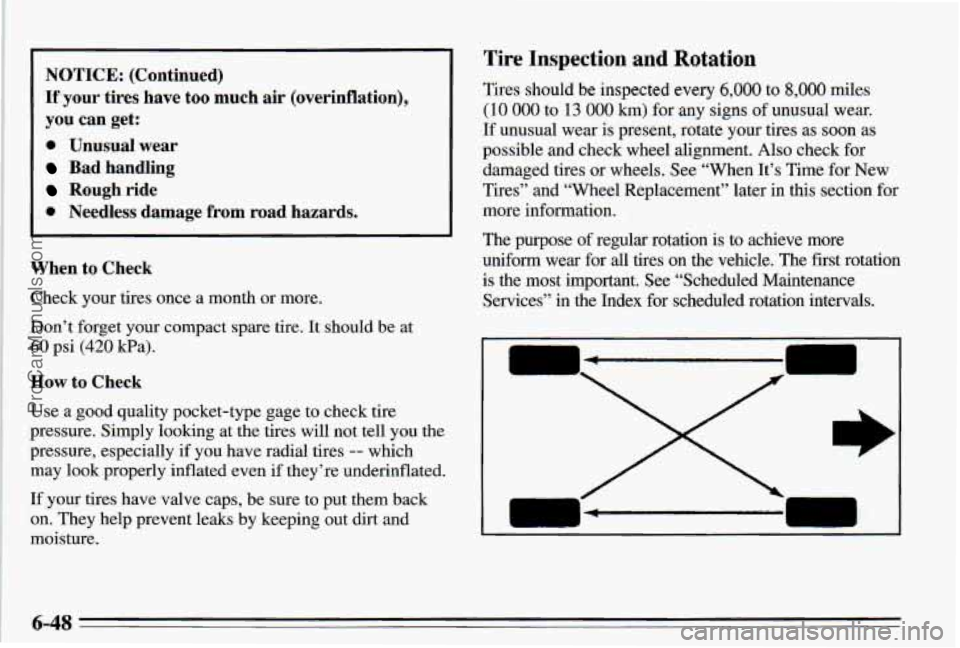
Tire Inspection and Rotation
Tires should be inspected every 6,000 to 8,000 miles
(10 000 to 13 000 km) for any signs of unusual wear.
If unusual wear is present, rotate your tires as soon as
possible and check wheel alignment.
Also check for
damaged tires or wheels. See “When It’s Time for New
Tires” and “Wheel Replacement” later in this section for
more information.
The purpose of regularrotation is to achieve more
uniform wear for
all tires on the vehicle. The first rotation
is the most important. See “Scheduled Maintenance
Services”
in the Index for scheduled rotation intervals.
I
n
6-48
ProCarManuals.com
Page 263 of 354
Buying New Tires
To find out what kind and size of tires you need, look at
the Tire-Loading Information label.
The tires installed on your vehicle when it was new had
a Tire Performance Criteria Specification (TPC Spec)
number on each tire’s sidewall. When you get new tires,
get ones with that same
TPC Spec number. That way,
your vehicle will continue to have tires that are designed
to give proper endurance, handling, speed rating,
traction, ride and other things during normal service
on your vehicle.
If your tires have an all-season tread
design, the
TPC number will be followed by an “MS”
(for mud and snow).
If you ever replace your tires with those not having
a
TPC Spec number, make sure they are the same size,
load range, speed rating and construction type (bias,
bias-belted or radial) as your original tires.
Uniform Tire Quality Grading
The following information relates to the system
developed by the United States National Highway
Traffic Safety Administration which grades tires
by
treadwear, traction and temperature performance. (This applies only to vehicles sold in the United States.)
6-50 ProCarManuals.com
Page 265 of 354
While the tires available as standard or optional equipment on General Motors vehicles may vary with
respect to these grades, all such tires meet General
Motors performance standards and have been approved for use on General Motors vehicles. All passenger type
(P Metric) tires must conform to Federal safety
requirements in addition to these grades.
Wheel Alignment and Tire Balance
The wheels on your vehicle were aligned and balanced
carefully at the factory to give you the longest tire life
and best overall performance.
In most cases, you will not need to have your wheels
aligned again. However, if you notice unusual tire wear
or your vehicle pulling one way or the other, the
alignment may need to be reset. If you notice your
vehicle vibrating when driving on a smooth road, your
wheels may need to be rebalanced.
Wheel Replacement
Replace any wheel thatsis bent, cracked, or badly rusted
or corroded. If wheel nuts keep coming loose, the wheel,
wheel bolts, and wheel nuts should be replaced.
If the
wheel leaks air, replace it (except some aluminum
wheels, which can sometimes be repaired). See your
Pontiac dealer
if any of these conditions exist.
Your dealer will know the kind of wheel you need.
Each new wheel should have the same load carrying
capacity, diameter, width, offset, and be mounted the
same way
as the one it replaces.
If you need to replace any of your wheels, wheel bolts,
or wheel nuts, replace them only with new
GM original
equipment parts. This way, you will be sure to have the
right wheel, wheel bolts, and wheel nuts for your
Pontiac model.
6-52 ProCarManuals.com
Page 267 of 354
!
i Tire Chains
NOTICE:
If your Pontiac has P215/60R16 or P225/60R16
size tires, don’t use tire chains; they can damage
your vehicle.
If you have other tires, use tire chains only where
legal and only when
you must. Use only SAE
Class “S” type chains that are the proper size for
your
tires. Install them on the front tires and
tighten them
as tightly as possible with the ends
securely fastened. Drive slowly and follow the
chain manufacturer’s instructions. If you can
hear the chains contacting your vehicle, stop and
retighten them. If the contact continues, slow
down until
it stops. Driving too fast or spinning
the wheels with chains on will damage your
vehicle.
Appearance Care
Remember, cleaning products can be haza )us, Some
are toxic. Others can burst into flame if you strike a
match or get them on a hot part of the vehicle. Some are
dangerous if you breathe their fumes
in a closed space.
When you use anything from a container to clean your
Pontiac, be sure to follow the manufacturer’s warnings
and instructions. And always open your doors or
windows when you’re cleaning the inside.
Never use these to clean your vehicle:
Gasoline
Benzene
Naphtha
0 Carbon Tetrachloride
0 Acetone
0 Paint Thinner
0 Turpentine
0 Lacquer Thinner
0 Nail Polish Remover
They can all be hazardous
-- some more than
others
-- and they can all damage your vehicle, too.
ProCarManuals.com
Page 268 of 354
Don’t use any of these unless this manual says you can.
In many uses, these will damage your vehicle:
Alcohol
Laundry Soap
Bleach
0 Reducing Agents
Cleaning the Inside of Your Pontiac
Use a vacuum cleaner often to get rid of dust and loose
dirt. Wipe vinyl or leather with a clean, damp cloth.
Your Pontiac dealer has two
GM cleaners, a
solvent-type spot lifter and a foam-type powdered
cleaner. They will clean normal spots and stains very
well. Do not use them on vinyl or leather.
Here are some cleaning tips:
0 Always read the instructions on the cleaner label.
Clean up stains as soon as you can -- before they set.
Use a clean cloth or sponge, and change to a clean area
often.
A soft brush may be used if stains are stubborn.
0 Use solvent-type cleaners in a well-ventilated area
only.
If you use them, don’t saturate the stain.ed area.
If a ring forms after spot cleaning, clean the entire
area immediately or it will set.
Using Foam-mpe Cleaner on Fabric
0
0
e
0
0
0
0
0
0
0
Vacuum and brush the area to remove any loose dirt.
Always clean a whole trim panel
or section. Mask
surrounding trim along stitch or welt lines.
Mix Multi-Purpose Powdered Cleaner following the
directions on the container label.
Use suds only and apply with a clean sponge.
Don’t saturate the material.
Don’t rub it roughly.
As soon as you’ve cleaned the section, use a sponge
to remove the suds.
Rinse the section with a clean, wet sponge.
Wipe
off what’s left with a slightly damp paper towel
or cloth.
Then
dry it immediately with a blow dryer or a heat lamp.
NOTICE:
Be careful. A blow dryer or a heat lamp may
scorch the fabric.
0 Wipe with a clean cloth.
6-55
ProCarManuals.com