Page 193 of 354
If you get the overheat warning with no sign of steam,
try this for
a minute or so:
1. Turn off your air conditioner.
2. Turn on your heater to full hot at the highest fan
3. If you’re in a traffic jam, shift to NEUTRAL (N);
speed and open the window as necessary.
otherwise, shift to the highest gear while
driving
-- DRIVE (D) or THIRD (3).
If you no longer have the overheat warning, you can
drive.
Just to be safe, drive slower for about ten minutes.
If the warning doesn’t come back on, you can drive
normally.
If the warning continues, pull over, stop, and park your
vehicle right away.
If there’s still no sign of steam, you can idle the engine
for two or three minutes while you’re parked, to see
if
the warning stops. But then, if you still have the
warning,
turn ofSthe engine and get everyone out
of the vehicle until it cools down.
You may decide not to lift the hood but to get service
help right away.
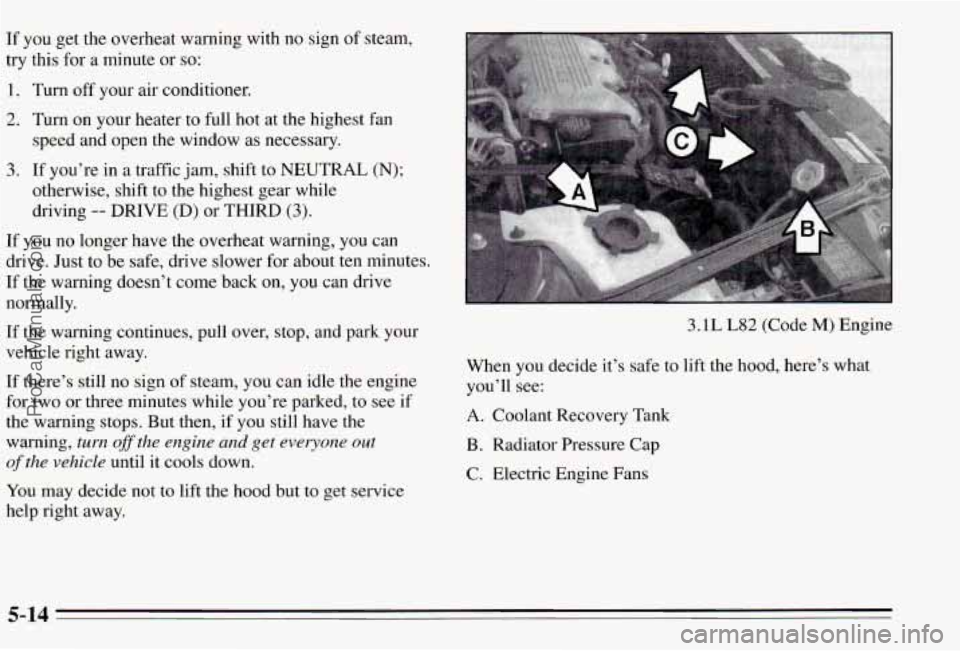
3.1L L82 (Code M) Engine
When you decide it’s safe to lift the hood, here’s what \
you’ll see:
A. Coolant Recovery Tank
B. Radiator Pressure Cap
C. Electric Engine Fans
5-14
ProCarManuals.com
Page 198 of 354
How to Add Coolant to the Radiator
NOTICE:
Your engine has a specific radiator fill procedure.
Failure to follow this procedure could cause your
engine
to overheat and be severely damaged.
i
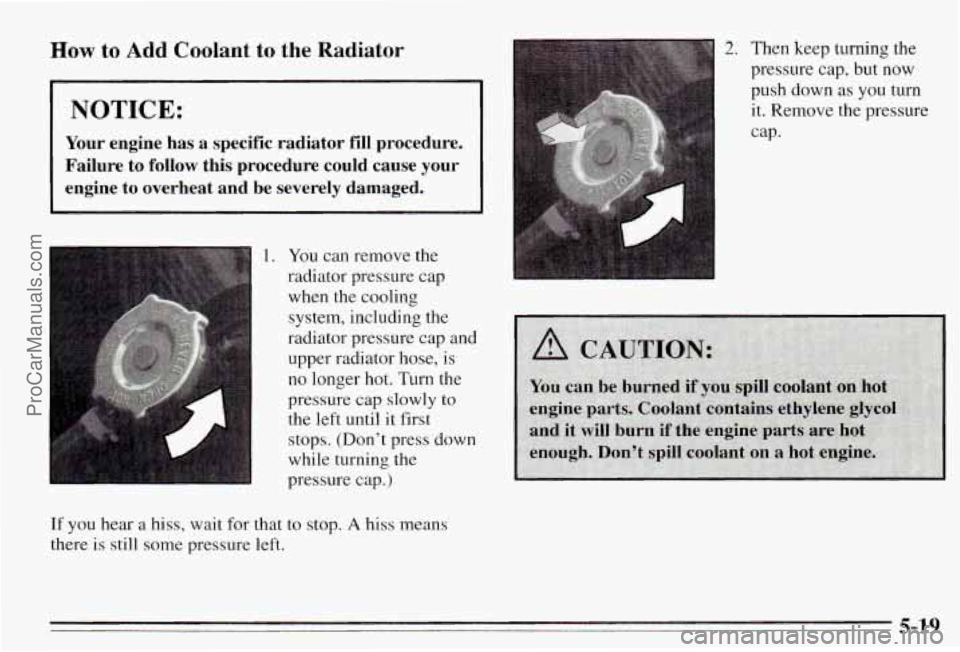
1. You can remove the
radiator pressure cap
when the cooling system, including the
radiator pressure cap and
upper radiator hose, is
no longer
hot. TU^ the
pressure cap slowly to
the left until it first
stops. (Don’t press down
while turning the
pressure cap.)
If you hear a
hiss, wait for that to stop. A hiss means
there is still some pressure left.
2. Then keep turning the
pressure cap, but now
push down
as you turn
it. Remove the pressure
cap.
5-19
ProCarManuals.com
Page 200 of 354
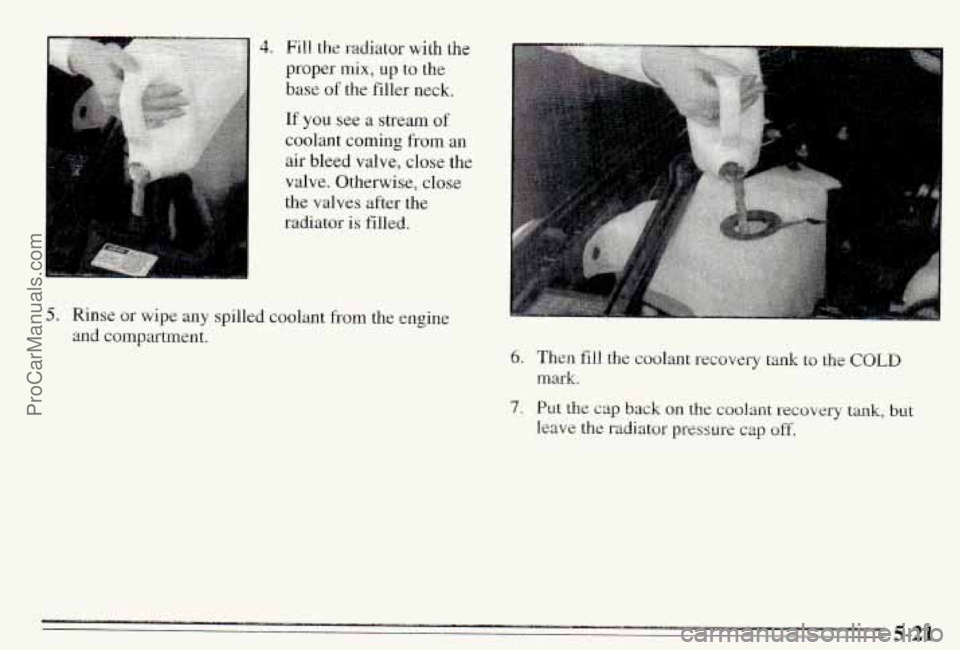
Fill the radiator with the
base of the filler neck,
If you see a stream of
coolant coming fi-om an
air bleed valve, close the
valve. Otherwise, close
the valves after the
radiatur is filled.
proper mix, up to the
5. Rinse or wipe any spilled coolant from the engine
and compartment.
6. Then fill the coolant recovery tank to the COLD
mark.
7. Put the cap back on the coolant recovery tank, but
leave the radiator pressure cap off,
5-21 ProCarManuals.com
Page 201 of 354
8. Start the engine and let it run until you can feel the
upper radiator hose getting hot. Watch out for the
engine fans.
filler neck may be lower. If the level is lower, add
more
of the proper mix through the filler neck until
the level reaches the base of the filler neck.
9. By this time the coolant level inside the radiator
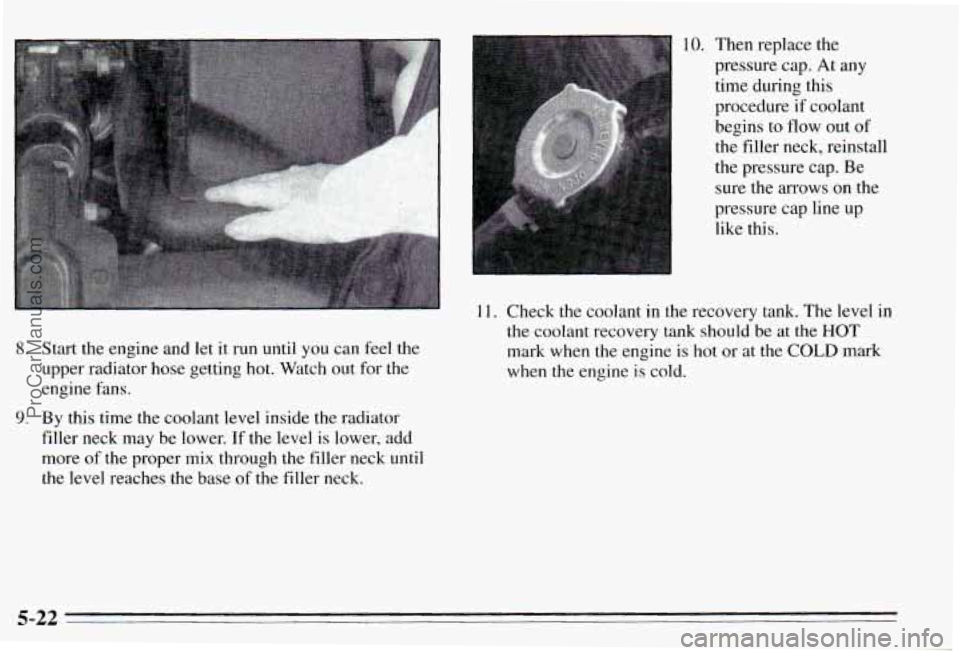
10. Then replace the
pressure cap. At
any
time during this
procedure
if coolant
begins to
flow out of
the filler neck, reinstall
the pressure cap.
Be
sure the arrows on the
pressure cap line up
like this.
11. Check the coolant in the recovery tank. The level in
the coolant recovery tank should be at
the HOT
mark when the engine is hot or at the COLD mark
when the engine is cold.
5-22
ProCarManuals.com
Page 221 of 354
I
a3
7
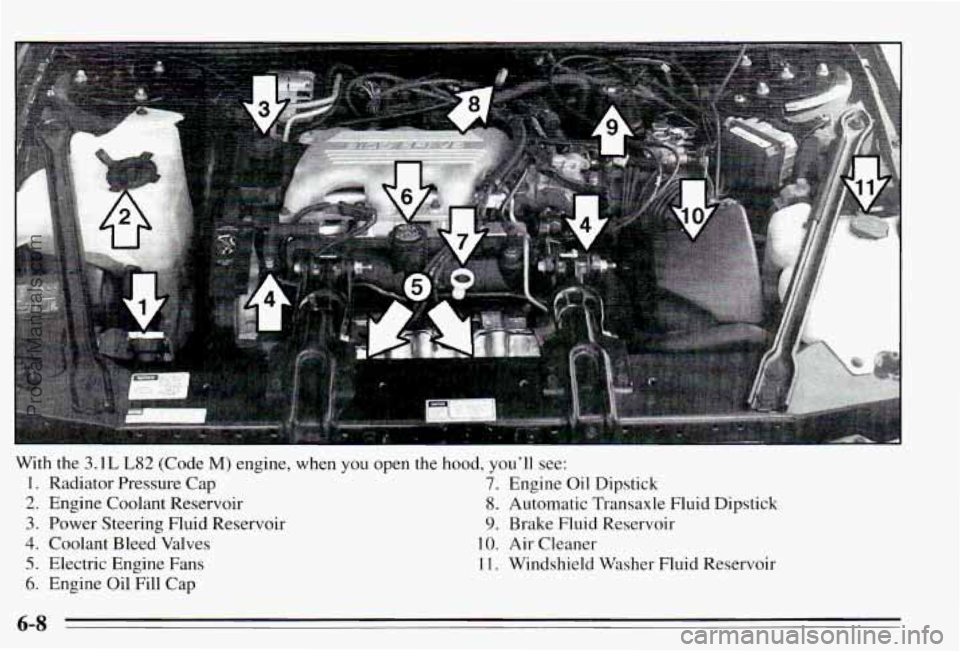
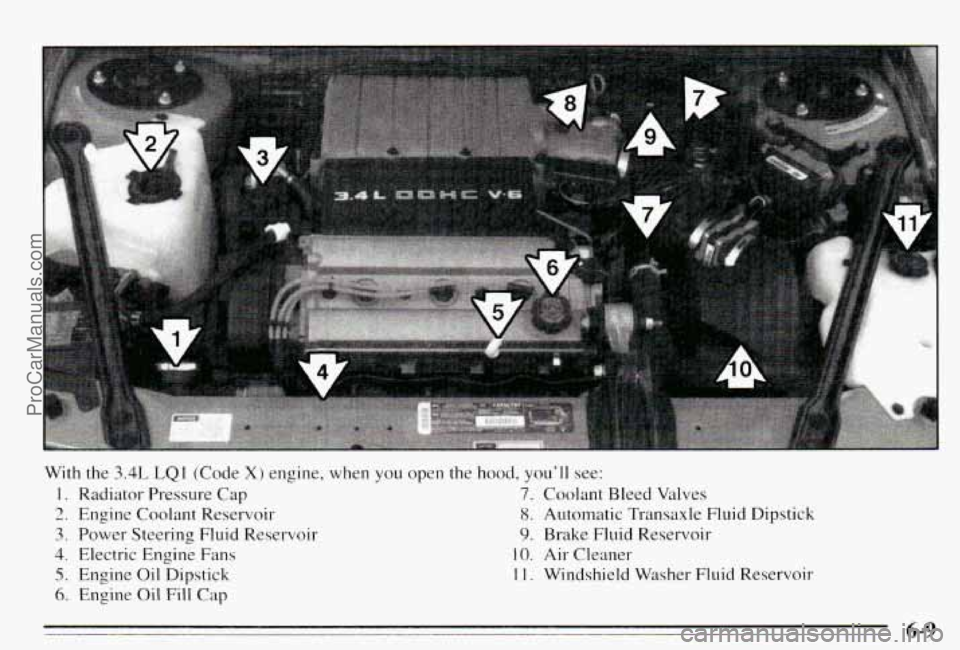
With the 3.1 L L82 (Code M) engine, when you open the hood, you’ll see:
1. Radiator Pressure Cap 7. Engine Oil Dipstick
2. Engine Coolant Reservoir 8. Automatic Transaxle Fluid Dipstick
3. Power Steering Fluid Reservoir 9. Brake Fluid Reservoir
4. Coolant Bleed Valves 10. Air Cleaner
5. Electric Engine Fans 11. Windshield Washer Fluid Reservoir
6. Engine Oil Fill Cap
6-8
ProCarManuals.com
Page 222 of 354
'4 L,
With the 3.4L LQI (Code X) engine, when you open the hood, you'll see:
1. Radiator Pressure Cap 7. Coolant Bleed Valves
2. Engine Coolant Reservoir 8. Automatic Transaxle Fluid Dipstick
3. Power Steering Fluid Reservoir 9. Brake Fluid Reservoir
4. Electric Engine Fans 10. Air Cleaner
5. Engine Oil Dipstick 1 1. Windshield Washer Fluid Reservoir
6. Engine Oil Fill Cap
6-9 ProCarManuals.com
Page 235 of 354
Radiator Pressure Cap
NOTICE:
Your radiator cap is a 15 psi (105 kPa)
pressure-type cap and must be tightly installed
to prevent coolant loss and possible engine
damage from overheating. Be sure the arrows
on
the cap line up with the overflow tube on the
radiator filler neck.
When you replace your radiator pressure cap, an A@
cap is recommended.
Thermostat
Engine coolant temperature is controlled by a thermostat
in the engine coolant system. The thermostat stops the
flow
of coolant through the radiator until the coolant
reaches a preset temperature.
When you replace your thermostat, an
AC@ thermostat
is recommended.
Power Steering Fluid
3.1L L82 (Code M) Engine 3.4L LQl (Code X) Engine
How To Check Power Steering Fluid
When the engine compartment is cool, unscrew the cap
and wipe the dipstick with a clean rag. Replace the cap
and completely tighten it. Then remove the cap again
and look at the fluid level on the dipstick.
6-22
ProCarManuals.com
Page 237 of 354
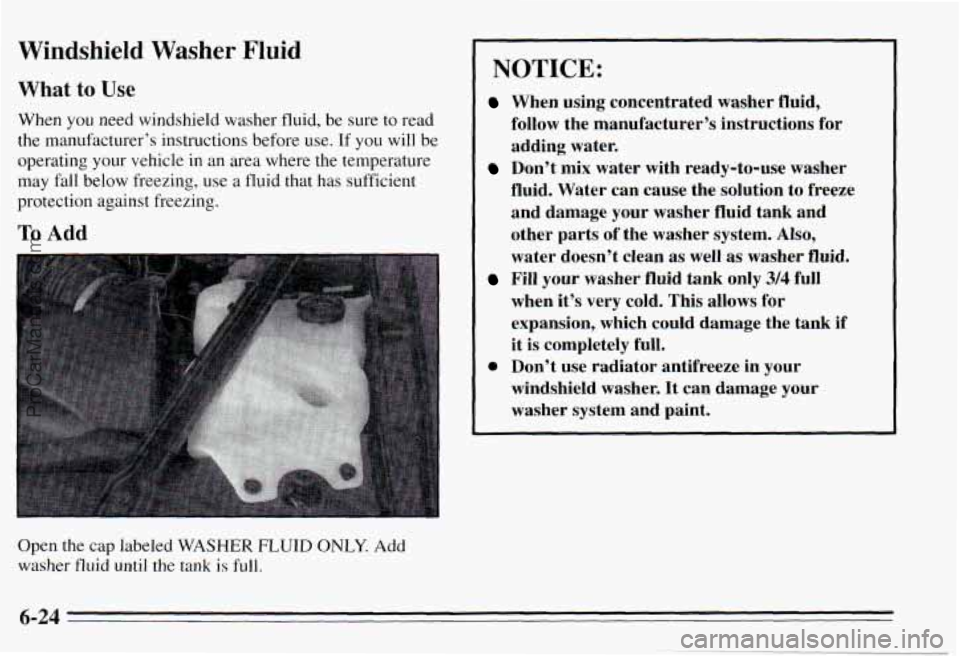
Windshield Washer Fluid
What to Use
When you need windshield washer fluid, be sure to read
the manufacturer’s instructions before use.
If you will be
operating your vehicle in an area where the temperature
may fall below freezing, use a fluid that has sufficient
protection against freezing.
To Add
Open the cap labeled WASHER FLUID ONLY. Add
washer fluid
until the tank is full.
NOTICE:
When using concentrated washer fluid,
follow the manufacturer’s instructions for
adding water.
Don’t mix water with ready-to-use washer
fluid. Water can cause the solution to freeze
and damage your washer fluid tank and
other parts of the washer system. Also,
water doesn’t clean as well as washer fluid.
Fill your washer fluid tank only 3/4 full
when it’s very cold. This allows for
expansion, which could damage the tank if
it is completely full.
windshield washer. It can damage your
washer system and paint.
0 Don’t use radiator antifreeze in your
6-24
ProCarManuals.com