Page 89 of 390
Liftgate Lock Raising the Liftgate
Open the liftgate using the handle above the license
plate. Once slightly opened, the liftgate will rise
by
itself. Lamps in the liftgate will come on, illuminating
the rear cargo area (see “Rear Interior Lamps” in the
Index).
I NOTICE:
Be sure there are no overhead obstructions, such
as a garage door, before you open the liftgate.
You could slam the liftgate into something and
break the glass.
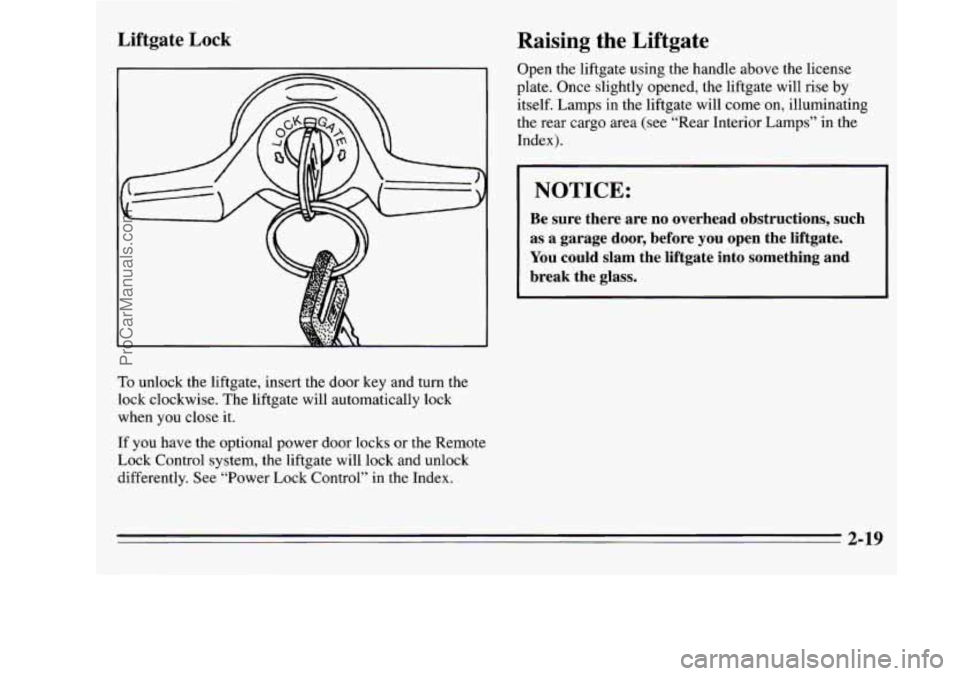
To unlock the liftgate, insert the door key and turn the
lock clockwise. The liftgate will automatically lock
when you close it.
If you have the optional power door locks or the Remote
Lock Control system, the liftgate will lock and unlock
differently. See “Power Lock Control’’ in the Index.
2-19
ProCarManuals.com
Page 92 of 390
Key in the Ignition
If you walk away from your vehicle with the keys
inside, it’s an easy target for joy riders or professional
thieves
-- so don’t do it.
New Vehicle ''Break-in"
When you park your Oldsmobile and open the driver’s
door’ you’ll hear a chime reminding you to remove your
key from the ignition and take it with you. Always
do
this. Your steering wheel will be locked, and so will your
ignition and transaxle. And remember to lock the doors.
Parking at Night
Park in a lighted spot, close all windows and lock your
vehicle. Remember to keep your valuables out
of sight.
Put them in a storage area, or take them with you.
Parking Lots
If you park in a lot where someone will be watching
your vehicle, it’s best to lock it up and take your keys.
But what if you have to leave your ignition key? What if
you have
to leave something valuable in your vehicle?
Put your valuables in a storage area, like your glove
box or locking storage bin.
Lock the storage bin.
Lock all the doors except the driver’s.
0 Then take the door key with you.
NOTICE:
Your modern Oldsmobile doesn’t need an
elaborate “break-in.” But it
will perform better
in the long run if you follow these guidelines:
Don’t drive at any one speed -- fast or
slow
-- for the first 500 miles (804 km).
Don’t make full-throttle starts.
200 miles (322 km) or so. During this time
your new brake linings aren’t yet broken
in. Hard stops with new linings can mean
premature wear and earlier replacement.
Follow this “breaking-in” guideline every
time you get new brake linings.
Don’t tow a trailer during “break-in.” See
“Towing
a Trailer” in the Index for more
information.
0 Avoid making hard stops for the first
2-22
ProCarManuals.com
Page 93 of 390
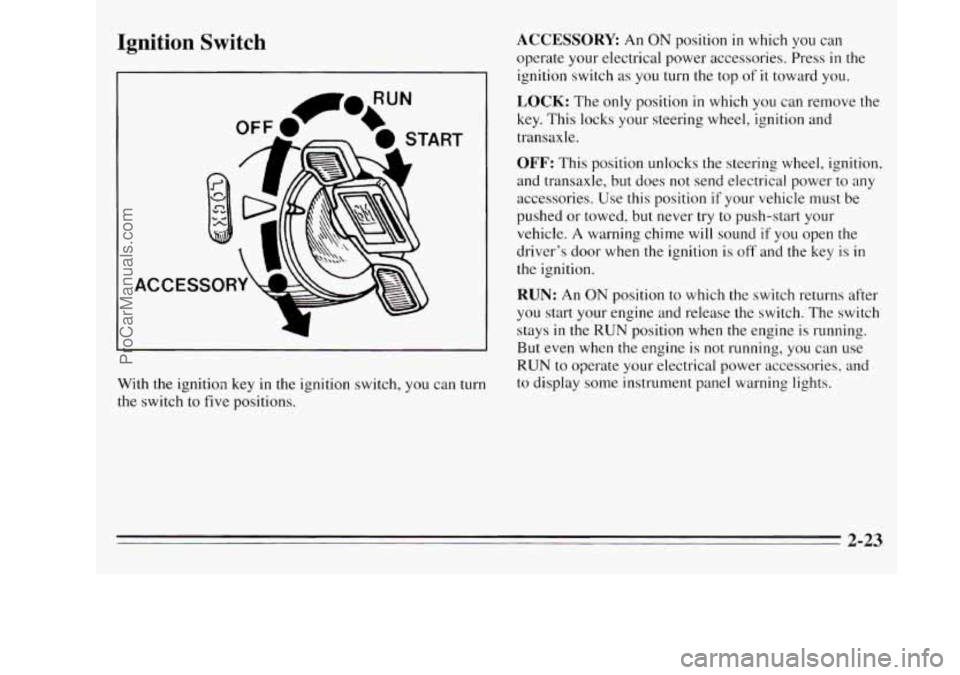
Ignition Switch
ACCE
With the ignition key in the ignition switch, you can turn
the switch to five positions.
ACCESSORY An ON position in which you can
operate your electrical power accessories. Press
in the
ignition switch
as you turn the top of it toward you.
LOCK: The only position in which you can remove the
key. This locks your steering wheel, ignition and
transaxle.
OFF: This position unlocks the steering wheel, ignition,
and transaxle, but does not send electrical power to any
accessories. Use this position
if your vehicle must be
pushed or towed, but never try
to push-start your
vehicle. A warning chime will sound if
you open the
driver’s door when the ignition is off and the key is in
the ignition.
RUN: An ON position to which the switch returns after
you start your engine and release the switch. The switch
stays in
the RUN position when the engine is running.
But even when the engine is not running, you can use
RUN to operate your electrical power accessories, and
to display some instrument panel warning lights.
2-23
ProCarManuals.com
Page 94 of 390
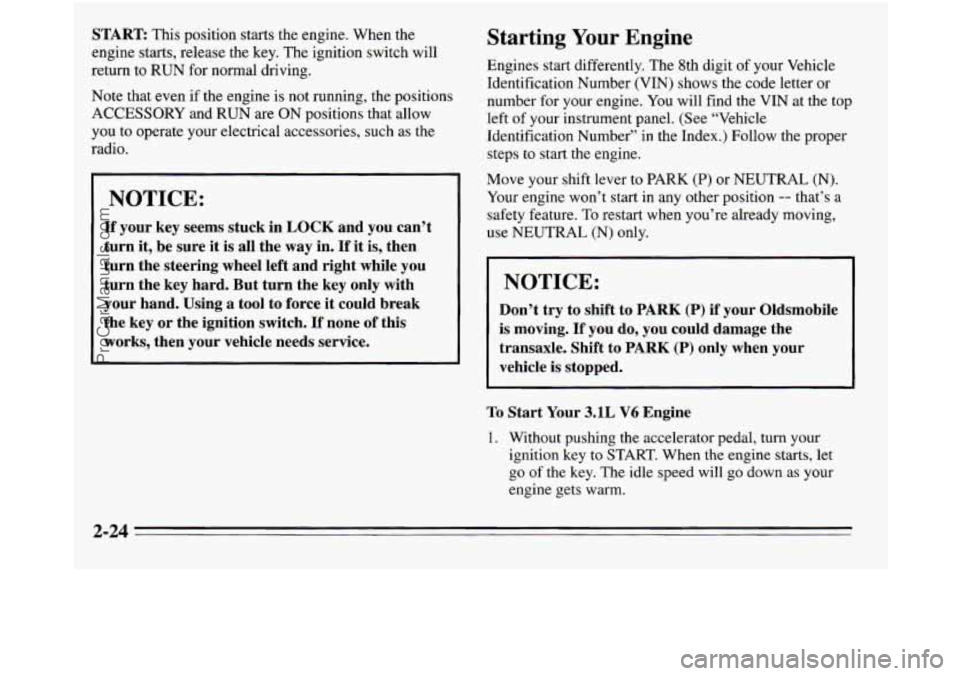
START This position starts the engine. When the
engine starts, release the key. The ignition switch will
return to RUN for normal driving.
Note that even if the engine is not running, the positions
ACCESSORY and RUN are
ON positions that allow
you to operate your electrical accessories, such as the
radio.
NOTICE:
If your key seems stuck in LOCK and you can’t
turn it, be sure
it is all the way in. If it is, then
turn the steering wheel left and right while you
turn the key hard. But turn the key only with
your hand. Using
a tool to force it could break
the key or the ignition switch. If none of this
works, then your vehicle needs service.
Starting Your Engine
Engines start differently. The 8th digit of your Vehicle
Identification Number (VIN) shows the code letter or
number for your engine. You will find the VIN at the top
left
of your instrument panel. (See “Vehicle
Identification Number” in the Index.) Follow the proper
steps to start the engine.
Move your shift lever to PARK (P) or NEUTRAL
(N).
Your engine won’t start in any other position -- that’s a
safety feature. To restart when you’re already moving,
use NEUTRAL (N) only.
NOTICE:
Don’t try to shift to PARK (P) if your Oldsmobile
is moving.
If you do, you could damage the
transaxle. Shift to
PARK (P) only when your
vehicle is stopped.
To Start Your 3.1L V6 Engine
1. Without pushing the accelerator pedal, turn your
ignition key to START. When the engine starts, let
go of the key. The idle speed will go down as your
engine gets warm.
2-24
ProCarManuals.com
Page 99 of 390
PARK (P): This position locks your front wheels. It’s
the best position to
use when you start your engine
because your vehicle can’t move easily.
Ensure the shift lever
is fully in PARK (P) before starting
the engine. Your Oldsmobile has brake-transaxle shift
interlock
(BTSI). You must fully apply your regular brakes
before you can shift from PARK (P) when the ignition key is
in the RUN position.
As you step on the brake pedal,
while in PARK (P),
you may hear a click from the solenoid
of the
BTSI. This ensures that the BTSI is operating
properly.
If you cannot shift out of PARK (P), ease pressure on
the shift lever
-- push the shift lever all the way into
PARK (P) as you maintain brake application. Then
move the shift lever into the gear you wish. See
“Shifting Out of PARK
(P)” in this part.
REVERSE (R): Use this gear to back up.
I NOTICE: I
Shifting to REVERSE (R) while your vehicle is
moving forward could damage your transaxle. Shift to REVERSE
(R) only after your vehicle is
stopped.
To rock your vehicle back and forth to get out of snow,
ice or sand without damaging your transaxle, see “If
You’re Stuck: In Sand,
Mud, Ice or Snow” in the Index.
2-29
ProCarManuals.com
Page 104 of 390
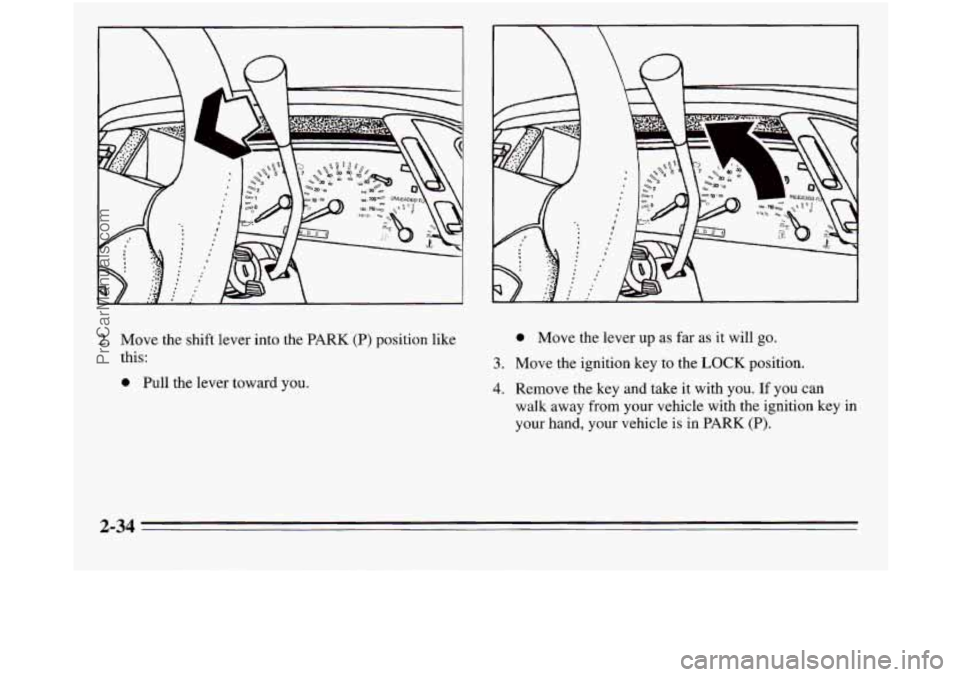
2. Move the shift lever into the PARK (P) position like
this:
0 Pull the lever toward you.
0 Move the lever up as far as it will go.
3. Move the ignition key to the LOCK position.
4. Remove the key and take it with you. If you can
walk away from your vehicle with the ignition key in
your hand, your vehicle is
in PARK (P).
2-34
ProCarManuals.com
Page 105 of 390
Leaving Your Vehicle With the Engine
Running
If you have to leave your vehicle with the engine
running, be sure your vehicle is in PARK (P) and your
parking brake is firmly set before you leave it. After
you’ve moved the shift lever into the PARK (P)
position, hold the regular brake pedal down. Then, see if
you can move the shift lever away from PARK (P)
without first pulling it toward you.
If you can, it means that the shift lever wasn’t fully
locked into PARK
(P).
Torque Lock
If you are parking on a hill and you don’t shift your
transaxle into PARK (P) properly, the weight
of the
vehicle may put too much force on the parking pawl in
the transaxle. You may find it difficult to pull the shift
lever out of PARK (P). This
is called “torque lock.” To
prevent torque lock, set the parking brake and then shift
into PARK (P) properly before you leave the driver’s
seat.
To find out how, see “Shifting Into PARK (P)” in
the Index.
When you are ready to drive, move the shift lever out of
PARK (P) before you release the parking brake.
If “torque
lock” does occur, you may need to have
another vehicle push yours a little uphill to take some of
the pressure from the transaxle,
so you can pull the shift
lever out of PARK (P).
2-35
ProCarManuals.com
Page 106 of 390
Shifting Out of PARK (P)
Your Uldsmobile has braketransaxle shift interlock.
You have to fully uppZy your regular brake before you
can shift from PARK (P), when the ignition is in the
RUN position. See “Shifting the Automatic Transaxle”
in
the Index.
~f you cmot wt out of PARK e), ,&e pressure on
the shift lever A- push the shift lever all the way into
PARR (P) as you maintain brake application. Then
move the shift lever into the gear you want. If you ever
hold
the brake pedal down but still can’t shift out of’
1. Turn the key to OFF.
2. Apply and hold the brake til the end of Step 4.
PARK (P), try this:
3. shift to NEUTRAL m.
4. Start the vehicle and then shift to the drive gear you
5. Have the vehicle €ixd as soon as you can.
want.
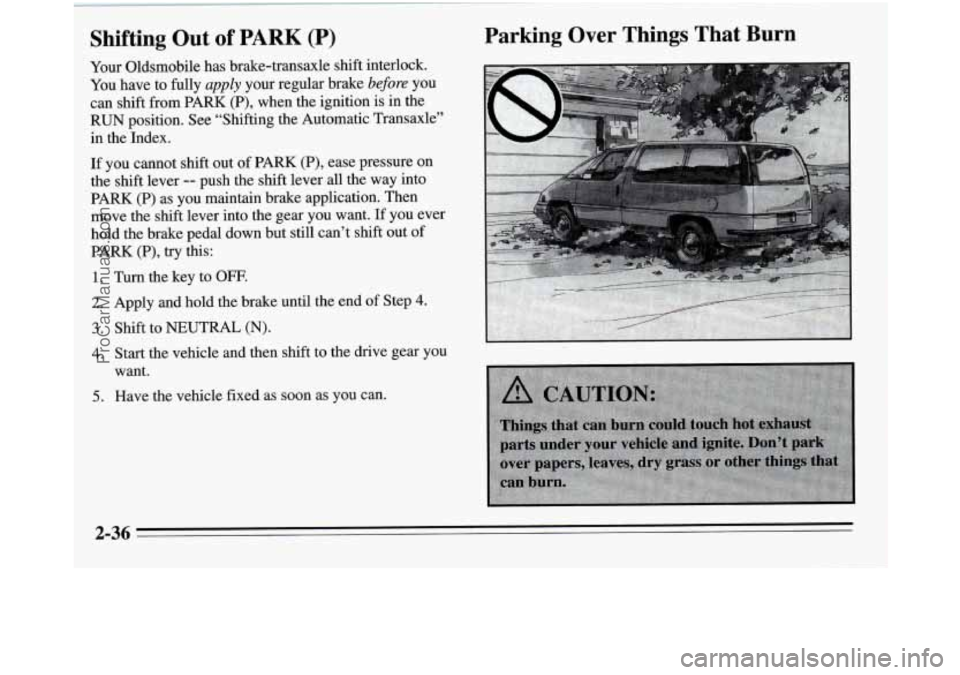
Parking Over Things That Burn
2-36
ProCarManuals.com