1995 GMC SIERRA air condition
[x] Cancel search: air conditionPage 279 of 488
Checking Things Under the Hood
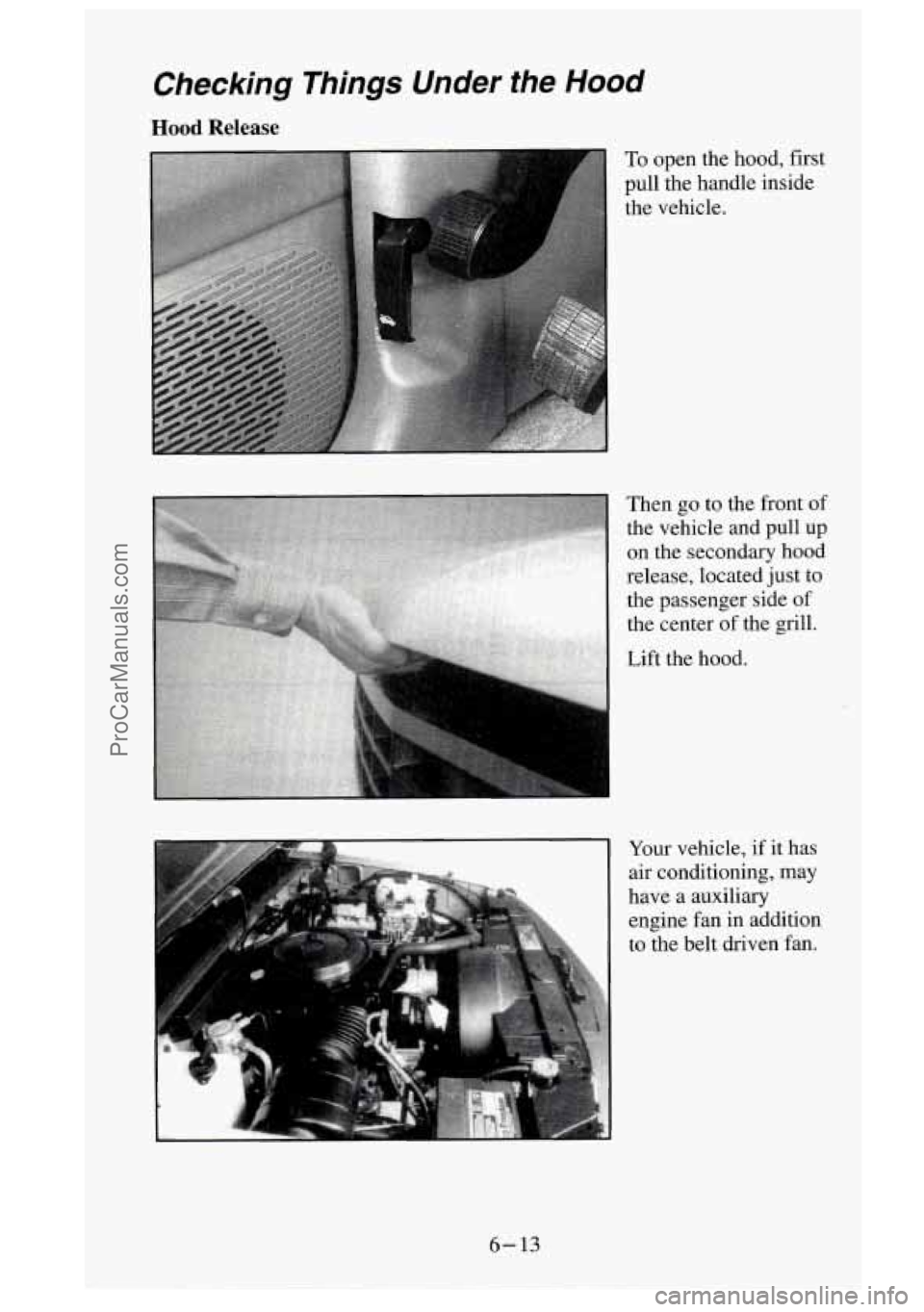
Hood Release
To open the hood, first
pull the handle inside
the vehicle.
Then go to the front of
the vehicle and pull up
on the secondary hood
release, located just to
the passenger side
of
the center of the grill.
Lift the hood.
Your vehicle,
if it has
air conditioning, may
have a auxiliary
engine fan in addition
to the belt driven fan.
6- 13
ProCarManuals.com
Page 280 of 488
A CAUTION:
If your vehicle has air conditioning, the auxiliary engine fan
under the hood can start up and injure you even when the
engine is not running. Keep hands, clothing and tools
away from
any underhood electric fan.
A CAUTION:
Things that burn can get on hot engine parts and start a fire.
These include liquids like gasoline or diesel fuel, oil, coolant,
brake fluid, windshield washer and other fluids, and plastic
or
rubber. You or others could be burned. Be careful not to drop or
spill things that
will burn onto a hot engine.
Before closing the hood, be sure
all filler caps are on properly. Pull down
the
hood and close it firmly.
Cleaning Your Diesel Engine
I NOTICE:
If you spray or pour water or any other liquid on your engine
when it is warm or hot, or when it
is running, you could cause
serious damage to it.
If you ever clean the engine, clean it only
when it is cold.
Noise Control System
The following information relates to compliance with Federal noise
emission standards for vehicles with a Gross Vehicle Weight Rating
(GVWR)
of more than 10,000 pounds (4 536 kilograms). The Maintenance
Schedule booklet provides information on maintaining
the noise control
system to minimize degradation of the noise emission control system during
the life of your vehicle. The noise control system warranty is given in your
Warranty booklet.
These standards apply only
to vehicles sold in the United States.
6-14
ProCarManuals.com
Page 302 of 488
NOTICE:
If you use an improper coolant mix, your engine could overheat
and be badly damaged. The repair cost wouldn’t be covered by
your warranty.
Too much water in the mix can freeze and crack
the engine, radiator, heater core and other parts.
Some conditions. such as air trapped
in the cooling system. can affect the
coolant level
in thc radiator. Check the coolant level when the engine is cold
and
follow the steps under “Adding Coolant“ for the proper way to add
coolant.
If you have to add coolant more than lour timcs a ycar, have your dealer
check your cooling system.
NOTICE:
If you use the proper coolant, you don’t have to add extra
inhibitors or additives which claim to improve the system. These
can be harmful.
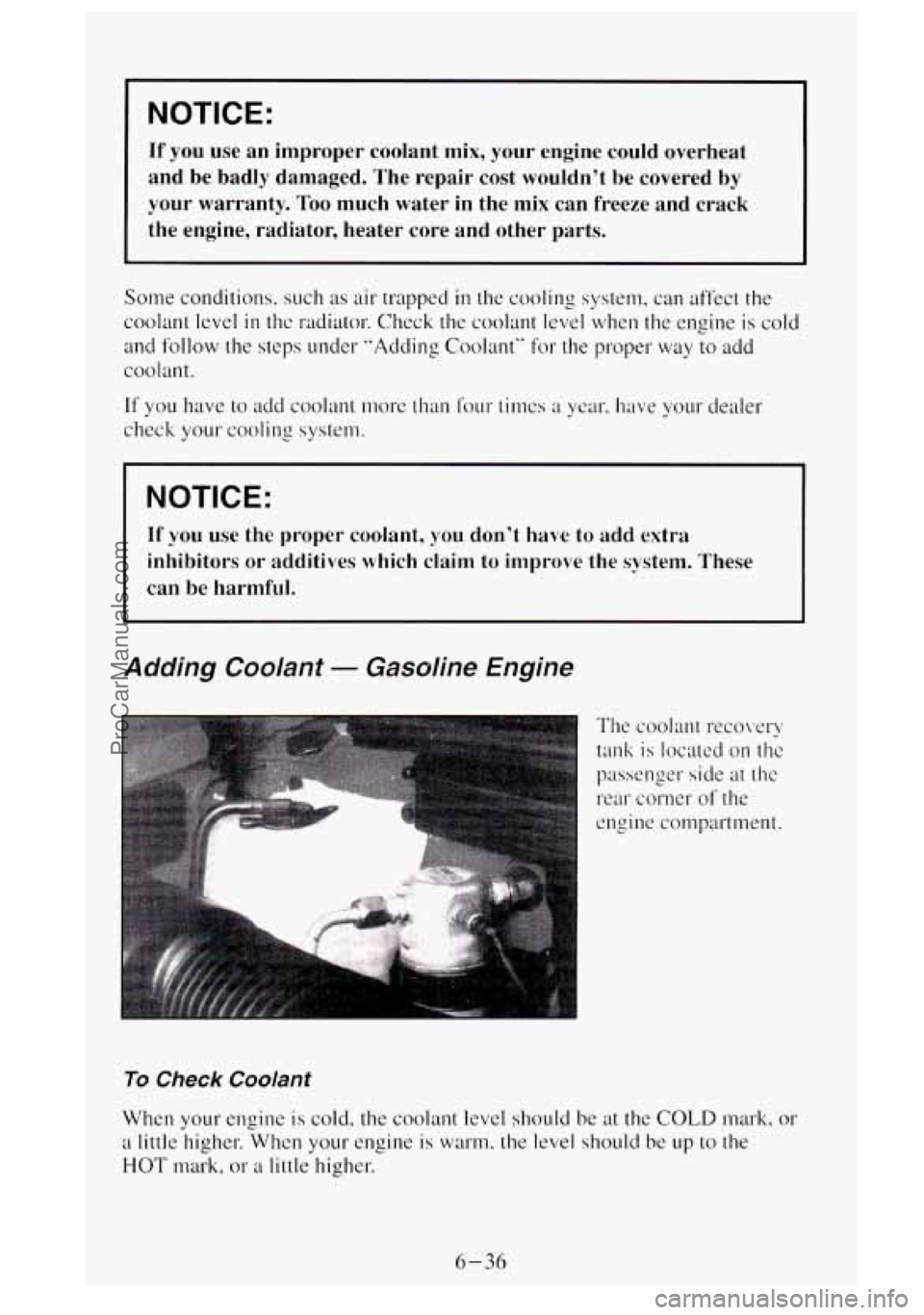
Adding Coolant - Gasoline Engine
The coolant reco\wy
tank is located on the
passenger side
at the
rear comer
of the
engine compartment.
To Check Coolant
When your engine is cold, the coolant level should be at the COLD mark, or
a little higher. When your engine is warm, the level should be up to the
HOT mark, or a little higher.
6-36
ProCarManuals.com
Page 310 of 488

Brake Wear
Your vehicle has front disc brakes and rear drum brakes. If you have a C
3500 HD model, it has four-wheel disc brakes.
Disc brake pads have built-in wear indicators that make
a high-pitched
warning sound when the brake pads are worn and new pads are needed. The
sound may come and
go or be heard all the time your vehicle is moving
(except when you are pushing on the brake pedal firmly).
I A CAUTION:
The brake wear warning sound means that sooner or later your
brakes won’t work well. That could lead to an accident. Whe\
n
you hear the brake wear warning sound, have your vehicle
serviced.
NOTICE:
Continuing to drive with worn-out brake pads could result in
costly brake repair.
Some driving conditions or climates may cause a brake squeal when the
brakes are first applied or lightly applied. This does not mean something is
wrong with your brakes.
If you have rear drum brakes, they don’t have wear indicators, but if you
ever hear
a rear brake rubbing noise, have the rear brake linings inspected.
Also, the rear brake drum should be removed and inspected each time the
tires are removed for rotation
or changing. When you have the front brakes
replaced, have the rear brakes inspected, too.
Brake linings should always be replaced as complete axle sets.
Brake Pedal Travel
See your dealer if the brake pedal does not return to normal height, or if
there is a rapid increase in pedal travel. This could be a sign of brake
trouble.
6-44
ProCarManuals.com
Page 312 of 488
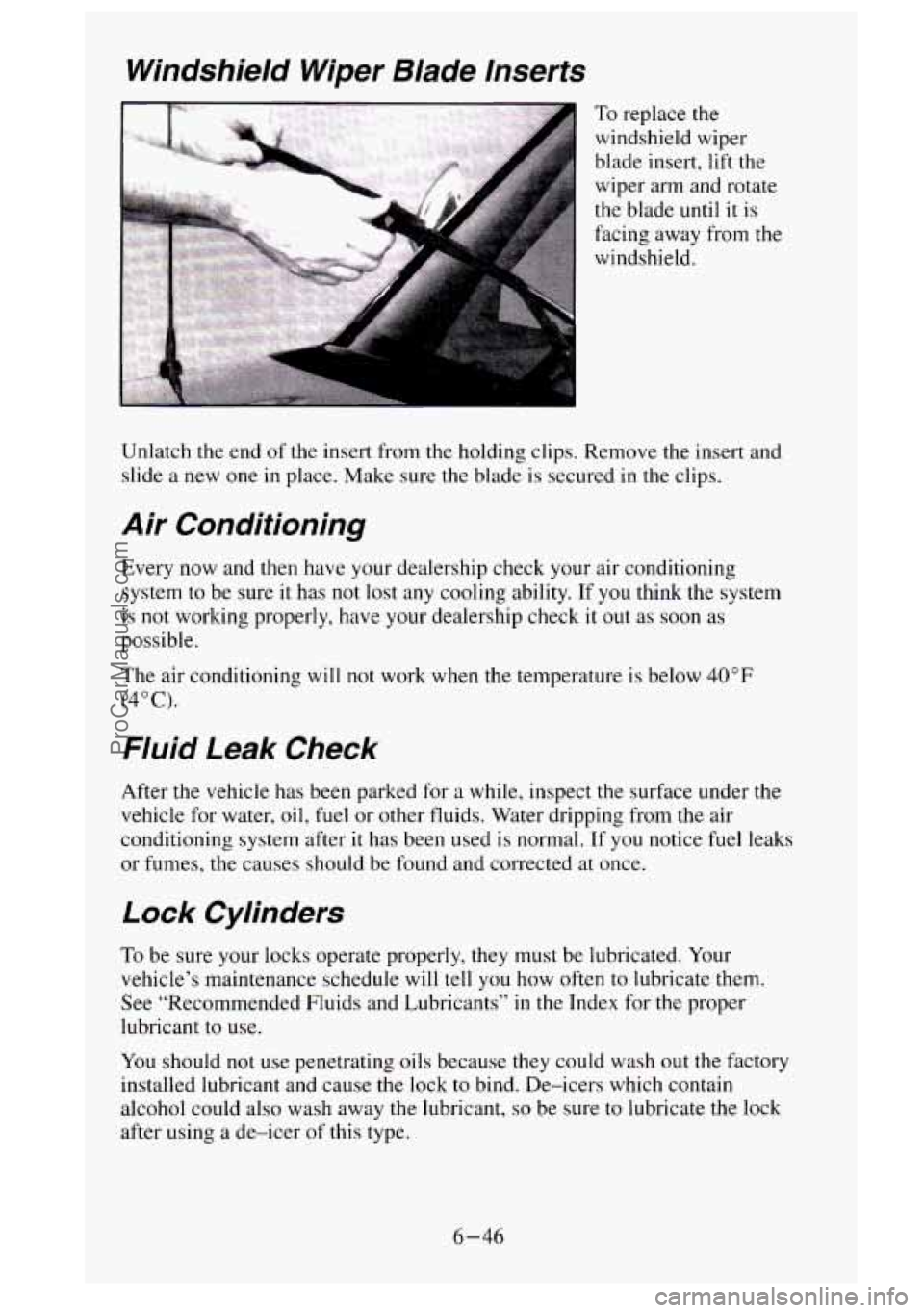
Windshield Wiper Blade Inserts
To replace the
windshield wiper
blade insert, lift
the
wiper arm and rotate
the blade until
it is
facing away from the
windshield.
Unlatch the end
of the insert from the holding clips. Remove the insert and
slide
a new one in place. Make sure the blade is secured in the clips.
Air Conditioning
Every now and then have your dealership check your air conditioning
system to be sure it
has not lost any cooling ability. If you think the system
is not working properly, have your dealership check it out as soon as
possi bleb
The air conditioning will
not work when the temperature is below 40°F
(4°C).
Fluid Leak Check
After the vehicle has been parked for a while, inspect the surface under the
vehicle for water, oil, fuel
or other fluids. Water dripping from the air
conditioning system after it has been used is normal.
If you notice fuel leaks
or fumes, the causes should be found and corrected at once.
Lock Cylinders
To be sure your locks operate properly, they must be lubricated. Your
vehicle’s maintenance schedule will tell you how often to lubricate them.
See “Recommended Fluids and Lubricants” in the Index for
the proper
lubricant to use.
You should
not use penetrating oils because they could wash out the factory
installed lubricant and cause
the lock to bind. De-icers which contain
alcohol could also
wash away the lubricant, so be sure to lubricate the lock
after using
a de-icer of this type.
6-46
ProCarManuals.com
Page 328 of 488
When it’s Time for New Tires
You need a new tire if:
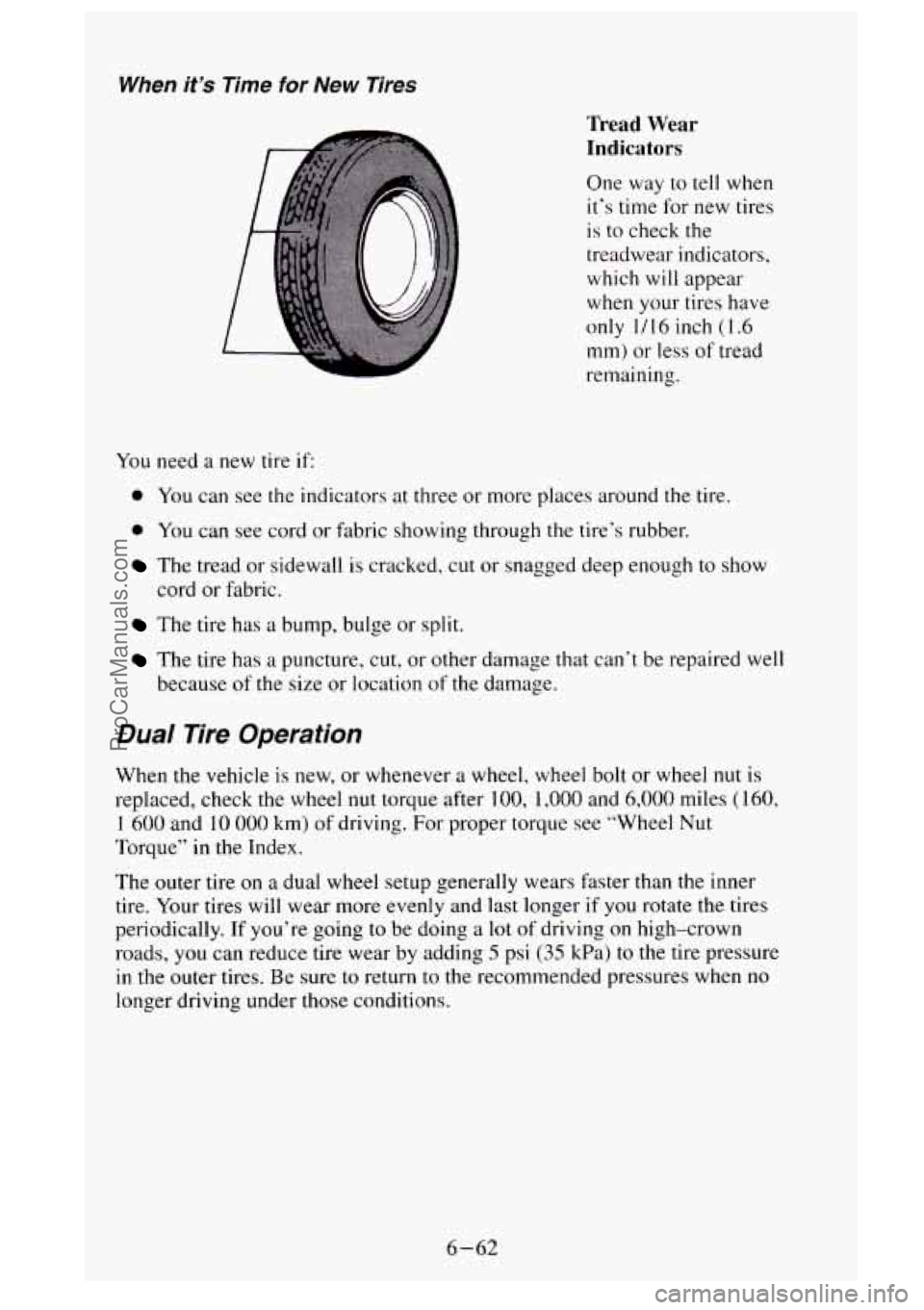
Tread Wear
Indicators
One way to tell when
it’s time for new tires
is to check the
treadwear indicators,
which will appear
when your tires have
only
1/16 inch (1.6
mm)
or less of tread
remaining.
0 You can see the indicators at three or more places around the tire.
0 You can see cord or fabric showing through the tire’s rubber.
The tread or sidewall is cracked, cut or snagged deep enough to show
cord
or fabric.
The tire has a bump, bulge or split.
The tire has a puncture, cut, or other damage that can‘t be repaired well
because
of the size or location of the damage.
Dual Tire Operation
When the vehicle is new, or whenever a wheel, wheel bolt or wheel nut is
replaced, check the wheel
nut torque after 100, 1,000 and 6,000 miles (160,
1 600 and 10 000 km) of driving. For proper torque see “Wheel Nut
Torque” in the Index.
The outer tire
on a dual wheel setup generally wears faster than the inner
tire. Your tires will wear more evenly and last longer
if you rotate the tires
periodically. If you’re going to be doing
a lot of driving on high-crown
roads, you can reduce tire wear by adding
5 psi (35 kPa) to the tire pressure
in the outer tires. Be sure to return
to the recommended pressures when no
longer driving under those conditions.
6-62
ProCarManuals.com
Page 331 of 488
Wheel Alignment and Tire Balance
The wheels on your vehicle were aligned and balanced carefully at the
factory
to give you the longest tire life and best overall performance.
In most cases, you will not need to have your wheels aligned again.
However, if
you notice unusual tire wear or your vehicle pulling one way or
the other,
the alignment may need to be reset. If you notice your vehicle
vibrating when driving
on a smooth road, your wheels may need to be
rebalanced.
Wheel Replacement
Replace any wheel that is bent, cracked, or badly rusted or corroded. If
wheel nuts keep coming loose, the wheel, wheel bolts, and wheel nuts
should be replaced.
If the wheel leaks air, replace it (except some aluminum
wheels, which can sometimes be repaired). See your
GM dealer if any of
these conditions exist.
Your dealer will know the kind of wheel you need.
Each new wheel should have the same load carrying capacity, diameter,
width, offset, and be mounted the same way as the one
it replaces.
If you need to replace any of your wheels, wheel bolts, or wheel nuts,
replace them only with new
GM original equipment parts. This way, you
will be sure to have the right wheel, wheel bolts, and wheel nuts for your
vehicle.
A CAUTION:
Using the wrong replacement wheels, wheel bolts, or wheel nuts
on your vehicle can be dangerous. It could affect the braking
and handling
of your vehicle, make your tires lose air and make
you lose control, You could have a collision in which
you or
others could be injured. Always use the correct wheel, wheel
bolts, and wheel
nuts for replacement.
NOTICE:
The wrong wheel can also cause problems with bearing life,
brake cooling, speedometer/odometer calibration, headlamp
aim, bumper height, vehicle ground clearance, and tire or tire
chain clearance to the body and chassis.
6-65
ProCarManuals.com
Page 340 of 488
Finish Damage
Any stone chips, fractures or deep scratches in the finish should be repaired
right away. Bare metal will corrode quickly and may develop into
a major
repair expense.
Minor chips and scratches can be repaired with touch-up materials available
from your dealer or other service outlets. Larger areas of finish damage can
be corrected in your dealer’s body and paint shop.
Underbody Maintenance
Chemicals used for ice and snow removal and dust control can collect on
the underbody. If these are not removed, accelerated corrosion (rust) can
occur
on the underbody parts such as fuel lines, frame, floor pan, and
exhaust system even though they have corrosion protection.
At least every spring, flush these materials from
the underbody with plain
water. Clean any areas where mud and other debris can collect. Dirt packed
in closed areas of the frame should be loosened before being flushed. Your
dealer or
an underbody vehicle washing system can do this for you.
Chemical Paint Spotting
Some weather and atmospheric conditions can create a chemical fallout.
Airborne pollutants can fall upon and attack painted surfaces on your
vehicle. This damage can take two forms: blotchy, ringlet-shaped
discolorations, and small irregular dark spots etched into the paint surface.
Although no defect
in the paint job causes this, GM will repair, at no charge
to
the owner, the surfaces of new vehicles damaged by this fallout condition
within
12 months or 12,000 miles (20 000 km) of purchase, whichever
comes first.
This applies only to materials manufactured and sold by General Motors.
Bodies, body conversions or equipment not made or sold by General Motors
are not covered.
6-74
ProCarManuals.com