1995 GMC SIERRA air condition
[x] Cancel search: air conditionPage 149 of 488
Before using your vehicle's air conditioning. open the windows to clear the.
vehicle of hot air.
Using the recirculation function can also help. See "Recirculation Buttor:"
in this section for more information.
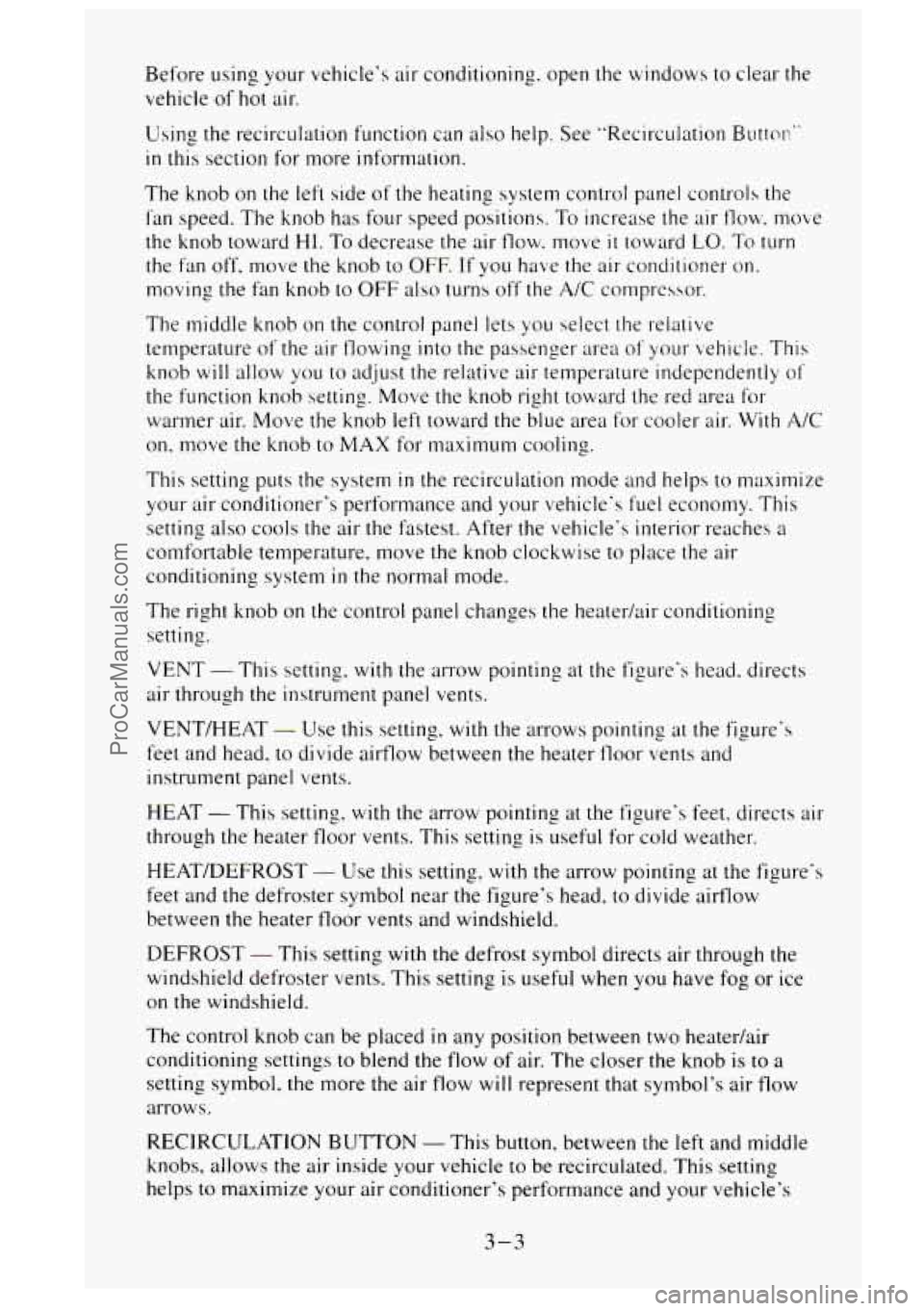
The knob on the left side of the heating system control panel controls the
fan speed. The knob has four speed positions. To increase the air
flow. move
the knob toward
HI. To decrease the air flow. move it toward LO. To turn
the fan off. move the knob
to OFF. If you have the air conditioner on.
moving the fan knob
to OFF also turns off' the A/C compressor.
The middle knob on the control panel lets you select the relative
temperature of the air flowing into the passenger
area of your vehicle. This
knob
will allow you to adjust the relative air temperature independently of'
the function knob setting. Move the knob right toward the red area for
warmer air. Move the knob left toward the blue area for cooler air. With
A/C
on, move the knob to MAX for maximum cooling.
This setting puts the system
in the recirculation mode and helps to maximize
your air conditioner's performance and your vehicle's fuel economy. This
setting also cools the air the fastest. After the vehicle's interior reaches
a
comfortable temperature, move the knob clockwise to place the air
conditioning system
in the normal mode.
The right knob
on the control panel changes the heatedair conditioning
setting.
VENT - This setting, with the arrow pointing at the figure's head. directs
air through the instrument panel vents.
VENT/HEAT
- Use this setting, with the arrows pointing at the figure's
feet and head, to divide airflow between the heater floor vents and
instrument panel vents.
HEAT
- This setting. with the arrow pointing at the figure's feet. directs air
through the heater floor vents. This setting is useful for cold weather.
HEAT/DEFROST
- Use this setting, with the arrow pointing at the figure's
feet and the defroster symbol near the figure's head. to divide airflow
between the heater floor vents and windshield.
DEFROST
- This setting with the defrost symbol directs air through the
windshield defroster vents. This setting is useful when you have fog
or ice
on the windshield.
The control knob can be placed
in any position between two heatedair
conditioning settings to blend the flow
of air. The closer the knob is to a
setting symbol, the more the air flow will represent that symbol's air flow
arrows.
RECIRCULATION
BUTTON - This button, between the left and middle
knobs, allows the air inside your vehicle
to be recirculated. This setting
helps to maximize your air conditioner's performance and your vehicle's
3-3
ProCarManuals.com
Page 150 of 488
fuel economy. This setting also cools the air the fastest and can be used to
keep “unwanted odors” and/or dust from entering the vehicle. When using
the air conditioner, turn off recirculation after the vehicle reaches
a
comfortable interior temperature.
When
the right knob on the control panel is between HEAT and DEFROST,
the recirculation feature will not function.
A/C - This button, between the middle and right knobs. allows the air
coming into your vehicle
to be cooled and directed through the instrument
panel vents. This setting is useful for normal cooling
on hot days. When you
first use
A/C with the recirculation button pushed in, turn off recirculation
as soon as the vehicle reaches a comfortable interior temperature.
Engine Coolant Heater
If your vehicle has a diesel engine, it is equipped with an engine coolant
heater.
An engine coolant heater is optional on gas engine vehicles. If you
use the engine coolant heater before starting your engine
(in cold weather
(20” F, (-8” C), or lower) your heating system will produce warmer air
faster, to heat the passenger compartment
in cold weather.
The use
of an engine coolant heater also reduces the time it takes for the
engine to reach normal operating temperature. and shortens the time it takes
the heater
to reach full output. For more information, See “Engine Coolant
Heater” in the Index.
Diesel Engine Heater Output
If you idle your diesel engine for a long time when it’s cold outside, your
heater may blow out cool air. This is normal. When you increase the engine
speed, your heater should blow out warmer air.
If it doesn’t, your coolant
level may be too low. See “Engine Coolant”
in the Index to see how to
check your coolant level.
Rear Window Defogger (Option)
You can tell if your vehicle has this option by looking at the rear window. If
you see lines running across the glass, you have it. These are the wire-like
elements which heat your window.
I NOTICE:
Scraping the inside of your rear window could cut and damage
the defogger.
Your warranty would not cover this damage. And,
don’t put decals there, you might have to scrape them off.
For best results, clear the window of as much snow or ice as possible first.
3-4
ProCarManuals.com
Page 151 of 488
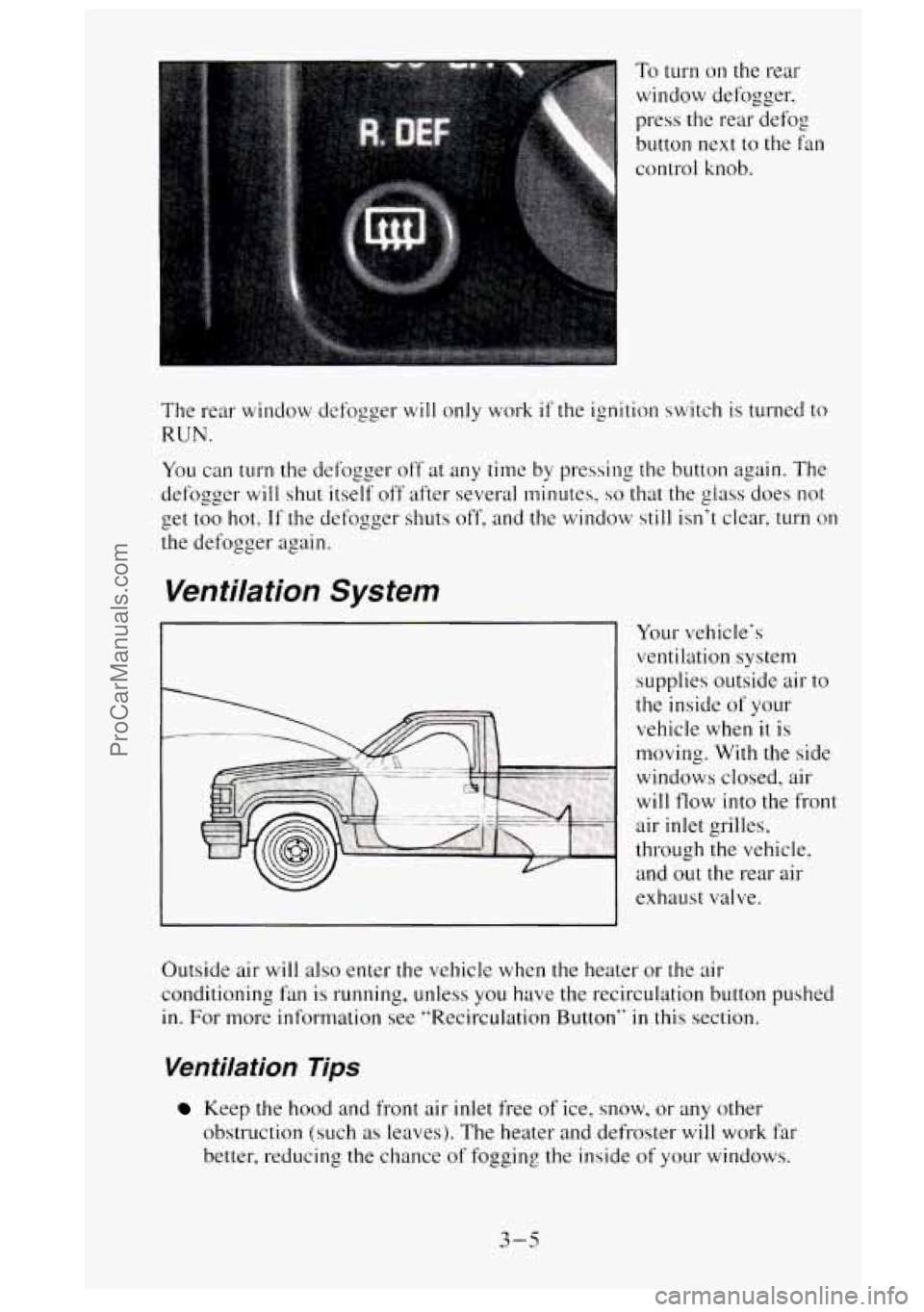
To turn on the rear
window defogger,
press the rear defog
button
next to the fan
control knob.
‘he rear window defogger
will only work if the ignition switch is turned to
:UN.
‘ou can turn the defogger off at any time by pressing the button again. The
efogger
will shut itself off after several minutes, so that the glass does not
et too hot.
If the defogger shuts off, and the window still isn’t clear, turn on
le defogger again.
Ventilation System
Your vehicle‘s
ventilation system
supplies outside air
to
the inside of your
vehicle when
it is
moving. With the side
windows closed, air
will flow into the front
air inlet grilles,
through the vehicle, and out the rear air
exhaust valve.
Outside air
will also enter the vehicle when the heater or the air
conditioning fan is running, unless you have the recirculation button pushed
in.
For more information see “Recirculation Button’‘ in this section.
Ventilation Tips
Keep the hood and front air inlet free of ice, snow, or any other
obstruction (such
as leaves). The heater and defroster will work far
better, reducing the chance
of fogging the inside of your windows.
3-5
ProCarManuals.com
Page 227 of 488
A CAUTION:
If your vehicle has air conditioning, the auxiliary electric fan
under the hood can
start up even when the engine is not running
and can injure you. Keep hands, clothing and
tools away from
any underhood electric fan.
-
NOTICE:
Ignoring these steps could result in costly damage to your
vehicle that wouldn’t be covered by your vehicle warranty.
Trying to start your vehicle by pushing or pulling it could
damage your vehicle, even if you have a manual transmission.
And if you have an automatic transmission,
it won’t start that
way.
To Jump Start Your Vehicle
1. Check the other vehicle. It must have a 12-volt battery with a negative
ground system.
NOTICE:
If the other system isn’t a 12-volt system with a negative
ground, both vehicles can be damaged.
If you have a diesel engine vehicle with two batteries (or more), you
should know before you begin that, especially in cold weather, you may
not be able to get enough power from a single battery
in another
vehicle to start your diesel engine.
If your vehicle has more than one battery, use the battery that’s on the
passenger side
of the vehicle - this will reduce electrical resistance.
2. Get the vehicles close enough so the jumper cables can reach, but be
sure the vehicles aren’t touching each other.
If they are, it could cause a
ground connection you don’t want.
You wouldn’t be able to start your
vehicle, and the bad grounding could damage
the electrical systems.
5-3
ProCarManuals.com
Page 235 of 488
If No Steam Is Coming From Your Engine
If you get the overheat warning but see or hear no steam, the problem may
not be too serious. Sometimes the engine can get a little too hot when you:
0 Climb a long hill on a hot day.
0 Stop after high speed driving.
0 Idle for long periods in traffic.
Tow a trailer. See “Driving on Grades’’ in the Index.
If
you get the overheat warning with no sign of steam, try this for a minute
or
so:
1. If you have an air conditioner, turn it off.
2. Turn on your heater to full hot at the highest fan speed and open the
window as necessary.
3. If you’re in a traffic jam, shift to NEUTRAL (N); otherwise, shift to the
highest gear while driving
- AUTOMATIC OVERDRIVE (@) or
DRIVE
(3) for automatic transmissions.
If you no longer have the overheat warning, you can drive. Just to be safe,
drive slower for about ten minutes. If the warning doesn’t come back on,
you can drive normally.
If
the warning continues, pull over, stop, and park your vehicle right away.
If there’s still no sign of steam, push the accelerator until the engine speed is
about twice as fast as normal idle speed. Bring the engine speed back to
normal idle speed after two or three minutes. Now see
if the warning stops.
But then, if
you still have the warning, turn ofSthe engine and get everyone
out of the vehicle until it cools down.
You may decide not to lift the hood but to get service help right away.
5-11
ProCarManuals.com
Page 236 of 488
Cooling System - Gasoline Engines
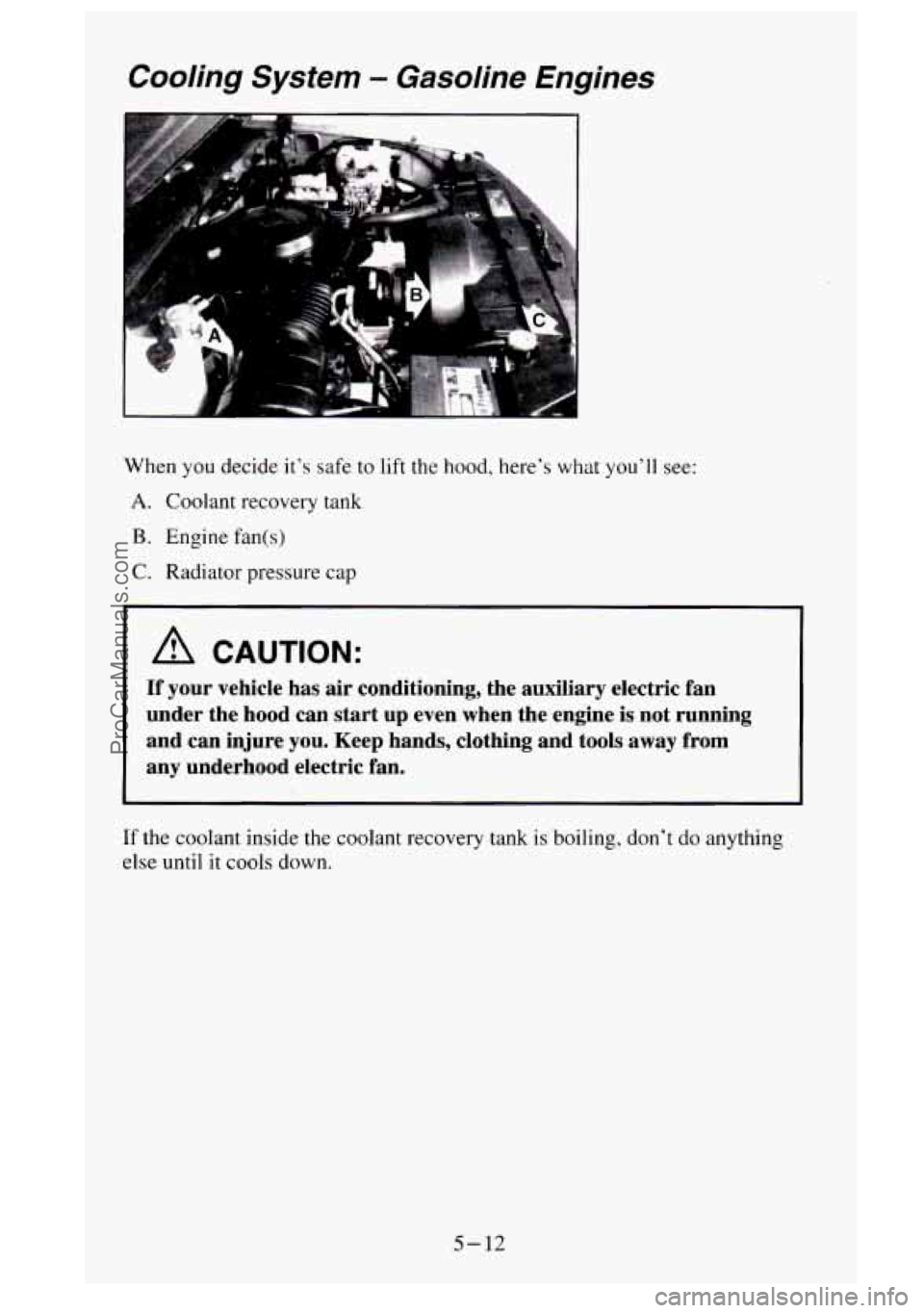
When you decide it’s safe to lift the hood, here’s what you’ll see:
A. Coolant recovery tank
B. Engine fan(s)
C. Radiator pressure cap
I A CAUTION:
If your vehicle has air conditioning, the auxiliary electric fan
under the hood can start up even when the engine is not runn\
ing
and can injure you. Keep hands, clothing and tools away from any underhood electric fan.
If the coolant inside the coolant recovery tank is boiling, don’t do anything
else
until it cools down.
5-12
ProCarManuals.com
Page 243 of 488
Cooling System - Diesel Engines
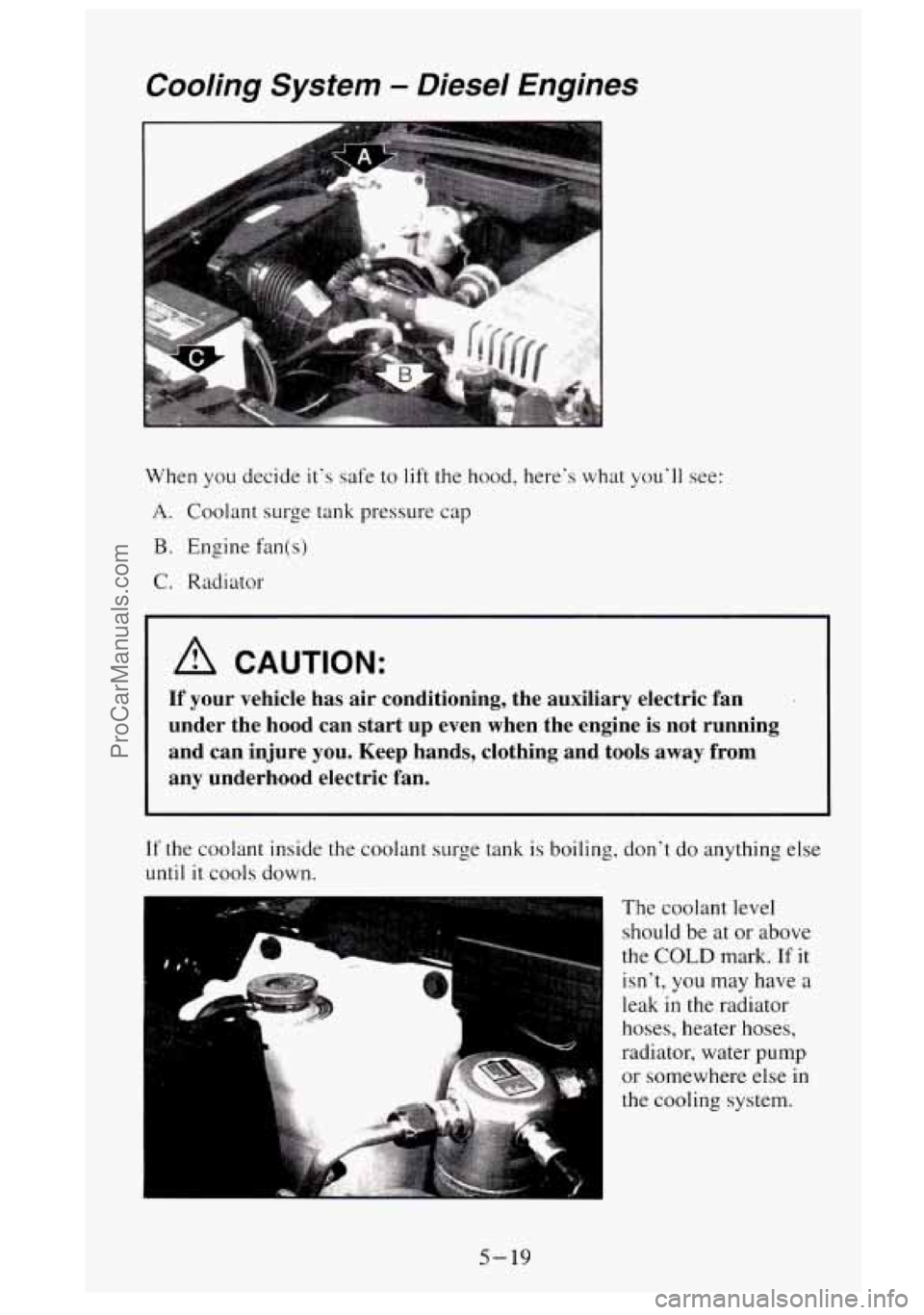
When you decide it‘s safe to lift the hood, here’s what you’ll see:
A. Coolant surge tank pressure cap
B. Engine fan(s)
C. Radiator
A CAUTION:
If your vehicle has air conditioning, the auxiliary electric fan
under the hood can start up even when the engine is not running
and can injure you. Keep hands, clothing and tools away from
any underhood electric fan.
If the coolant inside the coolant surge tank is boiling, don’t do anything else
until it cools down.
The coolant level
should be
at or above
the
COLD mark. If it
isn’t,
you may have a
leak in the radiator
hoses, heater hoses,
radiator, water pump
or somewhere else in
the cooling system.
5-19
ProCarManuals.com
Page 249 of 488
Engine Fan Noise
Your vehicle has a clutched engine cooling fan. When the clutch is engaged,
the fan spins faster
to provide more air to cool the engine. In most every day
driving conditions the fan is spinning slower and the clutch is
not fully
engaged. This improves fuel economy and reduces fan noise. Under heavy
vehicle loading, trailer towing and/or high outside temperatures, the fan
speed increases as the clutch more fully engages.
So you may hear an
increase
in fan noise. This is normal and should not be mistaken as the
transmission slipping or making extra shifts.
It is merely the cooling system
functioning properly. The fan will slow down when additional cooling is not
required and the clutch partially disengages.
You may also hear this fan noise when you start the engine. It will go away
as the
fan clutch partially disengages.
If a Tire Goes Flat
It’s unusual for a tire to “blow out” while you’re driving, especially if you
maintain your tires properly. If air goes out
of a tire, it’s much more likely to
leak out slowly. But if you should ever have a “blowout,” here are a few tips
about what to expect and what to do:
If a front tire fails, the flat tire will create a drag that pulls the vehicle
toward that side. Take your foot
off the accelerator pedal and grip the
steering wheel firmly, Steer
to maintain lane position, then gently brake to a
stop well out of
the traffic lane.
A rear blowout, particularly on a curve, acts much like a skid and may
require the same correction you’d use in a skid. In any rear blowout, remove
your
foot from the accelerator pedal. Get the vehicle under control by
steering the way
you want the vehicle to go. It may be very bumpy and
noisy, but you can still steer. Gently brake to a stop, well
off the road if
possible.
If a tire goes flat, the next part shows how to use your jacking equipment to
change a flat tire safely.
5-25
ProCarManuals.com