Page 245 of 488
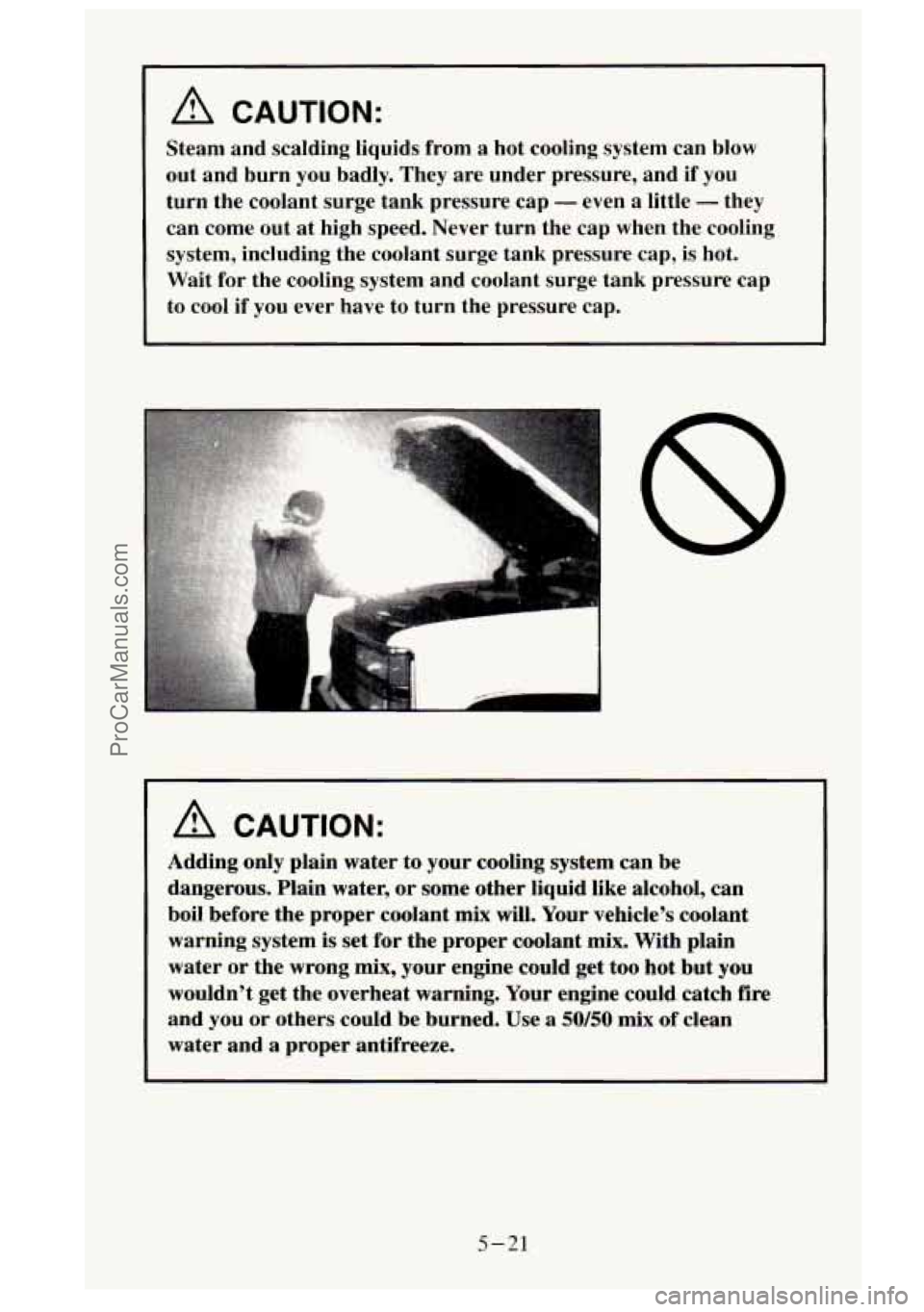
A CAUTION:
Steam and scalding liquids from a hot cooling system can blow
out and burn you badly. They are under pressure, and
if you
turn the coolant surge tank pressure cap
- even a little - they
can come out at high speed. Never turn the cap when the cooling
system, including the coolant surge tank pressure cap,
is hot.
’ Wait for the cooling system and coolant surge tank pressure cap
to cool
if you ever have to turn the pressure cap.
A CAUTION:
Adding only plain water to your cooling system can be
dangerous. Plain water, or some other liquid like alcohol, can
boil before the proper coolant mix
will. Your vehicle’s coolant
warning system is set for the proper coolant mix. With plain
water
or the wrong mix, your engine could get too hot but you
wouldn’t get the overheat warning. Your engine could catch fire
and you or others could be burned. Use
a 50/50 mix of clean
water and a proper antifreeze.
5-21
ProCarManuals.com
Page 296 of 488
How to Add Fluid
Refer to the Maintenance Schedule to determine what kind of transmission
fluid
to use. See “Recommended Fluids and Lubricants” in the Index.
Add fluid only after checking the transmission fluid
HOT. (A COLD check
is used
only as a reference.) If the fluid level is low, add only enough of the
proper fluid to bring the level up
to the HOT area for a hot check. It doesn’t
take much fluid, generally less than a
int. Don ’t overfill. We recommend
you use only fluid labeled DEXRON
-111, because fluid with that label is
made especially for your automatic transmission. Damage caused by fluid
other than DEXRON@-I11 is not covered by your
new vehicle warranty.
8
0 After adding fluid, recheck the fluid level as described under “How to
Check.”
0 When the correct fluid level is obtained, push the dipstick back in all
the way; then flip the handle down
to lock the dipstick in place.
Manual Transmission Fluid
When to Check
A good time to have it checked is when the engine oil is changed. However,
the fluid
in your manual transmission doesn’t require changing.
How to Check
Because this operation can be a little difficult, you may choose to have this.
done at your
GM dealer Service Department.
If you do it yourself, be sure to follow all the instructions here, or you could
get a false reading.
NOTICE:
Too much or too little fluid can damage your transmission. Too
much can mean that some of the fluid could come out and fall on
hot engine parts or exhaust system parts, starting a fire.
Be sure
to get an accurate reading if you check your transmission fluid.
Check the fluid level only when your engine is off, the vehicle is parked on
a level place and the transmission is cool enough for you to rest your fingers
on the transmission case.
6-30
ProCarManuals.com
Page 301 of 488
If the differential is at operating temperature (warm), add enough lubricant
to raise the level to the bottom
of the filler plug hole.
If the differential is cold, add enough lubricant to raise the level to
1/2 inch
( 12 mm) below the filler plug hole.
What to Use
Refer to the Maintenance Schedule to determine what kind of lubricant to
use. See “Recommended Fluids and Lubricants” in the Index.
Engine Coolant
The following explains your cooling system and how to add coolant when it
is low. If you have a problem with engine overheating, see “Engine
Overheating”
in the Index.
The proper coolant for your vehicle will:
Give freezing protection down to -34°F (-37°C).
0 Give boiling protection up to 262°F (128°C).
Protect against rust and corrosion.
Help keep the proper engine temperature.
Let the warning gages work as they should.
What to Use
Use a mixture of one-half cleun water (preferably distilled) and one-half
antifreeze that meets “GM Specification 6038-M,” which won’t damage
aluminum parts.
You can also use a recycled coolant conforming to “GM
Specification 6038-M.” Use GM Coolant Supplement (Sealer) with a
complete coolant flush and refill. If you use this mixture. you don’t need to
add anything else.
A CAUTION:
Adding only plain water to your cooling system can be
dangerous. Plain water, or some other liquid like alcohol, can
boil before the proper coolant mix will. Your vehicle’s coolant
warning system
is set for the proper coolant mix. With plain
water or the wrong mix, your engine could get too hot but
you
wouldn’t get the overheat warning. Your engine could catch fire
and you or others could be burned. Use
a 50/50 mix of clean
water and
a proper antifreeze.
6-35
ProCarManuals.com