Page 52 of 354
Starting Your Engine
Automatic transmission:
NOTICE:
If your key seems stuck in LOCK and you can’t
turn
it, be sure it is all the way in. If it is, then
turn the steering wheel left and right while you
turn the key hard. But turn the key only with
your hand. Using
a tool to force it could break
the key or the ignition switch.
If none of this
works, then your vehicle needs service.
Move your shift lever to PARK (P) or NEUTRAL (N).
Your engine won’t start in any other position -- that’s a
safety feature.
To restart when you’re already moving,
use NEUTRAL
(N) only,
NOTICE:
Don’t try to shift to PARK (P) if your Geo is
moving. If you do, you could damage the
transmission. Shift to
PARK (P) only when your
vehicle is stopped.
Manual transmission:
The gear selector should be in neutral. Hold the clutch
pedal to the floor and start the engine. Your vehicle
won’t start
if the clutch pedal is not all the way
down
-- that’s a safety feature.
2-9
ProCarManuals.com
Page 53 of 354

To start your 1.6 Liter engine:
1. Without pushing the accelerator pedal, turn your
ignition key to
START. When the engine starts, let
go
of the key.
NOTICE:
Holding your key in START for longer than
15 seconds at a time will cause your battery to be
drained much sooner. And the excessive heat can
damage your starter motor.
2. If it doesn’t start right away, hold your key in
START for about three seconds at a time until your
engine
starts. Wait about 15 seconds between each
try
to help avoid draining your battery.
If your engine still won’t start, call your dealer for help.
I
~ NOTICE:
~
Your engine is designed to work with the
electronics in your vehicle.
If you add electrical
parts or accessories, you could change the
way
the fuel injection system operates. Before adding
electrical equipment, check with your dealer.
If
you don’t, your engine might not perform
properly.
If you ever have to have your vehicle towed, see
the part
of this manual that tells how to do it
1 without damaging your vehicle. See “Towing
Your Vehicle” in the Index.
i
ProCarManuals.com
Page 55 of 354
Ensure the shift lever is fully in PARK (P) range before
starting the engine. Your Geo has
a brake-transmission
shift interlock. You have to fully
apply your regular
brakes before
you can shift from PARK (P) when the
ignition key
is in the ON position. If you cannot shift
out
of PARK (P), ease pressure on the shift lever - push
the shift lever all
the way into PARK (P) and release the
shift lever button as
you maintain brake application.
Then press the shift lever button and move the shift
lever into the gear you wish. See “Shifting Out
of
PARK (P)” in the Index.
REVERSE (R): Use this gear to back up.
I
I NOTICE:
Shifting to REVERSE (R) while your vehicle is
moving forward could damage your
transmission. Shift to REVERSE
(R) only after
your vehicle is stopped.
To rock your vehicle back and forth to get out of snow,
ice or sand without damaging your transmission, see
“Stuck: In Sand, Mud, Ice
or Snow” in the Index.
ProCarManuals.com
Page 65 of 354
1.
2.
3.
4.
5.
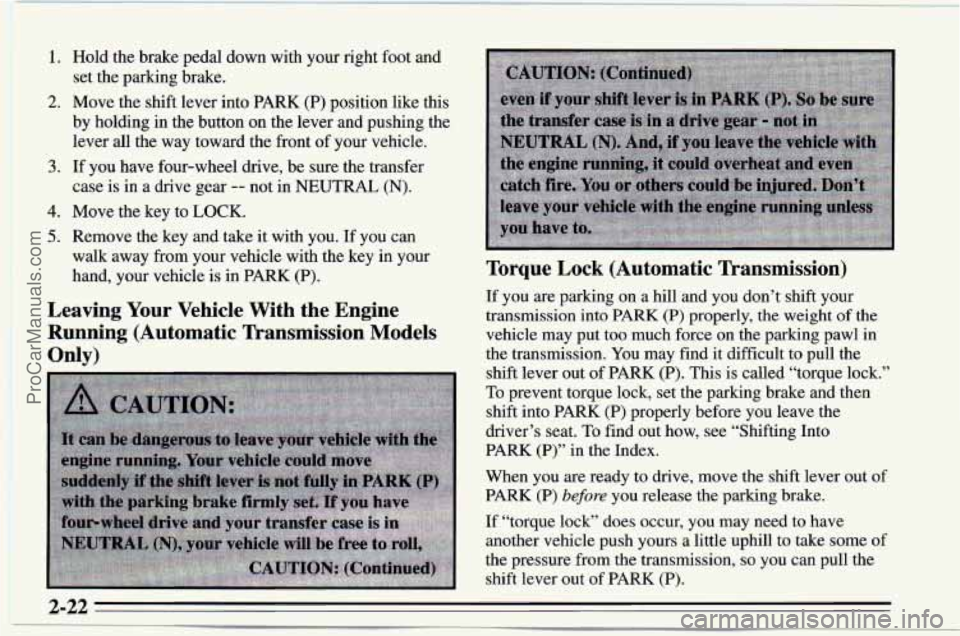
Hold the brake pedal down with your right foot and
set the parking brake.
Move the shift lever into PARK
(P) position like this
by holding
in the button on the lever and pushing the
lever all the way toward the front of your vehicle.
If you have four-wheel drive, be sure the transfer
case is in a drive gear
-- not in NEUTRAL (N).
Move the key to LOCK.
Remove the key and take it with you. If you can
walk away
from your vehicle with the key in your
hand, your vehicle is in PARK (P).
Leaving Your Vehicle With the Engine
Running (Automatic Transmission Models
Only) Torque Lock (Automatic Transmission)
If you
are parking on a hill and you don’t shift your
transmission
into PARK (P) properly, the weight of the
vehicle may put too much force
on the parking pawl in
the transmission. You may find it difficult to pull the
shift lever out
of PARK (P). This is called “torque lock.”
To prevent torque lock, set the parking brake and then
shift into PARK (P) properly before you leave the
driver’s seat. To find out how, see “Shifting Into
PARK (P)” in the Index.
When you are ready to drive, move the shift lever out of
PARK (P)
before you release the parking brake.
If “torque lock” does occur, you may need to have
another vehicle push yours a little uphill to take some of
the pressure from the transmission,
so you can pull the
shift lever out of PARK
(P).
2-22
ProCarManuals.com
Page 66 of 354
Shifting Out of PARK (P)
(Automatic Transmission)
Your Geo has a brake-transmission shift interlock. You
have to fully
apply your regular brakes before you can
shift from PARK
(P) when the ignition is in the ON
position. See “Automatic Transmission” in the Index.
If you cannot shift out of
PARK (P), ease pressure on
the shift lever -- push the shift lever all the way into
PARK
(P) and release the shift lever button as you
maintain brake application. Then press the shift lever
button and move the shift lever into the gear you wish. If
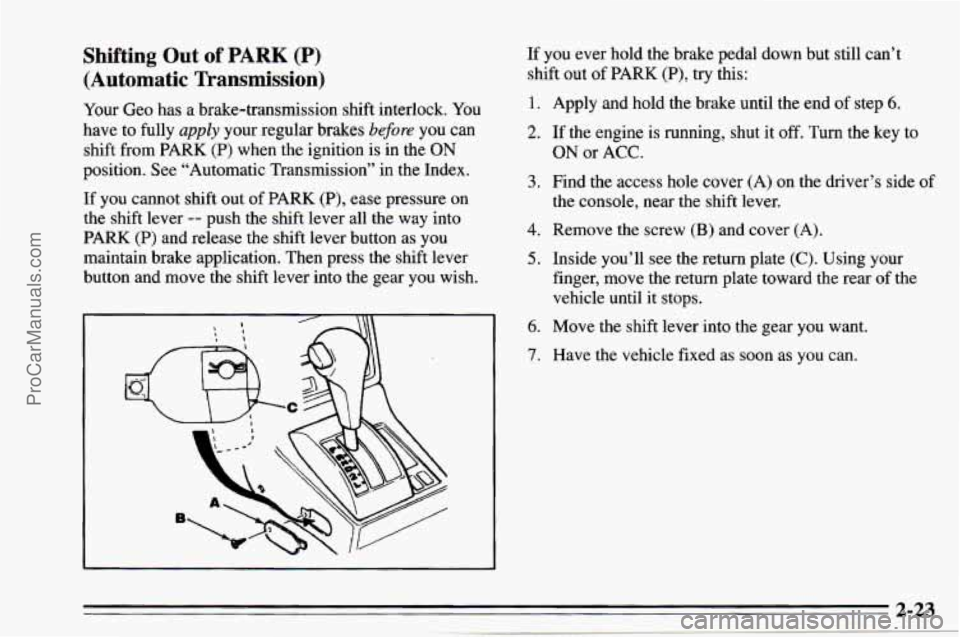
you ever hold the brake pedal down but still can’t
shift out of
PARK (P), try this:
1. Apply and hold the brake until the end of step 6.
2. If the engine is running, shut it off. Turn the key to
3. Find the access hole cover (A) on the driver’s side of
4. Remove the screw (B) and cover (A).
5. Inside you’ll see the return plate (C). Using your
ON or ACC.
the console, near the shift lever.
finger, move the return plate toward the rear of the
vehicle until it stops.
6. Move the shift lever into the gear you want.
7. Have the vehicle fixed as soon as you can.
2-23
ProCarManuals.com
Page 73 of 354

Lamps On Reminder Windshield Wipermasher Lever
If you turn the ignition off, remove the key, open the
door and leave the lamps on, a chime will remind you to
turn
off your lamps.
Headlamp High/Low Beam
First, you must have the
headlamps on. For high
beams, push the turn signal
lever away from you. When
the high beams are
on, a
blue light on the instrument
panel also will be on.
It will
go
off when you switch to
low beam.
To switch back to low beams, pull the lever toward you.
Passing Signal
With the lever in the low beam position, pull the lever
toward you to momentarily switch to high beam (to
~ signal that you are going to pass). When you release the
lever, the headlamps will return to low beam operation. The lever
on the right side
of the steering column
controls the windshield wipers
and washers.
Move the wiper switch to the position you want:
OFF: The wipers are off.
INT: Intermittent wiper operation. In light rain or snow,
you might want
to use this position rather than
continuous wiping.
LO: The wipers will run continuously at low speed.
2-30
ProCarManuals.com
Page 87 of 354
Safety Belt Reminder Light
When the key is turned to
ON or START, a light will
come
on for about eight
seconds to remind people to
fasten their safety belts.
Unless the driver’s safety
belt
is already buckled, a
chime will also sound.
Charging System Light
This red light will come on
briefly when you turn on the
ignition, but the engine is
not running, as
a check to
show you it is working.
Then it should
go out when
the engine starts.
If the light stays on or comes on while you are driving,
you may have a problem with the electrical charging
system. It could indicate that you have
a loose generator
drive belt or another electrical problem. Have
it checked
right away. Driving while this light is
on could drain
your battery.
If you must drive a short distance with this light on, be
certain to turn
off all your accessories, such as the radio
and air conditioner.
ProCarManuals.com
Page 127 of 354
Drunken Driving
Death and injury associated with drinking and driving is
a national tragedy. It’s the number one contributor to the
highway death toll, claiming thousands of victims every
year.
Alcohol affects four things that anyone needs to drive a
vehicle:
0 Judgment
0 Muscular Coordination
0 Vision
Attentiveness
Police records show that almost half
of all motor
vehicle-related deaths involve alcohol. In most cases,
these deaths are the result of someone who was drinking
and driving. In recent years, some
18,000 annual motor
vehicle-related deaths have been associated with the use
of alcohol, with more than
300,000 people injured.
Many adults
-- by some estimates, nearly half the adult
population
-- choose never to drink alcohol, so they
never drive after drinking.
For persons under 21, it’s
against the law in every
U.S. state to drink alcohol.
There are good medical, psychological and
developmental reasons for these laws.
The obvious way to solve this highway safety problem
is for people never to drink alcohol and then drive. But
what if people
do? How much is “too much” if the
driver plans to drive?
It’s a lot less than many might
think. Although it depends on each person and situation,
here is some general information on the problem.
The Blood Alcohol Concentration (BAC)
of someone
who is drinking depends upon four things:
How much alcohol consumed
0 The drinker’s body weight
The amount of food that is consumed before and
The length of time it has taken the drinker to
during drinking
consume the alcohol
According to the American Medical Association, a
180-pound (82 kg) person who drinks three 12-ounce
(355 ml) bottles of beer in an hour will end up with a
BAC of about
0.06 percent. The person would reach the
same BAC by drinking three 4-ounce (120 ml) glasses
of wine or three mixed drinks
if each had 1 - 1/2 ounces
(45 ml) of a liquor like whiskey, gin or vodka.
4-2
ProCarManuals.com


