1995 CHEVROLET TRACKER traction control
[x] Cancel search: traction controlPage 133 of 354
Braking in Emergencies
At some time, nearly every driver gets into a situation
that requires hard braking.
You have the rear-wheel anti-lock braking system. Your
front wheels can stop rolling when
you brake very hard.
Once they do, the vehicle can’t respond to your steering.
Momentum will carry it in whatever direction it was
headed when the front wheels stopped rolling. That
could be
off the road, into the very thing you were trying
to avoid, or into traffic.
So, use a “squeeze” braking technique. This will give
you maximum braking while maintaining steering
control. You
do this by pushing on the brake pedal with
steadily increasing pressure. When
you do, it will help
maintain steering control.
In many emergencies, steering
can help you more than even the very best braking.
Steering
Power Steering
If you lose power steering assist because the engine
stops or the system is not functioning, you
can steer but
it will take much more effort.
Steering Tips
Driving on Curves
It’s important to take curves at a reasonable speed.
A lot of the “driver lost control” accidents mentioned on
the news happen on curves. Here’s why:
Experienced driver or beginner, each
of us is subject to
the same laws
of physics when driving on curves. The
traction
of the tires against the road surface makes it
possible for the vehicle
to change its path when you turn
the front wheels.
If there’s no traction, inertia will keep
the vehicle going in the same direction.
If you’ve ever
tried
to steer a vehicle on wet ice, you’ll understand this.
The traction you can get in
a curve depends on the
condition of your tires and the road surface, the angle at
which the curve is banked, and your speed. While
you’re
in a curve, speed is the one factor you can
control.
ProCarManuals.com
Page 138 of 354

If your vehicle starts to slide, ease your foot off the
accelerator pedal and quickly steer the way you want the
vehicle to go. If you start steering quickly enough, your
vehicle may straighten
out. Always be ready for a
second skid if it occurs.
Of course, traction is reduced when water, snow, ice,
gravel, or other material is on the road. For safety,
you’ll
want to slow down and adjust your driving to these
conditions. It is important to slow down on slippery
surfaces because stopping distance will be longer and
vehicle control more limited.
While driving
on a surface with reduced traction, try
your best to avoid sudden steering, acceleration, or
braking (including engine braking by shifting to a lower
gear). Any sudden changes could cause the tires to slide.
You may not realize the surface
is slippery until your
vehicle is skidding. Learn
to recognize warning
clues
-- such as enough water, ice or packed snow on
the road to make a “mirrored surface” -- and slow
down when you have any doubt.
Remember: The rear-wheel anti-lock braking system
(RWAL) helps avoid only a rear braking skid.
In a
braking skid (where the front wheels are no longer
rolling), release enough pressure
on the brakes to get the front
wheels rolling again. This restores steering control.
Push the brake pedal down steadily when you have to
stop suddenly. As long as the front wheels are rolling,
you will have steering control.
Driving Guidelines
This multipurpose passenger vehicle is defined as a
utility vehicle
in Consumer Information Regulations
issued by the National Highway Traffic Safety
Administration (NHTSA) of the United States
Department of Transportation, Utility vehicles have
higher ground clearance and a narrower track to make
them capable of performing in a wide variety
of off-road
applications. Specific design characteristics give them
a
higher center of gravity than ordinary cars. An
advantage
of the higher ground clearance is a better
view
of the road allowing you to anticipate problems.
They are
not designed for cornering at the same speeds
as conventional 2-wheel drive vehicles any more than
low-slung sports cars are designed
to perform
satisfactorily under off-road conditions. If at all
possible, avoid sharp turns or abrupt maneuvers.
As with
other vehicles of this type, failure
to operate this vehicle
correctly may result in loss of control or vehicle
rollover.
ProCarManuals.com
Page 141 of 354

Controlling your vehicle is the key to successful
off-road driving. One of the best ways to control your
vehicle is to control your speed.
Here are some things to
keep in mind. At higher speeds:
you approach things faster and you have less time to
scan the terrain for obstacles.
you have less time to react.
you have more vehicle bounce when you drive over
obstacles.
you’ll need more distance for braking, especially
since you’re on an unpaved surface.
Scanning the Terrain
Off-road driving can take you over many different kinds
of terrain. You need
to be familiar with the terrain and
its many different features. Here are some things to
consider.
Sugace Conditions. Off-roading can take you over
hard-packed dirt, gravel, rocks, grass, sand, mud, snow or
ice. Each
of these surfaces affects the steering,
acceleration, and braking of your vehicle in different ways.
Depending upon the kind of surface
you are on, you may
experience slipping, sliding, wheel spinning, delayed
acceleration, poor traction, and longer braking distances.
Surjke Obstacles. Unseen or hidden obstacles can be
hazardous. A rock, log,
hole, rut, or bump can startle
you if you’re not prepared for them. Often these
obstacles are hidden by grass, bushes, snow or even the
rise and fall of the terrain itself. Here are some things to
consider:
Is the path ahead clear?
Will the surface texture change abruptly up ahead?
Does the travel take you uphill or downhill? (There’s
more discussion of these subjects later.)
Will you have to stop suddenly or change direction
quickly?
ProCarManuals.com
Page 150 of 354
Driving In Mud, Sand, Snow, Or Ice
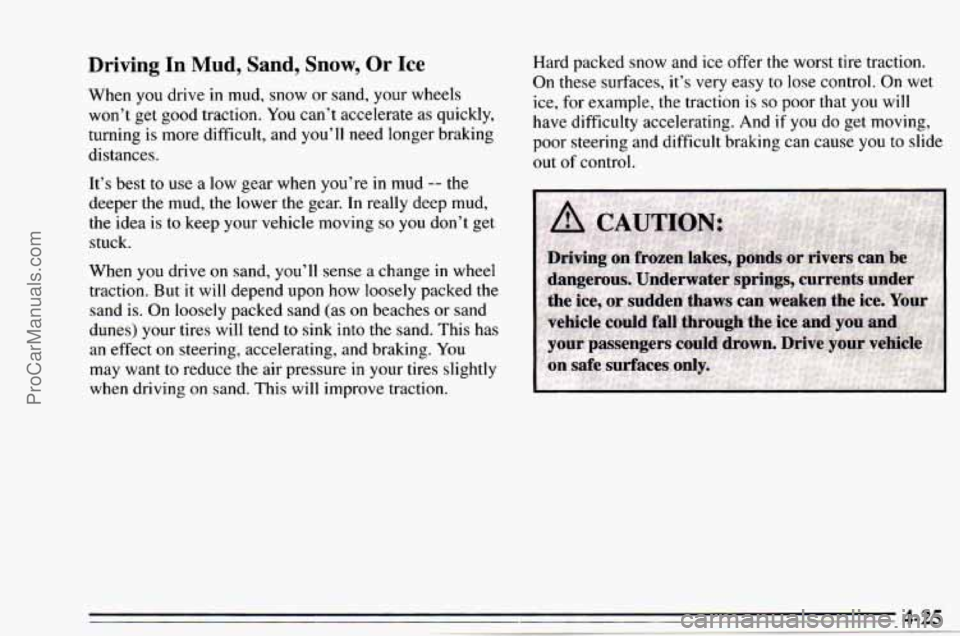
When you drive in mud, snow or sand, your wheels
won’t get good traction. You can’t accelerate as quickly,
turning
is more difficult, and you’ll need longer braking
distances.
It’s best to use a low gear when you’re
in mud -- the
deeper the mud, the lower the gear. In really deep mud,
the idea is to keep your vehicle moving
so you don’t get
stuck.
When you drive on sand, you’ll sense
a change in wheel
traction. But
it will depend upon how loosely packed the
sand is. On loosely packed sand (as on beaches or sand
dunes) your tires will tend to sink into the sand. This has
an effect on steering, accelerating, and braking. You
may want to reduce the air pressure
in your tires slightly
when driving on sand. This will improve traction. Hard
packed snow and ice offer the worst tire traction.
On these surfaces, it’s very easy to lose control. On wet
ice, for example, the traction is
so poor that you will
have difficulty accelerating. And if you do get moving,
poor steering and difficult braking can cause you to slide
out of control.
ProCarManuals.com
Page 256 of 354
Treadwear
Uniform Tire Quality Grading
The following information relates to the system
developed by the United States National Highway
Traffic Safety Administration which grades tires by
treadwear, traction and temperature performance. (This
applies only to vehicles sold in the United States.) The
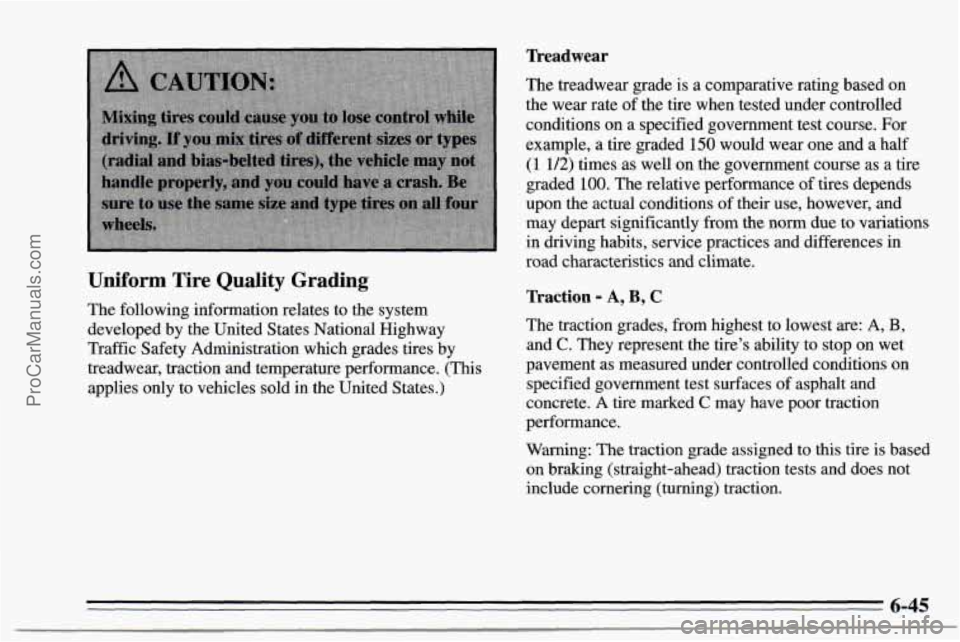
treadwear grade is a comparative rating based on
the wear rate
of the tire when tested under controlled
conditions on a specified government test course. For
example, a tire graded
150 would wear one and a half
(1 1/2) times as well on the government course as a tire
graded
100. The relative performance of tires depends
upon the actual conditions of their use, however, and
may depart significantly from the norm due to variations
in driving habits, service practices and differences in
road characteristics and climate.
Traction - A, B, C
The traction grades, from highest to lowest are: A, B,
and C. They represent the tire’s ability to stop on wet
pavement as measured under controlled conditions on
specified government test surfaces of asphalt and
concrete.
A tire marked C may have poor traction
performance.
Warning: The traction grade assigned to this tire is basea
on braking (straight-ahead) traction tests and does not
include cornering (turning) traction.
6-45
ProCarManuals.com
Page 352 of 354
Service Parts Identification Label .................. 6-59
Service Publications
.............................. 8-7
Service Work. Doing Your Own .................... 6-1
Sheet Metal Damage ............................ 2- 16
Shift Speeds. Manual Transmission ................. 2- 16
Shifting Into Park (P) ............................ 2-21
Shifting Out of Park (P) .......................... 2-23
Side Window. Removing and Installing the
........... 2-54
Sidemarker Lamps. Replacement
.................. 6-38
Signal. Passing
................................. 2-30
Signaling Turns ................................ 2-28
Skidding
...................................... 4-12
Sound Equipment. Adding
........................ 3- 18
Special Care of Canvas Top and Plastic Windows ..... 6-55
Specifications Chart
............................. 6-64
Speedometer
................................... 2-42
Stains. Cleaning
................................ 6-5 1
Stalling on an Incline ............................ 4-24
Starterswitch
.................................. 7-49
Starting Your Engine
Automatic Transmission
........................ 2-9
Manual Transmission
.......................... 2-9
Steam. If Coming From Your Engine
................ 5- 1 1
Steering ....................................... 4-8
Steering Column Lock
........................... 7-50
Steering Column, Adjustable
...................... 2-27
Steering. In Emergencies
.......................... 4-9
Steering, Power
................................. 4-8
Steering, Tips
................................... 4-8
Storage and Compartments
........................ 2-5
Storage, Front Seat Side Pockets
.................... 2-6
Storage. Of Your Vehicle
......................... 6-34
Stuck,
If You Are ............................... 5-3 1
SunVisors .................................... 2-35 Sunroof
....................................... 2-50
Sunroof. Opening and Closing
..................... 2-50
Symbols. Vehicle
.................................. v
Tachometer .................................. 2-42
Tailgate Lock
................................... 2-4
Tape Player Care
............................... 3-19
Temperature Control Lever ........................ 3-2
Theft .......................................... 2-7
Theft-Deterrent Feature
..................... 3- 10. 3- 15
Thermostat .................................... 6-28
Third (3). Manual Transmission
................... 2-15
Tirechains
.................................... 6-48
Tire Inspection and Rotation
...................... 6-42
TireLoading
................................... 4-42
Tires
......................................... 6-41
Alignment and Balance
........................ 6-46
BuyingNew
................................ 6-44
ChangingaFlat
.............................. 5-21
Inflation .................................... 6-42
Inspection and Rotation
....................... 6-42
Temperature
................................ 6-46
Traction
.................................... 6-45
Treadwear
.................................. 6-45
Uniform Quality Grading
...................... 6-45
Wear Indicators
.............................. 6-44
Wheel Replacement
.......................... 6-47
When
It’s Time for New ....................... 6-44
TopStrap
..................................... 1-26
TorqueLock
................................... 2-22
Torque. Wheel Nut
......................... 5-29. 6-66
Towing a Trailer
................................ 4-44
Towing Your Vehicle
............................. 5-6
3 9-9 ......... ProCarManuals.com