Page 141 of 354

Controlling your vehicle is the key to successful
off-road driving. One of the best ways to control your
vehicle is to control your speed.
Here are some things to
keep in mind. At higher speeds:
you approach things faster and you have less time to
scan the terrain for obstacles.
you have less time to react.
you have more vehicle bounce when you drive over
obstacles.
you’ll need more distance for braking, especially
since you’re on an unpaved surface.
Scanning the Terrain
Off-road driving can take you over many different kinds
of terrain. You need
to be familiar with the terrain and
its many different features. Here are some things to
consider.
Sugace Conditions. Off-roading can take you over
hard-packed dirt, gravel, rocks, grass, sand, mud, snow or
ice. Each
of these surfaces affects the steering,
acceleration, and braking of your vehicle in different ways.
Depending upon the kind of surface
you are on, you may
experience slipping, sliding, wheel spinning, delayed
acceleration, poor traction, and longer braking distances.
Surjke Obstacles. Unseen or hidden obstacles can be
hazardous. A rock, log,
hole, rut, or bump can startle
you if you’re not prepared for them. Often these
obstacles are hidden by grass, bushes, snow or even the
rise and fall of the terrain itself. Here are some things to
consider:
Is the path ahead clear?
Will the surface texture change abruptly up ahead?
Does the travel take you uphill or downhill? (There’s
more discussion of these subjects later.)
Will you have to stop suddenly or change direction
quickly?
ProCarManuals.com
Page 165 of 354
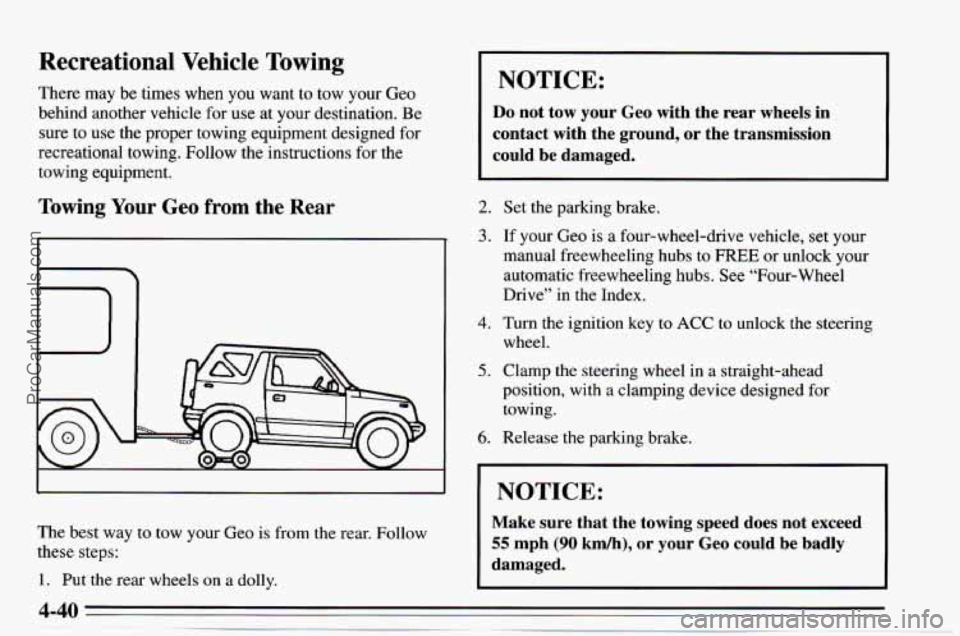
Recreational Vehicle Towing
There may be times when you want to tow your Geo
behind another vehicle for use at your destination. Be
sure to use the proper towing equipment designed for
recreational towing. Follow the instructions for the
towing equipment.
Towing Your Geo from the Rear
The best way to cow your Geo is from the rear. Follow
these steps:
1. Put the rear wheels on a dolly.
I NOTICE:
Do not tow your Geo with the rear wheels in
contact with the ground,
or the transmission
could be damaged.
2. Set the parking brake.
3. If your Geo is a four-wheel-drive vehicle, set your
manual freewheeling hubs
to FREE or unlock your
automatic freewheeling hubs. See “Four-wheel
Drive” in the Index.
4. Turn the ignition key to ACC to unlock the steering
5. Clamp the steering wheel in a straight-ahead
wheel.
position, with a clamping device designed for
towing.
6. Release the parking brake.
NOTICE:
Make sure that the towing speed does not exceed
55 mph
(90 km/h), or your Geo could be badly
damaged.
ProCarManuals.com
Page 166 of 354

Towing Your Geo from the Front
I NOTICE:
If your vehicle has automatic freewheeling hubs
or two-wheel drive, do not tow it on all four
wheels. If you do, your transmission could be
damaged.
If you have a four-wheel-drive vehicle with manual
freewheeling hubs, it can be towed from the front with
all four wheels on the ground. Follow these steps:
1. Set the parking brake.
2. Turn the ignition key to ACC to unlock the steering
wheel.
3. Shift your automatic transmission into PARK (P), or
your manual transmission into SECOND
(2).
4. Shift the transfer case to NEUTRAL (N).
5. Set the hubs to FREE. See “Four-wheel Drive” in
the Index.
6. Release the parking brake.
Stop towing every
200 miles (300 km) and start
the engine. Leave the transfer
case shift lever in
NEUTRAL (N). Shift your automatic transmission
to
DRIVE (D); leave a manual transmission in
SECOND
(2) with the clutch engaged. Run the engine
at medium speed for
one minute to circulate the oil in
the transfer case. Turn the ignition key to ACC. Now,
you can continue towing your Geo.
ProCarManuals.com
Page 178 of 354
GeGS Section 3 Problems on the Road
Here you'll find what to do about some problems that
can occur on the road.
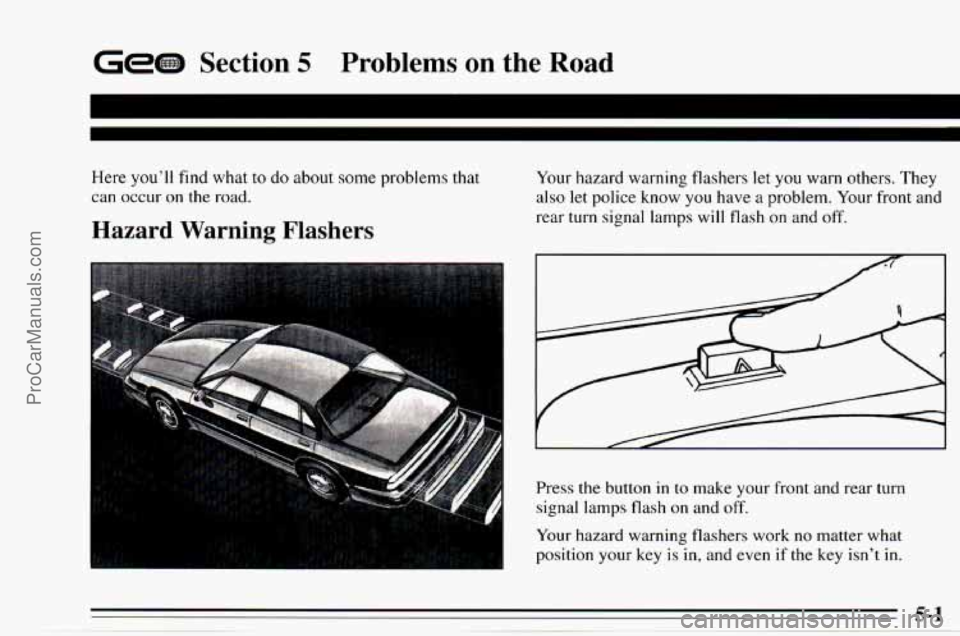
Hazard Warning Flashers
Your hazard warning flashers let you warn others. They
also let police know you have a problem. Your front and
rear turn signal lamps will flash
on and off.
Press the button in to make your front and rear turn
signal lamps flash
on and off.
Your hazard warning flashers work no matter what
position your key is in, and even if the key isn't in.
ProCarManuals.com
Page 184 of 354
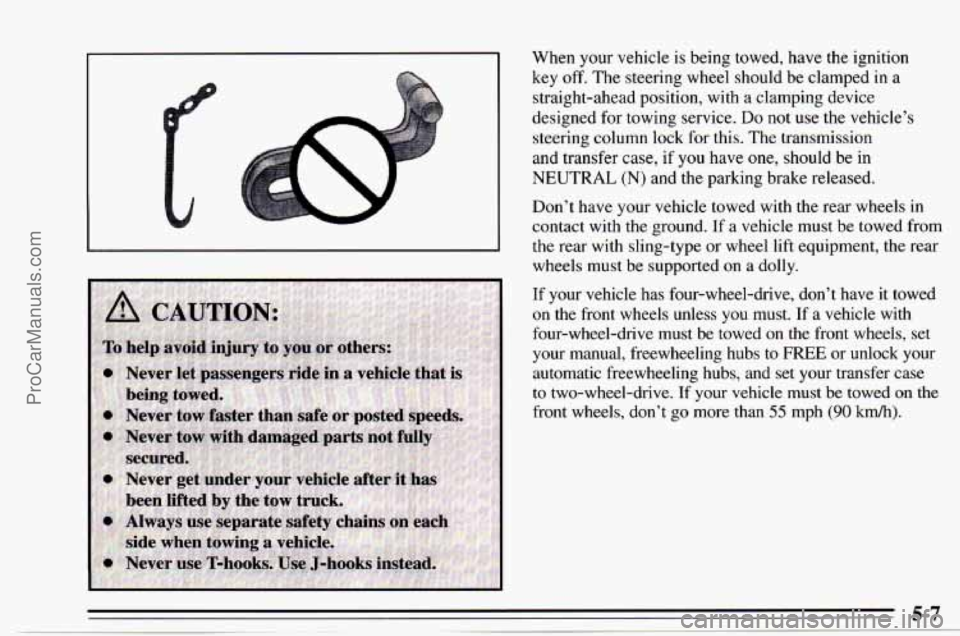
When your vehicle is being towed, have the ignition
key
off. The steering wheel should be clamped in a
straight-ahead position, with a clamping device
designed for towing service.
Do not use the vehicle’s
steering column lock
for this. The transmission
and transfer
case, if you have one, should be in
NEUTRAL (N) and the parking brake released.
Don’t have your vehicle towed with the rear wheels in
contact with the ground. If a vehicle must be towed from
the rear with sling-type or wheel lift equipment, the rear
wheels must be supported on a dolly.
If your vehicle has four-wheel-drive, don’t have it towed on
the front wheels unless you must. If a vehicle with
four-wheel-drive must be towed
on the front wheels, set
your manual, freewheeling hubs to FREE or unlock your
automatic freewheeling hubs, and set your transfer case
to two-wheel-drive. If
your vehicle must be towed on the
front wheels, don’t
go more than 55 mph (90 km/h).
5-7
ProCarManuals.com
Page 201 of 354
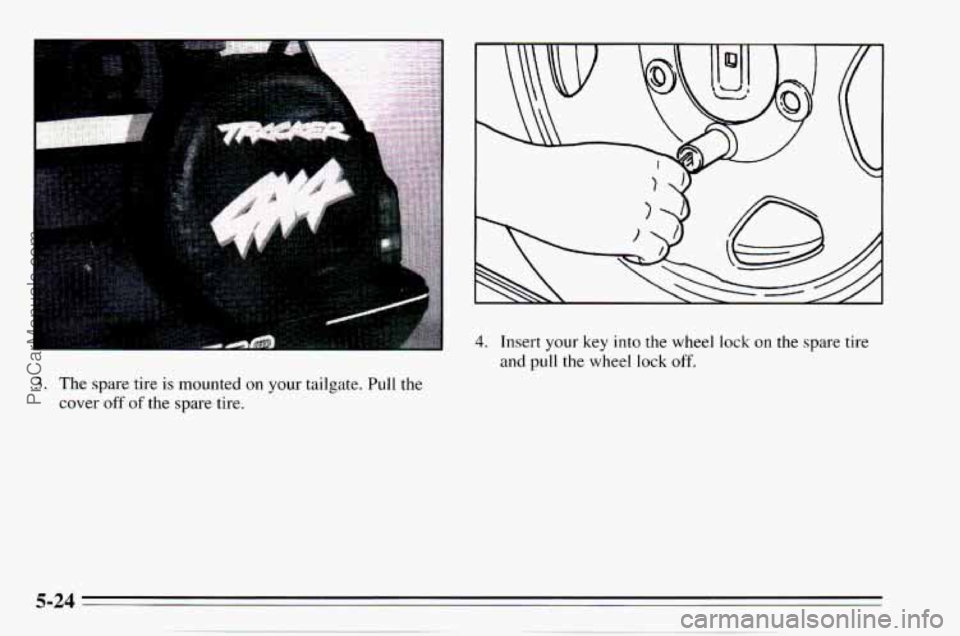
3. The spare tire is mounted on your tailgate. Pull the
cover off of the spare tire.
4. Insert your key into the wheel lock on the spare tire
and pull
the wheel lock off.
ProCarManuals.com
Page 326 of 354

At Least mice a Year Starter Switch
Fluid Level Check
Check the transfer case, axle differential(s) and
automatic or manual transmission fluid levels and add
as needed.
See “Transfer Case,” “Axle, Rear,” “Axle,
Front” and “Automatic Transmission” or “Manual
Transmission” in the Index.
A fluid loss in these systems
could indicate
a problem. Have the system inspected and
repaired at
once.
At Least Once a Year
Key Lock Cylinders
Lubricate the key lock cylinders with the lubricant
specified
in Part D.
Body Lubrication
Lubricate all body door hinges. Also lubricate all hinges
and latches, including those for the hood, rear
compartment, glove box door, console door and any
folding seat hardware. Part
D tells you what to use.
More frequent lubrication may be required when
exposed
to a corrosive environment.
1. Before you start, be sure you have enough room
around the vehicle.
2. Firmly apply both the parking brake (see “Parking
Brake”
in the Index if necessary) and the regular brake.
NOTE:
Do not use the accelerator pedal, and be
ready to turn
off the engine immediately if it starts.
3. On automatic transmission vehicles, try to start the
engine in each gear. The starter should work only in
PARK (P) or NEUTRAL (N). If the starter works in
any other position, your vehicle needs service.
On manual transmission vehicles, put the shift lever
in
NEUTRAL (N), push the clutch down halfway
and try
to start the engine. The starter should work
only when the clutch is pushed down all the way to
the floor. If the starter works when the clutch isn’t
pushed
all the way down, your vehicle needs service.
7-49
ProCarManuals.com
Page 327 of 354
Brake-Transmission Shift Interlock -- BTSI
(Automatic Transmission)
1.
2.
3.
Before you start, be sure you have enough room
around the vehicle. It should be parked on a level
surface.
Firmly apply the parking brake
(see “Parking Brake”
in the Index if necessary).
NOTE: Be ready to apply the regular brake
immediately if the vehicle begins to move.
With the engine off, turn the key
to the ON position,
but don’t start the engine. Without applying the
regular brake, try to move the shift lever out of
PARK
(P) with normal effort. If the shift lever
moves out of PARK (P), your vehicle’s BTSI needs
service.
Steering Column Lock
While parked, and with the parking brake set, try to turn
the key to
LOCK in each shift lever position.
0 With an automatic transmission, the key should turn
to
LOCK only when the shift lever is in PARK (P).
With a manual transmission, the key should turn to
LOCK only if you push the key in farther, while
turning it towards
LOCK.
On vehicles with a key release lever, try to turn the key
to
LOCK without pressing the lever. The key should
turn to
LOCK only with the key lever depressed.
On all vehicles, the key should come out only in LOCK.
ProCarManuals.com