1995 CHEVROLET S10 light
[x] Cancel search: lightPage 131 of 354
Downloaded from www.Manualslib.com manuals search engine NOTICE:
Before you add any sound equipment to your vehicle - like a
tape player,
CB radio, mobile telephone or two-way radio - be
sure you can add what you want. If
you can, it’s very important
to do it properly. Added sound equipment may interfere with th\
e
operation of your vehicle’s engine, Delco@ radio or other
systems, and even damage them. And, your vehicle’s systems
may interfere with the operation of sound equipment that has been added improperly.
So, before adding sound equipment, check with your dealer and
be sure to check Federal rules covering mobile radio and telephone units.
Care of Your Cassette Player and Tape
A tape player that is not cleaned regularly is subject to reduced sound
quality, ruining the cassette, or damaging the mechanism. Tape cassettes that
are not properly stored in their plastic cases away from contaminants, direct
sunlight, and extreme heat, may not operate properly and could cause
premature failure of the tape player.
Your tape player should be cleaned with every
50 hours of use to provide
optimum performance. Your radio may display “Cln” (Clean)
to indicate
that you have used your tape player for
50 hours without re-setting the tape
clean timer. If you notice a reduction in sound quality, regardless \
of when
the tape player was last cleaned, try playing a different cassette to see if the
tape
or tape player is at fault. If the second cassette results in no
improvement in sound quality, try cleaning the tape player.
Proper tape player cleaning should be done with a scrubbing action,
non-abrasive cleaning cassette. This is a wet-type cleaning system that uses
a cleaning cassette with pads which scrub the tape head as the hubs of the
cleaner cassette turn. To properly clean your tape player, follow instructions
with the cleaning cassette. If
you use this type of cleaner, the radio may
display an error and eject
the cartridge. This is normal and is the result of an
added feature in the tape player that detects broken tapes. If an error occurs,
you will need to insert the cleaning cassette at least
3 times to thoroughly
clean the tape player.
You may prefer
to use a non-scrubbing action, wet-type cleaner. This type
of cleaner uses a fabric belt to clean the tape head. This type of cleaner
cassette will not cause an error, but it may not clean the tape player as
thoroughly as the scrubbing type cleaner.
3-18
Page 132 of 354
Downloaded from www.Manualslib.com manuals search engine A scrubbing action cleaner cassette is available through your retailer (SPO
12344600).
Cassettes are subject to wear and the sound quality may degrade over time.
Always verify that the cassette tape
is in good condition and the tape player
is clean before obtaining service on your tape player.
NOTICE:
Cassette tape adapter kits for portable CD players will not work
in your cassette player. These adapters will cause the radio
to
display an error and the adapter cassette will be ejected.
Care of Compact Discs
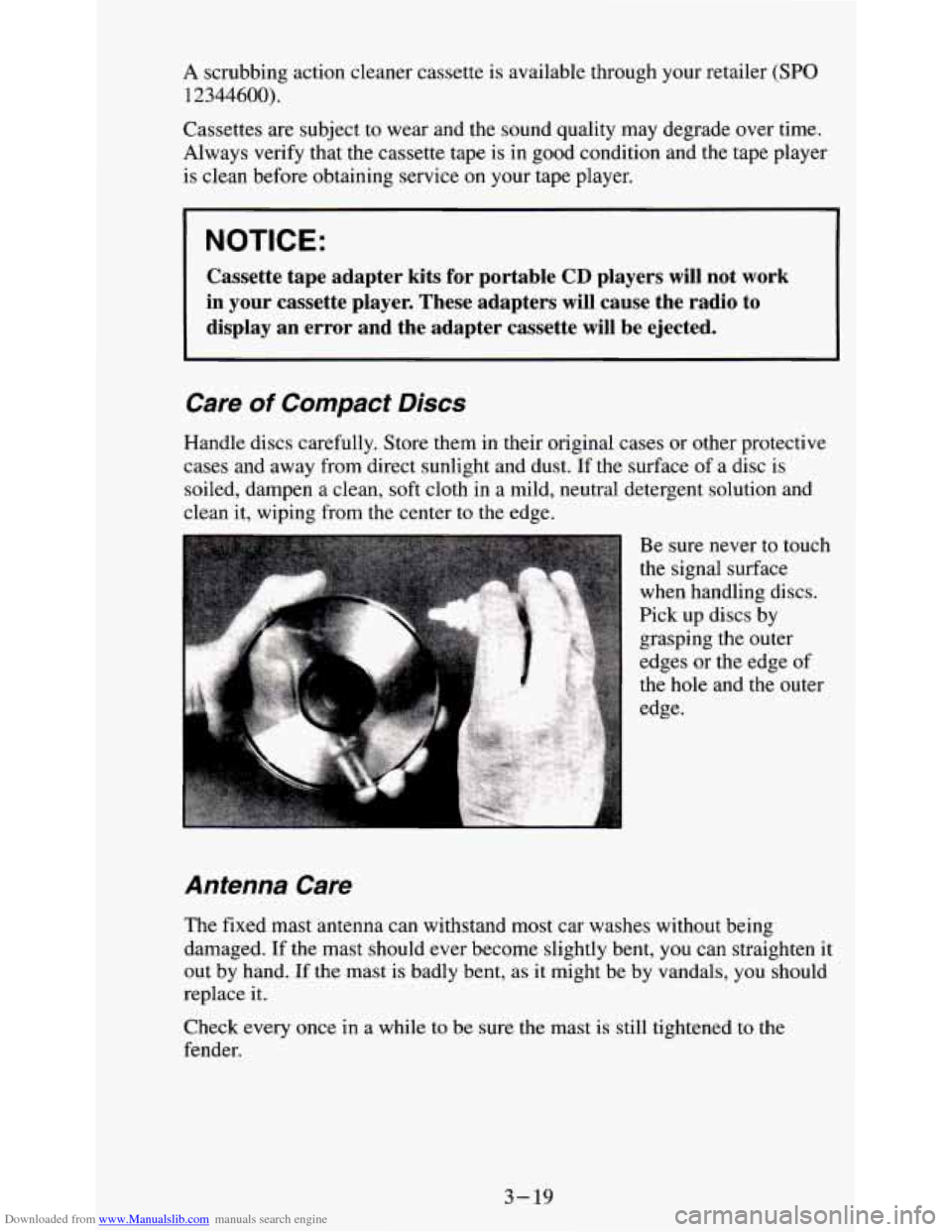
Handle discs' carefully. Store them in their original cases or other protective
cases and away from direct sunlight and dust. If the surface of a disc
is
soiled, dampen a clean, soft cloth in a mild, neutral detergent solution and
clean it, wiping from the center to the edge.
Antenna Care
The fixed mast antenna can withstand most car washes without being
damaged. If the mast should ever become slightly bent, you can straighten
it
out by hand. If the mast is badly bent, as it might be by vandals, you should
replace it.
Check every once in a while to be sure the mast is still tightened
to the
fender.
3-19
Page 138 of 354
Downloaded from www.Manualslib.com manuals search engine Braking
Braking action involves perception time and reaction time.
First, you have to decide to push on the brake pedal. That’s perception time.
Then you have to bring up your foot and do it. That’s reaction time.
Average reaction time is about 3/4 of a second. But that’s only an average. It
might be less with one driver and as long as two or three seconds or more
with another. Age, physical condition, alertness, coordination, and eyesight
all play a part.
So do alcohol, drugs and frustration. But even in 3/4 of a
second, a vehicle moving at
60 mph (100 km/h) travels 66 feet (20 m). That
could be a lot of distance in an emergency,
so keeping enough space
between your vehicle and others is important.
And, of course, actual stopping distances vary greatly with the surface of the
road (whether it’s pavement or gravel); the condition of the road (wet, dry,
icy); tire tread; and the condition of your brakes.
Avoid needless heavy braking. Some people drive in spurts
- heavy
acceleration followed by heavy braking
- rather than keeping pace with
traffic. This is a mistake. Your brakes may not have time to cool between
hard stops. Your brakes will wear out much faster if you do a lot of heavy
braking. If you keep pace with the traffic and allow realistic following
distances, you will eliminate a lot
of unnecessary braking. That means better
braking and longer brake
life.
If your engine ever stops while you’re driving, brake normally but don’t
pump your brakes. If you do, the pedal may get harder to push down. If
your engine stops, you will still have some power brake assist. But you will
use it when you brake. Once the power assist is used up, it may take longer
to stop and the brake pedal will be harder to push.
Anti-Lock Brakes (ABS)
Your vehicle has an advanced electronic braking system that can help you
keep it under control.
If your vehicle has an anti-lock brake system warning light on the
instrument panel, it has four-wheel anti-lock brakes. Otherwise, it has
rear-wheel anti-lock brakes. When you start a vehicle that has four-wheel
anti-lock brakes and begin to drive away, you may hear a momentary motor
or clicking noise. This is the
ABS system testing itself.
4-5
Page 142 of 354
Downloaded from www.Manualslib.com manuals search engine An emergency like this requires close attention and a quick decision. If you
are holding the steering wheel at the recommended
9 and 3 o’clock
positions, you can turn it a
full 180 degrees very quickly without removing
either hand. But you have to act fast, steer quickly, and just as quickly
straighten the wheel once
you have avoided the object.
The fact that such emergency situations are always possible is a good reason
to practice defensive driving at all times and wear safety belts properly.
Off-Road Recovery
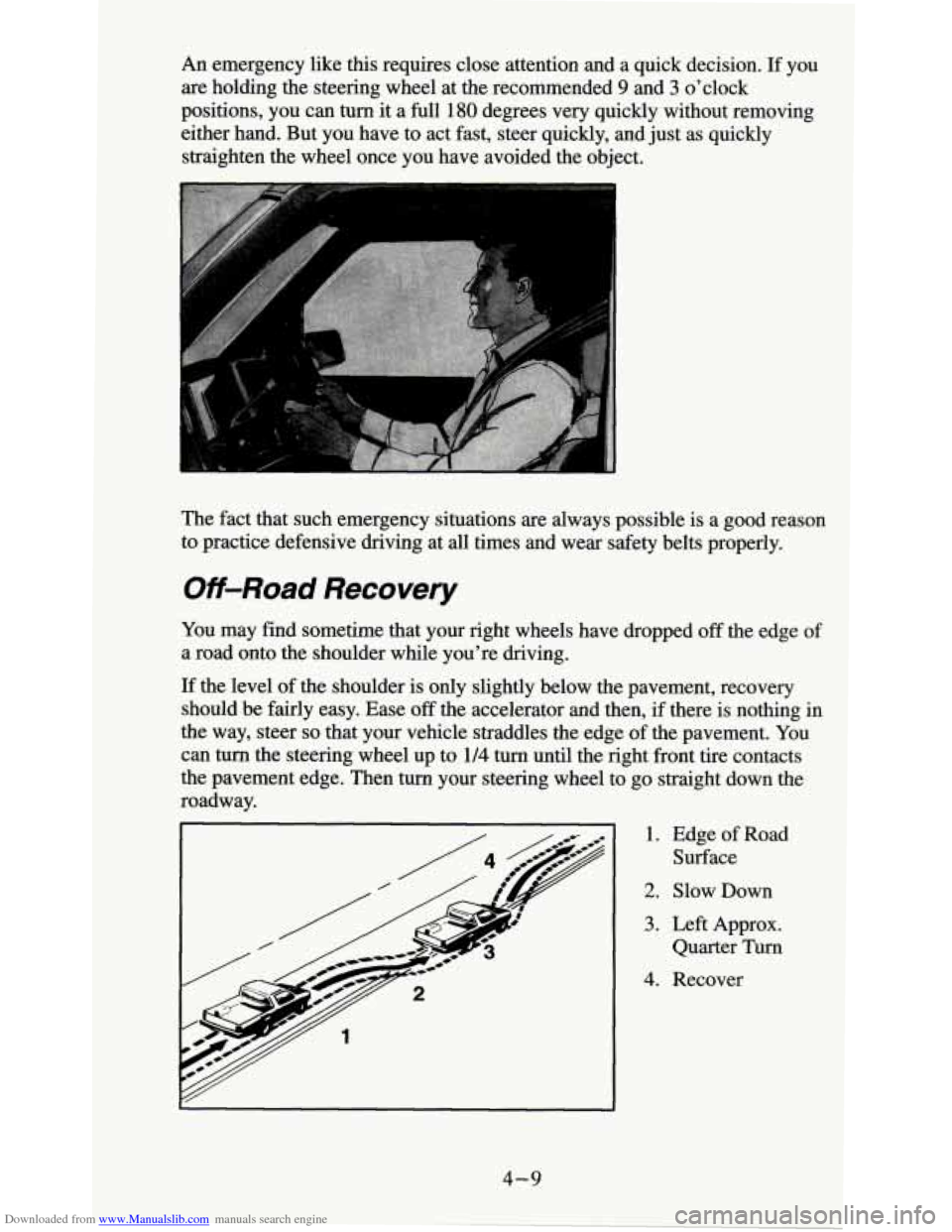
You may find sometime that your right wheels have dropped off the edge of
a road onto the shoulder while you’re driving.
If the level of the shoulder is only slightly below the pavement, recovery
should be fairly easy. Ease
off the accelerator and then, if there is nothing in
the way, steer
so that your vehicle straddles the edge of the pavement. You
can turn the steering wheel up to 114 turn until the right front tire contacts
the pavement edge. Then turn your steering wheel to go straight down the
roadway.
1. Edge of Road
Surface
2. Slow Down
3. Left Approx.
Quarter Turn
4. Recover
4-9
Page 148 of 354
Downloaded from www.Manualslib.com manuals search engine Sur$ace Obstacles. Unseen or hidden obstacles can be hazardous. A rock,
log, hole, rut, or bump can startle you if you’re not prepared for them. Often
these obstacles are hidden by grass, bushes, snow or even the rise and fall of
the terrain itself. Here are some things to consider:
Is the path ahead clear?
0 Will the surface texture change abruptly up ahead?
0 Does the travel take you uphill or downhill? (There’s more discussion
of these subjects later.)
0 Will you have to stop suddenly or change direction quickly?
When you drive over obstacles or rough terrain, keep a
firm grip on the
steering wheel. Ruts, troughs, or other surface features can jerk the wheel
out of your hands if you’re not prepared.
When
you drive over bumps, rocks, or other obstacles, your wheels can
leave the ground. If this happens, even with one or two wheels, you can’t
control the vehicle
as well or at all.
Because you will be on an unpaved surface, it’s especially important
to
avoid sudden acceleration, sudden turns, or sudden braking.
In a way, off-road driving requires a different kind
of alertness from driving
on paved roads and highways. There are no road signs, posted speed limits
or signal lights. You have to use your own
good judgment about what is safe
and what isn’t.
Drinking and driving can be very dangerous on any road. And this
is
certainly true for off-road driving. At the very time you need special
alertness and driving skills, your reflexes, perceptions and judgment can be
affected by even a small amount of alcohol. You could have
a serious - or
even fatal - accident if you drink and drive or ride with a driver who has
been drinking. (See “Drunken Driving” in the Index.)
Driving On Off-Road Hills
Off-road driving often takes you up, down, or across a hill. Driving safely
on hills requires good judgment and an understanding of what your vehicle
can and can’t do. There are some hills that simply can’t be driven, no matter
how well built the vehicle.
4- 15
Page 150 of 354
Downloaded from www.Manualslib.com manuals search engine Ease up on your speed as you approach the top of the hill.
Attach a flag to the vehicle to make you more visible to approaching
traffic
on trails or hills.
0 Sound the horn as you approach the top of the hill to let opposing
traffic know you’re there.
Use your headlights even during the day. They make you more visible
to oncoming traffic.
Q: What should I do if my vehicle stalls, or is about to stall, and I
can’t make it up the hill?
A: If this happens, there are some things you should do, and there are
some things you must not do. First, here’s what
you should do:
Push the brake pedal to stop the vehicle and keep it from rolling
backwards. Also, apply the parking brake.
If your engine is still running, shift the transmission into reverse,
release the parking brake, and slowly back down the hill in reverse.
If your engine has stopped running, you’ll need to restart it. With the
brake pedal depressed and the parking brake still applied, shift the
transmission to PARK (P) (or, shift to NEUTRAL
(N) if your vehicle
has a manual transmission) and restart the engine. Then, shift to
reverse, release the parking brake, and slowly back down the hill as
straight as possible
in reverse.
As you are backing down the hill, put your left hand on the steering
wheel at the
12 o’clock position. This way, you’ll be able to tell if your
wheels are straight and maneuver as
you back down. It’s best that you
back down the hill with your wheels straight rather than in the left or
right direction. Turning the wheel
too far to the left or right will
increase the possibility of a rollover.
Here are some things you
must not do if you stall, or are about to stall,
when going up a hill.
4-17
Page 155 of 354
Downloaded from www.Manualslib.com manuals search engine Driving In Mud, Sand, Snow, Or Ice
When you drive in mud, snow or sand, your wheels won’t get good traction.
You can’t accelerate as quickly, turning is more difficult, and you’ll need
longer braking distances.
It’s best
to use a low gear when you’re in mud - the deeper the mud, the
lower the gear.
In really deep mud, the idea is to keep your vehicle moving
so you don’t get stuck.
When
you drive 6fi Sad, you’ll sense a change in wheel traction. But it will
depend upon how loosely packed the sand is. On loosely packed sand (as
on
beaches or sand dunes) your tires will tend to sink into the sand. This has an
effect on steering, accelerating, and braking. You may want to reduce the air
pressure in your tires slightly when driving on sand. This will improve
traction.
Hard packed snow and ice offer the worst tire traction. On these surfaces.
it’s very easy to lose control. On wet ice, for example, the traction is
so poor
that you will have difficulty accelerating. And if
you do get moving, poor
steering and difficult braking can cause
you to slide out of control.
Driving In Water
Light rain causes no special off-road driving problems. But heavy rain can
mean flash flooding, and flood waters demand extreme caution.
Find out how deep the water is before
you drive through it. If it’s deep
enough to cover your wheel hubs, axles, or exhaust pipe, don’t try it
- you
probably won’t get through. Also, water that deep can damage your axle and
other vehicle parts.
If the water isn’t too deep, then drive through it slowly. At fwt speeds, water
splashes
on your ignition system and your vehicle can stall. Stalling can also
occur if you get your tailpipe under water. And, as long as your tailpipe is
under water, you’ll never be able
to start your engine. When you go through
water, remember that when your brakes get wet, it may take you longer to
stop.
4-22
Page 157 of 354
Downloaded from www.Manualslib.com manuals search engine Here are some tips on night driving.
Drive defensively.
0 Don’t drink and drive.
Adjust your inside rearview mirror to reduce the glare from headlights
Since you can’t see as well, you may need to slow down and keep more
behind you.
space
between you and other vehicles.
Slow down, especially on higher speed roads. Your headlights can light
up
only so much road ahead.
In remote areas, watch for animals.
0 If you’re tired, pull off the road in a safe place and rest.
Night Vision
No one can see as well at night as in the daytime. But as we get older these
differences increase. A 50-year-old driver may require at least twice as
much light to see the same thing at night as a 20-year-old.
What you do in the daytime can also affect your night vision.
For example,
if you spend the day in bright sunshine you
are wise to wear sunglasses.
Your eyes will have less trouble adjusting to night. But
if you’re driving,
don’t wear sunglasses at night. They may cut down on glare from
headlights, but they also make a lot of things invisible.
You can be temporarily blinded by approaching lights. It can take a second
or
two, or even several seconds, for your eyes to readjust to the dark. When
you
are faced with severe glare (as from a driver who doesn’t lower the high
beams, or a vehicle with misaimed headlights), slow down a little. Avoid
staring directly into the approaching lights.
Keep your windshield and all the glass on your vehicle clean
- inside and
out. Glare at night is made much worse by dirt on the glass. Even the inside
of the glass can build up a film caused by dust. Dirty glass makes lights
dazzle and flash more than clean glass would, making
the pupils of your
eyes contract repeatedly.
Remember that your headlights light up far less of a roadway when you
are
in a turn or curve. Keep your eyes moving; that way, it’s easier to pick out
dimly lighted objects. Just as your headlights should be checked regularly
for proper aim,
so should your eyes be examined regularly. Some drivers
suffer from night blindness
- the inability to see in dim light - and aren’t
even aware
of it,
4-24