Page 185 of 354
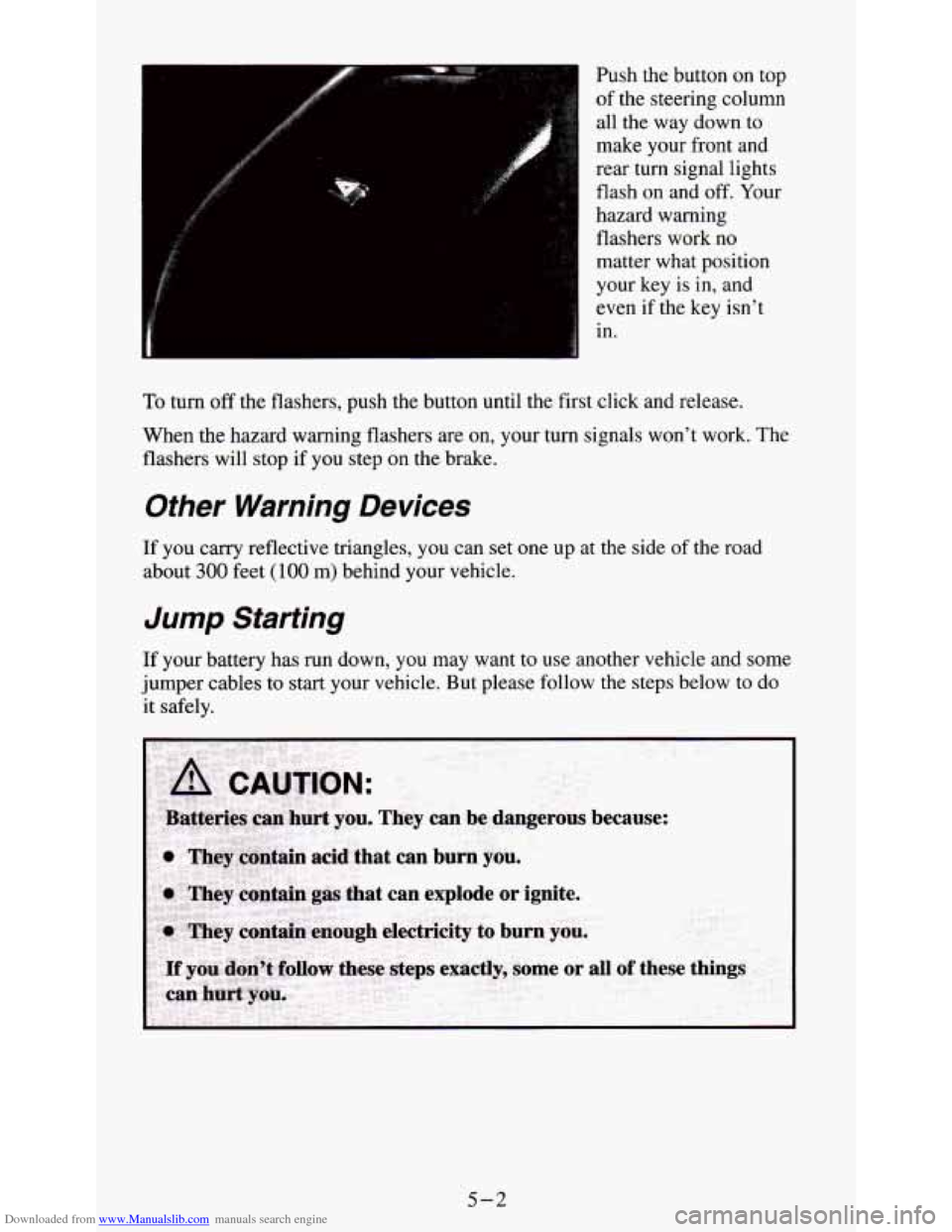
Downloaded from www.Manualslib.com manuals search engine Push the button on top
of the steering column
all the way down
to
make your front and
rear turn signal lights
flash on and
off. Your
hazard warning
flashers work
no
matter what position
your key is
in, and
even if the key isn’t
in.
To turn off the flashers, push the button until the first click and release.
When the hazard warning flashers are on, your turn signals won’t work. The
flashers will stop if you step on the brake.
Other Warning Devices
If you carry reflective triangles, you can set one up at the side of the road
about
300 feet (100 m) behind your vehicle.
Jump Starting
If your battery has run down, you may want to use another vehicle and some
jumper cables to start your vehicle. But please follow the steps below to do
it safely.
5-2
Page 186 of 354
Downloaded from www.Manualslib.com manuals search engine NOTICE:
Ignoring these steps could result in costly damage to your
vehicle that wouldn’t be covered by your warranty.
Trying to start your vehicle by pushing or pulling
it could
damage your vehicle, even if you have a manual transmission.
And if you have an automatic transmission, it won’t
start that
way.
To Jump Start Your Vehicle;
1. Check the other vehicle. It must have a 12-volt battery with a negative
ground system.
NOTICE:
If the other system isn’t a 12-volt system with a negative
ground, both vehicles can be damaged.
2. Get the vehicles close enough so the jumper cables can reach, but be
sure the vehicles aren’t touching each other. If they are, it could cause
a
ground connection you don’t want. You wouldn’t be able to start your
vehicle, and the bad grounding could damage the electrical systems.
You could be injured if the vehicles roll. Set the parking brake firmly
on each vehicle. Put an automatic transmission in
PARK (P) or a
manual transmission in NEUTRAL (N). If you have
a
four-wheel-drive vehicle with a manual transfer case shift lever, be
sure the transfer case is not in NEUTRAL
(N).
3. Turn off the ignition on both vehicles. Turn off all lights that aren’t
needed, and radios. This will avoid sparks and help save both batteries.
And it could save your radio!
NOTICE:
If you leave your radio on, it could be badly damaged. The
repair wouldn’t be covered by your warranty.
4. Open the hoods and locate the batteries. Find the positive (+) and
negative
(-) terminals on each battery.
5-3
Page 216 of 354

Downloaded from www.Manualslib.com manuals search engine NOTICE:
Spinning your wheels can destroy parts of your vehicle as well\
as
the tires. If you spin the wheels too fast while shifting you\
r
transmission back and forth, you can destroy your transmission. \
For information about using tire chains on your vehicle, see “Tire Chains”
in the Index.
Rocking your vehicle to get it out:
First, turn your steering wheel left and right. That will clear the area around
your front wheels. Then shift back and forth between REVERSE (R) and a
forward gear (or with a manual transmission, between FIRST
(1) or
SECOND
(2) gear and REVERSE), spinning the wheels as little as possible.
Release the accelerator pedal while you shift, and press lightly
on the
accelerator pedal when the transmission
is in gear. If that doesn’t get you
out after a few tries, you may need to be towed out. Or, you can use your
recovery hooks, if your vehicle has them.
If you do need to be towed out,
see “Towing Your Vehicle” in the Index.
Using the Recovery Hooks
Your vehicle may be equipped with recovery hooks. The recovery hooks are
provided at the front of your vehicle. You may need to use them
if you’re
stuck off-road and need to be pulled to some place where you can continue
driving.
5-33
Page 219 of 354
Downloaded from www.Manualslib.com manuals search engine You should keep a record with all parts receipts and list the mileage and the
date
of any service work you perform. See “Maintenance Record” in the
Index.
NOTICE:
If you try to do your own service work without knowing enough
about it, your vehicle could be damaged.
Fuel
The 8th digit of your vehicle identification number (VIN) shows the code
letter for your engine. You will find the VIN at the top left
of your
instrument panel. (See “Vehicle Identification Number”
in the Index.)
Use regular unleaded gasoline rated at 87 octane or higher. With the
4.3L
(Code W) engine, use premium unleaded gasoline rated at 9 1 octane or
higher for high power performance, when towing
a trailer or with a high
payload requirement. But when operating with a light load
as a normal
condition, you may use middle grade or regular unleaded gasolines.
The gasoline you use should meet specifications
ASTM D48 14 in the
United States and CGSB
3.5-92 in Canada. These fuels should have the
proper additives,
so you should not have to add anything to the fuel.
In the United States and Canada, it’s easy to be sure you get the right kind
of gasoline (unleaded). You’ll see UNLEADED right on the pump. And
only unleaded nozzles will fit into your vehicle’s filler neck.
Be sure the posted octane
is at least 91 for premium, 89 for middle grade
and 87 for regular. If the octane
is less than 87, you may get a heavy
6-2
Page 223 of 354
Downloaded from www.Manualslib.com manuals search engine Checking Things Under the Hood
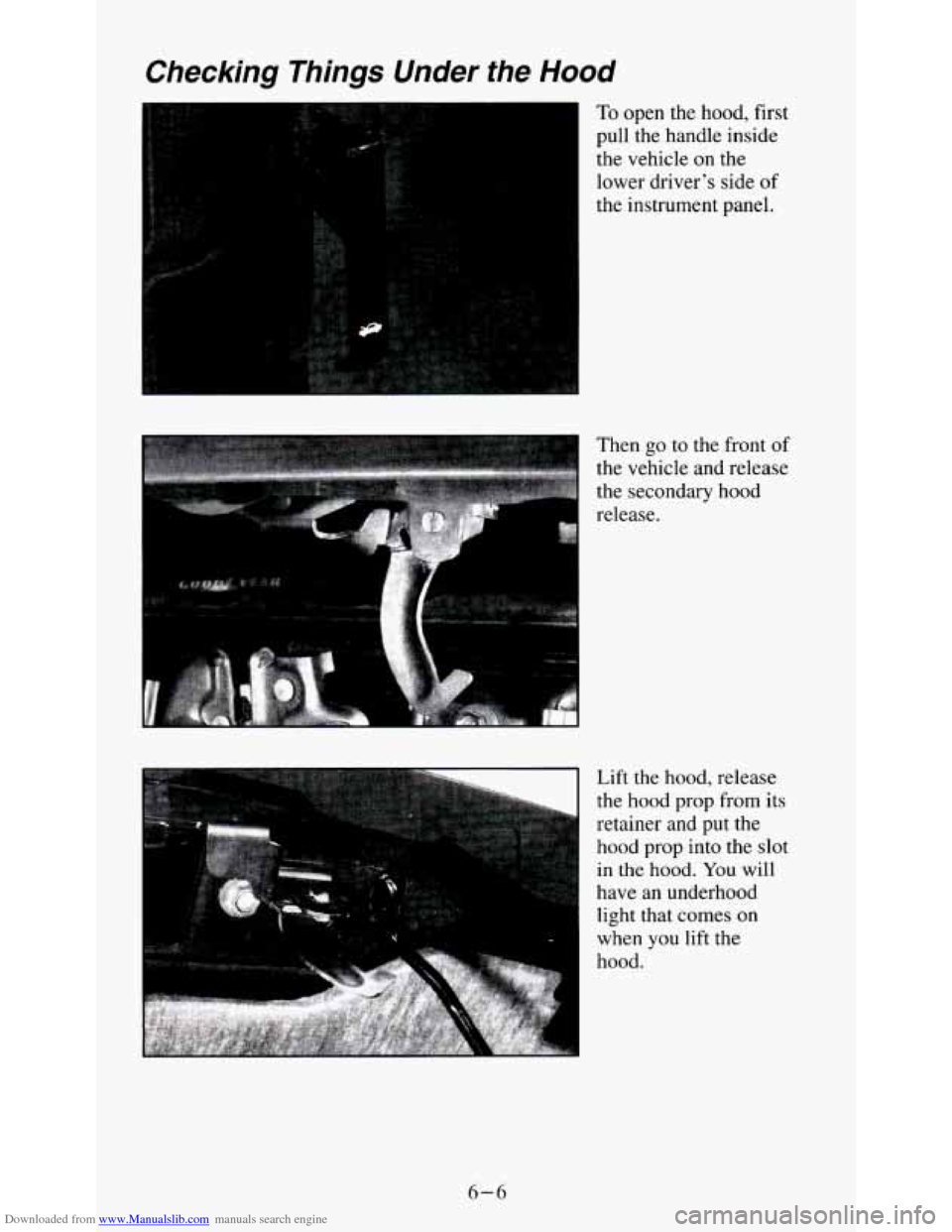
To open the hood, first
pull the handle inside
the vehicle on the
lower driver’s side
of
the instrument panel.
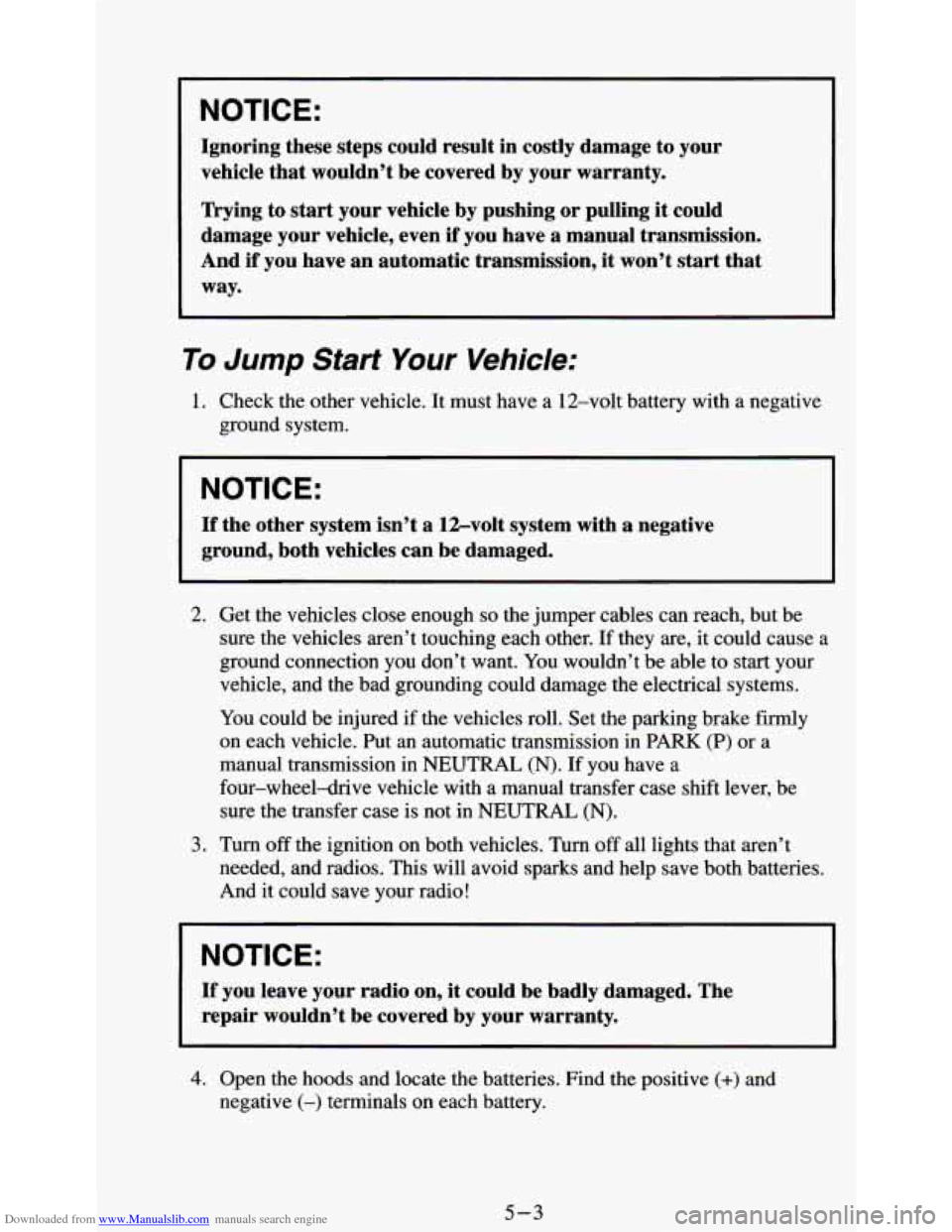
Then
go to the front of
the vehicle and release
the secondary hood
release.
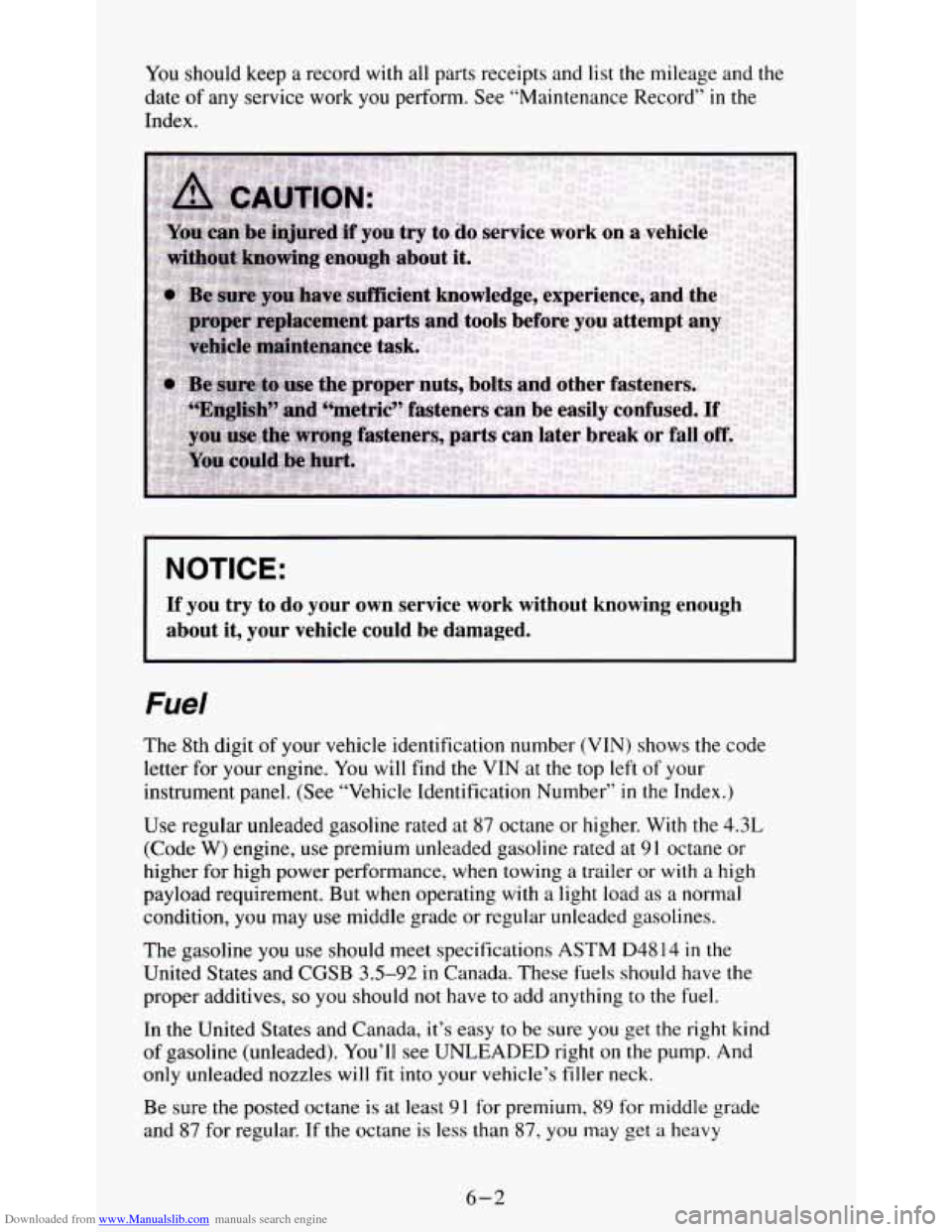
Lift the hood, release
the hood prop from its
retainer and put the
hood prop into the slot
in the hood. You will
have
an underhood
light that comes
on
when you lift the
hood.
6-6
Page 235 of 354
Downloaded from www.Manualslib.com manuals search engine How to Add Fluid
Here’s how to add fluid. Refer to the Maintenance Schedule to determine
what kind of fluid to
use. See “Recommended Fluids and Lubricants” in the
Index.
1. Remove the filler plug.
2. Add fluid at the filler plug hole. Add only enough fluid to bring the
fluid level up to the bottom of the filler plug hole.
3. Install the filler plug. Be sure the plug is fully seated.
Hydraulic Clutch
The hydraulic clutch linkage in your vehicle is self-adjusting. A slight
amount of play
(1/4 inch to 1/2 inch) in the pedal is normal.
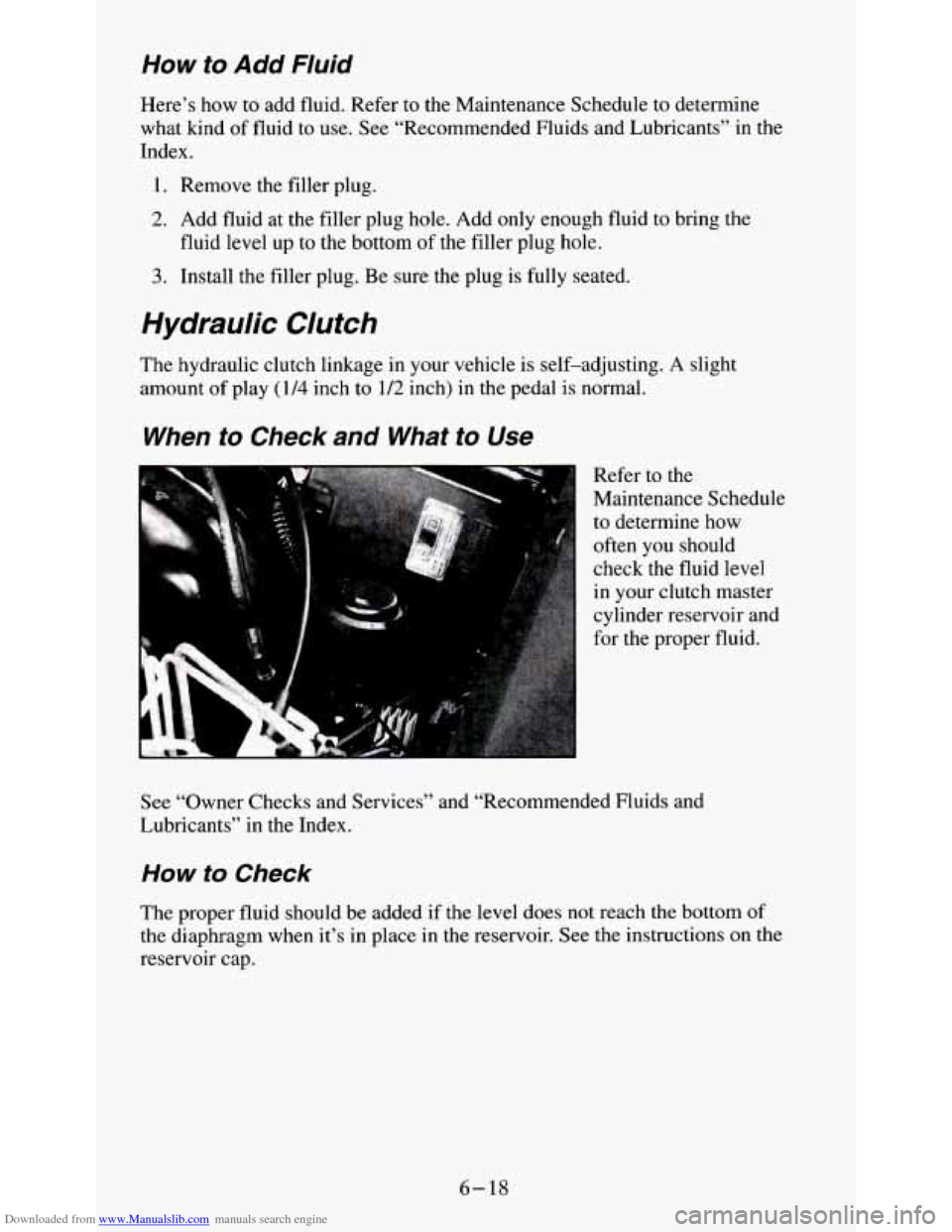
When to Check and What to Use
Refer to the
Maintenance Schedule
to determine how
often
you should
check the fluid level
in your clutch master
cylinder reservoir and
for the proper fluid.
See “Owner Checks and Services” and “Recommended Fluids and
Lubricants” in the Index.
How to Check
The proper fluid should be added if the level does not reach the bottom of
the diaphragm when it’s in place in the reservoir. See the instructions on the
reservoir cap.
6-18
Page 238 of 354
Downloaded from www.Manualslib.com manuals search engine What to Use
Refer to the Maintenance Schedule to determine what kind of lubricant to
use. See “Recommended Fluids and Lubricants” in the Index.
Engine Coolant
The following explains your cooling system and how to add coolant when it
is low. If you have a problem with engine overheating, see “Engine
Overheating” in the Index.
The proper coolant for your vehicle will:
Give freezing protection down to -34°F (-37 “C).
Give boiling protection up to 262°F (128 “C).
Protect against rust and corrosion.
Help keep the proper engine temperature.
Let the warning lights and gages work as they should.
What to Use
Use a mixture of one-half clean water (preferably distilled) and one-half
antifreeze that meets “GM Specification 6038-M,” or “GM Specification
6043-M’ with the 2.2L (LN2) Code 4 engine, which won’t damage
aluminum parts.
You can also use a recycled coolant conforming to “GM
Specification 603%”’ or “GM Specification 6043-M” with the 2.2L
(LN2) Code 4 engine. Use GM Coolant Supplement (Sealer) with a
complete coolant flush and refill. If you use this mixture, you don’t need to
add anything else.
6-21
Page 245 of 354
Downloaded from www.Manualslib.com manuals search engine NOTICE:
Don’t let someone put in the wrong kind of fluid. For
example, just a few drops
of mineral-based oil, such as engine
oil, in your brake system can damage brake system parts
so
badly that they’ll have to be replaced.
Brake fluid can damage paint, so be careful not to spill brake
fluid on your vehicle.
If you do, wash it off immediately. See
“Appearance Care” in the Index.
Brake Wear
Your vehicle has front disc brakes and rear drum brakes.
Disc brake pads have built-in wear indicators that make a high-pitched
warning sound when the brake pads are
worn and new pads are needed. The
sound may come and go or be heard all the time your vehicle
is moving
(except when you are pushing
on the brake pedal firmly).
I NOTICE:
Continuing to drive with worn-out brake pads could result in
costly brake repair.
Some driving conditions or climates may Cause a brake squeal when the
brakes are
first applied or lightly applied. This does not mean something is
wrong with your brakes.
Your rear drum brakes don’t have wear indicators, but if you ever hear a
rear brake rubbing noise, have the rear brake linings inspected. Also, the
rear brake drums should be removed and inspected each time the tires are
removed for rotation or changing. When you have the front brakes replaced,
have
the rear brakes inspected, too.
Brake linings should always be replaced as complete axle sets.
6-28