Page 52 of 324
Downloaded from www.Manualslib.com manuals search engine Larger Children
Children who have outgrown child restraints should
wear
the vehicle's safety belts. If
you have the choice, a child should sit next to a
window
so the child can wear a lap-shoulder belt and
get the additional restraint a shoulder belt can provide,
Accident statistics show that children are safer if they
are restrained in the rear seat. But they need to use the
safety belts properly.
Children who aren't buckled up can be thrown out
a crash.
Children who aren't buckled up can strike other
people who are. in
1-42
Page 54 of 324
Downloaded from www.Manualslib.com manuals search engine &: What if a child is wearing a lap-shoulder belt,
but the child is
so small that the shoulder belt is
very close to the child’s face or neck?
A: Move the child toward the center of the vehicle, but
be sure that the shoulder belt still is on the child’s
shoulder,
so that in a crash the child’s upper body
would have the restraint that belts provide. If the
child is sitting in a rear seat outside position, see
“Rear Safety Belt Comfort Guides”
in the Index. If
the child is so small that the shoulder belt is still
very close to the child’s face
or neck, you might
want to place the child
in the center seat position,
the one that has only a lap belt.
1-44
Page 55 of 324
Downloaded from www.Manualslib.com manuals search engine Wherever the child sits, the lap portion of the belt
should be worn
low and snug on the hips, just touching
the child’s thighs. This applies belt force to the child’s
pelvic bones
in a crash.
Safety Belt Extender
If the vehicle’s safety belt will fasten around you, you
should use
it.
But if a safety belt isn’t long enough to fasten, your
dealer will order
you an extender. It’s free. When you go
in to order it, take the heaviest coat you will wear, so the
extender will be long enough for you. The extender will
be just
for you, and just for the seat in your vehicle that
you choose. Don’t let someone else use it, and use
it
only for the seat it is made to fit. To wear it, just attach it
to the regular safety belt.
1-45
Page 56 of 324

Downloaded from www.Manualslib.com manuals search engine Checking Your Restraint Systems
Now and then, make sure all your belts, buckles, latch
plates, retractors, anchorages and reminder systems are
working properly. Look for any other loose or damaged
restraint system parts. If you
see anything that might
keep a restraint system from doing its job, have it
repaired.
Torn or frayed belts may not protect you in
a crash.
They can rip apart under impact forces.
If a belt is torn
or frayed, get a new one right away.
Replacing Seat and Restraint System
Parts After a Crash
If you’ve had a crash, do you need new belts?
After
a very minor collision, nothing may be necessary.
But if
the belts were stretched, as they would be if worn
during a more severe crash, then
you need new belts.
If belts are cut or damaged, replace them. Collision
damage also may mean you will need to have safety belt
or seat parts repaired or replaced. New parts and repairs
may be necessary even
if the belt wasn’t being used at
the time
of the collision.
1-46
Page 99 of 324
Downloaded from www.Manualslib.com manuals search engine Charging System Light
Fuel Gage
E F
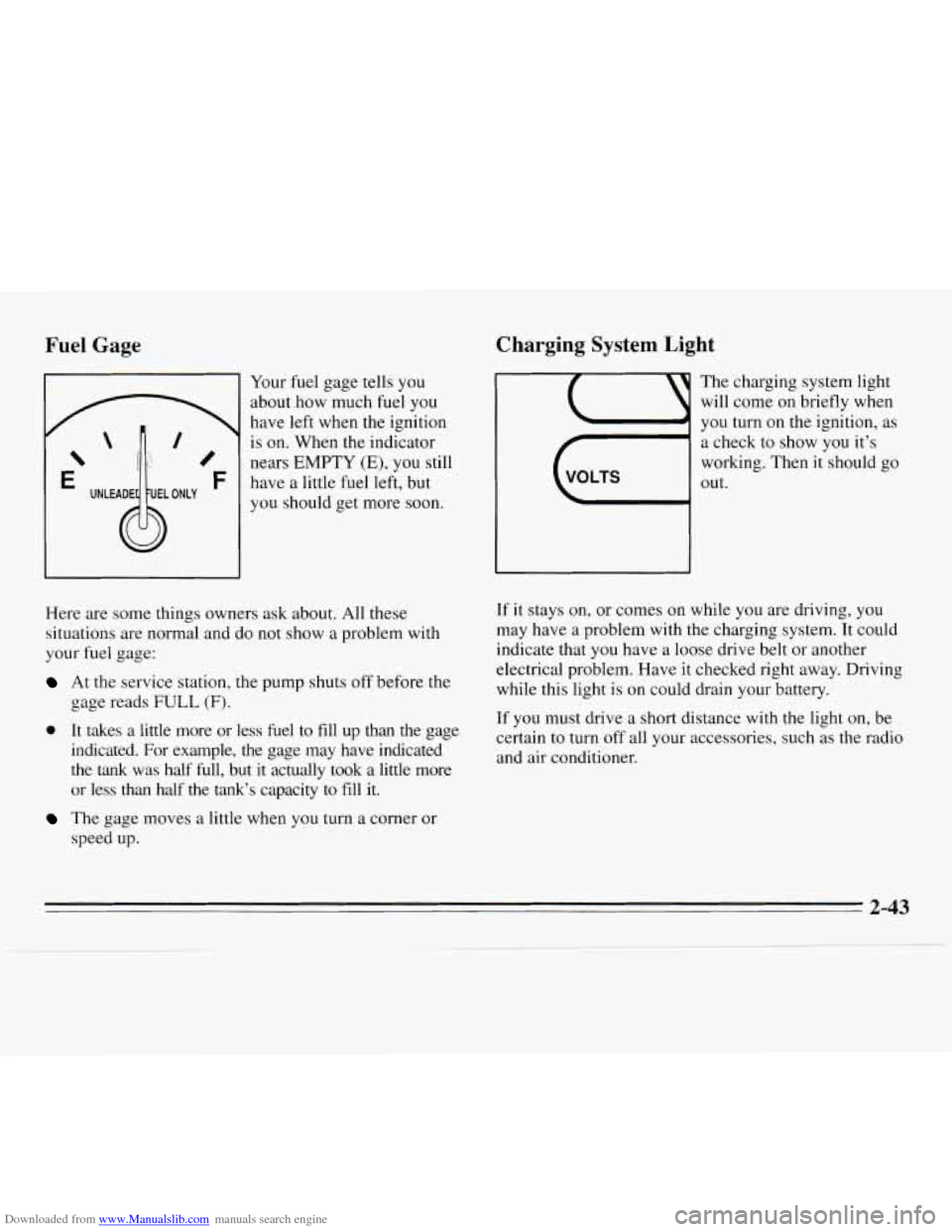
Your fuel gage tells you
about how much fuel you
have left when the ignition
is on. When the indicator
nears EMPTY
(E), you still
have a little fuel left, but
you should get more soon.
Here are some things owners ask about. All these
situations are normal and do not show a problem with
your fuel gage:
At the service station, the pump shuts off before the
gage reads
FULL (F).
0 It takes a little more or less fuel to fill up than the gage
indicated. For example, the gage may have indicated
the tank was half full, but it actually took a little more
or less than half
the tank’s capacity to fill it.
The gage moves a little when you turn a corner or
speed
up.
c7
VOLTS
The
will
YOU
charging system light
come on briefly when
turn on the ignition, as
a check to show you it’s
working. Then it should go
out.
If it stays on, or comes on while you are driving, you
may have a problem with the charging system. It could
indicate that you have a loose drive belt or another
electrical problem. Have it checked right away. Driving
while this light is
on could drain your battery.
If you must drive a short distance with the light on, be
certain to turn
off all your accessories, such as the radio
and air conditioner.
2-43
Page 100 of 324

Downloaded from www.Manualslib.com manuals search engine Safety Belt Reminder Light
8
When the key is turned to
RUN or START, a chime
will come on for about eight
seconds
to remind people to
fasten their safety belts,
unless the driver’s safety
belt is already buckled.
The safety belt light will also come on and stay on
until
the driver’s belt is buckled.
Air Bag Readiness Light
There is an air bag readiness light on the instrument
panel, which shows AIR
BAG or the air bag symbol.
The system checks the air bag’s electrical system for
malfunctions.
The light tells you if there is an electrical
problem. The system check includes the air bag sensors
and modules, the wiring and the diagnostic module. For
more information on the air bag system, see “Air Bag”
in the Index.
You will see this light flash
for
a few seconds when you
turn your ignition to RUN
or START. Then the light
should go out. This means
the system is ready.
1
If the air bag readiness light doesn’t come on when you
start your vehicle, or
stays on, or comes on when you
are driving, your air bag system may not work properly.
Have your vehicle serviced right away.
2-44
Page 126 of 324
Downloaded from www.Manualslib.com manuals search engine Care of Your Cassette Tape Player
A tape player that is not cleaned regularly is subject to
reduced sound quality, ruining the cassette or damaging
the mechanism. Tape cassettes that are not properly
stored
in their plastic cases away from contaminants,
direct sunlight, and extreme heat may not operate
properly and could cause premature failure
of the
tape player.
Your tape player should be cleaned with every
50 hours
of use to provide optimum performance.
Your radio may
display Cln to indicate that you have used your tape
player for
50 hours without resetting the tape clean
timer.
If you notice a reduction in sound quality,
regardless
of when the tape player was last cleaned, try
playing a different cassette to see
if the tape or the
tape player is at fault. If the second cassette results
in
no improvement in sound quality, try cleaning the
tape player.
Proper tape player cleaning should be done with
a
scrubbing action, non-abrasive cleaner cassette. This is a
wet-type cleaning system that uses
a cleaning cassette
with pads that scrub the tape head as the hubs of
the
cleaner cassette turn. To properly clean your tape player,
follow the instructions with the cleaning cassette. If
you
use this type of cleaner, the radio may display an error
and eject the cartridge. This is normal and is the result
of an added feature in the tape player that detects broken
tapes. If an error occurs, you will need to insert the
cleaning cassette at least three times to thoroughly clean
the tape player.
You may prefer to use a non-scrubbing action, wet-type
cleaner. This type
of cleaner uses a fabric belt to clean
the tape head. This type of cleaner cassette will not
cause an error, but
it may not clean the tape player as
thoroughly as the scrubbing-type cleaner.
A scrubbing action cleaner is available through your
dealer
(GM Part No. 12344600).
Cassettes are subject to wear, and the sound quality may
degrade over time. Always verify that the cassette tape
is
in good condition and the tape player is clean before
obtaining service on your tape player.
3-16
Page 129 of 324

Downloaded from www.Manualslib.com manuals search engine a Section 4 Your Driving and the Road
IS
Here you’ll find information about driving on different
kinds
of roads and in varying weather conditions. We’ve
also included many other useful tips on driving.
Defensive Driving
The best advice anyone can give about driving is: Drive
defensively.
Please start with
a very important safety device in your
Chevrolet: Buckle up. (See “Safety Belts”
in the Index.)
Defensive driving really means “be ready for anything.”
On city streets, rural roads, or freeways,
it means
“always expect the unexpected.”
Assume that pedestrians or other drivers are going to be
careless and make mistakes. Anticipate what they might
do. Be ready for their mistakes.
Rear-end collisions are about
the most preventable of
accidents. Yet they are common. Allow enough
following distance. It’s the best defensive driving
maneuver,
in both city and rural driving. You never
know when the vehicle
in front of you is going to brake
or
turn suddenly.
4-1


