1995 CHEVROLET MONTE CARLO low beam
[x] Cancel search: low beamPage 81 of 324
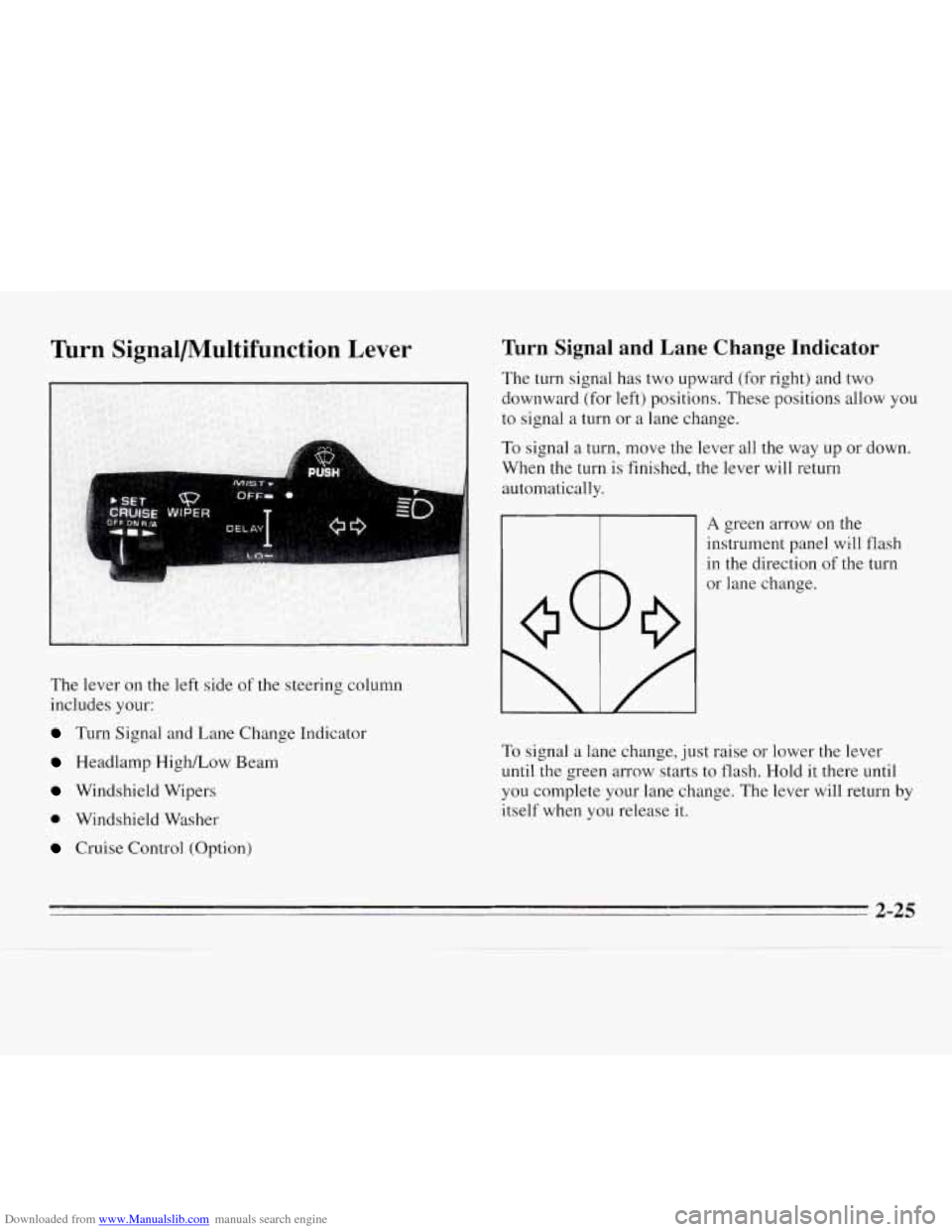
Downloaded from www.Manualslib.com manuals search engine Turn Signal/Multifunction Lever
The lever on the left side of the steering column
includes your:
Turn Signal anu Lane Lnange rndicator
Headlamp HighLow Beam
Windshield Wipers
0 Windshield Washer
Cruise Control (Option)
Turn Signal and Lane Change Indicator
The turn signal has two upward (for right) and two
downward
(for left) positions. These positions allow you
to signal a turn or a lane change.
To signal a turn, move the lever all the way
up or down.
When the turn is finished, the lever will return
automatically.
A green arrow on the
instrument panel will flash
in
or the
direction
lane change. of
the turn
To signal a lane change, just raise or lower the lever
until the green arrow starts to flash. Hold
it there until
you complete your lane change. The lever will return by
itself when you release it.
Page 82 of 324
Downloaded from www.Manualslib.com manuals search engine As you signal a turn or a lane change, if the arrow
flashes faster than normal, a signal bulb may be burned
out and other drivers won’t
see your turn signal.
If a bulb is burned out, replace it to help avoid an
accident. If the green arrows don’t
go on at all when you
signal a turn, check the fuse (see “Fuses and Circuit
Breakers’’ in the Index) and for burned-out bulbs.
A chime will sound if you leave your turn signal on for
more than
1/2 mile (0.8 km).
Headlamp High-Low Beam Windshield Wipers
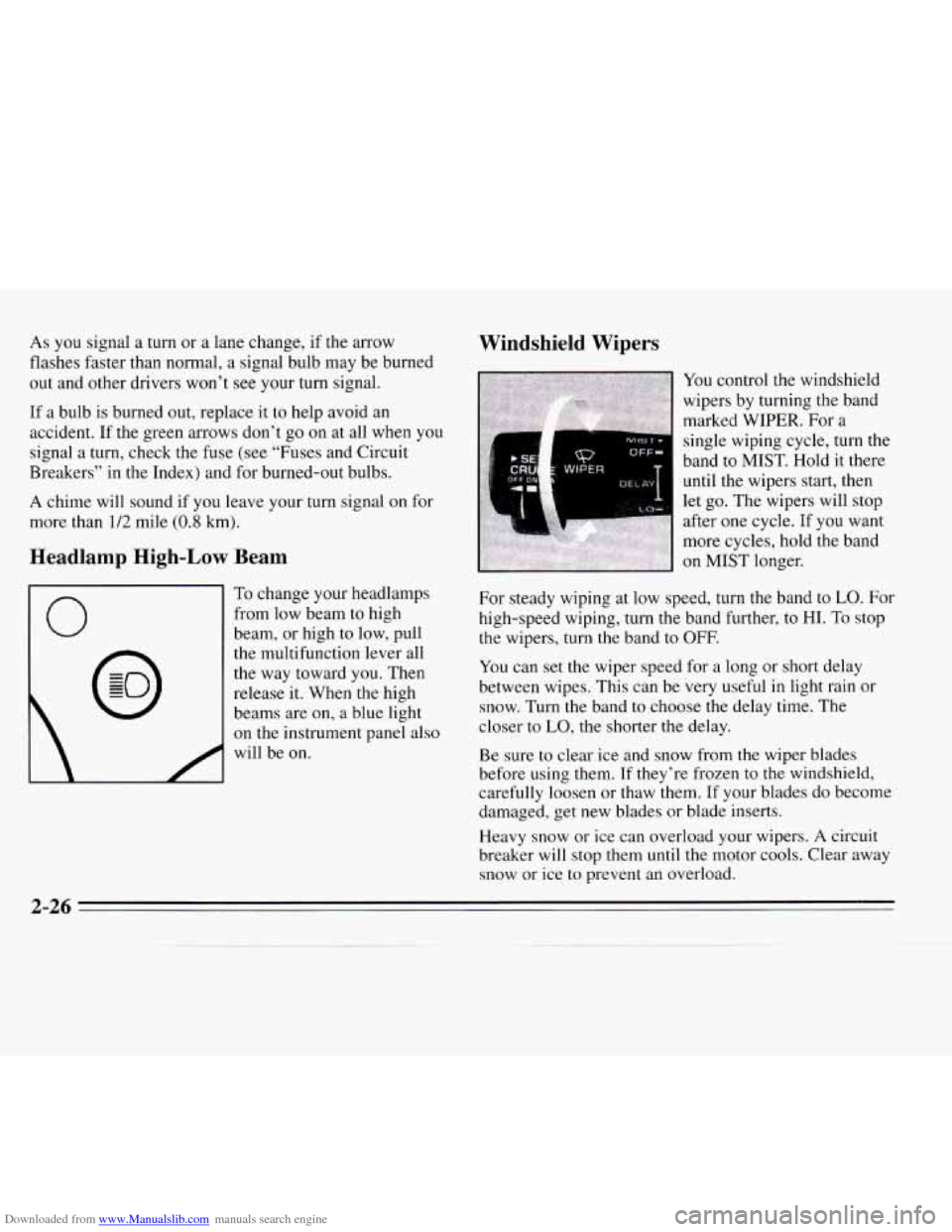
You control the windshield
wipers by turning the band
marked WIPER. For a
6s WIPER
single wiping cycle, turn the
band to
MIST. Hold it there
until the wipers start, then
let
EO. The wipers will stop
0
To change your headlamps
from low beam
to high
beam, or high to low, pull
the multifunction lever all
the way toward you. Then
release it. When
the high
beams are on, a blue light
on the instrument panel also
will be on.
For steady wiping at low speed, turn the band to LO. For
high-speed wiping, turn the band further, to
HI. To stop
the wipers, turn the band
to OFF.
You can set the wiper speed for a long or short delay
between wipes. This can be very useful in light rain or
snow.
Turn the band to choose the delay time. The
closer to
LO, the shorter the delay.
Be sure to clear ice and
snow from the wiper blades
before using them.
If they’re frozen to the windshield,
carefully loosen or thaw them, If your blades
do become
damaged, get new blades or blade inserts.
Heavy snow or ice can overload your wipers.
A circuit
breaker will stop them until the motor cools. Clear away
snow or ice to prevent an overload.
2-26
Page 88 of 324

Downloaded from www.Manualslib.com manuals search engine Daytime Running Lamps (Canada Only)
Daytime Running Lamps (DRL) make it easier to see
the front of your vehicle during the day. DRL can be
helpful when it’s raining and in the short periods after
dawn and before sunset. Several countries, including
Canada, require
DRL.
A light sensor on top of the instrument panel makes the
DRL work,
so be sure it isn’t covered.
The DRL system will make your low-beam headlamps
come on at reduced brightness in daylight when:
0 The ignition is on,
0 The headlamp switch is off, and
0 The parking brake is released.
When the
DRL are on, only your low-beam headlamps
will be on. The taillamps, sidemarker and other lamps
won’t be
on. Your instrument panel won’t be lit up
either.
When it’s dark enough outside, your low-beam
headlamps will change to full brightness. The other
lamps that come on with your headlamps will also come
on.
When it’s bright enough outside, the regular lamps will
go off, and your low-beam headlamps change to the
reduced brightness of DRL.
To idle your vehicle with the DRL
off, set the parking
brake while the ignition
is in OFF or LOCK. Then start
your vehicle. The DRL will stay off until you release the
parking brake.
As with any vehicle, you should turn on the regular
headlamp system any time you need it.
Interior Lamps
When any door is opened, several lamps come on. These
lamps are courtesy lamps. They make it easy for you
to
enter and leave your vehicle. You can also turn these
lamps on by moving the dial near the headlamp knob all
the way
up.
Some of the lamps have switches so you can turn them
on, even when the doors are closed. These lamps are
reading lamps. To avoid draining your battery, be sure to
turn off all reading lamps when leaving your vehicle.
2-32
Page 142 of 324
Downloaded from www.Manualslib.com manuals search engine Here are some tips on night driving.
0
0
0
0
0
0
0
Drive defensively.
Don’t drink and drive.
Adjust your inside rearview mirror to reduce the
glare from headlamps behind you.
Since
you can’t see as well, you may need to slow
down and keep more space between you and other
vehicles.
Slow down, especially on higher speed roads. Your
headlamps can light up only
so much road ahead.
In remote areas, watch for animals.
If you’re tired, pull off the road in a safe place and
rest.
Night Vision
No one can see as well at night as in the daytime. But as
we get older these differences increase. A 50-year-old
driver may require at least twice
as much light to see the
same thing at night
as a 20-year-old.
What you do in the daytime can also affect your night
vision. For example,
if you spend the day in bright
sunshine you are wise to wear sunglasses. Your eyes will have less trouble adjusting to night.
But if
you’re
driving, don’t wear sunglasses at night. They may cut
down on glare from headlamps, but they also make a lot
of things invisible.
You can be temporarily blinded by approaching
headlamps. It can take
a second or two, or even several
seconds, for your eyes to readjust to
the dark. When you
are faced
with severe glare (as from a driver who
doesn’t lower the high beams, or
a vehicle with
misaimed headlamps), slow down
a little. Avoid staring
directly into the approaching headlamps.
Keep your windshield and all the glass on your vehicle
clean
-- inside and out. Glare at night is made much
worse by dirt on the glass. Even the inside
of the glass
can build up
a film caused by dust. Dirty glass makes
lights dazzle and flash more than clean glass would,
making
the pupils of your eyes contract repeatedly.
Remember that your headlamps light up far less of a
roadway when you are in
a turn or curve. Keep your
eyes moving; that way, it’s easier
to pick out dimly
lighted objects. Just
as your headlamps should be
checked regularly for proper aim,
so should your eyes
be examined regularly. Some drivers suffer from night
blindness
-- the inability to see in dim light -- and
aren’t even aware of
it.
4-14
Page 144 of 324
Downloaded from www.Manualslib.com manuals search engine Driving too fast through large water puddles or even
going through some car washes can cause problems, too.
The water may affect your brakes. Try to avoid puddles.
But if
you can’t, try to slow down before YOU hit them.
Hydroplaning
Hydroplaning is dangerous. So much water can build up
under your tires that they can actually ride on the water.
This can happen
if the road is wet enough and you’re
going fast enough. When your vehicle is hydroplaning,
it has little or no contact with the road. Hydroplaning
doesn’t happen often. But it
can if your
tires haven’t much tread or if the pressure
in one or
more is low. It can happen
if a lot of water is standing on
the road. If
you can see reflections from trees, telephone
poles, or other vehicles, and raindrops “dimple” the
water’s surface, there could be hydroplaning.
Hydroplaning usually happens at higher speeds. There
just isn’t a hard and fast rule about hydroplaning. The
best advice is to slow down when
it is raining.
Some Other Rainy Weather Tips
Turn on your low-beam headlamps -- not just your
parking lamps
-- to help make you more visible to
others.
Besides slowing down, allow some extra following
distance. And be especially careful when you pass
another vehicle. Allow yourself more clear room
ahead, and be prepared to have your view restricted
by road spray.
Have good tires with proper tread depth. (See
“Tires”
in the Index.)
4-16
Page 254 of 324
Downloaded from www.Manualslib.com manuals search engine Replacement Bulbs
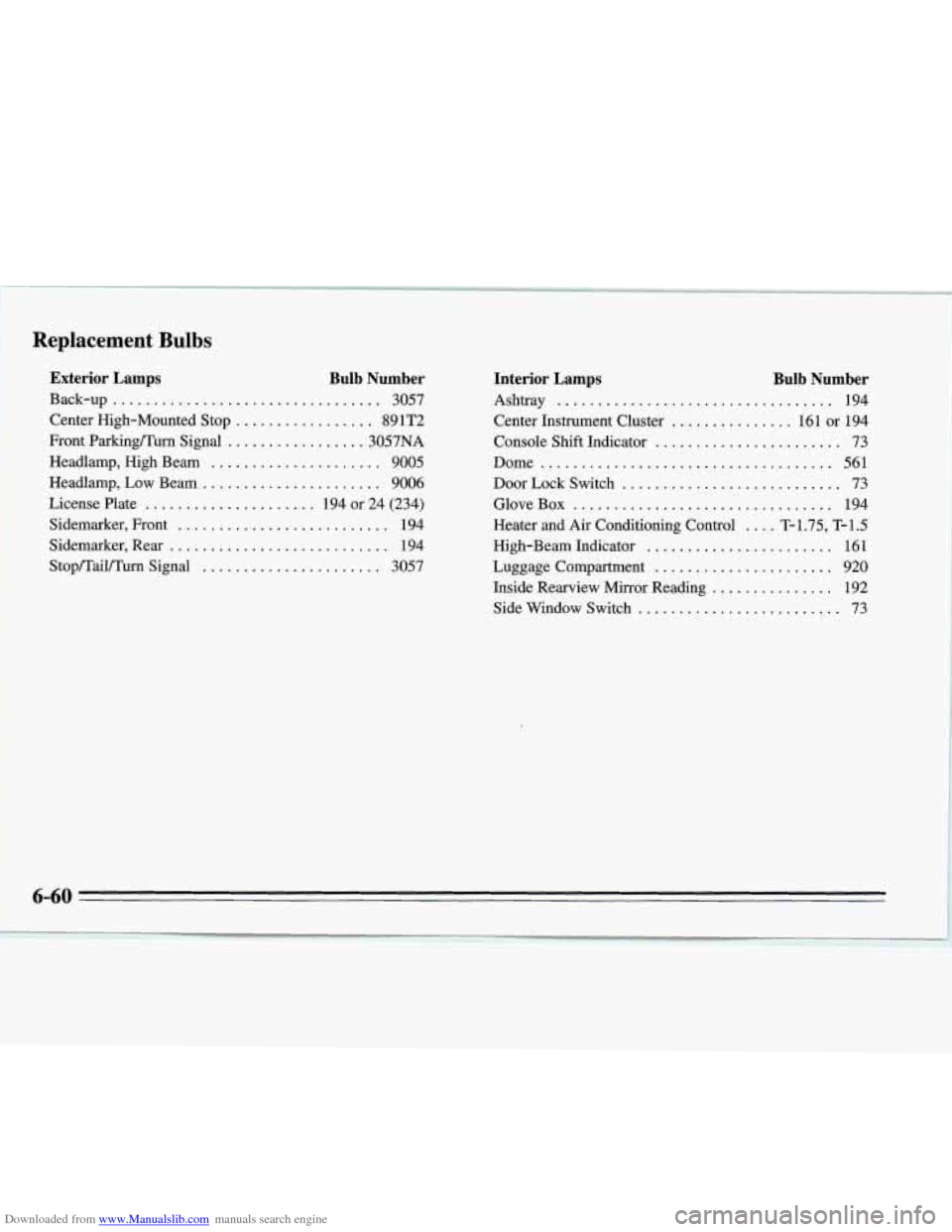
Exterior Lamps Bulb Number
Back-up ................................. 3057
Center High-Mounted Stop
................. 891T2
Front Parking/Turn Signal
................. 3057NA
Headlamp. High Beam
..................... 9005
Headlamp. Low Beam
...................... 9006
License Plate
..................... 194 or 24 (234)
Sidemarker. Front
.......................... 194
Sidemarker. Rear
........................... 194
Stop/Tail/Turn Signal
...................... 3057
Interior Lamps
Bulb Number
Ashtray .................................. 194
Center Instrument Cluster
............... 161 or 194
Console
Shift Indicator ....................... 73
Door Lock Switch
........................... 73
Glove Box
................................ 194
High-Beam Indicator
....................... 161
Luggage Compartment
...................... 920
Inside Rearview Mirror Reading ............... 192
Side Window Switch
......................... 73
Dome
.................................... 561
Heater and Air Conditioning Control
.... T-1.75, T-1.5
Page 315 of 324
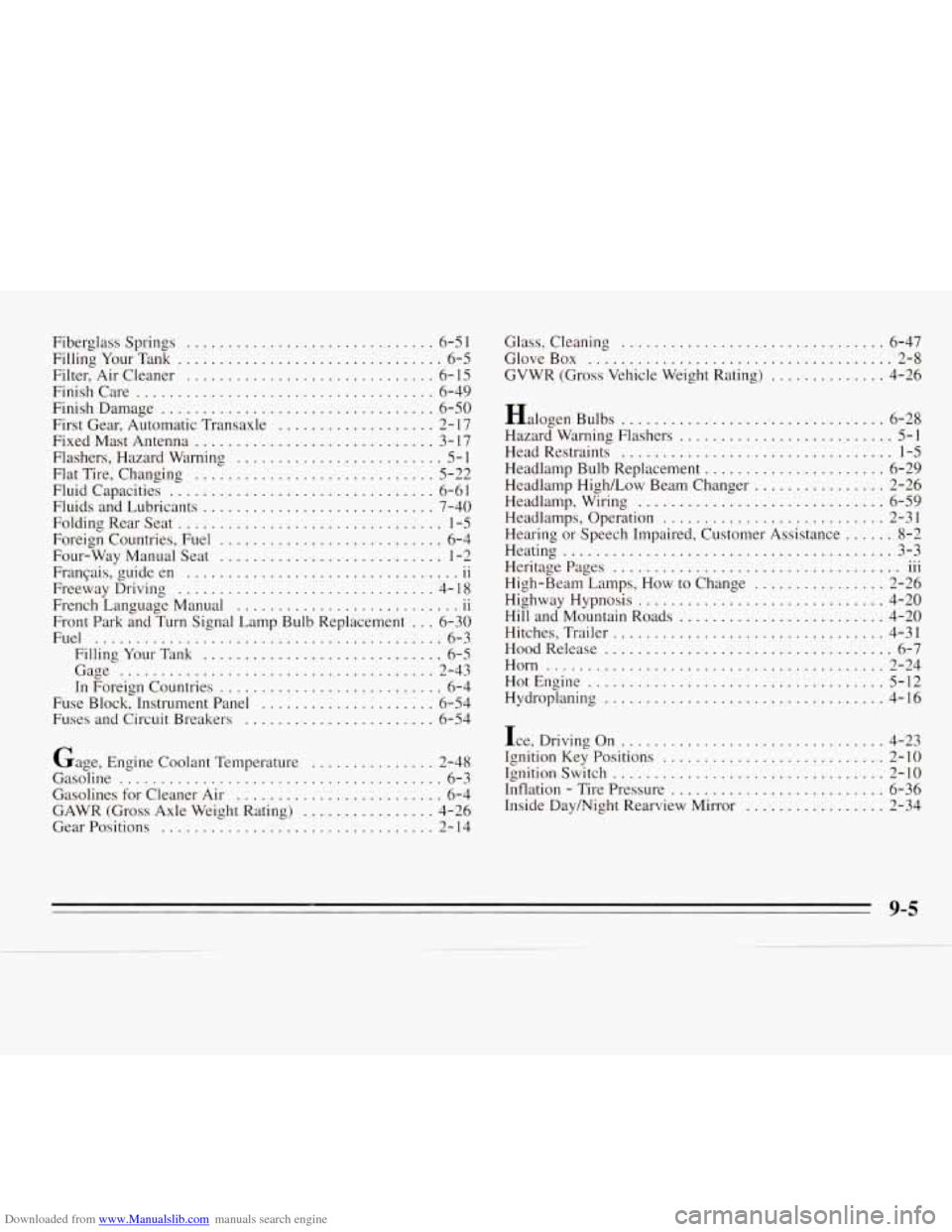
Downloaded from www.Manualslib.com manuals search engine Fiberglass Springs .............................. 6-5 1
FillingYourTank ................................ 6-5
Filter. Air Cleaner
.............................. 6-15
Finish Care
.................................... 6-49
Finish Damage
................................. 6-50
First Gear. Automatic Transaxle
................... 2- 17
Fixed Mast Antenna
............................. 3- 17
Flashers. Hazard Warning ......................... 5-1
Flat Tire. Changing
............................. 5-22
Fluid Capacities
................................ 6-61
Fluids and Lubricants
............................ 7-40
Folding Rear Seat
................................ 1-5
Foreign Countries. Fuel
........................... 6-4
Four-Way Manual Seat
........................... 1-2
Franpis. guide en
11
Freeway Driving ............................... 4- 18
French Language Manual 11
Front Park and Turn Signal Lamp Bulb Replacement ... 6-30
Fuel
.......................................... 6-3
Filling Your Tank ............................. 6-5
Gage
...................................... 2-43
In Foreign Countries
........................... 6-4
Fuse Block. Instrument Panel
..................... 6-54
Fuses and Circuit Breakers
....................... 6-54
.. .................................
.. ...........................
Gage . Engine Coolant Temperature ............... 2-48
Gasoline
....................................... 6-3
Gasolines for Cleaner Air ......................... 6-4
GAWR (Gross Axle Weight Rating)
................ 4-26
GearPositions
................................. 2-14 Glass. Cleaning
................................ 6-47
GloveBox
..................................... 2-8
GVWR (Gross Vehicle Weight Rating)
.............. 4-26
Halogen Bulbs
................................ 6-28
Hazard Warning Flashers
.......................... 5-1
Head Restraints
................................. 1-5
Headlamp Bulb Replacement ...................... 6-29
Headlamp HighLow Beam Changer
................ 2-26
Headlamp. Wiring
.............................. 6-59
Headlamps. Operation
........................... 2-31
Hearing
or Speech Impaired. Customer Assistance ...... 8-2
Heating
........................................ 3-3
Heritage Pages ................................... 111
High-Beam Lamps. How to Change ................ 2-26
Highway Hypnosis
.............................. 4-20
Hill and Mountain Roads
......................... 4-20
Hitches. Trailer ................................. 4-31
Hood Release
................................... 6-7
Horn
......................................... 2-24
HotEngine
.................................... 5-12
Hydroplaning
.................................. 4-16
...
Ice. Driving On ................................ 4-23
Ignition Key Positions
........................... 2-10
Ignitionswitch
................................. 2-10
Inflation
. Tire Pressure .......................... 6-36
Inside Daymight Rearview Mirror
................. 2-34
9-5