Page 138 of 324
Downloaded from www.Manualslib.com manuals search engine An emergency like this requires close attention and a
quick decision. If you are holding the steering wheel at
the recommended
9 and 3 o’clock positions, you can
turn it a full
180 degrees very quickly without removing
either hand. But you have
to act fast, steer quickly, and
just
as quickly straighten the wheel once you have
avoided the object.
The fact that such emergency situations are always
possible is
a good reason to practice defensive driving at
all times and wear safety belts properly.
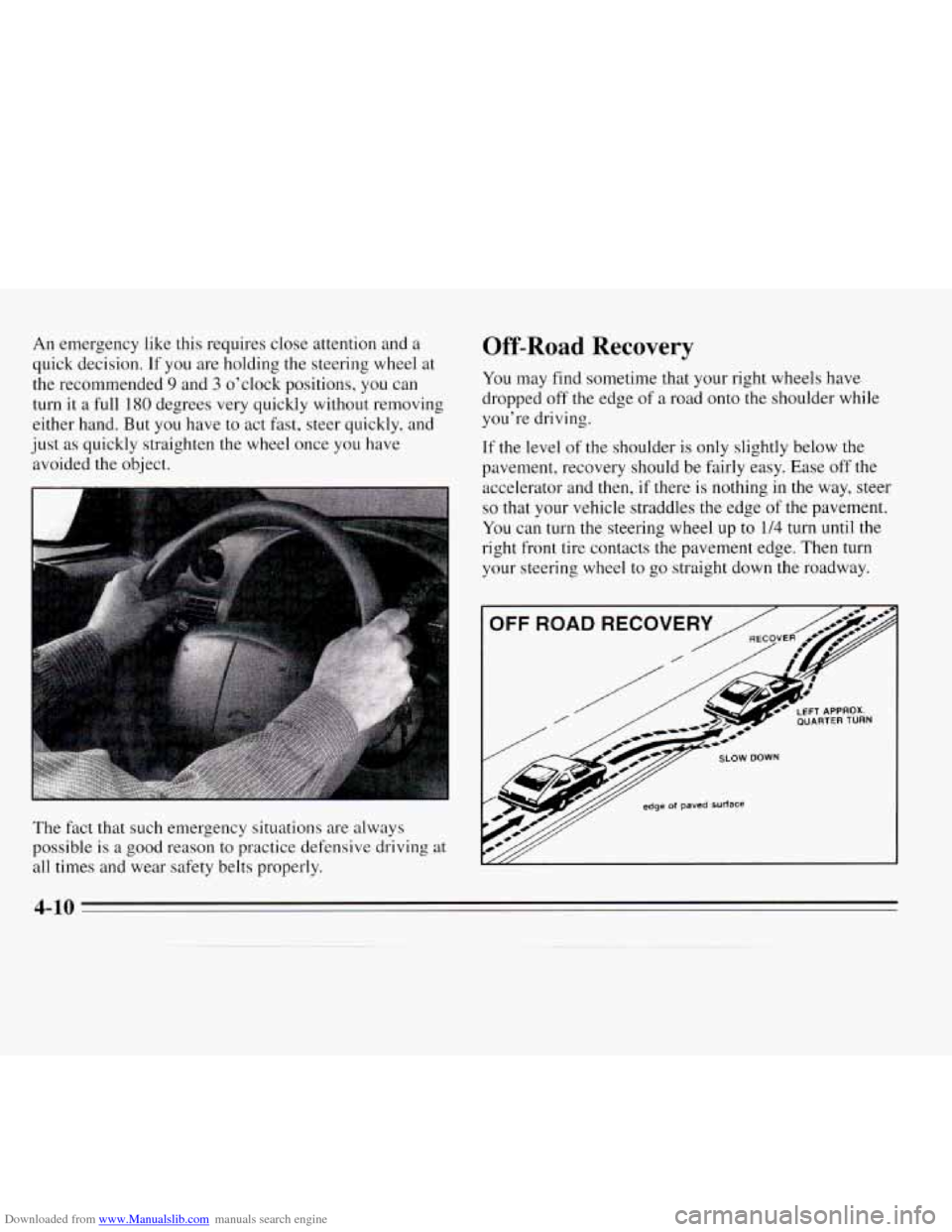
Off-Road Recovery
You may find sometime that your right wheels have
dropped off the edge of
a road onto the shoulder while
you’re driving.
If the level of the shoulder is only slightly below the
pavement, recovery should be fairly easy. Ease
off the
accelerator and then, if there is nothing in the way, steer
so that your vehicle straddles the edge of the pavement.
You can turn the steering wheel up to 1/4 turn until the
right front tire contacts the pavement edge. Then
turn
your steering wheel to go straight down the roadway.
4-10
Page 162 of 324
Downloaded from www.Manualslib.com manuals search engine When You Are Ready to Leave After
Parking on a Hill
1. Apply your regular brakes and hold the pedal down
while you:
Start your engine;
Shift into a gear; and
Release the parking brake.
2. Let up on the brake pedal.
3. Drive slowly until the trailer is clear of the chocks.
4. Stop and have someone pick up and store the chocks.
Maintenance When Trailer Towing
Your vehicle will need service more often when you’re
pulling a trailer. See the Maintenance Schedule for more
on this. Things that are especially important in trailer
operation are automatic transaxle fluid (don’t overfill),
engine
oil, belts, cooling system, and brake adjustment.
Each
of these is covered in this manual, and the Index
will help you find them quickly. If you’re trailering, it’s
a good idea to review these sections before you start
your trip.
Check periodically
to see that all hitch nuts and bolts are
tight.
Page 234 of 324
Downloaded from www.Manualslib.com manuals search engine If you ever replace your tires with those not having a
TPC Spec number, make sure they are the same size,
load range, speed rating and construction type (bias,
bias-belted or radial) as your original tires.
Uniform Tire Quality Grading
The following information relates to the system
developed by the United States National Highway
Traffic Safety Administration which grades tires by
treadwear, traction and temperature performance.
(This applies only to vehicles sold
in the United States.)
Treadwear
The treadwear grade is a comparative rating based on
the wear rate of the tire when tested under controlled
conditions on a specified government test course. For
example, a tire graded
150 would wear one and a half
(1 1/2) times as well on the government course as a tire
graded
100. The relative performance of tires depends
upon the actual conditions
of their use, however, and
may depart significantly from the norm due to variations
in driving habits, service practices and differences in
road characteristics and climate.
Traction - A, B, C
The traction grades, from highest to lowest are: A, B,
and C. They represent the tire’s ability to stop on wet
pavement as measured under controlled conditions on
specified government test surfaces
of asphalt and
concrete. A tire marked
C may have poor traction
performance.
Warning: The traction grade assigned
to this tire is based
on braking (straight-ahead) traction tests and does not
include cornering (turning) traction.
6-40
Page 241 of 324

Downloaded from www.Manualslib.com manuals search engine Cleaning Leather
Use a soft cloth with lukewarm water and a mild soap or
saddle soap.
0
0
0
For stubborn stains, use a mild solution of 10%
isopropyl alcohol (rubbing alcohol) and
90% water.
Never use oils, varnishes, solvent-based or abrasive
cleaners, furniture polish or shoe polish on leather.
Soiled leather should be cleaned immediately.
If dirt
is allowed to work into finish, it can harm the
leather.
Cleaning the Top of the Instrument Panel
Use only mild soap and water to clean the top surfaces
of the instrument panel. Sprays containing silicones or
waxes may cause annoying reflections in the windshield
and even make it difficult to see through the windshield
under certain conditions.
Care of Safety Belts
Keep belts clean and dry.
Glass
Glass should be cleaned often. GM Glass Cleaner (GM
Part No. 1050427) or a liquid household glass cleaner
will remove normal tobacco smoke and dust films.
Don’t use abrasive cleaners
on glass, because they may
cause scratches. Avoid placing decals
on the inside rear
window, since they may have to be scraped off later. If
abrasive cleaners
are used on the inside of the rear
window, an electric defogger element may be damaged.
Any temporary license should not be attached across the
defogger grid.
6-47
Page 262 of 324

Downloaded from www.Manualslib.com manuals search engine Maintenance Schedule
Schedule I Definition
Follow Maintenance Schedule I if any one of these is
true for your vehicle:
Most trips are less than 5 to 10 miles (8 to 16 km).
This is particularly important when outside
temperatures are below freezing.
0 Most trips include extensive idling (such as frequent
driving in stop-and-go traffic).
Most trips are through dusty areas.
0 You frequently tow a trailer or use a carrier on top of
your vehicle.
Schedule
I should also be followed if the vehicle is used
for delivery service, police, taxi, or other commercial
application.
Schedule I Intervals
Every 3,000 Miles (5 000 km) or 3 Months
Engine Oil and Filter Change
Every 6,000 Miles (10 000 km) or 6 months
Chassis Lubrication
At 6,000 Miles (10 000 km) - Then Every
12,000 Miles (25
000 km)
Tire Rotation
Every 15,000 Miles (25 000 km)
Air Cleaner Filter Inspection, if dnving in dusty conditions
Every 30,000 Miles (50 000 km)
Air Cleaner Filter Replacement
Spark Plug Replacement
Spark Plug Wire Inspection
Fuel Tank,
Cap and Lines Inspection
Engine Accessory Drive Belt Inspection (or every
Cooling System Service (or every 24 months)
Automatic Transaxle Service (severe conditions)
24 months)
Every 50,000 Miles (83 000 km)
At 60,000 Miles (100 000 km) - Then Every
15,000 Miles
(25 000 km)
Camshaft Timing Belt lnspection (3.4L Code X
engine only)
7-4
Page 263 of 324
Downloaded from www.Manualslib.com manuals search engine Maintenance Schedule
I Schedule I1 Definition
Follow Schedule I1 only if none of the conditions from
Schedule
I is true.
Schedule I1 Intervals I
Every 7,500 Miles (12 500 km)
Engine Oil and Filter Change (or every 12 months)
Chassis Lubrication (or every
12 months)
At 7,500 Miles (12 500 km) - Then Every
15,000 Miles (25 000 km)
Every
30,000 Miles (50 000 km)
Tire Rotation
Engine Accessory Drive Belt Inspection
(or every
Cooling System Service (or every
24 months)
Spark Plug Replacement
Spark Plug Wire Inspection
Air Cleaner Filter Replacement
Fuel Tank, Cap and Lines Inspection
Every 50,000 Miles (83 000 km)
Automatic Transaxle Service (severe conditions)
At 60,000 Miles (100 000 km) - Then Every
15,000 Miles
(25 000 km)
24 months)
Camshaft Timing Belt Inspection
(3.4L Code X
engine only)
7-5
Page 269 of 324

Downloaded from www.Manualslib.com manuals search engine Maintenance Schedule I
30,000 Miles (50 000 km)
0 Change engine oil and filter (or every
3 months, whichever occurs first).
An Emission Control Service.
0 Lubricate the shift linkage, parking brake cable
guides, underbody contact
points and linkage
(or every
6 months, whichever occurs first).
every 24 months, whichever occurs first).
0 Drain, flush and refill cooling system (or
every 24 months, whichever occurs first).
See “Engine Coolant’’ in the Index for what
to use. Inspect hoses. Clean radiator,
condenser, pressure cap and neck. Pressure
test the cooling system and pressure cap.
0 Inspect engine accessory drive belt (or
An Emission Control Service.
An Emission Control Service.
0 Replace spark plugs. An Emission Control
Service.
17 Replace air cleaner filter. Replace filter
more often under dusty conditions.
An Emission Control Service.
0 Inspect fuel tank, cap and lines for damage
or leaks. Inspect fuel cap gasket for any
damage. Replace parts as needed.
An Emission Control Service. i-
0 Rotate tires. See “Tire Inspection and
Rotation’’ in the Index for proper rotation
pattern and additional information.
7-11
Page 275 of 324

Downloaded from www.Manualslib.com manuals search engine Maintenance Schedule I
60,000 Miles (100 000 km)
0 Change engine oil and filter (or every
3 months, whichever occurs first).
An Emission Control Service.
0 Lubricate the shft linkage, parlung brake cable
guides, underbody contact points and linkage
(or every
6 months, whchever occurs first).
every
24 months, whichever occurs first).
0 Inspect engine accessory drive belt (or
An Emission Control Service.
0 Inspect camshaft timing belt. An Emission
0 Drain, flush and refill cooling system (or
every
24 months, whichever occurs first).
See “Engine Coolant” in the Index for what
to use. Inspect hoses. Clean radiator,
condenser, pressure cap and neck. Pressure test the cooling system and pressure cap.
Control Service.
An Emission Control Service.
Replace spark plugs. An Emission Control
0 Inspect spark plug wires. An Emission Control
0 Replace air cleaner filter. Replace filter
more often under dusty conditions.
Service.
Service.
An Emission Control Service.
0 Inspect fuel tank, cap and lines for damage
or leaks. Inspect fuel cap gasket for any
damage. Replace parts
as needed.
An Enzi.ssion Control Service.?
DATE
SERVICED BY: ACTUAL MILEAGE
7-17