Page 10 of 324
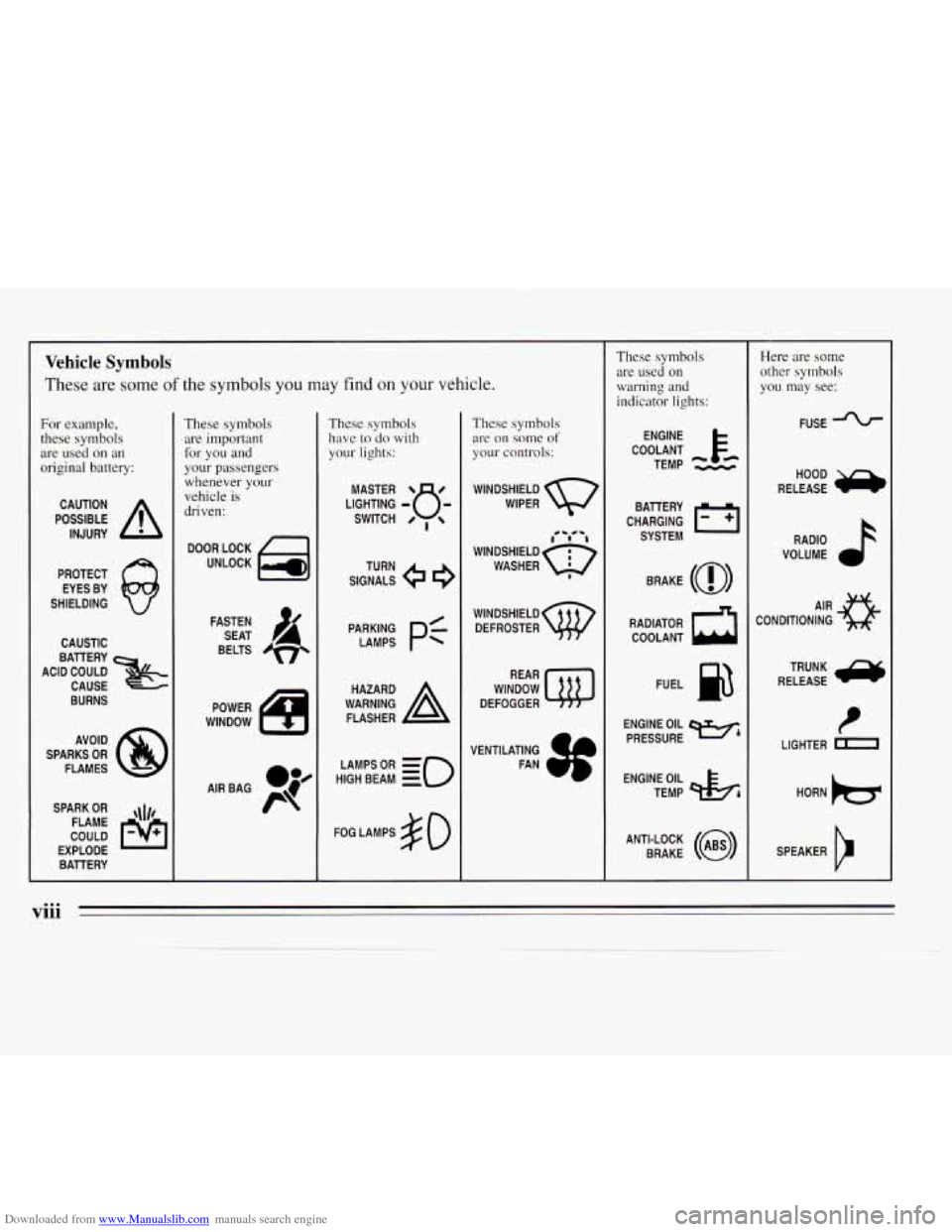
Downloaded from www.Manualslib.com manuals search engine Vehicle Symbols
These are some of the symbols you may find on your vehicle.
For example, these symbols
are used on an
original battery:
POSSIBLE A
CAUTION
INJURY
PROTECT EYES BY
SHIELDING
CAUSTIC
ACID COULD
x
BATTERY
CAUSE
BURNS
AVOID
SPARKS
OR
FLAMES
SPARK
OR ,\I/,
COULD FLAME
EXPLODE BAllERY
These symbols are important
for you and
your passengers whenever your
vehicle
is
driven:
DOOR LOCK
UNLOCK
FASTEN SEAT
4
BELTS
POWER
WINDOW
These symbols have
to do with
your lights:
SIGNALS e
TURN
HIGH
LAMPSoR BEAM = =o
FOG LAMPS $0
These symbols are
on solne of
your controls:
WIPER Q
f0 -** -1
WINDSHIELDQ
WASHER I
WINDSHIELD
DEFROSTER
WINDOW
DEFOGGER
VENTILATING FAN
These symbols are used
on
warning and
indicator lights:
COOLANT F-
TEMP --
ENGINE
CHARGING
I-1
BATTERY SYSTEM
BRAKE
(@)
RADIATOR COOLANT
a
FUEL e3
ENGINE OIL
PRESSURE
Wb
TEMP OIL 9b
ANTI-LOCK (@)
BRAKE
Here are some other symbols
you may see:
FUSE J
RADIO k
VOLUME a
CONDITIONING AIR a
t
LIGHTER m
viii
Page 83 of 324
Downloaded from www.Manualslib.com manuals search engine Windshield Washer
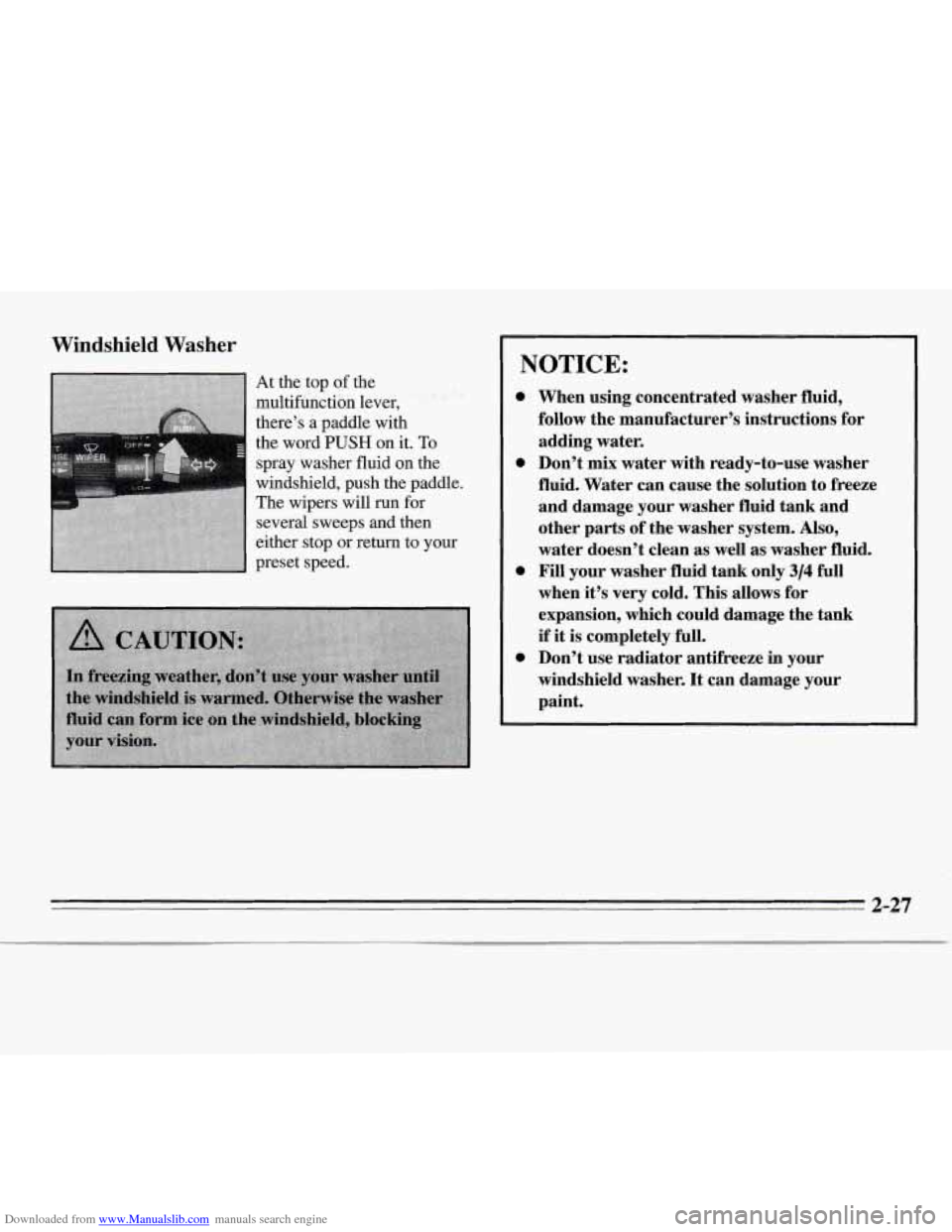
At the top of the
multifuiiction lever,
.‘ ’
there’s a paddle with
the word
PUSH on it. To
spray washer fluid on the
NOTICE:
0
0
0
0
When using concentrated washer fluid,
follow the manufacturer’s instructions for
adding water.
Don’t mix water with ready-to-use washer
fluid. Water can cause the solution to freeze
and damage your washer fluid tank and
other parts of the washer system.
Also,
water doesn’t clean as well as washer fluid.
Fill your washer fluid tank only 3/4 full
when it’s very cold. This allows for
expansion, which could damage the tank
if it is completely full.
Don’t use radiator antifreeze in your
windshield washer.
It can damage your
paint.
Page 103 of 324
Downloaded from www.Manualslib.com manuals search engine Anti-Lock Brake System Active Light
x 1000
LOW
TRAC
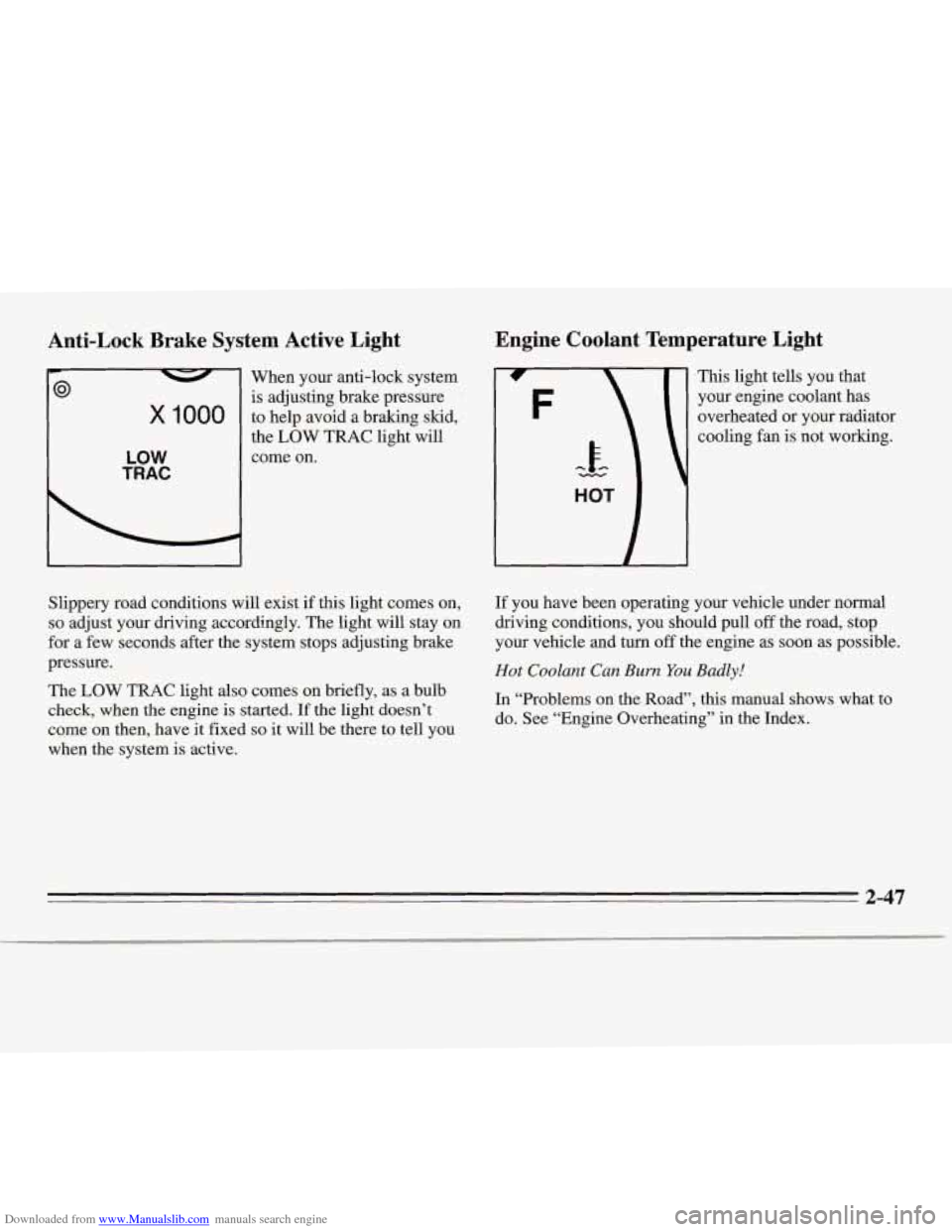
When your anti-lock system
is adjusting brake pressure
to help avoid a braking skid,
the
LOW TRAC light will
come on.
Engine Coolant Temperature Light
This light tells you that
your engine coolant has
overheated
or your radiator
cooling
fan is not working.
Slippery road conditions will exist if this light comes on,
so adjust your driving accordingly. The light will stay on
for a few seconds after the system stops adjusting brake
pressure.
The
LOW TRAC light also comes on briefly, as a bulb
check, when the engine is started.
If the light doesn’t
come on then, have
it fixed so it will be there to tell you
when the system is active. If you
have been operating your vehicle under normal
driving conditions, you should pull
off the road, stop
your vehicle and
turn off the engine as soon as possible.
Hot Coolant Can Burn You Badly!
In “Problems on the Road”, this manual shows what to
do. See “Engine Overheating” in the Index.
2-47
Page 176 of 324
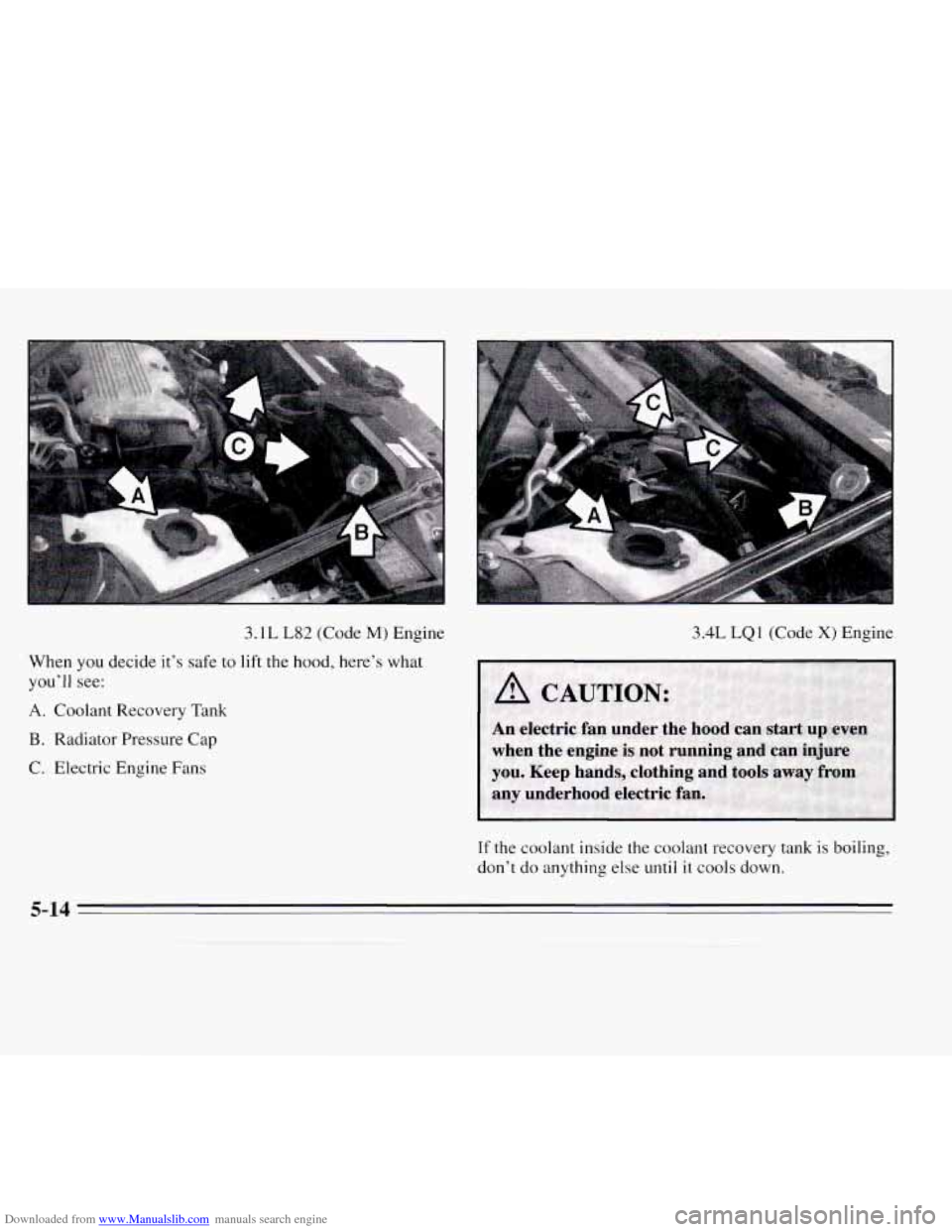
Downloaded from www.Manualslib.com manuals search engine 3.1L L82 (Code M) Engine 3.4L LQ 1 (Code X) Engine
When you decide it’s safe to lift the hood, here’s what
you’ll see:
A. Coolant Recovery Tank
B. Radiator Pressure Cap
C. Electric Engine Fans
If the coolant inside the coolant recovery tank is boiling,
don’t do anything else
until it cools down.
5-14
Page 177 of 324
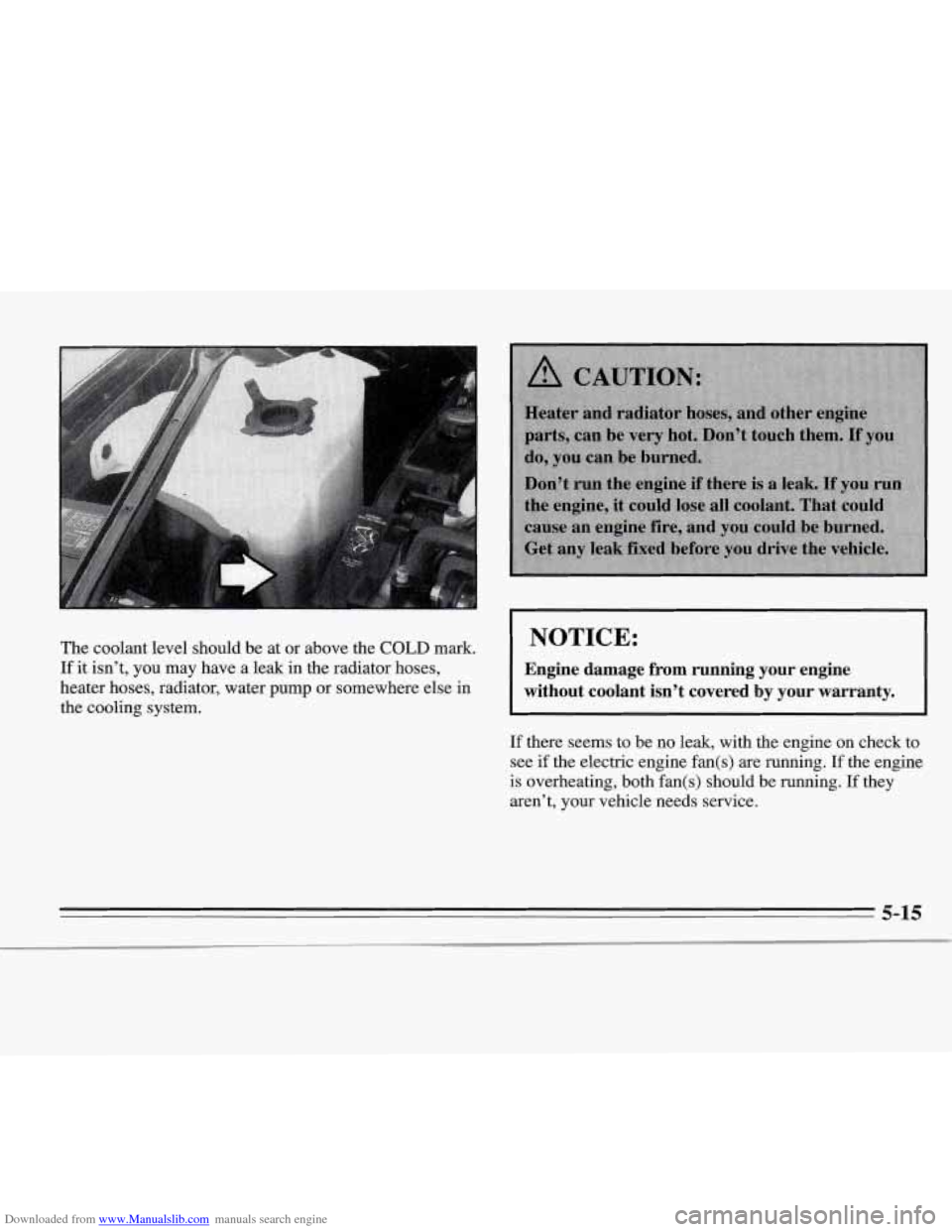
Downloaded from www.Manualslib.com manuals search engine The coolant level should be at or above the COLD mark.
If it isn’t, you may have a leak in the radiator hoses,
heater hoses, radiator, water pump or somewhere else in
the cooling system.
I NOTICE
Engine damage from running your engine
without coolant isn’t covered by your warranty.
If there seems to be no leak, with the engine on check to
see if the electric engine fan(s) are running. If the engb
is overheating, both fan(s) should be running.
If they
aren’t, your vehicle needs service.
5-15
Page 178 of 324
Downloaded from www.Manualslib.com manuals search engine How to Add Coolant to the Coolant
Recovery Tank
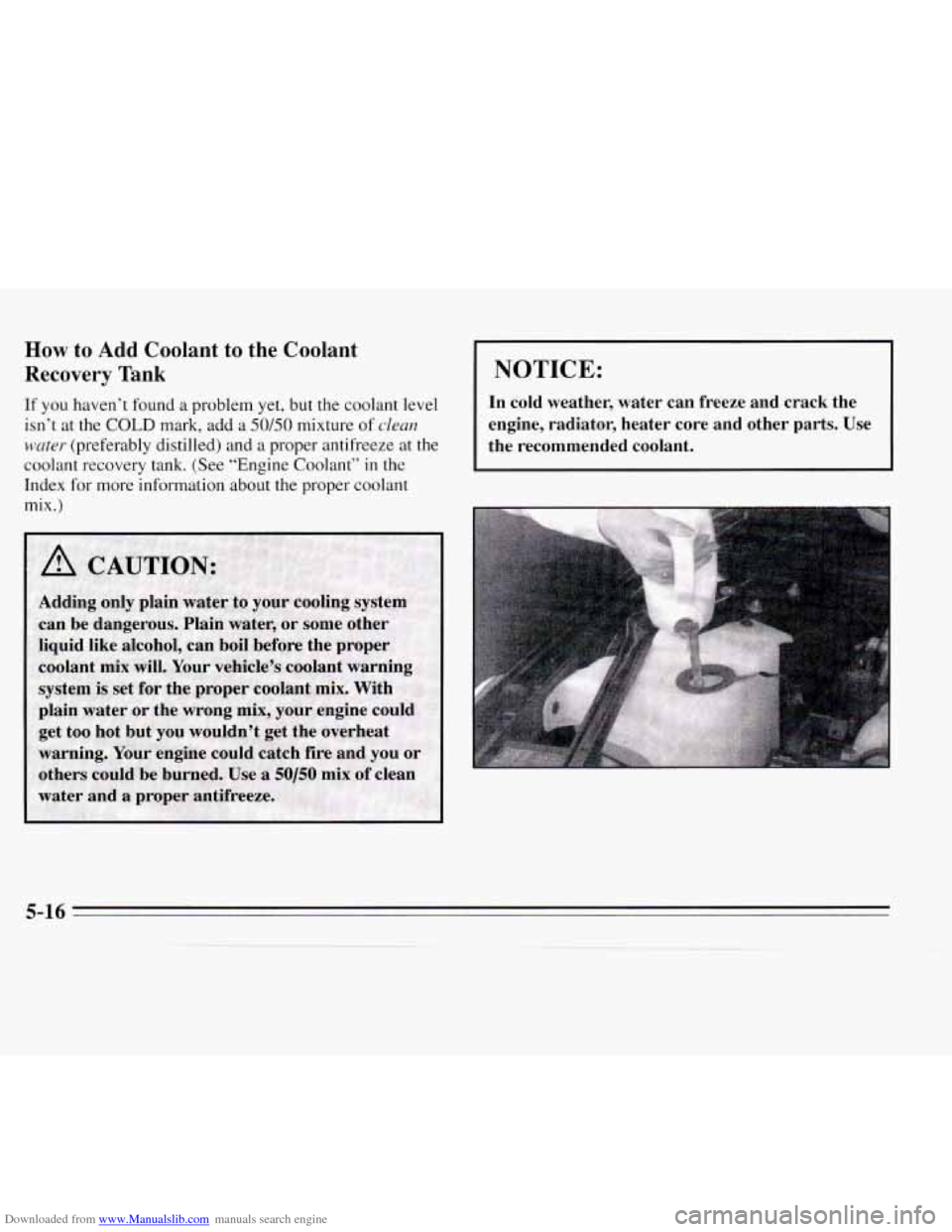
If you haven’t found a problem yet, but the coolant level
isn’t at the COLD mark, add a
50/50 mixture of clean
water (preferably distilled) and a proper antifreeze at the
coolant recovery tank. (See “Engine Coolant’’
in the
Index
for more information about the proper coolant
mix. j
I NOTICE:
In cold weather, water can freeze and crack the
engine, radiator, heater core and other parts.
Use
the recommended coolant.
5-16
Page 179 of 324
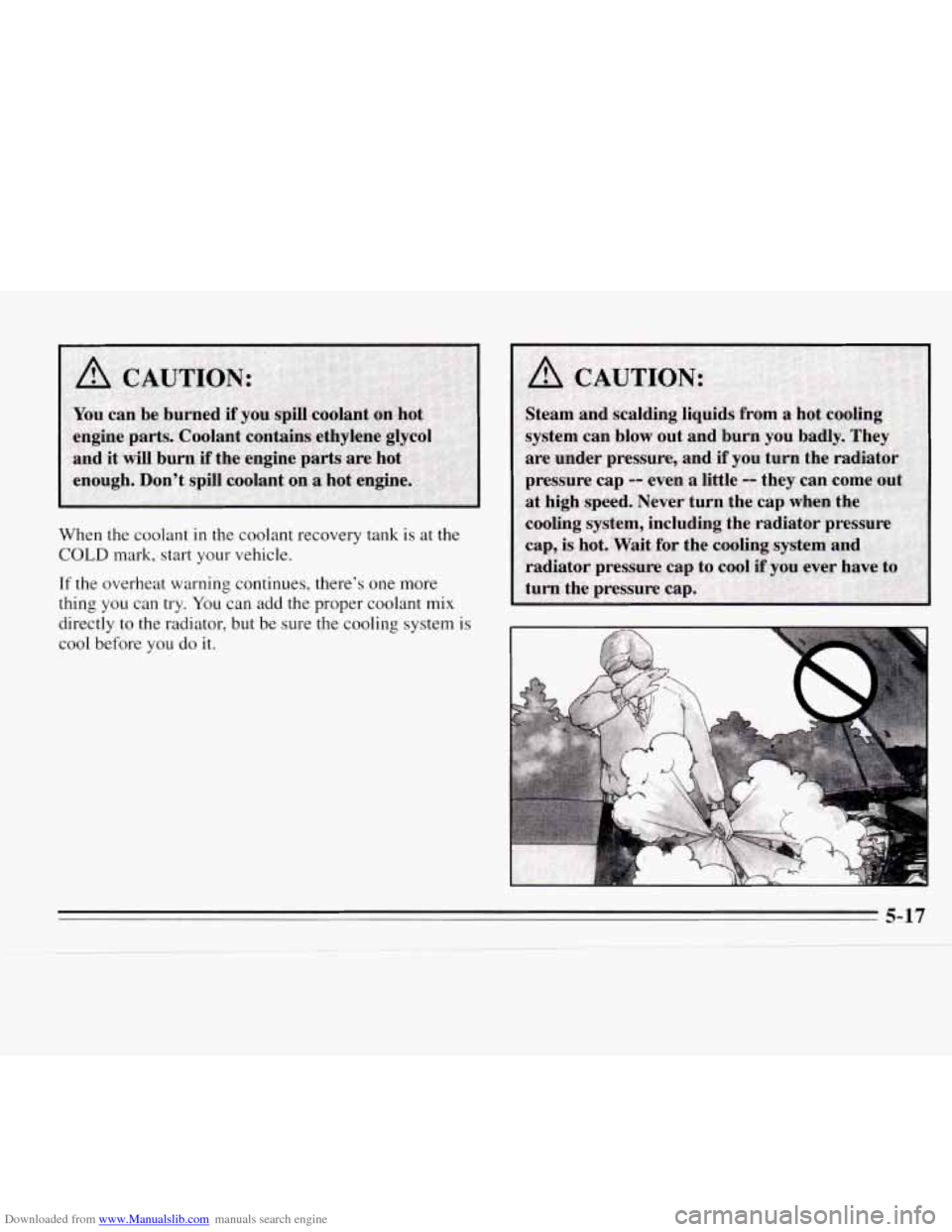
Downloaded from www.Manualslib.com manuals search engine When the coolant in the coolant recovery tank is at the
COLD mark, start your vehicle.
If the overheat warning continues, there's one more
thing you can try.
You can add the proper coolant mix
directly
to the radiator, but be sure the cooling system is
cool before you do it.
5-17
Page 180 of 324
Downloaded from www.Manualslib.com manuals search engine How to Add Coolant to the Radiator
NOTICE:
Your engine has a specific radiator fill procedure.
Failure to follow this procedure could cause
your
engine to overheat and be severely damaged.
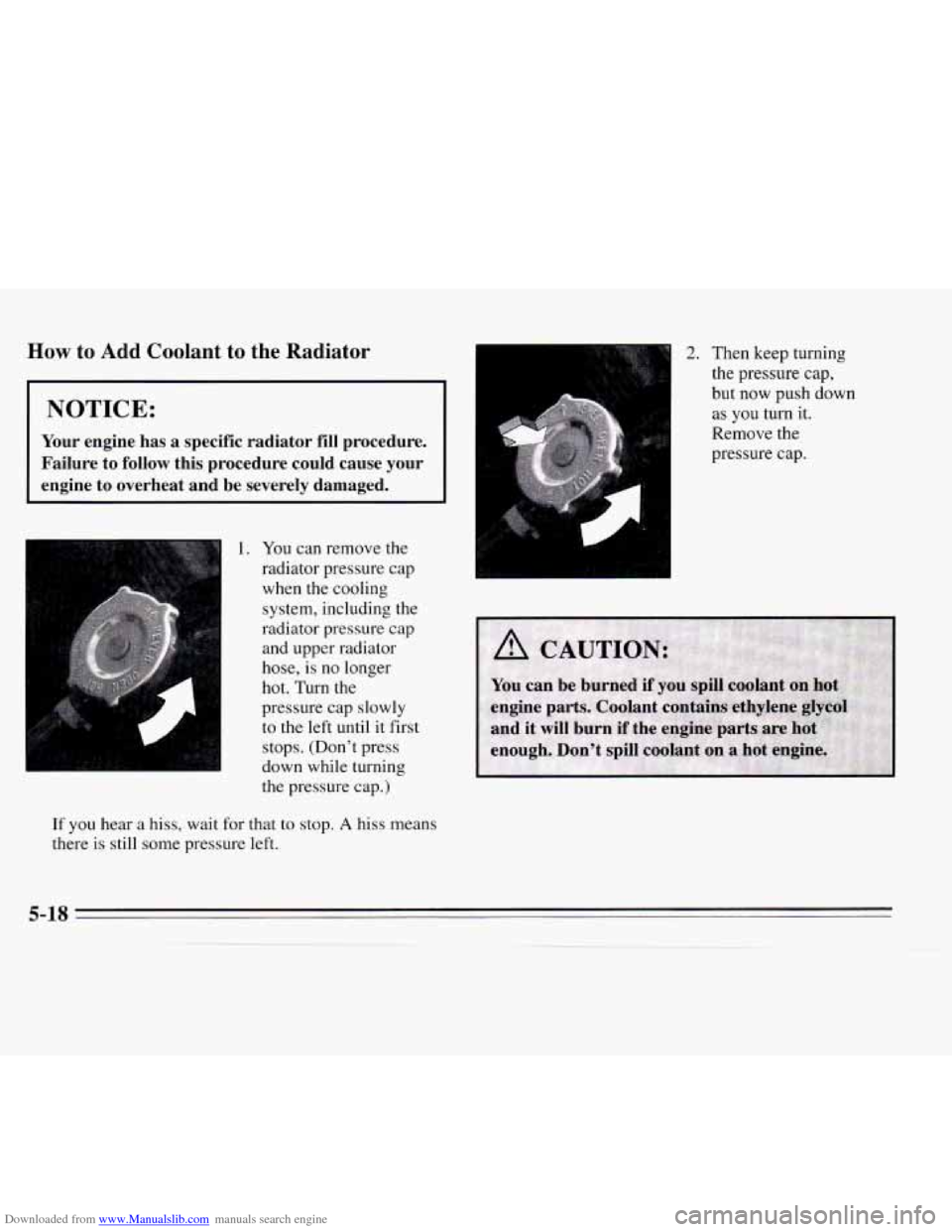
r 1. You can remove the
radiator pressure cap
when the cooling system, including the
radiator pressure cap
and upper radiator
hose, is no longer
hot.
Turn the
pressure cap slowly
to the left until it first
stops. (Don't press
down while turning
the pressure cap.)
If you hear a hiss, wait for that to stop. A hiss means
there is still some pressure left.
-1 2. Then keep turning
I the pressure cap,
but now push down
as you turn it.
Remove the
pressure cap.
5-18