1995 CHEVROLET MONTE CARLO warning lights
[x] Cancel search: warning lightsPage 10 of 324
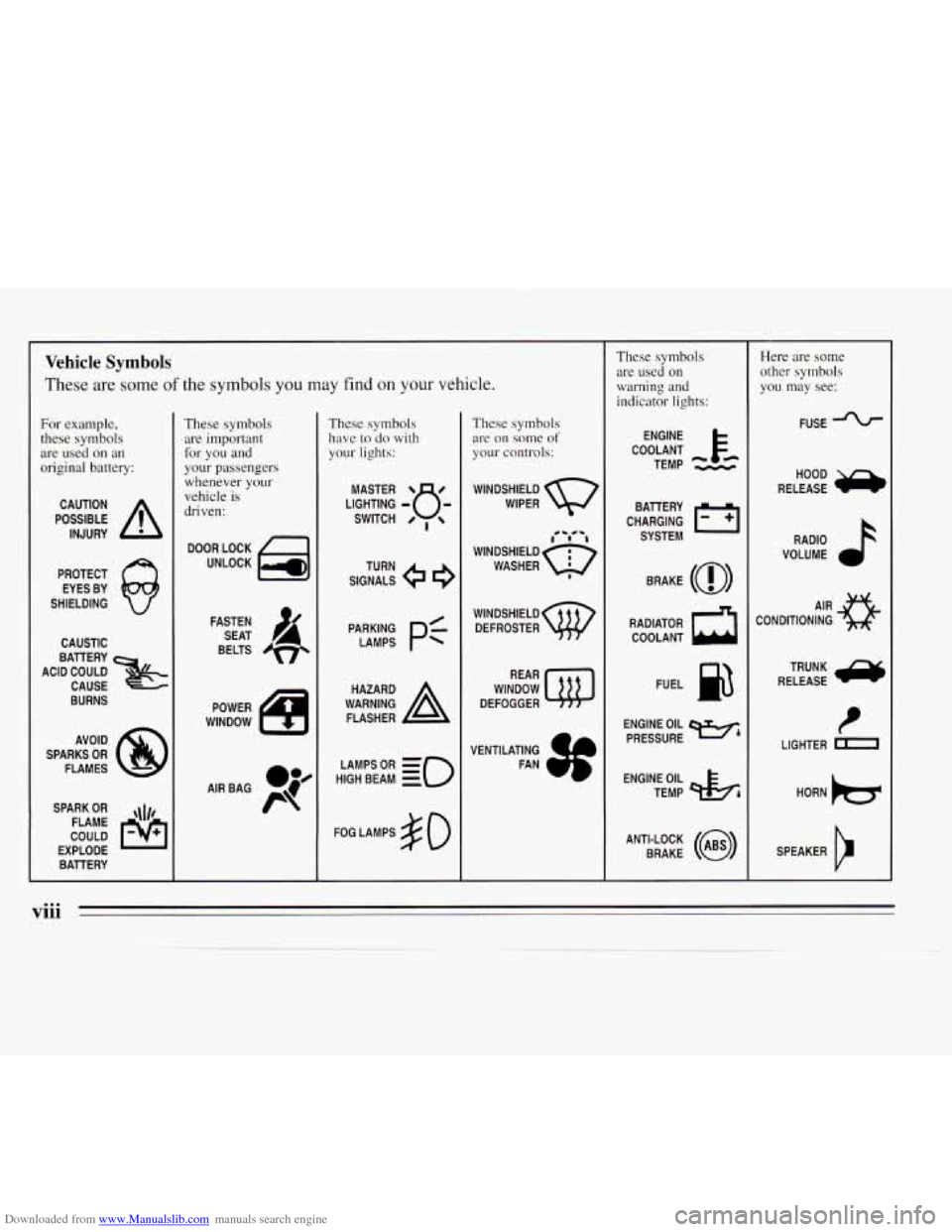
Downloaded from www.Manualslib.com manuals search engine Vehicle Symbols
These are some of the symbols you may find on your vehicle.
For example, these symbols
are used on an
original battery:
POSSIBLE A
CAUTION
INJURY
PROTECT EYES BY
SHIELDING
CAUSTIC
ACID COULD
x
BATTERY
CAUSE
BURNS
AVOID
SPARKS
OR
FLAMES
SPARK
OR ,\I/,
COULD FLAME
EXPLODE BAllERY
These symbols are important
for you and
your passengers whenever your
vehicle
is
driven:
DOOR LOCK
UNLOCK
FASTEN SEAT
4
BELTS
POWER
WINDOW
These symbols have
to do with
your lights:
SIGNALS e
TURN
HIGH
LAMPSoR BEAM = =o
FOG LAMPS $0
These symbols are
on solne of
your controls:
WIPER Q
f0 -** -1
WINDSHIELDQ
WASHER I
WINDSHIELD
DEFROSTER
WINDOW
DEFOGGER
VENTILATING FAN
These symbols are used
on
warning and
indicator lights:
COOLANT F-
TEMP --
ENGINE
CHARGING
I-1
BATTERY SYSTEM
BRAKE
(@)
RADIATOR COOLANT
a
FUEL e3
ENGINE OIL
PRESSURE
Wb
TEMP OIL 9b
ANTI-LOCK (@)
BRAKE
Here are some other symbols
you may see:
FUSE J
RADIO k
VOLUME a
CONDITIONING AIR a
t
LIGHTER m
viii
Page 67 of 324
Downloaded from www.Manualslib.com manuals search engine OFF (C): This position lets you turn off the engine but
still turn the steering wheel.
It doesn’t lock the steering
wheel like LOCK. Use
OFF if you must have your
vehicle pushed or towed.
RUN (D): This position is where the key returns after
you start your vehicle. With the engine off, you can use
RUN to display some of your warning and indicator
lights.
START
(E): This position starts your engine.
A warning chime will sound
if you open the driver’s
door when the ignition is
in OFF, LOCK or ACC and
the key is in the ignition.
Starting Your Engine
Move your shift lever to PARK (P) or NEUTRAL (N).
Your engine won’t start in any other position -- that’s a
safety feature. To restart when you’re already moving,
use NEUTRAL
(N) only.
NOTICE:
Don’t try to shift to PARK (P) if your Chevrolet
is moving. If you do, you could damage the
transaxle. Shift to PARK
(P) only when your
vehicle is stopped.
I NOTICE:
If your key seems stuck in LOCK and you can’t
turn it, be sure it
is all the way in. If it is, then
turn the steering wheel left and right while you
turn the key hard. But turn the key only with
your hand. Using
a tool to force it could break
the key or the ignition switch. If none
of this
works, then your vehicle needs service.
2-11
Page 98 of 324
Downloaded from www.Manualslib.com manuals search engine Warning Lights, Gages and
Indicators
This part describes the warning lights and gages that
may be on your vehicle. The pictures will help you
locate them.
Warning lights and gages can signal that something is
wrong before
it becomes serious enough to cause an
expensive repair or replacement. Paying attention to
your warning lights and gages could also save you or
others from injury.
Warning lights come on when there may be or is a
problem with one of your vehicle’s functions.
As you
will see in the details on the next few pages, some
warning lights come on briefly when you start the
engine
just to let you know they’re working. If you are
familiar with this section, you should
not be alarmed
when this happens. Gages can indicate
when there may be or is
a problem
with one
of your vehicle’s functions. Often gages and
warning lights work together to let you know when
there’s a problem with your vehicle.
When one
of the warning lights comes on and stays on
when you are driving, or when one of the gages shows
there may be a problem, check the section that tells you
what to do about it. Please follow this manual’s advice.
Waiting to
do repairs can be costly -- and even
dangerous.
So please get to know your warning lights
and gages. They’re a big help.
2-42
Page 213 of 324
Downloaded from www.Manualslib.com manuals search engine How to Add Fluid
Refer to the Maintenance Schedule to determine what
kind of transaxle fluid to use. See “Recommended
Fluids and Lubricants” in the Index.
If the fluid level is low, add only enough of the proper
fluid
to bring the level into the cross-hatched area on the
dipstick.
1. Pull out the dipstick.
2. Using a long-neck funnel, add enough fluid at the
dipstick hole to bring it
to the proper level.
It doesn’t take much fluid, generally less than a pint
(OSL). Don’t overfill. We recommend you use only fluid
labeled DEXRON@-111, because fluid with that label is
made especially for your automatic transaxle. Damage
caused by fluid other than DEXRON@-III
is not covered
by your new vehicle warranty.
After adding fluid, recheck the fluid level as
described under “How
to Check.”
When the correct fluid level is obtained, push the
dipstick back in all the way.
Engine Coolant
The following explains your cooling system and how to
add coolant when
it is low. If you have a problem with
engine overheating or if you need to add coolant to your
radiator, see “Engine Overheating” in the Index.
The proper coolant for your Chevrolet will:
0 Give freezing protection down to -34°F (-37°C).
Give boiling protection up to 262 OF ( 128 O C).
Protect against rust and corrosion.
Help keep the proper engine temperature.
Let the warning lights work as they should.
What to Use
Use a mixture of one-half clean water (preferably
distilled) and one-half antifreeze that meets
“GM
Specification 1825-M,” which won’t damage aluminum
parts. You can also use
a recycled coolant conforming to
GM Specification 1825-M with a complete coolant flush
and refill. Use GM Engine Coolant Supplement (sealer)
with any complete coolant flush and refill. If you use
this mixture, you don’t need to add anything else.
6-19
Page 316 of 324
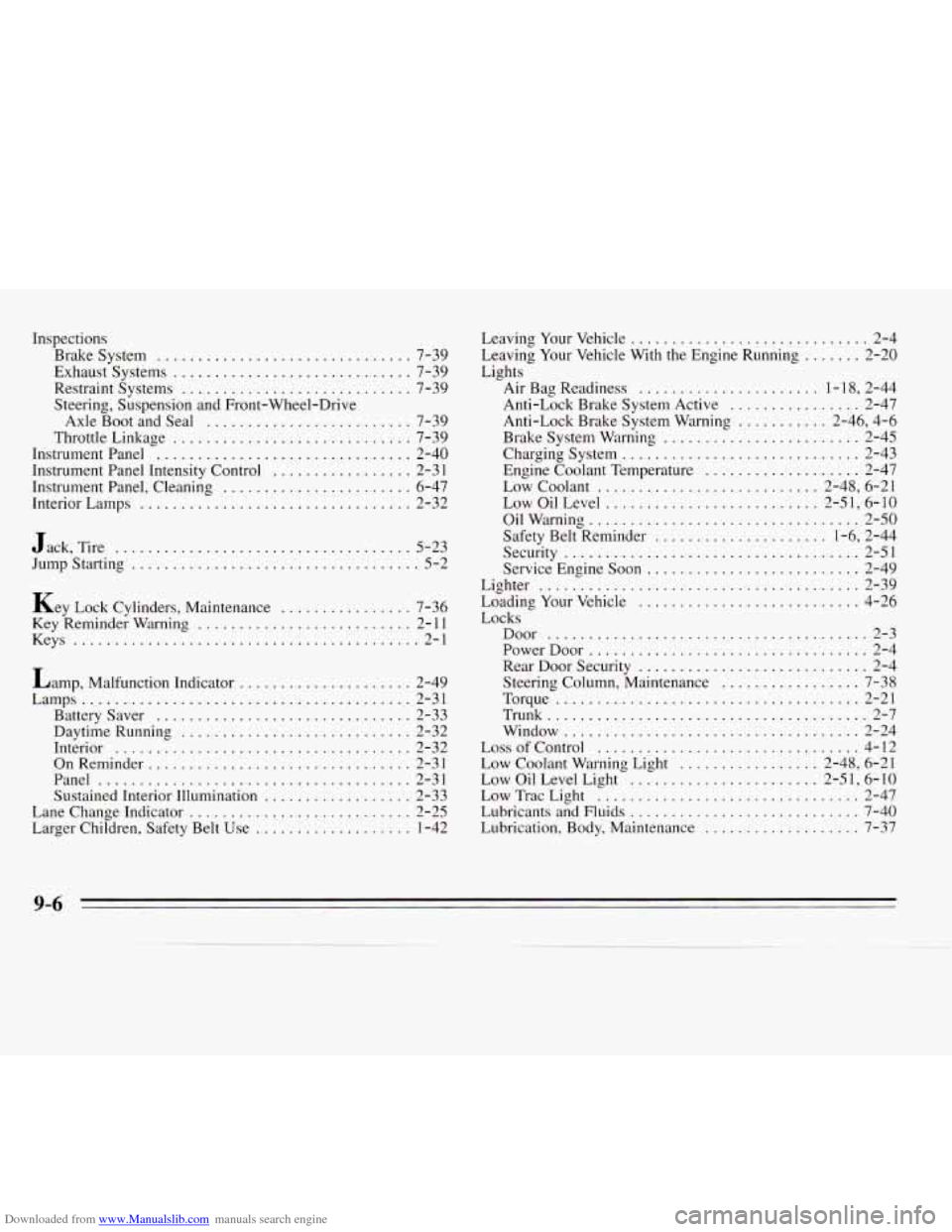
Downloaded from www.Manualslib.com manuals search engine Inspections Brakesystem
............................... 7-39
Exhaust Systems
............................. 7-39
Restraint Systems
............................ 7-39
Steering. Suspension and Front-Wheel-Drive
Axle Boot and Seal
......................... 7-39
Throttle Linkage
............................. 7-39
InstrumentPanel
............................... 2-40
Instrument Panel Intensity Control
................. 2-3 1
Instrument Panel. Cleaning ....................... 6-47
Interior Lamps
................................. 2-32
Jack. Tire
.................................... 5-23
Jump Starting
................................... 5-2
Key Lock Cylinders. Maintenance ................ 7-36
Key Reminder Warning .......................... 2- 1 1
Keys
.......................................... 2-1
Lamp. Malfunction Indicator
..................... 2-49
Lamps
........................................ 2-31
Battery Saver
............................... 2-33
Daytime
Running ............................ 2-32
Interior
.................................... 2-32
OnReminder
................................ 2-31
Panel
...................................... 2-31
Sustained Interior Illumination
.................. 2-33
Lane Change Indicator
........................... 2-25
Larger Children. Safety Belt Use
................. 1-42 Leaving
Your Vehicle
............................. 2-4
Leaving Your Vehicle With the Engine Running
....... 2-20
Lights Air Bag Readiness
...................... 1 . 18. 2-44
Anti-Lock Brake System Active
................ 2-47
Anti-Lock Brake System Warning
........... 2.46. 4.6
Brake System Warning
........................ 2-45
Engine Coolant Temperature
................... 2-47
Low Coolant
........................... 2-48. 6-21
Low Oil Level
.......................... 2-5 1. 6- 10
Oil Warning ................................. 2-50
Safety Belt Reminder
..................... 1-6. 2-44
Security
.................................... 2-51
Service Engine Soon
.......................... 2-49
Lighter
....................................... 2-39
Loading Your Vehicle
........................... 4-26
Locks Door
....................................... 2-3
PowerDoor .................................. 2-4
Rear Door Security
............................ 2-4
Steering Column. Maintenance
................. 7-38
Torque
..................................... 2-21
Trunk
....................................... 2-7
Window
.................................... 2-24
Loss of Control
................................ 4-12
Low Coolant Warning Light
................. 2.48. 6-21
Low Oil Level Light
....................... 2-5 1. 6- 10
Low Trac Light ................................ 2-47
Lubricants and Fluids
............................ 7-40
Lubrication. Body. Maintenance
................... 7-37
Charging
System
............................. 2-43
9-6
Page 321 of 324
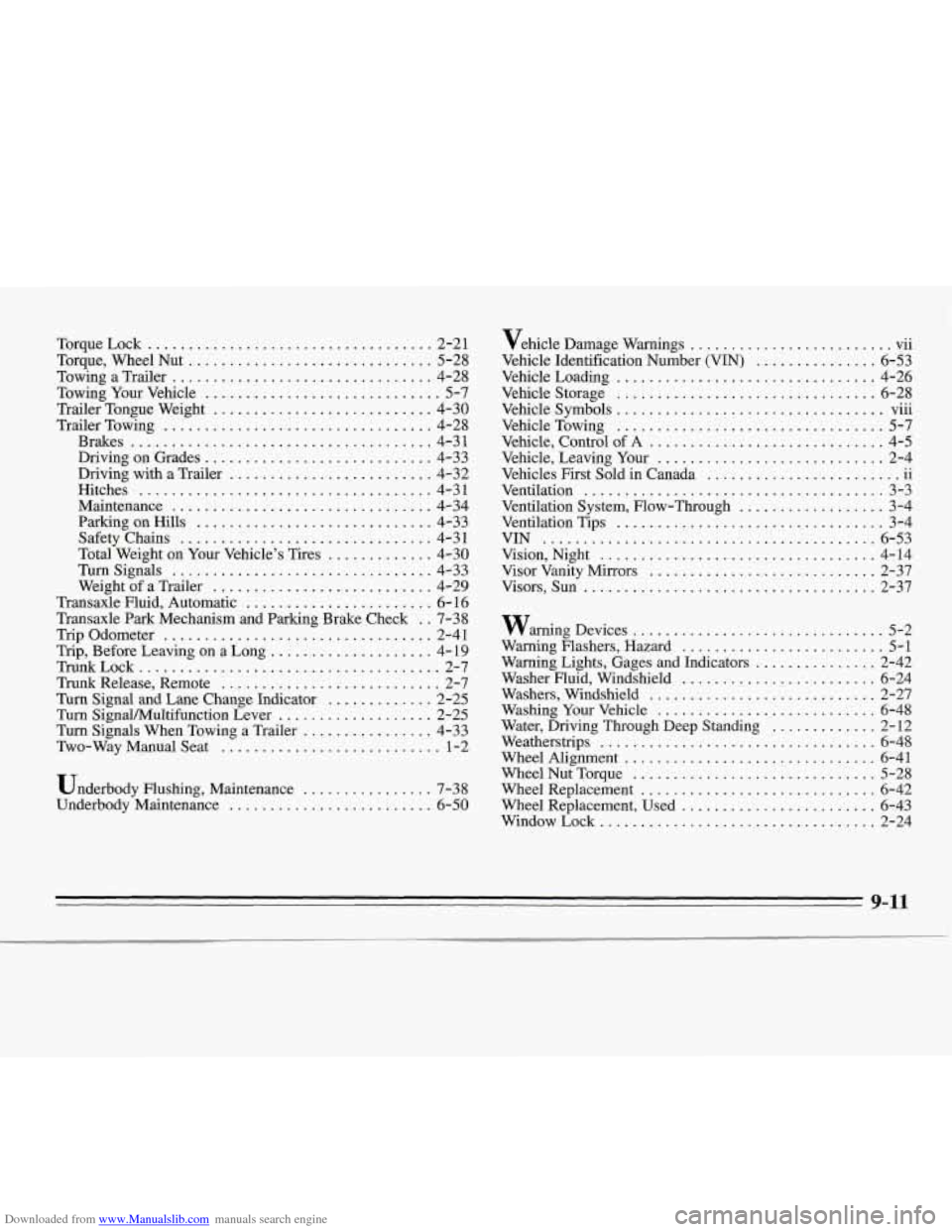
Downloaded from www.Manualslib.com manuals search engine TorqueLock ................................... 2-21
Towing Your Vehicle
............................. 5-7
TrailerTongue Weight
........................... 4-30
TrailerTowing
................................. 4-28
Brakes
..................................... 4-31
Driving on Grades
............................ 4-33
Driving with a Trailer
......................... 4-32
Hitches
.................................... 4-31
Maintenance
................................ 4-34
ParkingonHills
............................. 4-33
Safety Chains
............................... 4-3 1
Turnsignals ................................ 4-33
Weight
of a Trailer ........................... 4-29
Transaxle Fluid. Automatic
....................... 6- 16
Transaxle Park Mechanism and Parking Brake Check
. . 7-38
Trip Odometer
................................. 2-41
Trip. Before Leaving on a Long
.................... 4- 19
TrLlnkLock
..................................... 2-7
Trunk Release. Remote
........................... 2-7
Turn Signal and Lane Change Indicator
............. 2-25
Turn Signal/Multifunction Lever ................... 2-25
Torque.
Wheel Nut
.............................. 5-28
TowingaTrailer
................................ 4-28
Total Weight on Your Vehicle’s Tires
............. 4-30
Turn Signals When Towing a Trailer ................ 4-33
Two-WayManualSeat
........................... 1-2
Underbody Flushing. Maintenance
................ 7-38
Underbody Maintenance
......................... 6-50 vehicle
Damage Warnings
......................... vii
Vehicle Loading
................................ 4-26
Vehicle Storage
................................ 6-28
Vehicle Symbols
................................. VIU
Vehicle Towing ................................. 5-7
Vehicle. Control of A ............................. 4-5
Vehicle. Leaving Your
............................ 2-4
Vehicles
First Sold in Canada 11
Ventilation ..................................... 3-3
Ventilation System. Row-Through
.................. 3-4
VentilationTips
................................. 3-4
VIN ......................................... 6-53
Vision. Night
.................................. 4-14
Visor Vanity Mirrors ............................ 2-37
Visors. Sun .................................... 2-37
Vehicle
Identification Number
(VIN) ............... 6-53
...
.. ........................
warning Devices ............................... 5-2
Warning Rashers. Hazard
......................... 5-1
Washer Fluid. Windshield
........................ 6-24
Washers. Windshield
............................ 2-27
Washing Your Vehicle ........................... 6-48
Weatherstrips .................................. 6-48
Wheel Alignment
............................... 6-41
WheelNutTorque
.............................. 5-28
Wheel Replacement
............................. 6-42
Wheel Replacement. Used
........................ 6-43
WindowLock
.................................. 2-24
Warning
Lights. Gages and Indicators
............... 2-42
Water. Driving Through Deep Standing
............. 2-12