1995 CHEVROLET MONTE CARLO night vision
[x] Cancel search: night visionPage 141 of 324
Downloaded from www.Manualslib.com manuals search engine A cornering skid and an acceleration skid are best
handled by easing your foot off the accelerator pedal.
If your vehicle starts to slide, ease your foot off
the
accelerator pedal and quickly steer the way you want the
vehicle to go. If you start steering quickly enough, your
vehicle may straighten out. Always be ready for a
second skid if it occurs.
Of course, traction is reduced when water, snow, ice,
gravel, or other material is on the road. For safety,
you’ll
want to slow down and adjust your driving to these
conditions. It is important to slow down on slippery
surfaces because stopping distance will be longer and
vehicle control more limited.
While driving on
a surface with reduced traction, try your
best to avoid sudden steering, acceleration, or braking
(including engine braking by shifting to a lower gear).
Any sudden changes could cause the tires to slide.
You
may not realize the surface is slippery until your vehicle
is skidding. Learn to recognize warning clues
-- such
as enough water, ice or packed snow on the road to make
a “mirrored surface”
-- and slow down when you
have any doubt.
Remember: Any anti-lock brake system
(ABS) helps
avoid only
the braking skid.
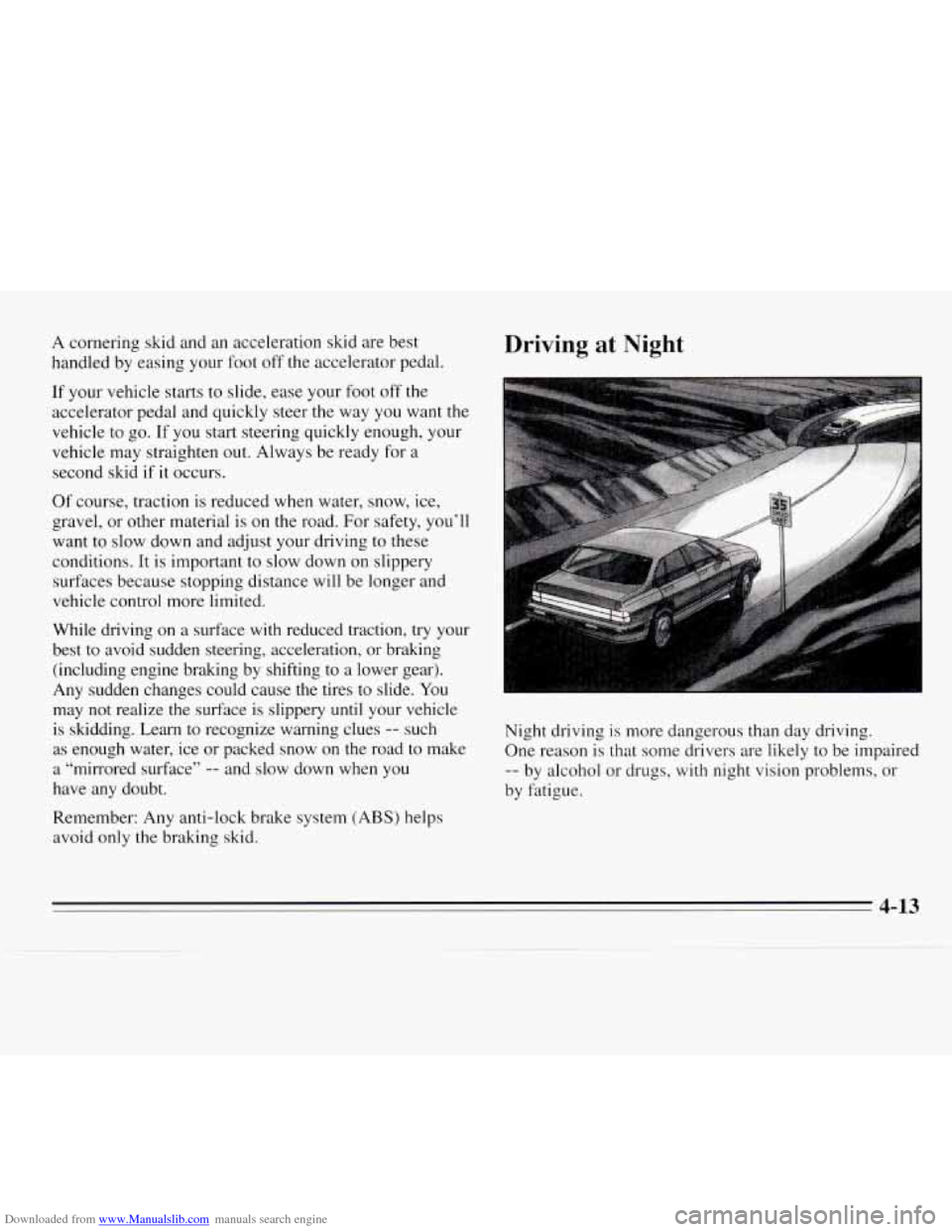
Driving at Night
F _+--
Night driving is more dangerous than day driving.
One reason is that some drivers are likely to be impaired
-- by alcohol or drugs, with night vision problems, or
by fatigue.
4-13
Page 142 of 324
Downloaded from www.Manualslib.com manuals search engine Here are some tips on night driving.
0
0
0
0
0
0
0
Drive defensively.
Don’t drink and drive.
Adjust your inside rearview mirror to reduce the
glare from headlamps behind you.
Since
you can’t see as well, you may need to slow
down and keep more space between you and other
vehicles.
Slow down, especially on higher speed roads. Your
headlamps can light up only
so much road ahead.
In remote areas, watch for animals.
If you’re tired, pull off the road in a safe place and
rest.
Night Vision
No one can see as well at night as in the daytime. But as
we get older these differences increase. A 50-year-old
driver may require at least twice
as much light to see the
same thing at night
as a 20-year-old.
What you do in the daytime can also affect your night
vision. For example,
if you spend the day in bright
sunshine you are wise to wear sunglasses. Your eyes will have less trouble adjusting to night.
But if
you’re
driving, don’t wear sunglasses at night. They may cut
down on glare from headlamps, but they also make a lot
of things invisible.
You can be temporarily blinded by approaching
headlamps. It can take
a second or two, or even several
seconds, for your eyes to readjust to
the dark. When you
are faced
with severe glare (as from a driver who
doesn’t lower the high beams, or
a vehicle with
misaimed headlamps), slow down
a little. Avoid staring
directly into the approaching headlamps.
Keep your windshield and all the glass on your vehicle
clean
-- inside and out. Glare at night is made much
worse by dirt on the glass. Even the inside
of the glass
can build up
a film caused by dust. Dirty glass makes
lights dazzle and flash more than clean glass would,
making
the pupils of your eyes contract repeatedly.
Remember that your headlamps light up far less of a
roadway when you are in
a turn or curve. Keep your
eyes moving; that way, it’s easier
to pick out dimly
lighted objects. Just
as your headlamps should be
checked regularly for proper aim,
so should your eyes
be examined regularly. Some drivers suffer from night
blindness
-- the inability to see in dim light -- and
aren’t even aware of
it.
4-14
Page 317 of 324

Downloaded from www.Manualslib.com manuals search engine I
Mainrenance Record ........................... 7-42
Maintenance Schedule
............................ 7- 1
Owner Checks and Services .................... 7-36
Periodic Maintenance Inspections
............... 7-39
Recommended Fluids and Lubricants
............ 7-40
Schedule1
................................... 7-6
Schedule
I Definition .......................... 7-4
ScheduleII
................................. 7-26
Schedule
11 Definition .......................... 7-5
Scheduled Maintenance Services ................. 7-3
Maintenance. Normal Replacement Parts
............ 6-62
Maintenance. Underbody
......................... 6-50
Maintenance. When Trailer Towing
................. 4-34
Malhnction Indicator Lamp
(Service Engine Soon Light)
..................... 2-49
Manual Front Seat
............................... 1-1
Manual Outside Mirror
.......................... 2-35
Methanol
(In Fuel) ............................... 6-3
Mirrors
....................................... 2-34
Convex Outside
............................. 2-35
Inside Daymight Rearview
.................... 2-34
Manual Outside
.............................. 2-35
Power Outside
............................... 2-35
Visorvanity
................................ 2-37
MTBE (In Fuel) ................................. 6-3
MultifunctionLever
............................. 2-25
Net. Convenience
.............................. 2-36
Neutral Position. Automatic Transaxle
.............. 2- 15
New Vehicle Break-In
........................... 2-10
Nightvision
................................... 4-14 Odometer
.................................... 2-41
Odometer. Trip
................................. 2-41
Off-RoadRecovery
............................. 4-10
Oil
Engine
..................................... 6-10
Warning Light
............................... 2-50
Owner Publications
............................ 8-8
Service Bulletins .............................. 8-8
ServiceManuals
.............................. 8-7
Overdrive Position. Automatic Transaxle
............ 2-16
Overheated Engine
.............................. 5-12
Owner Checks and Services
....................... 7-36
Owner Publications. Ordering
...................... 8-8
Ordering
Paint Spotting. Chemical
........................ 6-51
Park Position. Automatic Transaxle
................. 2-14
Park (P). Shifting Into
........................... 2-18
Park (P). Shifting Out Of
......................... 2-21
Parking
AtNight
.................................... 2-8
Brake
...................................... 2-18
Brake and Transaxle Park Mechanism Check
...... 7-38
Lots
........................................ 2-8
On Hills While Towing a Trailer
................ 4-33
Over Things That
Burn ........................ 2-22
PASS-KeyII
................................... 2-9
Passing
....................................... 4-11
PanelLamps
................................... 2-31
9-7
Page 321 of 324
Downloaded from www.Manualslib.com manuals search engine TorqueLock ................................... 2-21
Towing Your Vehicle
............................. 5-7
TrailerTongue Weight
........................... 4-30
TrailerTowing
................................. 4-28
Brakes
..................................... 4-31
Driving on Grades
............................ 4-33
Driving with a Trailer
......................... 4-32
Hitches
.................................... 4-31
Maintenance
................................ 4-34
ParkingonHills
............................. 4-33
Safety Chains
............................... 4-3 1
Turnsignals ................................ 4-33
Weight
of a Trailer ........................... 4-29
Transaxle Fluid. Automatic
....................... 6- 16
Transaxle Park Mechanism and Parking Brake Check
. . 7-38
Trip Odometer
................................. 2-41
Trip. Before Leaving on a Long
.................... 4- 19
TrLlnkLock
..................................... 2-7
Trunk Release. Remote
........................... 2-7
Turn Signal and Lane Change Indicator
............. 2-25
Turn Signal/Multifunction Lever ................... 2-25
Torque.
Wheel Nut
.............................. 5-28
TowingaTrailer
................................ 4-28
Total Weight on Your Vehicle’s Tires
............. 4-30
Turn Signals When Towing a Trailer ................ 4-33
Two-WayManualSeat
........................... 1-2
Underbody Flushing. Maintenance
................ 7-38
Underbody Maintenance
......................... 6-50 vehicle
Damage Warnings
......................... vii
Vehicle Loading
................................ 4-26
Vehicle Storage
................................ 6-28
Vehicle Symbols
................................. VIU
Vehicle Towing ................................. 5-7
Vehicle. Control of A ............................. 4-5
Vehicle. Leaving Your
............................ 2-4
Vehicles
First Sold in Canada 11
Ventilation ..................................... 3-3
Ventilation System. Row-Through
.................. 3-4
VentilationTips
................................. 3-4
VIN ......................................... 6-53
Vision. Night
.................................. 4-14
Visor Vanity Mirrors ............................ 2-37
Visors. Sun .................................... 2-37
Vehicle
Identification Number
(VIN) ............... 6-53
...
.. ........................
warning Devices ............................... 5-2
Warning Rashers. Hazard
......................... 5-1
Washer Fluid. Windshield
........................ 6-24
Washers. Windshield
............................ 2-27
Washing Your Vehicle ........................... 6-48
Weatherstrips .................................. 6-48
Wheel Alignment
............................... 6-41
WheelNutTorque
.............................. 5-28
Wheel Replacement
............................. 6-42
Wheel Replacement. Used
........................ 6-43
WindowLock
.................................. 2-24
Warning
Lights. Gages and Indicators
............... 2-42
Water. Driving Through Deep Standing
............. 2-12