1995 CHEVROLET MONTE CARLO inflation pressure
[x] Cancel search: inflation pressurePage 154 of 324
Downloaded from www.Manualslib.com manuals search engine Loading Your Vehicle
r
OCCUPANTS VEHICLE CAP. WT.
TIRE-LOADING INFORMATION
FRT. CTR.
RR. TOTAL LBS. KG
MAX. LOADING & GVWR SAME AS VEHICLE
CAPACITY WEIGHT
XXX COLD TIRE
TIRE
SIZE SPEED PRESSURE
RTG PSIiKPa
FRT.
RR.
SPA.
IF TIRES ARE HOT, ADD 4PSIi28KPa
SEE OWNER’S MANUAL
FOR ADDITIONAL
INFORMATION
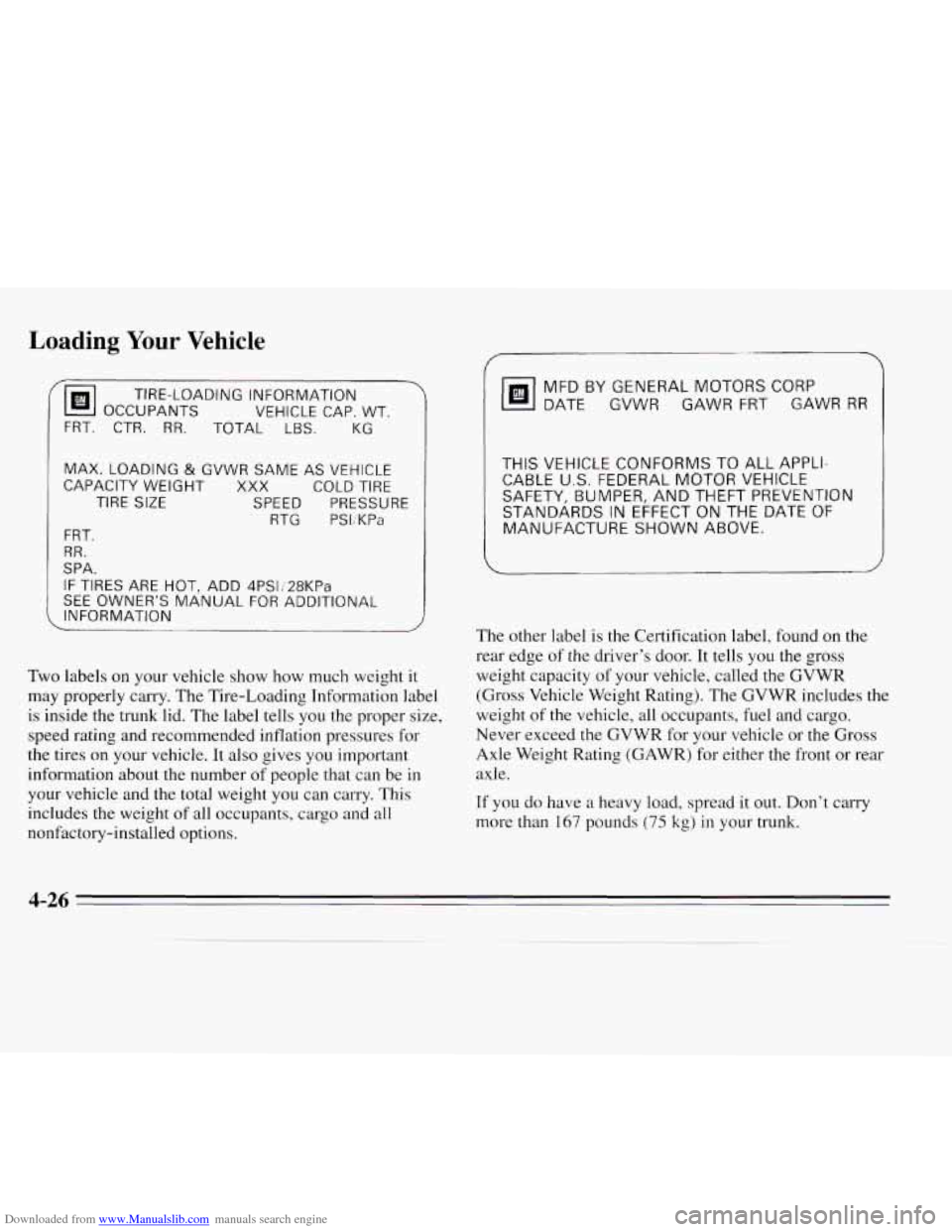
Two labels on your vehicle show how much weight it
may properly carry. The Tire-Loading Information label
is inside the trunk lid. The label tells you the proper size,
speed rating and recommended inflation pressures for
the tires on your vehicle.
It also gives you important
information about the number of people that can be in
your vehicle and the total weight
you can carry. This
includes the weight
of all occupants, cargo and all
nonfactory-installed options.
MFD BY GENERAL MOTORS CORP
DATE
GVWR GAWR FRT GAWR RR
THIS VEHICLE CONFORMS TO ALL APPLI-
CABLE U.S. FEDERAL MOTOR VEHICLE
SAFETY, BUMPER,
AND THEFT PREVENTION
STANDARDS
IN EFFECT ON THE DATE OF
MANUFACTURE SHOWN ABOVE.
The other label is the Certification label, found on the
rear edge of
the driver’s door. It tells you the gross
weight capacity of your vehicle, called the GVWR
(Gross Vehicle Weight Rating). The GVWR includes the
weight of the vehicle, all occupants, fuel and cargo.
Never exceed the GVWR for your vehicle or the Gross
Axle Weight Rating (GAWR) for either the front or rear
axle.
If you do have a heavy load, spread it out. Don’t carry
more than
167 pounds (75 kg) in your trunk.
4-26
Page 193 of 324
Downloaded from www.Manualslib.com manuals search engine Compact Spare Tire
Although the compact spare was fully inflated when
your vehicle was new, it can lose air after a time. Check
the inflation pressure regularly. It should be
60 psi
(420 Wa). After installing the compact spare on your
vehicle, you should stop as soon as possible and make
sure your spare tire is correctly inflated. The compact
spare is made to perform well at posted speed limits for
distances up to
3,000 miles (5 000 km), so you can
finish your trip and have your full-size tire repaired or
replaced where you want. Of course, it’s best to replace
your spare with a full-size tire as soon as you can. Your
spare will last longer and be
in good shape in case you
need it again.
NOTICE:
Don’t take your compact spare through an
automatic car wash with guide rails. The
compact spare can get caught on the rails. That
can damage the tire and wheel, and maybe other
parts
of your vehicle.
Don’t use your compact spare on some other vehicle.
And don’t mix your compact spare or wheel with other
wheels or tires. They won’t fit. Keep your spare and its
wheel together.
NOTICE:
Tire chains won’t fit your compact spare. Using
them will damage your vehicle and destroy the
chains too. Don’t use tire chains on your compact
spare.
3-3 1
Page 231 of 324
Downloaded from www.Manualslib.com manuals search engine Inflation - Tire Pressure
The Tire-Loading Information label which is on the
inside of the
trunk lid shows the correct inflation
pressures for your tires, when they’re cold. “Cold”
means your vehicle has been sitting for at least three
hours
or driven no more than a mile.
NOTICE:
Don’t let anyone tell you that underinflation or
overinflation
is all right. It’s not. If your tires don’t
have enough
air (underinflation) you can get:
Too much flexing
Too much heat
0 Tire overloading
Bad wear
Bad handling
Bad fuel economy.
If your tires have too much
air (over
you can get:
Unusual wear
Bad handling
Rough ride inflation),
0 Needless
damage from road hazards. When
to Check
Check your tires once a month or more.
Don’t forget your compact spare tire. It should be at
60 psi (420 kPa).
How to Check
Use a good quality pocket-type gage to check tire
pressure. Simply looking at the tires will not tell you the
pressure, especially
if you have radial tires -- which
may look properly inflated even
if they’re underinflated.
If your tires have valve caps, be sure to put them back
on. They help prevent leaks by keeping out dirt and
moisture.
Tire Inspection and Rotation
Tires should be inspected every 6,000 to 8,000 miles
(10
000 to 13 000 km) for any signs of unusual wear. If
unusual wear is present, rotate your tires as soon as
possible and check wheel alignment. Also check for
damaged tires or wheels. See “When It’s Time for New
Tires” and “Wheel Replacement” later in this section for
more information.
6-37
Page 232 of 324
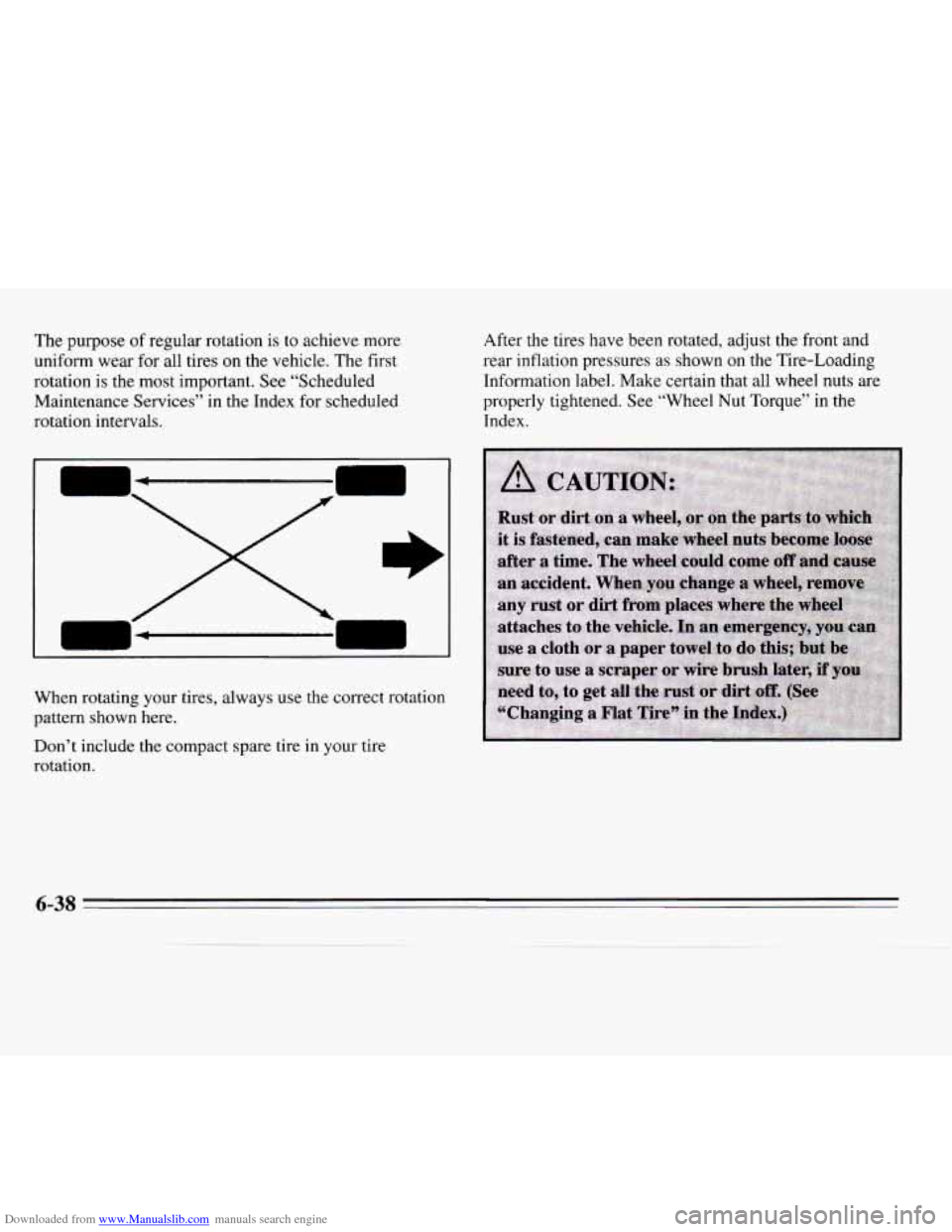
Downloaded from www.Manualslib.com manuals search engine The purpose of regular rotation is to achieve more
uniform wear for all tires on the vehicle. The first
rotation is the most important. See “Scheduled
Maintenance Services” in the Index for scheduled
rotation intervals. After the tires have been rotated, adjust
the front and
rear inflation pressures as shown
on the Tire-Loading
Information label. Make certain that all wheel nuts are
properly tightened. See “Wheel Nut Torque” in the
Index.
When rotating your tires, always use the correct rotation
pattern shown here.
Don’t include the compact spare tire in your tire
rotation.
6-38
Page 294 of 324
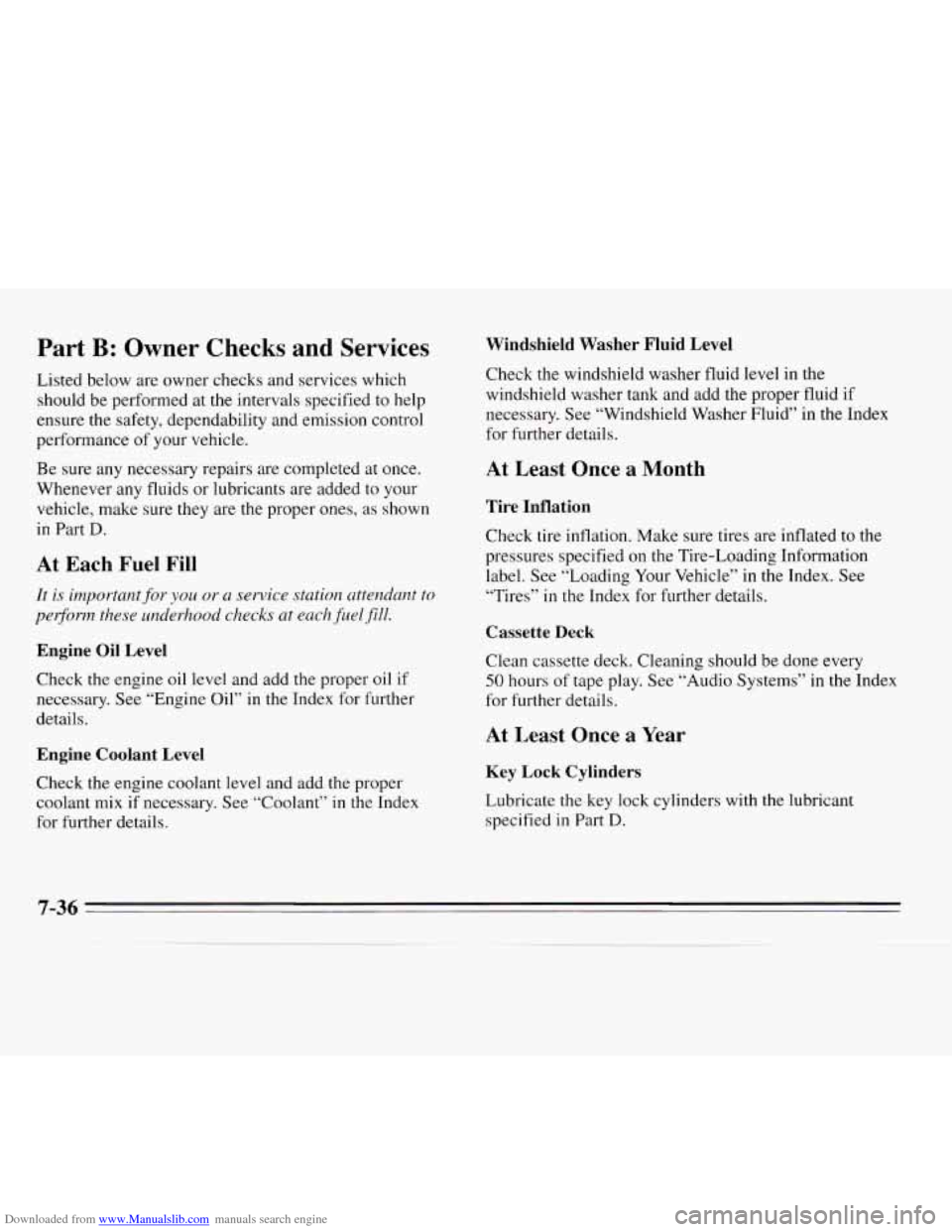
Downloaded from www.Manualslib.com manuals search engine Part B: Owner Checks and Services
Listed below are owner checks and services which should be performed at the intervals specified
to help
ensure the safety, dependability and emission control
performance
of your vehicle.
Be sure any necessary repairs are completed at once.
Whenever any fluids or lubricants are added to your
vehicle, make sure they are the proper ones, as shown
in Part
D.
At Each Fuel Fill
It is important for you or a service station attendant to
perform these underhood checks at each.fuelfil1.
Engine Oil Level
Check the engine oil level and add the proper oil if
necessary. See “Engine Oil” in the Index for further
details.
Engine Coolant Level
Check the engine coolant level and add the proper
coolant mix
if necessary. See “Coolant” in the Index
for further details.
Windshield Washer Fluid Level
Check the windshield washer fluid level in the
windshield washer tank and add the proper fluid
if
necessary. See “Windshield Washer Fluid” in the Index
for further details.
At Least Once a Month
Tire Inflation
Check tire inflation. Make sure tires are inflated to the
pressures specified on the Tire-Loading Information
label. See “Loading
Your Vehicle” in the Index. See
“Tires” in
the Index for further details.
Cassette Deck
Clean cassette deck. Cleaning should be done every
50 hours of tape play. See “Audio Systems” in the Index
for further details.
At Least Once a Year
Key Lock Cylinders
Lubricate the key lock cylinders with the lubricant
specified
in Part D.
Page 315 of 324
Downloaded from www.Manualslib.com manuals search engine Fiberglass Springs .............................. 6-5 1
FillingYourTank ................................ 6-5
Filter. Air Cleaner
.............................. 6-15
Finish Care
.................................... 6-49
Finish Damage
................................. 6-50
First Gear. Automatic Transaxle
................... 2- 17
Fixed Mast Antenna
............................. 3- 17
Flashers. Hazard Warning ......................... 5-1
Flat Tire. Changing
............................. 5-22
Fluid Capacities
................................ 6-61
Fluids and Lubricants
............................ 7-40
Folding Rear Seat
................................ 1-5
Foreign Countries. Fuel
........................... 6-4
Four-Way Manual Seat
........................... 1-2
Franpis. guide en
11
Freeway Driving ............................... 4- 18
French Language Manual 11
Front Park and Turn Signal Lamp Bulb Replacement ... 6-30
Fuel
.......................................... 6-3
Filling Your Tank ............................. 6-5
Gage
...................................... 2-43
In Foreign Countries
........................... 6-4
Fuse Block. Instrument Panel
..................... 6-54
Fuses and Circuit Breakers
....................... 6-54
.. .................................
.. ...........................
Gage . Engine Coolant Temperature ............... 2-48
Gasoline
....................................... 6-3
Gasolines for Cleaner Air ......................... 6-4
GAWR (Gross Axle Weight Rating)
................ 4-26
GearPositions
................................. 2-14 Glass. Cleaning
................................ 6-47
GloveBox
..................................... 2-8
GVWR (Gross Vehicle Weight Rating)
.............. 4-26
Halogen Bulbs
................................ 6-28
Hazard Warning Flashers
.......................... 5-1
Head Restraints
................................. 1-5
Headlamp Bulb Replacement ...................... 6-29
Headlamp HighLow Beam Changer
................ 2-26
Headlamp. Wiring
.............................. 6-59
Headlamps. Operation
........................... 2-31
Hearing
or Speech Impaired. Customer Assistance ...... 8-2
Heating
........................................ 3-3
Heritage Pages ................................... 111
High-Beam Lamps. How to Change ................ 2-26
Highway Hypnosis
.............................. 4-20
Hill and Mountain Roads
......................... 4-20
Hitches. Trailer ................................. 4-31
Hood Release
................................... 6-7
Horn
......................................... 2-24
HotEngine
.................................... 5-12
Hydroplaning
.................................. 4-16
...
Ice. Driving On ................................ 4-23
Ignition Key Positions
........................... 2-10
Ignitionswitch
................................. 2-10
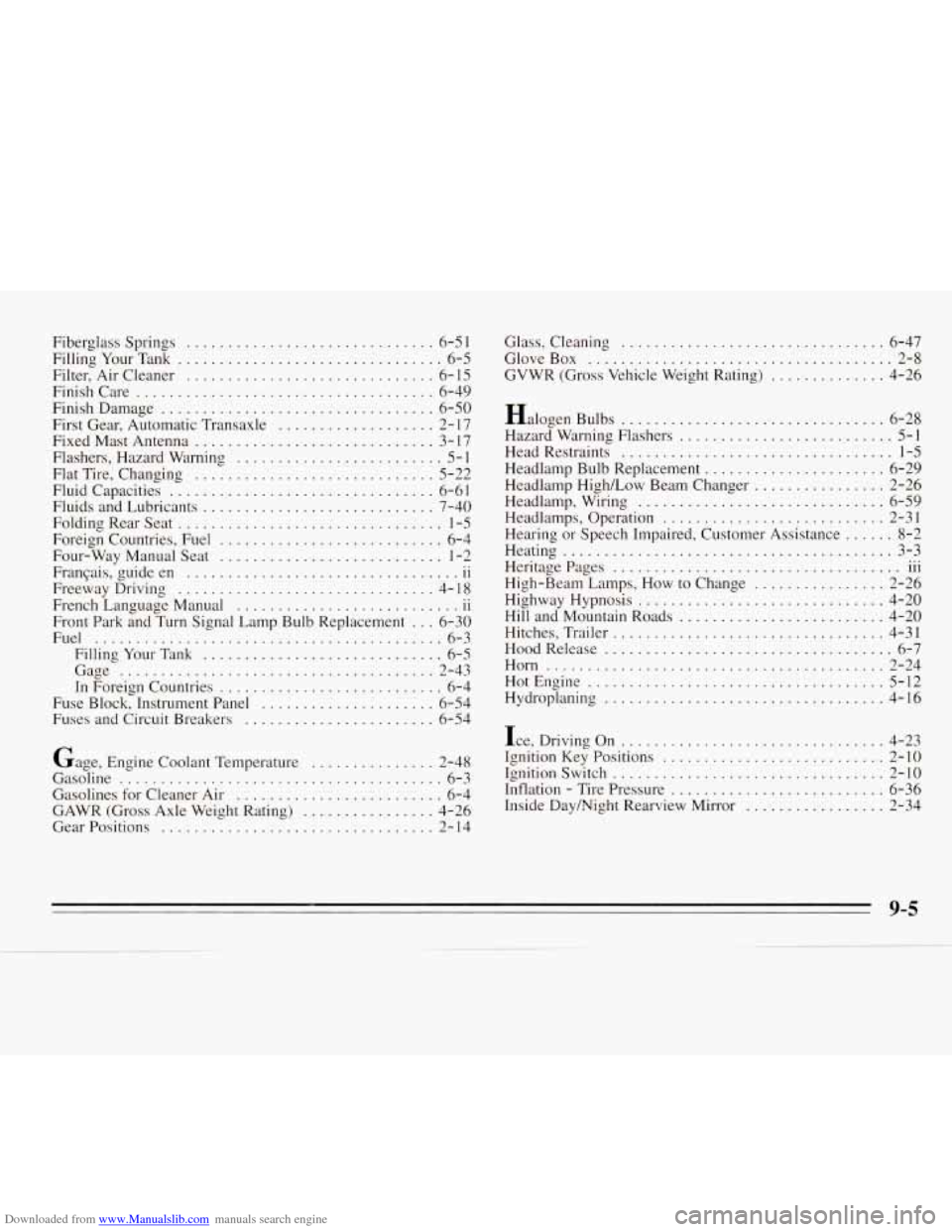
Inflation
. Tire Pressure .......................... 6-36
Inside Daymight Rearview Mirror
................. 2-34
9-5