Page 107 of 324

Downloaded from www.Manualslib.com manuals search engine Security Light
Low Oil Level Light
Your engine is equipped
with an oil level monitoring
system. When the ignition
key is turned on, the LOW
OIL light will briefly flash.
If the light does not flash,
have
it fixed so it will be
ready to warn you if there’s
a problem.
If the light stays on, stop the vehicle on a level surface and
turm the engine off. Check the oil level using the engine oil
dipstick. (See “Engine Oil” in the Index.) If the light does
not flash, have the low oil level sensor system repaired
so
it will be ready to warn you if there’s a problem.
The oil level monitoring system only checks oil
level
during the brief period between key on and engine
crank. It does not monitor engine oil level when the
engine is running. Additionally, an oil level check is
only performed if the engine has been turned off for a
considerable period of time, allowing the oil normally
in
circulation to drain back into the oil pan. This light
will come on
when you turn the key to
START and stay on until the
vehicle starts. It will also
come on and stay on if your
key is too dirty or wet for
the PASS-Key@II system to
read the resistor pellet.
If the resistor pellet is damaged or missing, the light will
flash.
If you’re driving and the light comes on and remains on,
your PASS-Key% system is
not working properly.
Your vehicle is not protected by PASS-Key@II, and you
should see your dealer.
2-51
Page 202 of 324
Downloaded from www.Manualslib.com manuals search engine 1 LA
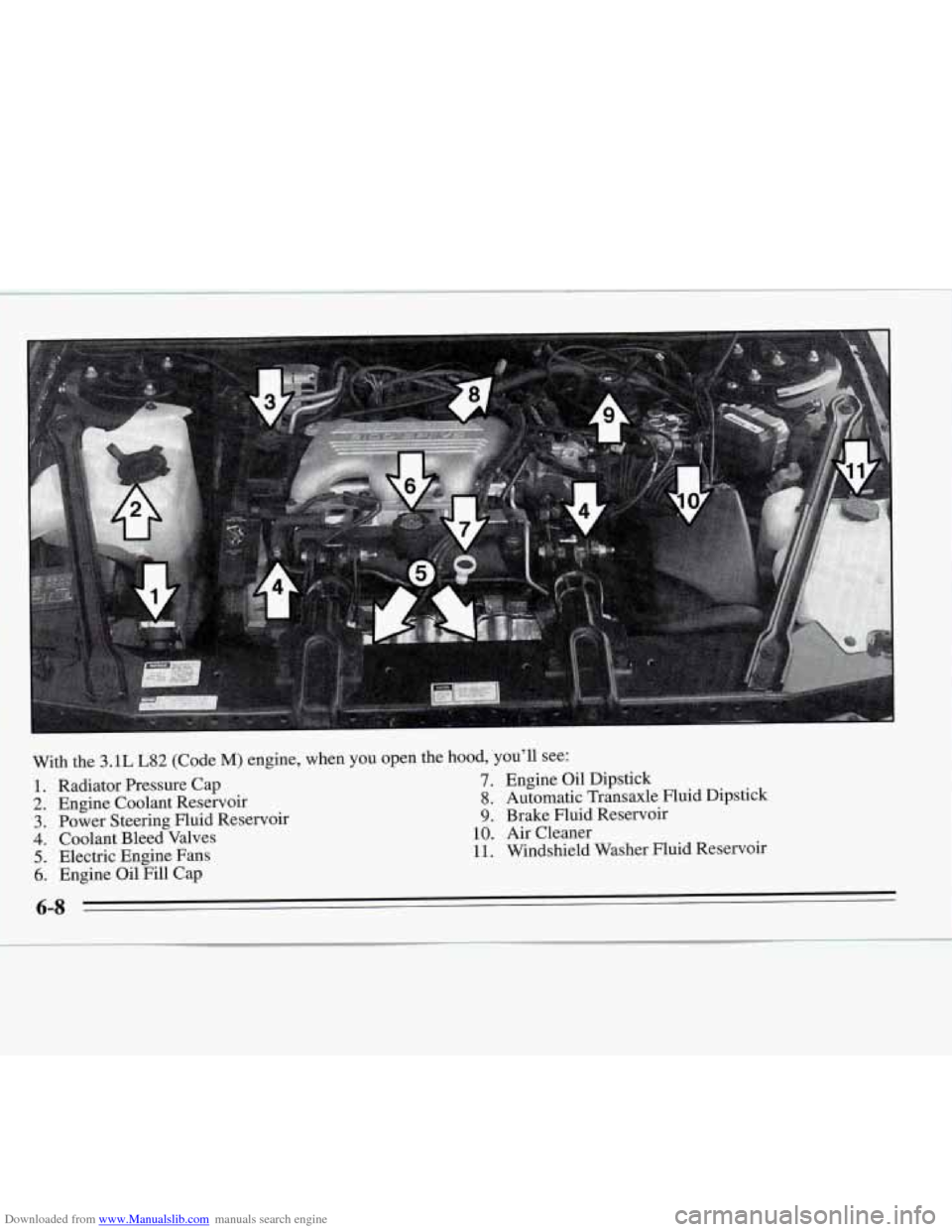
1. Radiator Pressure Cap
2. Engine Coolant Reservoir
3. Power Steering Fluid Reservoir
4. Coolant Bleed Valves
5. Electric Engine Fans
7. Engine Oil Dipstick
8. Automatic Transaxle Fluid Dipstick
9. Brake Fluid Reservoir
10. Air Cleaner
11. Windshield Washer Fluid Reservoir
6. Engine OilFill Cap
6-8
Page 203 of 324
Downloaded from www.Manualslib.com manuals search engine 1.
2.
3.
4.
5.
6.
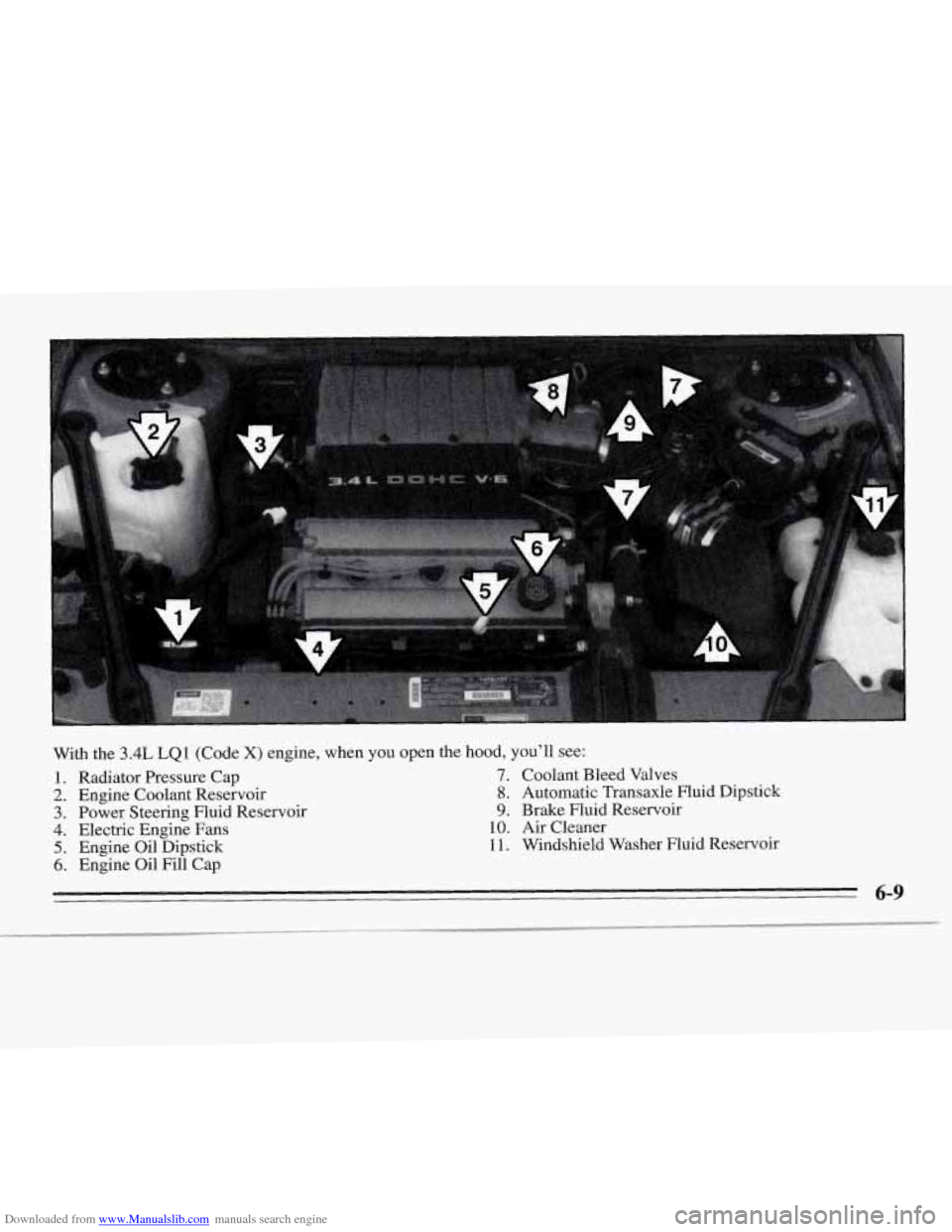
With the 3.4L LQ1 (Code X) engine, when you open the hood, you’ll see:
Radiator Pressure Cap Engine Coolant Reservoir
Power Steering Fluid Reservoir
Electric Engine Fans
Engine Oil Dipstick
Engine Oil
Fill Cap
7. Coolant Bleed Valves
8. Automatic Transaxle Fluid Dipstick
9. Brake Fluid Reservoir
10. Air Cleaner
11. Windshield Washer Fluid Reservoir
6-9
Page 204 of 324
Downloaded from www.Manualslib.com manuals search engine Engine Oil
If the LOW OIL light on the
instrument panel comes on,
it means you need to check
your engine oil level right
away. For more
information, see
“Low Oil
Level Light” in
the Index.
You should check your engine oil level regularly; this is
an added reminder.
It’s a good idea to check your engine
oil every time you
get fuel. In order to get an accurate reading, the oil must
be warm and the vehicle must be on level ground.
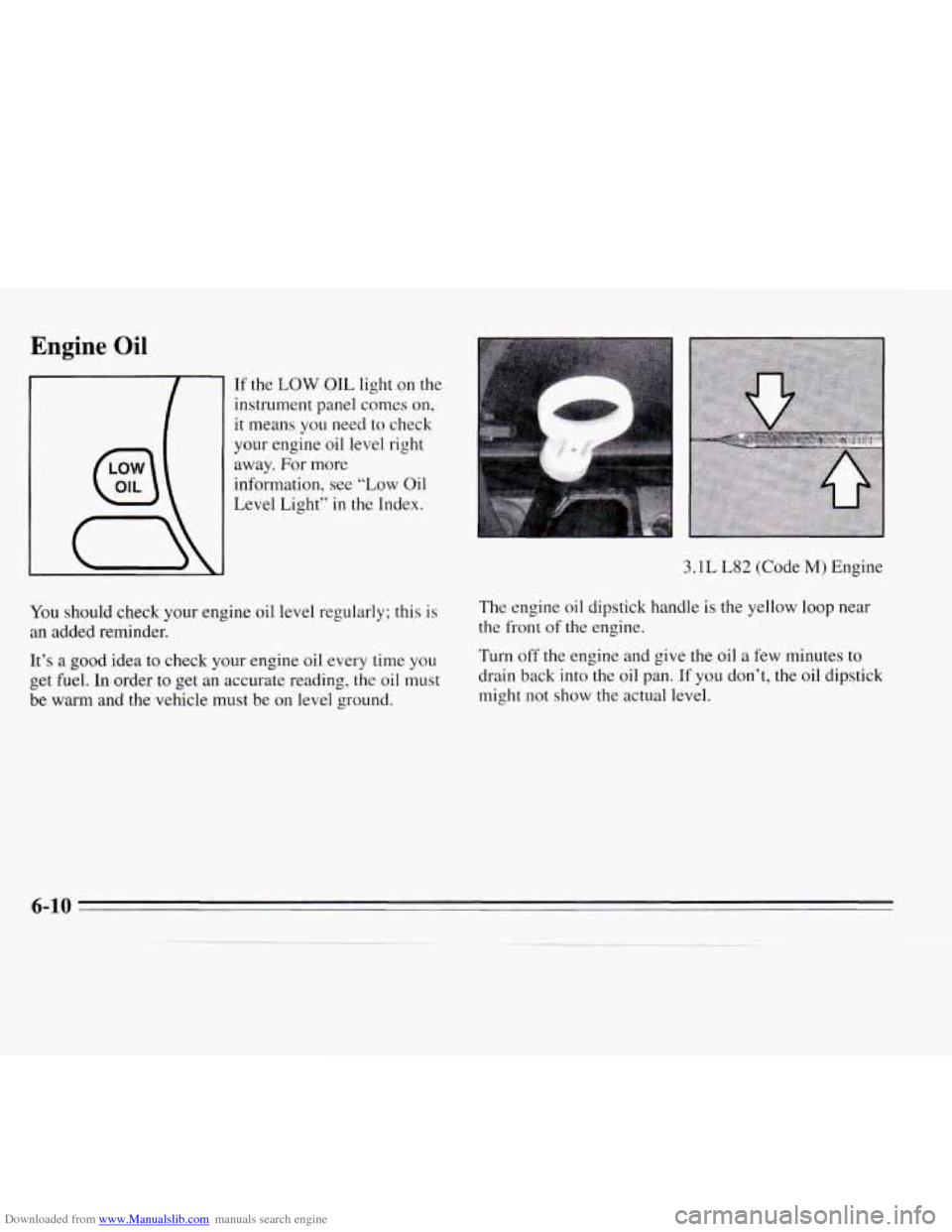
3.1L L82 (Code M) Engine
The engine oil dipstick handle is the yellow loop near
the front of the engine.
Turn
off the engine and give the oil a few minutes to
drain back into the oil pan.
If you don’t, the oil dipstick
might not show the actual level.
Page 205 of 324
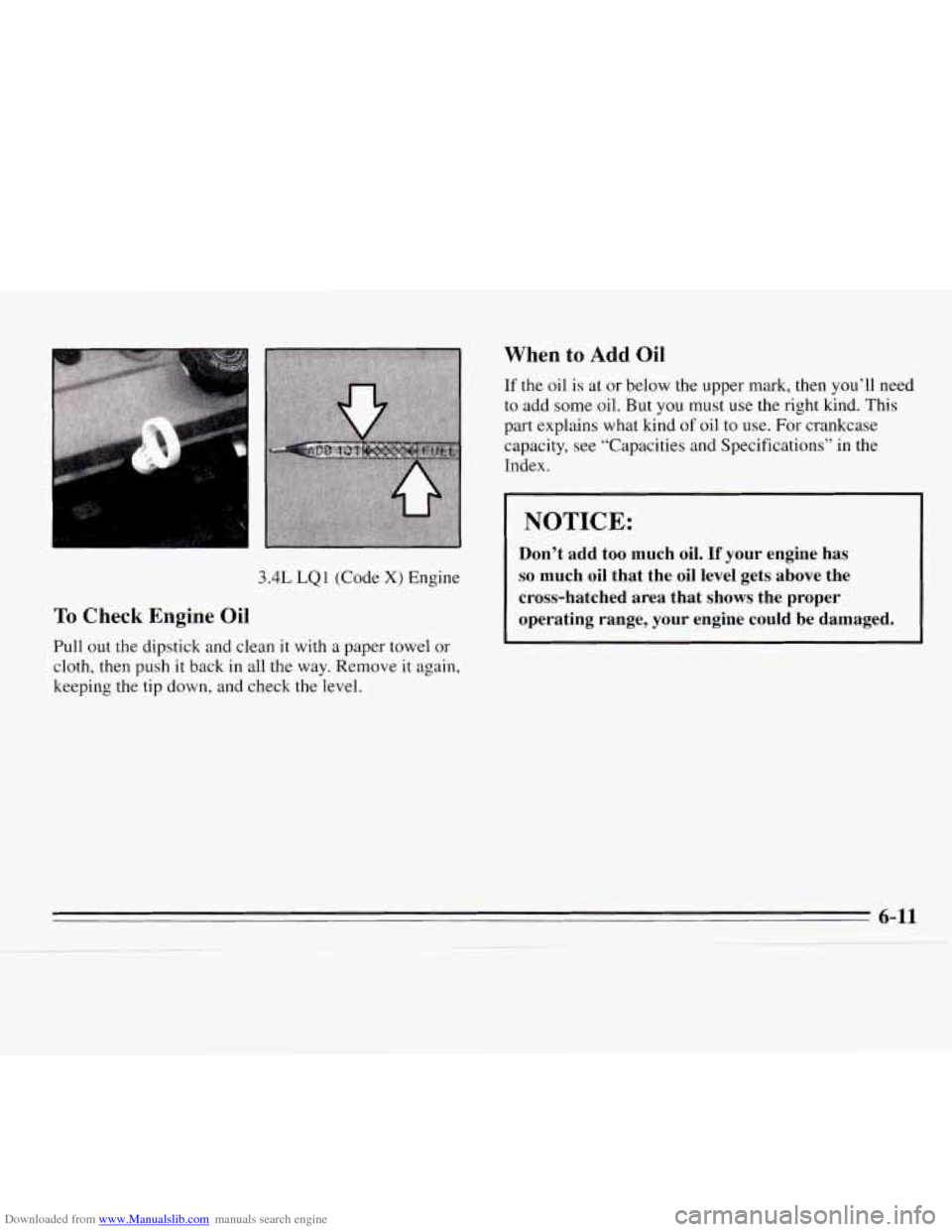
Downloaded from www.Manualslib.com manuals search engine 3.4L LQ1 (Code X) Engine
To Check Engine Oil
Pull out the dipstick and clean it with a paper towel or
cloth, then push it back in all the way. Remove it again,
keeping
the tip down, and check the level.
When to Add Oil
If the oil is at or below the upper mark, then you’ll need
to add some oil. But
you must use the right kind. This
part explains what kind
of oil to use. For crankcase
capacity, see “Capacities and Specifications” in
the
Index.
NOTICE:
Don’t add too much oil. If your engine has
so much oil that the oil level gets above the
cross-hatched area that shows the proper operating range, your engine could be damaged.
6-11
Page 206 of 324
Downloaded from www.Manualslib.com manuals search engine 3.1 L L82 (Code M) Engine 3.4L LQ 1 (Code X) Engine
Just fill it enough to
put the level somewhere in the
proper operating range. Push the dipstick
all the way
back in when you’re through.
What Kind of Oil to Use
Oils of the proper quality for your vehicle can be
identified by looking for
the “Starburst” symbol. The
“Starburst” symbol indicates that the oil
has been
certified by the American Petroleum Institute
(API), and
is preferred for use in your gasoline engine.
If
you change your own
oil, be sure you use oil that
has the “Starburst” symbol
on the front of the oil
container. If you have your
oil changed for you, be sure
the oil put into your engine
is American Petroleum
easoline engines.
~ Institute certified for
You should
also use the proper viscosity oil for your
vehicle,
as shown in the following chart:
6-12
Page 210 of 324
Downloaded from www.Manualslib.com manuals search engine NOTICE:
If the air cleaner is off, a backfire can cause a
damaging engine fire. And, dirt can easily get
into your engine, which wiIl damage it. Always
have the air cleaner
in place when you’re driving.
Automatic Transaxle Fluid
When to Check and Change
A good time to check your automatic transaxle fluid
level is when
the engine oil is changed. Refer to the
Maintenance Schedule to determine when to change
your fluid. See “Scheduled Maintenance Services” in
the Index.
How to Check
Because this operation can be a little difficult, you may
choose to have this done at your Chevrolet dealer
Service Department.
If you do it yourself, be sure to follow all the
instructions here, or you could get a false reading on the
dipstick.
6-16
Page 213 of 324
Downloaded from www.Manualslib.com manuals search engine How to Add Fluid
Refer to the Maintenance Schedule to determine what
kind of transaxle fluid to use. See “Recommended
Fluids and Lubricants” in the Index.
If the fluid level is low, add only enough of the proper
fluid
to bring the level into the cross-hatched area on the
dipstick.
1. Pull out the dipstick.
2. Using a long-neck funnel, add enough fluid at the
dipstick hole to bring it
to the proper level.
It doesn’t take much fluid, generally less than a pint
(OSL). Don’t overfill. We recommend you use only fluid
labeled DEXRON@-111, because fluid with that label is
made especially for your automatic transaxle. Damage
caused by fluid other than DEXRON@-III
is not covered
by your new vehicle warranty.
After adding fluid, recheck the fluid level as
described under “How
to Check.”
When the correct fluid level is obtained, push the
dipstick back in all the way.
Engine Coolant
The following explains your cooling system and how to
add coolant when
it is low. If you have a problem with
engine overheating or if you need to add coolant to your
radiator, see “Engine Overheating” in the Index.
The proper coolant for your Chevrolet will:
0 Give freezing protection down to -34°F (-37°C).
Give boiling protection up to 262 OF ( 128 O C).
Protect against rust and corrosion.
Help keep the proper engine temperature.
Let the warning lights work as they should.
What to Use
Use a mixture of one-half clean water (preferably
distilled) and one-half antifreeze that meets
“GM
Specification 1825-M,” which won’t damage aluminum
parts. You can also use
a recycled coolant conforming to
GM Specification 1825-M with a complete coolant flush
and refill. Use GM Engine Coolant Supplement (sealer)
with any complete coolant flush and refill. If you use
this mixture, you don’t need to add anything else.
6-19